
Deflationary token development is the work of building a crypto token whose supply shrinks over time. This guide explains how these tokens work, which burn model suits which kind of project, and what real tokens such as BNB, ETH, HYPE and CAKE teach us in 2026. It also covers the build steps, the risks, the rules and what a launch costs.
The market is crowded. CoinGecko tracked more than 22,000 active crypto assets on 9 October 2026, with a total market value of about $2.78 trillion. In a field that busy, a burn alone will not make a token stand out. A burn tied to real use and backed by clean code can.
In this guide:
- How burns, buybacks and fee burns remove tokens, and when each one fits
- Why many “deflationary” tokens still grow in supply, with worked numbers
- Live 2026 examples, from BNB’s quarterly burn to Hyperliquid’s fee burn
- The build process, the security traps and the rules to plan for
- Real timelines and cost ranges for a deflationary token launch
See How Our MVP System Can Launch Your Deflationary Token Faster
Deflationary Token Development — done right.
- MVP System:Launch your deflationary crypto token 90% faster.
- Smart Tokenomics:Automated burn & reward mechanisms to boost token value.
- Blockchain Flexibility:Deploy on Ethereum, BNB Chain, Solana, or Polygon.
- Brand & Customization:Your logo, your tokenomics, your ecosystem.
- Revenue Engine: Earn from transaction fees, staking, and liquidity pools.
Get a free demo of your deflationary token — see how it performs in real time before you invest a cent.
Book a Free Demo to discover how our Deflationary Token Development Company can take you from concept to launch in just 2–4 weeks.
What Is Deflationary Token Development?
Deflationary token development is the process of building a crypto token that is designed to cut its total supply over time. Fewer tokens in circulation create scarcity, which can support long-term value if demand holds. A deflationary token development company writes smart contracts with rules such as token burns, fee burns, buybacks or hard supply caps that take tokens out of use on their own.
Projects use these tokens to control inflation, reward holders and keep token economics stable. You will find them in DeFi platforms, exchanges, meme coins, utility tokens and governance systems.
So what is a deflationary token model designed to do? In short, it is designed to make the supply go down, or at least grow slower than demand. Everything else in this guide is about doing that in a way that is honest, safe and lasting.
How Do Deflationary Tokens Work?
Every deflationary token takes tokens out of use in one of a few ways. Most real projects mix two or more.
- Burn on transfer: The contract destroys a small share of every transfer, for example 1%. Supply falls faster when trading is busy.
- Fee burn: Part of the fee users pay in the token is destroyed. Ethereum’s EIP-1559 burns the base fee of every transaction, and BNB Smart Chain burns part of its gas fees.
- Buyback and burn: The project spends part of its revenue to buy its own token on the market, then burns it. Burns grow as the business grows.
- Timed burns: Tokens are burned on a set plan or formula, like BNB’s Auto-Burn every three months.
- Hard cap: The contract fixes a maximum supply that can never be raised. This is not a burn by itself, but it stops new minting from undoing the burns.
How does a burn actually happen? The contract either sends tokens to an address that no one controls (often called a “dead” address) or calls a burn function that cuts the total supply directly. Either way, the tokens can never be spent again. Shared code such as OpenZeppelin’s ERC-20 contracts includes a tested burn add-on, so teams do not need to write this logic from scratch.
A “hyper deflationary” token is simply one with a very high burn rate, often 5% or more of each transfer. These burn fast at first, but they also punish every trade, and most of them lose their trading volume quickly.
Deflationary vs Inflationary Tokens
Neither model is better in every case. The right choice depends on what the token does.
| Deflationary token | Inflationary token | |
| Supply over time | Falls, or grows slower than demand | Rises through new minting |
| Main goal | Scarcity and holder value | Paying for security, staking or rewards |
| Typical tools | Burns, buybacks, hard caps | Block rewards, staking rewards, grants |
| Good fit | Fee tokens, exchange tokens, revenue-sharing tokens | Proof-of-stake gas tokens, game currencies with steady rewards |
| Main risk | People hoard instead of using it | Holders are diluted if demand does not keep up |
| 2026 example | BNB (quarterly burn toward 100M) | Most staking tokens with yearly emissions |
Many large tokens sit in the middle. Ethereum mints new ETH to pay validators and burns ETH through fees. Whether it is deflationary depends on how busy the network is.
Deflationary Token Examples in 2026
These are live tokens with burn models you can check on-chain. They are examples of design, not investment picks.
1. BNB (BNB Chain)
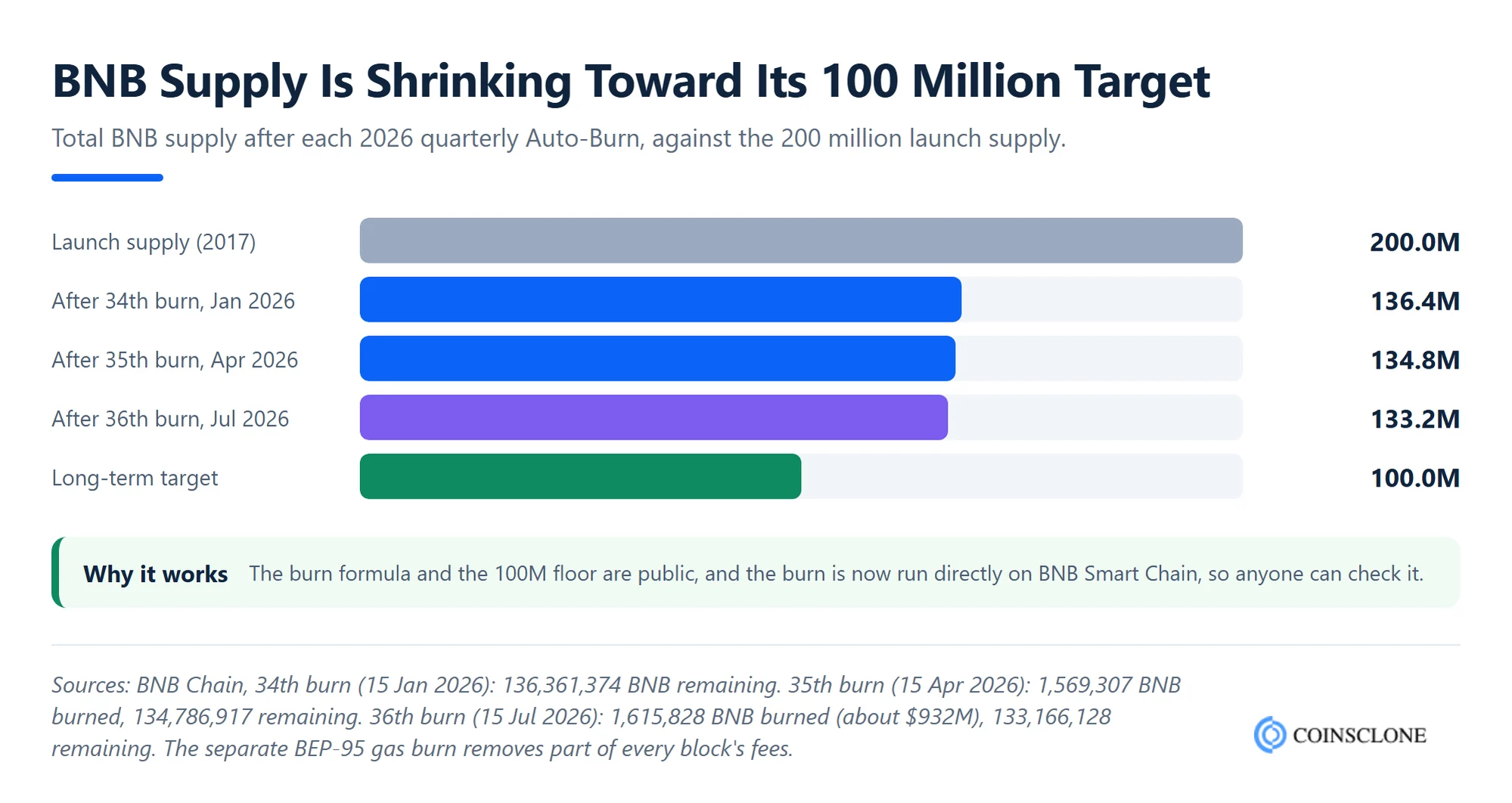
BNB started with 200 million tokens and aims to cut its supply to 100 million. It uses two burns. The quarterly Auto-Burn follows a public formula based on BNB’s price and the number of blocks produced. The separate BEP-95 burn destroys part of the gas fees in every block.
The 36th quarterly burn on 15 July 2026 destroyed 1,615,828 BNB, worth about $932 million at the time, and left 133,166,128 BNB in total supply. It was also the first quarterly burn run directly on BNB Smart Chain.
2. ETH (Ethereum)
Since the London upgrade in August 2021, Ethereum burns the base fee of every transaction. During busy periods it burns more ETH than it issues. During quiet periods it does not. Supply was about 120.5 million ETH at the Merge in September 2022, and CoinGecko showed about 122.1 million ETH on 9 October 2026. So ETH has grown slightly overall, even with the burn. You can follow the live numbers on ultrasound.money.
3. HYPE (Hyperliquid)
Hyperliquid sends its trading fees to its HLP vault, its Assistance Fund and the teams that list assets. The Assistance Fund turns fees into HYPE automatically, and Hyperliquid’s own docs state that HYPE in that fund is burned and removed from total supply. This is a clean example of buyback and burn funded by real revenue.
4. CAKE (PancakeSwap)
PancakeSwap burns CAKE using a share of fees from its products, including 15% to 23% of spot trading fees. In January 2026, holders approved lowering the hard cap from 450 million to 400 million CAKE. The PancakeSwap tokenomics page aims to cut supply by about 4% a year and by roughly 20% by 2030.
The lesson from all four is the same. Each burn is tied to something people actually pay for: gas, trading or platform fees. None of them relies on a tax that punishes ordinary transfers.
Our Two Ways to Build a Deflationary Token
Build a Deflationary Token From Scratch
A custom build is the best choice for teams that want full control over tokenomics, supply rules and long-term health. We design and build the smart contracts from the ground up. Every burn rule, such as token burns, fee burns, buybacks or supply caps, is built around your goals.
Hire Our Expert Token Team
Hiring our crypto token developers is a faster, more flexible choice for teams that want expert hands without hiring a full in-house team. Our blockchain team works closely with yours to design, launch and improve your token using proven tools and best practice.
What Are the Benefits of Deflationary Tokens?
These tokens bring real gains to holders and projects when the design is sound. Here are the main ones.
Value Appreciation
The basic law of supply and demand applies. If demand stays the same while supply falls, each token becomes scarcer. Deflationary tokens are designed to slow or reverse supply growth and build that scarcity. People tend to value things that are harder to get, and holders often prefer a token with a clear, shrinking supply over one that can be printed at will. Over time, this can support the token’s price, though only if real demand is there.
Enhanced Profitability
A burn funded by revenue links the token to the health of the business. When a platform uses part of its income to buy back and burn tokens, every holder gains from that income without the project paying anyone directly. Holders also gain a clear signal. A public burn record shows that the project earns money and returns some of it to the token.
Elimination of Excess Supply
Too many tokens in circulation can hurt a crypto project. A deflationary mechanism lets a project remove surplus tokens instead of flooding the market. Also, if tokens were first given out in the wrong amounts, burning them is a way to correct the mistake in public.
How to Design Deflationary Tokenomics That Work
This is where most projects go wrong. A burn makes a token deflationary only if it removes more tokens than the project creates. Staking rewards, team unlocks and liquidity rewards all add supply. If those add more than the burn removes, the token is inflationary, whatever its marketing says.
Here is a simple worked example. Picture a token with 1 billion supply, a 1% burn on every transfer and 10% a year in staking rewards.
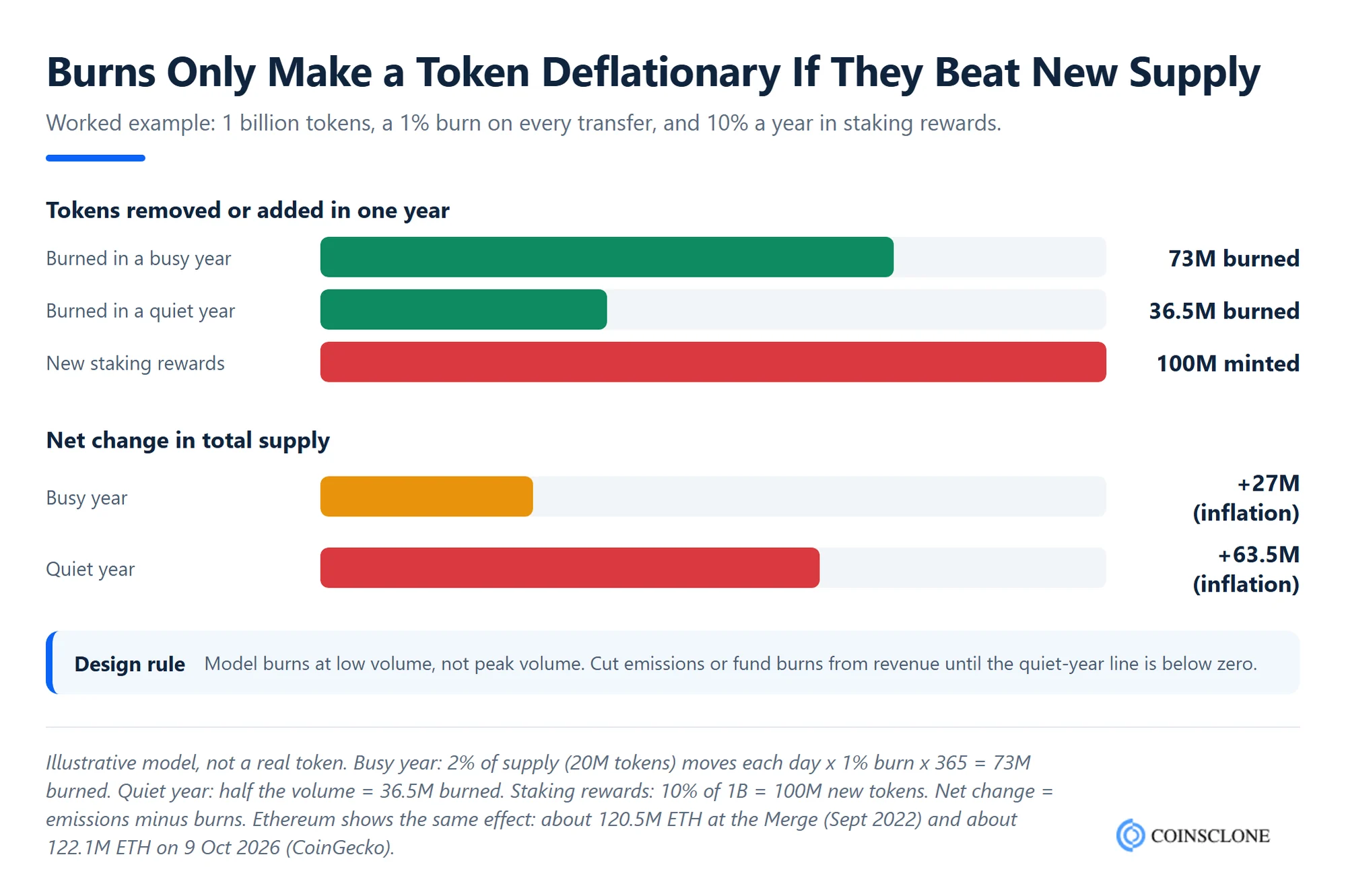
In a busy year the burn removes 73 million tokens. In a quiet year, it removes only half that. Meanwhile, staking adds 100 million. The token grows in supply both years. To fix this, the team must cut emissions, fund extra burns from revenue, or both.
Good token design follows these rules:
- Model the quiet year: Plan burns at low trading volume, not at peak volume.
- Tie burns to revenue: Buybacks paid from real income are more lasting than taxes on trades.
- Keep fees low: A total transfer fee above a few percent drives traders away and can make the token look like a scam.
- Set a floor: Decide in advance when burns stop, as BNB does with its 100 million target.
- Publish everything: Share the formula, the burn address and a dashboard so anyone can check the numbers.
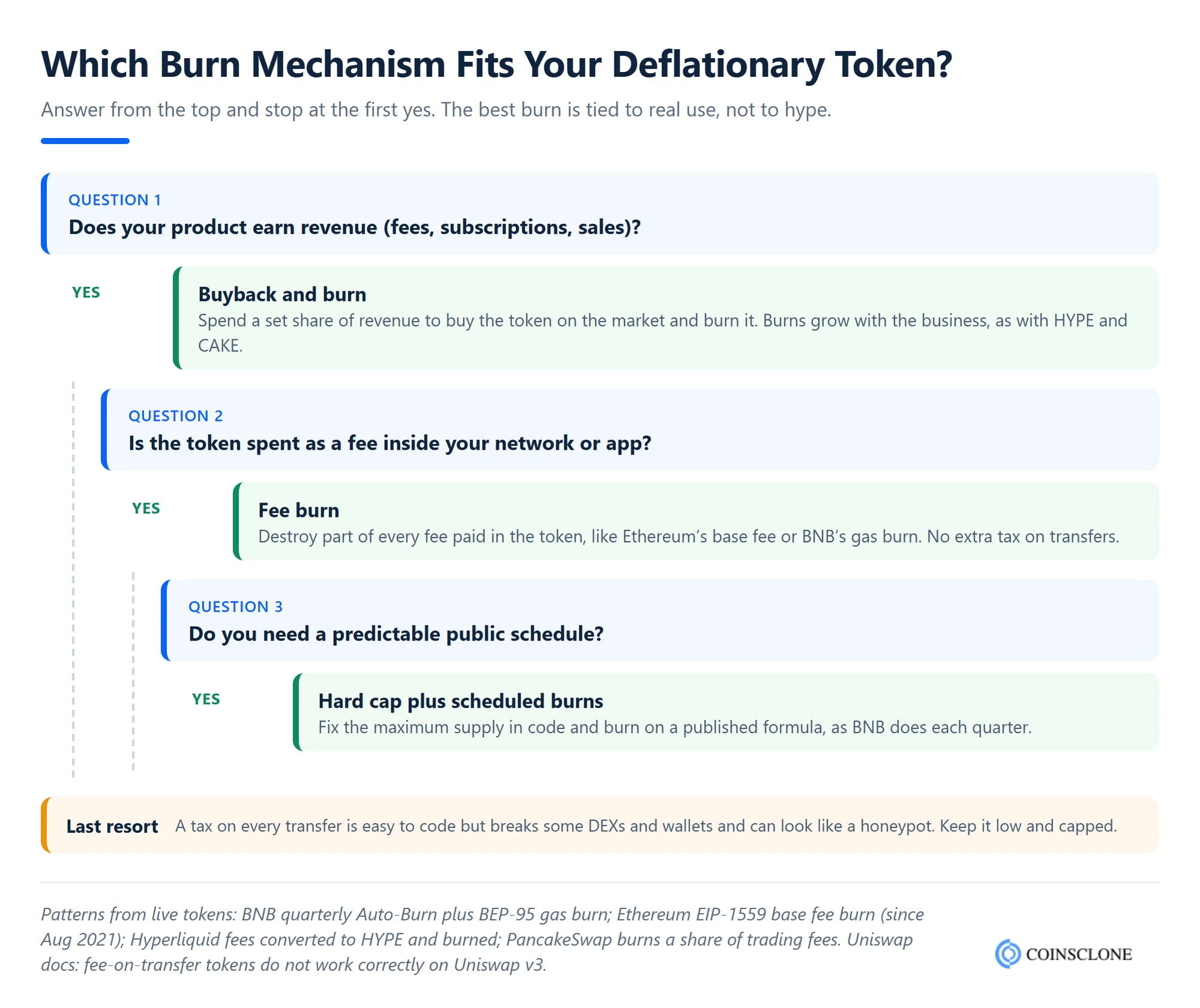
Not sure which burn model fits your project? Start with the question below.
How We Build Your Deflationary Token, Step by Step
Requirement Analysis
We begin by understanding your project vision, use case, target users and growth plans. This step decides which burn rules will help your business, and how.
Deflationary Tokenomics Design
Next, our experts design a tokenomics model that sets the total supply, circulation limits, burn rates, fees, buyback rules and rewards. We test it against both busy and quiet market conditions, so the token does not burn too fast or too slowly.
Blockchain Network Selection
Based on scale, fees and the tools available, we help you choose the right blockchain. We pick from Ethereum, BNB Chain, Polygon, Solana and others so the burn logic works well on that chain.
Smart Contract Development
We write secure smart contracts that hold the burn logic, including auto burns, supply caps, pause controls and admin roles. We keep admin powers small and put them behind multi-sig wallets or time locks, so no single key can change the rules overnight. If you want to understand this stage in depth, read our guide on how to develop a smart contract.
Deflation Mechanism Integration
At this stage, we connect the chosen burn model, or a mix of models, to the rest of your product. This includes DEX pools, wallets, staking and any revenue flows that fund buybacks, without hurting the user experience.
Testing & Launch
Finally, we test the token for security flaws and logic errors, including tests on real DEX routers. We help you through an outside audit, then launch the token on your chosen chain and verify the code in public.
Create Your Own Crypto Token
Cost-effective, White-Label Solution, Premium Features, Customizable. Live Demo Available.
Technical Points to Get Right Before Launch
A deflationary token touches DEXs, wallets and other contracts that may not expect its behaviour. These are the issues that cause most launch problems.
- DEX support for transfer fees: Uniswap’s docs say fee-on-transfer tokens will not work correctly on Uniswap v3. On Uniswap v2 style DEXs, users must trade through the special “supporting fee on transfer” router functions. If your token burns on every transfer, test it on every DEX you plan to list on.
- Solana works differently: On Solana, the Token-2022 transfer fee extension holds back a fee on each transfer, and a chosen wallet collects it. The fee is not burned by default, so a Solana deflationary token needs a second step that burns the collected fees.
- Access control on burn functions: A burn function that anyone can call on someone else’s balance is dangerous. Only holders, or approved spenders, should be able to burn tokens.
- Exempt addresses: Most taxed tokens exempt their own pools, treasury and staking contracts. Keep this list short and public, because hidden exemptions are a common red flag.
- Honeypot checks: Token scanners flag tokens with high sell taxes, changeable fees or blocklists. Fix these before launch, or listings and wallets may warn users away.
- Gas cost: Extra logic in every transfer adds gas. On Ethereum mainnet this matters. On BNB Chain, Polygon or Layer 2 networks it is usually small.
Risks and Challenges of Deflationary Tokens
Deflationary tokens fail for the same few reasons again and again. Planning for them early is cheaper than fixing them after launch.
Burns Do Not Create Demand
Burning half the supply means little if demand also falls by half. A burn supports price only when people want the token for something real, such as paying fees, staking or accessing a product.
Hoarding Can Hurt Use
If people expect a token to be worth more tomorrow, they may not spend it today. That is fine for a store of value, but it can hurt a payment or game token that needs to change hands.
Code Bugs Can Drain Liquidity
SafeMoon is the clearest warning. In March 2023, a code update left its burn function open to anyone. An attacker used it to burn tokens inside the SFM/BNB liquidity pool, pushed the price up, then sold into the pool and drained about $8.9 million. Separately, its former CEO was convicted of fraud in May 2025 and sentenced to 100 months in prison in February 2026. A strong audit and limited admin powers are not optional.
Trust Problems
High taxes, hidden wallets that skip the tax, or admin keys that can change fees all make holders nervous. Clear rules and public dashboards build the trust a deflationary token needs.
Rules and Compliance
Deflationary features do not change how regulators see a token. In the EU, the MiCA rules require a white paper for public offers of most crypto tokens that are not stablecoins. In the US, the SEC staff said in a February 2025 statement on meme coins that most meme coins are not securities. However, a token sold with promises of profit from the team’s work can still be one. Get legal advice in each market you target before you sell.
How Much Does Deflationary Token Development Cost and How Long Does It Take?
Cost depends on how much sits around the token itself. Published 2026 agency cost guides put a standard ERC-20 or BEP-20 token at about $5,000 to $15,000 to build, and a feature-rich token with staking or vesting at about $20,000 to $80,000. Published 2026 audit price guides put a simple token audit at roughly $5,000 to $15,000, with complex DeFi systems far higher. Deploying the contract itself is cheap on most networks.
The main things that move the price are:
- The number of burn and reward mechanisms
- Staking, vesting or buyback contracts around the token
- Dashboards and burn trackers
- The chain (non-EVM chains such as Solana often cost more to audit)
- The depth of audit and legal work
For a full line-by-line breakdown, see our guide on the cost to create a crypto token.
Timelines on the Coinsclone token development pages run as follows:
| Scope | Typical timeline |
| Token contract only (tests, verification, deployment) | 1 to 2 weeks |
| Token with vesting and distribution | 3 to 5 weeks |
| Token with staking, utility, governance and audit | 6 to 10 weeks |
| Full multi-contract token ecosystem | 3 to 5 months |
Most deflationary tokens fall in the middle two rows, because buybacks, staking or burn dashboards usually come with them.
Supported Blockchain Networks of Our Deflationary Tokens
A deflationary token depends a lot on the chain it runs on. Network speed, fees, security and DEX support all shape how well the burn logic works. Below are the blockchain networks we support for deflationary token development:
- Ethereum
- BNB Chain (see our BEP20 token development service)
- Polygon
- Solana
- Tron
- Base
- Arbitrum
- Avalanche
- Optimism
- TON
Industries We Serve With Deflationary Tokens
- FinTech & Digital Payments: Deflationary tokens come with built-in burns and supply control. This suits payments, remittances and wallets where long-term value matters.
- Supply Chain & Logistics: In supply chain networks, these tokens can price usage. Controlled supply supports smooth coordination between suppliers, makers and distributors.
- Art & Collectibles: Burn tokens fit digital art and rare items. Limited supply models raise perceived value, support creator royalties and reward long-term owners.
- Real Estate: Deflationary tokens can support real estate tokenization. Controlled supply helps fractional ownership models keep their value over time.
- Gaming: Games use burn tokens so in-game money does not lose value. Burns on items and upgrades keep economies balanced and rewards meaningful.
- Metaverse & Virtual Worlds: These tokens support land, items and payments in virtual worlds. They reward people who stay and build.
- Ed-Tech: On learning platforms, these tokens can power rewards, certificates and access. This keeps rewards meaningful for learners and teachers.
- Sports & Fitness: They are used for fan engagement, loyalty rewards and fitness goals. Controlled supply keeps rewards valuable and motivates steady effort.
- Healthcare: Healthcare platforms can use deflationary tokens to manage access, data sharing and service rewards. Supply control adds trust and accountability.
- Agriculture: These tokens support crop tracking, farmer rewards and commodity markets. Scarcity models help keep fair prices across seasons.
- Entertainment & Media: These tokens support creator income, content access and fan rewards. Falling supply makes each reward worth more over time.
- Crowdfunding: On funding platforms, these tokens reward early backers who hold for the long term. Supply cuts align backer confidence with project growth.
Why Choose Coinsclone for Deflationary Token Development?
After weighing the benefits and the risks, you may be ready to create your own deflationary token. Coinsclone is a crypto token development company that has built blockchain products since 2018, with 350+ platforms delivered for 200+ clients across 20 industries. Our developers design the tokenomics, write and test the burn logic, prepare the contracts for audit and launch the token on the network that fits your plan.
We also build the products that give a token real demand, from exchanges and wallets to staking and DeFi platforms. Talk to our team to plan a deflationary token that holds up after launch, not just on launch day.
Frequently Asked Questions
1. What is a deflationary token?
A deflationary token is a crypto token built to cut its total supply over time, usually through token burns, fee burns, buybacks or a hard supply cap. By reducing supply, these tokens aim to create scarcity. They are common in DeFi platforms, exchanges, gaming and other blockchain products.
2. How does the deflation mechanism (burning) work?
A token burn takes tokens out of use for good. The contract either sends them to an address no one controls or calls a burn function that lowers the total supply. Burns can run on their own on each transfer, on a set schedule, or when the project buys tokens back with its revenue.
3. Why build a deflationary token for a project?
A deflationary token helps a project control inflation, reward long-term holders and keep token economics stable. It works best when burns are tied to real use, such as fees or revenue, and it is widely used in DeFi, exchanges, gaming and NFT platforms.
4. What services are included in deflationary token development?
The work often covers:
- Custom tokenomics design
- Smart contract development
- Burn and buyback setup
- Security testing and audit support
- Post-launch technical support
These services help you launch a token that is secure, scalable and ready for audit.
5. How long does it take to develop a deflationary crypto token?
A plain token contract takes about 1 to 2 weeks, including tests, checks and launch. A token with vesting and distribution takes about 3 to 5 weeks. Adding staking, buybacks, governance and an audit takes about 6 to 10 weeks. A full multi-contract token ecosystem takes 3 to 5 months.
6. Can deflationary tokens be used in real-world applications?
Yes. They are used in payments, supply chain tracking, real estate, game economies, loyalty programs and crowdfunding.
7. Which blockchain is best for deploying a deflationary token?
The best blockchain depends on your project goals. Choose:
- Ethereum for DeFi depth and strong security
- BNB Chain, Polygon, Base or Arbitrum for low fees and fast transactions
- Solana or Avalanche for high speed at scale
On Solana, plan an extra step to burn collected transfer fees. A deflationary token development company can help you weigh cost, DEX support and audience before you choose.
8. What is a deflationary token model designed to do?
It is designed to lower the circulating or total supply of a token over time, or keep supply growing slower than demand. The goal is scarcity that supports the token’s value, without relying on new buyers alone.
9. What is a hyper deflationary token?
A hyper deflationary token burns a very large share of each transfer, often 5% or more. Supply falls fast at first, but heavy fees discourage trading, so most hyper deflationary tokens lose volume quickly. A lower burn tied to real fees or revenue usually lasts longer.
10. Is the HYPE token deflationary?
Hyperliquid’s docs say its Assistance Fund turns trading fees into HYPE on its own, and that HYPE held in the fund is burned and taken out of total supply. Whether supply falls overall in a given period also depends on token unlocks and rewards, so check current supply data before drawing conclusions.
See How Our MVP System Can Launch Your Deflationary Token Faster
Deflationary Token Development — done right.
- MVP System:Launch your deflationary crypto token 90% faster.
- Smart Tokenomics:Automated burn & reward mechanisms to boost token value.
- Blockchain Flexibility:Deploy on Ethereum, BNB Chain, Solana, or Polygon.
- Brand & Customization:Your logo, your tokenomics, your ecosystem.
- Revenue Engine: Earn from transaction fees, staking, and liquidity pools.
Get a free demo of your deflationary token — see how it performs in real time before you invest a cent.
Book a Free Demo to discover how our Deflationary Token Development Company can take you from concept to launch in just 2–4 weeks.