
Asset-backed security tokens are crypto tokens that stand for a real thing held off the chain: an ounce of gold, a share in a fund, a slice of a building or a pool of loans. This guide walks through asset-backed crypto token development from start to finish. It shows how the backing works, which tokens lead the market in 2026, the rules that apply, and what a build costs and how long it takes.
You will also see the mint and redeem flow drawn out, a quick test for which rulebook covers your token, and the risks that sank some early projects. If you plan to issue a token backed by gold, homes, T-bills or invoices, you will finish with a clear plan to take to your team and your lawyer.
In this guide:
- What a backed token is, and why “asset-backed” is a label, not a legal class
- How a token is minted, backed, checked and redeemed, with gold as a worked case
- Real tokens in the market, from Tether Gold ($3.38 billion) to BlackRock’s BUIDL fund ($2.26 billion)
- Which rules and token standards fit your asset in the US and the EU
- Build steps, real timelines, market cost ranges and the risks to plan for
See How Our MVP System Can Launch Your Asset-Backed Token Faster
Asset-Backed Crypto Token Development — done right.
- MVP System : Tokenize real-world assets like real estate, gold, or commodities 90% faster.
- Smart Contracts & Security: Fully audited, compliant, and ready for institutional-grade use.
- Customization & Branding: Your brand, your rules — customizable token standards and utilities.
- Liquidity & Integration: Built-in wallets, exchanges, and DeFi compatibility from day one.
See a free branded demo of your token ecosystem in 48 hours — before you invest a cent.
Book a Free Demo to discover how our Asset-Backed Token Development Platform can take your idea from concept to market in just 2–4 weeks.
What Are Asset-Backed Security Tokens?
An asset-backed token is a claim on an asset that sits outside the blockchain. The issuer holds the asset, often through a vault firm or a legal shell company, and mints tokens to match it. If the asset gains value, so does the token. If the asset leaves the vault, the token should be burned.
Many people call all of these tokens “security tokens”, but that is only true for some of them. In practice, “asset-backed” is a broad market label. Under the law, the same label can cover very different things:
- A security: a token for a fund share, a bond or a stake in a firm. BlackRock’s BUIDL fund token is one case. Securities law applies in full.
- A claim on metal or goods: a token you can swap for gold in a vault, such as PAX Gold. Each PAXG token is one fine troy ounce on a London Good Delivery bar.
- A stablecoin: a token backed by cash and short-term government debt, such as USDC. These now have their own laws in the US and the EU.
So an asset-backed security token is the subset that is also a security. The split matters. It decides who may buy your token, which licence you need and which token standard you should use.
In short, the token’s price should track the asset, less fees. That is why these tokens move far less than Bitcoin or Ether, which have nothing outside the market behind them. A gold token still rises and falls with gold, though, so “backed” never means “fixed”.
What Is Asset-Backed Token Development?
Asset-backed token development is the work of building blockchain tokens that are tied to real assets such as real estate, gold, oil, invoices or company shares. Each token stands for a claim on a real or financial asset, which builds trust and makes the backing easy to check. A good build team designs the token, the smart contracts, the link between token and asset, and the rule checks, so the token always matches the asset behind it.
How Asset-Backed Tokens Work
Every backed token, from a gold token to a T-bill fund, runs on the same loop. Money comes in, an asset is bought and locked away, and tokens are minted. When someone redeems, the loop runs in reverse.
Here are the parties you need in that loop:
- Issuer: the firm, trust or fund that owns the asset and issues the token. It often sits in its own legal shell (an SPV), so the asset stays safe if the parent firm fails.
- Custodian: the vault, bank or trust firm that holds the asset. Paxos, for one, says it is a trust firm overseen by the US Office of the Comptroller of the Currency.
- Token contract: the smart contract that mints and burns tokens and, for securities, checks who may hold them.
- Proof of reserve: an audit report or an on-chain data feed that proves the tokens out there match the assets held. Paxos posts PAXG reports each month, and data networks such as Chainlink offer live proof-of-reserve feeds.
- Redeem terms: the rules for turning tokens back into the asset or cash, with minimums, fees and drop-off points.
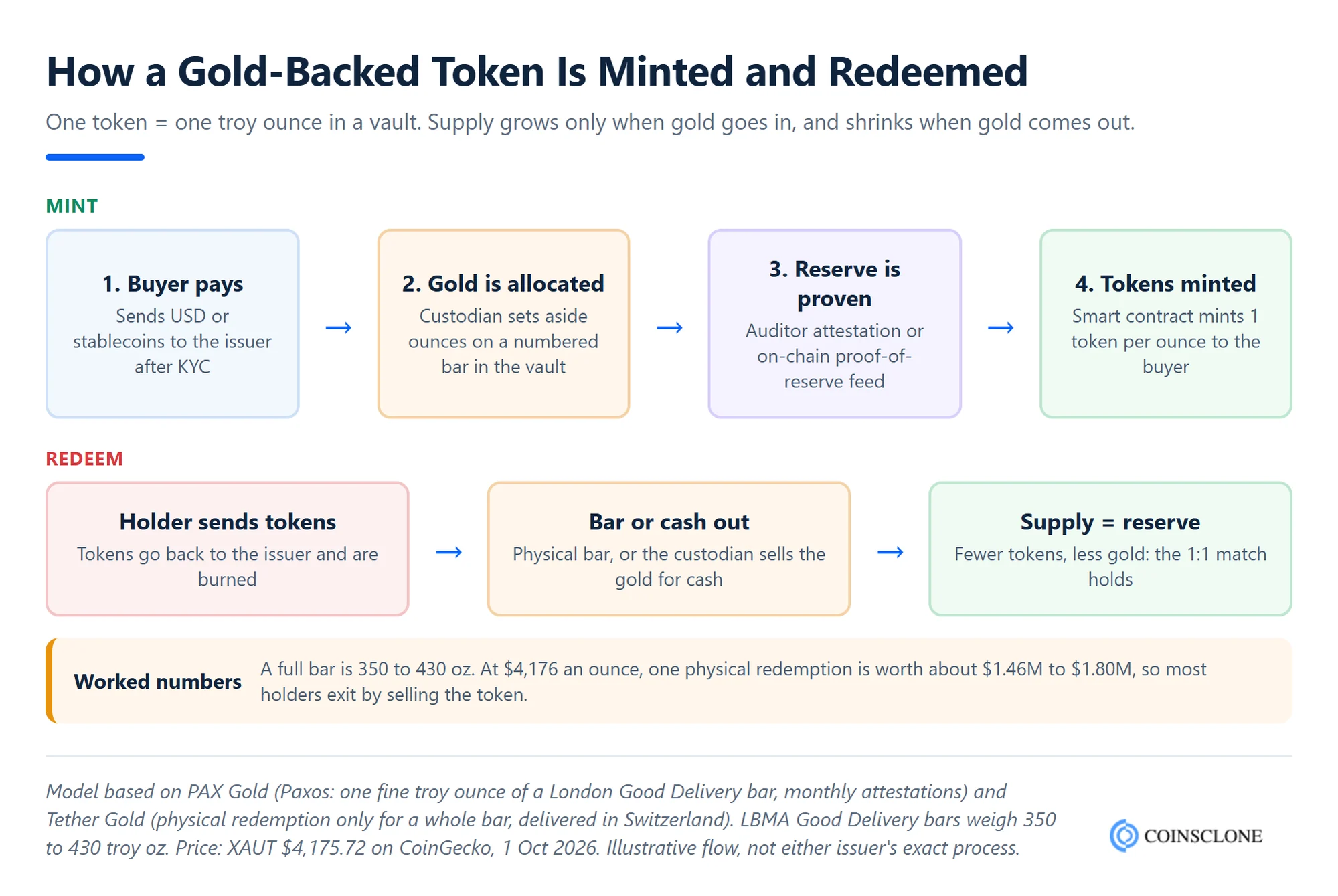
The redeem terms are where tokens differ most. Tether Gold lets holders take real gold only for a whole London Good Delivery bar, sent within Switzerland. A bar weighs 350 to 430 troy ounces. At the 1 October 2026 price of about $4,176 an ounce, one bar is worth roughly $1.46 million to $1.80 million. Smaller holders exit by selling the token or taking cash. Your design should state these limits clearly from day one.
Types of Asset-Backed Tokens
Almost any asset with a clear value and a clear owner can back a token. In practice, five groups cover most of the market in 2026.
1. Tangible Assets (Real Estate and Infrastructure)
Turning buildings, land or energy plants into tokens lets many small buyers share one large asset. Each token most often stands for a share in the firm that owns the building, plus a cut of the rent.
Real estate is still small on-chain. RWA.xyz counts only about $227 million of freely traded real estate tokens in October 2026. It is also the riskiest group, as the RealT case in our risks section shows. For a full walkthrough, see our guide to the tokenization of real estate.
2. Metals and Goods (Gold, Silver and Oil)
You can turn costly goods like gold, silver, oil or coffee into tokens. Outside auditors check the stock in the vault, so buyers can trust the backing.
Gold is the clear leader. On 1 October 2026, Tether Gold (XAUT) had a market value of about $3.38 billion and PAX Gold (PAXG) about $1.82 billion, per CoinGecko. Both map one token to one troy ounce in a vault. Older gold tokens such as Digix and Goldmint have faded, which shows how much trust and redeem terms matter. Coinsclone builds this model as a gold tokenization platform.
3. Equity and Debt (Funds, Bonds and Stocks)
Turning shares, bonds and fund units into tokens is now the largest part of this market. T-bill fund tokens held $14.69 billion on 1 October 2026, per RWA.xyz, and private credit held another $7.96 billion.
Well-known cases include BlackRock’s BUIDL ($2.26 billion), Ondo’s USDY ($2.28 billion) and Franklin Templeton’s BENJI fund. Ondo’s stock tokens also passed $1 billion in value in May 2026. All of these are securities, so they use locked-down tokens and buyer checks. See how we build tokenized Treasury platforms.
4. Rights, Art and NFT Assets
Hard assets are things you can touch. Soft assets include music rights, patents and brands. Turning them into NFTs or small shares can raise their value and reach. A single painting or song catalogue is one of a kind, so these projects often use an NFT for the asset and plain tokens for the shares. Our art tokenization guide covers this model in depth.
5. Fiat Money (Stablecoins)
Stablecoins are the biggest backed tokens of all. USDT had about $184 billion in use and USDC about $74 billion on 1 October 2026. Cash and short-term government debt back them, and they now have their own laws, such as the US GENIUS Act signed on 18 July 2025. If your asset is money, read our guide to stablecoin development.
Asset-Backed Tokens vs Stablecoins vs Utility Tokens
Buyers often mix these three up. The table shows how they differ in value, rules and design.
| Asset-backed token | Stablecoin | Utility token | |
| Value comes from | A set asset: gold, a fund, a building | Cash and short-term government debt | Demand for a product or network |
| Price moves with | The asset (gold, fund value, rent) | Pegged to one currency, such as $1 | Market supply and demand |
| Main rules | Securities law, or MiCA ART rules in the EU | GENIUS Act (US), MiCA EMT rules (EU) | Lighter, unless sold as an investment |
| Who can hold it | Often only checked buyers | Anyone, through licensed issuers | Anyone |
| Common standard | ERC-3643, ERC-1400 or ERC-20 | ERC-20, SPL, TRC-20 | ERC-20, BEP-20, SPL |
| Real tokens | PAXG, BUIDL, USDY | USDC, USDT | Network or app tokens |
Which Rules Apply to Asset-Backed Tokens in 2026
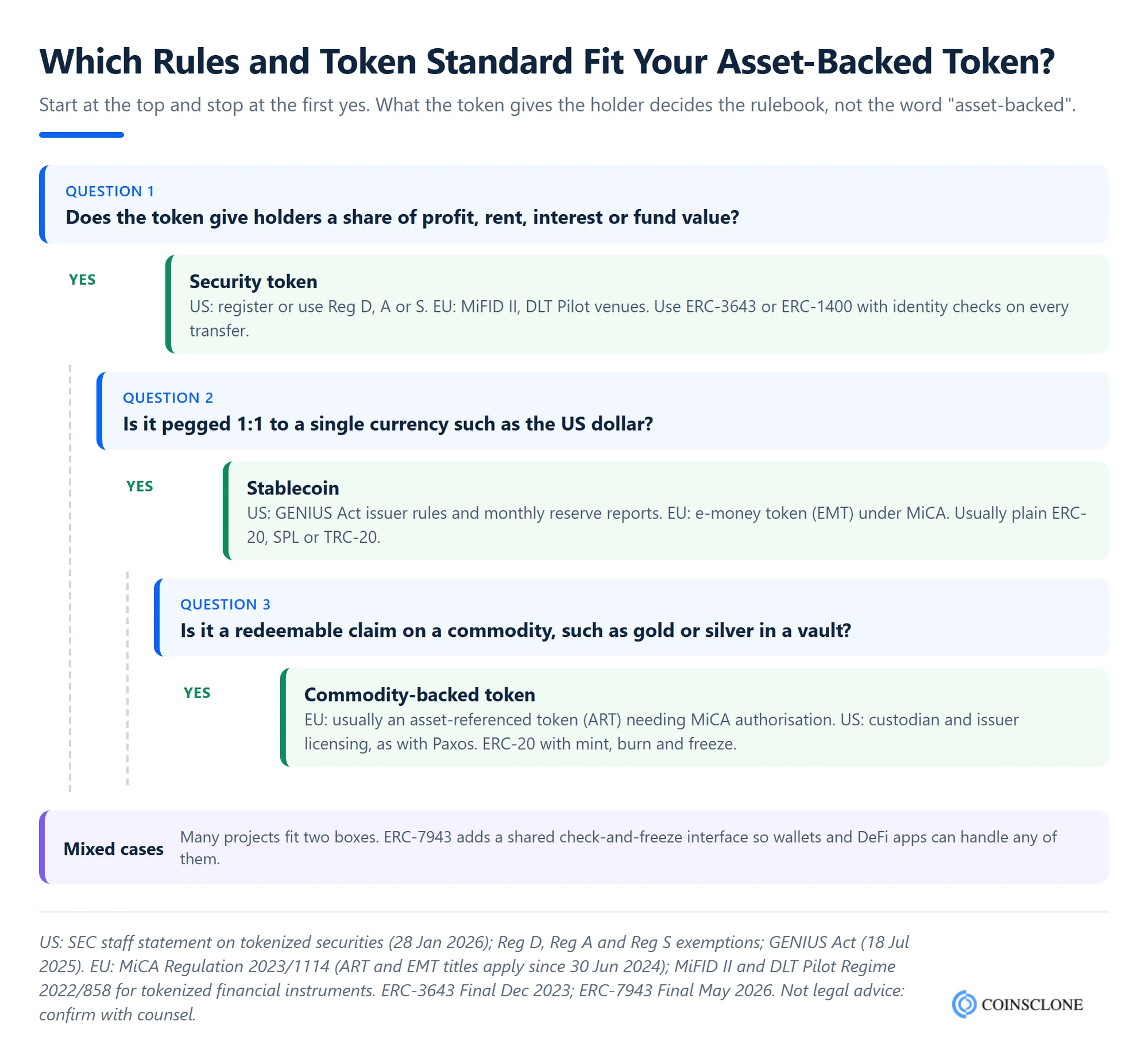
The token format does not change the law. The US SEC said so plainly in its staff statement on tokenized securities on 28 January 2026: a share on a blockchain is still a share. So start with what your token gives the holder, then pick the rulebook.
Here is how the main markets treat these tokens as of October 2026:
- United States, securities: a token that pays a share of profit or income from someone else’s work is most often a security under the Howey test. You must register it or use an exempt route such as Reg D, Reg A or Reg S. The SEC’s guide to exempt offerings lists the limits.
- United States, new trading route: on 17 September 2026 the SEC gave a five-year Innovation Exemption that lets approved venues trade stock tokens on public blockchains. The CLARITY Act, which would split oversight between the SEC and the CFTC, is not law as of October 2026.
- United States, stablecoins: the GENIUS Act covers payment stablecoins, with 1:1 reserves and monthly reserve reports.
- European Union: MiCA has no “asset-backed token” class. A token that tracks gold or a basket of assets is most often an asset-referenced token (ART), which needs a licence. A token that counts as a financial instrument falls under MiFID II instead. It can trade on venues under the DLT Pilot Regime.
- Other hubs: Hong Kong, Singapore, Dubai and Switzerland all have their own token rules or pilots.
We are engineers, not lawyers, so your counsel should confirm the route. What we do is build the rules your counsel picks into the token itself.
Our Asset-Backed Token Development Approaches
At Coinsclone, we focus on building safe backed tokens that meet your business needs. Our methods are flexible, grow with you, and keep the backing open and easy to check.
1. Asset-Backed Token Development from Scratch
We build your backed token from the ground up through our custom service. We work closely with you to design a token that fits your assets, rules and business model. You keep full control over the token standard, token supply plan, smart contracts and security setup.
2. Hire Asset-Backed Token Developers
Work with our skilled token developers to create safe, rule-ready backed tokens. Our team handles smart contract design, asset links, rule checks and launch, so your tokens meet the rules and work well in each transfer.
Key Features of Asset-Backed Crypto Tokens
By pairing blockchain with real assets, backed crypto tokens offer clear records, trust and steadier value. Each token stands for a share of a checked asset.
- Asset tokens: turn real and online assets into tokens on the blockchain, so they are easy to transfer and trade.
- Live pricing: price feeds and fund value updates help buyers and sellers price the asset fairly, which builds buyer trust.
- Shared ownership: split an asset into small token units so many buyers can co-own it.
- Proof of reserve checks: prove that the assets in the vault back each token issued, through audits or on-chain feeds.
- Smart contract issue: smart contracts handle minting and token admin, which cuts human error.
- Redeem and burn: holders can redeem tokens for the asset or cash. Redeemed tokens are burned, so supply always matches the reserve.
- Built-in rule checks: KYC and AML checks live inside the smart contract, so a token cannot move to a wallet that fails them.
- Safe vault links: connect licensed custodians that store and control the real or online assets.
- Clear transfer records: each transfer is logged on the blockchain, which makes audits simple.
- Trading access: your tokens can trade on supported venues, which brings more buyers and new markets.
Our Asset-Backed Crypto Token Development Services
We build crypto tokens backed by real goods, financial assets or services, and we follow the laws that apply to each. Our services help firms link their assets to tokens, so the assets are easier to reach, trade and track.
- Custom backed token creation: tokens built around your asset type and business model. Each token carries owner rights and reflects the value of the asset behind it.
- Audit and security checks: before any token is issued, our audit team reviews the code and security setup to lower the risk of attacks. We also support outside audits.
- Real asset links: we turn stocks, bonds, real estate or metals into blockchain tokens, so buyers can see the asset’s value and history at any time.
- Vault and asset tools: we connect your token to custody platforms and build tools to manage backing and stock.
- Token features: we add shared ownership, dividends, staking and redeem features that support long-term value.
- Wallet, exchange and dApp links: we connect your token to wallets, exchanges and dApps, which widens access and trading.
- KYC and AML setup: we set up identity and screening checks so you can run legally and earn buyer trust.
Real World Asset Tokenization: The Backbone of Asset-Backed Crypto Tokens
Real-world asset tokenization is the process of turning real assets, such as real estate, metals or bonds, into tokens on a blockchain. These tokens stand for a claim or a value. People can buy, sell or share them in small portions, which opens investing to more people.
Through RWA tokenization, firms can build full systems that handle asset checks, token creation, owner records and buyer access. This helps firms raise cash, keep records open and reach global buyers while meeting the rules. RWA.xyz counted $38.55 billion of freely traded real-world asset tokens on 1 October 2026, not counting stablecoins.
Benefits of Our Asset-Backed Crypto Token Development
Our backed tokens help firms turn real assets into safe, compliant tokens that bring steady value, clear records and wider reach.
- Easier to sell: buyers can trade assets that were hard to sell before, and a second market can form around them.
- Shared ownership: breaking assets into small units lets more people take part, so premium assets open up to retail and large buyers alike.
- Clear value: each token is tied to a checked asset with a known value. Buyers can track value and owners in real time.
- Wider spread of risk: buyers can reach several asset types on one platform, which spreads risk.
- Stronger security: smart contracts keep a safe record of who owns what, which lowers fraud risk. Code reviews and audits protect users and build trust.
- Smaller price swings: tokens backed by real assets move far less than standalone crypto, so they suit buyers who want steadier returns.
- Global reach: tokens can trade worldwide with fewer middlemen, which helps firms raise money abroad.
- Fit for token sales: backed tokens suit compliant fundraising through security token offerings, which follow local rules and protect buyer trust.
- New life for idle assets: tokens backed by real estate or rare items can earn income instead of sitting idle.
- Automatic payouts: smart contracts can pay rent, interest or dividends to each holder on time, often in stablecoins, which cuts admin costs.
Use Cases of the Asset-Backed Tokens We Create
Our backed tokens unlock real value across sectors. They give safe ownership, easier trading and clear records on the blockchain.
- Shared real estate: property tokens let many people own part of a building, so it is easier to invest in, sell or trade shares.
- Gold and rare metals: each token stands for a checked amount of metal, so people can buy and sell without storage worries.
- Goods and raw materials: tokens for oil, grain or coffee give buyers simple access with clear prices.
- Invoice funding and payments: firms turn unpaid invoices into tokens to raise cash fast and ease cash flow.
- Art and rare items: tokens let many people share costly art while proving where it came from.
- Supply chain funding: turning goods in transit into tokens helps fund each stage, improves tracking and cuts fraud.
- Small shares of large assets: splitting high-value assets into small parts makes them easier to sell and widens the buyer base.
- DeFi loans: T-bill and gold tokens can back loans on DeFi platforms, which links old-style assets to DeFi.
- Carbon credits: carbon credit tokens give firms and buyers an easy way into the carbon market while meeting green rules.
Risks and Challenges of Asset-Backed Tokens
A token is only as good as the asset, the legal claim and the people behind it. These are the risks buyers and regulators look at first, so plan for each one in your design.
- Vault or issuer failure: if the custodian or issuer fails, holders depend on how well the asset was walled off. Use a separate legal shell and a licensed custodian.
- Weak legal claim: some tokens give holders no direct right to the asset, only a promise. Spell out the legal right in the token terms.
- Redeem limits: high minimums, such as a full gold bar, mean most holders can only exit by selling. Post the terms and offer a cash route.
- Gaps in the backing: if reports are late or vague, trust drops fast. Monthly audit reports and on-chain proof of reserve help.
- Running the asset: in 2025 the City of Detroit sued RealT over code breaches on its rental homes. In April 2026 a court approved a deal that put an outside manager in charge of about 700 homes, per Michigan Public. In July 2026, RealT said it would wind down its US structures. Tokens do not remove the work of running the asset.
- Thin trading: a token can be easy to issue but hard to sell. Plan listings and market making before launch.
- Code and data feed bugs: a flaw in minting or price feeds can create tokens with nothing behind them. Audit the code and use more than one data source.
Our Asset-Backed Token Development Process
At Coinsclone, we follow a clear, step-by-step process to create safe, open token assets that are ready for the market.
1. Find and Value the Asset
The first step is to confirm the asset you want to turn into tokens. It could be a hard asset like real estate or rare items, or a soft asset like music rights or company shares. Next, an outside valuer checks the asset, so buyers can trust its stated worth.
2. Set Up the Legal Structure
Your lawyers pick the legal wrapper, such as an SPV, a fund or a trust, and the sale route for each market. We work with your counsel so the token reflects that structure, with KYC, AML and buyer safety rules built in.
3. Choose the Token Standard
Next, we match the token standard to the asset and the rules. Securities most often use ERC-3643, which checks each transfer against an ID registry, or ERC-1400. Freely traded gold tokens such as PAXG use plain ERC-20. The newer ERC-7943 standard, final since May 2026, adds a light shared layer that works across these designs.
4. Design the Token Economics
To support the asset’s long-term value, we draw up a clear token plan. It sets the total supply, price per token, how tokens are shared out, payout rules and how mint and burn track the reserve.
5. Select a Blockchain
We pick the chain that fits your cost, speed and buyer base. Ethereum is the most common choice for real-world assets, but low-fee chains are growing fast, as the table below shows.
6. Build the Smart Contracts
Our developers write and test the contracts for minting, burning, transfers, rule checks, payouts and admin roles such as freeze and recovery.
7. Connect the Vault and Proof of Reserve
We link the custodian’s records, audit reports or a live data feed, so anyone can check that the tokens issued match the assets held.
8. Audit, Launch and List
Finally, the contracts go through security audits. Then we launch them on mainnet and help with the token sale, payouts and listing on permitted venues. Our goal is wide market reach and an easy process for your buyers.
Supported Blockchain Networks for Asset-Backed Token Development
We support the leading blockchains for safe, fast and compliant backed tokens. You can choose a network based on fees, speed, links to other chains and the rules you must follow. The table shows where real-world asset tokens sit today.
| Blockchain | Real-world asset tokens held (1 Oct 2026) | Common token format |
| Ethereum | $16.7 billion | ERC-20, ERC-3643, ERC-1400 |
| BNB Chain | $5.7 billion | BEP-20 |
| Solana | $4.3 billion | SPL, Token-2022 |
| Stellar | $3.4 billion | Stellar assets |
| Avalanche | $1.8 billion | ERC-20 on C-Chain and L1s |
| Arbitrum | $982 million | ERC-20 |
| Polygon | $506 million | ERC-20 |
| XRP Ledger | $499 million | XRPL issued tokens |
Source: RWA.xyz value by network, 1 October 2026. We also build on Tron (TRC-20), Base, Tezos and Cardano when your buyers or partners need them.
How Much Does Asset-Backed Token Development Cost and How Long Does It Take?
Cost and time depend on how much you need around the token. A token contract alone is quick. A full platform with vault links, redeem flows and a trading venue takes months.
Coinsclone posts these timelines on its own service pages:
| Scope | Timeline |
| Token contract only, checked and launched | 1 to 2 weeks |
| Token plus payout plan, vesting and audit | 3 to 5 weeks |
| Token plus extra features (payouts, staking, voting) | 6 to 10 weeks |
| Single-asset platform (one vault, building or fund) | 8 to 12 weeks |
| Multi-asset platform | 4 to 6 months |
| Platform with redeem logistics or a trading venue | 6 to 9 months |
| Platform for large institutions | 9 to 14 months |
On price, build firms that post figures in 2026 quote about $10,000 to $50,000 for an MVP. A full backed token platform runs about $100,000 to $300,000. Inside a platform build, rule-check modules often cost $15,000 to $40,000 and smart contracts $20,000 to $60,000. Vault links run $10,000 to $25,000, and security audits $8,000 to $20,000.
Budget for costs outside the code too: legal setup, asset checks, vault fees, KYC checks per buyer and yearly audit reports.
Industries We Assist With Asset-Backed Token Development
We work with many sectors to turn real assets into tokens. This helps firms raise funds, keep records clear, free up cash and find new revenue.
- Finance: we let firms move fund units, bonds and loans as tokens, with faster settlement and stronger trust.
- Logistics and supply chain: our tokens improve tracking, cut fraud and keep the supply chain open to checks.
- Art and collectibles: we let many people share art and rare items through tokens, which widens the buyer base and proves each piece is real.
- Real estate: we turn buildings into tokens to make owning and trading simple, ease resale and lower the entry price for buyers.
- Healthcare: turning health assets and unpaid bills into tokens helps manage funds clearly and handle assets safely.
- Farming: we turn farm goods and land into tokens, which gives farmers and buyers fairer prices and better funding.
- Media and entertainment: we turn rights and content into tokens so creators and backers share revenue fairly.
- Crowdfunding: our compliant token sale models draw global buyers with asset-backed securities.
- Rare metals: we turn gold, silver and other metals into tokens for safe, open trading on the blockchain.
Why Choose Coinsclone for Asset-Backed Crypto Token Development?
Coinsclone is a leading crypto token development company that builds safe, rule-ready backed tokens for firms worldwide. We have been building since 2018 and have delivered 350+ platforms for 200+ clients across 20 industries, with a strong focus on real-world asset tokens.
Our team covers the full build: smart contracts, asset and vault links, proof of reserve, security audits, KYC and AML checks, and support for many blockchains. If you are ready to put gold, a building, a fund or invoices on-chain, Coinsclone can take your token from legal setup to mainnet, starting with a free scoping call.
Frequently Asked Questions
What is asset-backed token development?
Asset-backed token development is the creation of crypto tokens that stand for a claim on real assets. These tokens are issued on a blockchain and backed by real or financial assets stored off-chain. Smart contracts mint, burn and track them.
What are asset-backed crypto tokens?
Asset-backed crypto tokens are claims on a real asset, such as gold, a building, a fund or a pool of loans. Their price tracks the asset, less fees. Gold cases include PAX Gold and Tether Gold. Fund cases include BlackRock’s BUIDL and Ondo’s USDY. Fiat stablecoins such as USDC also belong here.
How do asset-backed tokens work?
Each token is linked to a checked asset through smart contracts. The issuer buys the asset, a custodian holds it, and tokens are minted to match. Audit reports or proof-of-reserve feeds show the backing, and tokens are burned when someone redeems them.
What are examples of security tokens?
Common cases are fund share tokens such as BlackRock’s BUIDL and Franklin Templeton’s BENJI, and US stock tokens such as those issued by Ondo. Digital bonds count too, such as the EUR 60 million bond Siemens issued on a blockchain in 2023. Each one is a security, so buyer checks and securities law apply.
What are some examples of asset-backed securities?
Classic asset-backed securities are pools of home loans, car loans, credit card debt or trade invoices. On-chain versions turn those pools into tokens, so payments and records update in real time. Private credit tokens held about $7.96 billion on RWA.xyz on 1 October 2026.
What assets can be tokenized using asset-backed tokens?
Common assets include real estate, gold, silver, oil, carbon credits, invoices, bonds, fund shares and company stock. Any asset with a clear value and a clear legal owner can become a token if the legal and tech needs are met.
Can I tokenize my house?
Yes, in most countries it is possible. The usual route is to place the house in a company or SPV and issue tokens for shares in that company, which makes them securities. You will need legal advice on property and securities law, a valuation and a plan for rent payouts. So a single home is often costly to turn into tokens.
Are asset-backed tokens secure?
Yes, backed tokens are safe when they use audited smart contracts, regular reserve checks and a licensed custodian. The main risks sit off-chain: the custodian, the legal claim and the redeem terms. Check all three before you buy or build.
What blockchain is used for asset-backed token development?
Ethereum holds the most real-world asset tokens, about $16.7 billion on 1 October 2026. BNB Chain, Solana, Stellar, Avalanche, Polygon and the XRP Ledger are also popular. The right choice depends on fees, speed and where your buyers are.
Is XRP tokenizing real-world assets?
XRP itself has no asset behind it, but the XRP Ledger hosts real-world asset tokens. RWA.xyz counted about $499 million of them on the network on 1 October 2026.
Are asset-backed tokens legal?
Yes, if they follow the local rules. Many backed tokens are securities and need to be registered or use an exempt route. In the EU, a token that tracks gold or a basket of assets is most often an asset-referenced token under MiCA, and stablecoins have their own laws.
How long does asset-backed token development take?
A simple token contract takes 1 to 2 weeks, and a token with a payout plan and audit takes 3 to 5 weeks. A single-asset platform with a vault link and redeem flow takes 8 to 12 weeks. Multi-asset and large platforms take 4 to 14 months.
What is the difference between asset-backed tokens and utility tokens?
Backed tokens get their value from real assets, while utility tokens give access to services or features within a platform. Backed tokens focus on owning a share of value, and they most often face stricter rules.
Why work with an asset-backed token development company?
A specialist team handles the smart contract logic, the link from asset to token, vault links, rule checks and a safe launch. This makes sure the token always matches the asset behind it.
See How Our MVP System Can Launch Your Asset-Backed Token Faster
Asset-Backed Crypto Token Development — done right.
- MVP System : Tokenize real-world assets like real estate, gold, or commodities 90% faster.
- Smart Contracts & Security: Fully audited, compliant, and ready for institutional-grade use.
- Customization & Branding: Your brand, your rules — customizable token standards and utilities.
- Liquidity & Integration: Built-in wallets, exchanges, and DeFi compatibility from day one.
See a free branded demo of your token ecosystem in 48 hours — before you invest a cent.
Book a Free Demo to discover how our Asset-Backed Token Development Platform can take your idea from concept to market in just 2–4 weeks.