
DeFi (decentralized finance) apps let people trade, lend, borrow and earn on crypto without a bank in the middle. Smart contracts hold the funds and apply the rules, so users stay in charge of their own money. In this guide, you will learn how to create a DeFi app step by step, from picking the type of app and the chain to writing contracts, keeping them safe and getting your first users.
We also show you what each part costs and how long it takes, using live 2026 data rather than guesses. The market is big and busy: DeFi apps held about $95 billion in total value locked on 1 October 2026, and traders paid about $470 million in DEX fees in the past 30 days alone. So it pays to plan well before you write a line of code.
In this guide:
- A 10-step plan to create a DeFi app, with the 2026 tools teams actually use
- How the parts of a DeFi app fit together, and where most 2026 hacks got in
- Which chain to pick, using current DefiLlama data
- How DeFi apps make money, with real fee and revenue numbers
- What a DeFi app costs, how long it takes, and when a clone script is the smarter route
See How Our MVP System Can Help You Create a DeFi App Faster
DeFi App Development — simplified for innovation and scalability.
- MVP System : Launch your DeFi app 90% faster with modular architecture.
- DeFi-Ready Modules : Lending, staking, swaps, wallets, and dashboards.
- Brand & Customization : Your UI, your token, your DeFi ecosystem.
- Revenue Engine : Earn through transaction fees and yield integrations.
Get a free branded DeFi app demo in just 48 hours — before you invest.
Book a Free Demo to understand how to create a DeFi app from concept to mainnet in just 8–12 weeks.
How to Create a DeFi App
Here is the short answer. To create a DeFi app, you:
- Define the use case: pick one job, such as swaps, loans, staking or yield.
- Plan features and tokens: list the core features, the fees and the token plan.
- Pick a blockchain: choose the chain where your users and their money already are.
- Write the smart contracts: build the pools, vaults or loan markets on proven code.
- Design the UI/UX: make each action clear, with prices, fees and risks shown before signing.
- Build in safety: use multisig admin keys, timelocks, price limits and monitoring.
- Connect wallets, oracles and APIs: let users sign with their own wallets and feed in live prices.
- Test, audit and deploy: test on a testnet, get an outside audit, then go live.
- Seed liquidity and market the app: fund the pools and bring in the first users.
- Monitor and upgrade: watch the app 24/7 and improve it through clear rules.
The rest of this guide explains each step in detail. First, though, it helps to know what a DeFi app is and how its parts work together.
What Is a DeFi App?
A DeFi app is a blockchain app that offers money services, such as trading, lending and borrowing, without a bank or broker in the middle. It runs on chains like Ethereum, Solana or BNB Chain. Smart contracts, which are programs stored on the chain, hold the funds and carry out each deal by themselves. Because the code and every transaction are public, anyone can check how the app works.
The main goal of DeFi is open access to money tools. Users keep their coins in their own wallets and only lend them to the app’s contracts when they trade, lend or stake. In return, they can earn a share of fees, interest or rewards. If you are new to the idea, our guide on what DeFi is covers the basics in more depth.
How a DeFi App Works
Every DeFi app follows the same pattern. The user opens the app, connects a wallet and picks an action, such as “swap 1 ETH for USDC”. The wallet asks the user to sign. Then a node sends the signed request to the chain, and the smart contract checks the rules and moves the funds. A few seconds later, the app reads the result back and shows the new balance.
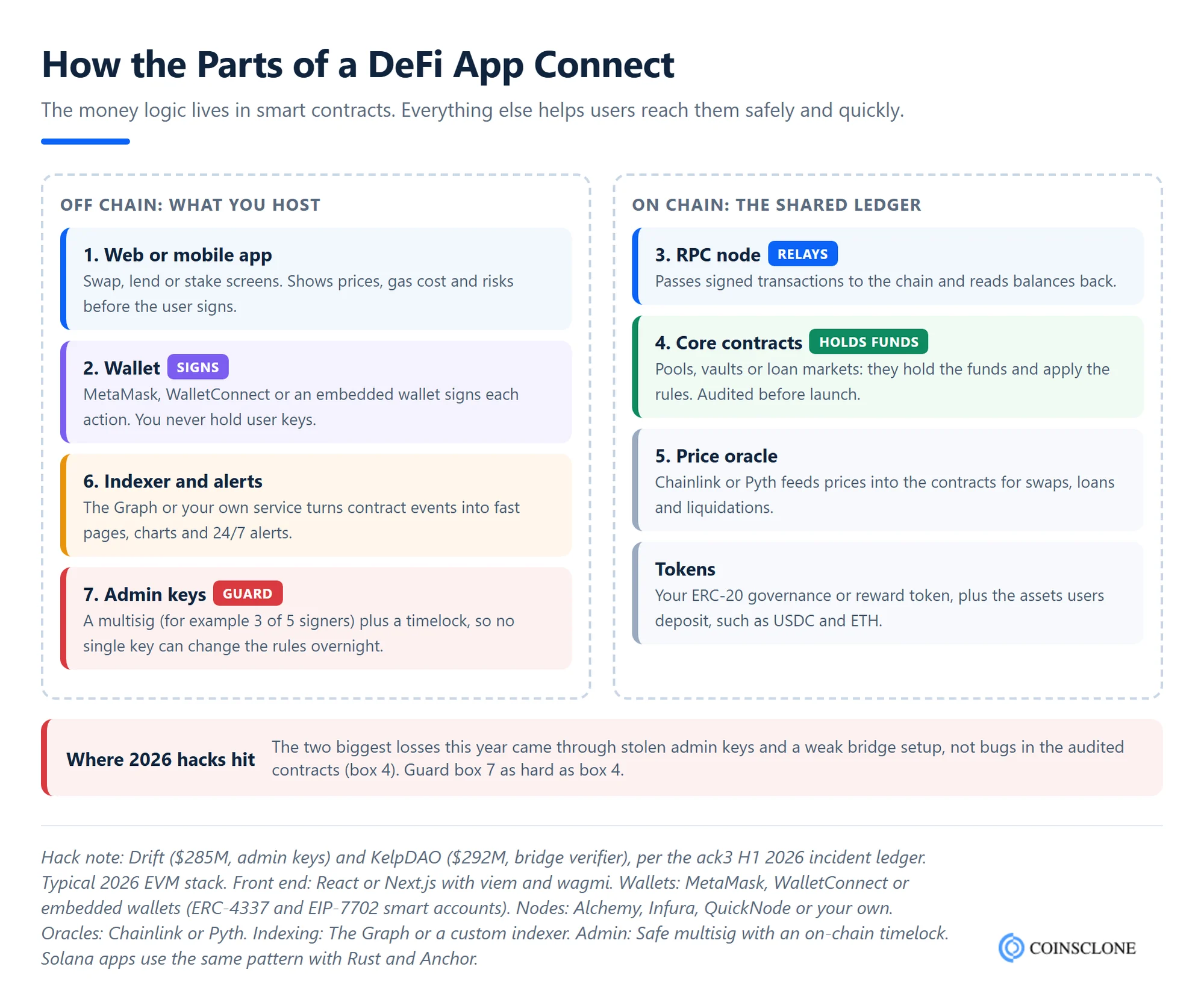
As the diagram shows, the app you host and the contracts on the chain do different jobs. Your screens, indexer and alerts make the app fast and easy to use. The contracts and the price oracle hold the money and apply the rules. That split matters when you plan for safety, as you will see in step 6.
Types of DeFi Apps to Build in 2026
There are plenty of chances for founders to build new DeFi apps. Whether you are new to the field or want to grow an existing business, knowing the main types will help you spot an idea that can last and make money.
1. Decentralized Exchange (DEX)
A DEX lets traders swap crypto straight from their own wallets, with no company holding their funds. Most DEXs use liquidity pools: users deposit pairs of tokens, and traders swap against those pools for a small fee. DEXs are the busiest corner of DeFi. They handled about $317 billion of trades in the 30 days to 1 October 2026, according to DefiLlama’s DEX data. To earn more, you can add yield farming, limit orders or a token launch pad on top. Consider creating a decentralized exchange like Uniswap to start from a model users already trust. Revenue comes from trading fees, listing fees and extra DeFi features.
2. DeFi Lending and Borrowing Apps
Lending apps let users deposit crypto to earn interest, while others borrow against their own coins. Smart contracts set the rates, track each loan and sell off the collateral if its value falls too far. This is the biggest DeFi category by money held: Aave V3 alone held about $18.2 billion on 1 October 2026. As the owner, you earn a share of the interest that borrowers pay. Building a decentralized lending platform like Aave lets you offer peer-to-peer loans run fully by smart contracts.
3. DeFi Staking Platform
As Proof-of-Stake (PoS) networks grow, staking has become a popular way to earn passive income. Users lock tokens to help secure a network or a pool, and they earn rewards in return. A strong staking app supports many coins, shows clear reward rates and offers flexible lock periods. Tools such as staking calculators also help new users join. PancakeSwap, for example, grew its user base by pairing its DEX with simple staking pools. Launching a DeFi platform like PancakeSwap gives you both swaps and staking in one place.
4. DeFi Yield Farming Platform
Yield farming lets users earn returns by adding funds to DeFi pools. A yield platform, or “vault”, pools user money and moves it between farms to chase the best return. It should balance risk and reward and show live returns on a clear dashboard. Many users want good yield for little effort, so a well-built vault can draw a wide audience. Creating a DeFi yield farming platform like Yearn Finance gives founders a proven model to build on.
5. DeFi Crowdfunding Platform
DeFi crowdfunding, often called a launchpad, helps new projects raise money in crypto from users around the world. Smart contracts collect the funds, hand out tokens and lock team shares, so raises are faster and easier to check. Launchpads are a large business: users paid about $301 million in launchpad fees in the 30 days to 1 October 2026, per DefiLlama. Many DAOs (groups run by token holder votes) also use such tools for their communities. If you want to help other startups raise funds, you can develop a DeFi crowdfunding platform like Polkastarter.
6. DeFi Asset Management Platform
As users spread their money across many DeFi apps, they need one place to track and manage it all. An asset management app pulls positions from many protocols into a single view. It can add rebalancing, risk scores, smart tips and tax reports. Both retail users and funds need such tools, and the need grows as DeFi gets more complex.
By tapping into these DeFi types, founders can build apps with several income streams and strong demand. For more ideas, see our list of DeFi use cases.
Why Should Startups Build a DeFi App in 2026?
DeFi has changed how people reach and hold money services. For startups, building a DeFi app is not just about chasing a trend. It is a way into a global market that runs 24/7 and is still growing.
- Global reach: Anyone with an internet link and a wallet can use your app. There are no bank hours and no border limits.
- Lower running costs: Smart contracts handle trades, loans and payouts by themselves, so you need fewer staff for daily tasks.
- Room to innovate: DeFi apps can plug into each other like building blocks. You can build on top of Uniswap, Aave or Chainlink instead of starting from zero.
- Real income: Fees are real and large. Users paid about $470 million in DEX fees and $113 million in lending fees in the 30 days to 1 October 2026, per DefiLlama.
- Active communities: DeFi users test, vote and give feedback in public. A strong community helps you improve the app and spread the word.
Still, the market is not what it was in 2021. Total value locked peaked at about $177 billion in November 2021 and sits near $95 billion today. So users are pickier now. They reward apps that are safe, easy to use and clear about fees. With that in mind, let us look at the build itself.
How to Create a DeFi App in 10 Steps
To create a DeFi app, start with your use case and target users. Then design and build smart contracts on the right chain, and wrap them in an app that people find easy to use. Here are the details in 10 steps.
STEP 1 – Define the DeFi Use Case
You need a clear view of the use case before you build. This step sets the business type, the services and the target users. You may build a DeFi app for a DEX, a payment gateway, lending, staking and more. Each choice changes how the app works and how it earns. So study your rivals, talk to likely users and write down the one problem your app will solve better than anyone else.
STEP 2 – Plan Features, Tokens and Architecture
Next, list the features and plan how the parts fit together. Based on your use case, the core features may include wallet login, swaps, liquidity pools, loans, staking, a rewards dashboard and an admin panel. This is also the time to plan your token, if you need one. Decide what it is for (voting, rewards or fee share), how many tokens exist and how they unlock over time. A token with no real use tends to lose users once the rewards run out.
STEP 3 – Pick the Right Blockchain
The chain you choose shapes your fees, speed and audience. Most teams go where the users and the money already are. Here is how the leading smart contract chains for DeFi compared on 1 October 2026, by total value locked on DefiLlama:
| Chain | Share of DeFi TVL | Contract language | Good fit for |
| Ethereum | 56.2% ($53.7B) | Solidity, Vyper | High-value lending, staking and blue-chip pools |
| Solana | 6.9% ($6.6B) | Rust (Anchor) | Fast, low-fee trading apps and launchpads |
| Base | 6.7% ($6.4B) | Solidity | Consumer apps with cheap fees and Coinbase users |
| BNB Chain | 6.0% ($5.7B) | Solidity | Retail DEX and staking apps with low fees |
| Tron | 5.9% ($5.6B) | Solidity (TVM) | USDT payments and lending |
| Arbitrum | 1.5% ($1.4B) | Solidity | Perpetuals and DeFi tools at layer 2 prices |
Ethereum-style chains (EVM) share the same code and tools, so you can launch on one and add others later. Solana needs a separate Rust codebase, but it offers very low fees and fast trades.
STEP 4 – Write the Smart Contracts
Smart contracts are the heart of a DeFi app. They hold the funds, apply the fees and run every trade or loan without anyone in the middle. Once deployed, they are hard to change, so mistakes cost real money. That is why good teams start from proven, audited building blocks such as OpenZeppelin Contracts instead of writing everything from scratch.
Most EVM teams write contracts in Solidity and test them with Hardhat or Foundry. Truffle and Ganache were retired in late 2023, so avoid guides that still list them. Our DeFi smart contract development page explains how we plan and test these contracts.
STEP 5 – Design the UI/UX
DeFi still loses many users at the first screen. So make the app clear for everyone, not just crypto experts. Show the price, the fee, the gas cost and the risk before a user signs anything. Use plain labels such as “You pay” and “You get”, and give a simple way to undo or cancel where possible. Good design builds trust, and trust brings more deposits.
STEP 6 – Build In Safety From Day One
Safety is the biggest risk in DeFi, and 2026 has shown where it really sits. Crypto firms lost about $972 million across 207 hacks in the first half of 2026, the highest number of incidents on record, per Immunefi’s mid-year data. The two largest did not come from contract bugs. KelpDAO ($292 million) was drained through a bridge that trusted a single verifier, and Drift ($285 million) lost its admin keys after months of social engineering. An ack3 study of 135 DeFi hacks found that two in three hacks with audit records hit parts the audit never covered.
So an audit alone is not enough. Protect your app with these basics:
- Multisig admin keys: Spread control across several signers, such as 3 of 5, kept on hardware wallets.
- Timelocks: Delay every rule change by a day or more, so users can see it coming.
- Price limits: Use more than one oracle feed and pause trading if prices jump too far.
- Live monitoring: Watch large moves 24/7 and keep a tested plan to pause the app.
- Bug bounty: Pay outside researchers to report flaws before attackers find them.
STEP 7 – Connect Wallets, Oracles and APIs
Users must sign in with their own wallets, so your app should support the popular ones. That means MetaMask, WalletConnect and Rabby on EVM chains, or Phantom on Solana. Embedded wallets with email login, built on ERC-4337 smart accounts, can also remove the seed phrase hurdle for new users. If you want your own branded wallet, see our DeFi wallet development service.
Next, connect a price oracle. Lending, perps and many vaults need live prices, so most teams use Chainlink or Pyth. Finally, add an indexer such as The Graph, so pages and charts load fast without querying the chain each time.
STEP 8 – Test, Audit and Deploy
Now your DeFi app is almost ready. First, run unit tests, fuzz tests and full user flows on a testnet. Then hire an outside firm to audit the contracts, and fix every issue they raise. Book early, because top audit firms are often busy for weeks. Only then deploy to mainnet, and publish the verified source code so users can check it.
STEP 9 – Seed Liquidity and Market the App
A DEX or lending app is only useful when its pools have money in them. So plan how you will fund the first pools. Common ways include your own treasury, a market maker deal or short-term rewards for early depositors. Then spread the word through X (Twitter), Discord, Telegram, partner apps and crypto media. Track deposits, active wallets and fees each week to see what works.
STEP 10 – Monitor, Upgrade and Govern
DeFi moves fast, so your app must keep improving. Watch the contracts and the market around the clock, and fix issues quickly. When you upgrade, use clear, public rules: a timelock, a multisig and, in time, token holder votes. This keeps users confident that no one can change the rules behind their backs.
With these steps, you now know how to create a DeFi app the right way. Next, let us look at the tools behind each step.
The DeFi App Tech Stack in 2026
Here is the stack most teams use today. You do not need every tool, but each layer needs a clear choice.
| Layer | Common 2026 choices |
| Smart contracts | Solidity or Vyper (EVM), Rust with Anchor (Solana), Move (Sui, Aptos) |
| Build and test | Foundry, Hardhat, OpenZeppelin Contracts, Slither and Echidna for checks |
| Front end | React or Next.js with viem and wagmi, or React Native for mobile |
| Wallets | MetaMask, WalletConnect, Rabby, Phantom, embedded smart wallets |
| Nodes (RPC) | Alchemy, Infura, QuickNode or your own node |
| Price oracles | Chainlink, Pyth, RedStone |
| Data and indexing | The Graph or a custom indexer with PostgreSQL |
| Admin and votes | Safe multisig, on-chain timelock, Snapshot or Tally for token votes |
| Monitoring | OpenZeppelin Defender, Tenderly or custom alerts |
How Do DeFi Apps Make Money?
DeFi apps earn from small fees on each action. The main models are:
- Trading fees: A DEX charges a fee on each swap, often 0.01% to 1%, and keeps a share of it.
- Interest spread: A lending app keeps part of the interest that borrowers pay.
- Staking fees: A staking app takes a cut of the rewards it earns for users.
- Vault fees: A yield app charges a management or performance fee.
- Launch and listing fees: A launchpad or DEX charges projects to raise funds or list tokens.
However, the fees users pay are not the same as your revenue. Most of the fees go to the people who supply the money, and only a slice stays with the protocol. The chart below shows how big that slice was for four leading apps.
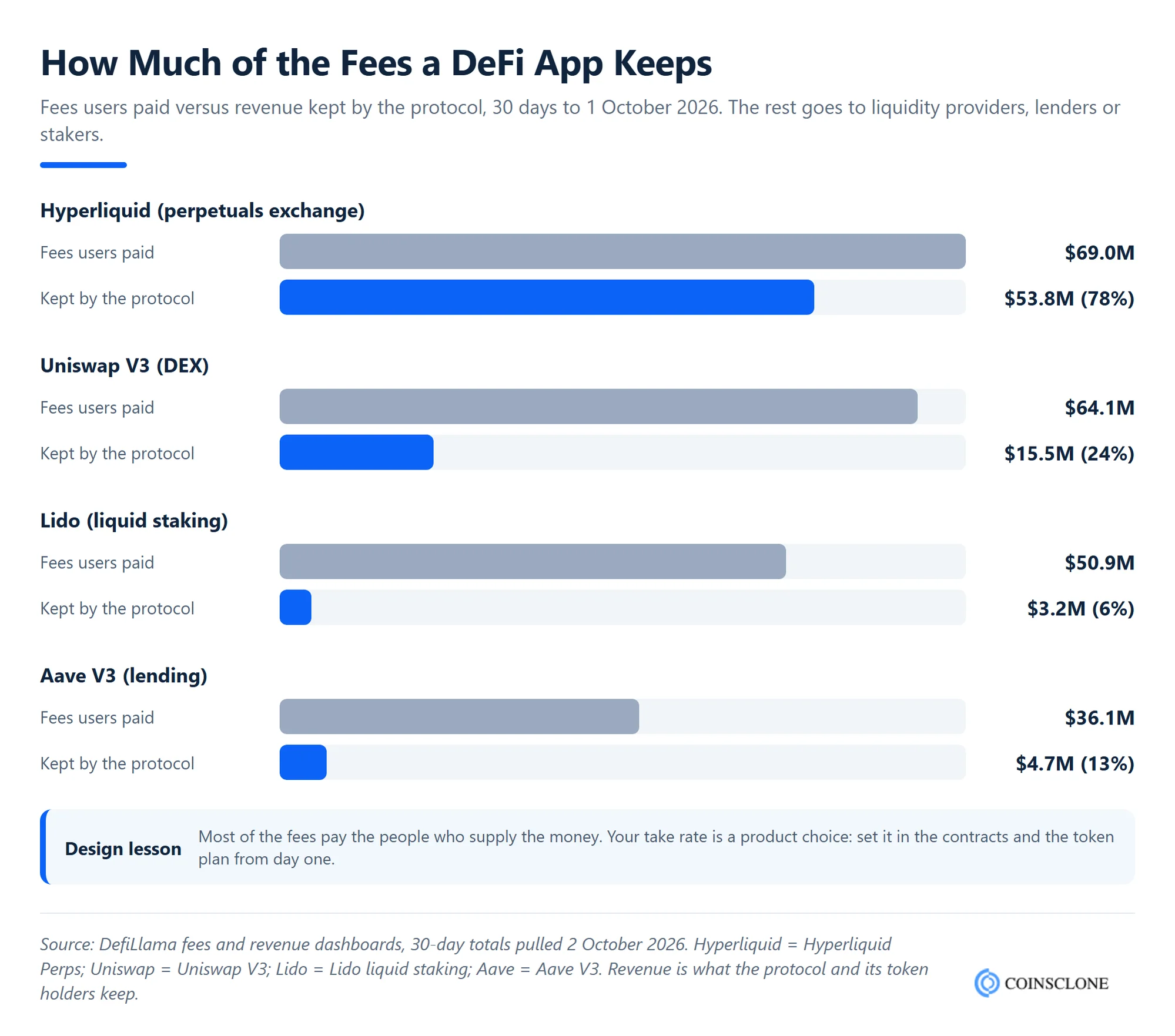
Hyperliquid kept 78% of its fees, while Lido kept just 6%. Both models work, but they lead to very different businesses. So decide your take rate early, and write it into both the contracts and the token plan.
Ways to Build a DeFi App
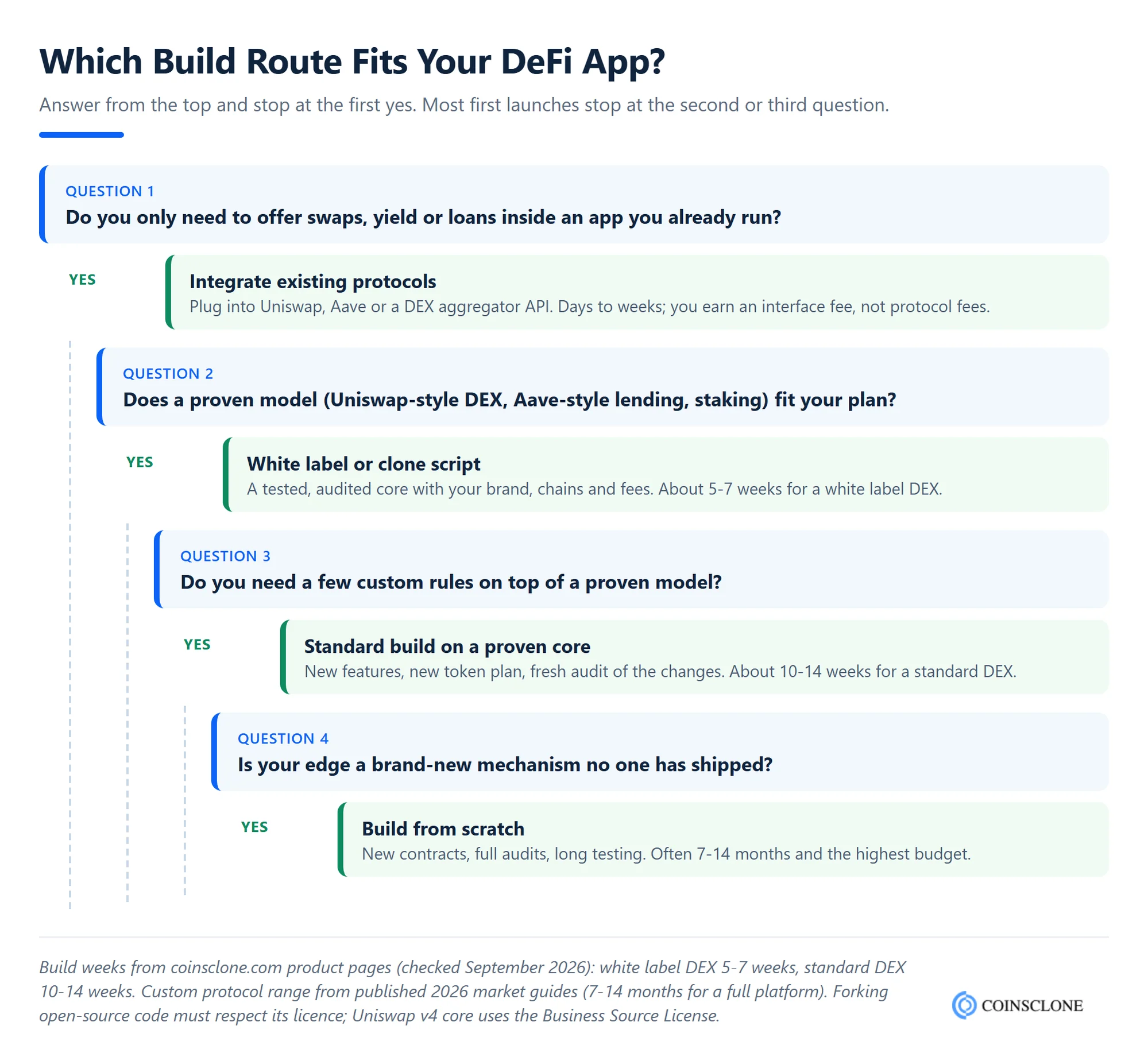
The right method depends on your budget, your goals and how fast you want to launch. There are two main ways to create a DeFi app:
- Build the DeFi app from scratch
- Use a DeFi app clone script
DeFi App Development From Scratch
Building from scratch means writing every contract and screen yourself. It gives you full control over the features, the look and how the app grows. However, it takes the most time, skill and money, and every new line of code needs a fresh audit. This route makes sense when your edge is a brand-new idea that no one has shipped yet.
Using DeFi App Clone Scripts
DeFi clone scripts are ready-made apps that copy the key features of proven platforms such as Uniswap or Aave. They launch faster and cost less, because the core is already built and tested. You still add your own brand, chains, fees and features. This route suits founders who want to test a business with a model users already trust before they scale it.
Whichever route you pick, a skilled DeFi team makes the work smoother and safer. Experts bring tested code, know the common traps and stay on for support after launch.
How Much Does It Cost to Create a DeFi App, and How Long Does It Take?
The cost to create a DeFi app depends on the type of app, the number of chains, custom features and audits. Published 2026 market guides give a useful range:
| Scope | Typical market cost | Typical time |
| DeFi MVP (one product, one chain) | $20,000 to $50,000, plus $10,000 to $20,000 for an audit | 2 to 4 months |
| Mid-size DeFi app | $50,000 to $120,000, plus $20,000 to $50,000 for audits | 4 to 7 months |
| Full DeFi platform | $100,000 to $300,000+, plus $50,000 to $150,000+ for audits | 7 to 14 months |
These ranges come from published 2026 agency cost guides. One puts a production-ready DeFi MVP at about $133,000 over 6 to 7 months, including a $15,000+ audit. Remember to budget for things beyond the code, too. Seeding liquidity can cost $30,000 to $500,000, and servers and nodes often run $1,000 to $5,000 a month.
A ready-made core cuts both time and cost. At Coinsclone, a white label DEX takes about 5 to 7 weeks to launch, and a standard DEX with custom features takes about 10 to 14 weeks.
Top Challenges in DeFi App Development and How to Overcome Them
Creating a DeFi app may look simple from the outside. However, the money at stake and the skills needed call for careful planning. Here are the main hurdles and how to handle each one.
- Safety risks: Hacks now come through stolen keys and admin access as much as through bad code. Use multisig keys, timelocks, more than one audit for big releases and live monitoring.
- Scaling and fees: Busy chains get slow and costly at peak times. Launch on a layer 2 or a low-fee chain, and keep the option to add more chains later.
- Liquidity: New pools start empty, and empty pools give poor prices. Plan a liquidity budget, a market maker deal and rewards that taper off over time.
- Rules and law: DeFi rules are still forming. In the US, the GENIUS Act set rules for stablecoins in July 2025, but the CLARITY Act for wider crypto markets failed a Senate vote 49 to 50 on 15 September 2026. In the EU, MiCA leaves out services that are “fully decentralised”, but front ends and token issuers often do not meet that test. Get legal advice for each market you serve.
- User trust: Many users still fear DeFi after past hacks. Publish your audits, verified code and admin setup, and explain risks in plain words.
These are the most common challenges that startups face when they build a DeFi app. If you are new to the space, or unsure where to start, it is wise to work with an experienced DeFi development company.
One trusted name in the industry is Coinsclone. Our skilled blockchain team helps you create a safe, scalable and feature-rich DeFi app, either from scratch or with a clone script built around your business model.
Why Choose Coinsclone to Create a DeFi App?
Coinsclone is a leading DeFi app development company trusted by startups and businesses around the world. Since 2018, we have delivered 350+ platforms for 200+ clients across 20 industries. Our team knows smart contracts, DEXs, lending apps, staking and wallets inside out. We focus on safe, reliable and feature-rich apps that meet your business goals, with audited code and support after launch.
So, rather than worrying about the fine details of the build, leave your vision to our experts. Let us work together to create a DeFi app that meets today’s market needs and puts your startup on the path to success in decentralized finance.
Frequently Asked Questions
How do I create a DeFi app?
Start by choosing one use case, such as swaps, lending or staking. Then plan the features and the token, pick a blockchain, write and test the smart contracts, and design a clear app. Connect wallets and price oracles, get an outside audit, deploy to mainnet and seed the first liquidity. After launch, monitor the app around the clock and upgrade it through a multisig and a timelock.
How much does it cost to build a DeFi app?
Published 2026 market guides put a DeFi MVP at about $20,000 to $50,000 plus an audit, a mid-size app at $50,000 to $120,000, and a full platform at $100,000 to $300,000 or more. Audits add $10,000 to $150,000+, depending on how much code you have. Seeding liquidity, servers and marketing come on top.
How long does it take to build a DeFi app?
A custom DeFi MVP usually takes 2 to 4 months, and a full platform can take 7 to 14 months, including audits. A white label route is much faster. For example, a Coinsclone white label DEX launches in about 5 to 7 weeks.
What are DeFi apps built on?
Most DeFi apps run on Ethereum or Ethereum-style chains such as Base, Arbitrum and BNB Chain, which use Solidity contracts. Ethereum alone held about 56% of all DeFi value on 1 October 2026, per DefiLlama. Solana, which uses Rust, is the second-largest DeFi chain and is popular for fast, low-fee trading.
How do I make money with a DeFi app?
You can earn from trading fees, a share of loan interest, staking and vault fees, and launch or listing fees. Keep in mind that most fees go to liquidity providers and lenders. For example, Aave V3 kept about $4.7 million of the $36.1 million in fees its users paid in the 30 days to 1 October 2026.
Do I need a smart contract audit?
Yes. An outside audit is the minimum before any DeFi app holds user funds. However, it is not enough on its own. In the first half of 2026, most of the money lost to hacks came through stolen keys and parts of apps that audits never covered. So pair the audit with multisig keys, timelocks, monitoring and a bug bounty.
Can a DeFi app be non-custodial and still easy to use?
Yes. Embedded wallets and smart accounts let users sign in with an email or passkey while still owning their keys. Apps can also pay gas fees for users and bundle several steps into one click. This removes the seed phrase hurdle that stops many new users.
Which are the top DeFi apps to watch in 2026?
By value locked on DefiLlama (1 October 2026), the leaders include Lido ($26.6 billion), Aave V3 ($18.2 billion), Morpho ($11.2 billion), Uniswap and Hyperliquid, which kept more fee revenue than any other DeFi trading protocol in the past month. These apps lead because of strong safety records, deep liquidity and steady upgrades.
What are the best non-KYC crypto exchanges?
Some of the best non-KYC crypto exchanges are DEXs such as Uniswap and PancakeSwap, and P2P platforms such as Bisq and Hodl Hodl. They let users trade crypto without sharing ID, which gives more privacy. Rules vary by country, though, so users should check local law.
What should a DeFi app offer?
A good DeFi app needs audited smart contracts, support for popular wallets and the core features of its type, such as swaps, loans, staking or yield farming. It should also show fees and risks clearly, protect admin keys with a multisig and a timelock, and offer a simple, fast app on web and mobile.
See How Our MVP System Can Help You Create a DeFi App Faster
DeFi App Development — simplified for innovation and scalability.
- MVP System : Launch your DeFi app 90% faster with modular architecture.
- DeFi-Ready Modules : Lending, staking, swaps, wallets, and dashboards.
- Brand & Customization : Your UI, your token, your DeFi ecosystem.
- Revenue Engine : Earn through transaction fees and yield integrations.
Get a free branded DeFi app demo in just 48 hours — before you invest.
Book a Free Demo to understand how to create a DeFi app from concept to mainnet in just 8–12 weeks.