

Crypto arbitrage bot development is the work of building software that spots the same coin selling at two prices and trades the gap before it closes. This guide explains how these bots work, the main types, the parts inside a good bot, and the steps to build one. It is written for founders, trading desks and exchange owners who want a bot of their own, not a rented tool.
You will also get honest 2026 numbers. We compare live Bitcoin prices on six exchanges, show the widest gap and what fees do to it, the risks that sink most bots, and what a build costs and how long it takes. By the end, you can judge if arbitrage fits your plan and brief a build team with confidence.
In this guide:
- Know the types: cross-exchange, triangular, DEX, flash loan, futures and statistical bots, and which one fits your setup.
- See the real math: a live Bitcoin price gap from 2 October 2026, and why fees decide whether a trade makes money.
- Look inside the bot: the six parts every serious arbitrage bot needs, from price feeds to the kill switch.
- Plan the build: steps, tech stack, team, cost by scope and a realistic timeline.
- Stay on the right side of the rules: whether arbitrage is legal, and what tax and exchange terms mean for you.
Launch Your Crypto Arbitrage Bot — 10x Faster with Our MVP System!
Arbitrage Automation, Simplified.
- MVP System : Go live with a profit-ready arbitrage bot in weeks, not months.
- Plug & Play Integrations : Instantly connect to Binance, Coinbase, Kraken & more — no code, no hassle.
- Smart Trading Engine : Run cross-exchange, triangular, and DeFi arbitrage strategies with precision.
- Profit Automation : Track opportunities, execute trades, and earn — all on autopilot.
Get a free branded demo of your arbitrage bot in just 48 hours — before you spend a cent.
Book a Free Demo to see how our Crypto Arbitrage Bot can take you from idea to live profits in 8-12 weeks.
Crypto Arbitrage Bot Development
Crypto arbitrage bot development is the process of creating tools that find and place arbitrage trades in the crypto market on their own. The bot buys a coin where it is cheap and sells it at the same moment where it is dearer. The profit is the small gap between the two prices, minus fees.
Prices differ because each exchange has its own buyers, sellers and order book. A big order on one venue can move its price for a few seconds before the others catch up. Local demand also matters. For example, coins often trade at a premium in markets with capital controls or a shortage of local liquidity.
These gaps are small and short-lived. On major pairs like BTC/USDT, they often last less than a second. That is why people use bots. A human cannot watch ten order books, do the fee math and place two orders in a few milliseconds. A well-built bot can, and it does so all day and night.
Why Create a Crypto Arbitrage Bot?
Crypto arbitrage bot development is a must for traders who want to automate trades on price gaps between exchanges. These bots read market data and place trades far faster than manual methods, which saves time and opens more profit chances.
Arbitrage is often called a lower-risk strategy because the bot does not bet on where the price is going. It holds a coin for seconds, not days. However, “lower risk” does not mean “no risk”. Fees, slow orders and frozen withdrawals can turn a winning trade into a loss. A good bot is built to measure those costs before it trades, so it can cut losses and capture the gaps that are truly worth it.
Owning the bot also gives you control. You choose the strategy, the exchanges and the risk limits, and you keep your API keys and trade data in-house. That matters for funds, exchanges and anyone planning to sell the bot as a product.
Is Crypto Arbitrage Still Profitable in 2026?
Yes, but only for bots that are cheap to run, fast and fee-aware. The easy gaps of 2017 are gone. Today, most of the work is in the math, not in finding the gap.
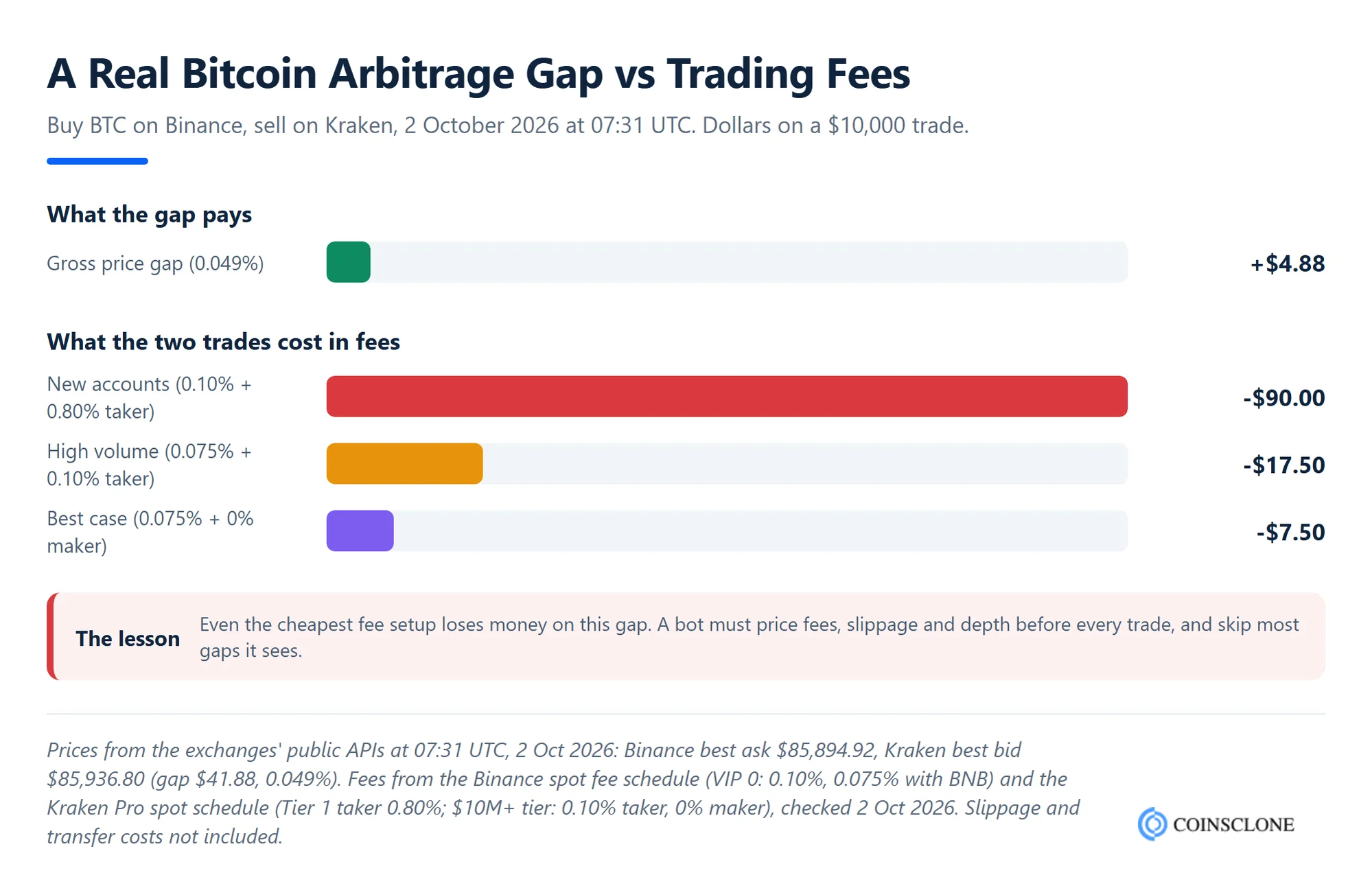
Here is a real example. At 07:31 UTC on 2 October 2026, we pulled the best buy and sell prices for BTC/USDT from six exchanges’ public APIs. The widest gap was between Binance and Kraken. You could buy Bitcoin on Binance at $85,894.92 and sell it on Kraken at $85,936.80. That is a gap of $41.88, or about 0.049%.
On a $10,000 trade, the gross profit is about $4.88. Now add fees:
- New accounts: Binance charges 0.10% per trade at the base tier, and Kraken Pro’s entry tier charges 0.80% for a taker order. The round trip costs about $90, so the trade loses about $85.
- High-volume accounts: with the BNB discount on Binance (0.075%) and a Kraken tier above $10 million a month (0.10% taker), the fees are $17.50. Still a loss.
- Best case: a 0% maker rate on Kraken plus 0.075% on Binance costs $7.50. Even this loses money on a 0.049% gap.
So where does the money come from? Bots that win in 2026 tend to do three things:
- Cut fees first: they reach VIP tiers, use maker orders and earn exchange rebates. Some are paid market makers, too.
- Hunt wider gaps: small-cap coins listed on only a few exchanges, regional premiums, new listings and stablecoin wobbles during market stress.
- Trade other kinds of gaps: for example, the difference between spot and perpetual futures prices, which pays a funding fee over hours rather than seconds.
In short, arbitrage is a numbers business. If a bot cannot model fees, slippage and timing for every trade, it will lose money slowly and quietly.
What are the Different Types of Arbitrage Trading Bot?
Crypto arbitrage trading comes in several types, based on the user’s strategy. They are,
Spatial Arbitrage Bots
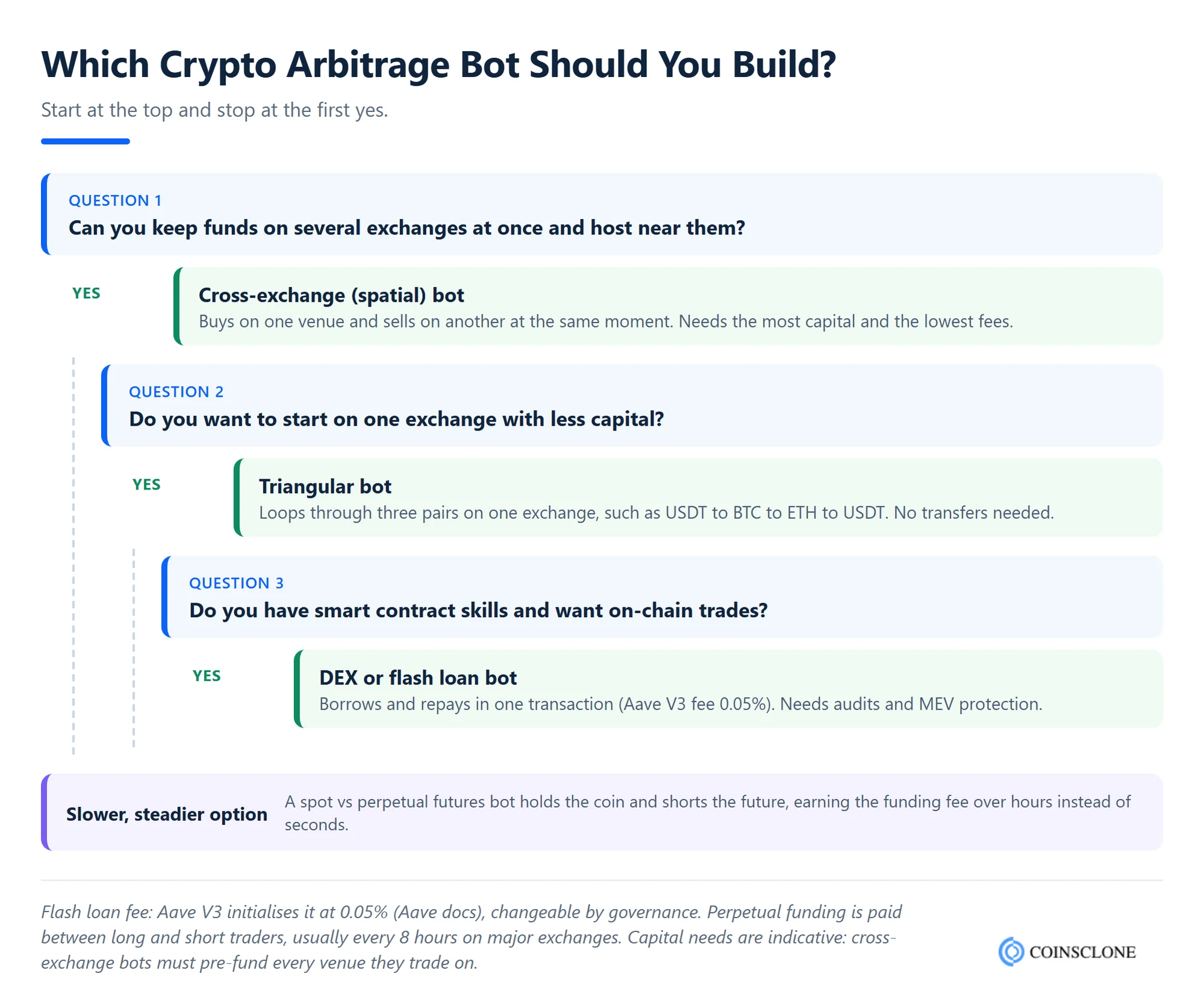
Spatial arbitrage bots, also called cross-exchange bots, use price gaps across exchanges. They buy on one and sell on another. To be fast, they keep funds on both exchanges in advance, so they never wait for a transfer during the trade.
Triangular Arbitrage Bots
Triangular arbitrage bots use price gaps within a single exchange. They trade through three pairs, for example USDT to BTC, BTC to ETH and ETH back to USDT. If the loop ends with more USDT than it started with, the bot profits. These bots need less capital because the money never leaves the exchange.
Latency Arbitrage Bots
Latency arbitrage bots use the small delay in price updates between exchanges. When one venue moves first, the bot trades on the slower one before it catches up. This type depends on speed, so it usually runs on servers close to the exchange’s own servers.
Statistical Arbitrage Bots
Statistical arbitrage bots use models and past data to find coins that tend to move as a pair. When the pair drifts apart, the bot buys the cheap one and sells the dear one, and waits for them to close the gap. Unlike pure arbitrage, this carries market risk, because the gap can widen before it closes.
Decentralized Exchange (DEX) Arbitrage Bots
DEX arbitrage bots use price gaps between DEXs, or between a DEX and a regular exchange. They work on-chain through smart contracts, so gas fees and block timing matter. They also face MEV bots that copy or front-run profitable trades, so many send orders through private channels. Many also use flash loans, which let a bot borrow funds and repay them in the same transaction. You can learn more in our guide to flash loan arbitrage bot development.
Futures Arbitrage Bots
Futures arbitrage bots use price differences between the spot market and futures contracts. They make profits by buying and selling the same asset in both markets at once. A common version holds a coin on spot and sells the perpetual future, then collects the funding fee that long traders pay.
Cross-Chain Arbitrage Bots
Cross-chain bots use gaps for the same token on two blockchains, such as USDC on Ethereum and on Solana. They need bridge or messaging tools and must account for bridge time and bridge risk, so they need careful design.
These types of bots contribute to the growing list of the top 10 best crypto trading bots in 2026, helping traders make profits across different exchanges.
How Do Crypto Arbitrage Trading Bots Work?
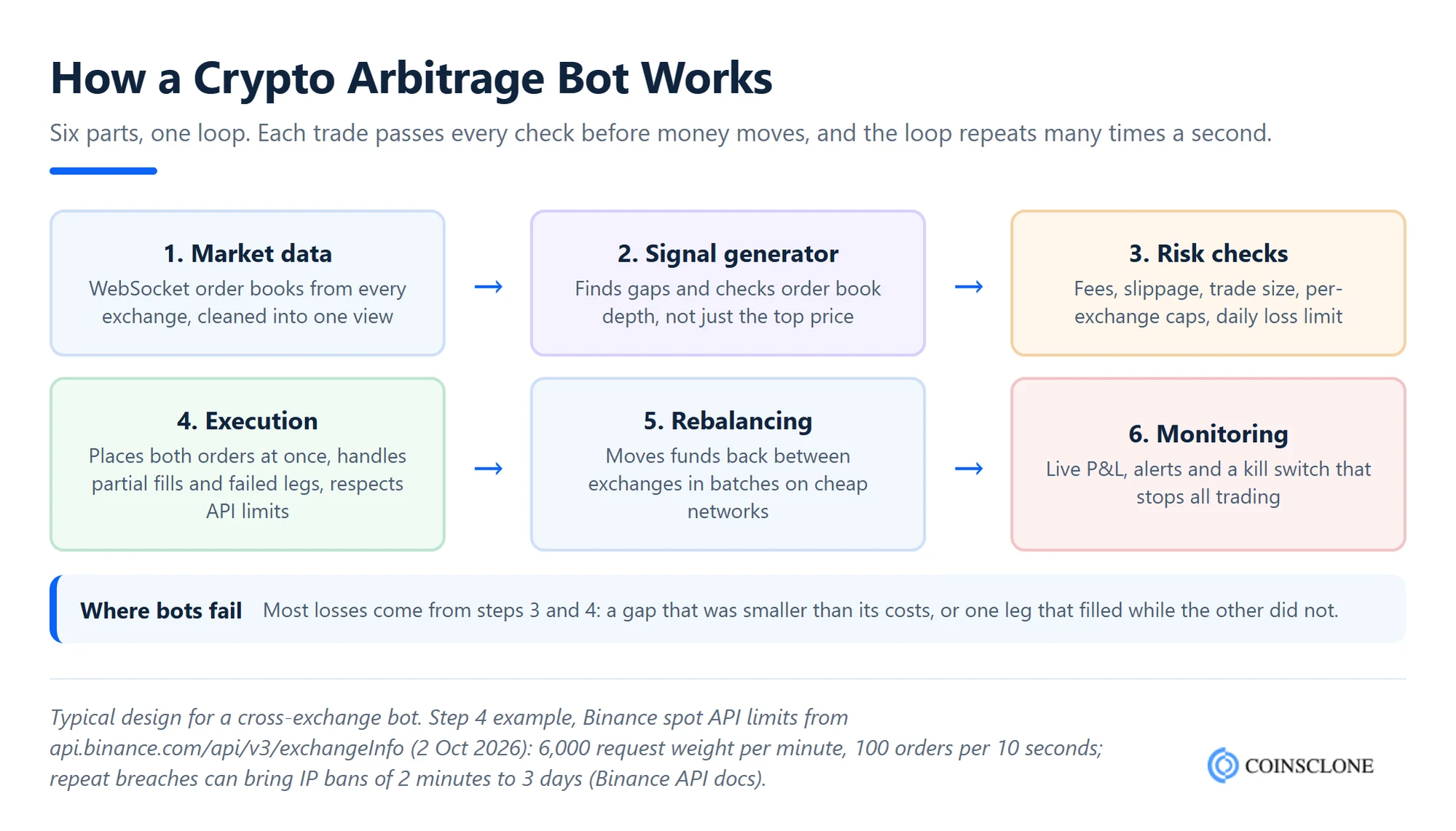
A crypto arbitrage bot is built from six parts. Each part has a clear job, and a weak link in any one of them costs money.
Market Data Feed
The bot connects to every exchange through WebSocket streams, which push each order book change as it happens. It then turns the different formats and coin names into one clean view. For example, Kraken calls Bitcoin “XBT”, while most exchanges call it “BTC”.
Signal Generator
The signal generator compares live order books across venues and finds gaps. A good one does not look at the top price only. It checks how many coins are on offer at each price level, because a big order fills at worse prices as it eats through the book.
Risk Allowance
This part decides if a gap is worth taking and how much to trade. It subtracts trading fees, expected slippage and transfer costs, then checks the trade against preset limits. These include the most capital per trade, the most exposure per exchange and the daily loss limit.
Processing (Trade Execution)
Once a trade passes the checks, the bot uses exchange APIs to place both orders at the same moment. It must also handle partial fills and failed legs. If one side fills and the other does not, the bot needs a rule to close or hedge the open position fast. It must also respect API limits. Binance, for instance, allows 6,000 request weight per minute and 100 orders per 10 seconds, and its API docs say repeat breaches can lead to IP bans of 2 minutes to 3 days.
Rebalancing
Cross-exchange trades slowly move your money to one side. After many trades, you hold too much USDT on one exchange and too much BTC on the other. The rebalancer moves funds back in batches, using cheap networks, so the bot can keep trading.
Monitoring and Kill Switch
A dashboard shows live profit and loss, open positions, balances and error rates. Alerts go to the team by email or chat. A kill switch stops all trading at once when losses, errors or exchange outages pass a limit.
Efficient Execution
Put together, these parts let the bot trade fast, with little human input. As a result, traders can capture short-term gaps that no person could catch by hand.
Key Features of a Crypto Arbitrage Bot
Beyond the core engine, these features separate a hobby script from a product that people will trust with real money:
- Multi-exchange connectors: ready links to major exchanges and DEXs, with a simple way to add more.
- Fee-aware profit check: live fee tiers, maker and taker rates, withdrawal costs and slippage go into each trade choice.
- Backtesting and paper trading: test a strategy on past data and on live prices with fake money before it touches real funds.
- Strategy settings: minimum profit, trade size, pairs and exchanges that users can change without code.
- Secure API key storage: encrypted keys with trading rights only, withdrawals switched off and IP allowlists turned on.
- Risk controls: daily loss limits, per-exchange caps and an automatic kill switch.
- Alerts and reports: live notices for fills, failures and balance changes, plus trade history for tax reports.
- User dashboard: clear profit and loss, balances by exchange and bot health on web and mobile.
Business Benefits of Building a Crypto Arbitrage Bot
Building your own crypto arbitrage bot brings clear gains for traders and firms. Here’s a closer look at them:
Error Reduction
One of the major benefits of crypto arbitrage bot development is fewer human errors. Bots follow set rules, not moods, so each trade is precise.
Quick Trading Execution
A crypto arbitrage bot uses automation to place trades the moment it spots a gap between exchanges. With crypto arbitrage bot development, traders can act on chances faster than manual methods allow.
Multi-tasking and Risk Control
A well-designed bot can scan markets, measure costs and place trades at the same time. With such a bot, traders gain a tool that handles many tasks, limits risk and bases each trade on data.
24/7 Operation
With a crypto arbitrage bot, trading no longer depends on human availability. Crypto markets never close, and bots work around the clock. As a result, traders never miss chances that appear at night or on weekends.
Cost Efficiency Over Time
Although building a crypto arbitrage bot needs an upfront investment, the long-term benefits make it worth the cost. These bots reduce manual work, improve trade precision and, once tuned, can run for years with only routine updates.
How to Develop A Crypto Arbitrage Bot?
Entrepreneurs looking to set up a new Cryptocurrency Trading Bot Development project need to go through a set of steps. The tech work covers the strategy, the design, the code, exchange links, security checks and much more. As a startup, there are two ways for you to build one. You can approach a freelancer or a development company with experts in the field.
Approaching a freelancer could be ideal if the startup’s focus is on building a trading bot at a low price. However, it could be a risky process, since quality is hard to assure. Proper guidance and the experience to solve complex problems would be a major question in that case.
Instead, startups can opt for a development company with experts in the blockchain field. This is an ideal way, since the whole build is done step by step with regular checks. Hence, the process is more open to the founders, and the team can handle any issues quickly. Here are the steps.
Step 1: Define the Strategy and Scope
Pick the arbitrage type, the exchanges, the pairs and the target trade size. Also set the business goal. Will you trade your own money, offer the bot to clients, or sell it as a white-label product? This choice shapes every later step.
Step 2: Model the Costs
Collect the real fee tiers, withdrawal fees, network fees and API limits for each venue. Then run the numbers on past price data. If the strategy cannot beat its costs on paper, it will not beat them live.
Step 3: Design the Architecture
Plan the six parts covered above, plus where the servers will run. For speed, many teams host in the same cloud region as their main exchanges. Plan for failover, logging and secure key storage from day one.
Step 4: Build the Connectors and Engine
Write the exchange connectors, the order book view, the signal generator and the order manager. For DEX bots, this step includes the smart contracts, which need a security audit before they hold funds.
Step 5: Backtest and Paper Trade
Replay past order book data through the bot, then run it on live prices with no real money. Compare the expected fills with what would really have happened. This step finds most of the costly bugs.
Step 6: Go Live Small
Start with small trade sizes and tight loss limits. Then raise limits slowly as live results match the tests. Watch partial fills and slippage closely in the first weeks.
Step 7: Monitor and Improve
Markets change, exchanges change their fees and APIs, and rivals get faster. Plan for ongoing tuning, new venues and security updates.
Tech Stack for a Crypto Arbitrage Bot
| Layer | Common choices | Why it matters |
| Core engine | Python for research and simple bots; Rust, C++ or Go for speed | Speed decides who wins the gap |
| Exchange connectors | Official REST and WebSocket APIs, CCXT library for broad coverage | Fast, reliable price and order data |
| Data storage | PostgreSQL or TimescaleDB for trades, Redis for live state | Fast reads and full trade history |
| On-chain (DEX bots) | Solidity or Rust smart contracts, private transaction relays | Safe execution and MEV protection |
| Hosting | Cloud servers near exchange data centres, with failover | Lower latency and uptime |
| Security | Encrypted key vault, IP allowlists, withdrawal-disabled keys | Protects funds if a server is breached |
| Monitoring | Grafana dashboards, alerting by email, Telegram or Slack | Fast response to failures |
Most build teams have a strategy lead, a few backend coders, a DevOps engineer and a security reviewer. DEX bots also need a smart contract coder.
Risks of Crypto Arbitrage Bots and How to Manage Them
Every arbitrage bot faces the same set of risks. Good design handles each one before it costs money.
- Fees eat the gap: this is the most common reason bots lose. The fix is a cost model that runs before every trade, plus lower fee tiers over time.
- Slippage: the best price may only cover a small amount. The fix is to read order book depth and size each trade to it.
- Leg risk: one order fills and the other does not, leaving an open position. The fix is fast hedge or exit rules.
- Transfer delays: blockchain transfers can take minutes, and exchanges can pause withdrawals. The fix is to pre-fund both sides and rebalance in batches.
- Exchange risk: an exchange can freeze funds, go offline or fail. The fix is to spread funds and cap how much sits on each venue.
- API bans and outages: too many calls can block your IP. The fix is rate-limit handling and backup connections.
- MEV on DEXs: other bots can copy or front-run on-chain trades. The fix is private order routing and tight slippage limits.
Is Crypto Arbitrage Legal?
Crypto arbitrage is legal in most countries. Buying an asset in one market and selling it in another is a normal trading activity, and it helps keep prices in line. Using a bot or AI to place trades is also legal. However, the way you trade and where you trade still matter.
- Exchange terms: most exchanges allow API trading but set rate limits and ban abuse. Read each venue’s terms before you connect.
- Market abuse rules: arbitrage is fine, but spoofing, wash trading and other manipulation are not. In the EU, the market abuse rules of the MiCA regulation apply to crypto-assets.
- Tax: each trade can create a taxable gain or loss. In the US, the IRS treats crypto as property, and brokers now report sales on Form 1099-DA. A bot that makes hundreds of trades a day needs clean trade records.
- Licences: trading your own money rarely needs a licence. Managing other people’s money, or selling signals as advice, may need one. Check local rules before you offer the bot to clients.
How Much Does it Cost to Develop a Crypto Arbitrage Bot?
The cost of crypto arbitrage bot development depends on the bot type, how many exchanges it uses, the speed you need and how much security and testing you add. As a rough guide, published 2026 estimates from development firms fall into three bands:
| Scope | What you get | Market range (2026) |
| Prototype | One strategy, one or two exchanges, paper trading | About $15,000 to $60,000 |
| MVP | Live trading on one to three venues, risk controls, basic dashboard | About $60,000 to $200,000 |
| Production platform | Many venues, low-latency hosting, 24/7 monitoring, audited contracts, client accounts | $200,000 and up |
A ready-made, white-label core costs less than a custom build, since the links, risk engine and dashboard are already done. You then pay mainly for branding, strategy changes and new exchange links.
Also budget for running costs. These include servers, market data, security audits for any smart contracts, exchange fees, and the capital you keep on each exchange. For cross-exchange bots, that working capital is often the biggest cost of all.
The development company you choose also plays a role in the cost. Some firms charge more than others, but quality is the key thing to check. Our team at Coinsclone puts quality first and quotes each project on its real scope.
How Do Cryptocurrency Arbitrage Bots Make Money?
Cryptocurrency arbitrage bots are not just trading tools. They can also be a whole business. Here are the smart ways an arbitrage bot business can earn money.
Subscription Models: Your clients pay regularly to use the bot with updates and support, which gives you a steady income.
Tier Pricing: You can offer different plans with different features and trade limits, so clients choose based on their needs.
White-label Services: You can build custom bots, like the best crypto arbitrage bots on the market today, that businesses can rebrand and sell as their own product.
Customization Services: You can tailor bots to a client’s own trading strategy and business goals, which adds more value for them.
Transaction Fees: You can earn a small commission on every trade the bot makes.
Performance Upgrades: You can charge for advanced features like faster trading, AI tools and better market analysis.
Integration Services: You can connect the bot to more exchanges and APIs for a fee, which widens its trading scope.
Technical Support Plans: You can offer paid plans for maintenance, fixes and regular updates, so the bot runs smoothly.
Training and Documentation: You can provide user guides and training sessions to help clients get the most from the bot.
Why Choose Coinsclone for Crypto Arbitrage Bot Development?
Coinsclone, a leading Cryptocurrency Exchange Development Company, has been building blockchain products since 2018. We have built 350+ platforms for 200+ clients across 20 industries, from exchanges and wallets to payment gateways and trading tools. This helps a lot with arbitrage. We know how order books, matching engines and APIs behave under load, because we build them.
Our crypto trading bot development team builds cross-exchange, triangular, DEX and futures bots. We can take a project from first idea to launch in 8 to 12 weeks. Every bot comes with fee-aware risk controls, backtesting, a dashboard and secure key handling. If you also need liquidity for your own exchange, our market making software uses the same trading core.
Crypto arbitrage still rewards teams that build carefully. Hence, make early inroads in the blockchain space by developing a crypto arbitrage bot with us.
Frequently Asked Questions
What is crypto arbitrage bot development?
Crypto arbitrage bot development is the process of building software that finds price gaps for the same coin across exchanges or trading pairs and trades them automatically. It covers the strategy, exchange connectors, risk controls, execution engine, dashboard and testing.
Is crypto arbitrage still profitable?
Yes, but the margins are thin. On 2 October 2026, the widest Bitcoin gap we found across six major exchanges was about 0.049%, which is smaller than most trading fees. Bots that profit today pay low fees, trade fast and focus on wider gaps, such as smaller coins, regional premiums and spot-versus-futures funding.
Is crypto arbitrage illegal?
No. Crypto arbitrage is legal in most countries, because buying low in one market and selling high in another is normal trading. You still need to follow each exchange’s API terms, avoid manipulation such as wash trading, and report your gains for tax.
Is it illegal to make an AI trading bot?
No. Building and using an AI trading bot for your own account is legal in most places, and most major exchanges offer APIs for it. Rules apply when you manage other people’s money or sell trading advice, and market manipulation is illegal whether a person or a bot does it.
Is AI arbitrage profitable?
AI can help a bot predict short-term price moves, pick the best venue and tune trade sizes, which can improve results. However, AI does not remove fees, slippage or speed limits. The same math applies: if a gap is smaller than its costs, AI cannot make it profitable.
How long does it take to develop a crypto arbitrage bot?
A simple prototype can be ready in a few weeks. A live, well-tested bot usually takes about two to three months. Coinsclone takes trading bot projects from concept to deployment in 8 to 12 weeks, depending on the strategy and the number of exchanges.
Which programming language is best for a crypto arbitrage bot?
Python is the most common choice for research and simpler bots, thanks to libraries like CCXT. For speed-critical bots, teams use Rust, C++ or Go. DEX bots also need Solidity or Rust for their smart contracts.
Is a crypto arbitrage bot safe to use for live trading?
It can be, if it has strong risk controls. Use API keys with withdrawals switched off, set daily loss limits, test on paper first and start with small sizes. Spread funds across exchanges so one failure cannot wipe out your capital.
Related Articles,
Flash Loan Arbitrage Bot Development – A complete Guide
Launch Your Crypto Arbitrage Bot — 10x Faster with Our MVP System!
Arbitrage Automation, Simplified.
- MVP System : Go live with a profit-ready arbitrage bot in weeks, not months.
- Plug & Play Integrations : Instantly connect to Binance, Coinbase, Kraken & more — no code, no hassle.
- Smart Trading Engine : Run cross-exchange, triangular, and DeFi arbitrage strategies with precision.
- Profit Automation : Track opportunities, execute trades, and earn — all on autopilot.
Get a free branded demo of your arbitrage bot in just 48 hours — before you spend a cent.
Book a Free Demo to see how our Crypto Arbitrage Bot can take you from idea to live profits in 8-12 weeks.