
Should you buy crypto on an exchange or through a broker? Both let you trade Bitcoin, Ether and other coins, and many apps now look alike. Yet the crypto exchange vs broker choice changes who sets your price, how much you pay, which coins you can trade and whether you truly own what you buy. It also shapes the business you build if you plan to launch a trading platform of your own.
This guide explains both models in plain words, shows how an order is filled on each, and puts real 2026 fees side by side. You will also see where hybrids like Coinbase fit, when an OTC desk makes more sense, and which licence and tech each model needs if you want to start one.
In this guide:
- The one difference that matters: who you trade with and who sets the price.
- A side-by-side table on fees, coins, ownership, liquidity and rules.
- A worked example of what $1,000 costs to trade on each.
- Which model suits a beginner, an active trader or a large buyer.
- What it takes to launch a crypto exchange or a crypto brokerage as a business.
Cryptocurrency Exchange vs Cryptocurrency Brokerage — What’s Right for You?!
- Exchange-Ready: Build a full trading platform with order books & liquidity.
- Brokerage Mode: Offer instant buy/sell with zero market-making hassle.
- Plug & Play Modules: Wallets, KYC, APIs — all pre-integrated
- Custom Branding: Your logo, your coins, your rules.
Get a Free Demo in 48 Hours — experience both Exchange & Brokerage versions before you invest a cent.
Book Your Free Demo and see how our MVP system can launch your crypto business in just 8-12 weeks.
Crypto Exchange vs Broker
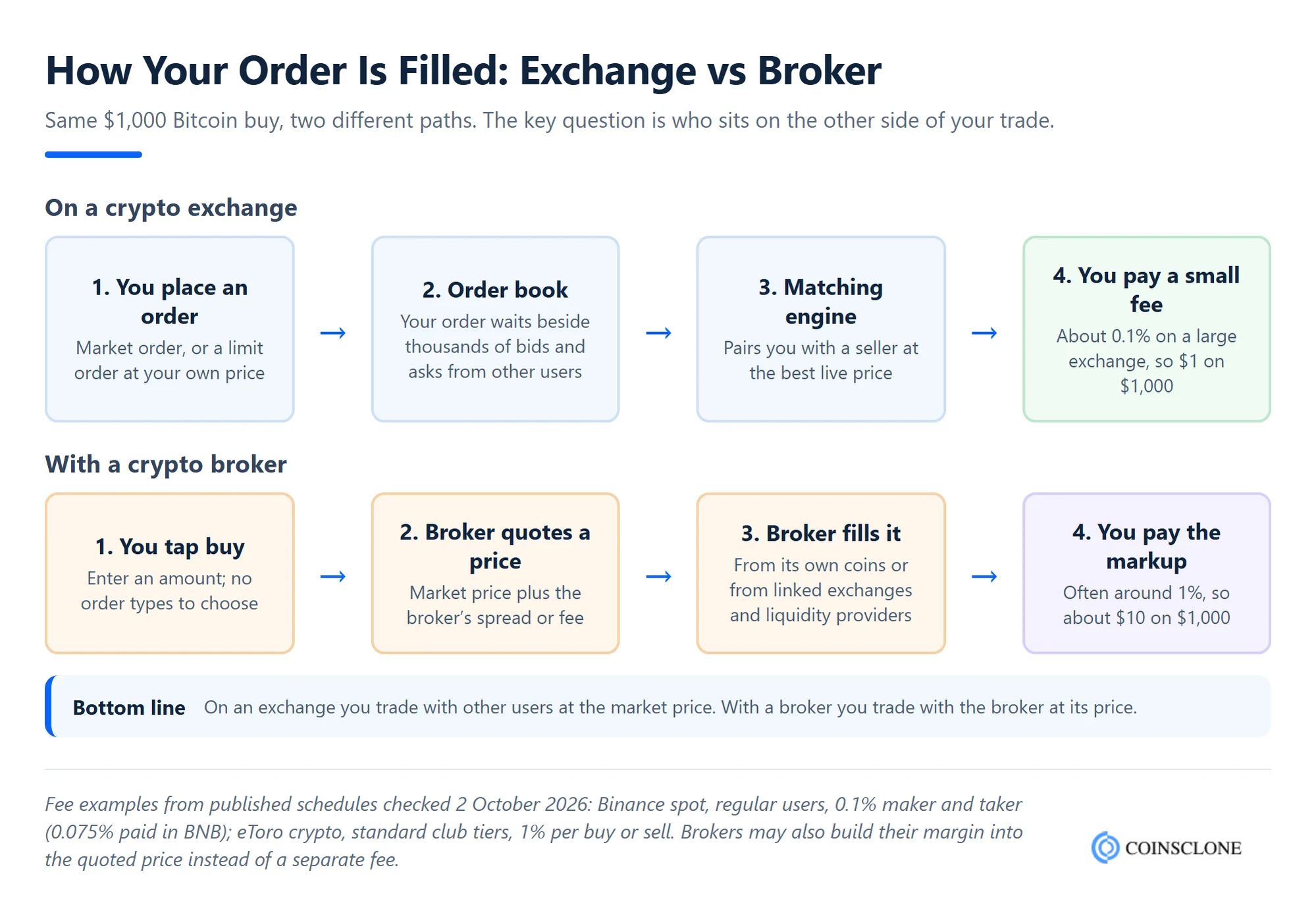
The short answer: on a crypto exchange, you trade with other users through an order book, and the market sets the price. With a crypto broker, you trade with the broker itself, and the broker quotes you a price that includes its margin.
Everything else follows from that. An exchange gives you live prices, many order types and low fees, but you must learn how it works. A broker gives you one simple “buy” button and a fixed quote, but you pay more for that ease, and the coin list is often shorter.
Neither model is better for everyone. The right pick depends on how often you trade, how much you trade and how much control you want. So let us look at each one in turn.
What Is a Cryptocurrency Exchange?
A cryptocurrency exchange is a platform where users can buy, sell, and trade digital currencies like Bitcoin, Ethereum, Solana and many others. Buyers and sellers place orders in a shared order book. A matching engine pairs them, and each trade sets the next market price. The exchange does not take the other side of your trade. It simply runs the market and charges a small fee.
Most exchanges use a maker and taker fee model. A “maker” adds a limit order to the book, and a “taker” fills an order that is already there. For example, Binance’s fee schedule charges regular users 0.1% for both, or 0.075% when they pay fees in BNB.
There are four common types of crypto exchange:
- Centralized exchange (CEX): A company runs the order book and holds user funds. Binance, Coinbase Advanced and Kraken work this way.
- Decentralized exchange (DEX): Smart contracts swap tokens straight from your own wallet, with no account.
- Peer-to-peer (P2P) exchange: Users trade directly with each other, and the platform holds the coins in escrow until the buyer pays.
- Hybrid exchange: A mix that pairs a fast central order book with self-custody or on-chain settlement.
As crypto trading grows, many startups and firms now build their own exchange platform. That is why crypto exchange development has become a popular business idea.
Also Read : How to Start Cryptocurrency Exchange Platform
Exchanges put a strong focus on security. They use SSL, encryption, two-factor login, cold storage for most funds and KYC checks for users. But here you may ask,
What is the need to choose a cryptocurrency exchange for trading?
Active traders choose exchanges for their features, low fees and deep markets. Let us see the main reasons in detail.
Why Choose a Cryptocurrency Exchange Platform for Trading?
The benefits depend on the type of exchange. Still, most exchanges share these common perks.
Wide Range of Cryptocurrencies
An exchange lists a wide range of coins and tokens, often hundreds of pairs. Users can buy or trade new tokens long before a broker adds them.
Direct Trading
On an exchange, you trade at the market price set by other users. You can see every bid and ask in the order book, so you know the real price before you buy. On a P2P exchange, an escrow system holds the coins until both sides confirm.
Lower Fees
Exchange fees are usually a small, clear percentage per trade. Frequent traders also get volume discounts, and makers often pay less than takers. Over many trades, this adds up to big savings.
Higher Liquidity
Large exchanges carry high trading volume for each pair, so liquidity is deep. As a result, you can fill big orders fast with little price slip.
Advanced Trading Tools
Exchanges offer limit, stop and other order types, live charts and APIs for trading bots. Many also add margin, futures and staking for skilled users.
Strong Security Controls
Good exchanges use cold storage, withdrawal checks and proof of reserves to protect users. Even so, no exchange is risk-free. Hackers stole about $1.5 billion from Bybit in February 2025, per Chainalysis. So users should still move long-term holdings to a wallet they control. Our guide on custodial vs non-custodial wallets explains that choice.
What Is a Cryptocurrency Broker?
A cryptocurrency broker is similar to a traditional broker in the stock market. It is a firm or app that stands between you and the market. You tell the broker what you want to buy. It then quotes you a price and fills the order from its own stock of coins or from the exchanges and liquidity providers it is linked to.
The broker earns from the spread, the gap between the market price and the price it quotes you, or from a flat fee per trade. For instance, eToro’s fee page lists a 1% fee to buy or sell crypto for standard members. That price is clear upfront, which is why beginners like it.
There are two kinds of crypto broker, and the difference matters:
- Spot broker: You buy real coins. The broker holds them for you, and many let you withdraw them to your own wallet.
- CFD broker: You sign a contract for difference (CFD) with the broker. You gain or lose on the price change, but you never own the coin and cannot withdraw it.
CFDs carry high risk, so many regulators limit them. The UK’s Financial Conduct Authority has banned the sale of crypto CFDs and other crypto derivatives to retail users since January 2021. US retail users cannot trade CFDs at all.
Reasons to Use Cryptocurrency Broker
A crypto broker suits people with little or no trading experience. Here are the main perks.
Convenient
Crypto brokers work like the stock apps people already know. You pick a coin, enter an amount and tap buy. Even some skilled traders use a broker for quick, small buys.
Fiat to Cryptocurrencies
Users who want to buy crypto with dollars, euros or pounds can go straight to a broker. The broker handles the cash-to-crypto swap in one step, often with card or bank payment.
Security
A licensed broker must meet financial rules on capital, client funds and checks. It also holds coins for you, so you do not need to manage private keys. Still, check the licence and ask whether your coins are held in your name.
Support
Many brokers offer strong customer support, and some offer a personal account manager for large clients. As a result, users get help when a trade or payment goes wrong.
Hassle-Free Trading
With a broker, there is no order book to read and no order type to choose. The quote you see is the price you pay, so a trade takes a few seconds.
Best Suit for Beginners
New crypto users who are wary of price swings often start with a broker. The simple app and fixed quotes make the first trades less stressful.
Affordable
Users who want to buy small amounts can use a broker. They can buy even costly coins like Bitcoin in fractions, starting from a few dollars.
These perks make brokers a good entry point. However, the convenience comes at a price, and the coin list is often shorter. The next section shows how the two models compare.
Crypto Exchange vs Broker: The Main Differences
Several factors set the two models apart. Based on your trading style, budget and choice of coins, one model will fit better.
| Factor | Crypto Exchange | Crypto Broker |
| Who you trade with | Other users, matched in an order book | The broker itself |
| How price is set | Live supply and demand | The broker’s quote, with its margin built in |
| Fees | Small maker and taker fee, often 0.1% or less | Spread or flat fee, often around 1% or more |
| Order types | Market, limit, stop and more | Mostly buy and sell at the quote |
| Range of coins | Hundreds of pairs, new tokens early | A curated list of major coins |
| Do you own the coin? | Yes on spot markets; you can withdraw | Yes with a spot broker; no with a CFD broker |
| Liquidity | Deep order books on large exchanges | Depends on the broker’s linked liquidity |
| Ease of use | Steeper learning curve | Very simple |
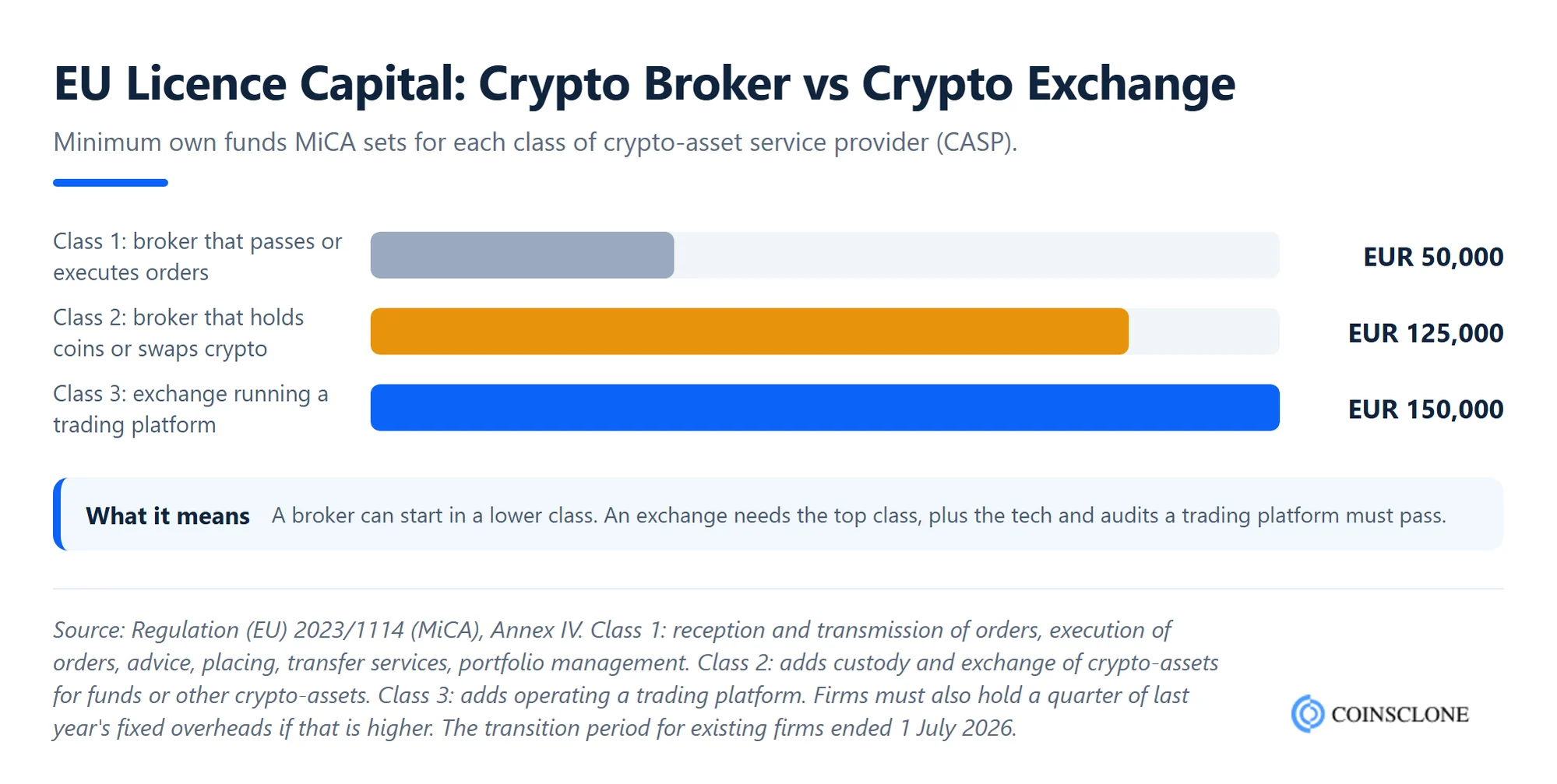
| Licence in the EU (MiCA) | Trading platform licence, EUR 150,000 capital | Order or exchange services licence, EUR 50,000 to 125,000 |
| Best for | Active traders and large orders | Beginners and small, simple buys |
In short, an exchange gives you more control and lower costs, while a broker gives you ease and a fixed price. From a startup’s point of view, an exchange also earns more ways, from trading fees to listings. That is why many founders choose to launch a cryptocurrency exchange.
How Much Does Each One Cost? A Worked Example
Fees look small as percentages, so let us put real numbers on them. Say you buy $1,000 of Bitcoin and sell it later. You pay a fee on both trades.
On Binance at the standard 0.1% rate, the round trip costs about $2, or $1.50 if you pay fees in BNB. On eToro at the standard 1% rate, the same round trip costs about $20. That is ten times more, and the gap grows with every trade.
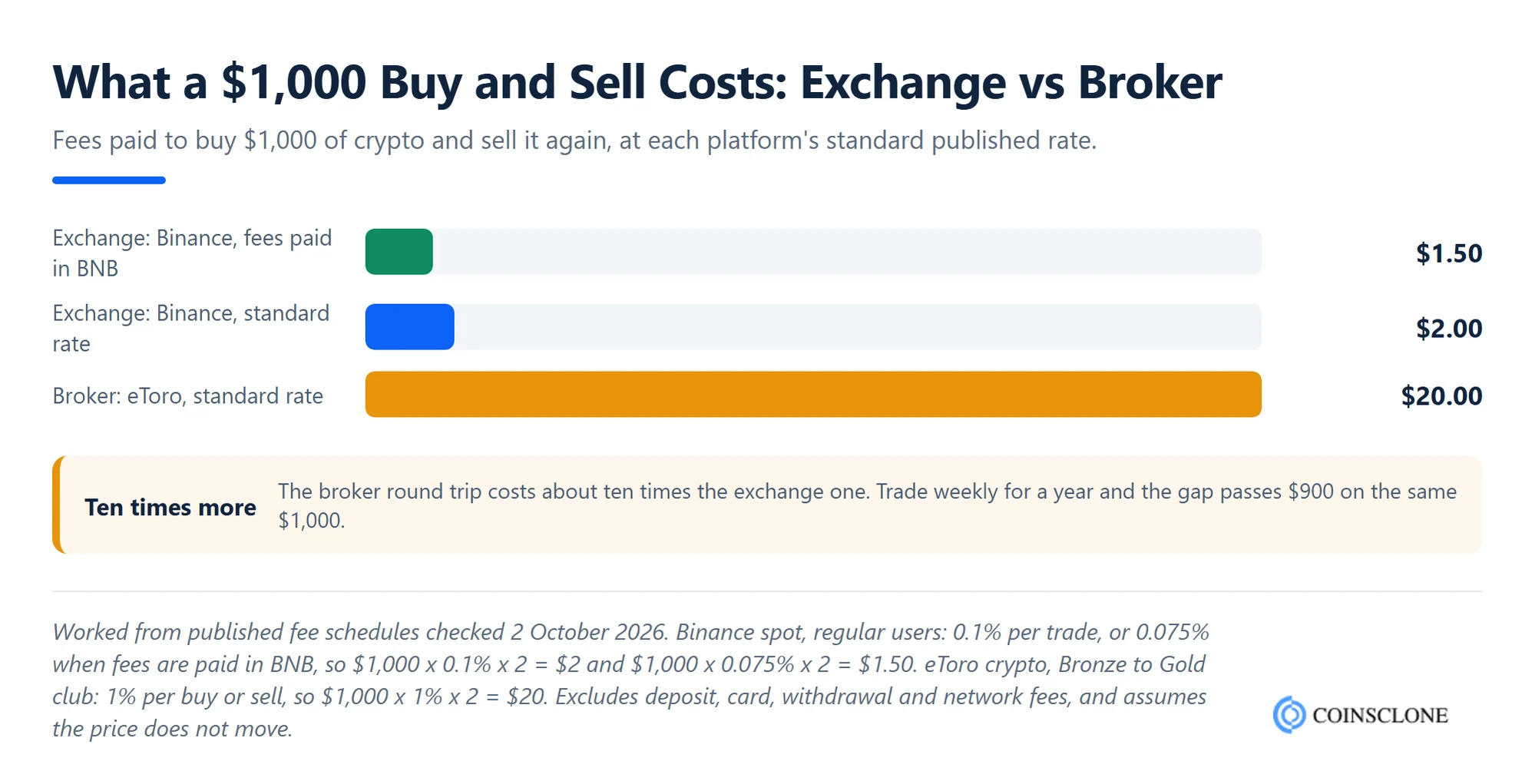
Keep in mind that brokers do not always show a separate fee. Many build the cost into the spread, so the quote already includes their margin. To compare fairly, check the final amount of coins you receive, not just the fee label. Also count withdrawal and card fees, which both models may charge.
Is Coinbase an Exchange or a Broker? The Rise of Hybrids
Today the line between the two is blurring. Many large platforms now run both models in one app:
- Coinbase: The simple buy screen works like a broker, with a quoted price and a spread. Coinbase Advanced is a real order-book exchange with maker and taker fees.
- Robinhood: It works as a broker for crypto. You trade at the prices Robinhood quotes, not on a public order book, though you can now move coins to an outside wallet.
- Binance and Kraken: Both are exchanges at heart, but each offers a simple “Convert” or “Buy” screen that acts like a broker, with the cost built into the price.
- Bitpanda and eToro: Both are mainly brokers that quote fixed prices, while Bitpanda also runs an exchange-style product for active traders.
So when you pick a platform, check which screen you are using. The same app can charge very different costs on its simple and advanced views.
What About OTC Desks?
Large buyers have a third choice: an over-the-counter (OTC) desk. An OTC desk is a broker for big trades, often $50,000 or more. Instead of placing a huge order on a public order book and moving the price, you get one private quote for the full amount.
Funds, miners and wealthy clients use OTC desks to avoid price slip. If you want to serve this market, see how an OTC crypto exchange works.
Which Should You Use?
Use these simple rules to choose:
- Choose a broker if you are new, you buy small amounts now and then, and you value a simple app over the lowest fee.
- Choose an exchange if you trade often, you want limit orders and charts, or you want coins that brokers do not list.
- Choose an OTC desk if a single trade is large enough to move the market price.
- In every case, check the licence in your country and whether you can withdraw your coins to your own wallet.
Exchange or Brokerage: Which Business Should You Launch?
The same question looks different from the founder’s side. Both models can be strong businesses, but they earn in different ways and need different setups.
Revenue model:
- Exchange: Earns small maker and taker fees on a large volume of trades, plus listing fees, withdrawal fees and paid API or market data.
- Brokerage: Earns the spread or a flat fee on each trade, so it makes more per trade but needs steady flow from users.
Liquidity:
- Exchange: Needs an order book that looks busy from day one. Most new exchanges hire market makers or link to crypto liquidity providers to fill it.
- Brokerage: Routes orders to outside liquidity, so it never needs its own busy order book. It must still manage the price risk while it holds coins.
Technology:
- Exchange: Needs a matching engine, order book, wallets with hot and cold storage, a trading interface, admin tools and risk controls.
- Brokerage: Needs a quote engine, links to liquidity providers, a simple buy and sell app, wallets or custody and a risk dashboard.
Licence: In the EU, MiCA sets a separate licence class for each service, with a minimum capital for each. The transition period for existing firms ended on 1 July 2026, so every EU crypto business now needs full authorisation.
In the US, rules are still in progress. The GENIUS Act set rules for stablecoins in July 2025, but the wider CLARITY Act market bill stalled in the Senate in September 2026. Other key markets, such as the UK, Dubai and Singapore, run their own licence regimes, so plan for each country you serve.
Time to launch: A brokerage needs less tech, so it can start lean. An exchange is a bigger build, but a white label base cuts the time sharply. For example, a white label crypto exchange can go live in about 4 to 6 weeks, 7 to 10 weeks with fiat payment rails, and 9 to 13 weeks with mobile apps. For a full budget breakdown, read our guide on the cost to develop a cryptocurrency exchange.
Many founders now mix both. They launch an exchange with an order book for active traders and add a simple “buy” screen that works like a broker for beginners. That way, one platform earns from both groups.
Final Words
Crypto exchanges and crypto brokers both help people buy and sell digital assets. An exchange gives you live prices, more coins and lower fees, while a broker gives you a simple, fixed-price path into crypto. For traders, the right choice comes down to how often you trade and how much control you want. For founders, it comes down to which users you want to serve and how you plan to earn.
As we have seen, a cryptocurrency exchange is a strong option for a startup. Then, you may ask,
Who creates a cryptocurrency exchange with exemplary features?
Coinsclone is a leading Cryptocurrency Exchange Development Company. Since 2018, we have delivered 350+ platforms for 200+ clients across 20 industries. Our team can build your exchange from scratch, launch it fast with a white label exchange script, or add a broker-style instant buy screen to it.
Apart from exchange services, we also offer crypto wallet development, payment gateway creation, and token development. We also provide ICO and STO scripts. Book a live demo and see the platform in action.
Frequently Asked Questions
What is the difference between a crypto broker and a crypto exchange?
On an exchange, you trade with other users in an order book, and supply and demand set the price. With a broker, you trade with the broker, which quotes you a fixed price with its margin built in. Exchanges are cheaper and offer more coins, while brokers are simpler.
Is Coinbase an exchange or a broker?
Coinbase is both. Its simple buy screen works like a broker, with a quoted price and a spread. Coinbase Advanced is an order-book exchange with maker and taker fees, which are usually lower.
Is Robinhood an exchange or a broker?
Robinhood is a broker for crypto. You buy and sell at prices Robinhood quotes rather than on a public order book. It now lets users move many coins to an outside wallet.
Do brokers charge more than exchanges?
Usually, yes. Exchange fees on large platforms sit around 0.1% per trade or less, as on Binance. Brokers often charge around 1% or more through a fee or spread, as eToro’s standard 1% rate shows. The gap matters most for people who trade often.
Is a crypto broker safe?
A licensed broker is generally safe for small, simple buys, because it must follow rules on capital and client funds. Still, it holds your coins, so you rely on its security and solvency. Check its licence, and move large holdings to a wallet you control.
What are the risks of using a crypto broker?
The main risks are higher costs hidden in the spread, a shorter coin list, and limits on withdrawing coins. With a CFD broker, you never own the coin at all. As with any custodial platform, the broker could also be hacked or fail.
Cryptocurrency Exchange vs Cryptocurrency Brokerage — What’s Right for You?!
- Exchange-Ready: Build a full trading platform with order books & liquidity.
- Brokerage Mode: Offer instant buy/sell with zero market-making hassle.
- Plug & Play Modules: Wallets, KYC, APIs — all pre-integrated
- Custom Branding: Your logo, your coins, your rules.
Get a Free Demo in 48 Hours — experience both Exchange & Brokerage versions before you invest a cent.
Book Your Free Demo and see how our MVP system can launch your crypto business in just 8-12 weeks.