

A crypto exchange business plan is the document that turns your exchange idea into numbers, steps and dates. It sets out your exchange type and business model, your fees, your licences, what the launch costs, who runs it and when you break even. This guide walks through each section with real 2026 figures, then shows how to fund and scale the exchange. You also get a one-page template you can copy and fill in today.
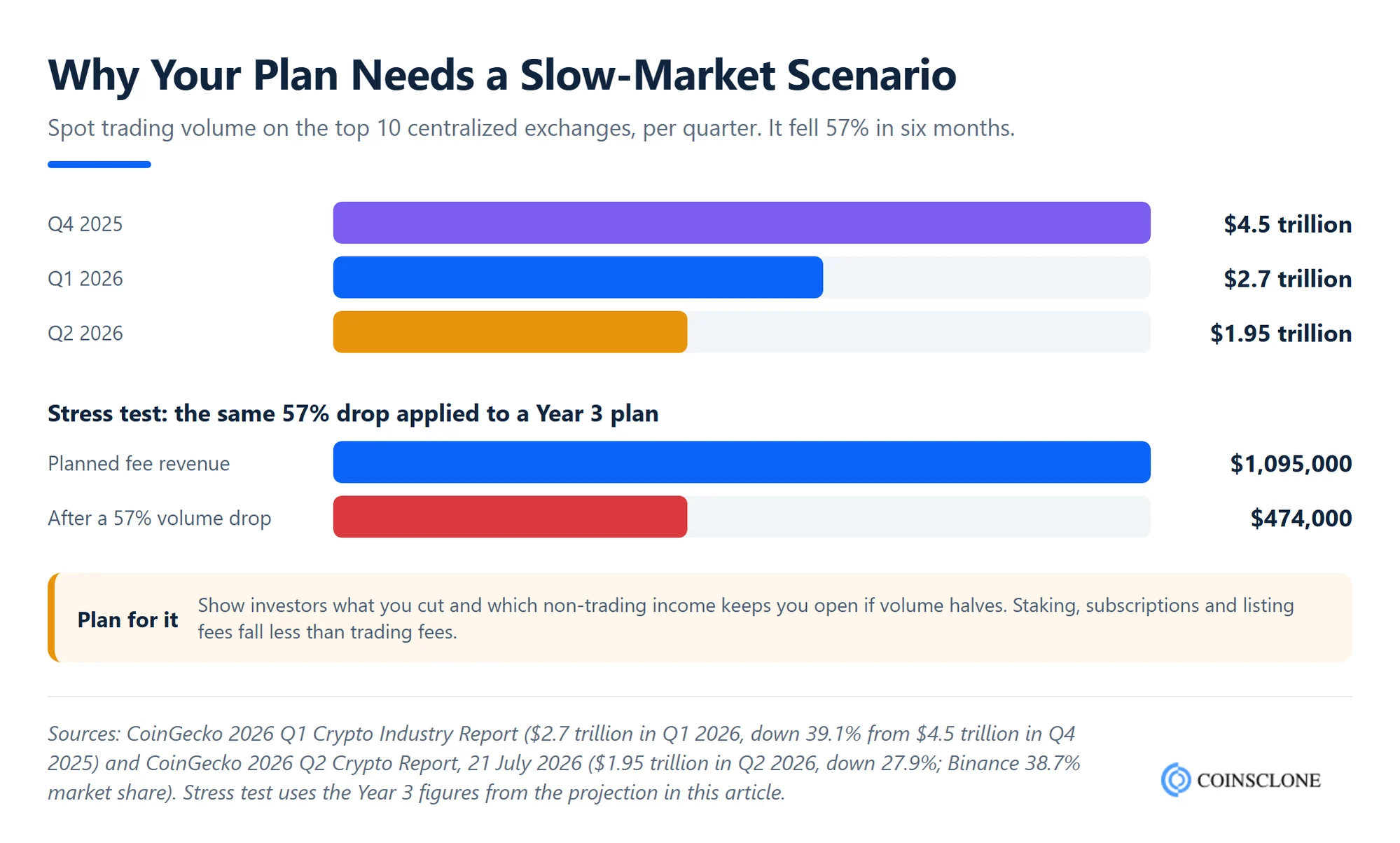
Why does this matter now? The market is huge, but it is also crowded and moody. In Q2 2026, the top 10 exchanges handled $1.95 trillion in spot trades, and Binance alone took 38.7% of it. That volume also fell by more than half in six months. So investors now want a plan that shows how you will win users, stay legal and survive a slow quarter, not just a pitch about growth.
In this guide:
- The 12 sections every crypto exchange business plan needs, and what investors look for in each
- The main crypto exchange business models, with real fee rates you can use in your forecast
- Licence costs in the EU, US, UK, Dubai, Singapore and India
- A worked 3-year projection that shows when a lean exchange breaks even
- How to fund the launch and scale the exchange once it is live
- A one-page crypto exchange business plan template you can copy
Build a Winning Cryptocurrency Exchange Business Plan — Faster!
Start your crypto exchange journey with a proven blueprint for success.
- Step-by-Step Strategy : Launch your Binance-like exchange 90% faster.
- Built-In Growth Models : Liquidity, wallets, and revenue streams — all mapped out.
- Custom Branding Plan : Define your market, your tokens, your identity.
- Revenue Framework : Earn from trading fees, token listings, staking, and more.
Get a free custom business plan preview in 48 hours — before you commit a cent.
Book a Free Demo to discover how our crafted Cryptocurrency Exchange Business Plan can take you from concept to launch in just 8 to 12 weeks.
Crypto Exchange Business Plan: What It Is and Why You Need One
A crypto exchange business plan is a written roadmap for your trading platform. It explains who your users are, which type of exchange you will run, how you will earn money, which licences you need, what the launch costs, and how you will grow. In short, it answers every question a bank, a regulator or an investor will ask before they back you.
Starting a cryptocurrency exchange without a solid plan is like driving without a clear destination. Here is how a business plan helps on your exchange journey:
- Makes you competitive: The crypto space is full of exchanges trying to own a niche. A strong plan helps you spot the gap and shape ideas that make your exchange stand out.
- Prepares you for the unexpected: Crypto markets swing hard. A plan helps you handle sudden market drops, security issues and new rules. Because you prepared early, you can get through these shocks with less damage.
- Provides clarity: Your plan works like a blueprint. It sets out your goals, your target users, your tech and your revenue model, so every later decision gets easier.
- Gives you an operational roadmap: Running an exchange day to day is hard. A clear method helps you avoid costly pullbacks and move forward safely.
- Guides resource allocation: Budget, team and tech all matter when you build an exchange. A plan makes sure each dollar goes where it should, with no waste.
- Wins licences and bank accounts: Regulators ask for one. In the EU, a MiCA licence file must include a programme of operations for the next three years. Banks and payment partners also ask for a plan before they open accounts for you.
Now that you know why the plan matters, let’s look at what goes into it.
What to Include in a Cryptocurrency Exchange Business Plan
By following these steps, you can build a strong crypto exchange business plan and position your platform in the busy 2026 market. Each step below matches a section of the final document.
- Write the summary page
- Research the market
- Set your goals
- Choose your exchange type
- Pick your tech
- Plan licences and legal steps
- Plan daily operations
- Introduce your team
- Plan your money
- Plan strong security
- Plan your marketing
- Plan for growth and risk
Write the Executive Summary
The executive summary sits first in your plan, but you should write it last. It is a one-page overview that tells a busy reader what you are building, for whom, and why it will work. Many investors read only this page before they decide whether to read the rest.
Keep it short and concrete. Include your exchange type, your target market, your main edge over rivals, your licence plan, the money you need and when you expect to break even. For example: “We are launching a spot exchange for retail traders in the UAE, licensed by VARA, with local-currency deposits in under a minute. We need $750,000 to reach break-even in Year 3.”
Research Your Market and Rivals
Start by studying global and local crypto trends and what users need right now. These facts help you plan and position your business well.
Next, look at the big players, like Binance, Kraken or Coinbase, and study what they do well, where they are weak and what makes each one stand out. You can even build a competitor matrix that lists what each platform does well and where it falls short. Study their features, fees, coin lists and user reviews, and then find the gaps you can fill.
Also, show investors that you understand the market’s cycles. Trading volume swings with prices, so a strong plan models a slow year as well as a busy one. The chart below shows how fast volume can drop.
Also Read :Coinbase Business Model – A Successful Case Study!
Set Your Business Goals
Setting clear, measurable goals keeps your business focused and in line with what the market needs. Breaking those goals into small milestones also makes the bigger picture easier to reach. Even with so many big exchanges, traders still look for a better fit. Use that demand to find gaps and set your project’s scope.
Start by choosing a name for your project. It should be unique and suit your goals. Next, your plan should state the vision and mission of your business, plus your unique value proposition (UVP): the one reason a trader picks you over Binance. A UVP could be local bank deposits, a niche coin list, lower fees for a region, or a simpler app for first-time buyers. This keeps your team focused and makes your plan more attractive to investors.
Finally, turn goals into numbers. For example: 10,000 verified users in Year 1, $500,000 in average daily volume, and a licence approved before launch.
Choose Your Exchange Type and Business Model
The type of exchange you run shapes your whole business plan. You can run a central order book (CEX), a simple “Buy” app, an instant swap service, a DEX, a P2P market or a hybrid of these. Each one has its own pros and cons, so your choice should match your target market and your resources.
| Exchange type | How it earns | Licence load | Best for |
| Centralized (CEX) | Trading, withdrawal and listing fees | Heavy: you hold user funds and often fiat | Founders with funding and a licence path |
| Brokerage (“Buy” button app) | A spread or flat fee on each simple buy | Heavy: you handle fiat and custody | Apps for first-time buyers in one country |
| Instant exchanger (swap service) | A spread or fee on each crypto-to-crypto swap | Medium: AML checks, and a licence in most markets | Small teams that want to launch without an order book |
| Decentralized (DEX) | Swap fees on liquidity pools | Lighter, though rules are growing | Web3 teams with smart contract skills |
| Peer-to-peer (P2P) | Fee on each completed trade | Medium: escrow and KYC still apply | Markets with weak banking or local payment apps |
| Hybrid | Mix of CEX and DEX fees | Heavy | Teams that want speed plus self-custody |
Brokerage apps charge the most per trade. Coinbase, for example, earned about 1.3% on each dollar of consumer trading in late 2025, against roughly 0.1% on most order book exchanges.
If you plan to launch a crypto exchanger business, your plan looks a little different. An exchanger has no order book. Instead, it quotes a price for each swap, routes the trade to partner liquidity and keeps a small margin. So the plan should name your liquidity partners, your margin per swap and your AML checks for large or risky transfers. Our Changelly clone script guide shows how this model works.
Then judge each option against your market research, tech choice and budget, and state your choice clearly in your plan.
Pick Your Tech Stack and Build Path
Stating the right tech stack early in your plan matters for both investors and smooth execution. Start with the backend, since it decides the core functions of your exchange: the matching engine, wallets, order book, admin panel and APIs. Our guide to crypto exchange architecture breaks down each layer.
On the front end, focus on a clean, fast and friendly app on web and mobile. Your plan should also name the tools you will use to make the platform fast, simple and good-looking. By listing these tools, you show that the platform is competitive and built around the user.
Also, explain your build path. A white label exchange launches in weeks, while a custom build takes many months. Your plan should say which one you chose and why.
Plan Your Licences and Legal Steps
Legal and licence checks are a must in your crypto exchange business plan. Governments around the world keep tightening their crypto rules. So your plan must explain how you will handle licences, user checks and anti-fraud steps, and where you will base your company.
For strong compliance, build KYC (know your customer) and AML (anti-money laundering) checks straight into your exchange. Also add how you will store and protect user data. Here is what the main licences cost and require in 2026:
| Region | Licence you need | Capital or fee | What to know |
| European Union | MiCA CASP licence | EUR 125,000 capital for exchange services; EUR 150,000 to run a trading platform | One licence covers all EU states. The transition period ended on 1 July 2026. |
| United States | FinCEN MSB registration plus state money transmitter licences | MSB registration is free; New York’s BitLicense costs $5,000 to apply | Each state licenses separately, so most firms launch state by state. |
| United Kingdom | FCA cryptoasset authorisation | GBP 28,150 to apply for a trading platform | The FCA gateway is open from 30 Sept 2026 to 28 Feb 2027. The new regime starts 25 Oct 2027. |
| Dubai | VARA exchange licence | AED 100,000 to apply, AED 200,000 a year | You need a licence before you serve users in or from Dubai. |
| Singapore | MAS digital payment token licence | S$250,000 base capital | MAS is strict on retail marketing and custody. |
| India | FIU-IND registration under PMLA | No capital floor; full AML duties | Users pay 30% tax on gains and 1% TDS on trades. |
Sources: MiCA regulation, VARA fee schedule, NYDFS and FCA notices, checked October 2026. Our crypto license guide covers each path in more depth.
A trusted exchange builder like Coinsclone can make this step easier. Our exchange software comes with ready KYC and AML tools, strong safety features and support for local rules. With that, you can launch a legally sound, scalable exchange in 2026 and beyond.
Plan Daily Operations and Partners
Your plan should explain how your exchange runs each day. This sets the working method of your platform and shows how it differs from other exchanges. So list the features and functions clearly, including the trading engine, price tools, charts, wallets and payment gateways.
Next, cover the partners you depend on. An exchange needs a bank or payment firm for fiat deposits, a KYC vendor, a crypto custody setup and at least one liquidity source. A thin order book drives traders away fast, so name your crypto liquidity providers or market makers and what they cost.
Further, your exchange should put customer support first, with chatbots, FAQs and a 24/7 support team. By showing how you will keep the platform fast and simple to use, your plan proves your exchange can run well at scale.
Introduce Your Team
Investors back people as much as ideas. So add a short section on your founders and key hires. Show who runs tech, compliance, finance and growth, and what each person has done before.
Regulators look at this too. Most licences need a named compliance lead and a named person who reports money laundering. Regulators also check that your directors are “fit and proper”. If you plan to outsource tech or support, say so, and name the partner.
Plan Your Finances
A good budget helps you spend wisely, avoid waste and prepare for surprises. While you plan your finances, knowing the Crypto Exchange Development Cost will help you plan your funds. It also shows investors that you have done your homework and can afford to bring your exchange to life.
Your revenue model matters just as much. It shows how your business will make money, and it ties the whole plan together. A full financial plan has three parts: profit and loss, cash flow and a balance sheet. Also add a break-even point and the total money you need to raise. We cover the revenue model, the budget and a worked projection in the sections below.
Plan Your Security
Security is the one thing an exchange can never cut. Your plan should set out how you will protect the platform and user funds. In 2025, hackers stole $3.4 billion in crypto, and the Bybit hack alone took about $1.5 billion. That number tells investors why your security plan matters.
So show how you will add layers of defence against attacks. Keep most funds in cold storage. Then add MPC or multi-sig wallets, two-step login, withdrawal caps and regular code audits. Our guide on how to build a non-hackable crypto exchange explains each layer.
Finally, show that your platform meets global security standards, such as ISO 27001 or SOC 2. Also plan to publish proof of reserves, so users can check that you hold their funds one for one. This builds trust with partners and proves your care for user safety.
Plan Your Marketing
Marketing helps you win and keep users. Based on your niche and audience, prepare a marketing plan of your own. This section shows how you will position your platform in a crowded space and earn loyal traders.
Include plans for content, trading webinars, partnerships and paid campaigns. You can also use crypto influencers and social platforms like X, Reddit and Telegram to reach a global audience. Referral bonuses and fee discounts for early users work well too.
Also, put numbers on it. State your budget per channel, your target cost to win each verified user, and how many of them you expect to trade each month. Investors trust a marketing plan with targets more than a list of channels.
Plan for Growth and Risk
Your plan should show how you will keep growing without tech limits. Explain how the platform handles more users and more trading volume as you scale.
In addition, show how you plan to enter new markets and new products, such as futures, staking or a mobile app. Then add a short risk table. List each major risk, such as a market crash, a hack, a lost banking partner or a rule change, with how likely it is and what you will do about it. By covering growth and risk side by side, your plan becomes a clear roadmap for a lasting, competitive exchange.
Now that you know what goes into the plan, let’s put real numbers behind it.
Crypto Exchange Business Model: How Your Exchange Makes Money
A crypto exchange business model is the mix of who you serve, how you match their trades and how you charge for it. In practice, most exchanges earn from several fee streams, not just one. Your revenue model is the heart of the financial plan, so here are the main streams, with real benchmarks you can use:
| Revenue stream | How it works | Real-world benchmark |
| Trading fees | A maker or taker fee on each trade | Binance charges 0.10% at the entry tier; Coinbase Advanced charges up to 1.20% for takers |
| Spread on instant buys | A small markup on the “Buy” button price | Common on simple buy screens in exchange apps |
| Withdrawal fees | A flat fee each time a user moves coins out | Usually set per coin to cover network fees |
| Listing fees | New projects pay to list their token | Charged mainly by mid-size and niche exchanges |
| Margin and futures | Interest, funding and higher trade volume | Top exchanges traded $12.7 trillion in perpetual futures in Q2 2026 |
| Staking and earn | A cut of the rewards users earn | Adds steady income when trading slows |
| Subscriptions and services | Premium plans, APIs, custody, stablecoin income | Coinbase earned $2.83 billion from these in 2025 |
Coinbase is a useful model here. In 2025 it made $7.18 billion in revenue, and about 56% came from trading fees. The rest came from subscriptions, services and interest. When trading slowed, its revenue fell to $1.22 billion in Q2 2026, about 19% below a year earlier, and it posted a $359 million net loss. Even so, subscriptions and services made up 48% of its net revenue that quarter. So a strong plan adds at least one income stream that does not depend on trading volume. For all 12 streams in detail, read how crypto exchanges make money.
In your model, use a realistic “take rate”, the share of volume you actually keep after discounts and market maker rebates. A take rate of about 0.1% is a fair starting point for a new exchange. Our guide on whether owning a crypto exchange is profitable shows the break-even volume at take rates from 0.05% to 1%.
How Much Does It Cost to Start a Crypto Exchange Business?
The build costs about $15,000 to $60,000 for a white label exchange, $100,000 to $200,000 for a custom MVP and $250,000 to $500,000 or more for a full custom exchange. On top of that, a lean exchange spends about $45,000 a month to run. The total depends on your exchange type, tech, security, licences and size. Here are the main cost lines for a lean centralized exchange in its first year:
| Cost line | Typical 2026 range | What it covers |
| Exchange build | $15,000 to $60,000 for white label; $100,000 to $200,000 for a custom MVP; $250,000 to $500,000+ for a full custom build | Matching engine, wallets, admin, web and mobile apps |
| Licence and legal | From a few thousand dollars to $150,000+ | Applications, capital, legal opinions, compliance staff |
| Liquidity | Often $5,000 to $30,000 a month for a market maker; we use $15,000 | A deep order book from day one |
| Team and 24/7 support | About $12,000 a month for a lean team | Operations, support and compliance work |
| Marketing | About $8,000 a month to start | Content, ads, referral rewards |
| Hosting, security and KYC | About $10,000 a month | Cloud, DDoS shield, audits, KYC at about $1.35 per check |
Build ranges come from published 2026 agency cost guides. KYC pricing is Sumsub’s Basic plan. Monthly lines follow the worked example in our cost guide, which totals about $45,000 a month.
Alternatively, a White Label Crypto Exchange Solution can cut both build time and cost without hurting security or speed. Coinsclone’s white label exchange launches in 4 to 6 weeks, 7 to 10 weeks with fiat rails, and 9 to 13 weeks with mobile apps. That lets startups go live within their planned budget. Keep in mind that a licence review often takes longer than the build, so start the licence file first.
Finally, a clear forecast of setup, running and growth costs makes your plan easier for investors to trust.
Crypto Exchange Business Plan Example: A 3-Year Projection
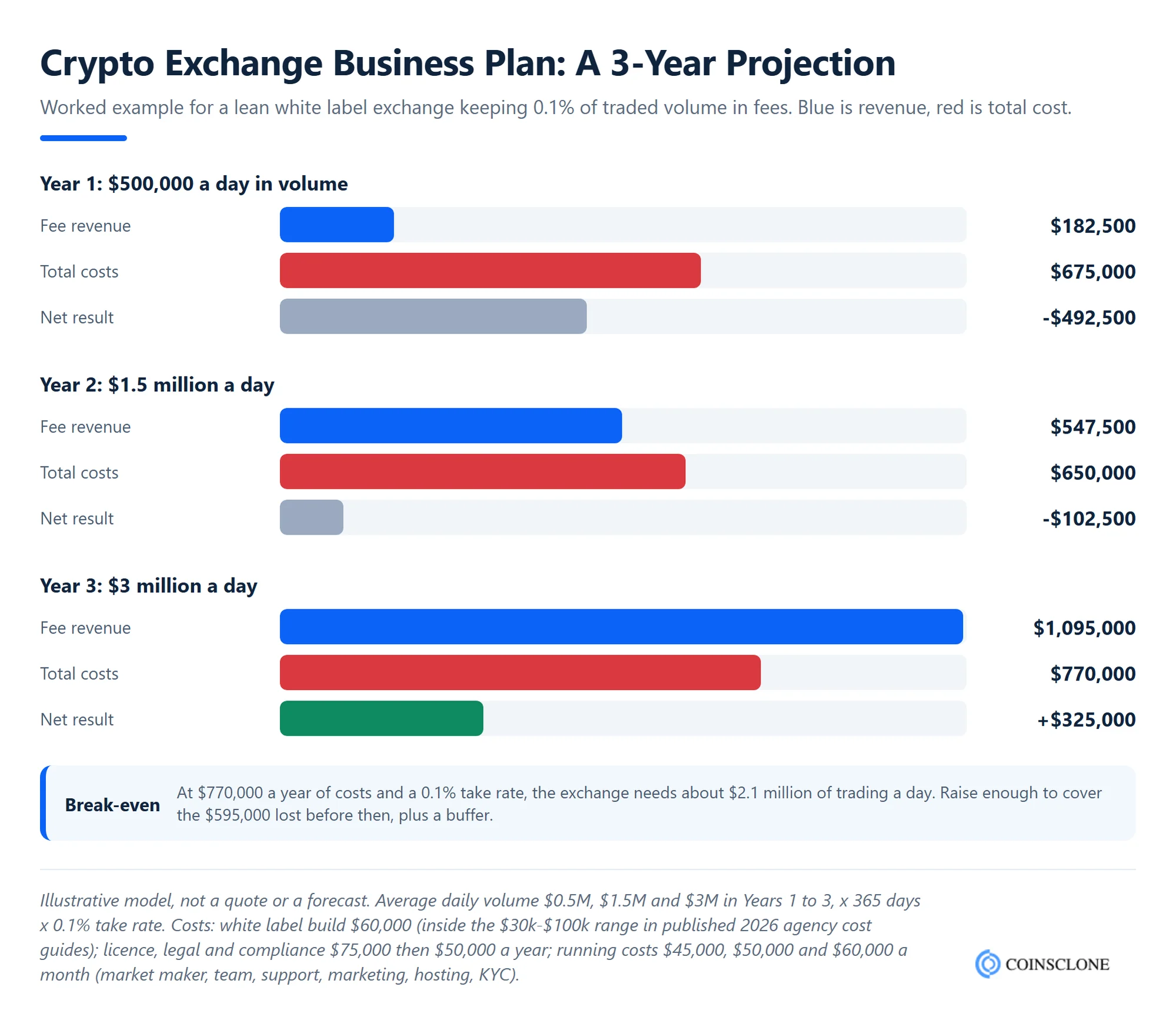
Numbers make a plan real. Below is a worked example for a lean white label exchange. It uses a 0.1% take rate and the running costs from the budget above. Treat it as a model to adapt, not a promise.
| Year 1 | Year 2 | Year 3 | |
| Average daily volume | $500,000 | $1,500,000 | $3,000,000 |
| Fee revenue (0.1% take rate) | $182,500 | $547,500 | $1,095,000 |
| Build (white label) | $60,000 | $0 | $0 |
| Licence, legal and compliance | $75,000 | $50,000 | $50,000 |
| Running costs | $540,000 | $600,000 | $720,000 |
| Total costs | $675,000 | $650,000 | $770,000 |
| Net result | -$492,500 | -$102,500 | +$325,000 |
Three lessons come out of this example:
- Plan for two lean years: The exchange loses about $595,000 before it turns a profit. So you need to raise that much, plus a buffer of 6 to 12 months of costs, before you launch.
- Know your break-even volume: With $770,000 of yearly costs and a 0.1% take rate, the exchange breaks even at about $2.1 million in daily volume. Put this number in your executive summary.
- Stress test the plan: If volume fell about 57%, as it did across the top exchanges from Q4 2025 to Q2 2026, Year 3 revenue would drop to about $474,000. Show investors how you would cut costs or lean on other revenue if that happens.
How to Fund Your Crypto Exchange Startup
In the worked example above, the exchange needs about $595,000 to cover two lean years. With a 6 to 12 month safety buffer, the real raise is closer to $865,000 to $1.1 million. Your plan should show where that money comes from, in a simple “sources and uses” table. Here are the usual sources:
- Founders and angels: Most new exchanges start with the founders’ own money and a few angel investors. This keeps control in-house while you prove demand.
- Venture capital: Crypto funds and fintech investors back exchanges with a clear niche, a licence path and a strong team. They read your summary page and your 3-year numbers first.
- Strategic partners: Payment firms, market makers or larger exchanges sometimes invest, or offer better terms, in return for flow in a new region.
- Token sales: Some exchanges raise money by selling their own token. Treat this as a legal project. In the EU, a public token offer usually needs a MiCA white paper, and in the US it may count as a securities offer.
Also, keep regulator rules in mind. Licences such as MiCA need set capital that you must hold, not spend. Regulators also check where your funds come from, so keep clean records of every investor.
How to Scale a Crypto Exchange Business
You scale a crypto exchange by deepening liquidity first, then adding markets and products that do not depend on spot volume alone. Your tech and compliance must keep pace at each step. These are the main levers, in the order most exchanges use them:
- Deepen liquidity: Traders stay where spreads are tight. Add market makers, or link your order book to larger exchanges through liquidity aggregation. Our guide on how crypto market makers make money explains what they charge and why.
- Add regions and fiat rails: Each new country needs local payment partners and, often, its own licence. In the EU, one MiCA licence lets you serve every member state.
- Add products: Futures, staking, a launchpad and a P2P desk each bring new users and new fees. A crypto derivatives exchange module is the usual next step, since top exchanges traded $12.7 trillion in perpetual futures in Q2 2026.
- Win pro and business users: Offer trading APIs, VIP fee tiers and an OTC desk for large orders. These users trade more and churn less.
- Scale the tech: Load test your matching engine before every big campaign, and run your servers on cloud capacity that grows with demand.
- Keep trust as you grow: More users means more scrutiny. Keep up audits and proof of reserves, and follow the crypto travel rule for transfers.
Finally, track a few numbers each month. Watch users, active traders, daily volume, take rate and the cost to win a user. Also watch how much income comes from streams other than trading. If that share grows, a slow market hurts you less.
One-Page Crypto Exchange Business Plan Template
Many founders search for a crypto exchange business plan PDF or a free template. Here is a one-page version you can copy into any document. Fill in each line with your own facts, then expand each one into a full section.
| Section | What to write | Example |
| Executive summary | What you build, for whom, the money you need, break-even date | “Spot exchange for UAE retail traders; raising $750,000; break-even in Year 3” |
| Problem and UVP | The gap you fill and why users will switch | “Instant AED deposits and a simple app for first-time buyers” |
| Market | Target region, user numbers, top rivals and their gaps | “Rivals charge high card fees and lack local support” |
| Exchange type | CEX, DEX, P2P or hybrid, and why | “CEX with spot trading first, futures in Year 2” |
| Revenue model | Fee rates and other income streams | “0.1% take rate, listing fees, staking commission” |
| Licences | Where you will be licensed and when | “VARA licence filed before the build starts” |
| Tech and partners | Build path, banks, KYC, custody, liquidity | “White label build, one market maker, cold storage” |
| Team | Founders, compliance officer, key hires | “CEO, CTO, MLRO, head of growth” |
| Marketing | Channels, budget, cost to win a user | “$8,000 a month; referral rewards; X and Telegram” |
| Financials | 3-year forecast, break-even volume, funding need | “Loss in Years 1-2, profit in Year 3” |
| Risks | Top five risks and your response | “Hack: cold storage, audits, insurance fund” |
Common Mistakes in a Crypto Exchange Business Plan
Even good ideas fail when the plan has gaps. Watch out for these common mistakes:
- Treating the build as the main cost: The software is often the cheapest part. Liquidity, staff, licences and marketing cost far more over the first two years.
- Leaving licences until the end: A licence review can take longer than a white label build. Start the licence file first, or your finished exchange will sit idle.
- Assuming volume from day one: New exchanges start with thin order books. Budget for a market maker and model a slow ramp.
- Relying on one revenue stream: Trading fees fall hard in a bear market. Add at least one stream that does not depend on volume.
- Skipping the risk section: Investors know crypto is risky. A plan that ignores hacks, bank exits and rule changes looks naive.
Turn Your Crypto Exchange Business Plan Into a Live Exchange
Launching a crypto exchange is not just about tech. It is about vision, strategy and execution. A well-built crypto exchange business plan is your blueprint for success. It helps you handle rules, attract investors and build user trust in a fast-changing market.
It also guides every decision and keeps your exchange in line with both market needs and business goals. With this guide and the template above, writing your plan becomes much easier. While the journey may seem complex, the right tech partner can simplify every step.
As we said earlier, working with a leading Cryptocurrency Exchange Development Company like Coinsclone can make all the difference. We have been building crypto platforms since 2018 and have delivered 350+ platforms for 200+ clients across 20 industries. Our team helps you turn the plan into a live exchange, from KYC and AML tools to liquidity and security. Be it market insight, compliance or scale, our team makes sure your exchange is as bold as your vision.
With the right partner by your side, you can launch with confidence.
Frequently Asked Questions
Why is a crypto exchange business plan so important?
A crypto exchange business plan is a strategic roadmap that sets out your vision. It helps startups set goals, attract investors and prepare for real-world challenges in crypto trading. Regulators and banks also ask for it before they grant a licence or open an account. Without a plan, it is hard to manage costs, legal duties or user growth.
How do I start a crypto exchange business?
First, write your business plan and choose your exchange type and target market. Then set up a company, apply for the right licence, and pick a build path, either white label or custom. Next, sign up banking, KYC and liquidity partners, test the platform, and launch with a marketing plan. Our guide on how to start a cryptocurrency exchange covers each step.
How do I start a Bitcoin exchange business?
Follow the same plan as any crypto exchange, with a narrower coin list. A Bitcoin-only exchange still needs a company and a licence where you trade. It also needs KYC and AML checks, safe storage for coins and a liquidity source. It saves you token listing work, but it also limits your income to fewer trading pairs. The build costs the same as any exchange, from about $15,000 for white label software.
How much does it cost to create a crypto exchange?
The build alone costs about $15,000 to $60,000 for a white label exchange, $100,000 to $200,000 for a custom MVP and $250,000 to $500,000 or more for a full custom build, based on published 2026 agency cost guides. Licences, liquidity, staff and marketing add much more. A lean exchange spends about $45,000 a month to run, so plan to raise $600,000 or more for the first two years.
How long does it take to launch a crypto exchange?
A white label exchange from Coinsclone launches in 4 to 6 weeks, 7 to 10 weeks with fiat rails, and 9 to 13 weeks with mobile apps. A custom build takes many months. In most markets, the licence is the slowest step, so file it before or alongside the build.
Is a crypto exchange business profitable?
It can be, once trading volume covers your fixed costs. In the worked example above, a lean exchange breaks even at about $2.1 million in daily volume and turns a profit in Year 3. Even Coinbase posted a loss in Q2 2026 when trading slowed, so plan for slow quarters. Read more in our guide on whether owning a crypto exchange is profitable.
How do you create liquidity on a new crypto exchange?
Most new exchanges hire a market maker, link their order book to larger exchanges through a liquidity aggregation API, or both. Fee discounts and rewards for early active traders also help fill the book. Our guide to crypto liquidity providers compares the options.
Do I really need an LLC for a crypto exchange?
You need a legal company, but it does not have to be an LLC. Licences go to firms, not to people. In the US, many small crypto firms use an LLC, while founders who plan to raise venture money often pick a Delaware C-corporation. In the EU, a MiCA licence requires a legal entity with its registered office in an EU state.
Do I need a license to operate a crypto exchange?
Yes. Most countries make crypto exchanges register with, or get a licence from, a financial watchdog. Where you operate decides which one. In the US you need FinCEN MSB registration and state licences. In the EU you need a MiCA CASP licence, in the UK FCA approval, and in Dubai a VARA licence. Putting this in your business plan builds long-term trust and avoids legal risks.
Can I create my own crypto exchange?
Yes. You can build one from scratch with your own team, or launch faster with white label exchange software that you brand as your own. Either way, you still need a licence, banking partners, liquidity and a security plan. Most startups choose white label first, then add custom features as they grow.
What are the main challenges in launching a crypto exchange?
Startups often struggle with compliance, liquidity, security and keeping users. A clear business plan helps you spot these risks early. It lets founders set a budget for the rules, sign up liquidity partners and use strong security from day one.
What are the future trends to include in a crypto exchange business plan?
Key trends include DeFi links, trading across chains, AI tools for traders, stablecoin payments and Web3 wallet support. Adding these to your business plan shows forward thinking and keeps your project relevant as crypto trading evolves.
Build a Winning Cryptocurrency Exchange Business Plan — Faster!
Start your crypto exchange journey with a proven blueprint for success.
- Step-by-Step Strategy : Launch your Binance-like exchange 90% faster.
- Built-In Growth Models : Liquidity, wallets, and revenue streams — all mapped out.
- Custom Branding Plan : Define your market, your tokens, your identity.
- Revenue Framework : Earn from trading fees, token listings, staking, and more.
Get a free custom business plan preview in 48 hours — before you commit a cent.
Book a Free Demo to discover how our crafted Cryptocurrency Exchange Business Plan can take you from concept to launch in just 8 to 12 weeks.