
A BSCPad clone script is ready-made software for launching your own IDO launchpad, the kind of platform where new crypto projects sell tokens to early buyers before the token trades on a DEX. It copies the model BSCPad made famous on BNB Chain in 2021: users stake a platform token to reach a tier, small tiers win places through a lottery, and big tiers get a guaranteed share of every sale. This guide explains what the script includes, how BSCPad’s two-round sales worked, and where BSCPad stands in October 2026.
You will also learn what still works in this model today, the features and security layers to insist on, the rules that apply to token sales in 2026, and the time and money a launch takes. By the end, you will know how to build a BSCPad-style launchpad that keeps buyers safe and keeps good projects coming back.
In this guide:
- BSCPad’s real status in 2026: its website is down and its token trades at a tiny share of its 2021 peak.
- A worked example of the 20% lottery and 80% guaranteed split, the engine of every BSCPad-style sale.
- Where token launches on BNB Chain have moved, and what that means for your design.
- Features, revenue models, security layers and the 2026 rules in the EU and the US.
- Build steps, Coinsclone’s launch timelines and real market cost ranges.
See How Our MVP System Can Launch Your BSCPad-Like Platform Faster
BSCPad Clone Script — built for next-gen token launches.
- MVP System:Launch your BSCPad-style IDO platform 90% faster.
- Multi-Tier Staking:Enable fair and transparent token allocations for all investors.
- Smart Contracts:Pre-audited, secure, and fully customizable on Binance Smart Chain.
- Branding & Customization:Your design, your tokens, your launchpad identity.
- Revenue Engine:Earn from token listings, staking pools, and project launches.
See a free branded demo of your BSCPad-like platform in 48 hours — before you invest a cent.
Book a Free Demo to discover how our BSCPad Clone Script can take you from idea to live IDO launchpad in just 2–4 weeks.
What Is a BSCPad Clone Script?
A BSCPad clone script is pre-built launchpad software that copies the core features of BSCPad. It covers tier staking, KYC, project listings, lottery and guaranteed rounds, first-come, first-served (FCFS) sales, vesting and claims, and an admin panel, all running on audited smart contracts. You can shape the design, the tiers, the fees, the chains and the sale rules around your own brand.
In short, you start from a working base instead of a blank page. That cuts build time and cost compared with writing every contract and screen from scratch. However, a clone script is a starting point, not a finished business. You still need an outside audit, a plan to find good projects and a legal review before your first sale.
Before you copy BSCPad, it helps to know how IDOs work and what the original did well.
Crowdfunding Method: How an IDO Works
Crowdfunding means raising a small sum from a large group of people instead of a large sum from one source. In crypto, the most common way to do this is the IDO, or initial DEX offering. A project sells its tokens through a launchpad, and soon after the sale the tokens start trading on a decentralized exchange such as PancakeSwap.
IDOs replaced many older ICOs because the sale and the listing both run on smart contracts. There is no middleman holding the funds, buyers know the price up front, and the token is tradable within hours. For projects, that means fast funding and a ready community. For buyers, it means a chance to get in early.
A launchpad sits in the middle. It checks projects, runs the sale and decides who gets to buy. BSCPad was one of the first platforms to do this on BNB Chain, and its rules became a template for many launchpads that followed.
What Is BSCPad?
BSCPad is a decentralized IDO launchpad built on BNB Chain (then called Binance Smart Chain). The team behind DeFi Prophets launched it in early 2021, and its first sale, for BSCView, ran in March 2021. Early sales such as the AIOZ Network IDO in April 2021 drew large crowds, and in May 2021 BSCPad and TRON announced TronPad, a sister launchpad for the TRON network.
Its token, BSCPAD, was the key to every sale. Users bought BSCPAD, staked it to reach a tier, passed a one-time KYC check and then joined sales. The token hit its all-time high of $7.45 on 7 March 2021, at the height of the IDO boom.
Is BSCPad Still Running in 2026?
Not in any active way. Here is what we found on 16 October 2026:
- The website is down. bscpad.com and its docs site both return a “504 Gateway Timeout” error, which means the servers behind them are not answering.
- No new sales. We found no BSCPad sale announcements from 2025 or 2026, and recent reviews report no live IDOs.
- The token has lost almost all its value. CoinGecko lists BSCPAD at about $0.0045, with a market cap near $690,000 and only a few dollars of daily trading. That is more than 99.9% below its 2021 peak, and down about 70% in the past year alone.
- Sale tokens fell too. Chain Broker tracks about $6.1 million raised across BSCPad sales. On average, those tokens peaked at 4.8 times their sale price. Today they trade at about 28% of it.
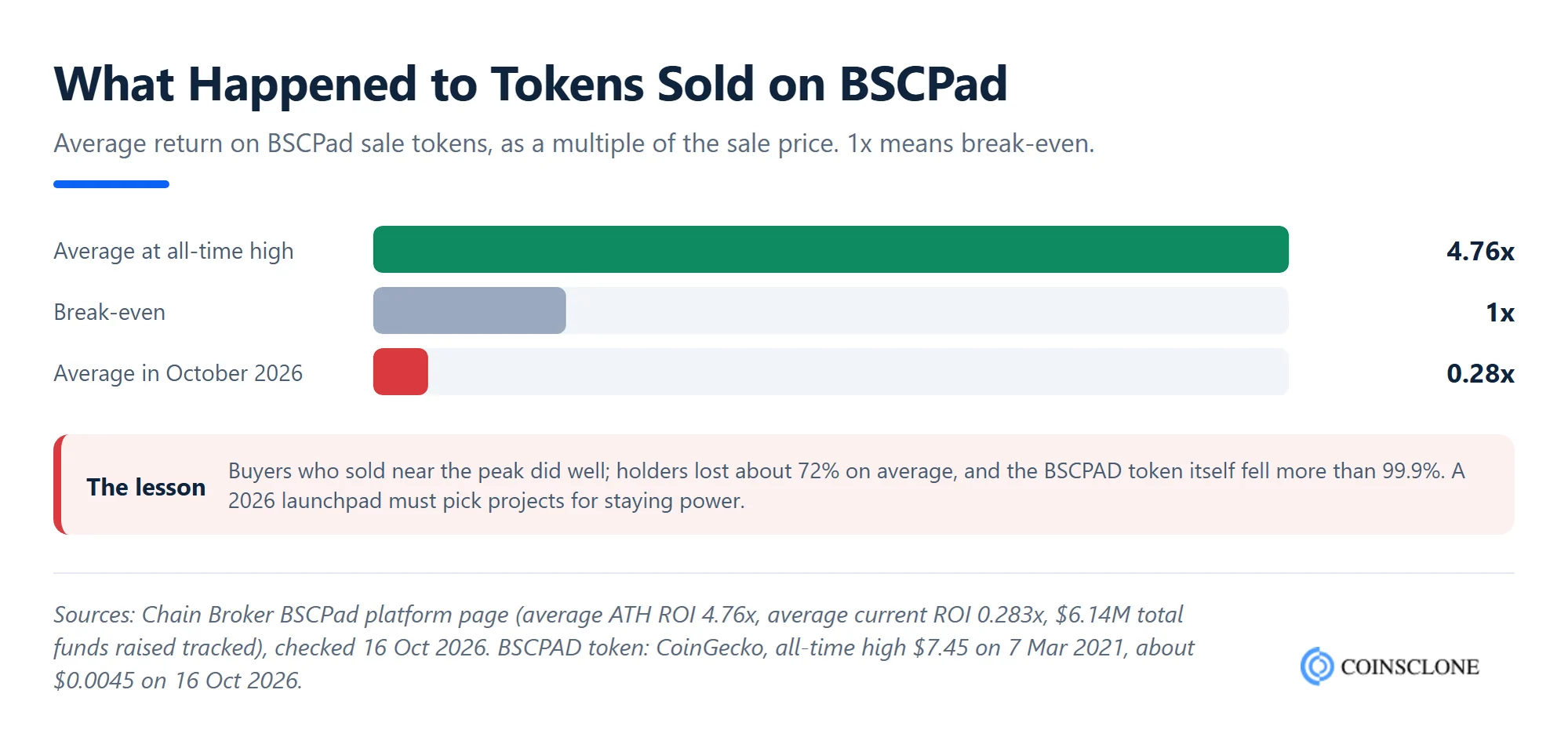
So why build a BSCPad clone at all? Because the launchpad model itself is still alive. Launchpad apps earned more than $1 billion in fees over the past 12 months, according to DefiLlama. What faded was the 2021 recipe: many small hype sales, access tied to one platform token, and too little care about what happened after listing. Your clone should keep the parts users liked and fix the parts that let the original fade.
Why Would You Create an IDO Platform Like BSCPad?
BSCPad’s rise showed how much demand there is for fair, simple token sales. Its fall showed what to avoid. Here are the main reasons founders still build a platform like it in 2026:
- Projects still need to raise money. New tokens need early buyers, a community and liquidity. A launchpad gives them all three in one event.
- BNB Chain is still busy. Fees are low and transactions are fast, so small buyers can join a sale without losing much to gas. That made BSCPad possible, and it still holds today.
- Fair access sells. BSCPad’s lottery gave small holders a real chance, while its guaranteed tiers rewarded big stakers. Buyers still look for that balance.
- Several income streams. A launchpad earns from listing fees, a share of each raise, project tokens and demand for its own token.
- A proven playbook. Tier staking, lotteries, FCFS rounds and vesting are well tested, so you do not have to invent the rules.
There are many ways to build a BSCPad-like platform, but most startups prefer a method that has already worked in real projects. That is why a BSCPad clone script is often the first choice. Coinsclone helps you build an IDO platform like BSCPad using its BSCPad clone script, and the sections below show how it works.
How the BSCPad Model Worked
BSCPad’s rules are simple, which is why so many launchpads copied them. These are the parts a clone script copies.
Six Tiers
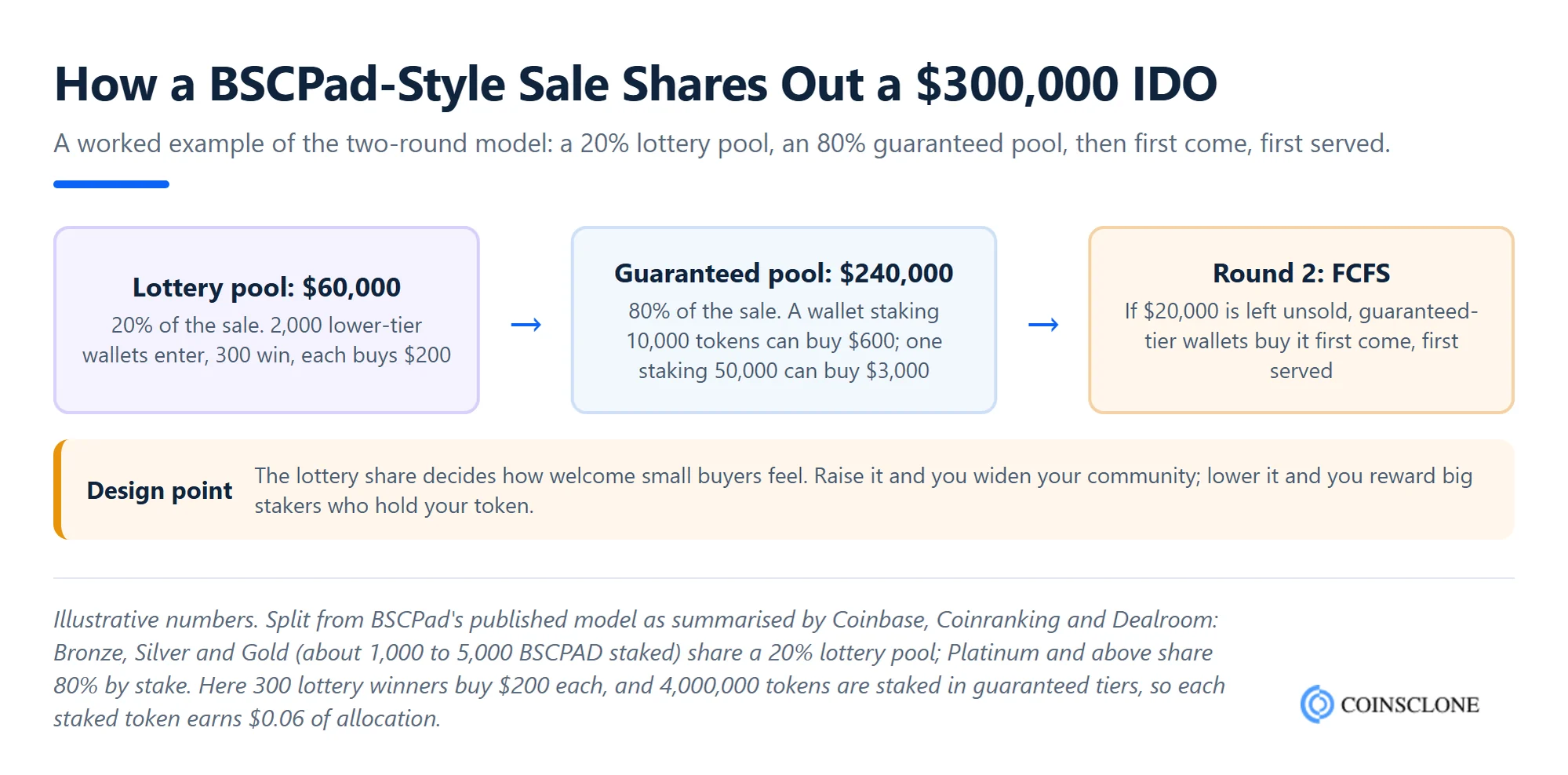
BSCPad used six tiers: Bronze, Silver, Gold, Platinum, Diamond and Blue Diamond. Users reached a tier by staking BSCPAD. The three lower tiers, from about 1,000 to 5,000 BSCPAD staked, were lottery tiers. Platinum and above were guaranteed tiers.
The 20% Lottery and 80% Guaranteed Split
Each sale was split into two pools. 20% of the tokens went to a lottery for Bronze, Silver and Gold stakers, and the winners could buy a fixed amount. The other 80% went to the guaranteed tiers, shared by how much each wallet had staked. This split is BSCPad’s best-known device. It gave small holders a fair chance without starving the big stakers who kept the token in demand.
KYC and Staking Deadlines
Buyers passed a one-time KYC check. They also had to stake before a cut-off, at least three hours before each sale, so that last-minute stakers could not game the pools.
Round 2: First Come, First Served
Tokens left unsold in the first round moved to an FCFS round. This round was open to guaranteed-tier holders (Platinum and above), and it ran until every token was sold.
How Does the BSCPad Clone Script Work?
A BSCPad clone script serves two groups: the project teams that raise money and the investors who buy tokens. Our BSCPad clone script guides both through each step. Here is the work process for each.
For the crypto project team:
- Apply: The team submits its details, such as the project name, chain, token plan, team, whitepaper and raise target.
- Review: The admin team checks the project, the team’s identity, the token contract and the audit.
- Set up the sale: The admin sets the price, the hard cap, the lottery and guaranteed pool sizes, the vesting schedule and the payment token.
- Go live: The project page goes live with its whitepaper, links and sale dates. After the sale, funds go to the project, and part of them can seed a locked liquidity pool on a DEX.
For investors:
- Stake for a tier: Investors stake the platform token before the cut-off and pass KYC once.
- Enter the sale: Lottery-tier wallets enter the draw, and guaranteed-tier wallets see their allocation.
- Buy in round 1: Lottery winners and guaranteed wallets buy their share during the allocation round.
- Buy in round 2: If tokens remain, eligible wallets buy them first come, first served.
- Claim: Tokens unlock on the vesting schedule, and investors claim them from their dashboard.
This flow gives you a clear picture of how the BSCPad clone software works. Next, let us see what still works in this model, and what does not.
What Works in the BSCPad Model in 2026
The launchpad market looks very different from the IDO boom of 2021. CryptoRank counted 533 public token sales in 2025, and only about 12% traded above their sale price by the end of the year. Meanwhile, big sales have moved to exchanges. Coinbase paid about $375 million for the sale platform Echo in October 2025, and its first sale, for Monad, drew $269 million from 85,820 buyers. Kraken Launch now runs sales with Legion.
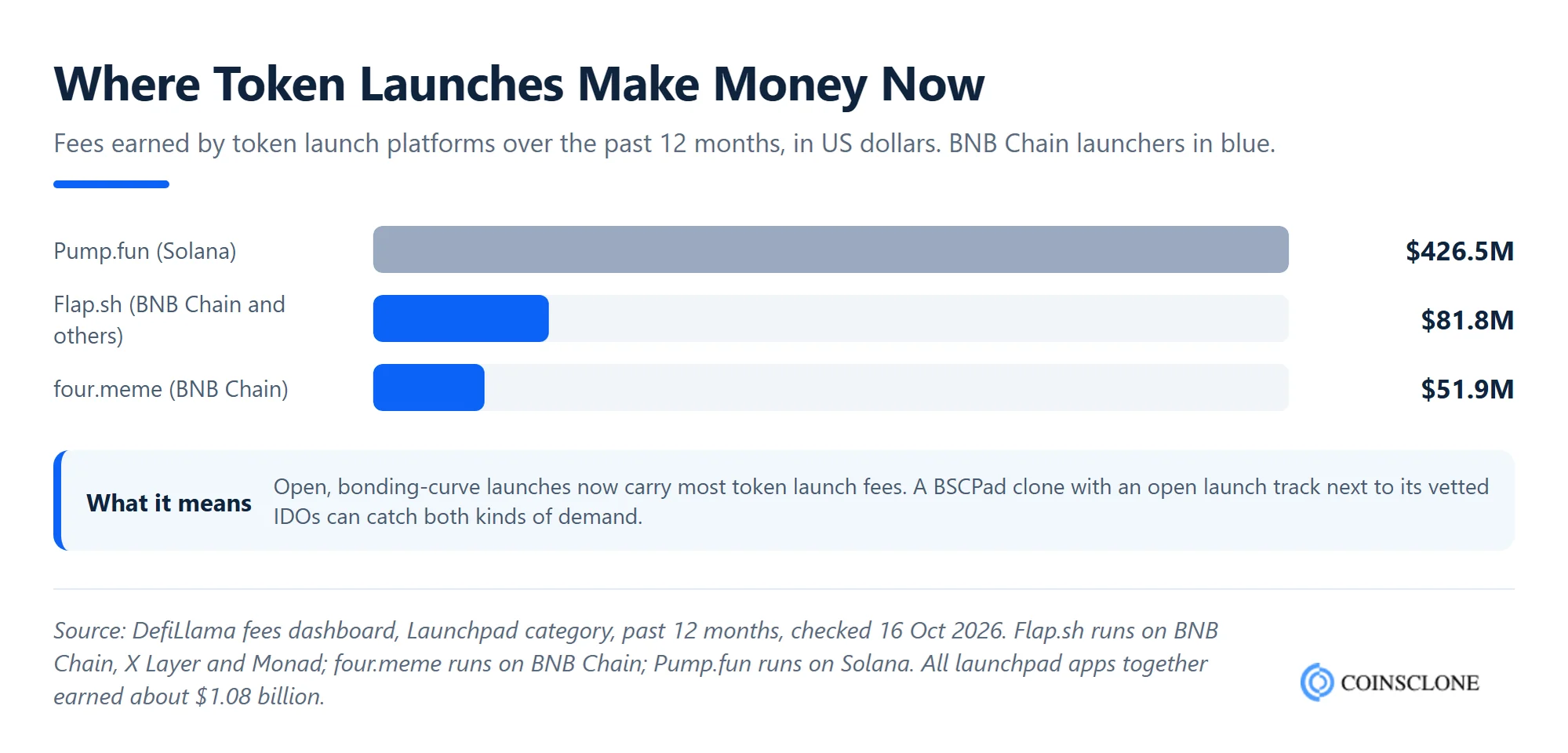
On BNB Chain itself, much of the launch activity has moved to open, bonding-curve launchers. Over the past 12 months, Flap.sh earned about $82 million in fees and four.meme about $52 million, according to DefiLlama. On Solana, Pump.fun earned more than $400 million.
So, here is what to keep, change and add.
Keep:
- The lottery and guaranteed split. It is still one of the fairest ways to share a popular sale.
- Staking cut-offs and KYC. They stop last-minute gaming and keep your platform on the right side of the rules.
- Vesting and liquidity locks. They stop teams and early buyers from dumping on day one.
Change:
- Do not make the platform token the only way in. When BSCPAD fell, tiers lost their pull. Add scores based on wallet history, as Legion and Binance Alpha do, or tiers based on stablecoin deposits.
- List fewer, better projects. One good sale a month beats ten weak ones. Coinbase runs about one sale a month.
- Stop multi-wallet gaming. Lotteries break when one person splits funds across many wallets. Tie entries to KYC and add sybil checks.
Add:
- Lockups for project teams, such as the six-month issuer lockup Coinbase requires.
- Refund windows, so buyers can get their money back if a token lists far below its sale price.
- An open launch track for small tokens next to a vetted track for larger raises, so you also catch the demand that goes to bonding-curve launchers today.
Diverse Blockchain Networks Supported in BSCPad Clone
Blockchains play a major role in any decentralized platform. The BSCPad clone script runs on BNB Chain by default, but it has multichain support, so it can run sales on other networks too. BSCPad itself moved in this direction when it built TronPad for TRON.
The blockchains our BSCPad clone script supports include:
- BNB Chain: low fees and the home of the original BSCPad.
- Ethereum: the largest DeFi market and the widest wallet support.
- Base and Arbitrum: low-cost Ethereum layer 2 networks with fast-growing user bases.
- Polygon: cheap transactions and strong gaming and payments projects.
- Solana: very fast sales and the busiest token launch market today.
- Tron: large stablecoin flows, using TRC-20 tokens.
Many teams start on one chain to launch faster, then add more as their users ask for them. Let us now see the features that keep investors engaged from the first stake to the final claim.
Features of the BSCPad Clone Script
Features are what convince projects and investors to choose your platform over others. A good BSCPad clone script includes the following.
Investor Features
- Multi-tier staking: Stake the platform token to reach one of several tiers, with the lottery and guaranteed rules you choose.
- Lottery entry: Lower tiers enter a fair, on-chain draw for a share of each sale.
- Guaranteed and FCFS rounds: Buy a fixed allocation first, then extra amounts if tokens remain.
- Multiple wallets: Connect MetaMask, Trust Wallet, WalletConnect, Phantom and others.
- Claim dashboard: Track vesting and claim unlocked tokens in one place.
- Diverse staking modules: Flexible and locked staking, LP token staking and reward pools.
Project Features
- Project application form with token details, team details and audit uploads.
- Sale setup: price, hard cap, soft cap, payment token, pool sizes and dates.
- Vesting builder: cliffs, monthly unlocks and the share released at listing.
- Liquidity pool lock: lock part of the raise in a DEX pool, such as PancakeSwap, for a set time.
Admin Features
- Project review queue with KYC and KYB checks.
- Tier settings: stake amounts, lottery and guaranteed pool shares, and staking cut-offs.
- Fee settings: listing fees, raise commission and token share.
- Country blocks and per-sale buyer rules.
- Analytics: sign-ups, stakers, raise totals and claim rates.
Advantages of Our BSCPad Clone Script
A BSCPad clone script gives you a tested base, so you can focus on projects, users and growth. Here are its main advantages.
Cost-effective
A clone script costs far less than a full custom build, because the core contracts, screens and admin tools already exist. You pay for branding, changes and audits, not for every line of code.
Customizable
You can change the tiers, the lottery share, the fees, the chains and the design, and add new modules such as refunds, NFT sales or a DAO as your business grows.
Time Effective
A white label BSCPad-style launchpad can go live in about 5 to 7 weeks, and a standard custom build in 10 to 14 weeks. A build from scratch often takes several months. You do not need your own blockchain team to run it, since the package comes ready to deploy.
Proven Sale Mechanics
Tiers, lotteries, FCFS rounds and vesting have already been tested by real users in real sales. As a result, you start with rules that buyers already understand.
Security for a BSCPad Clone
A launchpad holds other people’s money for hours or days, so attackers watch it closely. Stolen keys now do even more damage than code bugs. DefiLlama’s hack tracker logged 285 attacks worth $2.24 billion from January to 1 October 2026, and stolen keys alone caused $704 million of that.
A BSCPad-style platform also has risks of its own. Because of this, your clone should include these safety layers:
- Fair randomness for the lottery. Use a verifiable random source, such as Chainlink VRF, so no one can predict or rig the draw.
- Sybil checks. Tie lottery entries to KYC so one person cannot enter with hundreds of wallets.
- Caller checks on every function that moves tokens or changes stake data.
- Outside audits of the staking, lottery, sale and vesting contracts, plus a re-audit after every change.
- Multisig wallets for the treasury and admin keys, with time delays on big changes.
- Bot protection on the website and APIs, especially for FCFS rounds.
How a BSCPad-Style Launchpad Makes Money
A launchpad earns from both sides of every sale. These are the common revenue models:
| Model | How it works |
| Listing fees | Projects pay for a launch slot |
| Raise commission | You take a share of the funds each sale raises |
| Token allocation | You receive a small share of the project’s tokens |
| Tier token demand | Investors buy and stake your token to reach higher tiers |
| Staking rewards | You keep a share of the rewards from staking pools |
| Featured placement | Projects pay for premium promotion |
| Advisory services | Token design and launch advice alongside the listing |
Plan for at least three of these. If your only income is demand for your own token, your business falls with it, as BSCPad’s did.
Rules to Plan For in 2026
Token sales can count as securities offerings, and running sales for others can make your platform a regulated business. Here is the 2026 picture in the two biggest markets:
- European Union: Under MiCA, placing tokens for a project is a regulated crypto service, so an EU launchpad usually needs a CASP licence. The transition period for older firms ended on 1 July 2026.
- United States: On 18 August 2026, the SEC proposed Regulation Crypto Assets. It would let startups raise up to $5 million over four years. It is still a proposal, with comments open until 20 October 2026.
- Everywhere: Plan for KYC and anti-money laundering checks, country blocks and clear terms of use. A lottery for token sales can also raise local gambling questions, so ask your lawyer about it.
In practice, build these checks into the platform and let each project’s lawyers decide who may buy.
How to Build a BSCPad Clone: Steps and Timeline
Here is the usual path from idea to first sale:
- Pick your niche: one chain, one sector (such as gaming or AI) or one buyer group.
- Design your tiers and sale rules: stake amounts, lottery share, FCFS rules, vesting and refunds.
- Brand and adjust the script: UI, chains, wallets and admin tools.
- Audit the contracts: staking, lottery, sale and vesting, with fixes and a re-audit.
- Test on a testnet: run mock sales with real users and load tests for busy sale days.
- Set up legal and KYC: terms, country blocks and an identity check provider.
- Launch on mainnet: start with one or two strong projects and grow from there.
| Option | What you get | Typical build time |
| White label BSCPad clone | Your brand, standard tiers and lottery, one chain | 5 to 7 weeks |
| Standard custom launchpad | Custom tiers, vesting, project vetting, audit | 10 to 14 weeks |
| Launchpad with governance | Community listing votes, advanced tiers, analytics | 4 to 6 months |
| Multi-chain launchpad | Several chains, cross-chain sales, full project tools | 6 to 10 months |
These times come from Coinsclone’s own crypto launchpad development work. Audits, tier design, load tests and legal review usually decide the final date. For a full walk-through, see our guide on how to create a crypto launchpad.
Cost of a BSCPad Clone Script
There is no single price, because the cost depends on your chains, features and audit scope. The main cost drivers are:
- The number of chains and wallets
- Custom tier, lottery and vesting logic
- Outside smart contract audits
- KYC and compliance tools
- Design, hosting and support after launch
As a guide, published 2026 agency cost guides put a white label launchpad at roughly $20,000 to $50,000 and a custom build at about $100,000 to $300,000. Audits are a large share of that. Sherlock’s 2026 audit pricing guide puts mid-level DeFi code at $40,000 to $100,000, with each re-audit round adding $5,000 to $20,000.
You will also need a platform token if you want tier staking. If you do, our guide to the cost to create a BEP20 token breaks down that budget.
Other Launchpad Clone Scripts to Compare
BSCPad is one of several launchpad models. If you are still choosing, compare it with these:
- TrustPad clone script: a multi-chain IDO launchpad known for its refund policy.
- Polkastarter clone script: a multi-chain IDO platform with allowlist sales.
- DAO Maker clone script: a launchpad built around strong holder offerings and staking.
- Pump.fun clone script: an open meme token launcher with a bonding curve.
Why Choose Coinsclone for the BSCPad Clone Script?
Coinsclone is a leading crypto launchpad development company that provides an ideal BSCPad clone script with advanced features to launch your business. Since 2018, we have delivered 350+ platforms for 200+ clients across 20 industries. We study current market trends and shape your launch plan around them.
Our team covers UI/UX design, tier and lottery logic, sale and vesting contracts, audits, liquidity setup and support after launch. You own the code and the contracts, deployed under your own keys. If you plan to run DEX-based sales, our IDO development team can build that track too. Talk to us and launch your IDO platform like BSCPad with confidence.
See How Our MVP System Can Launch Your BSCPad-Like Platform Faster
BSCPad Clone Script — built for next-gen token launches.
- MVP System:Launch your BSCPad-style IDO platform 90% faster.
- Multi-Tier Staking:Enable fair and transparent token allocations for all investors.
- Smart Contracts:Pre-audited, secure, and fully customizable on Binance Smart Chain.
- Branding & Customization:Your design, your tokens, your launchpad identity.
- Revenue Engine:Earn from token listings, staking pools, and project launches.
See a free branded demo of your BSCPad-like platform in 48 hours — before you invest a cent.
Book a Free Demo to discover how our BSCPad Clone Script can take you from idea to live IDO launchpad in just 2–4 weeks.
Frequently Asked Questions
What is a BSCPad clone script?
A BSCPad clone script is ready-made software for launching an IDO launchpad like BSCPad. It includes tier staking, KYC, project listings, lottery and guaranteed rounds, FCFS sales, vesting and claims, and an admin panel. You can rebrand it and change its features, chains and fees before launch.
How much does it cost to build a BSCPad clone?
Published 2026 agency cost guides put a white label launchpad at roughly $20,000 to $50,000 and a custom build at $100,000 to $300,000. Outside audits often add $40,000 to $100,000. The final price depends on your chains, features and audit scope.
How long does development take?
A white label BSCPad clone can go live in about 5 to 7 weeks, and a standard custom launchpad in about 10 to 14 weeks. Adding governance or several chains can stretch that to 4 to 10 months.
Can I add multi-chain support from day one?
Yes. The script can run sales on BNB Chain, Ethereum, Base, Arbitrum, Polygon, Solana and Tron. Still, many teams launch on one chain first, because each extra chain adds contracts to audit and liquidity to manage.
Do I need my own token?
Not always. BSCPad used its own token for tier staking, and that is still the most common setup. However, you can also base tiers on stablecoin deposits or wallet history scores, which keeps your platform working even if your token price falls.
Can I add my own tokenomics and vesting rules?
Yes. You can set the lottery and guaranteed pool shares, stake amounts, staking cut-offs, vesting cliffs, monthly unlocks and the share released at listing. The vesting contract enforces each schedule, so no one can claim early.
Is a BSCPad clone secure enough for a real IDO?
It can be, if you treat security as part of the build. Insist on outside audits, a verifiable random source for the lottery, multisig wallets for the treasury and admin keys, and bot protection for FCFS rounds.
Can I integrate KYC and AML into the platform?
Yes. The script connects to identity check providers, so buyers pass KYC once before staking. You can also add anti-money laundering screening, country blocks and per-sale buyer rules.