
A Polkastarter clone script is ready-made software for launching your own IDO platform, the kind of launchpad where new crypto projects sell tokens to early backers before the token trades on an exchange. It copies the model Polkastarter made famous in 2021: users hold or stake a platform token, earn tickets for an allowlist, and then buy in a guaranteed round and a first come, first served round. This guide explains what the script includes, how Polkastarter’s sales really work, and where Polkastarter stands in October 2026.
You will also learn what still works in this model today, the features and safety layers to insist on, how the platform earns money, the 2026 rules for token sales, and the time and budget a launch takes. By the end, you will know how to build a Polkastarter-style launchpad that keeps backers safe and keeps good projects coming back.
In this guide:
- Polkastarter’s real status in 2026: it now leads with a shop for rare cards and games, and its last known IDO was in late 2025.
- How POLS Power tiers, allowlist tickets and sale rounds work, with a real sale timeline.
- What to keep, change and add when you copy the model today.
- Features, revenue models, security lessons and the 2026 rules in the EU and the US.
- Build steps, Coinsclone’s launch timelines and real market cost ranges.
See How Our MVP System Can Launch Your IDO Platform Faster
Polkastarter Clone Script — Multi-Chain IDO Platform Development.
- MVP System : Launch your Polkastarter-like IDO launchpad 90% faster.
- Launchpad Ready : Built-in token sales, whitelisting, and liquidity locking modules
- Brand & Customization : Your design, your tokens, your governance structure.
- Revenue Engine : Earn from token sale fees, staking, and launch commissions.
Get a free branded demo of your Polkastarter-like platform in just 48 hours — before you invest a cent.
Book a Free Demo to discover how our Polkastarter Clone Script can take you from concept to a live multi-chain IDO launchpad in just 8–12 weeks.
What Is a Polkastarter Clone Script?
A Polkastarter clone script is pre-built launchpad software that copies the core features of Polkastarter. It covers wallet connection, project listings, tier staking, allowlist draws, fixed-price token sales, vesting and claims, and an admin panel, all running on audited smart contracts. You can shape the design, tiers, fees, chains and sale rules around your own brand.
In short, you start from a working base instead of a blank page. That cuts build time and cost compared with writing every contract and screen from scratch. Many founders use it to start an IDO platform in weeks rather than months.
However, a clone script is a starting point, not a finished business. You still need an outside audit, a plan to find good projects and a legal review before your first sale. Before going deeper, let us look at the platform you are copying.
What Is Polkastarter?
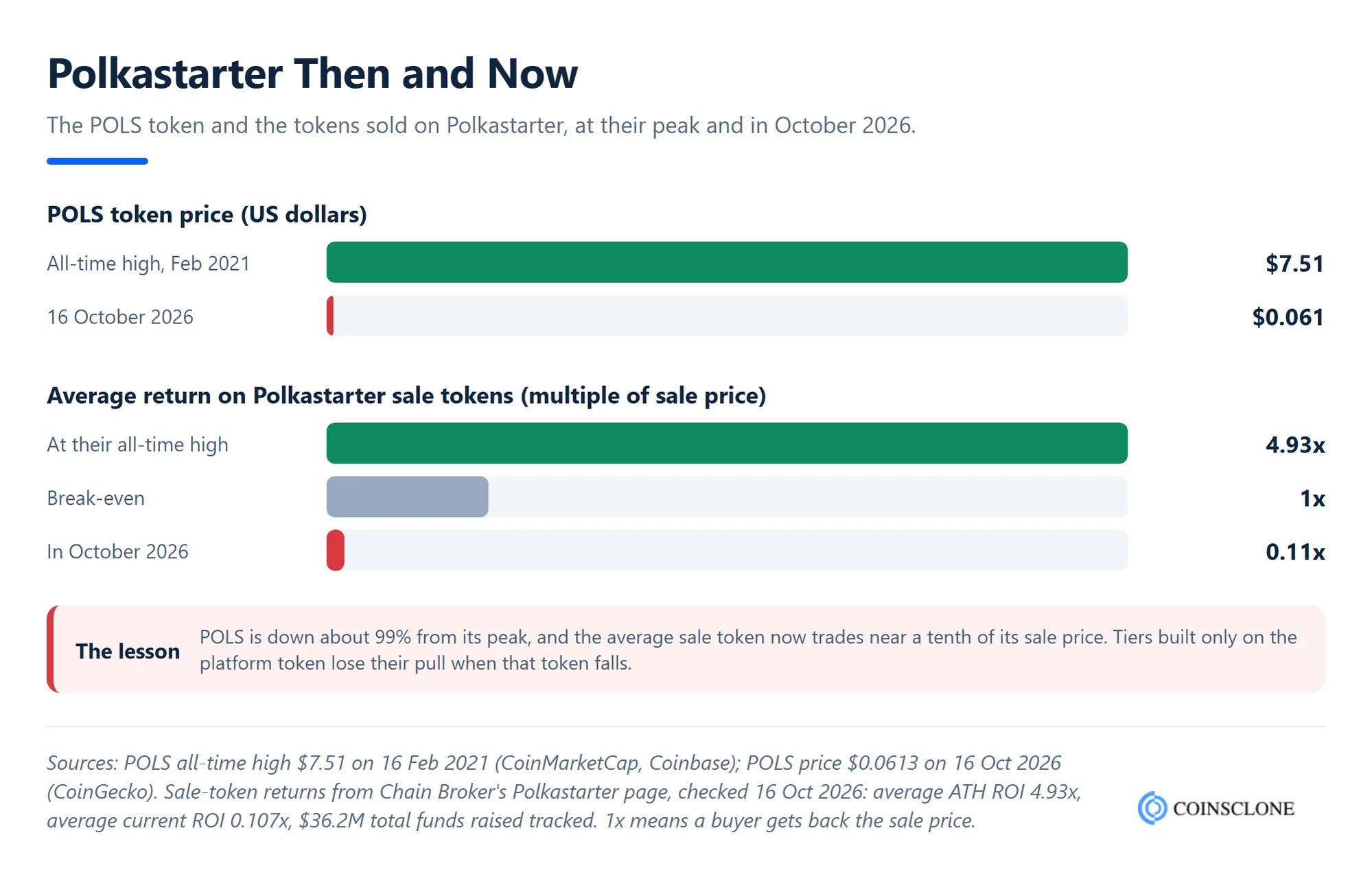
Polkastarter is an open fundraising platform where new blockchain projects raise money from their users. Daniel Stockhaus, Tiago Martins and Miguel Leite founded it in 2020, and the protocol went live in December 2020. Its POLS token reached an all-time high of $7.51 on 16 February 2021, at the height of the IDO boom.
Despite the name, Polkastarter is not a Polkadot chain. Its sales run on EVM networks such as Ethereum and BNB Chain, and many clone vendors still describe it wrongly. Each sale uses a fixed swap pool: according to the Polkastarter docs, the token price stays the same until the pool sells out.
Projects do not list themselves. According to Polkastarter’s launch page, a project applies through its Governance Portal. Then the Research team checks the project, interviews the team, and passes the best ones to the DAO Council for a final vote. Approved projects get help with token design, marketing, audits, market makers, exchange listings and meetings with backers. Teams that are not ready yet can join an accelerator run with Poolside that offers up to $100,000 in early funding.
Is Polkastarter Still Running in 2026?
Yes, but the launchpad is no longer its main product. Here is what we found on 16 October 2026:
- The site now leads with collectibles. The Polkastarter homepage asks users to “discover, collect and trade” cards, video games and other rare items, with mystery packs and on-chain escrow. Its recent blog posts are all about Pokémon card prices.
- IDOs still exist, but they are rare. The “Apply for IDO” page and the POLS Power tiers are still live. The last sale we could confirm was Helios on 19 December 2025, and we found no IDO in 2026. The homepage shows recent raises of only $50,000 to $150,000 each.
- Staking has moved. A September 2026 Securities.io review says POLS staking moved to Base on 13 August 2026, with rewards paid in MINT tokens and points for the shop.
- The token is down about 99%. CoinGecko lists POLS at about $0.061, with a market cap near $6.1 million.
The tokens sold on Polkastarter tell the same story. Chain Broker tracks $36.2 million raised across its sales. On average, those tokens peaked at 4.93 times their sale price, but today they trade at about 0.11 times.
So why build a Polkastarter clone at all? Because the launchpad model itself is still alive. Launchpad apps earned about $1.04 billion in fees over the past 12 months, according to DefiLlama. What faded was the 2021 recipe: many small hype sales, access tied to one platform token, and weak follow-through after listing. Your clone should keep the parts users liked and fix the parts that made the original shift its focus.
How the Polkastarter Model Works
Polkastarter’s sale rules are public, so they make a good blueprint. These are the parts a clone script copies.
POLS Power and Tiers
Users build POLS Power by holding POLS, staking it, or adding POLS liquidity on Uniswap or PancakeSwap. Staked POLS counts at once but stays locked for 7 days. According to the Polkastarter dashboard, POLS Power decides the tier:
| Tier | POLS Power needed | Extra perks |
| Bronze | 1,000+ | Allowlist tickets |
| Silver | 3,000+ | More tickets |
| Gold | 10,000+ | More tickets |
| Platinum | 30,000+ | No cooldown between sales |
| Diamond | 50,000+ | No cooldown, guaranteed allowlist spot |
Allowlist Tickets
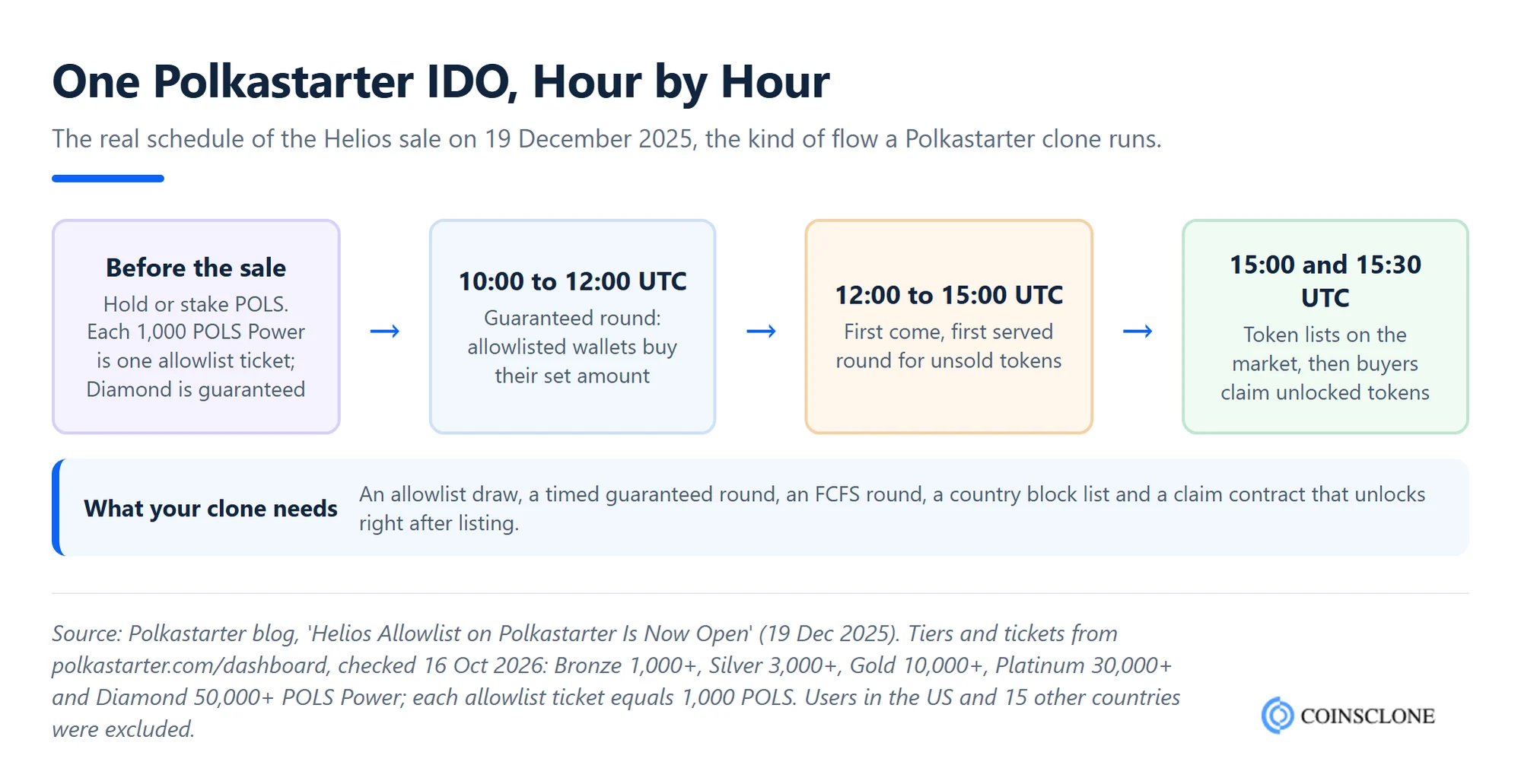
For each sale, users apply for the allowlist. Each 1,000 POLS counts as one ticket, and applying does not spend any POLS. A draw then picks the winners, so more tickets mean better odds. Polkastarter shows the average odds per tier from recent sales, but it does not promise a spot below Diamond.
Sale Rounds and Claims
On sale day, allowlisted wallets buy in a guaranteed round. After that, any unsold tokens go to a first come, first served (FCFS) round. Once the token lists on the market, buyers claim their tokens on the vesting schedule. Sales also block certain countries; the Helios sale, for example, excluded the US and 15 other countries.
Working Process of Polkastarter Clone Script
To understand how our Polkastarter clone works, let us first see how a user joins an IDO token sale on Polkastarter.
- Connect a wallet: The user visits the platform and connects a wallet, which is the first step in any decentralized platform. The wallet must be on the right network for the IDO project.
- Pick a project: The dashboard lists upcoming and live projects. The user checks each project’s network and makes sure the wallet holds enough crypto to buy.
- Join the allowlist: Before buying, the user applies for the allowlist. The chance of getting in depends on the user’s POLS Power.
- Join the sale: Once allowlisted, the user clicks “join sale” and enters the amount of crypto to spend.
- Claim the tokens: Finally, the user claims the tokens and sees them in the wallet.
Secondly, if project owners want to raise funds through Polkastarter, they follow these steps.
- Apply to raise: The project team applies through the “Launch with Polkastarter” page.
- Due diligence: The Research team reviews the project and interviews the team.
- Council vote: Selected projects go to the DAO Council, which makes the final decision.
- Pre-raise support: Once approved, the team helps with marketing, messages, community and design, and sets the IDO date.
The Polkastarter clone script follows the same working style, so your platform runs all these steps too. You can also swap the DAO Council for an in-house review team, or add a community vote later. Next up, let us see what still works in this model in 2026.
What Works in the Polkastarter Model in 2026
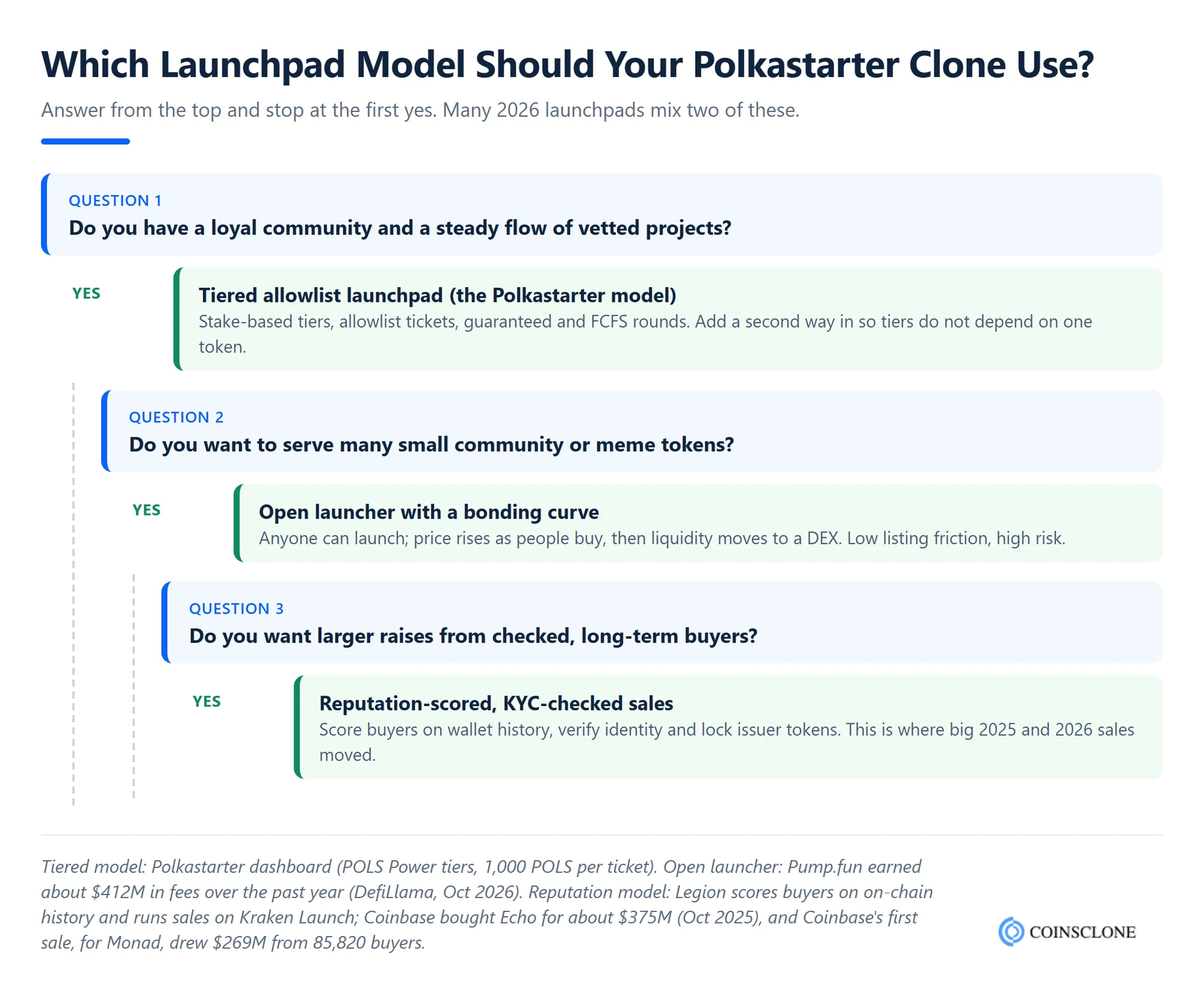
The launchpad market looks very different from the IDO boom of 2021. CryptoRank counted 533 public token sales in 2025, and only about 12% traded above their sale price by the end of the year. Meanwhile, big sales have moved to exchanges. Coinbase paid about $375 million for the sale platform Echo in October 2025, and its first sale, for Monad, drew $269 million from 85,820 buyers. Kraken Launch now runs sales with Legion.
Older tiered pads such as Polkastarter and DAO Maker still operate, but they run far fewer sales than they did. So, here is what to keep, change and add.
Keep:
- Council-style project review. Polkastarter’s research, interview and council steps are why its brand lasted. Good vetting is still your best marketing.
- Allowlist tickets with a sure spot for the top tier. Buyers like a fair draw, and big holders like a sure spot.
- Guaranteed and FCFS rounds. Two rounds sell out more sales without leaving tokens unsold.
Change:
- Do not make the platform token the only way in. When POLS fell, holding it for access lost its pull. Add scores based on wallet history, as Legion and Binance Alpha do, or access based on stablecoin deposits.
- List fewer, better projects. One good sale a month beats ten weak ones. Coinbase runs about one sale a month.
- Stop multi-wallet gaming. Ticket draws break when one person splits funds across many wallets. Add KYC, sybil checks or rules that reward long-term holders.
Add:
- Refund windows and lockups for project teams, such as the six-month issuer lockup Coinbase requires.
- Compliance tools: country blocks, investor checks and per-sale rules.
- A second product line. Polkastarter itself added a shop for rare cards and games. Your clone can add NFT sales, staking or an open launch track for small tokens. Open launchers such as Pump.fun earned about $412 million in fees over the past year.
Core Features of our Polkastarter Clone Software
Features can have a massive impact on a business, and the Polkastarter clone script is no different. Apart from the changes you can make, here are the core features that come with our software.
Investor Features
- Multi-chain support: Run sales on Ethereum, BNB Chain, Base, Polygon and more, and add chains as users ask.
- Wallet connect: Connect MetaMask, WalletConnect, Trust Wallet, Coinbase Wallet and others in one click.
- IDO dashboard: Browse upcoming, live and finished sales with raise size, price, vesting and dates.
- Tier staking: Stake the platform token, or LP tokens from a liquidity pool, to build power and reach a tier.
- Allowlist draw: Apply for each sale and win a spot by ticket draw, with a guaranteed spot for top tiers.
- Guaranteed and FCFS rounds: Buy a set amount first, then extra amounts if tokens remain.
- Claim dashboard: Track vesting and claim unlocked tokens in one place.
Project Features
- Launch with us: An application form for token details, team details, audits and raise goals.
- Sale setup: Price, hard cap, payment token, rounds, dates and country blocks.
- Vesting builder: Cliffs, monthly unlocks and the share released at listing.
- Liquidity lock: Lock part of the raise in a DEX pool for a set time.
- Community pages: Project pages with links, socials and updates so backers can explore each team.
Admin Features
- Review queue with due diligence notes, KYC and KYB checks, and council or community votes.
- Tier and ticket settings for every level, cooldown and staking period.
- Fee settings: listing fees, raise commission and token share.
- Analytics: sign-ups, stakers, allowlist entries, raise totals and claim rates.
All these features have their own purpose, and together they help you run a launchpad that both projects and backers trust.
Business Benefits of our Polkastarter Clone Script
Our Polkastarter clone script brings a range of business benefits, and founders should know them before they choose. Here are the main ones.
- Customizable features: Change the tiers, rounds, fees, chains and design to fit your brand.
- Time saving: The core contracts, screens and admin tools already exist, so you launch sooner.
- Cost-effective: You pay for branding, changes and audits, not for every line of code.
- Fast launch cycle: A white label launchpad can go live in about 5 to 7 weeks.
- Brand and community growth: Every sale brings new users to your platform and your token.
- Decentralized by design: Funds move through smart contracts, and backers keep their own wallets.
- Less effort: Proven sale rules mean less design work and fewer surprises on sale day.
These benefits are why many founders pick a clone script over a full build. Having explained them, let us see how the platform earns money.
How a Polkastarter-Style Launchpad Makes Money
A launchpad earns from both sides of every sale. These are the common revenue models:
| Model | How it works |
| Listing fees | Projects pay for a launch slot |
| Raise commission | You take a share of the funds each sale raises |
| Token allocation | You receive a small share of the project’s tokens |
| Tier token demand | Backers buy and stake your token to reach higher tiers |
| Featured placement | Projects pay for premium promotion |
| Launch services | Tokenomics, marketing and listing help alongside the sale |
| Second product line | Shop or NFT sale fees, as Polkastarter added with rare cards and games |
Plan for at least three of these. If your only income is demand for your own token, your business rises and falls with it.
Security Lessons for a Polkastarter Clone
A launchpad holds other people’s money for hours or days, so attackers watch it closely. Stolen keys now do even more damage than code bugs. DefiLlama’s hack tracker logged 285 attacks worth $2.24 billion this year to 1 October 2026, and stolen keys alone caused $704 million of that.
A Polkastarter clone should include these safety layers:
- Caller checks on every function that moves tokens or changes stake data.
- Outside audits of the staking, pool, vesting and claim contracts, plus a re-audit after every change.
- Multisig wallets for the treasury and admin keys, with time delays on big changes.
- Rate limits and bot protection on the website and APIs, since FCFS rounds draw bots.
- Phishing guards: fake allowlist links are common, so publish one official sale page and warn users often.
- A bug bounty and a public incident plan. Polkastarter itself runs a bounty on Immunefi.
Rules to Plan For in 2026
Token sales can count as securities, and running sales for others can bring your platform under financial rules. Here is the 2026 picture in the two biggest markets:
- European Union: Under MiCA, placing tokens for a project is a regulated crypto service, so an EU launchpad usually needs a CASP licence. The transition period for older firms ended on 1 July 2026.
- United States: On 18 August 2026, the SEC proposed Regulation Crypto Assets. It would let startups raise up to $5 million over four years. It is still a proposal, with comments open until 20 October 2026.
- Everywhere: Plan for KYC and money laundering checks, country blocks and clear terms of use. Polkastarter’s own sales block the US and 15 other countries.
In practice, build these checks into the platform and let each project’s lawyers decide who may buy.
How to Build a Polkastarter Clone: Steps and Timeline
Here is the usual path from idea to first sale:
- Pick your niche: one chain, one sector (such as gaming or AI) or one buyer group.
- Design your tiers and sale rules: power levels, tickets, cooldowns, rounds, refunds and vesting.
- Set up project review: due diligence steps, interview checklists and who makes the final call.
- Brand and adjust the script: UI, chains, wallets and admin tools.
- Audit the contracts: staking, pool, vesting and claim, with fixes and a re-audit.
- Test on a testnet: run mock sales with real users and load tests for busy FCFS rounds.
- Set up legal and KYC: terms, country blocks and an identity check provider.
- Launch on mainnet: start with one or two strong projects and grow from there.
| Option | What you get | Typical build time |
| White label Polkastarter clone | Your brand, standard tiers, one chain | 5 to 7 weeks |
| Standard custom launchpad | Custom tiers, allowlist draw, project review, audit | 10 to 14 weeks |
| Launchpad with governance | Council or community votes, advanced tiers, analytics | 4 to 6 months |
| Multi-chain launchpad | Several chains, cross-chain sales, full project tools | 6 to 10 months |
These times come from Coinsclone’s own crypto launchpad development work. Audits, tier design, load tests and legal review usually decide the final date. For a full walk-through, see our guide on how to create a crypto launchpad.
Cost of our Polkastarter Clone Software
There are plenty of ways to build an IDO platform like Polkastarter, and the cost depends on the route you pick. A clone script usually costs the least, because the core is already built and tested. The main cost drivers are:
- The number of chains and wallets
- Custom tier, ticket and vesting logic
- Outside smart contract audits
- KYC and compliance tools
- Design, hosting and support after launch
As a guide, published 2026 agency cost guides put a white label launchpad at roughly $20,000 to $50,000 and a custom build at about $100,000 to $300,000. Audits are a large share of that. Sherlock’s 2026 audit pricing guide puts mid-level DeFi code at $40,000 to $100,000, with each re-audit round adding $5,000 to $20,000.
Time matters as much as money. A white label clone can launch in about 5 to 7 weeks, while a custom build takes 10 to 14 weeks or more. That is why most startups start with a clone script and add custom parts as they grow.
Create an IDO Platform Identical to Polkstarter Instantly
Cost-effective, White-Label Solution, Premium Features, Customizable. Live Demo Available.
Other Launchpad Clone Scripts to Compare
Polkastarter is one of several launchpad models. If you are still choosing, compare it with these:
- TrustPad clone script: a multi-chain IDO launchpad with staking periods and refund windows.
- DAO Maker clone script: a launchpad built around strong holder offerings and staking.
- BSCPad clone script: a BNB Chain IDO launchpad with a tier system.
- Pump.fun clone script: an open meme token launcher with a bonding curve.
Final Thoughts
Overall, we have explained why startups can build an IDO platform with a clone script, and what has to change for 2026. If you are a founder with plans for an IDO platform, the next step is to take a demo of our Polkastarter clone script.
Coinsclone is a trusted crypto launchpad development company. Since 2018, we have delivered 350+ platforms for 200+ clients across 20 industries. We are also known as a trusted Decentralized Exchange development team, which helps when your sales list tokens on a DEX. If you plan to run DEX-based offerings, our IDO development team can build that track too.
We value our clients’ trust, and you own the code and contracts, deployed under your own keys. Do connect with Coinsclone and get our expert guidance on building an IDO platform with the Polkastarter clone script.
See How Our MVP System Can Launch Your IDO Platform Faster
Polkastarter Clone Script — Multi-Chain IDO Platform Development.
- MVP System : Launch your Polkastarter-like IDO launchpad 90% faster.
- Launchpad Ready : Built-in token sales, whitelisting, and liquidity locking modules
- Brand & Customization : Your design, your tokens, your governance structure.
- Revenue Engine : Earn from token sale fees, staking, and launch commissions.
Get a free branded demo of your Polkastarter-like platform in just 48 hours — before you invest a cent.
Book a Free Demo to discover how our Polkastarter Clone Script can take you from concept to a live multi-chain IDO launchpad in just 8–12 weeks.
Frequently Asked Questions
What is a Polkastarter clone?
A Polkastarter clone is ready-made software for launching an IDO platform like Polkastarter. It includes wallet connection, tier staking, allowlist draws, fixed-price token sales, vesting and claims, and an admin panel. You can rebrand it and change its features, chains and fees before launch.
What are the benefits of using a Polkastarter clone?
A clone saves time and money because the core contracts and screens already exist. A white label version can launch in about 5 to 7 weeks, and its sale rules have already been tested by real users. You can then spend your budget on audits, project review and marketing.
Can I customize my Polkastarter clone?
Yes. You can change the design, tiers, ticket rules, sale rounds, fees, vesting options and chains. You can also add features Polkastarter does not have, such as refund windows, wallet-history scores or an open launch track for small tokens.
How do Polkastarter clones make money?
They charge listing fees, take a share of each raise, receive a share of project tokens, sell featured placement and earn from demand for the tier token. Some also add a second product, as Polkastarter did with its card and game shop. Using several streams makes income steadier.
Is it safe for investors?
It can be, if the platform is built with care. Safety depends on audited contracts, multisig wallets, strict project checks, vesting, locked pools and clear warnings about fake sale links. No launchpad can promise that a token will keep its value, so honest project data matters too.
How much does a Polkastarter clone script cost?
Published 2026 agency cost guides put a white label launchpad at roughly $20,000 to $50,000 and a custom build at $100,000 to $300,000. Outside audits often add $40,000 to $100,000. The final price depends on your chains, features and audit scope.