

A white label ICO platform is ready-made token sale software that you rebrand and launch as your own. This guide explains what it is, how it works for the team running the sale and for the people buying, and which features and rules it must handle in 2026. It also compares it with a hosted launchpad and a custom build, so you can pick the right route before you spend money.
You will also get real numbers. We cover what a launch costs beyond the licence, how long each kind of build takes, and the questions to ask a vendor before you sign. By the end, you will know whether a white label ICO platform fits your raise and what a safe one looks like.
In this guide:
- What a white label ICO platform is, and why token sales are back in 2026
- White label vs hosted launchpad vs custom build, with a simple decision tree
- The admin, investor and sale-control features a 2026 platform needs
- A worked launch budget: platform, audit, re-review and KYC per buyer
- The US and EU rules your platform settings must support
Let’s begin with a little reminder,
See How Our MVP System Can Launch Your ICO Platform Faster
White Label ICO Platform Development — done right.
- MVP System : Launch your ICO or token sale platform 90% faster.
- Smart Contracts & Wallets : Fully audited, pre-integrated modules — no coding required.
- Brand & Customization : Your logo, your token, your fundraising model.
- Revenue Engine : Earn from token sales, commissions, and featured listings.
Get a free branded demo of your ICO platform in just 48 hours — before you spend a cent.
Book a Free Demo to discover how our White Label ICO Platform can take you from concept to live token sale in just 2–4 weeks.
What Is a White Label ICO Platform?
A white label ICO platform is ready-to-deploy, customizable software with pre-built features for raising funds through a token sale. A vendor builds and tests it once. Then each client gets its own copy, with its own logo, domain, token and sale rules. The buyer never sees the vendor’s name.
These solutions save time, cut costs and give you features that would take months to build alone. Furthermore, they remove the stress of writing a token sale system from scratch, which is where most security mistakes happen.
A typical white label ICO platform has four parts:
- Sale smart contracts: the code that takes payments, sets the price, enforces caps and releases tokens.
- Investor website and dashboard: where buyers sign up, pass KYC, connect a wallet, buy and track tokens.
- Admin panel: where your team sets rounds, approves buyers, watches funds and exports reports.
- Integrations: KYC providers, payment options, wallets and analytics.
Speaking about scratch, you might be thinking, why should you go with a white label solution for your ICO platform? Let’s look at the market first, and then the reasons.
Are Token Sales Back in 2026?
Yes, but the market looks very different from 2017. Public token sales returned strongly in 2025. However, buyers are now far more careful. CryptoRank data reported by PANews counted 533 public token sales in 2025, and only 63 of them, about 12%, traded above their sale price by year end.
The pace has also cooled in 2026. CryptoRank figures reported by Grafa show public sales raised about $390 million in Q1 2026 and only $58 million in Q2 by mid-June, the weakest quarter in five years.
Big players have moved in too. Coinbase agreed to buy Echo, the home of the Sonar public sale tool, for about $375 million in October 2025. A month later, Coinbase opened its own token sale platform, with Monad as the first sale. Coinbase charges the project a share of the USDC it raises.
So what does this mean for you? Buyers now expect KYC, fair allocation, clear vesting and audited contracts. A white label ICO platform gives you all of that under your own brand, without handing a slice of every raise to a third party.
Why Do You Need a White Label Solution for Your ICO Platform?
Here are the key reasons why white label software is the way to go.
Time and Cost Savings
Time and cost decide most business plans, and they make white label the smart choice for an ICO platform. Because the software is pre-built, you skip the long build stage and launch sooner. Coinsclone’s white label ICO platform goes from concept to a live token sale in 2 to 4 weeks. Moreover, you pay for the solution as a whole package, not for each phase of the build.
Also Read – Cost to Launch an ICO
Customization
Customization is the core benefit of a white label solution. It comes with built-in features, security systems and an interface you can shape to your business. You can study the market and then add or remove features that do not fit. Also, since the code is already tested, you can focus on marketing the platform under your own brand.
Global Reach
A white label ICO platform opens the door to buyers around the world. Most platforms support several cryptocurrencies, payment methods and languages, so you can serve a larger audience with less effort. A wider reach can lift your raise and also builds your brand.
Tested Security
Security matters at every step, because the platform holds real money. A good white label platform has been tested on earlier sales and comes with secure wallet connections, anti-phishing tools, two-factor login and KYC and AML checks. However, no software is risk-free. You still need an audit of any contract you change, and a multisig wallet for the funds you raise.
You Own the Buyer Relationship
When you sell on someone else’s launchpad, they keep the buyer list and set the rules. On your own platform, you keep the community, the data and the brand. This matters if you plan more than one round, a later sale or a loyalty scheme for early buyers.
In simple terms, a white label ICO platform lets you focus on what truly matters: your project and your community. Now you might be wondering how these platforms actually work. Let’s break it down into simple steps.
How Does a White Label ICO Platform Work?
To understand how a white label ICO platform works, let’s look at it from two sides: the admin and the user.
Admin Perspective
From the admin’s side, a white label ICO platform gives full control over the sale. Here is how it runs:
- The process begins with creating an ICO whitepaper that sets out the project’s details and goals. A clear paper draws the interest of buyers and builds trust.
- The whitepaper goes live on the ICO dashboard, and marketing starts to bring in buyers.
- The admin sets up the token and the sale: price, rounds, caps per wallet, accepted payments and vesting.
- Buyers are checked through KYC (Know Your Customer) and AML checks, and restricted countries are blocked, to prevent scams and meet the law.
- The platform keeps clear records of every token sold and every payment received. Raised funds move to a multisig wallet, so no single person can move them.
- After the sale ends, buyers claim their tokens at the token generation event (TGE), and the tokens can be listed on a DEX or a centralized exchange for trading.
Now let’s turn the tables and view this from the investor’s point of view.
User Perspective
For a user, a white label ICO platform should feel simple, secure and clear. Here is how it works:
- The buyer signs up on the platform and completes the KYC checks.
- After sign-up, the buyer lands on a dashboard with the whitepaper and full project details.
- If the project looks convincing, the buyer connects a wallet and buys tokens with stablecoins, crypto or, where offered, fiat.
- If the sale is oversubscribed, the platform shares out tokens by its set rules and refunds any extra.
- The dashboard shows the purchase, the vesting schedule and the claim date, so the buyer always knows what they hold.
The process may look easy in these steps. But for a smooth sale, the platform needs the right features, and features are what attract and keep buyers. So let’s look at the features that come with a white label ICO platform.
White Label ICO Platform vs Launchpad vs Custom Build
Before you look at features, decide which route fits your raise. There are three common ways to run a token sale in 2026, and each one trades control against speed and cost.
| Route | What you get | Time to launch | Best for | Watch out for |
| Hosted launchpad | A slot on someone else’s sale platform and their buyer base | Depends on their queue and review | One-off sales that need instant reach | They set the rules, keep the buyer data and take a share of the raise |
| White label ICO platform | A tested sale platform under your brand and domain | 2 to 4 weeks | Startups and businesses that want control and repeat rounds | Check what is audited and who holds the keys |
| Custom build | Contracts and rules written for your project | 9 to 13 weeks or more | New sale mechanics, many chains, security tokens | Higher cost and a longer audit |
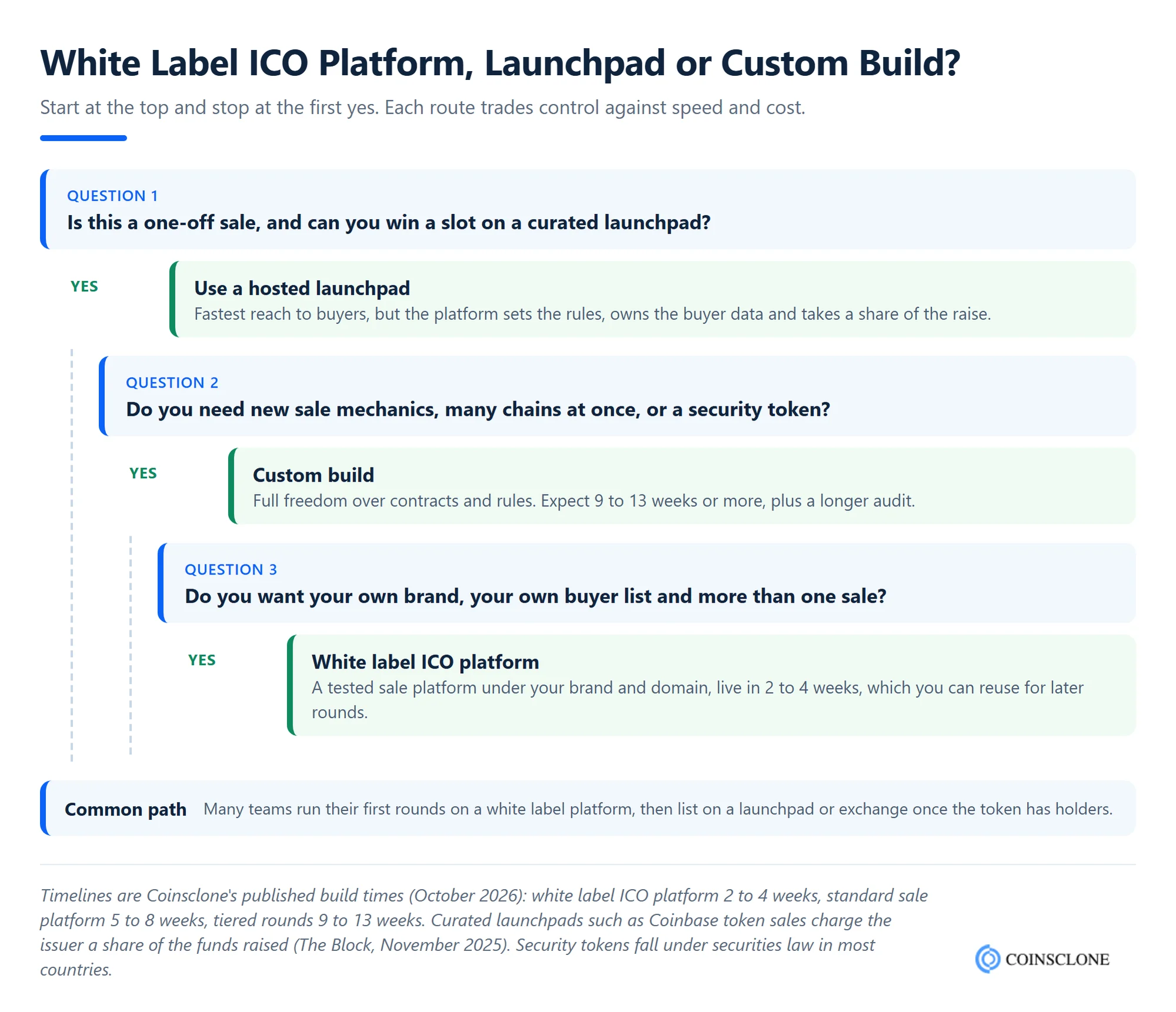
For most first-time issuers, the white label route gives the best balance. You launch in weeks, you keep your buyers, and you can still list on a launchpad or exchange later. If you would rather start from the code itself, our guide to the ICO script explains what a script includes and how to judge one.
Features of Our White Label ICO Platform Solution
An ICO platform needs strong tools for both the admin and the investors. Take a look at the key features.
Admin Features
- Admin Dashboard: An easy dashboard to view all ICO activity, track investments, watch token distribution and manage user data.
- Multi-Language Support: The platform can support many languages to serve buyers in different regions.
- Token Management: Create, distribute and manage token allocations with ease. Set the tokenomics and change them to fit your plan.
- Real-Time Analytics: Live data on sales and buyers helps you make better decisions during the sale.
- KYC and AML Checks: Smooth identity checks through a connected provider help prevent scams and keep the sale within the law.
- Crypto Exchange Integrations: Links to exchanges help you convert the crypto you receive into fiat when needed.
- Fundraising Dashboard: A clear view of every buyer’s activity and the progress of the raise.
- Token Loss Protection: Safe key handling and recovery options protect tokens from loss.
- Smart Contracts: Smart contracts run the sale on their own, so payments and token releases happen without manual steps.
- Multiple Payment Support: Accepting many payment methods makes buying easier and lifts sales.
User Features
- Investor Dashboard: An easy dashboard to view every investment and keep a record of it.
- Performance Tools: Tools to track the value and movement of the tokens bought.
- Educational Resources: Access to the whitepaper, FAQs and tutorials about the project.
- Referral System: Users can invite friends with referral codes and earn rewards.
- Security Tools: Strong login and account security, including two-factor sign-in, to keep accounts safe.
- Alert Notifications: Real-time updates on investment status, token release and other news.
- Customer Service Bots: 24/7 chatbots to answer common questions.
- Management Tools: A fund calculator, payment options and wallet balances in one place.
- Ticketing System: Users can raise a ticket to get help with any issue.
- Secure Wallet Integration: Support for popular wallets so users can store, receive and send tokens safely.
Sale Controls a 2026 Platform Needs
Sales in 2025 and 2026 showed that the hard part is not the “buy” button. It is fairness and clean records when demand is high. Make sure your platform can handle these controls:
- Rounds and pricing: private, presale and public rounds, each with its own price and dates.
- Caps and whitelists: limits per wallet, plus allow lists for approved buyers.
- Oversubscription rules: a clear method to share tokens when demand beats supply, with automatic refunds of the extra.
- Vesting and claims: tokens unlock on a set schedule, and buyers claim them on chain.
- Country and sanctions blocks: buyers from restricted places are stopped before they pay.
- Reports: exports that let your finance team match every payment to every token.
Rules Your White Label ICO Platform Must Support in 2026
Your lawyers decide how the sale is set up, but the platform has to enforce their choices. The rules changed a lot in the past year. This is general information, not legal advice.
United States
On 18 August 2026, the SEC proposed “Regulation Crypto Assets”. According to the SEC’s press release, it would allow a startup exemption of up to $5 million and a fundraising exemption of up to $75 million in each 12-month period, under set conditions. It is still a proposal, and comments close on 20 October 2026. Until a final rule arrives, most US sales use existing routes such as Reg D (accredited buyers only) or Reg S (buyers outside the US).
What the platform must do: check accredited status where needed, block US buyers for a Reg S sale, and keep records you can hand to a regulator.
European Union
In the EU, the MiCA regulation covers most public token offers. You must publish a crypto-asset white paper in a set format and notify your national regulator first. Small offers are exempt, for example those under EUR 1 million over 12 months or to fewer than 150 people per member state. Retail buyers also get a 14-day right to withdraw.
What the platform must do: cap the raise or buyer count if you use an exemption, track buyers by country, and handle refunds inside the 14-day window.
Other hubs such as Switzerland, Singapore, Dubai and the UK have their own rules. Choose your base before you set up the sale, not after. For the full legal path, see our step-by-step guide on how to start an ICO.
How Much Does a White Label ICO Platform Cost?
Knowing how it works and what it includes, you might think a white label ICO platform is expensive. In reality, it costs far less than building one from scratch. The cost of a white label ICO platform depends on how much you change it. Published 2026 agency cost guides start at about $15,000 for a basic token sale platform, and a premium multi-chain build can pass $200,000. A white label platform sits at the low end of that range, because the core code already exists and has been tested.
However, the licence is only part of the budget. Here is what else to plan for:
- Smart contract audit: Sherlock’s 2026 audit pricing reference puts a simple token contract at $5,000 to $20,000. Each re-review after fixes adds another $5,000 to $20,000.
- KYC checks: you pay per buyer. Sumsub’s published pricing starts at $1.35 per verification on its Basic plan, with a $149 monthly minimum.
- Hosting and support: servers, monitoring and updates after launch.
- Legal advice: often the largest cost that teams forget, and it varies by country.
- Marketing and listing: community building, ads and exchange listing costs.
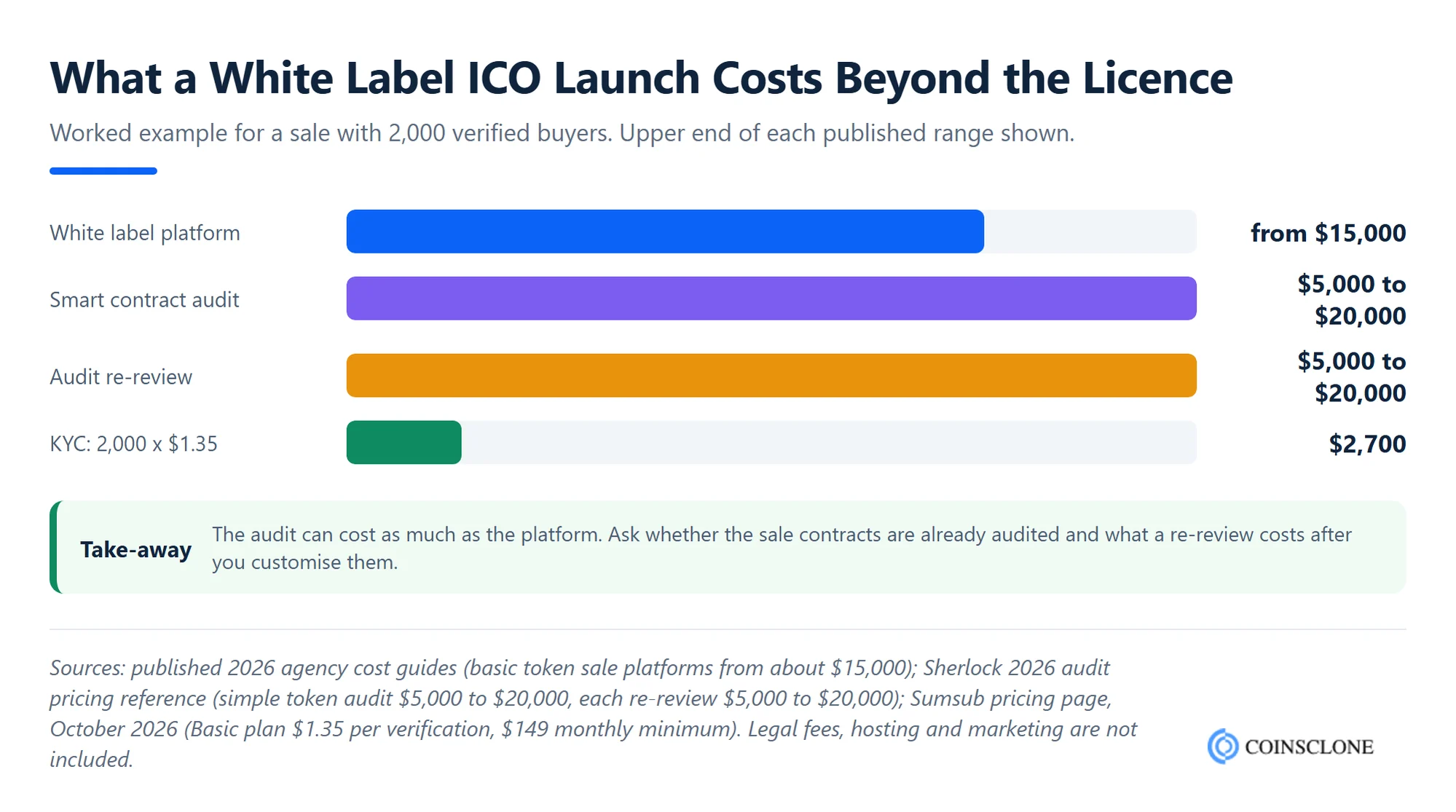
The worked example shows why the audit matters so much. If you change the sale contracts, the audit and re-review can cost as much as the platform itself. So ask your vendor which contracts are already audited and what changes will need a new review.
Many ICO development companies also include post-launch support in one package. In short, a white label ICO platform is about balancing the upfront cost with the long-term value of a secure, scalable platform.
Ready to take the next step in your ICO journey? Connect with Coinsclone to turn your vision into reality!
How Long Does It Take to Launch a White Label ICO Platform?
Time depends on how much you change and how fast the legal work moves. Coinsclone publishes these build times:
| Build | Time | What is included |
| White label ICO platform | 2 to 4 weeks | Ready sale platform, rebranded and set up |
| Standard token sale platform | 5 to 8 weeks | Sale contract, KYC gating, vesting and audit |
| Sale with tiered rounds | 9 to 13 weeks | Several rounds, custom pricing, dashboard and audit |
Legal work often sets the real pace. As a result, start it in week one, not after the build.
Steps to Launch an ICO With a White Label Platform
Here is the usual path from first call to live sale:
- Pick your provider: check their past sales, audits and support terms.
- Plan the tokenomics and whitepaper: set supply, price, rounds, vesting and the use of funds.
- Get legal advice: decide where you sell, to whom, and under which exemption.
- Brand and set up the platform: add your logo, domain, token and sale rules.
- Test and audit: run the sale on a test network, then audit any contract you changed.
- Launch and market: open the whitelist, run the sale and keep buyers updated.
- Claim and list: release tokens at the TGE and add liquidity or list on an exchange.
How to Choose a White Label ICO Platform Provider
Not every vendor offers the same thing under the same name. Ask these questions before you sign:
- Do I own the code and the contracts? You should get the source code and deploy the contracts under your own keys.
- What has been audited, and by whom? Ask for the audit report and check that it covers the version you will use.
- Who holds the keys to the funds? Raised money should go to a multisig wallet that your team controls.
- Which chains and payments are supported? Make sure your target chain, stablecoins and wallets are covered.
- How are KYC and country blocks handled? Ask which KYC provider is built in and how restricted buyers are stopped.
- What support comes after launch? Check bug fixes, updates and response times in writing.
Just remember that every startup begins somewhere. Why not take that first step with Coinsclone?
Launch your ICO instantly with our White Label platform today.
Cost-effective. Easy Customizations. Quick Branding. Get A Free Trial!
Why Choosing Coinsclone Is the Smartest Choice for a White Label ICO Platform
Choosing Coinsclone as your ICO Development Company means more than buying software. It means working with a team that turns your plan into a live token sale. Since 2018, we have delivered 350+ platforms for 200+ clients across 20 industries.
Our white label ICO platform is fully customizable to your business needs. We set up the token, the sale and vesting contracts, KYC, the investor dashboard and the admin panel, and you own the code under your own keys. We also keep the platform up to date with the latest security measures. If you plan to run your sale as a multi-project launchpad instead, our crypto launchpad development team builds that too. Start your journey with Coinsclone today and launch your token sale with confidence.
See How Our MVP System Can Launch Your ICO Platform Faster
White Label ICO Platform Development — done right.
- MVP System : Launch your ICO or token sale platform 90% faster.
- Smart Contracts & Wallets : Fully audited, pre-integrated modules — no coding required.
- Brand & Customization : Your logo, your token, your fundraising model.
- Revenue Engine : Earn from token sales, commissions, and featured listings.
Get a free branded demo of your ICO platform in just 48 hours — before you spend a cent.
Book a Free Demo to discover how our White Label ICO Platform can take you from concept to live token sale in just 2–4 weeks.
Frequently Asked Questions
What is a white label ICO platform?
It is ready-made token sale software that a vendor builds once and you rebrand as your own. It includes sale smart contracts, an investor dashboard, an admin panel and KYC tools, so you can launch a token sale in weeks instead of months.
How long does it take to launch an ICO using a white label solution?
Coinsclone’s white label ICO platform goes from concept to a live sale in 2 to 4 weeks. A standard sale platform with KYC, vesting and an audit takes 5 to 8 weeks, and a sale with tiered rounds takes 9 to 13 weeks. Legal work often sets the real pace.
How much does a white label ICO platform cost?
Published 2026 agency cost guides start at about $15,000 for a basic token sale platform. On top of that, plan for a smart contract audit ($5,000 to $20,000 for a simple token, per Sherlock), KYC per buyer (from $1.35 per check on Sumsub’s Basic plan), hosting, legal advice and marketing.
Is a white label ICO platform legal?
The software itself is legal. Whether your sale is legal depends on where you sell and to whom. In the EU, most public offers need a MiCA white paper. In the US, sales use exemptions such as Reg D or Reg S, and the SEC proposed new crypto exemptions in August 2026. Always get legal advice first.
What is the difference between an ICO platform and a launchpad?
An ICO platform runs one project’s own token sale under its own brand. A launchpad hosts sales for many projects and usually takes a share of each raise. A white label ICO platform can grow into a launchpad later if you add more projects.
Does the platform support multiple cryptocurrencies and blockchains?
Most white label ICO platforms accept stablecoins such as USDT and USDC, major coins such as ETH and BNB, and sometimes fiat. They usually run on EVM chains such as Ethereum, BNB Chain, Polygon and Base, and some also support Solana or TRON with TRC-20 tokens.
Is KYC/AML verification built into the platform?
Yes, a good platform connects to a KYC provider, so buyers verify their identity before they pay. It should also screen wallets for sanctions and block buyers from restricted countries.
Do I own the code and the smart contracts?
You should. Ask your vendor in writing for the source code and for the contracts to be deployed under your own keys and multisig wallet. At Coinsclone, you own the code and contracts once the project is delivered.