
This guide shows how to launch an ICO in 2026, from the first idea to the day buyers claim their tokens. It walks you through 10 clear steps, the sale model that fits your project, and the 2026 rules in the US and the EU that decide how much you can raise and who you can sell to. You will also see how a modern token sale really works on chain, and how long each kind of build takes.
The goal is simple. By the end, you will know whether you should start an ICO at all, which path to take, and which mistakes sink most token sales. ICOs are back after a quiet few years, but buyers and regulators now expect far more than a website and a whitepaper.
In this guide:
- The 10 steps to start an ICO, from idea check to post-sale support
- How to choose between your own ICO, an exchange launchpad, a DEX launchpad or a curated sale platform
- What the SEC’s 2026 proposal and the EU’s MiCA rules mean for your raise
- How money and tokens move through a sale contract, vesting and the treasury
- Real build timelines, from 2 to 4 weeks for a white label platform to 6 to 10 months for a full token programme
See How Our MVP System Can Launch Your ICO Faster
ICO Development — done right.
- MVP System : Launch your Initial Coin Offering 90% faster.
- Smart Contracts & Token Setup : Fully audited and blockchain-ready — no coding needed.
- Brand & Customization : Your token, your whitepaper, your design — 100% yours.
- Investor Dashboard : Manage contributions, token sales, and vesting with ease.
Get a free branded ICO demo within 48 hours — before you spend a cent.
Book a Free Demo to discover how our ICO Development Services can take you from concept to token launch in just 2–4 weeks.
How to Launch an ICO in 10 Steps
An ICO (Initial Coin Offering) is a way to raise money by selling a new crypto token straight to the public. Buyers send funds such as USDC or ETH to a smart contract. In return, they get tokens that power your product, give them a vote or unlock a feature. Because the sale runs on a blockchain, anyone can check how much was raised and where the funds went.
Here are the 10 steps to start an ICO and launch it with confidence:
- Step 1: Check your idea and decide if a token is needed
- Step 2: Study the market and your competitors
- Step 3: Choose your ICO development partner
- Step 4: Write the whitepaper
- Step 5: Create the ICO token and its tokenomics
- Step 6: Set up legal and compliance
- Step 7: Build the ICO website and dashboard
- Step 8: Test, audit and launch the sale
- Step 9: Run the marketing campaign
- Step 10: Support holders after the ICO
Step 1: Check Your Idea and Decide if a Token Is Needed
Before you launch an ICO, check that the idea can stand on its own. Pick the niche you want to serve and the problem you will solve. Then ask the hard question first: does your product really need a token? A token should do a job inside the product, such as paying fees, voting, staking or unlocking access. If it only exists to raise money, buyers and regulators will both notice.
In this phase:
- Define your project goals: what the product does, who uses it, and what the token does inside it.
- Set a budget: include build, audit, legal, KYC and marketing costs, plus a reserve for after the sale.
- Pick a target raise: a clear goal shapes your token price, your rules and your choice of sale model.
Step 2: Study the Market and Your Competitors
Next, research your competitors, current trends and what users actually want. Look at recent token sales in your niche. How much did they raise, how many buyers took part, and where does the token trade today? This tells you what buyers will pay and what they expect.
You should also know the regions where your platform will work. Demand, investor interest and rules differ a lot by country. For example, a sale open to US buyers follows very different rules from one open only to buyers in Asia. As a result, this research gives you a clear vision before you spend money on the build.
Step 3: Choose Your ICO Development Partner
The next step is to pick the right ICO development company. A good partner brings the team, tools and setup you need. They will build your token, the sale contracts and the ICO platform. They also work with your legal advisers on KYC, investor checks and sale limits.
If you want a faster route, try a White Label ICO Platform. It comes ready with the core features and compliance tools, so you can focus on your project instead of the technical details.
Before you choose a partner, check their:
- Track record: past token sales and the amounts they handled.
- Client reviews: real feedback from founders, not only logos.
- Cost and timeline: a written scope with clear weeks for each stage.
- Feature set: KYC, vesting, multi-chain support and an investor dashboard.
- Free demo: a working demo shows more than a sales deck.
Taking time here pays off. The right partner saves months of rework and makes your project look credible to buyers.
Step 4: Write the Whitepaper
Once you have your partner, start with the ICO whitepaper. It explains your project in full, so buyers can judge it without a call. In the EU, a whitepaper is also a legal document under MiCA, so every claim must be fair, clear and not misleading.
Your whitepaper should cover:
- Project overview and the problem you solve
- Token roadmap and ICO phases
- Tokenomics: total supply, allocation, price and vesting
- Token sale terms: rounds, caps, accepted coins and who can buy
- Tech stack and the chain you use
- Team and advisers, with real names
- Legal status, risks and disclaimers
- Privacy policy and security measures
- Community and governance plans
A whitepaper is the backbone of your token launch. It builds trust, shows your vision and helps you win over buyers.
Also Read: How To Write A White Paper For an ICO to Attract Investors?
Step 5: Create the ICO Token and Its Tokenomics
Now design a token with a clear use case that makes you stand out. First, define what the token does. Tokens can grant access to features, pay for services, reward users or give voting rights.
Next, create a crypto token on the right chain. Most ICO tokens today use ERC-20 on Ethereum or its layer 2 networks such as Base and Arbitrum, BEP-20 on BNB Chain, or SPL tokens on Solana. Your choice depends on where your users are and how much they will pay in fees.
Then set the tokenomics:
- Total supply: fixed or with a clear issue schedule.
- Allocation: how much goes to the public sale, team, investors, treasury and community.
- Vesting: team and early investor tokens usually unlock over 1 to 4 years, often with a cliff.
- Unlock at launch: how much of the supply can trade on day one.
For example, Monad sold 7.5% of its supply in its November 2025 public sale, and about 10.8% of the supply was in circulation when its mainnet went live. Those numbers matter because a big float on day one can push the price below the sale price.
Step 6: Set Up Legal and Compliance
Bring in legal experts early, because the rules shape every other step. Your counsel will check whether the token could count as a security, which buyers you can accept, and which KYC (know your customer) and AML (anti-money laundering) checks you must run.
Before you start the legal work, consider:
- Location: where your company is based and where your buyers live.
- Token type: utility token, governance token or security token.
- Sale limits: caps per buyer, total raise and blocked countries.
- Data protection: privacy laws such as GDPR for the KYC data you collect.
- Disclaimers: clear risk warnings on the website and in the whitepaper.
The 2026 rules have changed a lot, so we cover them in detail in a section below. A solid legal base prevents penalties and builds trust with buyers.
Step 7: Build the ICO Website and Dashboard
In this phase, your developers design the ICO website and the token sale dashboard. Keep it simple, fast and safe. Some of the key features to add are:
- Admin Panel: live analytics, user management, KYC review, sale settings and security controls.
- User Panel: whitepaper, tokenomics, roadmap, team and sale timeline.
- Token Sale Dashboard: KYC sign-up, wallet connection, token purchase, receipts and a vesting tracker.
Do not add features just to look busy. Instead, focus on a clear buying flow, accurate numbers and strong security. A ready-made ICO dashboard can save weeks here.
Step 8: Test, Audit and Launch the Sale
Once the website is ready, run a full quality check. Unit tests, load tests and penetration tests remove bugs before real money arrives. Most importantly, get an independent audit of the sale and vesting contracts, because they hold buyer funds.
After testing, run the sale itself. Many projects start with a smaller ICO presale for early backers, then open the public round. At the end of the sale comes the TGE (token generation event), when buyers can claim their tokens and trading can begin.
Step 9: Run the Marketing Campaign
Marketing starts weeks before the sale and continues long after it. Build a strong brand that speaks to your target buyers. Share your progress openly, show the team and explain the product in plain words.
Some of the key channels to grow your ICO’s reach are:
- X (formerly Twitter)
- Telegram
- Discord
You can also use press releases, AMAs (ask me anything sessions) and partner launches. However, never promise returns or price gains. In both the US and the EU, that kind of claim can turn a marketing post into a legal problem.
Step 10: Support Holders After the ICO
After the launch, focus on keeping your promises. Ship the product on the roadmap, publish treasury reports and stay in touch with your community. If you plan exchange listings, prepare liquidity and market making ahead of time.
Overall, keep watching the market and be ready to adjust your plan. Projects that stay open and keep shipping are the ones whose tokens hold value.
Are ICOs Still a Thing in 2026?
Yes. After years of quiet, public token sales came back in 2025. The difference is that the big ones now run on regulated, curated platforms with KYC, caps and fair allocation, not on anonymous websites.
Here is what changed:
- Record speed: Pump.fun raised $600 million in its public sale in 12 minutes on 12 July 2025, according to Wikipedia’s Pump.fun entry.
- Big exchanges joined in: Coinbase bought the token sale platform Echo, maker of Sonar, for about $375 million in October 2025, as Bloomberg reported.
- Wide access: Coinbase’s first token sale, for Monad, drew $269 million in bids from 85,820 buyers for $187.5 million of tokens between 17 and 22 November 2025, per The Block.
However, a raise is not the same as a success. CryptoRank data reported by PANews counted 533 public token sales in 2025, and only 63 of them, about 12%, traded above their sale price by year end. The pace has also cooled in 2026. CryptoRank figures reported by Grafa show public sales raised about $390 million in Q1 2026 and only $58 million in Q2 by mid-June, the weakest quarter in five years. In short, demand is still there, but buyers now judge the product, the unlock plan and the team, not just the hype.
ICO vs IPO: How Are They Different?
An ICO looks a bit like an IPO (Initial Public Offering), because both sell a stake in a project’s future to the public. In practice, they are very different.
| Point | ICO | IPO |
| What buyers get | A token that works inside a product | Shares in the company |
| Rights | Use, voting or rewards, set by the token design | Ownership, dividends and legal shareholder rights |
| Who can launch | Early-stage teams, often before profit | Mature companies with audited accounts |
| Gatekeepers | Your own site, a launchpad or a sale platform | Investment banks, exchanges and the regulator |
| Time to launch | Weeks to months | Often one to two years |
| Trading | On crypto exchanges right after the TGE | On a stock exchange after listing |
So an ICO is faster and open to younger projects. On the other hand, it gives buyers fewer legal protections, which is why the rules below matter so much.
Which Token Sale Model Should You Choose?
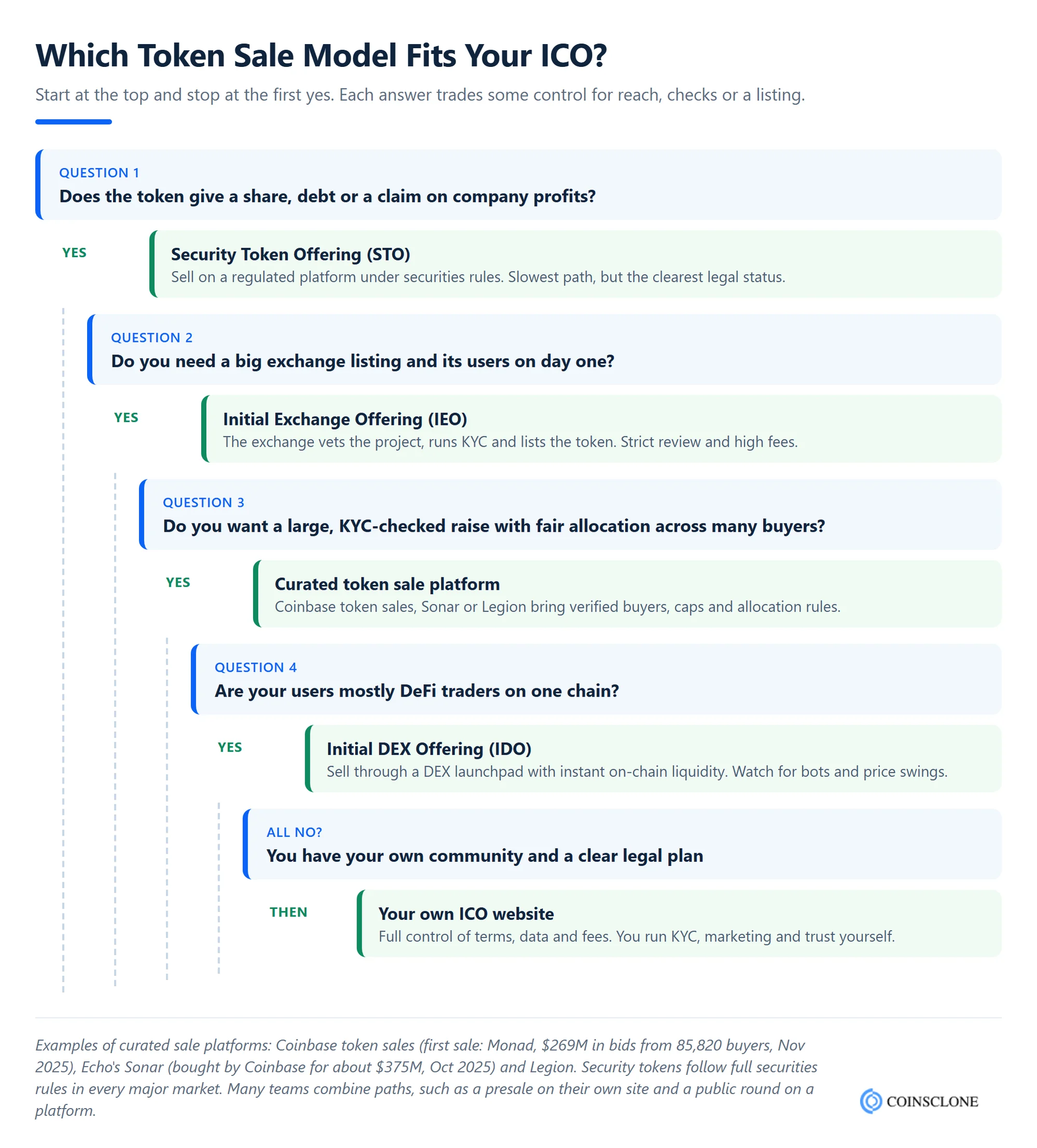
“ICO” is now an umbrella term. You can run the sale yourself or through a partner that brings buyers and checks. Each path changes your cost, reach and control.
| Model | Where the sale runs | Best for | Trade-off |
| ICO | Your own website and sale contract | Teams with a community and a clear legal plan | You handle KYC, marketing and trust yourself |
| IEO | A centralized exchange launchpad | Projects that want instant reach and a listing | Strict review, high fees and less control |
| IDO | A DEX launchpad | DeFi projects with on-chain users | Fast and open, but bots and price swings |
| Curated sale platform | Platforms like Coinbase’s token sales, Echo’s Sonar or Legion | Larger raises that need KYC and fair allocation | Selective, and you follow their rules |
| STO | A regulated security token platform | Tokens that are clearly securities, like shares or real estate | Full securities rules, but the clearest legal path |
ICO Rules in 2026: US and EU
The legal picture changed more in the last year than in the five years before it. Here is where things stand in October 2026. This is general information, not legal advice, so always confirm with your own counsel.
United States
On 17 March 2026, the SEC and the CFTC issued a joint interpretive release (Release 33-11412) on how securities laws apply to crypto. It sorts crypto assets into five groups: digital commodities, digital collectibles, digital tools, stablecoins and digital securities. The first four are generally not securities, unless they are sold as part of an investment contract. In plain words, the way you sell a token still matters, even if the token itself is not a security.
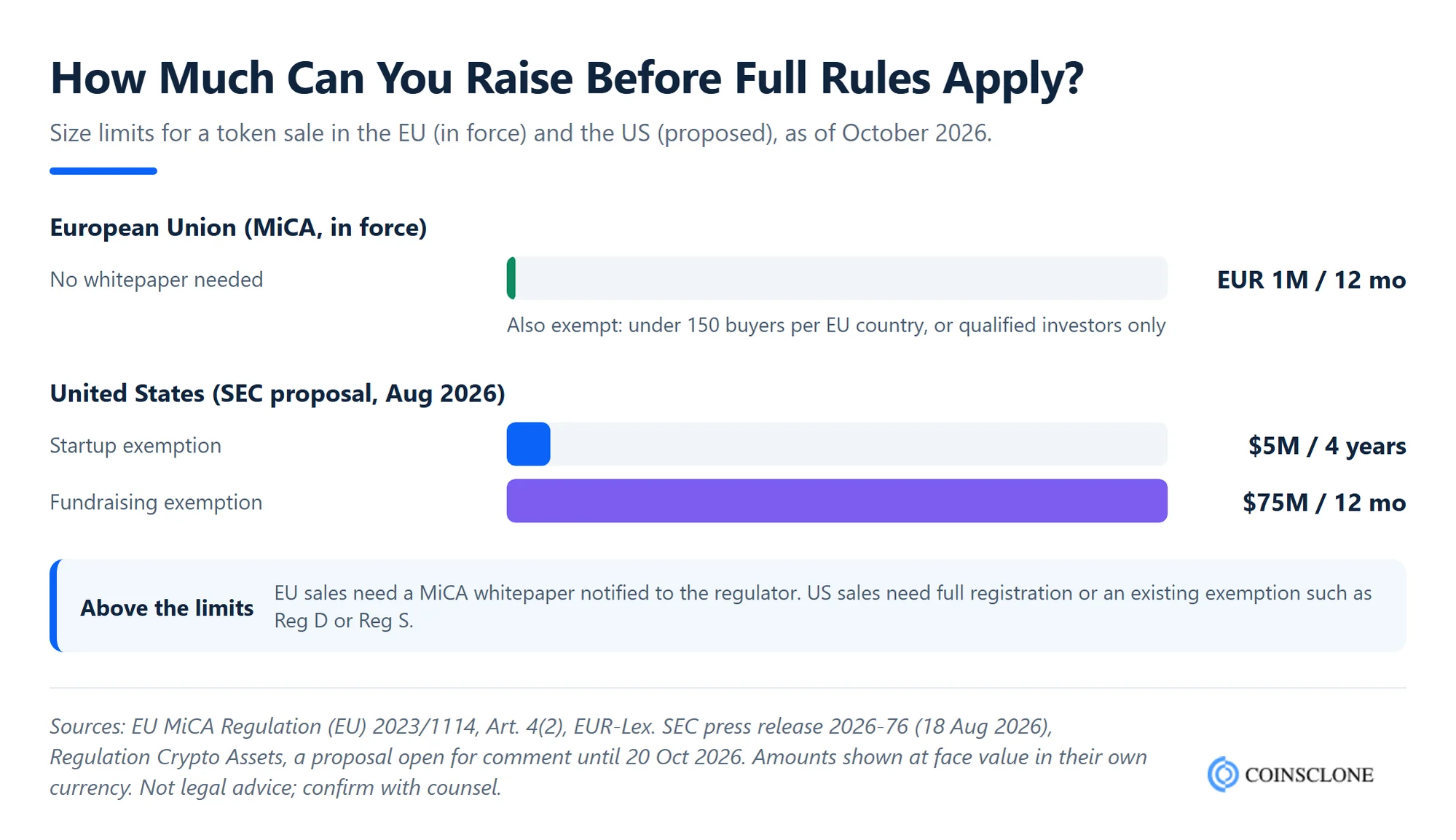
Then, on 18 August 2026, the SEC proposed “Regulation Crypto Assets”. According to the SEC’s press release, it would add:
- A startup exemption: raise up to $5 million over four years without full registration, with simple disclosures.
- A fundraising exemption: raise up to $75 million in each 12-month period, with financial statements and ongoing reports.
- A safe harbor: a path for a token to stop being treated as part of an investment contract once set conditions are met.
This is still a proposal. Comments are open until 20 October 2026, and the final rule may change. Meanwhile, Congress has not passed a market structure law. The CLARITY Act passed the House in July 2025 but stalled in the Senate in September 2026. Until a final rule arrives, most US sales still use existing exemptions such as Reg D (accredited buyers only) or Reg S (buyers outside the US).
European Union
In the EU, the MiCA regulation covers token sales to the public. For most utility and governance tokens, it means:
- A MiCA whitepaper: you must write one in a set format and notify your national regulator before you publish it.
- Small-sale exemptions: no whitepaper is needed if you sell to fewer than 150 people per EU country, raise no more than EUR 1 million over 12 months, or sell only to qualified investors.
- A 14-day right of withdrawal: retail buyers who buy straight from you can change their minds within 14 days.
- A 12-month limit: if the product the token unlocks does not exist yet, the offer can last no longer than 12 months.
Other popular hubs include Switzerland (FINMA), Singapore (MAS), Dubai (VARA) and the UK (FCA). Each has its own licence and marketing rules, so choose your base before you design the sale, not after.
How Money and Tokens Move in a Token Sale
Many founders picture an ICO as a website with a “buy” button. In reality, it is a small system of smart contracts and checks. Knowing the parts helps you plan the build, the audit and the budget.
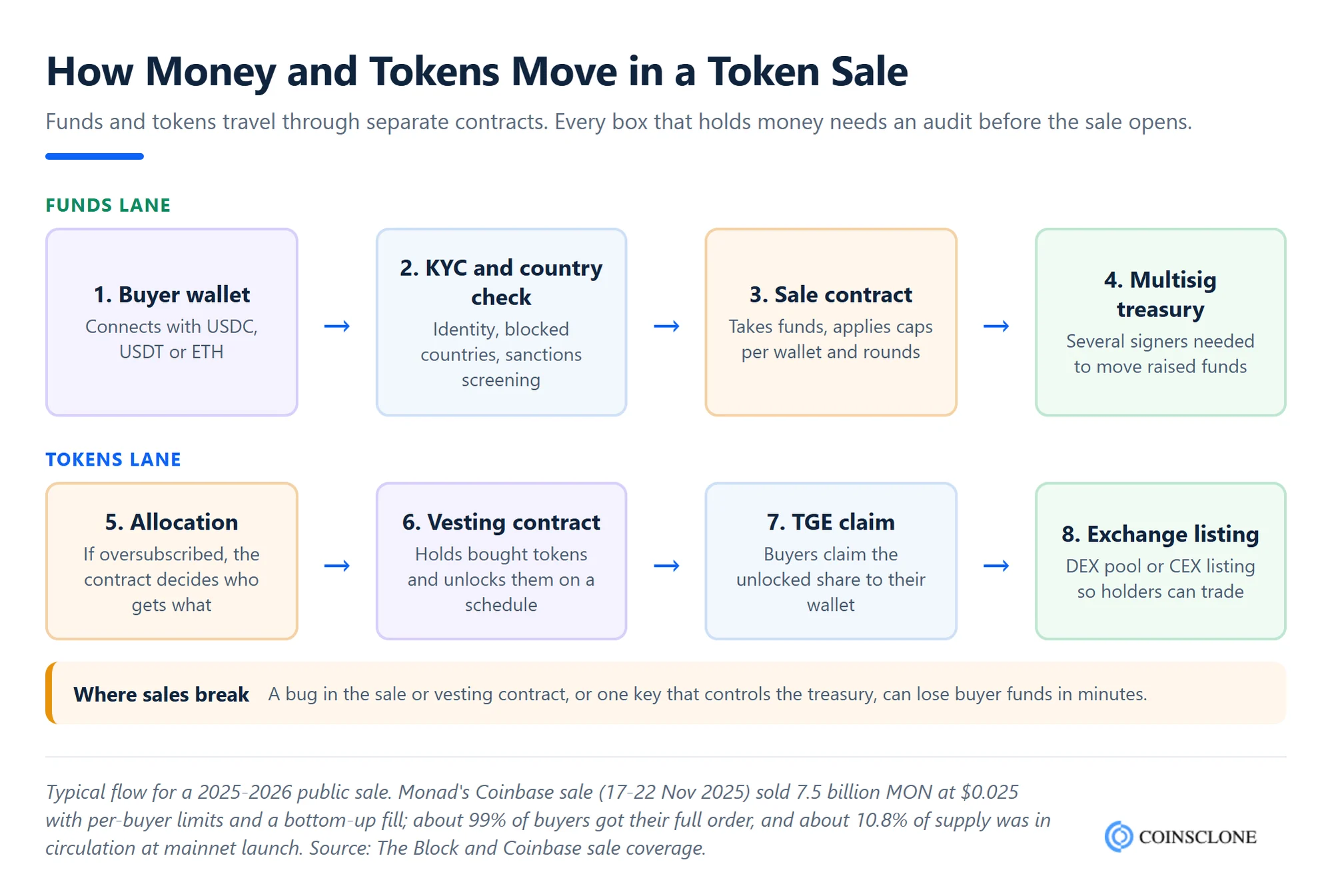
Here is the flow in simple terms:
- Sign-up and checks: the buyer connects a wallet and passes KYC. The platform also blocks restricted countries and screens wallets for sanctions.
- Commit funds: the buyer sends USDC, USDT or ETH to the sale contract. Caps per wallet stop a few whales from taking most of the supply.
- Allocation: if the sale is oversubscribed, the contract decides who gets what. Monad used a “fill from the bottom” method, so small buyers got their full order first, and about 99% of buyers received their full request.
- Treasury: raised funds move to a multisig wallet that needs several signers, so no single person can move the money.
- Vesting and claim: tokens sit in a vesting contract. At the TGE, buyers claim the unlocked share, and the rest unlocks over time.
- Listing: the team adds liquidity on a DEX or lists on a centralized exchange, so holders can trade.
Each of these parts holds or moves real money. That is why the audit and load tests in Step 8 are not optional.
How Long Does It Take to Launch an ICO?
The time depends on how complex your sale is and how fast legal work moves. Coinsclone’s own ICO development timelines give a realistic guide:
| Scope | Timeline | What it includes |
| White label ICO platform | 2 to 4 weeks | Ready sale platform, rebranded and set up |
| Standard token sale | 5 to 8 weeks | Sale contract, KYC gating, vesting and audit |
| Sale with tiered rounds | 9 to 13 weeks | Several rounds, custom pricing, dashboard and audit |
| Compliance-heavy sale | 4 to 6 months | Transfer limits, investor checks and many countries |
| Full token programme | 6 to 10 months | Sale plus governance, treasury, staking and listing support |
Legal work is often the slowest part, because it gates everything else. As a result, start it in week one, not after the build.
What Are the Development Methods to Launch an ICO Platform?
There are many ways to build a token sale platform. Two methods are used most often around the world, and both have a proven record.
How To Launch an ICO From Scratch?
Building an ICO platform from scratch gives you full control over every feature and contract. However, you need a large team of skilled developers, security experts and designers.
This path needs more money and more time. Still, it suits established companies with unusual sale designs, such as complex rounds, custom vesting or a sale tied to an existing app.
How To Create an ICO Website Using an ICO Script?
For first-time founders, or anyone who wants a faster and cheaper route, you can choose an ICO script. An ICO script is ready-made software with the core dashboards, features and plugins you need to launch an ICO.
You can still change the design and features to fit your business. Compared to building from scratch, it costs less and saves months. The key is to pick a skilled ICO development company that will support the code after launch. In that regard, Coinsclone is a trusted partner for creating an ICO platform.
Common ICO Mistakes to Avoid
Most failed token sales fail for the same few reasons. Avoid these and you are already ahead of the pack:
- A token with no job: if the product works fine without it, buyers will sell it.
- Big unlocks at launch: too much supply on day one pushes the price below the sale price.
- Skipping the audit: a bug in the sale or vesting contract can lose buyer funds in minutes.
- Promising profits: price targets and “guaranteed returns” create legal risk in the US and EU.
- Ignoring where buyers live: selling to blocked countries can undo the whole raise.
- Going quiet after the sale: silence kills trust faster than a slow roadmap.
Choose Coinsclone To Launch an ICO Platform Successfully!
Coinsclone is a leading ICO development company. Since 2018, we have delivered 350+ platforms for 200+ clients across 20 industries. Our blockchain experts build the full token sale stack: the token, the sale and vesting contracts, KYC, the investor dashboard and the treasury setup. You own the contracts and code, deployed under your own keys and multisig.
Beyond ICOs, we also build crypto launchpads, IDO platforms and other token tools. So, if you are ready to start an ICO, talk to us and get a clear, scoped plan for your launch.
Frequently Asked Questions
How much does it cost to launch an ICO?
The cost depends on the sale model, the number of rounds, the chains you use, the audit, legal work, KYC checks and marketing. A white label platform is the cheapest route, while a custom, compliance-heavy sale costs the most. For a line-by-line breakdown, see our guide to the cost to launch an ICO.
Is an ICO like an IPO?
In part. Both raise money from the public, but an ICO sells tokens that work inside a product, while an IPO sells shares in a company. An ICO is faster and open to younger projects, but buyers get fewer legal rights and the token trades on crypto exchanges, not stock markets.
How do I make an ICO?
To start an ICO, check that your product needs a token, study the market, pick a development partner, write the whitepaper, design the token and tokenomics, and set up legal and KYC. Then build the website and sale contracts, audit them, run the presale and public sale, and keep supporting holders after the TGE.
Are ICOs still a thing?
Yes, but buyers are pickier. Public token sales came back strongly in 2025, with Pump.fun raising $600 million in 12 minutes and Coinbase’s first sale drawing $269 million in bids for Monad. Most large sales now run on curated platforms with KYC and caps, only about 12% of 2025’s sales traded above their sale price by year end, and the amount raised slowed sharply in mid-2026.
Is it legal to start an ICO?
Yes, in most places, if you follow local rules. In the US, sales usually rely on exemptions such as Reg D or Reg S, and the SEC proposed new crypto exemptions in August 2026. In the EU, MiCA requires a notified whitepaper for most public sales. Some countries, such as China, ban ICOs outright.
How long does it take to launch an ICO?
A white label ICO platform can be ready in 2 to 4 weeks. A standard custom sale takes 5 to 8 weeks, tiered rounds take 9 to 13 weeks, and a compliance-heavy sale takes 4 to 6 months. Legal work often sets the real pace.
What are the main risks of launching an ICO?
The main risks are smart contract bugs, legal trouble from selling to the wrong buyers, low demand, and a falling price after launch. A full audit, clear sale limits, a sensible unlock plan and honest marketing reduce all four.
See How Our MVP System Can Launch Your ICO Faster
ICO Development — done right.
- MVP System : Launch your Initial Coin Offering 90% faster.
- Smart Contracts & Token Setup : Fully audited and blockchain-ready — no coding needed.
- Brand & Customization : Your token, your whitepaper, your design — 100% yours.
- Investor Dashboard : Manage contributions, token sales, and vesting with ease.
Get a free branded ICO demo within 48 hours — before you spend a cent.
Book a Free Demo to discover how our ICO Development Services can take you from concept to token launch in just 2–4 weeks.