
A white label DeFi wallet lets you launch your own branded Web3 wallet without writing one from scratch. This guide explains what it is, what it includes and how it works when a user swaps, stakes or signs. It also shows how the wallet makes money for you, which chains to support, and the security and legal checks to make before you launch.
By the end, you will know whether white label is the right path for your business, what it costs in 2026, and how long it takes. You will also get a simple checklist for picking a vendor, so you can avoid lock-in and hidden fees.
In this guide:
- What a white label DeFi wallet is, and who uses one
- White label vs wallet SDK vs custom build, with a simple decision tree
- How a swap earns you fees, with worked numbers
- Which chains to support, based on where DeFi money sits today
- 2026 costs, a 3 to 5 week launch plan and the rules to know
See How Our MVP System Can Launch Your DeFi Wallet Faster
White-Label DeFi Wallet Development — done right.
- MVP System : Launch your MetaMask-like wallet 90% faster with full DeFi support.
- Multi-Chain Ready : Seamlessly connect Ethereum, BSC, Polygon, Solana & more.
- Brand & Customization : Your logo, your UI, your token integrations.
- Revenue Engine : Earn from swaps, staking, and token promotions.
Get a free branded DeFi wallet demo in 48 hours — before investing a cent!
Book a Free Demo to discover how our White-Label DeFi Wallet Solution can take you from idea to a live, secure wallet in 8–12 weeks.
What Is a White Label DeFi Wallet?
A white label DeFi wallet is a ready-made crypto wallet that you rebrand and launch as your own. Users can store, send and receive crypto. They can also swap tokens, stake, earn yield and join liquidity pools, all without a middleman.
Instead of building a wallet from scratch, you take a tested core and change the parts users see: the name, colours, screens, tokens, chains and features. As a result, you launch faster, you know your costs up front, and you start with security that has already been tested.
Most white label DeFi wallets are non-custodial. In other words, users hold their own keys, and your company cannot move their funds. This matters for trust, and it also shapes which rules apply to you (more on that below). If you are new to the difference, our guide to custodial vs non-custodial wallets explains it in plain terms.
How It Differs From a Regular Crypto Wallet
A basic crypto wallet only holds and moves coins. A DeFi wallet adds the tools people use to put that money to work. For example, it has an in-app swap, staking screens, yield tracking and a link to dApps. In short, a DeFi wallet is where users trade and earn, not just where they store.
There is real money to serve. According to DefiLlama, DeFi apps held about $95 billion in total value locked on 1 October 2026. Every dollar of it moves through a wallet.
Who Uses a White Label DeFi Wallet?
- Crypto exchanges: add a self-custody wallet next to the exchange account, so users can reach DeFi without leaving your brand.
- DeFi protocols: give users a wallet built around your own pools, staking or token.
- Fintech and payment apps: offer stablecoin balances and on-chain yield inside an app people already use.
- Web3 games, NFT and community projects: give every member a wallet on day one.
- Startups: test a wallet business idea in weeks, then grow the parts that work.
Now that we know what a White Label DeFi Wallet is, let’s look at why startups and new Web3 brands pick white label over building from scratch.
Why Businesses Prefer White Label DeFi Wallet Solutions?
Building a DeFi wallet from scratch is hard for startups and founders because of the time, cost and technical risk. A White Label DeFi Wallet makes it easier. It gives you a ready, fully customizable base that you shape into your own branded wallet. At Coinsclone, a white label wallet goes live in 3 to 5 weeks, compared with 8 to 12 weeks for a custom wallet.
Here are the key reasons to choose a White Label DeFi Wallet.
Quicker Time-to-Market
Instead of spending months on design, backend setup and audits, a white label solution lets you go live in a few weeks. As a result, you reach the market faster and can ride trends while they last.
Cost Savings
A custom wallet comes with high engineering costs. You pay engineers to build the software, then you keep paying for security audits and upkeep. A white label wallet cuts both the build cost and the running cost, and the quality stays the same.
Custom Branding & Features
You have full control over how the wallet looks and what it does: features, tokens and integrations. So you can shape the wallet around your business model and audience, while you rely on a proven, tested backend.
Battle-Tested Security
A white label DeFi wallet comes with audited smart contracts, key management and multi-factor login already built in. These parts have been tested in live use, which removes much of the risk that a brand new codebase carries.
On the whole, a White Label DeFi Wallet Solution is the fastest and most affordable way to get your DeFi wallet live. Coinsclone offers ready White Label DeFi Wallets that startups, exchanges and Web3 firms can shape to their own needs. Next, let us see how white label compares with the other ways to get a wallet.
White Label vs Wallet SDK vs Custom Build
There are three ways to put a DeFi wallet in front of your users. Each one trades speed for control in a different way, so the right pick depends on what the wallet means to your business.
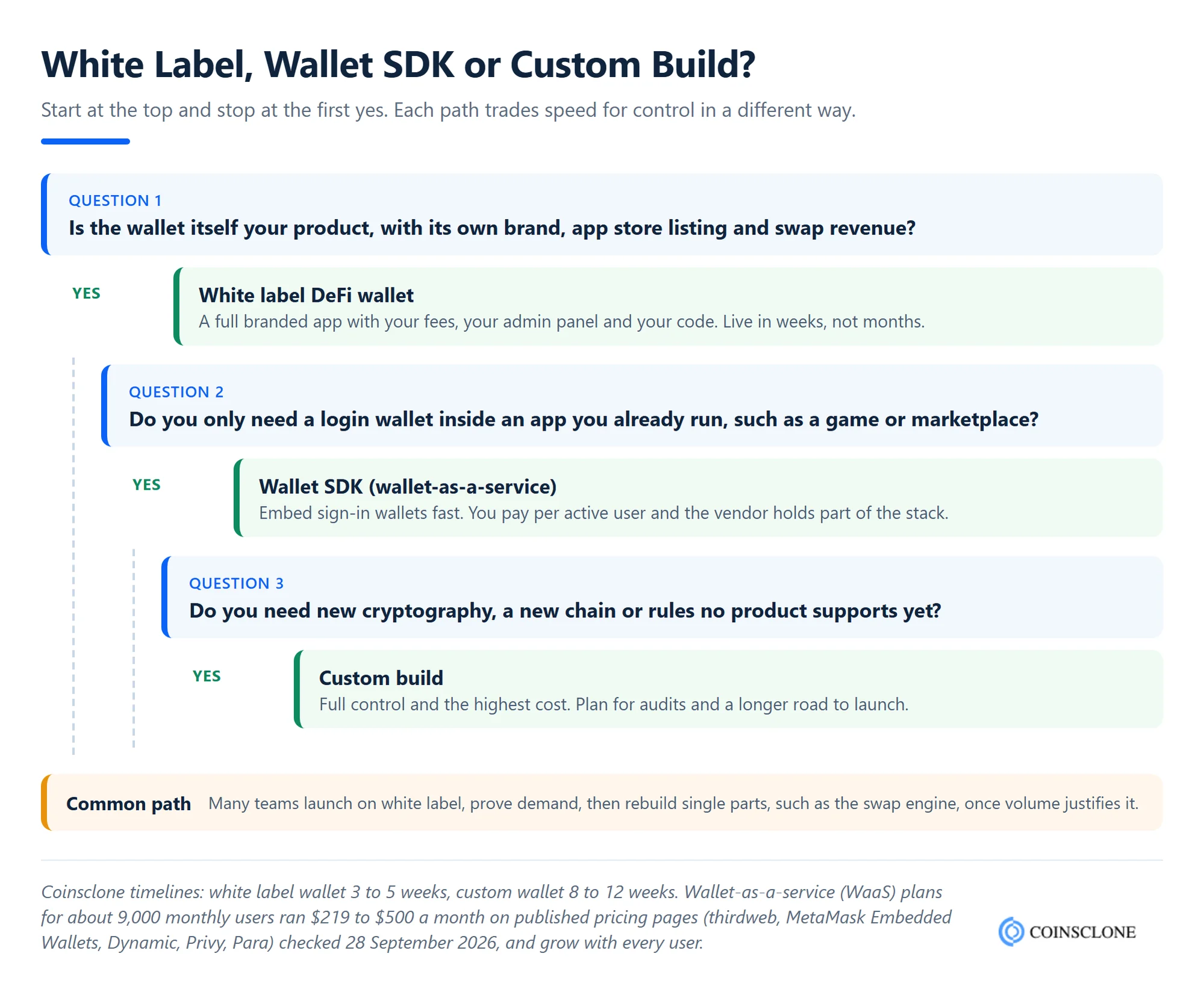
| Factor | White label DeFi wallet | Wallet SDK (WaaS) | Custom build |
| Time to launch | 3 to 5 weeks (Coinsclone) | Days to weeks | 8 to 12 weeks (Coinsclone), often months elsewhere |
| How you pay | One-time build fee, then upkeep | Monthly fee per active user | Full build cost, then upkeep |
| Your own app and brand | Yes | No, it sits inside your app | Yes |
| Swap and staking revenue | Yours | Limited | Yours |
| Code ownership | Usually yes (check the contract) | No | Yes |
| Best for | Wallet as the product | Login wallets in games and apps | New features no product has |
A wallet SDK (also called wallet-as-a-service, or WaaS) is the fastest way to add a login wallet to an app you already run. However, you pay for every active user, and the vendor holds part of the stack. On published pricing pages checked in late September 2026, plans for about 9,000 monthly users cost between $219 and $500 a month, and the bill grows with every new user.
A white label wallet fits when the wallet itself is your product. You get your own app store listing, your own fee wallet and your own admin panel. That is the path this guide covers. If you only need a plain wallet without DeFi tools, see our white label crypto wallet software instead.
Innovative Features of Our White Label DeFi Wallet Software
Our White Label DeFi Wallet is built to be secure, smooth and fast, whether your users are retail buyers, traders, DAOs, Web3 platforms or fintech startups. It joins a simple app, strong safety and many chains in one base. Below are the features that make it work and earn user trust.
- Multi-Chain Support: Users can send and swap on many chains, such as Ethereum, Base, BNB Chain, Solana and Tron, and see all their coins in one place.
- Non-Custodial Management of Private Keys: Users keep their own keys and their own money, with no central point of failure.
- Multi-Sig Wallets: Create shared wallets, or make large payments need more than one sign-off.
- MPC Key Management: Split private keys into encrypted shares, so no one device ever holds the full key. This suits teams, firms and seedless sign-in. Our guide to MPC wallet development explains how it works.
- Smart Accounts and Gasless Transactions: Support account abstraction (ERC-4337) and EIP-7702, which went live on Ethereum on 7 May 2025. As a result, you can pay gas for users, set spending limits and offer easy recovery.
- Integrated DEX & Swaps: Trade tokens instantly through a built-in swap that finds the best price across many decentralized exchanges.
- Staking & Yield Farming Modules: Users can earn by staking assets or joining yield farming pools, with simple built-in tracking.
- Safety Checks: The wallet tests each trade before the user signs. It warns about risky token approvals, fake tokens and known scam addresses.
- dApp Connection: Users can connect to thousands of DeFi apps through WalletConnect and a built-in dApp browser.
- Fiat On-Ramp: Users can buy crypto with a card or bank transfer through a licensed on-ramp partner, which also handles KYC.
- NFT Support: Users can store, send and show off NFTs, with a direct link to NFT marketplaces.
- Live Portfolio View: See what each coin is worth, how it has moved and what users did on-chain, all on one screen.
- Wallet Security Layers: Choose from Face ID, fingerprint, PIN, passkeys and Ledger or Trezor hardware wallet support.
- Full Branding & UI/UX Customization: Change the visuals, layouts, flows, token list and modules to suit your brand and audience.
With these features, you get to market quickly, keep the build simple and launch a secure White Label DeFi Wallet. Instead of spending months building from scratch, you get a ready DeFi wallet backed by proven design, real-world security and scalable blockchain links. Next, let us look at which chains to switch on first.
Which Blockchains Should Your DeFi Wallet Support?
Every extra chain adds testing, node costs and support work. So start with the chains where your users already keep their money, then add more as demand shows up.
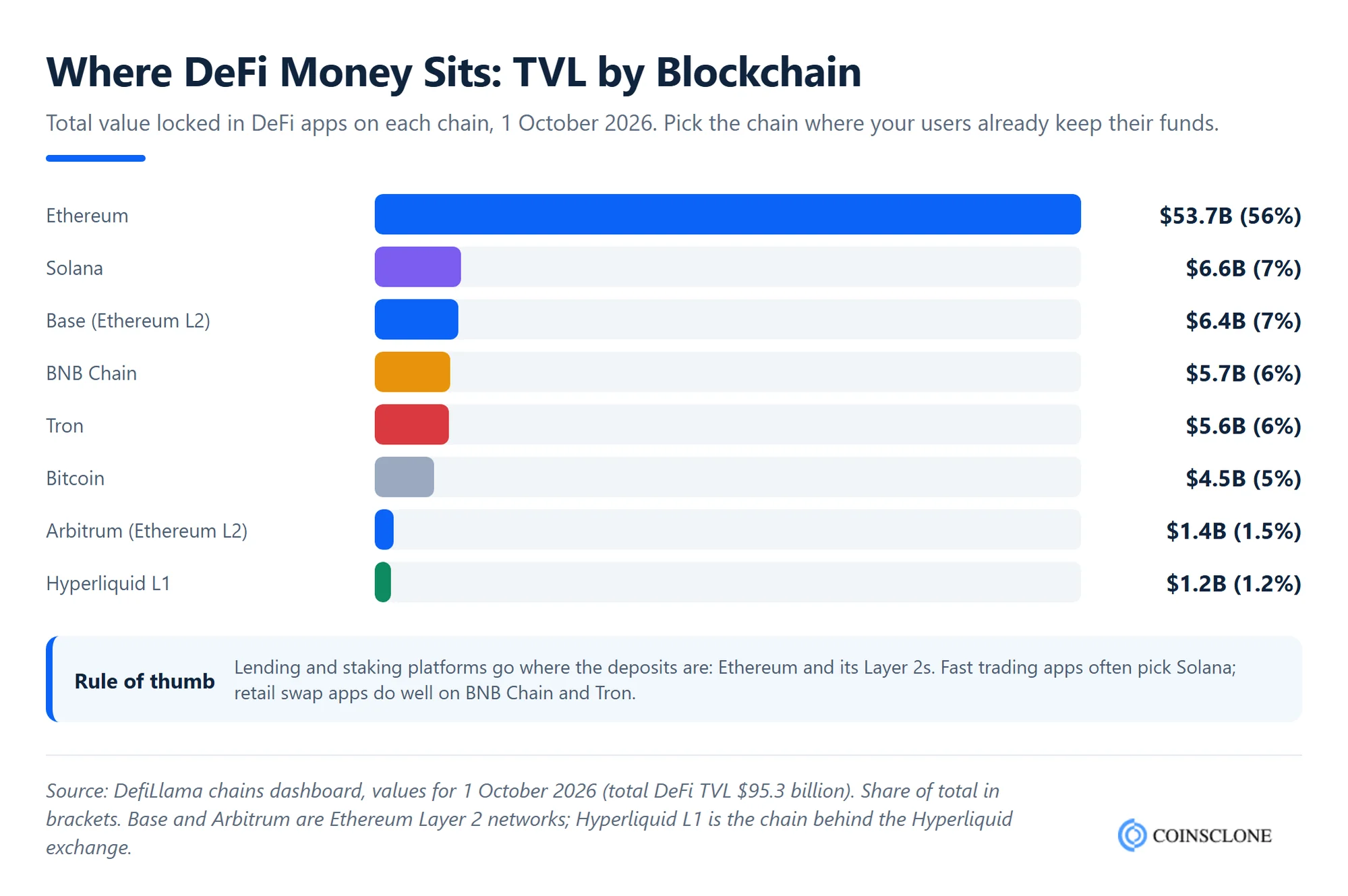
Here is a simple way to choose:
- Ethereum and its layer 2s (Base, Arbitrum): a must for almost every DeFi wallet, since most DeFi money sits here.
- Solana: add it if your users trade a lot or follow new tokens.
- Tron: add it if your users send USDT for payments or transfers, especially in Asia, Africa and Latin America.
- BNB Chain: add it for retail users in Asia who already use Binance products.
- Bitcoin: add it if users want to hold BTC next to their DeFi assets.
Key Benefits of Using Our White Label DeFi Wallet
With our White Label DeFi Wallet, startups and large firms can get to market fast, spend less on the build and rely on strong security, without the cost of building their own. The wallet is designed to scale and adapt as Web3 grows, so it keeps up with your business over time.
- Faster Go-To-Market: With a pre-built and pre-tested DeFi wallet, you can launch in weeks rather than months, meet demand sooner and get ahead of rivals.
- Lower Build Cost: Avoid the heavy build, audit and upkeep costs of a custom wallet. You pay only for changes, not for rebuilding the core.
- Full Branding: You can change the screens, features, tokens and add-ons to match your brand and product plan.
- Strong Security: Multi-Sig or MPC keys, Face ID login and audited smart contracts lower the risk of hacks.
- Cross-Chain Support: Because the wallet works across many blockchains, users can manage all their assets in one place, without juggling several wallets.
- Built-In Revenue Models: With swap fees, staking modules and fee routing, the wallet earns money for you from day one.
With these benefits, our White Label DeFi Wallet helps you launch a safe product that can grow and earn from day one. Next, we will walk through how the wallet works for users and admins.
How Does the White Label DeFi Wallet Work?
Our White Label DeFi Wallet runs on a secure, simple and decentralized transaction flow. It has a User Dashboard for managing assets and an Admin Dashboard for setup, monitoring and backend controls. Together, they keep each payment clear and safe, and users never give up their keys.
The flow below shows what happens behind the screen when a user swaps tokens. Notice two things. First, the key never leaves the user’s phone. Second, your fee is paid inside the same on-chain transaction.
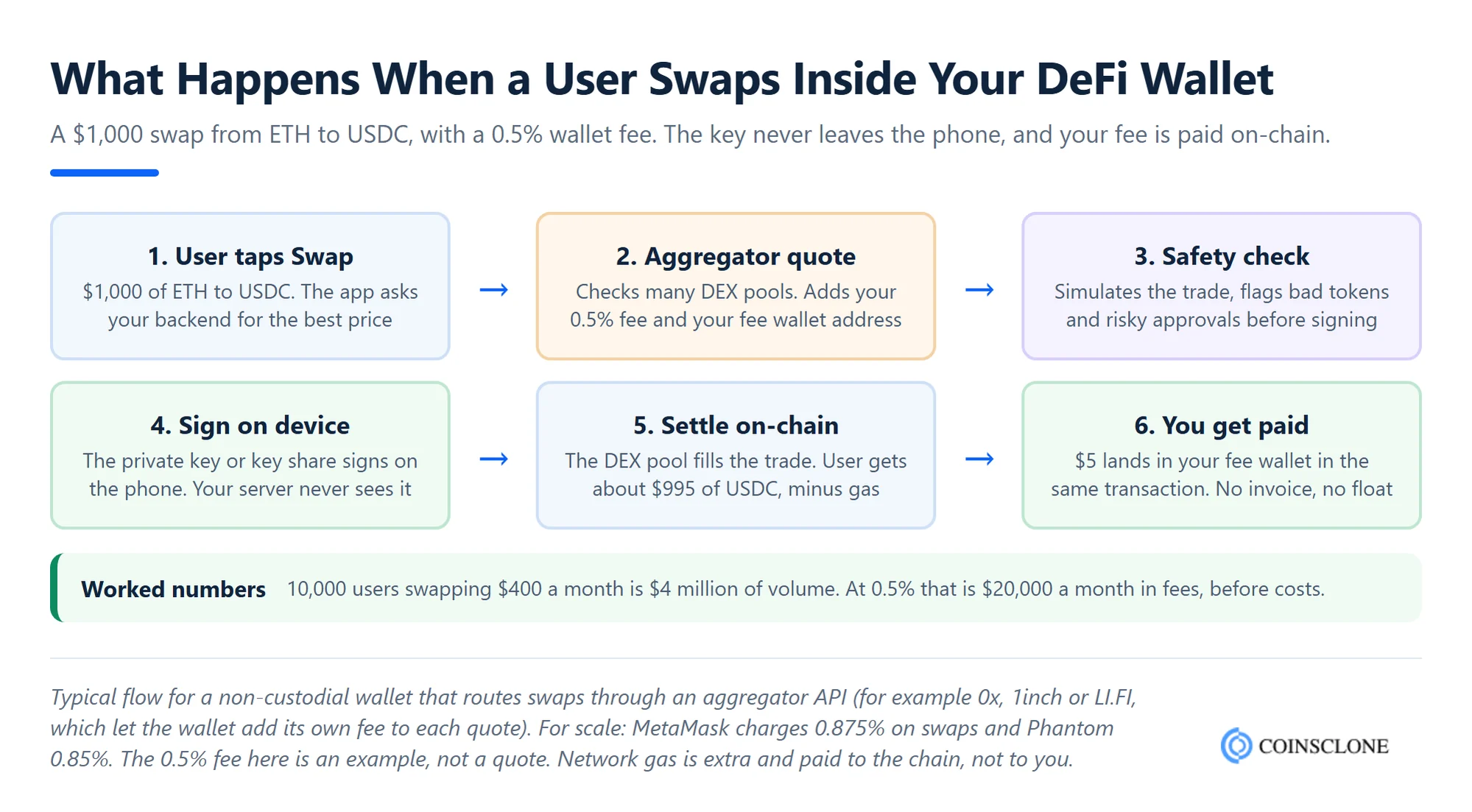
User Dashboard Workflow
- Sign Up: Users join with a seed phrase, email or passkey, or with KYC when your model needs it. Then MPC, Multi-Sig or Face ID locks the wallet.
- Portfolio View: Users can see balances, track trades and manage coins on every chain in one window.
- Swap, Transfer & Bridge: Built-in swap routers and bridges let users swap tokens or move assets across chains instantly inside the wallet.
- DeFi Earn Tools: Users can stake, add liquidity or earn yield right in the wallet.
- Confirm Before Sending: Users see a clear summary before each send, and Multi-Sig or MPC setups need sign-off from more than one party.
Admin Dashboard Workflow
- Team Access: The admin decides which team members can run tasks, approve payments or update the wallet.
- User Activity & Asset Monitoring: Watch what users do, with live logs, fund moves and risk alerts.
- Token & Network Setup: The admin can add new networks, turn tokens on or off, add new DeFi protocols or update features.
- Revenue & Fee Structure: A flexible fee setup lets you earn from swaps, bridges and staking.
- Risk Controls: The admin can manage smart contract updates and risk limits, and change Multi-Sig rules for team funds.
This workflow gives your users a smooth and secure experience. At the same time, your business keeps control, can customize freely and can oversee compliance.
How a White Label DeFi Wallet Makes Money
A good DeFi wallet pays for itself through small fees on the actions users already take. Here are the main revenue models, with real numbers where they exist:
- Swap fees: This is the biggest earner for most wallets. MetaMask charges 0.875% on swaps, and Phantom charges 0.85% on most swaps. Swap aggregator APIs let your wallet add its own fee to each quote, so the fee lands in your wallet in the same transaction.
- Bridge fees: A small fee on cross-chain transfers, charged the same way.
- Staking commission: A share of the rewards users earn through the wallet’s staking screens.
- On-ramp referrals: Fiat on-ramp partners pay a share of their fee when your users buy crypto with a card.
- Premium features and listings: Paid plans for power users, or fees from projects that want their token featured.
To see the scale, take a wallet with 10,000 active users who each swap $400 a month. That is $4 million of monthly volume. At a 0.5% fee, the wallet earns about $20,000 a month from swaps alone. For a deeper look at each model, read our guide on how crypto wallets make money.
Security and Compliance: What to Get Right
Users will only trust a DeFi wallet that keeps their money safe. In addition, the way you hold keys decides which rules apply to you. So plan both from day one.
The Real Threats in 2026
Most wallet losses today come from tricked users, not broken code. According to Chainalysis, about $3.4 billion in crypto was stolen in 2025. Personal wallets alone saw about 158,000 compromises, with roughly 80,000 victims and $713 million lost. The most common traps are fake approval requests, look-alike tokens and phishing links.
That is why a modern DeFi wallet needs:
- Trade preview: show users what will leave their wallet before they sign.
- Approval controls: warn about unlimited token approvals, and let users revoke old ones in one tap.
- Scam screening: flag known drainer contracts, fake tokens and risky addresses.
- Safe key storage: keep keys in the phone’s secure chip, or split them with MPC.
- Audits: have smart contracts and the app reviewed by an outside firm before launch, and again after big updates.
The Rules That Apply
- Non-custodial wallets carry the lightest rules in most places. In the US, FinCEN guidance from 2019 says providers of unhosted wallet software are not money transmitters. In the EU, MiCA leaves non-custodial wallet software out of scope.
- Custodial features change the picture. If your company can move user funds, you are a custodian. In the EU that needs a MiCA licence as a crypto-asset service provider (CASP), and other countries have similar rules.
- App stores have their own rules. Apple’s App Review Guideline 3.1.5 only allows crypto wallet apps from developers enrolled as an organization, not as a single person.
- Fiat on-ramps run KYC through the licensed partner, so you do not need to hold user identity data yourself.
Rules change by country and over time, so always confirm your plan with a local lawyer before launch.
How to Launch a White Label DeFi Wallet in 6 Steps
With a white label base, launch is mostly about choices and testing, not coding from zero. Here is the path most teams follow:
- Define your users and revenue model: decide who the wallet is for and how it will earn, for example through swap fees, staking or on-ramp referrals.
- Pick your custody model and chains: choose seed phrase, MPC or smart account sign-in, then pick your first chains from the data above.
- Brand and customize: set your name, colours, screens, token list and feature modules.
- Connect partners: add swap aggregators, an on-ramp, WalletConnect and node providers, and set your fee wallet.
- Test and audit: run security tests, check every swap and staking flow, and fix issues before users see them.
- Launch in stages: start with a small group of beta users, watch the admin dashboard closely, then open the app stores.
At Coinsclone, these steps take 3 to 5 weeks for a white label wallet. A custom wallet takes 8 to 12 weeks.
What to Check Before You Choose a Vendor
Not every white label DeFi wallet is the same. Before you sign, ask these questions:
- Do you get the source code? Without it, you depend on the vendor for every fix and change.
- Has the code been audited? Ask for recent reports, and check that they cover the version you will use.
- Who holds the keys? Make sure neither the vendor nor your team can move user funds alone, unless you plan to run a licensed custodial wallet.
- Who pays for nodes and APIs? Node, swap and price data costs can add up after launch.
- How are updates handled? Chains upgrade often. Ask how fast the vendor ships fixes and new chains.
- What happens if you part ways? Check that your users, data and brand stay with you.
A white label wallet also has limits. It works best for proven features such as swaps, staking and NFTs. If your idea needs new cryptography or a brand new chain, plan for custom work on top of the white label core.
Cost to Build a White Label DeFi Wallet
The cost to build a White Label DeFi Wallet depends on a few main things. These are how many chains you add, which key model you pick (Multi-Sig or MPC), how much you change the design, how deep the admin tools go and how many DeFi tools you need.
As a guide, published 2026 agency price guides put a white label wallet at roughly $10,000 to $80,000 up front. By contrast, a wallet built from scratch runs from about $70,000 to $500,000 and can take 8 to 12 months. The same guides suggest each extra chain adds about $5,000 to $20,000, and audits with MPC and penetration tests add $10,000 to $60,000 or more.
Plan for running costs too. Nodes, hosting, monitoring and support usually come to about 15% to 20% of the build cost each year. For a full breakdown by wallet type, see our crypto wallet development cost guide. To get a precise quote for your business model and market, reach out to our team.
Kickstart Your White Label DeFi Wallet Platform Now with Coinsclone
Coinsclone is a trusted DeFi Wallet Development Company that offers pre-built White Label DeFi wallets you can shape to suit your needs. Since 2018, we have delivered 350+ platforms for 200+ clients across 20 industries. Our DeFi wallet solution is safe, reliable and scalable, and it keeps pace with the modern DeFi wallet market. It includes multi-chain support along with modern asset management tools.
Whether you serve retail users, run an exchange or build enterprise-grade Web3 apps, Coinsclone will help you launch smoothly with expert technical support. Get started with your DeFi wallet today, and join the Web3 economy on a solid foundation.
Frequently Asked Questions
What is a white label crypto wallet?
A white label crypto wallet is a ready wallet that one firm builds and another firm renames and launches as its own. The buyer changes the name, design, tokens and features, while the tested core stays the same. A white label DeFi wallet adds DeFi tools such as swaps, staking and yield.
Is a white label DeFi wallet safe?
Yes, if it is built well. A non-custodial wallet keeps keys on the user’s device, so a server breach cannot empty user funds. Still, ask for recent audit reports. Also check that the wallet previews each trade and warns about risky approvals, since most losses come from scams, not broken code.
How do DeFi wallets make money?
Most DeFi wallets earn from a small fee on in-app swaps. For example, MetaMask charges 0.875% and Phantom 0.85%. Other income comes from bridge fees, staking commissions, fiat on-ramp referrals and premium features.
How much does a white label DeFi wallet cost?
2026 price guides put a white label wallet at roughly $10,000 to $80,000 up front, against about $70,000 to $500,000 for a build from scratch. The final price depends on chains, security model, modules and design work. Running costs add about 15% to 20% of the build cost each year.
How long does it take to launch a white label DeFi wallet?
At Coinsclone, a white label wallet goes live in 3 to 5 weeks. A custom wallet takes 8 to 12 weeks. Extra chains, custom modules and app store reviews can add time.
Can a White Label DeFi Wallet support multiple blockchain networks?
Yes. White Label DeFi Wallets can support many chains. So users can hold coins on Ethereum, Base, BNB Chain, Solana, Tron and more from one app.
Can I add DeFi services like staking, liquidity pools or yield farming?
Yes. White Label DeFi Wallets can include earning modules, so users can stake tokens, add liquidity and earn rewards. You can tailor each module to your business model.
How are private keys managed with White Label DeFi Wallets?
Private keys can sit in non-custodial storage on the device, in a hardware wallet, or behind Multi-Sig or MPC security. In each case, users stay in full control of their keys and are protected from unwanted access.
Can I rebrand and customize the UI/UX of a White Label DeFi Wallet?
Yes. White Label solutions are made to be fully rebrandable. You can change the interface, colours, features and user flows to match your business and your users’ needs.
When should I choose a custom build instead of white label?
Choose a custom build when you need a feature no product offers yet, such as new key tech, a brand new chain or rare legal rules. For proven features like swaps, staking and NFTs, white label is faster and cheaper.
How scalable is a White Label DeFi Wallet for an enterprise or very large user base?
White Label wallets use a modular design, so you can add features, support more blockchains and serve large numbers of users as your platform grows.
See How Our MVP System Can Launch Your DeFi Wallet Faster
White-Label DeFi Wallet Development — done right.
- MVP System : Launch your MetaMask-like wallet 90% faster with full DeFi support.
- Multi-Chain Ready : Seamlessly connect Ethereum, BSC, Polygon, Solana & more.
- Brand & Customization : Your logo, your UI, your token integrations.
- Revenue Engine : Earn from swaps, staking, and token promotions.
Get a free branded DeFi wallet demo in 48 hours — before investing a cent!
Book a Free Demo to discover how our White-Label DeFi Wallet Solution can take you from idea to a live, secure wallet in 8–12 weeks.