

The best crypto payment gateways in 2026 charge between 0% and 3% per payment, and the headline rate is only part of the choice. This guide compares the 10 leading processors on fees, coins, settlement, custody and the regions they can legally serve, with every fee checked at the provider’s own pricing page in October 2026.
The largest brand in crypto checkout stopped serving most of the world in March 2026, which is a useful reminder that choosing a payment gateway is a platform risk decision as much as a pricing one. Below you will find the processors still taking merchants, what each charges, who holds your funds between payment and settlement, and which one fits which kind of business.
See How Our MVP System Can Launch Your Crypto Payment Gateway Faster
Crypto Payment Gateway Development — done right.
- MVP System : Launch your gateway 90% faster with ready-to-use modules.
- Payment & Wallet Integration : Pre-built crypto wallets and payment flows, no coding needed.
- Brand & Customization : Your design, your tokens, your supported coins.
- Revenue Engine : Earn from transaction fees, subscriptions, and staking.
See a free branded demo of your crypto payment gateway in 48 hours — before you invest a cent.
Book a Free Demo to discover how our white-label crypto payment gateway can take you from idea to live platform in just 8 to 12 weeks.
10 Best Crypto Payment Gateways in 2026
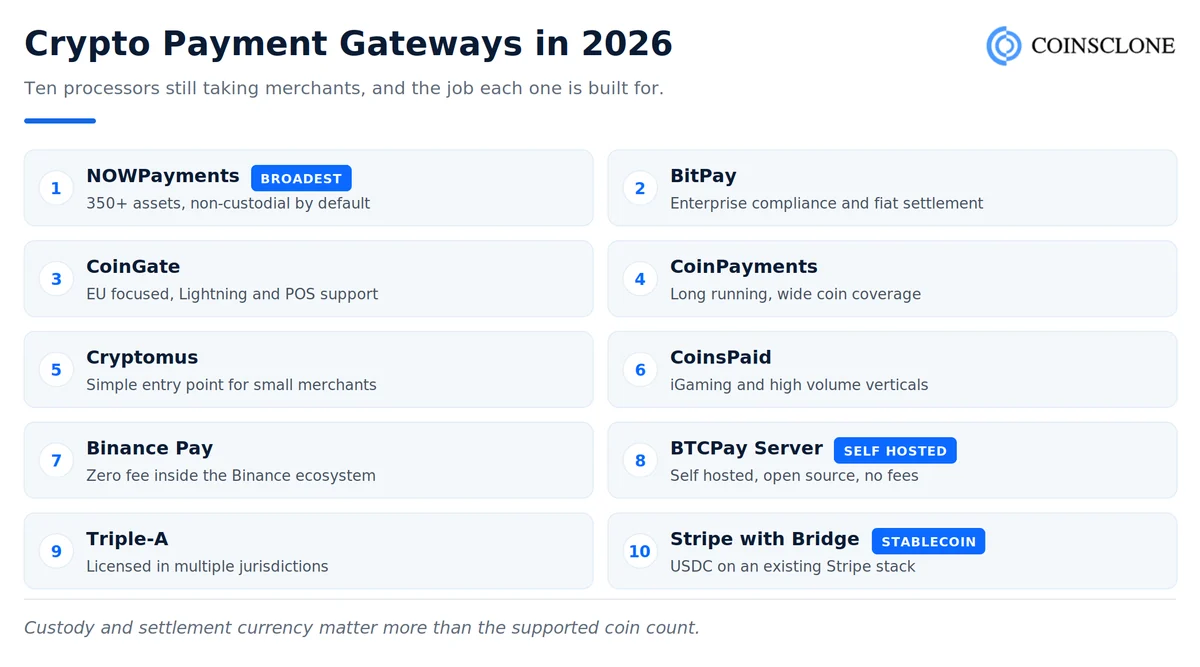
The 10 best crypto payment gateways in 2026 are NOWPayments, BitPay, CoinGate, CoinPayments, Cryptomus, CoinsPaid, Binance Pay, BTCPay Server, Triple-A and Stripe with its Bridge stablecoin stack. Whether you call it a cryptocurrency payment gateway, a crypto payment processor or a payment provider, they split into three groups, and that split matters more than any fee comparison: custodial processors hold your money before settling it, non-custodial routers never touch it, and self-hosted software puts you in charge of everything.
Crypto Payment Gateway Comparison Table (October 2026)
| # | Gateway | Fee (October 2026) | Coins | Settlement | Custody | Regions and licences |
| 1 | NOWPayments | 1% service fee, lower at high volume | 350+ | Crypto to your wallet; fiat through partners | Non-custodial by default | Global; no licence list published |
| 2 | BitPay | 2% + 25c under $500,000 a month; 1.5% + 25c to $999,999; 1% + 25c from $1 million | 15 settlement assets | USD, EUR, GBP, CAD, AUD, MXN, NZD or crypto | Custodial | US enterprise focus |
| 3 | CoinGate | 1%; crypto payouts 0.50 EUR + 0.5%; SEPA withdrawals free | 10+ on its pricing page | EUR, GBP, USD or crypto, weekly | Custodial | EU; MiCA CASP, Bank of Lithuania LB002323; 180+ countries |
| 4 | CoinPayments | From 3% on coins and 1% on tokens (new platform); +0.1% with conversion | 40+ on the new platform | Crypto, per payment or nightly batch | Custodial | Panama and US entities; check its restricted jurisdictions list |
| 5 | Cryptomus | 2% for new accounts, negotiable to 0.4%; auto-convert free | 11 listed | Crypto, auto-convert, mass payouts | Custodial | Global; verify licensing for your market |
| 6 | CoinsPaid | Quote-based, not published | 22 blockchains | By contract; enterprise settlement | Custodial | Europe-based; EUR 100 billion+ processed |
| 7 | Binance Pay | No merchant rate published | Binance-listed assets | To a Binance merchant account | Funds held on Binance | Where Binance operates |
| 8 | BTCPay Server | 0%, no processor | Bitcoin, Lightning, others via plugins | Your own wallet | Self-custodial | Anywhere you can host it |
| 9 | Triple-A | Quote-based, not published | Stablecoins and major coins | 30+ local currencies to 70+ countries, or stablecoins | Custodial | Licensed in Singapore, France, the US and Canada |
| 10 | Stripe (stablecoins) | Not listed on its public pricing page | USDC on 5 networks; USDP and USDG US-only | Local currency in your Stripe balance; $10,000 per payment | Custodial | US live; EU, Hong Kong, Mexico, Switzerland in preview |
Sources: each provider’s own pricing or docs page, read on 23 October 2026: NOWPayments, BitPay, CoinGate, CoinPayments, Cryptomus, CoinsPaid, BTCPay Server, Triple-A and Stripe. Binance publishes no merchant rate on a public page. Network fees and conversion spreads come on top everywhere.
- NOWPayments for the widest asset coverage with non-custodial routing by default
- BitPay for enterprise compliance and fiat settlement at scale
- CoinGate for European merchants who need EUR settlement
- CoinPayments for merchants already on its legacy platform; new accounts pay from 3%
- Cryptomus for a hosted checkout with conversion handled for you
- CoinsPaid for high volume merchants who want a full service processor
- Binance Pay for merchants whose customers already hold funds on Binance
- BTCPay Server for zero processor fees and complete self custody
- Triple-A for regulated fiat settlement in licensed markets
- Stripe with Bridge for merchants already running Stripe who want USDC
1. NOWPayments: The Broadest Asset Coverage
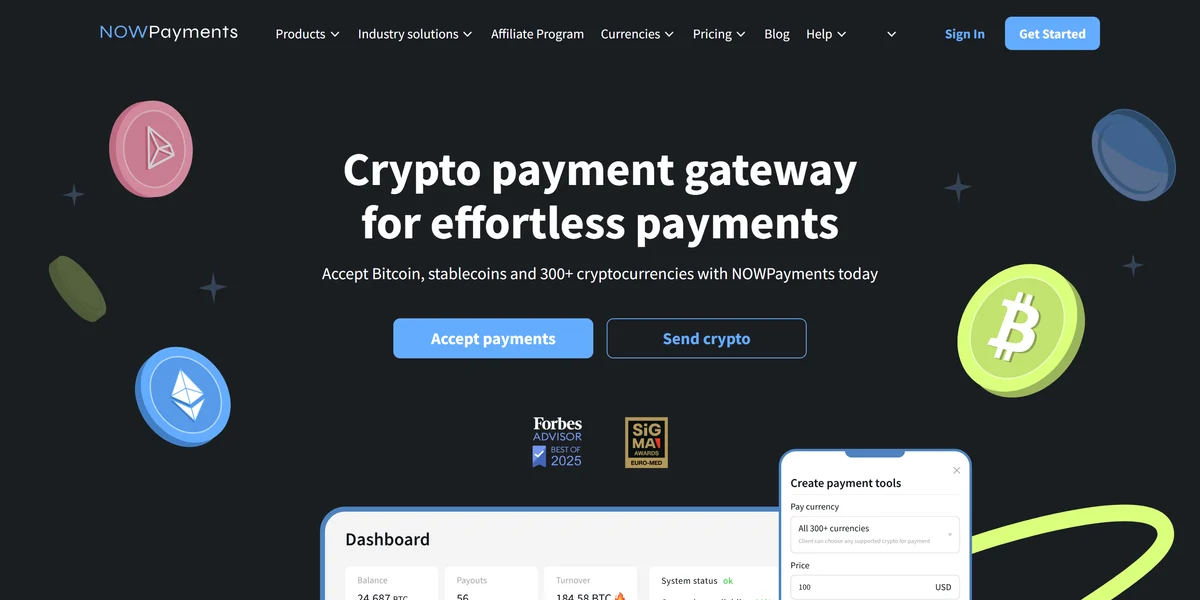
NOWPayments supports more than 350 assets and routes payments non-custodially by default, so funds reach your wallet without the provider taking possession. That combination of breadth and custody is why it is the usual first pick.
- Fees: 1% service fee, with lower rates offered as monthly volume grows
- Custody: non-custodial in its default mode
- Best for: merchants who need long tail coin support without giving up custody
2. BitPay: The Enterprise Compliance Choice
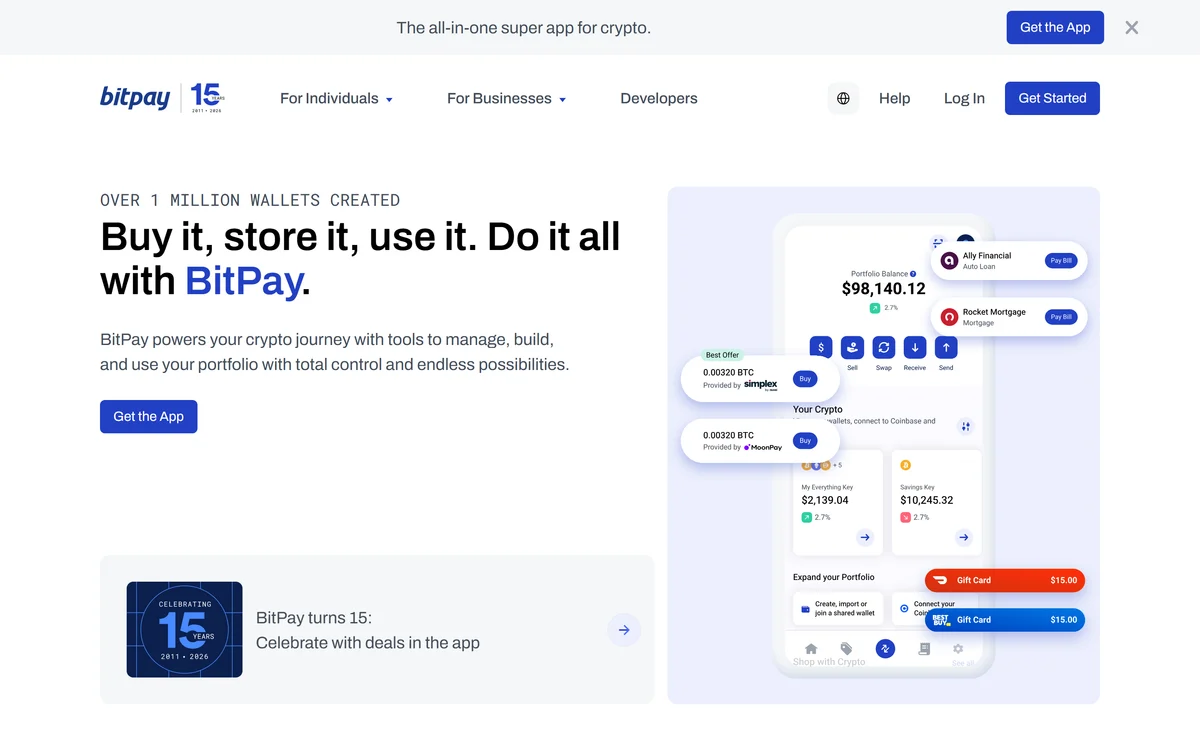
BitPay has operated since 2011, which makes it the longest running processor in the category, and it settles in seven fiat currencies (USD, EUR, GBP, CAD, AUD, MXN and NZD) or in crypto. It carries the heaviest compliance stack of any provider here, which is exactly what larger merchants are buying, and its pricing rewards volume.
- Fees: 2% plus 25 cents under $500,000 a month, 1.5% plus 25 cents up to $999,999, and 1% plus 25 cents from $1 million; higher for high-risk industries
- Custody: custodial, with fiat settlement to your bank
- Best for: established businesses that need documented compliance and accounting
- Note: the compliance depth comes with more onboarding than a lightweight processor
3. CoinGate: Built for European Merchants
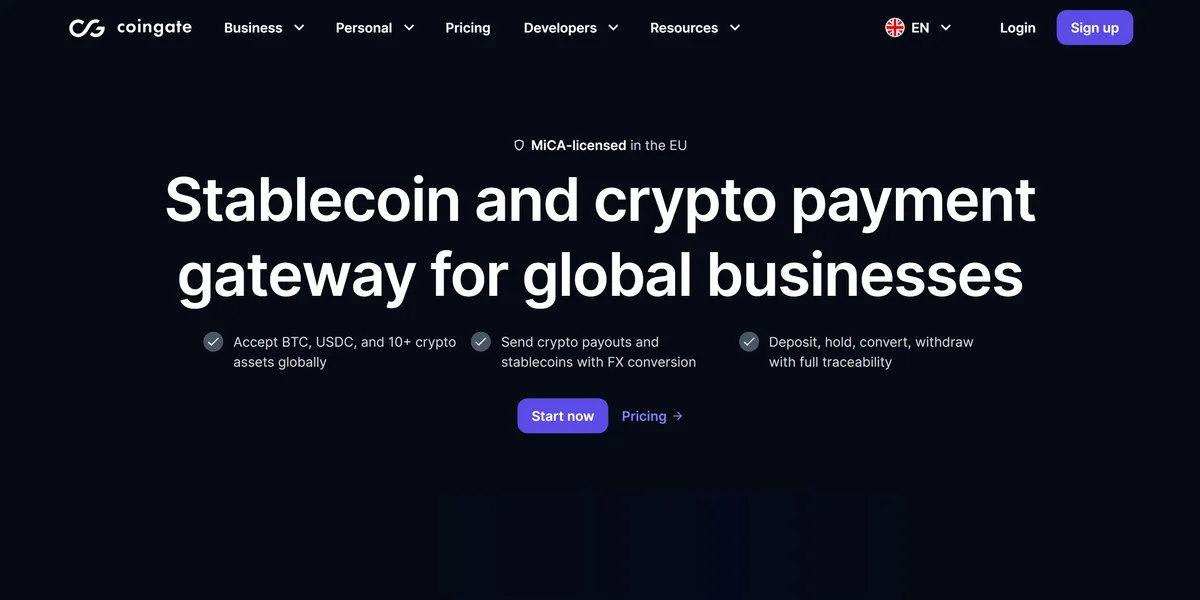
CoinGate focuses on Europe, supports Lightning and point of sale payments, and settles in EUR, GBP and USD. It is authorised as a crypto-asset service provider under MiCA by the Bank of Lithuania, which matters now that EU merchants need a licensed counterparty. For a merchant whose books run in euros, that settlement currency usually decides the choice on its own.
- Fees: 1% per payment, crypto payouts 0.50 EUR plus 0.5%, SEPA withdrawals free from 50 EUR, settlement weekly
- Custody: custodial, with EUR, GBP and USD settlement
- Best for: EU merchants, and anyone who needs in-person crypto payments
- Note: Lightning support keeps small Bitcoin payments viable where mainnet fees would not
4. CoinPayments: A Long-Running Name With a New 3% Platform

CoinPayments split its service in two. Accounts opened before 2025 stay on the legacy platform with its long coin list, while new accounts go to a new platform that supports 40+ coins and charges from 3% on coins and 1% on token payments, plus 0.1% on payouts that need conversion. That is about three times the rate of most rivals here, so it earns its place on track record rather than price. Its site also publishes a restricted countries list, so EU merchants should check it before signing up.
- Fees: from 3% on coins and 1% on tokens for new accounts
- Custody: custodial
- Best for: merchants already on its legacy platform, and stores that need its long plugin history
5. Cryptomus: Hosted Checkout With Conversion Included

Cryptomus is a custodial processor, which means it receives the payment, converts it and then settles to you. The appeal is a simpler set-up, because none of the conversion or volatility management lands on your team.
- Fees: 2% per transaction for new accounts, negotiable down to 0.4% by volume; auto-convert to your preferred currency is free
- Custody: custodial
- Best for: merchants who want the provider to absorb the conversion work
6. CoinsPaid: Full Service Processing at Volume

CoinsPaid sits in the same custodial group and targets merchants processing large volume rather than occasional payments. It runs 22 integrated blockchains and reports more than EUR 100 billion processed. The trade off is the same one every custodial processor asks you to make: simpler operations in exchange for a third party sitting on your revenue.
- Fees: quote-based; it publishes no rate
- Custody: custodial
- Best for: higher volume merchants who want processing, conversion and payouts in one contract
- Note: confirm settlement thresholds and payout timing before signing up
7. Binance Pay: An Ecosystem Rail, Not a Processor
Binance Pay moves funds between Binance accounts rather than acting as a general processor, so it works best when your customers already hold balances there. Settlement happens inside the ecosystem rather than to a bank.
- Fees: no merchant rate on a public page; check inside the merchant dashboard
- Custody: funds settle to a Binance account
- Best for: merchants with a customer base already on Binance
- Note: this is not a substitute for a processor if you need fiat in a bank account
8. BTCPay Server: Free, Self-Hosted, No Processor
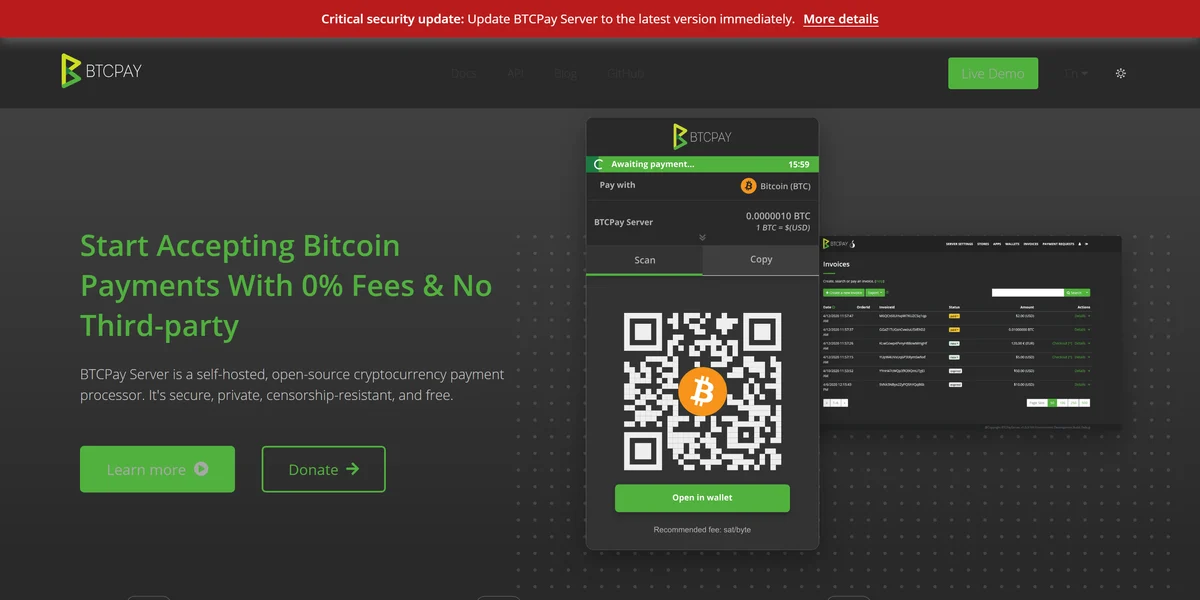
BTCPay Server is open source software you run yourself, with no company in the middle taking a percentage and nobody able to freeze your settlement. The software is free, but the hosting, monitoring and maintenance are yours.
- Fees: no processor fee, because there is no processor
- Custody: fully self-custodial
- Best for: Bitcoin focused merchants with the technical capacity to run the servers
9. Triple-A: Regulated Fiat Settlement
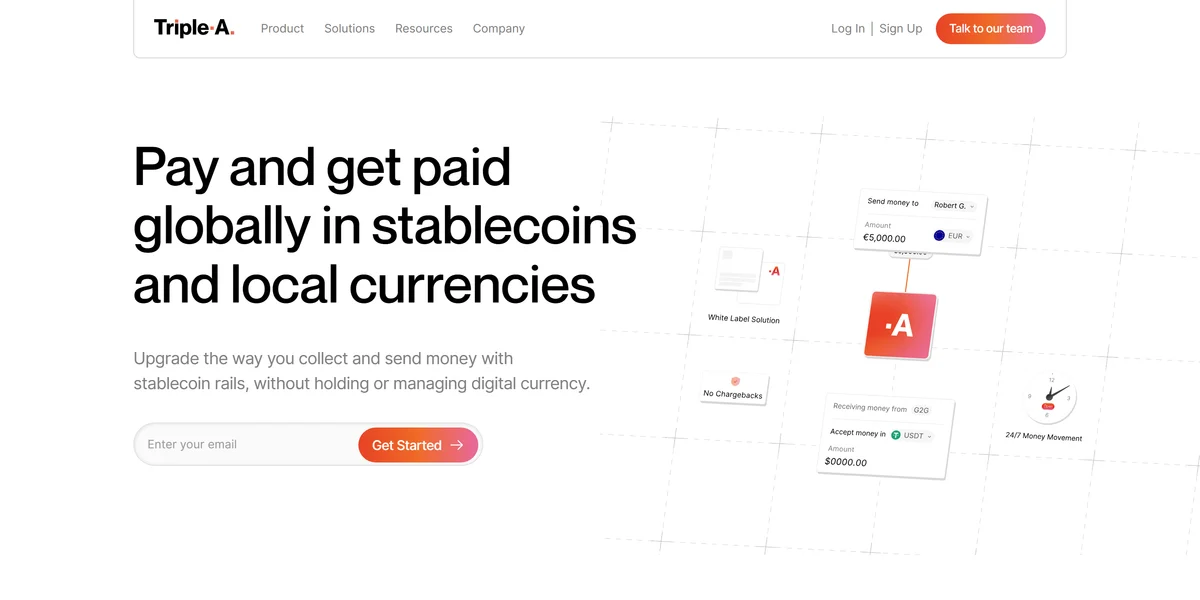
Triple-A operates as a licensed custodial processor, which is the key factor for merchants in countries where an unlicensed provider is not an option. Regulation now decides who can serve you in several markets, and this is the group that answers it.
- Fees: quote-based; it publishes no rate
- Custody: custodial, with payouts in 30+ local currencies to 70+ countries, or in stablecoins
- Licences: Major Payment Institution in Singapore (MAS), payment institution and CASP in France (ACPR and AMF), FinCEN-registered with state money transmitter licences in the US, and FINTRAC-registered in Canada
- Best for: merchants who need a licensed counterparty rather than the cheapest rate
10. Stripe With Bridge: Stablecoins Inside an Existing Stack

Stripe added crypto acceptance through its Bridge stablecoin stack, which lets merchants already running Stripe take USDC without adding a separate processor. It accepts USDC on Tempo, Ethereum, Solana, Polygon and Base (USDP and USDG for US merchants only), settles into your Stripe balance in local currency, and caps each payment at US$10,000. It is live for US businesses, with the EU, Hong Kong, Mexico and Switzerland in private preview. For existing Stripe merchants the integration work is close to zero, and that usually outweighs a better headline rate elsewhere.
- Fees: not listed on Stripe’s public pricing page; ask your account team
- Assets: stablecoin focused rather than broad coin coverage
- Best for: existing Stripe merchants adding USDC to a working checkout
- Note: this is not the route if you need long tail asset support
The Full List of Crypto Payment Gateways in 2026
The wider set operating at scale in 2026 also includes Crypto.com Pay, CoinRemitter, 0xProcessing, Coinify and OpenNode. They fall into the same three groups.
Custodial processors
- BitPay, CoinGate, CoinPayments, CoinsPaid, Cryptomus, Triple-A, Coinify
Non-custodial and self-hosted
- NOWPayments in its default mode, BTCPay Server, OpenNode for Bitcoin
Ecosystem and platform rails
- Binance Pay, Crypto.com Pay, Stripe with Bridge for USDC
Top Crypto Payment Gateway Companies
There is no single best provider, because the key factor is usually a constraint rather than a preference: your settlement currency, your country, your industry, or the platform your store already runs on. NOWPayments is the usual pick for breadth, BitPay for enterprise compliance, and CoinGate for European merchants who need EUR settlement.
- Settlement currency decides most choices, because your books run in one currency.
- Jurisdiction narrows the field fast, since several providers cannot serve regulated markets.
- Industry matters, as high risk groups are declined by the larger compliance-heavy processors.
- Existing platform often settles it, because a native plugin beats a slightly better rate.
Crypto Payment Gateway Fees Compared
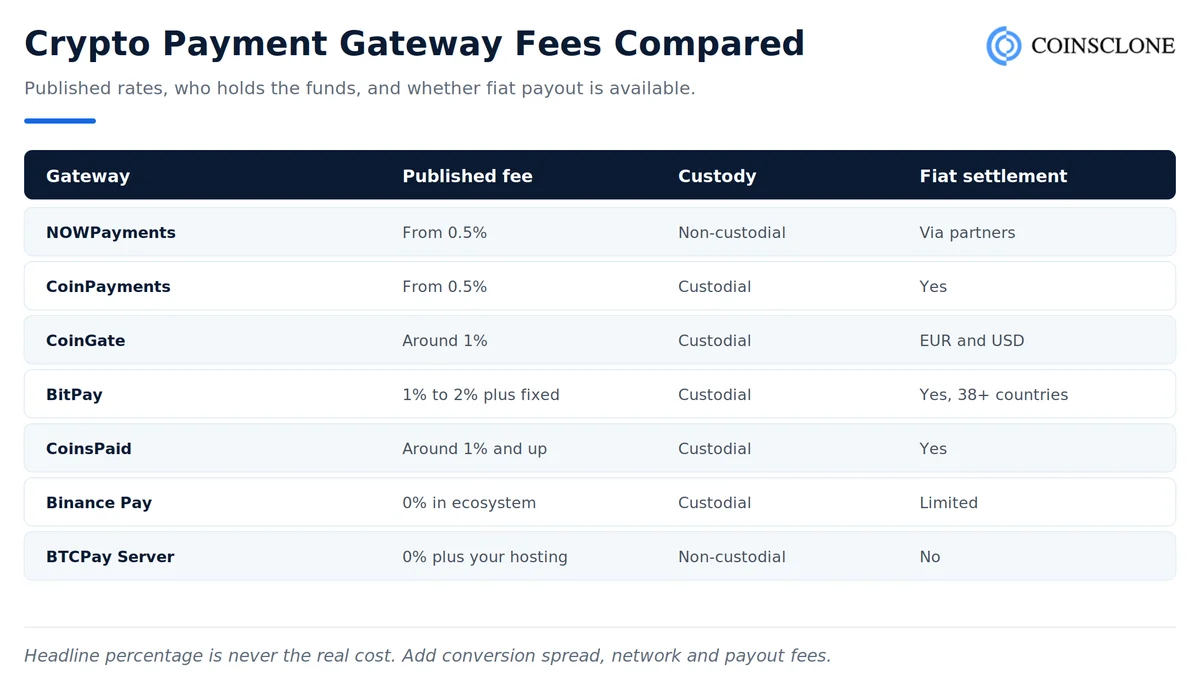
Published gateway fees in October 2026 run from 0% on self-hosted BTCPay Server to 3% on CoinPayments’ new platform, with most commercial processors at 1% to 2%: NOWPayments and CoinGate at 1%, Cryptomus at 2% for new accounts, and BitPay at 2% plus 25 cents until monthly volume passes $500,000. The headline percentage is rarely the real cost.
- Add the conversion spread if you settle in fiat or a different asset from the one received.
- Add network fees, which vary a lot between Bitcoin mainnet, Lightning, Ethereum and low cost chains.
- Add payout and withdrawal fees, minimum settlement thresholds and any charge for refunds.
- A zero fee self-hosted option still costs you hosting, monitoring and someone to maintain it.
Custodial or Non-Custodial Gateway
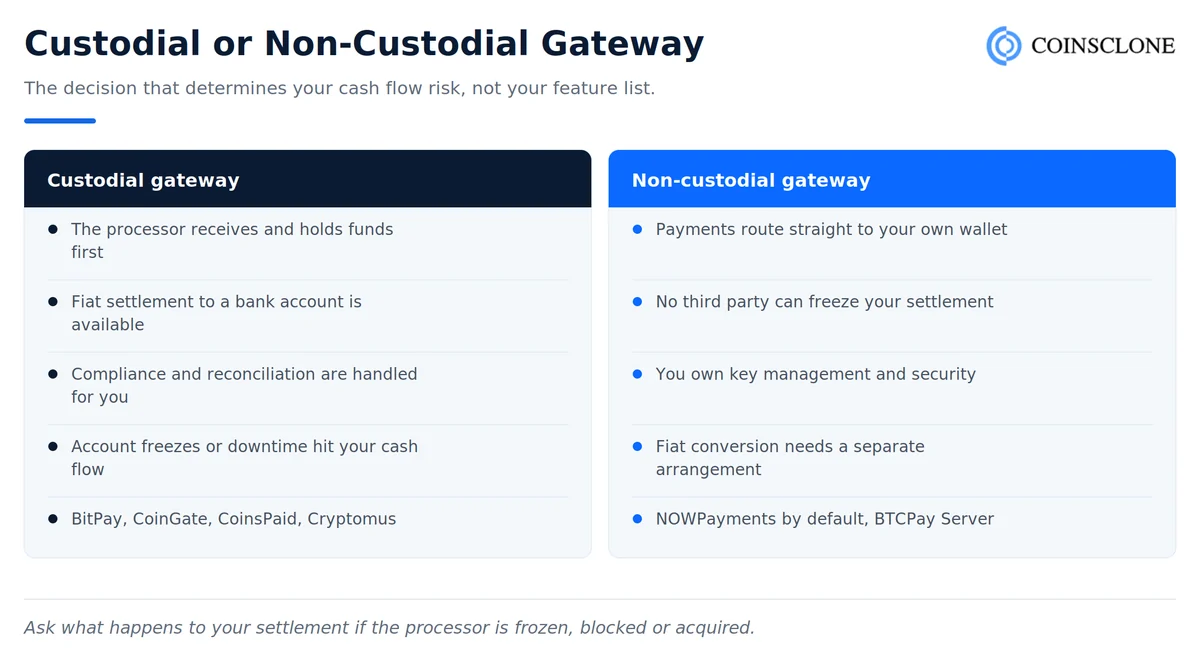
A custodial gateway receives the customer’s payment, holds it, converts it and then settles to you, while a non-custodial gateway routes the payment straight to your wallet and never takes possession. This single choice decides what happens to your cash flow if the provider is frozen, blocked or shut down.
- Custodial: simpler operations, fiat settlement, compliance handled for you, and a third party sitting on your revenue.
- Non-custodial: funds arrive in your wallet directly, nobody can freeze settlement, and key management becomes your responsibility.
- The practical test is whether you could switch processors next month without your money being stuck mid-migration.
What Happened to Coinbase Commerce
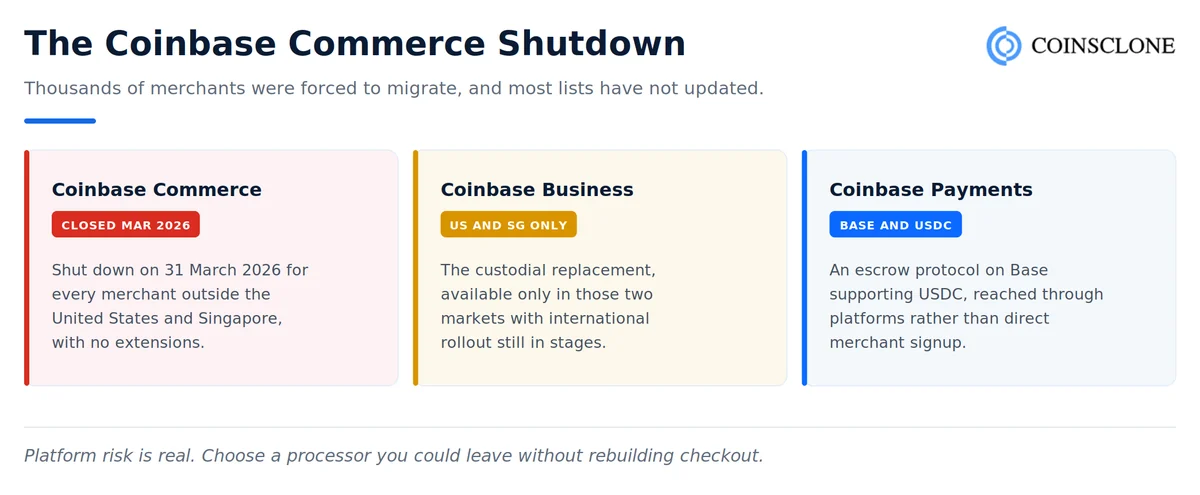
Coinbase for good shut down Coinbase Commerce on 31 March 2026 for every merchant outside the United States and Singapore, with no extensions offered. Thousands of merchants had to migrate, and most published gateway lists still recommend it.
- The replacement, Coinbase Business, is fully custodial and launched only in the United States and Singapore, with other countries rolling out in stages.
- Coinbase Payments is a separate product: an escrow protocol on Base supporting USDC, reached through platforms such as Shopify rather than direct merchant signup.
- Merchants were instructed to withdraw funds before the deadline, after which the merchant portal went offline for good.
Coinbase Commerce Alternatives
For merchants who lost Coinbase Commerce, the closest replacements by model are NOWPayments and BTCPay Server for self-custody, and CoinGate or BitPay if fiat settlement matters more than holding crypto. The main thing to preserve is the custody model you were used to.
- Coinbase Commerce was self-custodial, so a custodial processor is a change in how you work, not just a brand change.
- BTCPay Server reproduces the self-custody model exactly, at the cost of hosting it yourself.
- Check ecommerce plugin coverage before signing up, because reconnecting a store is most of the migration work.
What Changed in Crypto Payment Gateways in 2026
- Coinbase Commerce closed outside the United States and Singapore on 31 March 2026.
- CoinPayments moved new accounts to a platform priced from 3% on coins, up from the 0.5% its legacy merchants paid.
- Stripe’s stablecoin checkout went live for US businesses, with USDC on five networks and a $10,000 cap per payment.
- Licences now decide coverage: CoinGate holds a MiCA CASP authorisation, Triple-A is licensed in four regions, and providers without licences have quietly dropped markets.
How a Crypto Payment Gateway Works
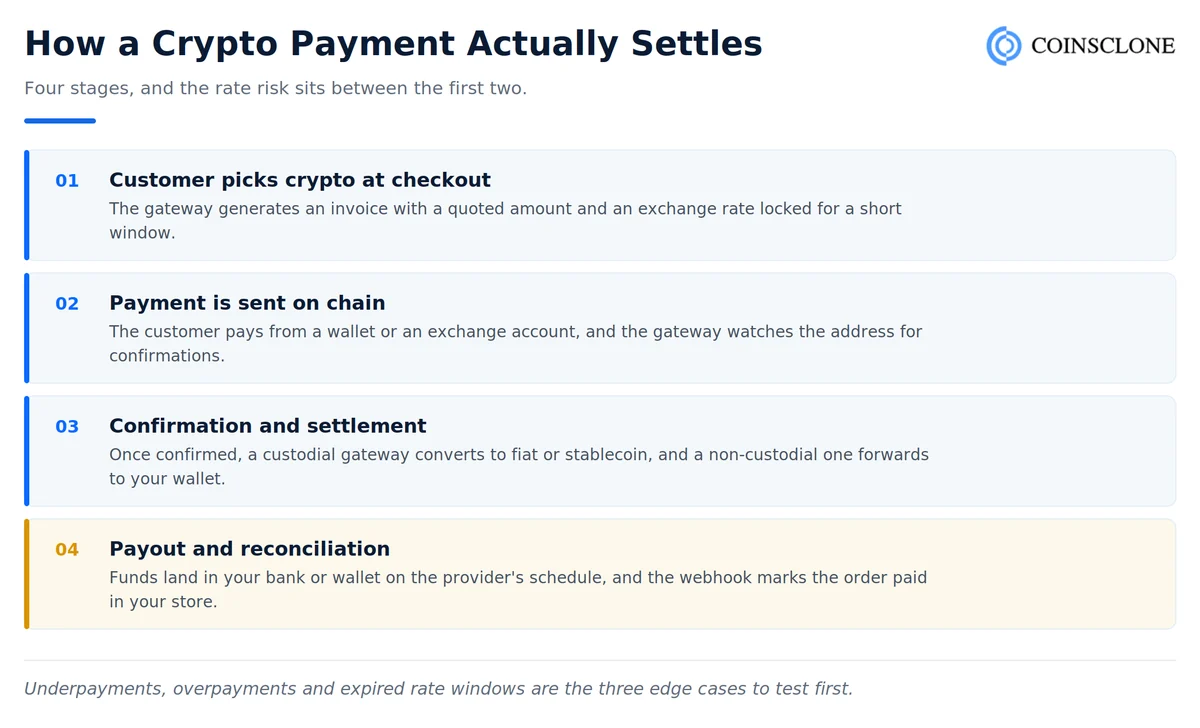
A crypto payment gateway generates an invoice with a rate locked for a short window, watches the blockchain for the payment, then converts and settles according to your settings. The rate risk sits between the quote and the confirmation, which is what the locked window exists to manage.
- The customer pays from a wallet or exchange account to a generated address or invoice.
- The gateway waits for a configured number of confirmations before marking the payment complete.
- A webhook updates your store, and settlement follows on the provider’s payout schedule.
Underpayments, Overpayments and Expired Invoices
These three edge cases cause more merchant support tickets than anything else, and gateways handle them differently. Test all three before you go live, because the default behaviour may not match your refund policy.
- An underpayment can leave an order unpaid with funds already sent, and the resolution path varies by provider.
- An expired rate window means the customer pays the right amount for the wrong rate.
- Refunds are not automatic in crypto, so check whether the gateway supports them natively.
Which Crypto Payment Gateway Fits Your Business
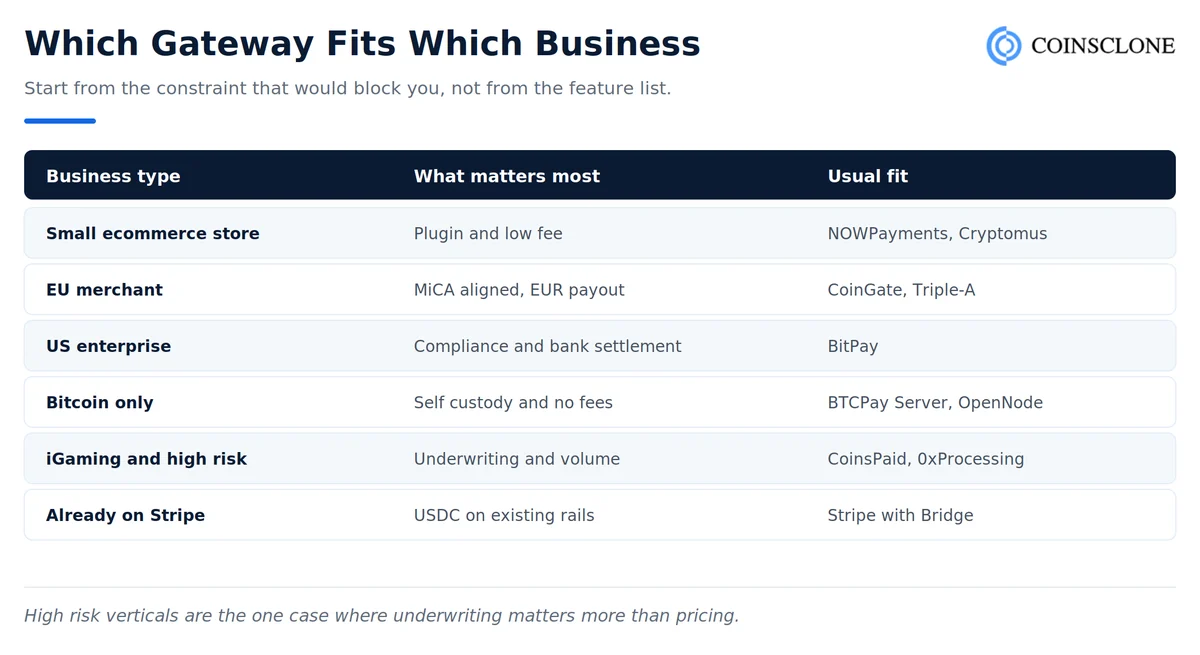
Start from the constraint most likely to block you rather than from a feature list. A small store needs a plugin and a low fee, an EU merchant needs EUR settlement under a MiCA aligned provider, and a high risk vertical needs risk approval before anything else.
- Small ecommerce: NOWPayments or Cryptomus, for plugin coverage and low fees.
- EU merchants: CoinGate or Triple-A, for EUR payout and European compliance.
- US enterprise: BitPay, for bank settlement and the heaviest compliance stack.
- Bitcoin only: BTCPay Server or OpenNode, for self custody and Lightning.
- iGaming and high risk: CoinsPaid or 0xProcessing, where risk approval matters more than pricing.
- Already on Stripe: Stripe with Bridge, to add USDC without a second integration.
Best Crypto Payment Processor for Business
For most businesses, the best crypto payment processor is the one that settles in the currency your accounts run in. BitPay and Triple-A suit companies that need bank settlement and heavy compliance, NOWPayments and CoinGate suit online stores that want low fees and plugins, and Stripe with Bridge suits businesses already on Stripe that want to add stablecoins.
- Invoicing and B2B: BitPay, CoinGate and Triple-A support invoices and payment links for business clients.
- Payouts: NOWPayments and CoinsPaid handle mass payouts to suppliers, affiliates or staff.
- Accounting: check for exports that match your bookkeeping system before you sign up.
Crypto Payment Gateways for High Risk Businesses
High risk merchants in gaming, adult and similar sectors are declined by most big processors, so the relevant providers are the ones that take on these sectors directly, such as CoinsPaid and 0xProcessing. Coinbase products have banned gambling across the board.
- Underwriting, volume tolerance and settlement reliability matter more than the headline rate here.
- Expect enhanced KYB, higher pricing and sector specific contract terms.
- Verify the provider’s own licensing, because a processor that loses banking access takes your settlement with it.
How to Add a Crypto Payment Gateway to Your Website
Adding crypto checkout to a website takes three routes, depending on how your site is built:
- Plugin: install the gateway’s plugin for Shopify, WooCommerce, Magento or similar, connect your account and choose which coins to accept. This is the fastest route.
- Payment links and invoices: create a link or invoice in the gateway dashboard and share it by email or chat. No code is needed.
- API: call the gateway’s API to create invoices from your own checkout, and listen for webhooks to mark orders as paid. This suits custom sites and apps.
Whichever route you use, test with a small real payment, check how underpayments and expired invoices are handled, and confirm the settlement currency before going live.
Regulation Now Decides Who Can Serve You
Which gateway can legally plug into your checkout increasingly depends on licensing rather than technology. In the European Union, MiCA requires CASP authorisation, and in the United States a processor needs FinCEN registration plus state money transmitter licences.
- Several providers now publish their MiCA position in plain terms, which is a reasonable signal to check before connecting.
- Stablecoin settlement is the fastest growing segment and is also the most actively regulated.
- A provider’s licensing determines which countries it can serve, which is why availability changes without notice.
Building Your Own Crypto Payment Gateway
Businesses build their own gateway when transaction volume makes third party fees material, when they want to resell payment services, or when no provider will take on their vertical. The build is an invoicing engine, wallet systems, a conversion layer, webhooks and a merchant dashboard.
- Invoicing and rate locking: quote generation, expiry handling and underpayment logic.
- Wallet systems: address generation per invoice, hot and cold split, payout batching.
- Conversion and treasury: stablecoin or fiat conversion, exposure limits and matching payments to records.
- Merchant tooling: dashboards, API keys, webhooks, plugins and reporting.
- Compliance: KYB onboarding, transaction monitoring and travel rule handling where applicable.
Our step-by-step guide on how to create a crypto payment gateway covers each part, with published build timelines. Coinsclone also offers crypto payment gateway development and a ready-made CoinPayments clone script for faster launches.
Frequently Asked Questions
What is a crypto payment gateway?
It is the service that sits between a customer paying in crypto and a merchant receiving funds, handling invoicing, blockchain monitoring, optional conversion and settlement.
Which crypto payment gateway has the lowest fees?
BTCPay Server charges nothing because there is no processor, at the cost of hosting it yourself. Among commercial processors, NOWPayments and CoinGate publish 1%, and Cryptomus negotiates below that for volume. Binance Pay publishes no merchant rate on a public page, and CoinPayments’ new platform starts at 3%.
Can I accept crypto on Shopify or WooCommerce?
Yes. Most gateways ship plugins for both, and plugin coverage is worth checking before you choose, since reconnecting a store is the bulk of any future migration.
Do I have to convert crypto payments to fiat?
No, but most merchants with fixed pricing do, because holding volatile assets between sale and accounting creates exposure. Stablecoin settlement is the middle option.
Is Coinbase Commerce still available?
Not for most merchants. It closed on 31 March 2026 outside the United States and Singapore, and the replacement products are narrower in scope and geography.
How long does a crypto payment take to settle?
Confirmation takes minutes on most chains and seconds on Lightning or low cost networks. Fiat payout then follows the provider’s schedule, which is usually daily or on request.
See How Our MVP System Can Launch Your Crypto Payment Gateway Faster
Crypto Payment Gateway Development — done right.
- MVP System : Launch your gateway 90% faster with ready-to-use modules.
- Payment & Wallet Integration : Pre-built crypto wallets and payment flows, no coding needed.
- Brand & Customization : Your design, your tokens, your supported coins.
- Revenue Engine : Earn from transaction fees, subscriptions, and staking.
See a free branded demo of your crypto payment gateway in 48 hours — before you invest a cent.
Book a Free Demo to discover how our white-label crypto payment gateway can take you from idea to live platform in just 8 to 12 weeks.
Build Your Crypto Payment Gateway with Coinsclone
Coinsclone builds crypto payment gateways for businesses that have outgrown third party processing or cannot get approved by it. Our work covers the invoicing and rate engine, wallet systems, stablecoin and fiat conversion, mass payouts, merchant dashboards, plugins and the KYB and monitoring layer that keeps banking partners comfortable.
We start from a live demo rather than a proposal document. Talk to our team about your volumes, settlement currency and target markets, and we will map the build that fits.