
This guide explains NFT website development from the first idea to launch day. It covers the two kinds of NFT website, the steps to build one, the features buyers expect, and what each build route costs in time and money. You will also see what sits behind the site, from smart contracts to file storage, and how to turn visitors into buyers.
The NFT market looks very different from the 2021 boom, so this guide uses current numbers. NFT sales reached $5.63 billion in 2025, and the average sale fell to $96. Even so, the number of sales stayed strong, which means people still buy NFTs, just at lower prices. So the sites that win today are focused, low-fee and easy to use. By the end, you will know which NFT website fits your plan and how to launch it.
In this guide:
- The two kinds of NFT website, and a quick test to pick the right one
- An 8-step build process, with the parts every NFT site needs under the hood
- The core, security and mint-page features that turn visitors into buyers
- Five niche website models with live examples from 2026
- Real build times and costs for a mint site, a white label platform and a custom build
Create a Powerful NFT Website with Expert Development
NFT Website Development — build a secure, scalable site for your NFT business.
- Custom UI/UX Design: Engaging interfaces tailored to your brand.
- Smart Contract Integration: Automate NFT minting and transactions.
- Cross-Chain Compatibility: Support multiple blockchain networks seamlessly.
- Robust Security Measures: Encryption, KYC, and fraud prevention built in.
See a free branded demo of your NFT marketplace in 48 hours — before you invest a cent.
Book a Free Demo to discover how NFT Website Development can help you launch in just 8–12 weeks.
What Is NFT Website Development?
NFT website development is the process of building a website where people can mint, buy, sell and trade NFTs. The site runs on a blockchain and uses smart contracts to record who owns each token. Users connect a crypto wallet, and the contracts handle the sale, the transfer and the creator’s royalty in one step. At the same time, artists and creators can list, auction and sell their collections.
So an NFT website is a shared need for both creators and collectors. Creators need a trusted place to launch work. Collectors need a safe place to find, check and buy it. Since NFT sites serve a global audience around the clock, a well-run platform can earn from several income streams at once.
Two Kinds of NFT Website
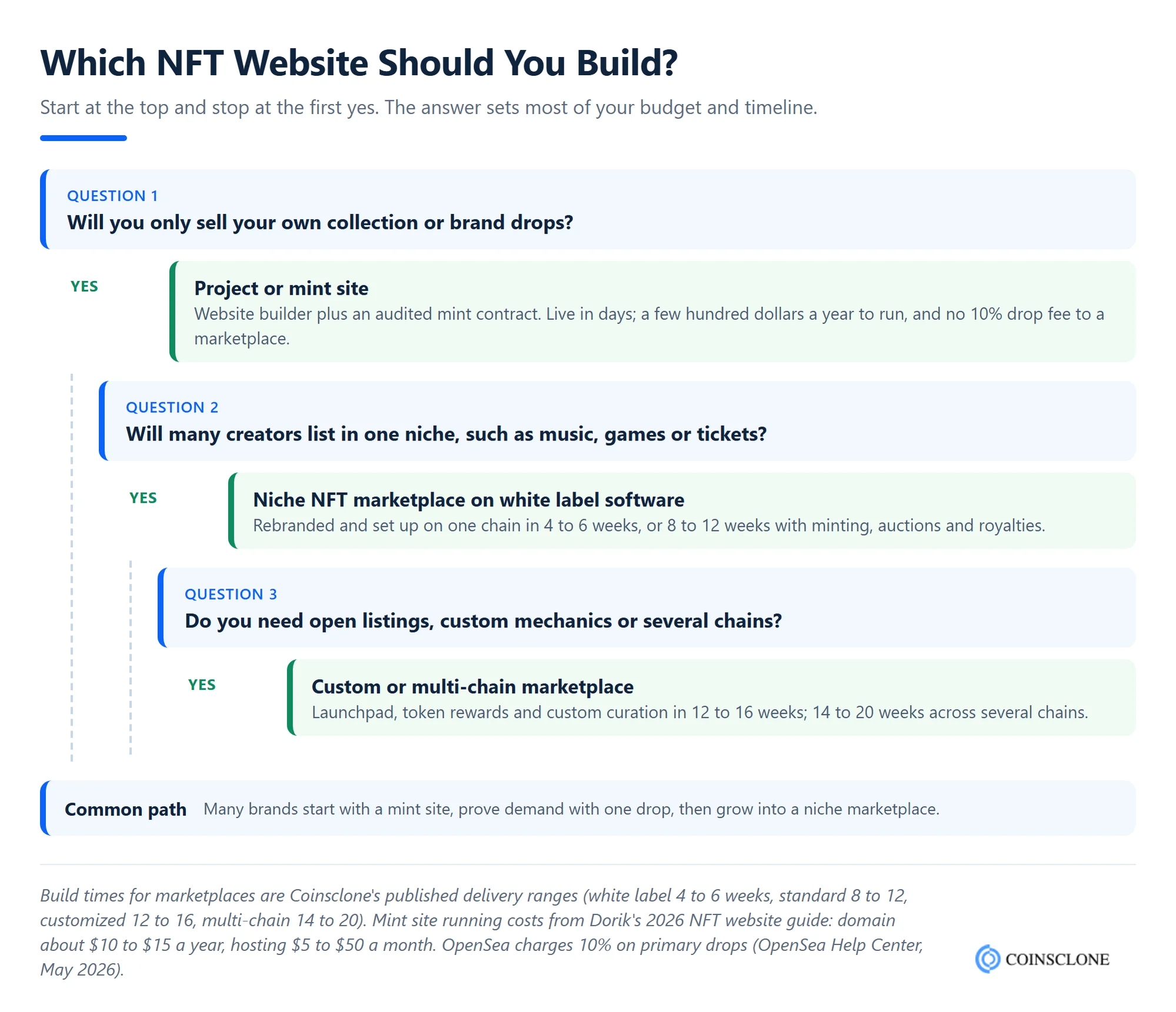
The phrase “NFT website” means two different things, and the difference decides your budget. Search results show it clearly: half the top pages are design galleries for project sites, and half are marketplace builders.
- Project or mint site: A website for one collection or brand. It shows the art, tells the story, and has a mint page where fans buy straight from your contract. Think of a landing page with a checkout.
- NFT marketplace: A platform where many creators list and many buyers trade, like OpenSea or Magic Eden. It needs listings, search, offers, auctions, royalties and an admin panel. This is a full software product.
A third option sits between them. A launchpad hosts drops for many projects but does not run open trading. Use the decision tree below to find your starting point.
Why Should You Build an NFT Website?
An NFT website that puts users first can help you stand out in a crowded market. For startups and founders who want to enter Web3, it is also one of the clearest business models: you earn when people trade. Here are the main reasons to build one.
Global Reach
NFT trading never closes, and it crosses borders by default. In the third quarter of 2025 alone, buyers made 18.1 million NFT sales, the highest quarterly count since 2022, according to DappRadar. As a result, your platform can reach a worldwide audience from day one. More users bring more listings, more trades and better liquidity.
Long-term Value
The hype has faded, but the use cases have grown. NFTs now power event tickets, game items, loyalty passes, vaulted trading cards and tokenized real-world assets. So a focused NFT website can grow with these new uses instead of depending on art prices alone. Statista projects NFT market revenue of US$318.3 million in 2026, with steady rather than explosive growth. In short, plan for a long game, not a quick flip.
Monetization Opportunities
A strong revenue model keeps any business alive. An NFT website can earn from trading fees, listing fees, primary drop fees, featured spots and brand partnerships. For scale, OpenSea charges 1% on resales and 10% on primary drops. Not only the platform owner earns, though. Artists who list their NFTs also earn from first sales and from royalties on resales.
Also Read : How does NFT Websites make money?
Room for New Ideas
At first, many NFT websites looked the same: a grid of art with a buy button. Lately, though, startups have tried fresh ideas such as music fan passes, game item trading, NFT lending and loyalty rewards. Building your own site lets you test these ideas in your niche, rather than waiting for a big platform to add them.
Future Business Scope
NFTs now meet the needs of many industries, from sports and fashion to real estate. With simple trading and support for many NFT types, your platform’s trade volume can grow over time. Thus, a complete NFT website gives you a base to expand into new markets later.
These benefits draw startups and founders to NFT website development. A site with useful features and a clean interface wins the trust of users and investors. However, you still need a clear process to get there. So here we explore…
Step-By-Step Process for NFT Website Development
Below is the step-by-step process to create an NFT website with strong features and a smooth user experience.
Idea Gathering and Planning
Before you build anything, research the needs of your target audience. Find out what people expect from NFT websites, what annoys them about current ones, and how you can solve it. This gives you a clear picture of the right build method, whether that is a simple mint site or a full marketplace.
Defining the Requirements
Once your idea is clear, list what the build needs. Define the tech stack, tools and custom parts. The key technical choices are:
- Blockchain: Ethereum for reach and trust, or a cheaper network like Polygon, Base or Solana for low gas fees.
- Token standard: ERC-721 for one-of-one items, ERC-1155 for editions and game items.
- Wallets: Which wallets users will connect, such as MetaMask, Phantom or Coinbase Wallet.
- Storage: Where the images and metadata will live, such as IPFS or Arweave.
UI/UX Design
Design is where most NFT websites win or lose users. A clean interface with easy navigation brings more traffic and more sales. Make sure the design is responsive and still performs well when you add new modules. Since many collectors browse on their phones, a mobile-first design is a must, not an extra.
Apart from these modules, you can add many other tools and upgrades to your NFT website. If you need more detail on the technical side, our guide to the “NFT Marketplace Tech Stack” walks through each layer of the platform.
Feature Integration
Next, add the essential features to the NFT website. But to build a thriving business, you also need add-on modules and extra services. So add features that help users track, compare and trade NFTs without friction. The feature list below shows what to include.
Smart Contract Development
Smart contracts are self-running programs that control how your NFT website works. They mint tokens, list items, settle sales and pay royalties. Therefore, writing them needs great care, since a bug can drain user funds within minutes. Most teams build on audited libraries such as OpenZeppelin, then add their own logic.
For royalties, use the ERC-2981 standard, which lets any marketplace read the creator’s royalty rate. Keep in mind that big trading sites often let sellers skip royalties. If creators need royalties enforced, use a contract that enforces them on-chain.
Wallet Integration
Users store and manage their NFTs in crypto wallets, so wallet support is a core part of NFT website development. Most sites let users connect the wallet they already have, such as MetaMask or Phantom. Some also add email or social login with an embedded wallet, so newcomers can buy without installing anything. Either way, make the wallet easy to reach for smooth trading and storage. If you want your own branded wallet, a crypto wallet development company can build one alongside the site.
Testing and Launching the NFT Website
Once the contracts and wallet setup are ready, test everything. First, run each contract on a test network such as Sepolia or Solana Devnet. Then check for glitches, slow pages and scaling issues under heavy traffic. Finally, get an outside security audit before you launch the NFT website on the mainnet.
Marketing and Monitoring
Launch day is the start of the work, not the end. A new site with no listings attracts no buyers, so sign creators before you go live and plan a launch drop. After launch, keep upgrading the platform and give users fast support when problems come up. So plan for regular updates and real-time help.
With this process, startups and founders can create a solid NFT website. However, every site also depends on parts users never see. So let us look at…
What Sits Behind an NFT Website
An NFT website looks like a normal web page, but it runs on four layers. Knowing them helps you plan the budget and ask the right questions of any build team.
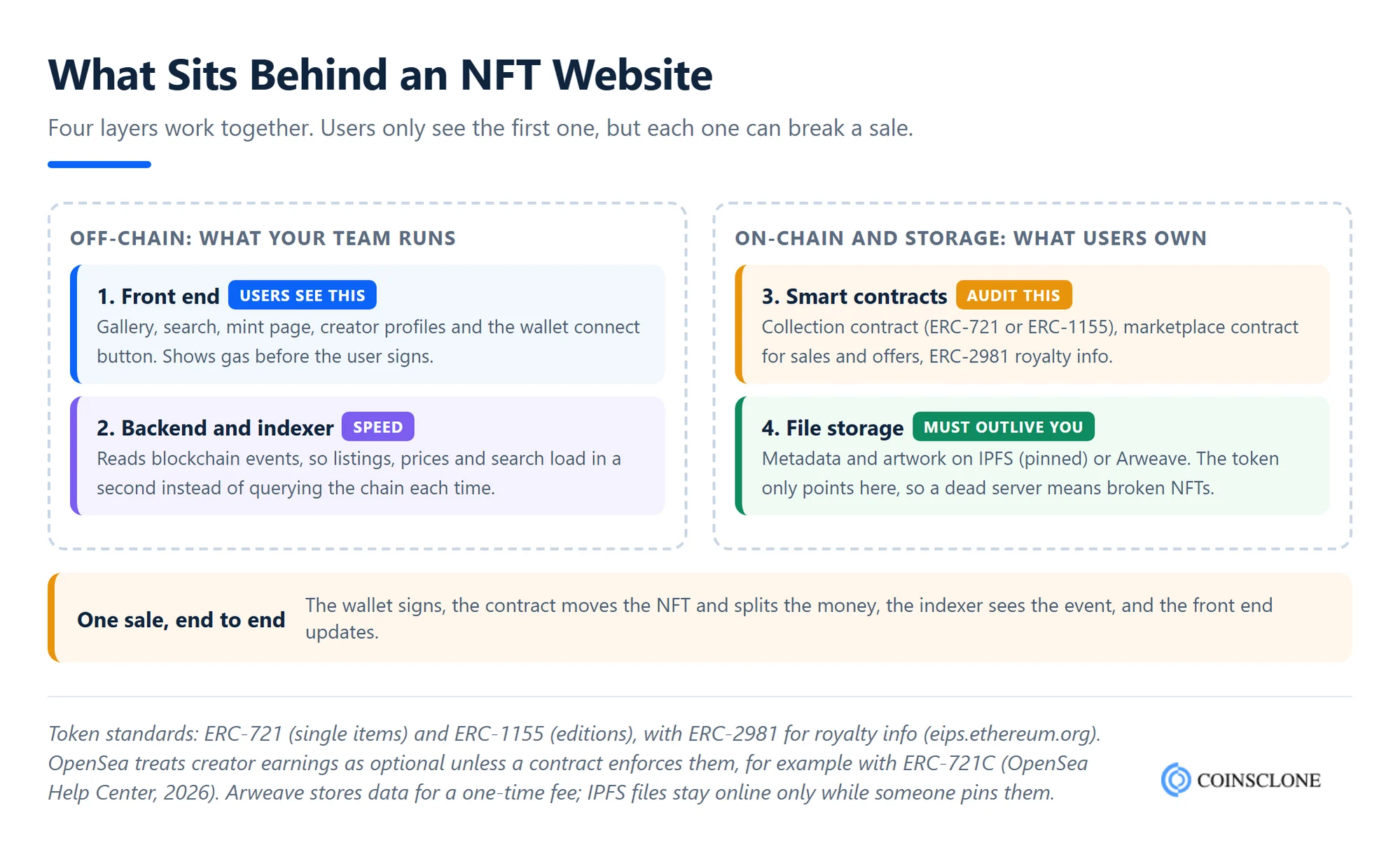
The token on the blockchain does not hold the image itself. Instead, it points to a metadata file, which then points to the artwork. So where you store those files matters. If they sit on your own server and the server goes down, collectors are left with broken links. That is why most serious projects pin files on IPFS or pay once to store them for good on Arweave.
Must-Have Features of an NFT Website
To stand out from the average NFT website, you need features that make trading smooth and safe. Your build plan should include these core, mint page and security features.
Core Features
- Attractive User Dashboard
- UI/UX design
- Cross-chain Compatibility
- Seamless Payment Options, including card checkout for new buyers
- Smart contract Auditing
- Feedback Analysis
- Referral/Reward Programs
- QR Scanner
- Efficient Listing
- Search/Filter Option
- Creator pages with royalty rates
Mint Page Features
The mint page is your checkout, so treat it like one. Small details here decide whether a visitor buys or leaves.
- One clear button: One “Connect wallet” step, then one “Mint” step. Avoid competing calls to action.
- Gas shown up front: Show the network fee before the wallet pops up, so the final price is never a surprise.
- Live supply count: Show how many are minted and how many remain.
- Plain approval steps: Explain each wallet prompt in simple words, since unclear prompts scare new buyers.
- Allowlist check: Let users see at once if their wallet qualifies for an early mint.
Security Features
- SSL Protection
- End-to-End Encryption
- Blockchain-based smart contracts
- Multi-layered Authentication
- Secure API connections
- KYC Integration
- Filters for fake and copied NFTs
Beyond these features, you can add extra modules that match your business. Pick the add-ons that support your service and your users.
To get this right, you need deep technical skill and a close eye on new trends in NFT website development. Hard work without careful planning rarely pays off. So, whatever your skills, an expert NFT Marketplace Development Company can save you time and costly mistakes.
How to Make an NFT Website Convert
A pretty site that does not sell is a gallery, not a shop. The best NFT websites build trust before they ask for money. Here is what turns visitors into buyers:
- Say what it is in one line: Put a clear promise in the hero section. Visitors should know what you sell within five seconds.
- Show the work: A collection preview or live gallery does more than any paragraph of text.
- Prove you are real: Show the team, a roadmap with dates, a contract address, and a link to the audit report.
- Answer doubts early: Add an FAQ before the final mint or buy button.
- Give a community path: Link a Discord, X or Telegram group so fans can ask questions before they buy.
- Fix the mobile view: Test the full mint and buy flow on a phone, since that is where many buyers start.
Coinsclone has delivered 350+ platforms for 200+ clients across 20 industries since 2018. That includes NFT marketplaces, minting platforms and wallets for startups at every stage. Here are the website models we build most often.
Types of NFT Website Development We Offer
At Coinsclone, our team first studies your plan for the NFT website. Based on your idea, you can build a general NFT website or a niche one. A general NFT website lets users trade any type of collectible, such as art, music or game items. OpenSea, Magic Eden and Blur are well-known examples.
On a niche NFT website, users trade only one category of NFT. NBA Top Shot, which sells licensed NBA highlight clips, is a well-known example. Based on your business needs, you can choose either model. We offer the following NFT website development services:
NFT Music Website Development
This is a niche model where only music NFTs are traded. Songs, albums, clips and fan passes are tokenized and sold as limited editions. The space is small and still changing. For example, Sound.xyz, one of the best-known music NFT sites, went offline on 16 January 2026 so its team could focus on a new fan app, Vault. So a new music NFT marketplace should pair collectibles with real fan perks, such as early access, tickets or a share of sales.
NFT Art Website Development
On this website, only art NFTs are listed and traded, from digital paintings and sketches to generative art. SuperRare is a well-known curated art site, while OpenSea also hosts a large art section. Many art sites have shut down since 2024, such as Foundation, Nifty Gateway, MakersPlace and KnownOrigin. So a new art site needs a sharp niche and low fees to last.
NFT Gaming Website Development
On a gaming website, only in-game NFTs are traded. Armor, weapons, skins, land and characters are tokenized so players can own and trade them. Axie Infinity and The Sandbox are two well-known NFT games. A gaming site works best when it connects directly to the game, so players can trade without leaving it.
NFT Minting Website Development
An NFT minting website lets users, creators and artists turn their work into NFTs. It handles the upload, the metadata, the smart contract and the drop page. OpenSea offers minting through its drops, but it charges 10% on primary sales. That fee is why many brands build their own NFT minting platform and keep the full revenue from each drop.
NFT Lending Website Development
On this platform, NFT holders can borrow crypto against their NFTs without selling them. Loans are paid out in crypto or stablecoins, and the NFT is held as collateral until the loan is repaid. Blur’s Blend and Gondi are the leading active protocols today. However, NFT lending volume has fallen about 97% from its early 2024 peak, so this model fits best as a feature inside a larger marketplace.
We create NFT websites for everyone from first-time founders to large brands, helping each one stand out in its niche. Our ready-made NFT software also keeps the cost down without cutting corners.
Speaking of cost, let us look at the numbers…
How Much Does It Cost to Create an NFT Website?
The cost to build an NFT website depends on three things: the kind of site, the build method and the features you need. A simple mint site can cost a few hundred dollars a year to run. A full marketplace, on the other hand, is a software project with a budget to match. Here is how the three routes compare.
A Project or Mint Site
If you only need a website for your own collection, a website builder is enough. A domain costs about $10 to $15 a year, and hosting about $5 to $50 a month, based on Dorik’s NFT website guide. Then add the cost of your mint contract, its audit and the gas to deploy it. Gas is a few cents on networks like Base or Polygon, but it costs far more on Ethereum.
Developing From Scratch
Building from scratch means creating every part of the NFT website from the ground up. Each feature goes through careful design and testing. This method gives you full control, so you can test unusual ideas and custom features. However, it takes the longest. Based on our own build times, a custom site takes 12 to 16 weeks, and one that runs on many chains takes 14 to 20 weeks.
As for budget, market estimates for a full NFT marketplace range from about $20,000 with a team in Asia to $200,000 or more in North America. Our NFT marketplace development cost guide breaks this down by region and feature.
Using a White Label NFT Website Solution
The next method is a white-label solution, the fastest and cheapest way to launch a full platform. It is ready-made software with proven features that you rebrand and customize with add-on modules. A white label NFT marketplace launches in 4 to 6 weeks, and a standard build with minting, auctions and royalties takes 8 to 12 weeks. Coinsclone builds these on its NFT marketplace clone script, with your brand, your chain and your fee model.
For example, if you want a general NFT website like OpenSea, you can start from the OpenSea Clone Script. It helps you launch quickly while keeping room to add your own features later.
Remember, these figures are averages, and your final cost depends on your plans. For an exact quote, share your project needs with our team. We will suggest the best method for you, with a clear cost and timeline. Building a successful NFT website takes time, effort and the right guidance, and Coinsclone can be your partner along the way.
Mark Your NFT Venture with Our NFT Website Development Services!
Perfect Solutions. Startup-Friendly. Customizable Products. Get A Free Consultation!
Why Choose Coinsclone for NFT Website Development Services?
Coinsclone is a leading NFT marketplace builder in the crypto space. Since 2018, our team has delivered 350+ platforms for 200+ clients across 20 industries, from NFT marketplaces to exchanges and wallets. We focus on what you need: a secure platform, a clean design and a fast launch at a fair budget.
Our team is on hand 24/7 to help. Our blockchain developers handle every part of the build, from smart contracts and audits to design, wallets and launch support. If you are new to the space, our guide on how to build an NFT marketplace explains each step in more depth. So reach out to our team and start your NFT website with a clear plan.
Create a Powerful NFT Website with Expert Development
NFT Website Development — build a secure, scalable site for your NFT business.
- Custom UI/UX Design: Engaging interfaces tailored to your brand.
- Smart Contract Integration: Automate NFT minting and transactions.
- Cross-Chain Compatibility: Support multiple blockchain networks seamlessly.
- Robust Security Measures: Encryption, KYC, and fraud prevention built in.
See a free branded demo of your NFT marketplace in 48 hours — before you invest a cent.
Book a Free Demo to discover how NFT Website Development can help you launch in just 8–12 weeks.
Frequently Asked Questions
What is NFT Website Development?
NFT website development is the process of creating a blockchain-based website where users can mint, buy, sell and show digital assets as NFTs. Smart contracts handle ownership, sales and royalties, while the website gives users a simple way to use them.
How does an NFT website work?
An NFT website connects a user’s crypto wallet to a blockchain. When a user mints or buys, the website asks the wallet to sign a transaction. The smart contract then moves the NFT, pays the seller and sends any royalty to the creator. The website reads the blockchain to show who owns what.
How long does it take to develop an NFT website?
It depends on the type of site and its features. A white label NFT marketplace launches in 4 to 6 weeks. A standard marketplace with minting, auctions and royalties takes 8 to 12 weeks. A customized platform with a launchpad and token rewards takes 12 to 16 weeks, and a multi-chain marketplace takes 14 to 20 weeks.
How much does it cost to build an NFT site?
A simple project site on a website builder costs a few hundred dollars a year, plus the cost of your mint contract and its audit. A full NFT marketplace is a larger project. Market estimates run from about $20,000 to $200,000 or more, depending on the team’s region, the build method and the features.
Do I need coding skills to create an NFT website?
Not for a simple project site. Website builders and no-code mint tools let you launch a collection page without code. However, a full marketplace needs skilled blockchain developers. Or you can start from white label software built by an expert team.
What technologies are used in NFT website development?
NFT websites use blockchain networks, smart contracts, Web3 libraries, crypto wallets, decentralized storage such as IPFS or Arweave, and modern frontend and backend tools. An indexer also reads the blockchain so the site can show listings and search results quickly.
What are the essential features of an NFT website?
Common features include user sign-up, wallet connection, NFT minting, listings, search and filters, royalty settings and secure payments. A good site also shows gas fees up front, works well on mobile and shows clear proof of trust, such as an audit report.
Is NFT still relevant in 2026?
Yes, but the market has changed. NFT sales fell 37% to $5.63 billion in 2025, and the average sale dropped to $96, according to CryptoSlam. At the same time, DappRadar counted 18.1 million sales in Q3 2025, the most in any quarter since 2022, and NFTs moved into tickets, games, loyalty and real-world assets. So NFTs are not worthless; they are cheaper and more useful than in 2021.
What are the best NFT websites?
OpenSea, Magic Eden and Blur are the largest general marketplaces, while sites like NBA Top Shot lead their niches. Each one has different fees, chains and buyers. See our list of the best NFT marketplaces for a full comparison.