
This guide explains NFT marketplace app development for founders who want their marketplace on iPhone and Android phones. It covers what an NFT app is, the ways to build one, the wallet and tech choices, the features users expect, and what it costs in time and money. It also covers the part most guides skip: what Apple and Google Play allow an NFT app to do.
The NFT market is quieter than the 2021 boom. NFT sales reached $5.63 billion in 2025, down 37% from 2024. Yet people still buy NFTs every day, and more of them use their phones to do it. In fact, OpenSea relaunched its mobile app in July 2026. So the apps that win now are simple, low-fee and built for a niche. By the end, you will know how to plan, build and launch your own NFT marketplace app.
In this guide:
- What an NFT marketplace app is and why mobile matters in 2026
- An 8-step build process, plus native vs cross-platform and wallet choices
- The App Store and Google Play rules that decide how users can buy NFTs in your app
- The features, real app examples and costs to plan around
- How long each build route takes, with Coinsclone’s published delivery times
Launch a Mobile NFT Marketplace App for Creators and Collectors
NFT Marketplace App Development — designed for users on the go and NFT enthusiasts.
- Seamless Mobile Experience: Mint, list, and trade NFTs directly from the app.
- Multi-Chain & Wallet Support: Integrates with Ethereum, BSC, and popular wallets.
- Real-Time Updates: Push notifications for auctions, bids, and new NFT drops.
- Monetization Ready: Earn through transaction fees, listings, and premium app features.
See a free branded demo of your NFT platform in 48 hours — before you invest a cent.
Book a Free Demo to discover how our NFT Marketplace App Development can help you launch a fully functional mobile NFT platform in just 8–12 weeks.
What Is NFT Marketplace App Development?
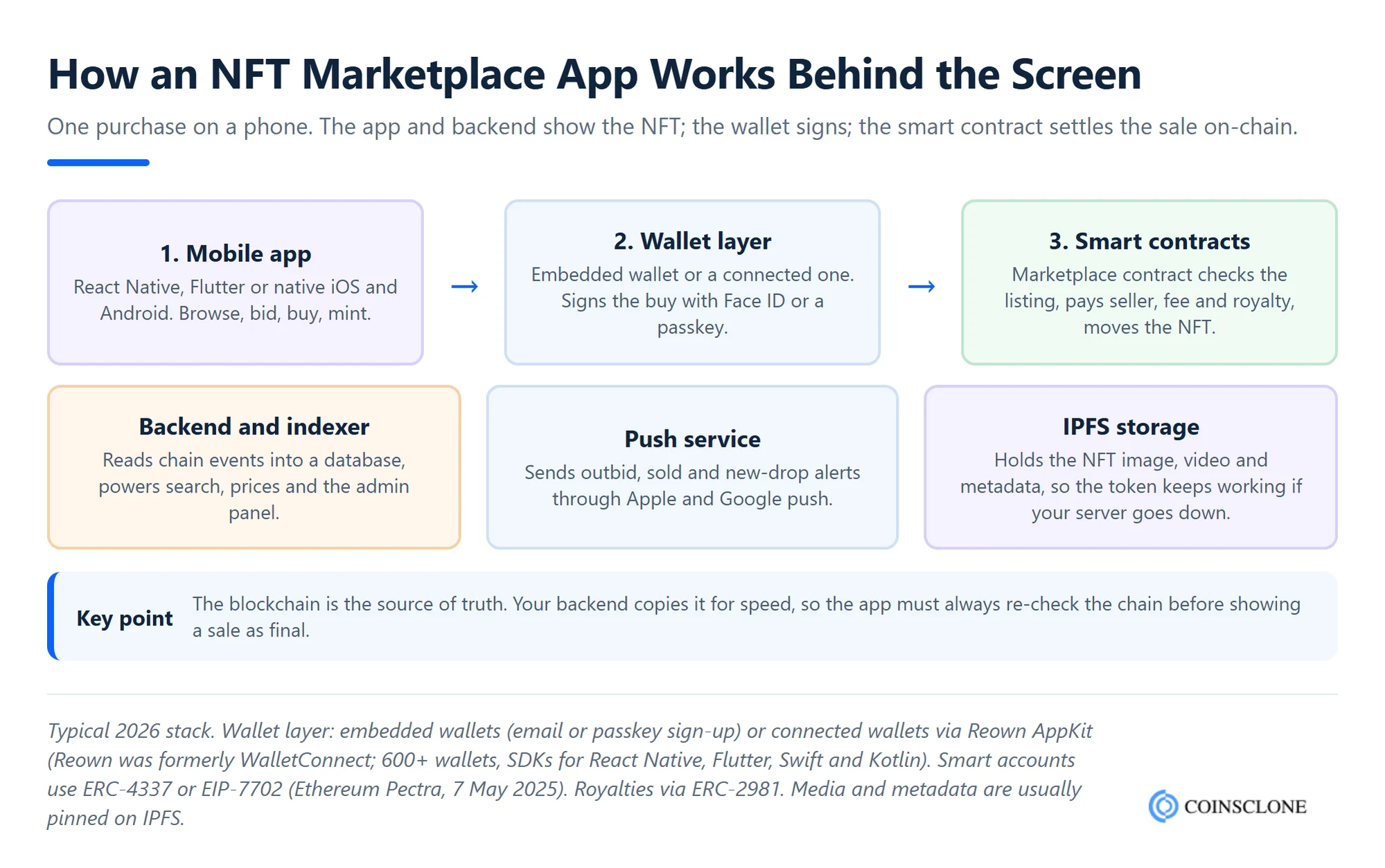
NFT marketplace app development is the process of building a mobile app where people can mint, buy, sell and trade NFTs. The app connects to a blockchain, such as Ethereum, Polygon, Base or Solana. Smart contracts on that chain record who owns each token and settle every sale. Users hold their NFTs in a crypto wallet, either built into the app or linked to it.
When NFTs first appeared, many people thought the craze would not last. The hype did fade, but NFTs stayed. Today they are used for digital art, music, game items, tickets, memberships and real-world assets. As a result, NFT marketplaces with focused features keep finding buyers, even in a smaller market.
Why Should You Opt for an NFT Marketplace App?
Crypto users prefer apps for one simple reason: convenience. With an NFT marketplace app, users can buy, sell or trade NFTs at any time and in any place. They carry their phones everywhere, so they can act the moment a drop goes live or a bid comes in.
Mobile also changes what a marketplace can do. For example:
- Push alerts: Tell users the second they are outbid, an item sells or a new collection drops.
- Faster sign-in: Face ID, fingerprint and passkeys replace long passwords and browser extensions.
- Camera and media: Creators can shoot, edit and mint new work straight from the phone.
- Real-world use: NFT tickets and passes can be scanned at the door from the same app.
This is why the biggest players are betting on mobile again. OpenSea’s new mobile app lets users sign up with just an email. It creates self-custodial wallets for them in the background, with no seed phrase to write down. That is the bar your app will be measured against.
How To Create an NFT Marketplace App?
There are three main ways to build an NFT marketplace app. You can build from scratch, use a white label solution, or use a clone script.
Building from scratch gives you full control. However, it takes a lot of time, money and deep technical skill, and the chance of failure is high. This is rarely the best choice for startups in a crowded market.
On the other hand, white-label NFT marketplace apps are ready-made, and you can shape them to fit your brand. To copy the model of a proven app, you can also use an NFT marketplace clone script, such as an OpenSea clone, from a trusted team. Both routes let you launch your app much faster.
Whichever route you choose, the build follows the same path. Here are the eight steps, with a mobile focus. For the full web-and-contract process, see our guide on how to build an NFT marketplace.
Step 1: Pick Your Niche and Audience
Start with who your app serves. A broad NFT app has to fight OpenSea for each user. A niche app for music, game items, tickets, sports or art can win a loyal crowd faster. Your niche also decides your fee, your features and your launch plan.
Step 2: Choose Your Blockchain
Next, pick the chain your NFTs will live on. Ethereum has the most trust and buyers. Layer 2 networks like Base, Arbitrum and Polygon keep fees low, which matters for small mobile purchases. Solana is fast and cheap, and gamers and art fans like it. Many apps now support more than one chain.
Step 3: Choose Your Build Route
Decide between white label, clone script or custom build, based on your budget and launch date. We compare the time and cost of each route later in this guide.
Step 4: Decide How Users Hold Their NFTs
This is the biggest mobile choice. You can build a wallet into the app, let users connect the wallet they already have, or offer both. We explain each option in the wallet section below.
Step 5: Design for the Phone
Design for a small screen and a busy thumb. Keep buying to a few taps. Show the full price, including network fees, before the user confirms. Make the NFT media load fast, even on a weak signal.
Step 6: Write and Audit the Smart Contracts
Smart contracts handle minting, listings, bids, sales and royalties. Use proven standards like ERC-721 and ERC-1155. Then have an outside firm check the code before launch. A bug in a contract can cost users real money, and it cannot be patched like an app.
Step 7: Build and Test the App
Your team now builds the iOS and Android apps, the server side and the admin panel. Test each flow on test chains first, such as Sepolia or Amoy, since Goerli and Mumbai are retired. Then run a closed beta with real users through TestFlight and Google Play’s internal testing.
Step 8: Submit to the App Stores and Launch
Finally, submit the app to Apple and Google. Apple says that, on average, 90% of submissions are reviewed in under 24 hours. However, NFT and wallet apps get extra checks, so plan for at least one round of changes. After launch, keep updating the app, the contracts and your security.
Native, Cross-Platform or Web App?
Once you know your route, choose how the app itself is built. Each option trades speed against polish.
| Approach | Tools | Best for | Trade-off |
| Native apps | Swift (iOS), Kotlin (Android) | Large apps that need top speed and deep phone features | Two code bases, so more time and cost |
| Cross-platform | React Native, Flutter | Most startups; one code base for both stores | Some phone features need extra native work |
| Mobile web app (PWA) | Next.js, React | Testing an idea before going to the stores | No App Store listing; weaker push alerts on iPhone |
For most NFT startups, cross-platform is the sweet spot. Both React Native and Flutter have mature Web3 tools. For example, Reown AppKit, from the team once called WalletConnect, works with React Native, Flutter, Swift and Kotlin.
Wallets in an NFT Marketplace App
Every NFT sits in a wallet, so the wallet choice shapes your whole app. There are three common models.
- Connected wallets: Users link a wallet they already own, such as MetaMask or Phantom. Reown AppKit connects to more than 600 wallets this way. This suits experienced collectors, who like to keep their own keys.
- Embedded wallets: The app creates a wallet when the user signs up with an email, social login or passkey. There is no seed phrase and no extension. This suits newcomers, and it is the model OpenSea’s new app uses.
- Smart accounts: A contract wallet built on ERC-4337 or EIP-7702 (live since Ethereum’s Pectra upgrade in May 2025). Your app can pay the gas for users, add spending limits and offer easy account recovery.
Many apps now offer an embedded wallet by default, with a “connect your own wallet” option for power users. In addition, wallet apps on iOS must come from a company account. Apple’s App Review Guidelines allow wallet features only from developers enrolled as an organization.
Essential Features for an NFT Marketplace Application
Crypto users pick an NFT app for its features and add-ons. So features play a key role in your success. Here are the essential features of an NFT marketplace app.
- Storefront: The home screen of your app. It must look good and be easy to use.
- Filter and Search: Users expect to find the right NFT fast, by price, collection, chain or traits.
- Listing: Sellers need a simple way to list NFTs at a fixed price or for auction.
- NFT Pages: Each NFT and collection gets its own page, with media, history, owner and price.
- Multi-wallet support: Users can sign in with an embedded wallet or connect the wallet they already use.
- Auction: Sellers can run timed auctions, and buyers get an alert the moment they are outbid.
- Minting: Creators can turn their work into NFTs inside the app, including gas-free lazy minting.
- Multi-chain Support: Users on many chains can trade in one place.
- Royalties: Creators earn a share of each resale, set through the ERC-2981 standard.
- Push Notifications: Alerts for bids, sales, price drops and new drops bring users back to the app.
- Face ID Login: Face or thumb checks guard logins and confirm each purchase.
The list above covers the core features. Apart from these, you can add your own modules, such as token-gated content, NFT staking or fiat on-ramps. For more ideas, see our list of must-have NFT marketplace features.
App Store and Google Play Rules for NFT Apps
This is where many NFT apps get stuck. Apple and Google both allow NFT apps, but each sets firm rules on how users can pay. Since these rules shape your whole business model, read them before you design the checkout.
Apple App Store
Apple’s rule 3.1.1 deals with NFTs head-on. In short:
- Selling NFTs: If your iOS app sells NFTs, or charges for minting, listing or moving them, it must use Apple’s in-app purchase. Apple then takes its usual cut: 30%, or 15% for developers in the Small Business Program (under $1 million in yearly proceeds).
- Viewing NFTs: Apps may show users their own NFTs and let them browse other collections. However, owning an NFT may not unlock features inside the app.
- Outside links: In most countries, the app may not show buttons or links that send users to buy elsewhere. The US store is the one exception. There, apps may link to other ways to pay.
Google Play
Google Play’s Blockchain-based Content policy lets apps sell NFTs, with a few rules:
- Declare it: You must declare NFT sales in the Financial features form in Play Console. Each in-app product that is an NFT must be marked as a tokenized digital asset.
- No paid mystery packs: Users cannot pay for a chance at an NFT of unknown value.
- No betting: NFTs cannot be used to wager for prizes of real-world value.
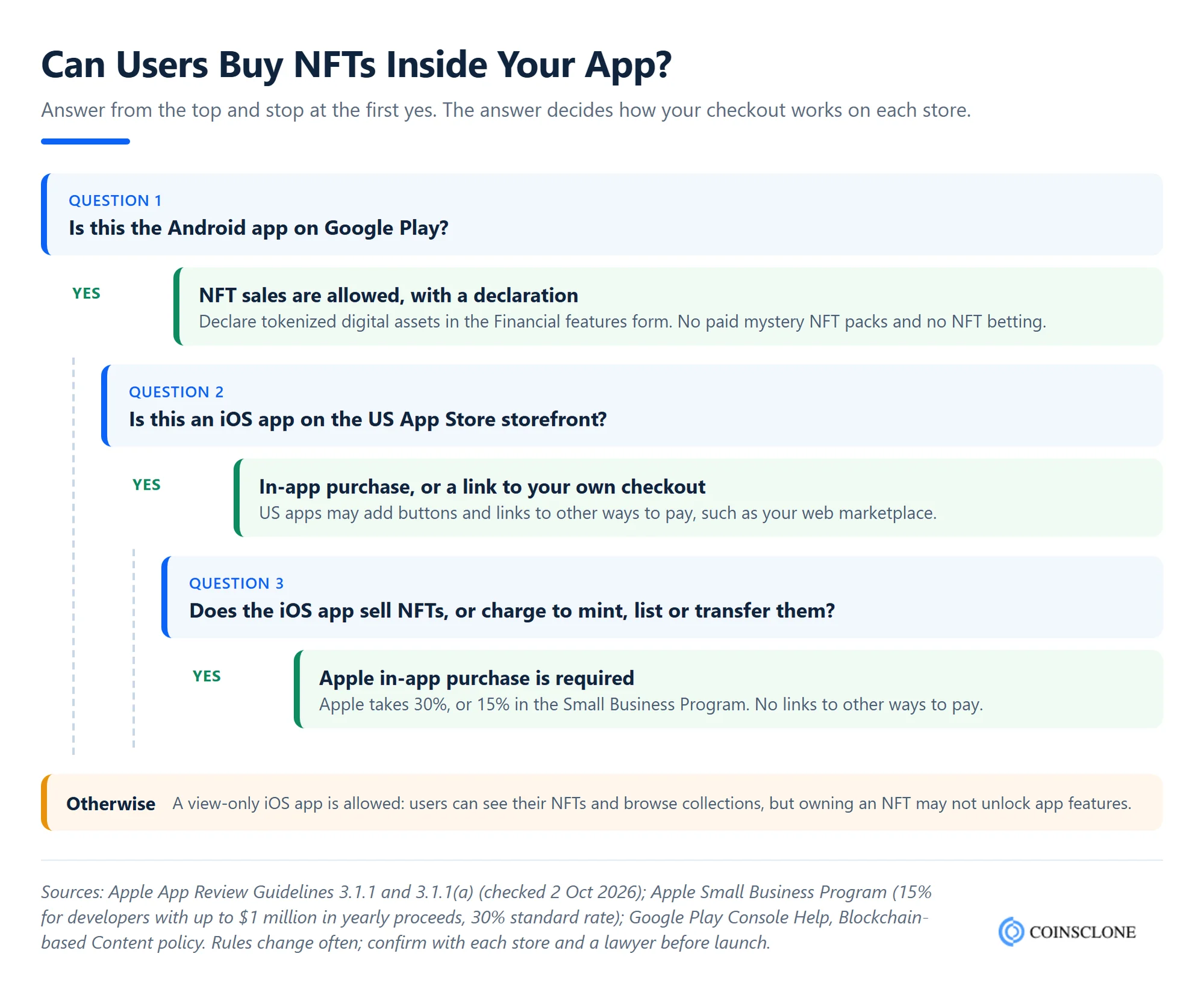
These rules explain a pattern you will see on the stores. Many NFT apps on iOS are “view and track” apps, while the actual buying happens on the web. Others focus on the US storefront, where they can link out to a web checkout. To see why, look at the money.
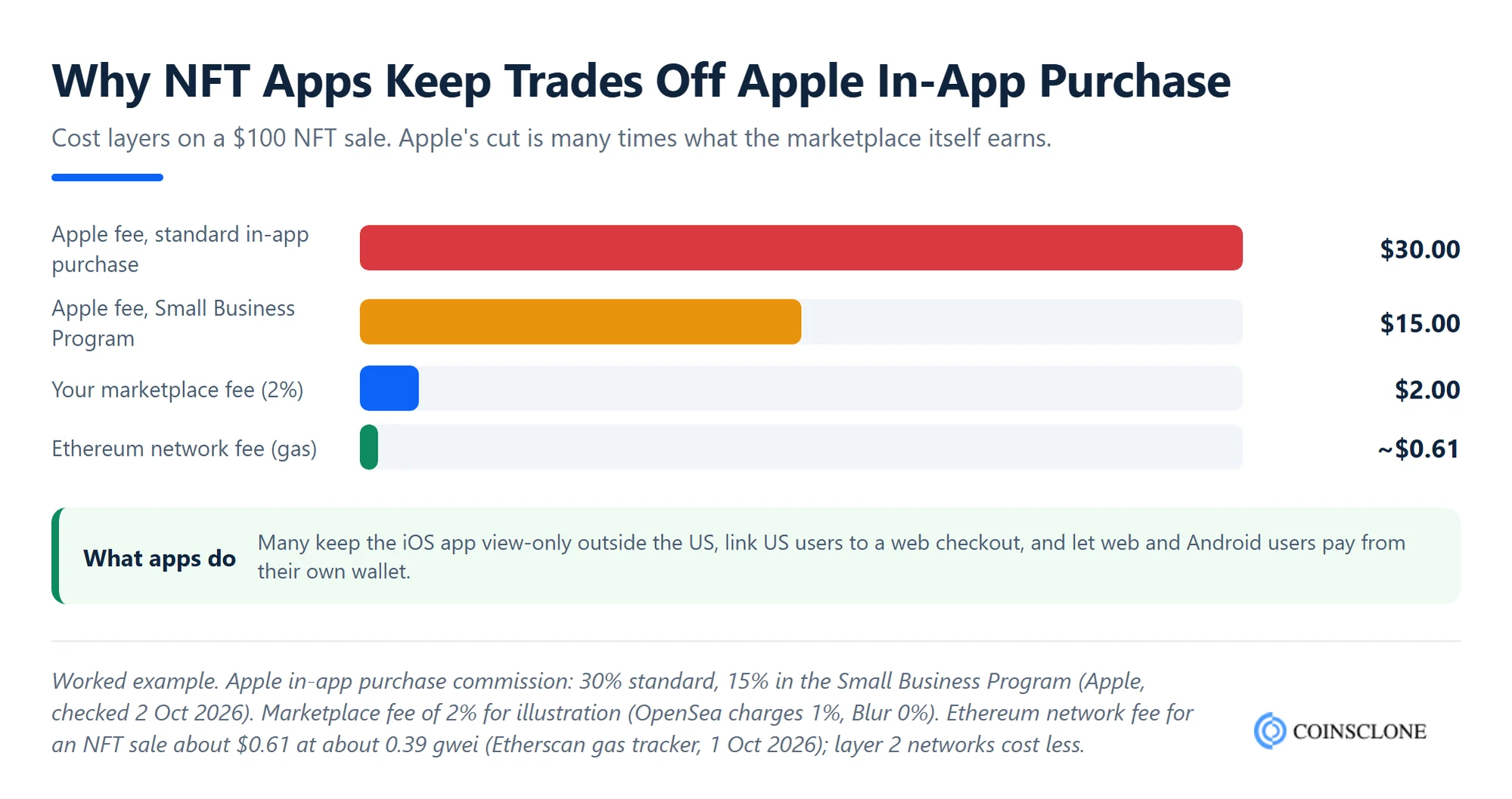
An NFT marketplace usually earns 0% to 2% per sale. Apple’s in-app purchase fee is 15% to 30%. So for trades, most apps keep payment on-chain, from the user’s own wallet, and design the iOS app around the rules above. Plan this with your development team and a lawyer before you build.
Benefits of NFT Marketplace App Development
For a startup or a founder, a well-built NFT app can bring many rewards. Here are the most common ones.
Easy to Use: Crypto users always prefer a simple screen. When your app’s features are simple and engaging, users can trade without confusion. A clean dashboard also helps you win the attention of global users.
Strong Security: Data locks, Face ID login, safe wallet links and checked contracts help you stand out. Phones are often lost or targeted by scams, so these protections are essential. They also build trust among NFT traders.
Vast Number of Users: Phone apps are easy to use and widely loved. So an NFT app is a smart way to reach crypto traders where they spend their time.
Faster Return With Ready-Made Software: A white label or clone-script app costs far less than a custom build and launches in weeks. That means you can test your idea and start earning sooner.
High ROI: NFT marketplaces can earn from trading fees, minting fees, listing upgrades, ads and royalties. We have mapped out each way you can earn money from your own NFT store.
Explore our detailed insights in: The Revenue Opportunities of NFT Marketplace.
These perks show why an NFT app is a strong business idea. After exploring the features and benefits, you might wonder how they work in real apps. So let us look at the leaders.
Top NFT Marketplace Apps in 2026
If you want your app to stand out, you need to know what users already get on their phones. Here is how the leaders handle mobile in 2026.
OpenSea: OpenSea is still the best-known NFT marketplace, and it charges a 1% fee on NFT sales. In July 2026, it relaunched its iOS and Android app as an all-in-one trading app. Users sign up with an email and get their own wallets on EVM chains and Solana. They can then see NFTs and tokens across 27 chains in one place. The rollout is gradual, with a waitlist.
Magic Eden: Magic Eden is the main NFT marketplace on Solana. In March 2026, it closed its Bitcoin and EVM markets to focus on Solana alone. It also shut down its Magic Eden Wallet app, which switched to export-only mode on 1 April 2026. So on phones, users now trade on its mobile website through a wallet such as Phantom.
MetaMask: MetaMask is a wallet, not a store, but it shapes how many people use NFTs on their phones. Its app lets users hold NFTs, use social login and connect to NFT apps across many chains. If your marketplace supports wallet links, many of your users will arrive this way.
Rarible: Rarible is an NFT store that runs on many chains and also pulls in listings from other sites. Its Android app has not been updated since November 2022, so on phones Rarible works best through its mobile website. This shows how hard it is to keep a standalone NFT app useful.
The lesson is clear. Users now expect easy sign-up, no seed phrases, many chains and one place for all their assets. A focused new app can still win, but it has to match this bar. For a wider view, see our list of the best NFT marketplaces and their fees.
Now that you know how the market looks, it is just as important to know the budget you will need. Let us look at the cost.
Cost To Build an NFT Marketplace App
There is no single price for an NFT app. The cost depends on your build route, features, chains, wallet model, audits and whether you need native apps. As a guide, here are the market ranges from published 2026 agency cost guides.
| Build type | Typical cost | Typical time | What you get |
| White label or clone script | $10,000 to $30,000 | 2 to 6 weeks | Tested code with your brand, chain and fee settings |
| Custom MVP | $20,000 to $45,000 | 2 to 3 months | Core marketplace with one chain |
| Mid-tier platform | $40,000 to $80,000 | 3 to 5 months | More chains, auctions, creator tools |
| Enterprise platform | $80,000 to $150,000+ | 5 to 8 months | Many chains, KYC, mobile apps, larger audit |
Phone apps on top of a web store often add $15,000 to $60,000 to the bill. Cross-platform apps sit at the low end, and two native apps at the high end. After launch, plan to spend about 15% to 25% of the build cost each year on hosting, storage, updates and security. For a full breakdown, read our guide to NFT marketplace development cost.
Time matters as much as money. Here are Coinsclone’s own launch times:
- White label NFT marketplace: 4 to 6 weeks
- White label with creator minting: 7 to 10 weeks
- Standard NFT marketplace: 9 to 13 weeks
If you want to launch on phones fast, Coinsclone builds NFT apps for iOS and Android on top of its tested software. That way, you skip the slow, risky parts of a custom build.
Launch a Feature-Rich NFT Marketplace App with Our Solutions!
Cost-effective. Tailored Products. Seamless Integration. Get A Free Demo!
Why Choose Coinsclone for NFT Marketplace App Development?
As a leading NFT Marketplace Development Company, Coinsclone has a skilled team that builds NFT apps with care. We have been building blockchain products since 2018. In that time, we have delivered more than 350 platforms for over 200 clients across 20 industries.
Our team covers every part of the build: smart contracts, wallets, backend, admin panel and the iOS and Android apps. We use proven, audited code, so you get a secure app within your budget.
So, without hesitation, you can choose us for your NFT marketplace app. Our white label marketplace can go live in 4 to 6 weeks, and a standard build in 9 to 13 weeks. If you want to see our work before you decide, our team offers a free live demo. It shows you exactly how your NFT marketplace app will look and work. Grab it today and take the first step to launch!
Launch a Mobile NFT Marketplace App for Creators and Collectors
NFT Marketplace App Development — designed for users on the go and NFT enthusiasts.
- Seamless Mobile Experience: Mint, list, and trade NFTs directly from the app.
- Multi-Chain & Wallet Support: Integrates with Ethereum, BSC, and popular wallets.
- Real-Time Updates: Push notifications for auctions, bids, and new NFT drops.
- Monetization Ready: Earn through transaction fees, listings, and premium app features.
See a free branded demo of your NFT platform in 48 hours — before you invest a cent.
Book a Free Demo to discover how our NFT Marketplace App Development can help you launch a fully functional mobile NFT platform in just 8–12 weeks.
Frequently Asked Questions
What is NFT Marketplace App Development?
NFT marketplace app development is the process of building a mobile or web app that lets users mint, buy, sell and trade NFTs securely on a blockchain. It includes smart contracts, a wallet, a backend, an admin panel and the iOS and Android apps.
How long does it take to develop an NFT marketplace app?
It depends on the build route. A white label NFT marketplace can launch in 4 to 6 weeks, and a standard build takes 9 to 13 weeks with Coinsclone. A fully custom app with many chains usually takes 5 to 8 months. App store review and audits add some time to each path.
How much does it cost to develop an NFT marketplace app?
Published 2026 agency cost guides put a white label or clone-script marketplace at $10,000 to $30,000. A custom MVP costs about $20,000 to $45,000, and an enterprise platform $80,000 to $150,000 or more. Mobile apps add about $15,000 to $60,000 on top of a web marketplace.
What features are essential in an NFT marketplace app?
Core features include easy sign-up, wallet support, NFT minting, listings, auctions, search and filters, royalty settings, secure payments, push notifications, biometric login and an admin dashboard.
Which blockchain networks can be used for NFT marketplace apps?
Top choices are Ethereum, BNB Chain, Solana and layer 2 chains such as Base and Polygon. Pick the chain based on where your buyers are and how much they will pay in network fees.
Is NFT marketplace app development secure?
Yes, when it is done right. Use audited smart contracts, secure APIs, encrypted data, biometric login and a trusted wallet model. Regular security updates after launch matter just as much as the first build.
Is NFT still profitable in 2026?
Yes, but in a different way than in 2021. NFT sales reached $5.63 billion in 2025, down from $8.9 billion in 2024, and the average sale fell to about $96. So the money now comes from focused marketplaces with low fees and real uses, such as tickets, game items, music and memberships, rather than from hype.