

Is owning a crypto exchange profitable in 2026? It can be, and the biggest players prove it. Coinbase earned $7.18 billion in revenue in 2025 and kept $1.26 billion as net income. But the same company lost money in the second quarter of 2026 when trading slowed. So the honest answer is yes, if you get enough trading volume, keep costs lean and protect user funds.
This guide shows you both sides of the sum. You will see how an exchange earns money, what it costs to build and run one, and how much daily trading you need before you make a profit. We use real 2025 and 2026 figures from published results, plus a simple worked example you can adjust before starting your own cryptocurrency exchange.
In this guide:
- What real exchanges earned in 2025 and 2026, and why profits swing with the market
- The nine main ways a crypto exchange makes money
- What it costs to launch and run an exchange each month
- How much trading volume you need to break even, with worked numbers
- The risks that turn a profitable exchange into a loss, and how to avoid them
Own a Crypto Exchange — and Make It Profitable Fast!
Start your own revenue-generating crypto exchange with our ready-to-launch MVP system.
- Launch Fast: Go live in weeks, not months.
- Plug & Profit: Built-in liquidity, wallets, and trading engine.
- Your Brand: Full design & token customization.
- Multiple Income Streams : Trading fees, staking, and listings.
Get a free branded demo of your exchange in 48 hours — no upfront cost.
Book Your Free Demo and see how to own a profitable crypto exchange today.
Is Owning a Crypto Exchange Profitable?
A big yes, but with conditions. A crypto exchange is a platform where people buy, sell and trade digital assets such as Bitcoin, Ether and stablecoins. Each time a trade happens, the exchange takes a small fee. When thousands of people trade every day, those small fees add up to a large and steady income.
But, you may ask, how can small fees on trades bring in enough profit?
The answer is scale. An exchange earns from almost every action a user takes: trading, withdrawing, staking, borrowing and paying for premium plans. On top of that, the costs do not grow as fast as the income. Once your platform, licences and security are in place, each extra trade costs you very little. That is why a busy exchange can be very profitable, while a quiet one struggles to cover its bills.
So the real question is not “can an exchange make money?” It is “can your exchange attract enough trading to cover its costs?” The rest of this guide helps you answer that.
What Real Crypto Exchanges Earned in 2025 and 2026
Most guides on this topic use made-up projections. Instead, let’s look at audited numbers from Coinbase, the largest listed crypto exchange in the US. Its results show both how much an exchange can earn and how fast income can drop.
- A strong 2025: Coinbase reported total revenue of $7.18 billion in 2025, up 9% from $6.56 billion in 2024. Its net income was $1.26 billion, according to its fourth quarter 2025 shareholder letter.
- A weaker 2026: In the quarter to 30 June 2026, revenue fell to $1.22 billion from $1.50 billion a year earlier, and Coinbase posted a net loss of $359 million. Trading revenue dropped 22% as markets cooled, per its Q2 2026 quarterly report.
- Retail fees are high: In the last quarter of 2025, Coinbase earned $734 million from $56 billion of consumer trading. That works out to about 1.3% of every dollar traded, far above the 0.1% that pro traders pay on most order book exchanges.
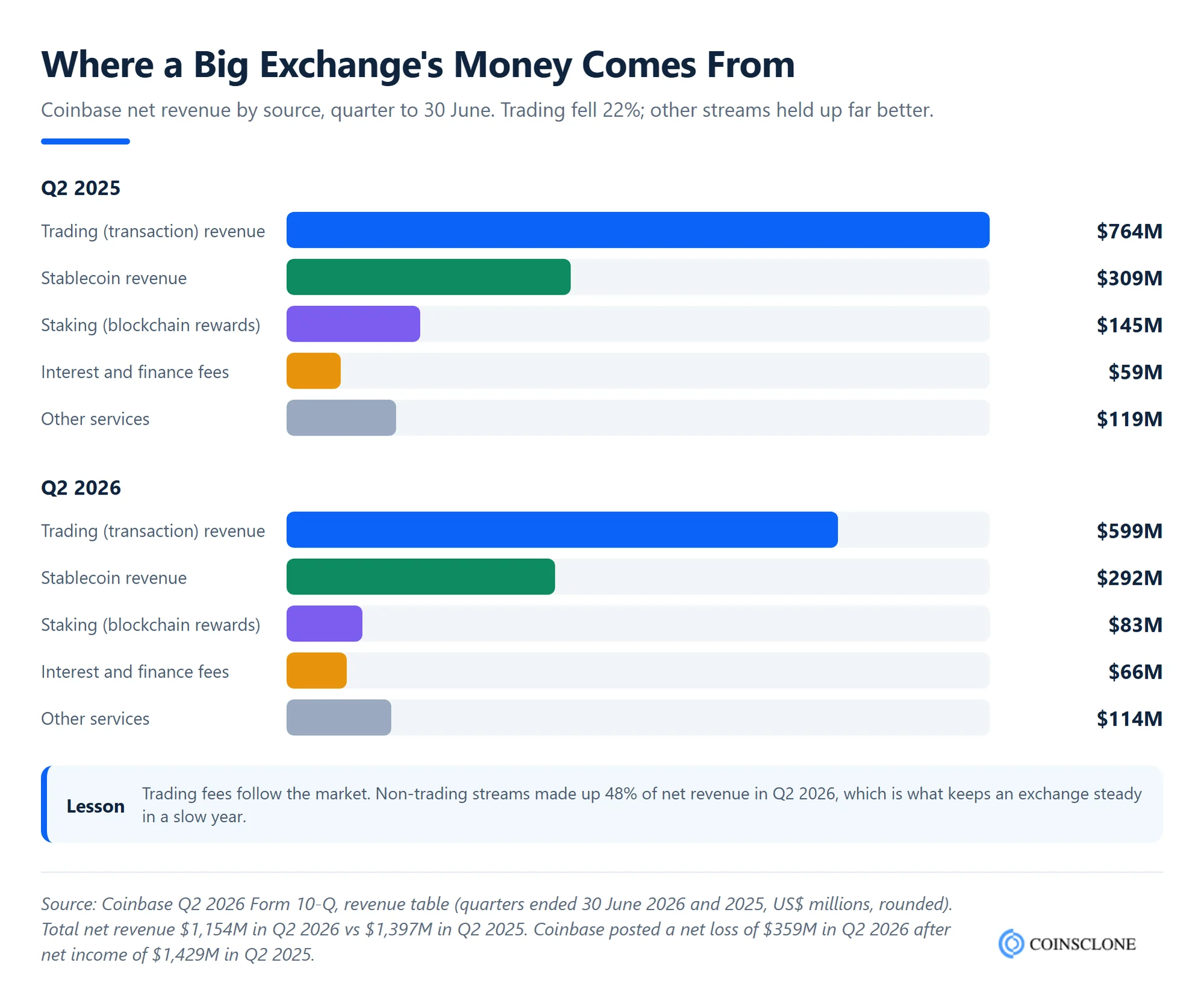
There is a clear lesson here. Trading fees rise and fall with the market. However, income from stablecoins, staking rewards and interest held up much better. In Q2 2026, these other streams made up 48% of Coinbase’s net revenue, the company said. In short, the most profitable exchanges do not rely on trading fees alone.
How a Crypto Exchange Makes Money
Through various means, an exchange can earn revenue. The mix depends on your market, your users and your features. Here are the most common streams. For a deeper look at each model, read our guide on how crypto exchanges make money.
By Enabling Trading
For each trade, the exchange takes a small fee from the buyer, the seller or both. Order book exchanges usually charge a “maker” fee to users who place orders and a “taker” fee to users who fill them. For example, regular users on Binance pay 0.1% maker and 0.1% taker on spot trades, per the Binance fee schedule. This may look small, but on millions of dollars of daily trades, it becomes the core of your income.
Simple “buy now” apps charge more for convenience. As shown above, Coinbase earns about 1.3% on its consumer trades. So your fee model should match your users: low fees for active traders, simple flat fees for beginners.
For Listing Cryptocurrencies
New token projects want to be listed so that people can trade their coins. Many smaller exchanges charge a listing fee, and the price depends on the exchange’s user base and volume. However, the largest exchanges say they do not charge for listings. Coinbase states that listing is free, although some founders publicly disputed that claim in November 2024. Either way, listing fees work best as an extra income stream, not your main one.
Through Withdrawing Cryptocurrencies
When users move coins from the exchange to their own wallet, they pay a withdrawal fee. Part of this fee covers the blockchain’s network cost, and the rest is profit for the exchange. Keep these fees fair, because high withdrawal fees push users to rivals.
IEO Launchpad
An IEO (Initial Exchange Offering) is a token sale run by the exchange itself. The exchange checks the project, hosts the sale and charges the project a fee. In return, the project gets access to the exchange’s users. A launchpad also brings new users to your platform. But IEOs are not risk-free. If a project fails, your brand takes the blame, so careful checks on each project are a must.
For Referring New Users
Many exchanges pay existing users to bring in new ones, often as a share of the new user’s trading fees. Each new user then pays trading, deposit and withdrawal fees for as long as they stay. As a result, referral programs grow both your user count and your income at the same time.
Crypto Staking and Lending
Like banks, an exchange can help users earn on their coins. With staking, the exchange stakes users’ coins on proof-of-stake networks and keeps a share of the rewards. With lending, users borrow against their crypto, and the exchange earns interest. These streams are real money makers. In Q2 2026, Coinbase earned $83 million from blockchain rewards and $66 million from interest and finance fees, per its quarterly report.
Revenue Through Yield Farming
Yield farming lets users lock their coins in pools and earn rewards. The exchange takes a small cut of the rewards it pays out. This feature also keeps more coins on your platform, which helps both trading volume and liquidity.
Advertising
Exchanges can show ads for crypto projects, wallets and events. Since your users are already interested in crypto, these ad spots carry real value. Still, keep ads light so they do not hurt the trading experience.
Premium Services
Through a premium plan, users get extras such as lower fees, faster support or advanced tools. They pay monthly or yearly, which gives you income that does not depend on the market. Coinbase reported almost 1 million paid Coinbase One subscribers in 2025, which shows that traders will pay for a better experience.
What It Costs to Start and Run a Crypto Exchange
Income is only half of the profit story. You also need to know what you will spend, both to launch and to keep the doors open each month.
Launch costs depend on how you build. Based on published 2026 agency cost guides, a white label exchange costs about $15,000 to $60,000, a custom MVP costs $100,000 to $200,000 and a full custom build costs $250,000 to $500,000 or more. Our full guide on the cost to develop a cryptocurrency exchange breaks down each item.
Running costs come every month, whether users trade or not. The main ones are:
- Liquidity: About $5,000 to $20,000 to set up, plus a market maker that often costs $5,000 to $30,000 a month to keep your order books full.
- Licences and compliance: Legal fees, KYC checks on each new user and ongoing reports to regulators. In the EU, for example, a MiCA licence also needs set capital. See our guide to a MiCA-compliant exchange for details.
- Servers and security: Cloud hosting, wallet security, monitoring and regular audits.
- Team and support: Support staff, compliance officers and developers for updates.
- Marketing: Ads, referral rewards and content to bring in your first users.
The key point is that most of these costs are fixed. You pay them on a slow day and a busy day alike. Therefore, profit depends on pushing your trading volume past the point where fees cover these fixed costs.
How Much Trading Volume Do You Need to Break Even?
This is the question most guides skip. The maths is simple: divide your monthly running costs by what you earn per dollar traded. That second number is your “take rate”, the share of each trade you keep after discounts, referral payouts and rebates.
Let’s use a worked example. Say your lean exchange spends $50,000 a month to run. Here is how much daily trading you need to cover that, at different take rates:
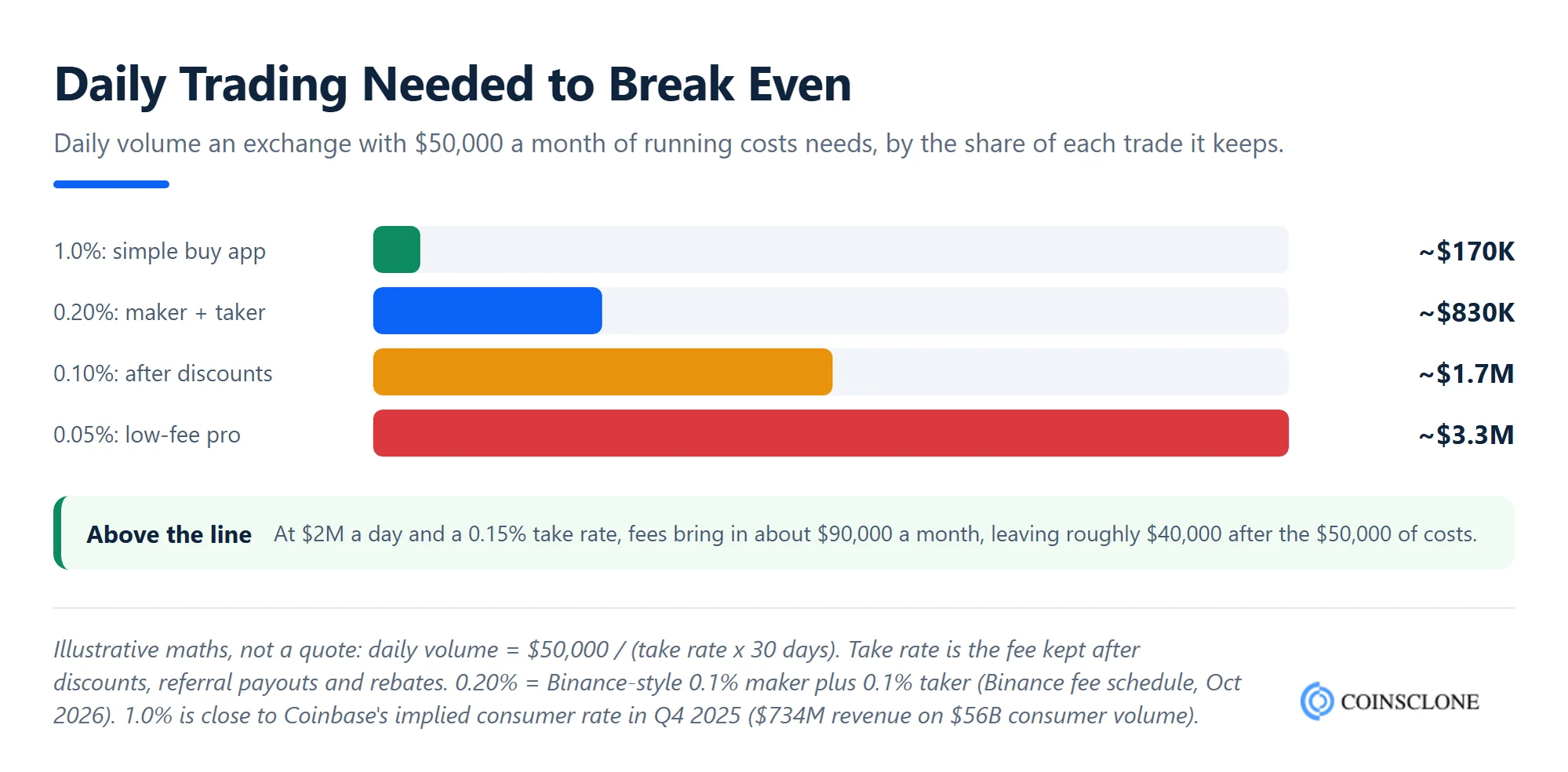
| Take rate (share of each trade you keep) | Typical model | Daily volume to break even |
| 1.0% | Simple “buy now” app for beginners | About $170,000 |
| 0.20% | Order book, 0.1% maker plus 0.1% taker | About $830,000 |
| 0.10% | Order book after VIP discounts and referral payouts | About $1.7 million |
| 0.05% | Low-fee exchange for pro traders | About $3.3 million |
Now look at the profit side. Suppose your exchange reaches $2 million a day in trading at a 0.15% take rate. That brings in about $90,000 a month. After $50,000 of running costs, you keep around $40,000 a month before tax. At that pace, a $60,000 white label build pays for itself in under two months of profit. Licensing and marketing will add to that, but the numbers show why a busy exchange can earn back its launch cost fast.
Also, keep in mind that this example covers trading fees only. Staking, listing, premium plans and launchpad fees all sit on top. So once you pass break-even, every extra stream adds almost straight to profit.
What Can Make a Crypto Exchange Unprofitable?
Not every exchange makes money. Here are the main risks, and how they hit your profits.
- Low trading volume: This is the most common cause of failure. Without enough liquidity, spreads widen, traders leave and fees dry up. A market maker and a focused launch market help fix this.
- Market cycles: Trading drops when prices fall. Coinbase’s own trading revenue fell 22% year on year in Q2 2026. Plan your cash for the slow months, not just the busy ones.
- Hacks: One attack can wipe out years of profit. In February 2025, hackers took about $1.5 billion from Bybit in a single attack, Chainalysis reports. Cold storage, multi-signature wallets and regular audits are not optional.
- Compliance failures: Weak checks can cost far more than good ones. In November 2023, Binance pleaded guilty to US federal charges linked to weak anti-money laundering controls and agreed to pay over $4.3 billion.
- Fierce competition: Large exchanges already offer low fees and deep liquidity. So a new exchange needs a clear reason for users to switch, such as a local currency, a niche market or better service.
How to Make Your Crypto Exchange Profitable Faster
You cannot control the market, but you can control how quickly you reach break-even. These steps help.
- Launch lean: A white label exchange gets you live in weeks rather than months, so you start earning sooner and spend less before you have users.
- Pick a niche: Serve a market the giants handle poorly, such as one country’s currency, a local payment method or a specific asset type.
- Solve liquidity on day one: Connect to cryptocurrency liquidity providers or a market maker, so early users find full order books.
- Add more than one stream: Turn on staking, premium plans and a launchpad early. As Coinbase shows, these streams carry you through slow markets.
- Build trust openly: Publish proof of reserves, explain your security and keep fees clear. Trust is what turns a first trade into a loyal user.
- Get licensed early: Licences can take months. Starting early avoids a costly delay at launch.
Where to Develop an Exemplary Cryptocurrency Exchange Platform?
Coinsclone, a leading Cryptocurrency Exchange Development Company, helps you create your own custom crypto exchange. We have built crypto products since 2018 and delivered 350+ platforms for 200+ clients across 20 industries. Our developers, blockchain experts, UI/UX designers and security team are ready to help with every stage.
You can build your exchange from scratch or start with our ready-made exchange software. Our white label crypto exchange software goes live in 4 to 6 weeks, 7 to 10 weeks with fiat rails and 9 to 13 weeks with mobile apps. It comes with trading, wallets, KYC, admin tools and the revenue features covered above, so you can start earning sooner. Other than exchange development, we also offer token development, crypto payment gateways and other blockchain services. Talk to our team and get a live demo.
Own a Crypto Exchange — and Make It Profitable Fast!
Start your own revenue-generating crypto exchange with our ready-to-launch MVP system.
- Launch Fast: Go live in weeks, not months.
- Plug & Profit: Built-in liquidity, wallets, and trading engine.
- Your Brand: Full design & token customization.
- Multiple Income Streams : Trading fees, staking, and listings.
Get a free branded demo of your exchange in 48 hours — no upfront cost.
Book Your Free Demo and see how to own a profitable crypto exchange today.
Frequently Asked Questions
Is building a crypto exchange still profitable in 2026?
Yes, for exchanges that reach enough trading volume. Coinbase earned $1.26 billion in net income in 2025, but it also posted a loss in Q2 2026 when trading slowed. So profit in 2026 depends on volume, lean running costs and more than one revenue stream, not just on launching a platform.
What is the average income from a crypto exchange business?
There is no true average, because income tracks trading volume. As a guide, an exchange that keeps 0.2% of each trade earns about $60,000 a month on $1 million of daily trading. A small exchange with less volume may earn a few thousand dollars a month, while a large one earns millions.
How do crypto exchanges make money?
Mainly through trading fees. They also earn from listing fees, withdrawal fees, staking and lending, launchpads, referral programs, advertising and premium plans. Large exchanges such as Coinbase now earn close to half their net revenue from streams other than trading.
How much does it cost to create a cryptocurrency exchange?
Based on published 2026 agency cost guides, a white label exchange costs about $15,000 to $60,000, a custom MVP $100,000 to $200,000, and a full custom build $250,000 to $500,000 or more. You also need a budget for liquidity, licences, security and marketing each month.