

If you run a crypto startup, one of your first questions is likely “how do I create a smart contract?” A smart contract is a small program that lives on a blockchain and runs by itself when set terms are met. It moves tokens, locks funds and settles trades with no middleman. This guide shows you how to create a smart contract step by step, from the first idea to a live, checked contract on the main network.
You will see which chain and language to pick, which free tools teams use in 2026, and how to test on a safe network first. We also cover the step most guides rush past: the security audit. Finally, you get real numbers on time and cost, so you can plan your budget before you write a line of code.
In this guide:
- The 12 steps to create, test, audit and launch a smart contract
- How to choose between Ethereum, layer 2s, BNB Chain, Polygon and Solana
- The 2026 toolkit: Remix, Foundry, Hardhat and OpenZeppelin, plus the Sepolia testnet
- What it really costs to deploy (often under a dollar) and to audit (thousands)
- How long each type of contract takes to build, in weeks
How to Create a Smart Contract
Here is the short answer. To create a smart contract, you:
- Plan it: write down what the contract must do and what must never happen.
- Pick the type, method and chain: decide what kind of contract it is, who builds it and where it runs.
- Set up your tools: a wallet, a testnet and a coding tool such as Remix, Foundry or Hardhat.
- Write, compile and test the code: usually in Solidity, using audited OpenZeppelin building blocks.
- Audit it: have an outside team look for bugs before real money touches it.
- Deploy and watch it: launch on the main network, verify the code and keep monitoring.
We have explained each of the 12 steps below so that you can follow it easily.
Step 1: Gather Ideas and Write a Spec
When you plan to develop a smart contract, start with its purpose. What should it do, who will use it, and how much value will it hold? Study similar contracts and their use cases. Then write a short spec: the functions, who can call each one, and the rules that must always hold true. For example, “the total supply can never go above 1 million” or “only the owner can pause transfers”.
This spec becomes your roadmap. It helps you estimate the cost, the time and the team you need. It also gives your testers and auditors a clear list of what to check later.
Step 2: Choose the Smart Contract Type
Next, choose the smart contract type based on how it works, how much it must scale and the niche it serves.
1. Smart legal contract: This is a common type used in fields like health care, crypto and real estate. Its simple rule is “if this happens, then that will occur”. The terms are set in advance, so the contract runs by itself with no central authority or middleman. For example, it can release tokens when a set price is reached.
These contracts are open to view and cannot be changed once deployed. That makes tampering very hard. Still, a bug in the code is also locked in, which is why testing and audits matter so much.
2. Application logic contract (ALC): These contracts hold the logic of an app and move data between devices and other contracts. Unlike usual contracts, they are often “signed” between machines. Many link the Internet of Things (IoT) with a blockchain, so a sensor reading can trigger a payment or a record.
3. Decentralized Autonomous Organization (DAO): Can you picture a group with no CEO or boss? DAO smart contracts make it work. Members vote with tokens, and the contract carries out the result. As a result, the group runs in an open, self-run and self-funded way.
Also Read: How To Start A DAO in 8 Simple Steps
Step 3: Pick the Right Development Method
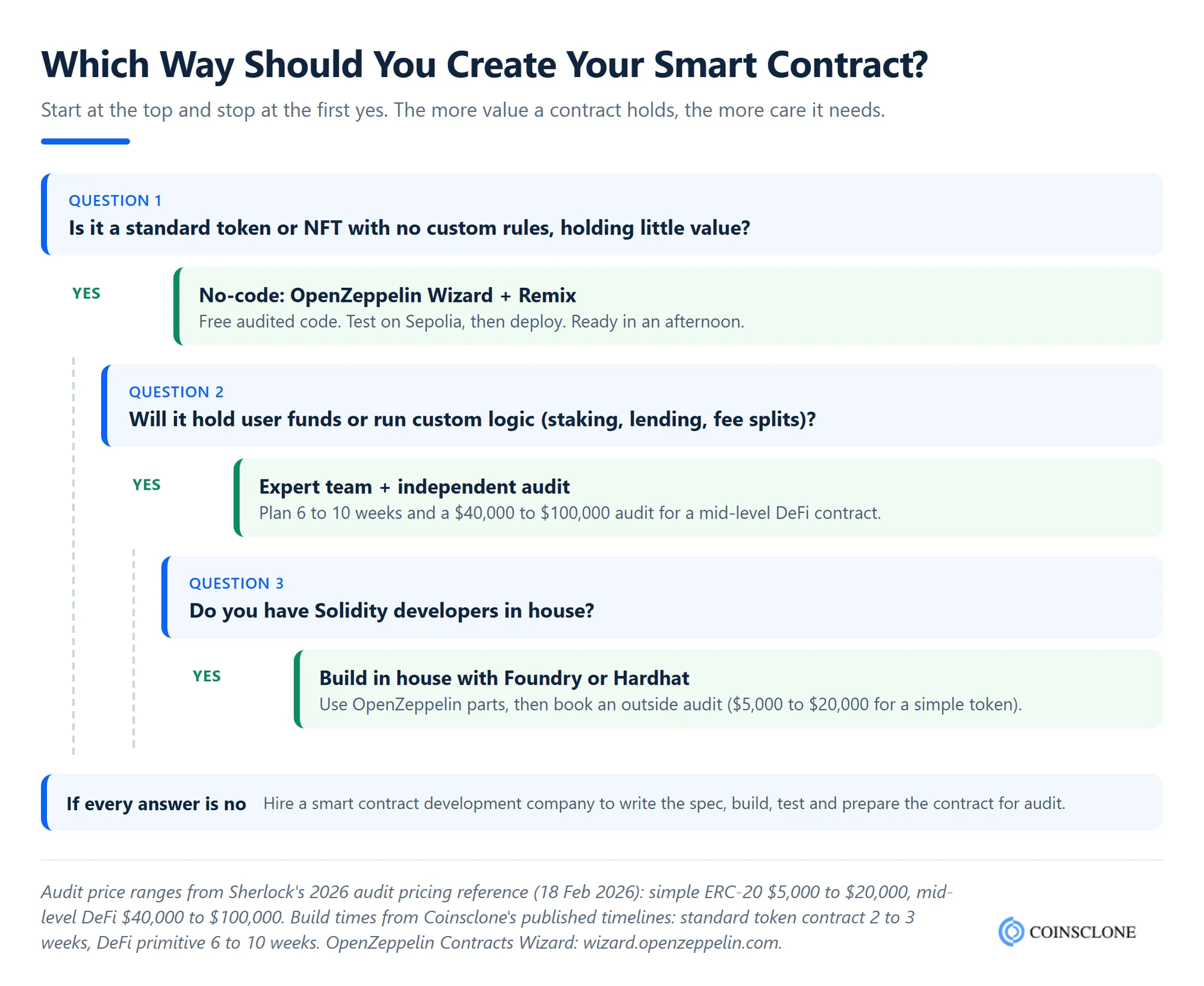
Now pick the build method that fits you. You have three routes:
- No-code generator: for a plain token or NFT, a tool like the OpenZeppelin Contracts Wizard writes the code for you from a few choices.
- Build it in house: if you have skilled Solidity developers, they can write, test and ship it with free tools.
- Hire a smart contract development company: for contracts that hold user funds or run custom logic, an expert team cuts the risk.
Even if you are skilled, mistakes happen. One bug in a live contract can turn a crypto project into a disaster, because the code is hard to change once deployed. That is why we suggest an experienced team for anything that holds real value. They have the developers, test setups and audit contacts to ship faster, and they guide you through each stage.
Step 4: Choose the Blockchain Network
Choose the blockchain based on your project’s users, needs and budget. Ethereum is still the most common choice for smart contracts. It powers most DeFi apps, NFTs and tokens. However, many teams now launch on a cheaper layer 2 (L2) such as Arbitrum or Base, which runs the same code at a lower fee.
The chain also decides your coding language:
| Blockchain | Main language | Best fit |
| Ethereum | Solidity, Vyper | High-value DeFi, tokens and NFTs that need the deepest liquidity |
| Arbitrum, Base, Optimism (Ethereum L2s) | Solidity, Vyper | Same code as Ethereum with far lower fees |
| BNB Chain, Polygon, Avalanche | Solidity | Low-cost tokens, games and payment apps |
| Solana | Rust | High-speed trading and consumer apps |
| Aptos, Sui | Move | Newer apps that want Move’s safety features |
If you pick any EVM chain (Ethereum, its L2s, BNB Chain, Polygon or Avalanche), one Solidity contract can be deployed to all of them. That makes Solidity the safest first language to learn.
Step 5: Install a Non-Custodial Wallet
You need a non-custodial wallet to sign and pay for your deployment. With this kind of wallet, only you hold the keys. You will also use it to connect to a test network, so you can try your contract for free first.
Let us take the popular MetaMask wallet as an example. Install the browser extension, click “Create a new wallet” and agree to the terms. Then write down your secret recovery phrase and keep it offline. Never share it with anyone. Finally, use a separate wallet for testing, not the one that holds your real funds.
Step 6: Pick the Testnet
A testnet is a copy of the blockchain where coins have no real value. You use it to check that your contract works before you spend real money. In the past, guides named Rinkeby, Ropsten, Kovan and Goerli, but all of them are now shut down or deprecated.
Today, Ethereum has two public testnets that client teams maintain, according to ethereum.org’s networks page:
- Sepolia: the recommended default testnet for app and smart contract development. Use this one.
- Hoodi: a testnet for validators and staking. App builders rarely need it.
Holesky, the older staking testnet, was deprecated in September 2025. Once you add Sepolia to MetaMask, get free test ETH from a Sepolia faucet. This dummy Ether pays the gas fees when you deploy and test your contract. Other chains have their own testnets too, such as BNB Chain Testnet and Polygon Amoy.
Step 7: Choose Your Smart Contract Tools
Depending on your needs, time and team, pick the tools that suit you. These are the most used, and all are free and open source:
- Remix IDE: a browser-based editor for writing, compiling, testing and deploying contracts. No setup needed, so it is great for beginners.
- Foundry: a fast toolkit where you write tests in Solidity itself. It includes fuzz testing, which throws thousands of random inputs at your code.
- Hardhat: a popular JavaScript and TypeScript framework, now on Hardhat 3, with plugins for testing, deploying and verifying.
- OpenZeppelin Contracts: a library of audited building blocks for tokens (ERC-20, ERC-721), access control and upgrades. It is on version 5.x.
Older tools like Truffle and Ganache were sunset by Consensys in 2023, so avoid tutorials that still use them. Most professional teams use Foundry or Hardhat for real projects and Remix for quick trials.
Step 8: Write the Programming Code
Now write the code. For a first contract, the Remix browser IDE is the easiest place to start. It comes with a built-in debugger, syntax and error highlights, and a deploy panel.
Write your contract in Solidity, the most popular smart contract language. The latest release is Solidity 0.8.37, from September 2026. Save the file with a .sol extension. Here is a complete ERC-20 token contract that uses OpenZeppelin:
// SPDX-License-Identifier: MIT
pragma solidity ^0.8.24;

import {ERC20} from "@openzeppelin/contracts/token/ERC20/ERC20.sol";

contract MyToken is ERC20 {
    constructor() ERC20("MyToken", "MTK") {
        _mint(msg.sender, 1000000 * 10 ** decimals());
    }
}
These few lines create a token named MyToken and send 1 million units to the wallet that deploys it. The audited ERC-20 logic comes from OpenZeppelin, so you do not write the risky parts yourself. Want to go further? See our guide on how to create an ERC20 token.
Step 9: Compile and Test the Smart Contract
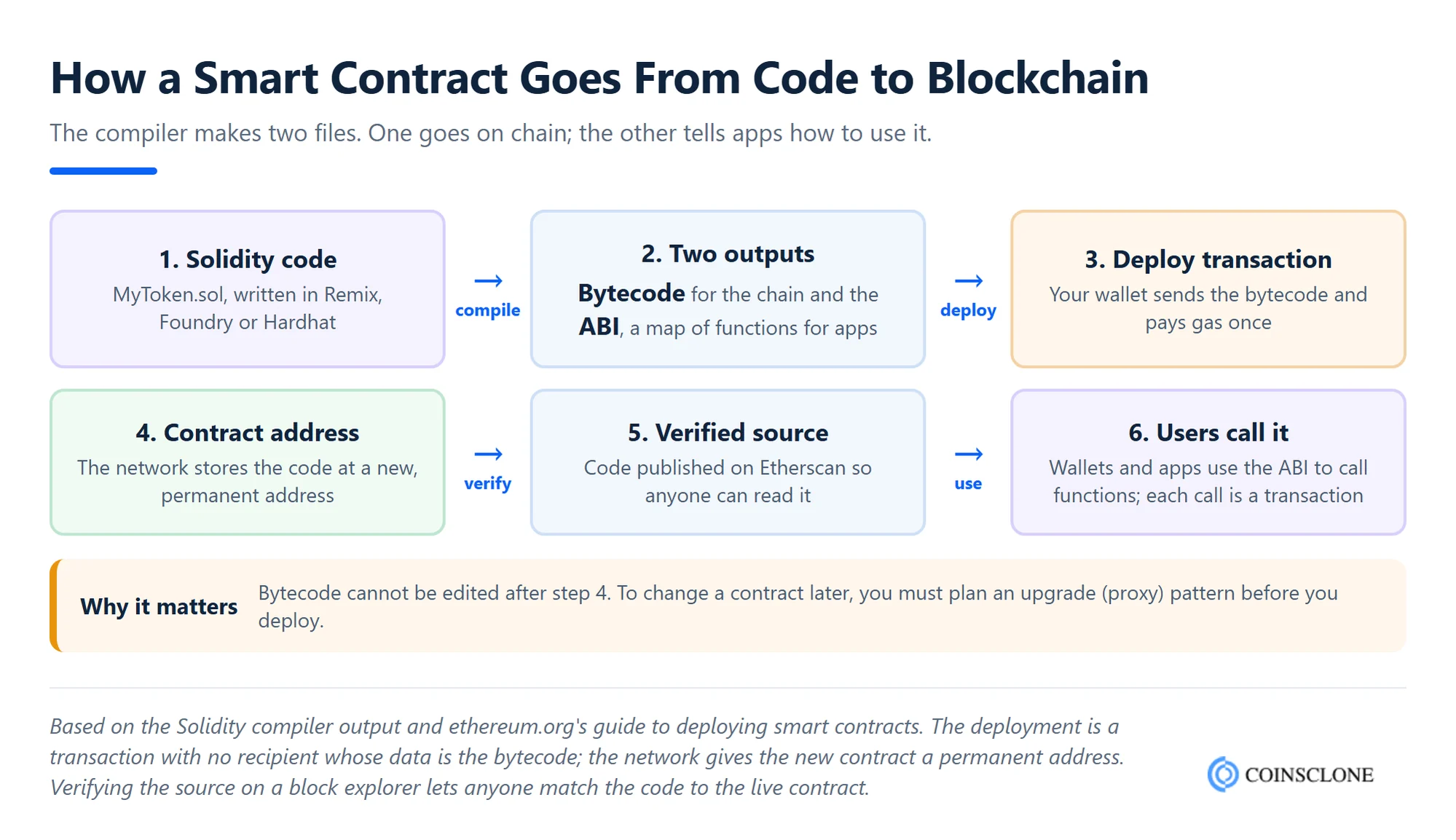
This is the most important step in the whole process. First, compile your code. The compiler turns your Solidity into bytecode, the machine code the blockchain runs. It also creates an ABI, a file that tells wallets and apps how to talk to your contract.
Then test it hard. Good testing catches bugs while they are still cheap to fix. Teams use a mix of tests:
- Unit tests: check that each function does what the spec says.
- Fuzz tests: feed thousands of random inputs to find edge cases you did not think of.
- Invariant tests: check that key rules, like “total supply never changes”, always hold.
- Testnet trial: deploy to Sepolia and use the contract like a real user would.
You can also run a beta version on the testnet and invite users to try it.
Step 10: Get an Independent Security Audit
Smart contracts often hold real money, and attackers know it. Chainalysis found that more than $3.4 billion in crypto was stolen in 2025. So before launch, have an outside team audit your code. Auditors read every line and look for known bug types. The OWASP Smart Contract Top 10 lists the most common ones:
- Access control flaws: functions that anyone can call when only the owner should.
- Price oracle tricks: attackers move a price feed to borrow or trade at a fake price.
- Logic errors: the code does something slightly different from what the spec intended.
- Missing input checks: the contract trusts values it should reject.
- Reentrancy: a hostile contract calls back in before the first call has finished, often to drain funds.
After the audit, fix every finding and have the auditor check the fixes. Then publish the report, because users and exchanges often ask for it. Learn more about scope and audit prices in our guide to smart contract development services.
Step 11: Deploy to the Mainnet and Verify
Once the audit is clean, switch your wallet to the main network and deploy. The deployment is a normal transaction that pays gas and returns your contract’s address. Check that the transaction has completed, then verify your source code on a block explorer such as Etherscan. Verification lets anyone read the code and match it to the live contract, which builds trust.
Now your smart contract is live and ready for its job, whether that is a token, an NFT drop or a DeFi app. If you are building on Ethereum, our team can help with creating an Ethereum smart contract from spec to audit.
Step 12: Monitor, Support and Upgrade
You must keep watching the contract after launch. Set alerts for big or strange transactions, so you can act fast if something looks wrong. Also keep a plan for emergencies, such as a pause function held by a multisig wallet.
Remember that a deployed contract cannot be edited. If you expect to add features later, build it with an upgrade pattern (a proxy contract) from the start. Put upgrades behind a timelock, so users can see changes coming before they take effect.
The steps may look simple, but deep skill and experience matter at every stage. So, as mentioned earlier, consider working with a smart contract development team for anything that holds real value. They have shipped many contracts, so you can launch faster and safer.
How to Create a Smart Contract Without Coding
Can you create a smart contract with no coding skills? Yes, for simple, standard contracts. The OpenZeppelin Contracts Wizard lets you pick a token type (ERC-20, ERC-721 or ERC-1155) and tick features like minting, burning and pausing. It then writes the Solidity code for you. You can open it in Remix with one click, compile it and deploy it.
This route is free apart from gas, and it uses audited code. However, it only covers standard features. Once you need custom rules, such as vesting, staking rewards or fee splits, you need a developer and an audit. The Wizard writes the code, but it cannot check that your business logic is safe.
Benefits of Creating Smart Contracts
Why are smart contracts so widely used? Here are the main reasons.
Security
Smart contracts remove the third party from crypto deals. They let the token buyer and seller deal directly, peer to peer. The rules are clear in the code, so there is less confusion about how a deal will run. Keep in mind that this security depends on the code itself, which is why audits matter.
Transparency
Because smart contracts run on a blockchain, anyone can view them. Both buyer and seller can check the deal data at any time. The data gives both sides the same facts, which cuts the room for tricks or disputes. In turn, this builds trust among users.
Lower Cost
When a third party runs a deal, it charges fees for its work. Smart contracts remove most of those fees, along with hidden charges. They carry out the set terms with no manual sign-off. On today’s networks, a simple contract call often costs only cents.
Immutability
Even though anyone can see them, the stored records cannot be changed or deleted. Once data is written to the blockchain, it stays there for good. So no one can falsely blame anyone with made-up data.
Global Access
Anyone, anywhere can use a smart contract. There are no borders or office hours. As a result, people across the world can use smart contracts on many blockchains.
Automation
The terms are digital and set in advance, so deals run fast and on their own. This cuts the wait for third-party approval. It also saves time and makes the whole crypto process smoother.
Long story short, smart contracts save time and cost. They also run crypto deals smoothly with no middleman. That is why they are now replacing paper contracts and agreements in many fields.
With so many benefits, you may wonder how long one takes to build. Let us look at that next.
How Much Time Does It Take to Develop a Smart Contract?
The time depends mainly on how complex the contract is and how much value it will hold. Based on the timelines Coinsclone publishes for its own projects:
- Standard token contract: 2 to 3 weeks, including tests, gas checks and an audit.
- DeFi building block (such as a staking or lending contract): 6 to 10 weeks, including deep testing and an audit cycle.
- Full protocol contract suite: 3 to 5 months.
A simple wizard-made token can be deployed in an afternoon. But a contract that holds user funds needs time for testing, the audit and fixes. Most audits take two to four weeks, and good audit firms are often booked weeks ahead, so plan for that in your schedule.
Some factors that change the timeline are:
- Team skill: how well the developers know the language and the chain
- Contract design: how complex the logic is and how many contracts work together
- Testing and fixes: how many bugs the tests and the audit find
- Upgrades and links: proxies, oracles and links to other protocols all add time
How Much Does a Smart Contract Cost to Create and Deploy?
The cost has three parts: building it, auditing it and deploying it. Most people expect gas to be the big cost, but on today’s networks it is often the smallest.
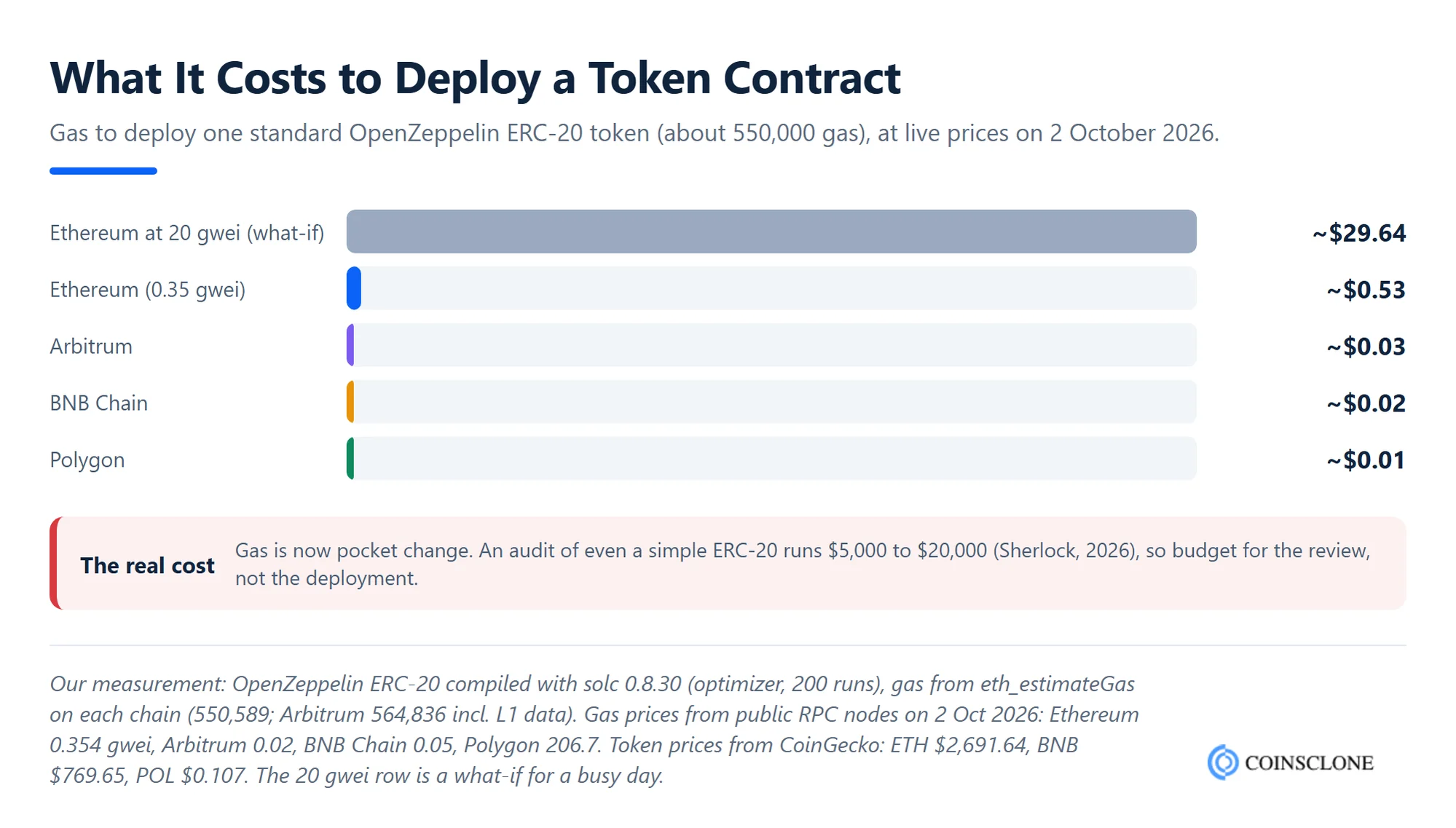
We measured it. Deploying a standard OpenZeppelin ERC-20 token needs about 550,000 gas. At 2 October 2026 gas prices, that cost about $0.53 on Ethereum and only a few cents on Arbitrum, BNB Chain or Polygon. Gas prices change by the minute, though. On a busy day at 20 gwei, the same Ethereum deployment would cost about $30.
The audit is where the real money goes. According to Sherlock’s 2026 audit pricing reference, audits run from about:
- Simple ERC-20 token: $5,000 to $20,000
- Mid-level DeFi protocol: $40,000 to $100,000
- Large multi-chain system: $150,000 and up
- Re-audit after fixes: $5,000 to $20,000 per round
Rust and Move contracts cost 25% to 45% more to audit than Solidity ones. Build costs follow the same pattern: the more value and custom logic, the more time a senior team needs. Other factors include:
- Tech stack: the chain, the language and any oracles or bridges
- Gas price: both for deployment and for the calls your users make later
- Post-launch work: monitoring, upgrades and support
- Regular audits: each major upgrade needs a fresh review
So, before you start, map out your budget with all three parts in mind. Get advice from experts who have shipped similar contracts. They can help you frame the roadmap, since a contract built without the right skills can turn your project into a disaster. For a full breakdown of scope and cost, read our guide to smart contract development services.
Why Choose Coinsclone for Smart Contract Development?
Coinsclone is a blockchain development company that has built crypto products since 2018. We have delivered 350+ platforms for 200+ clients across 20 industries, from exchanges and wallets to DeFi and token launches. Our Ethereum smart contract development team writes the spec, codes in Solidity, tests with fuzz and invariant checks, measures gas and prepares your contract for an independent audit.
We also build contracts for DeFi platforms and NFT projects, on Ethereum, its L2s, BNB Chain, Polygon, Solana and more. With the right team, you can turn your crypto plans into a live, secure product. Join us to turn the code into creation!
Frequently Asked Questions
Can I create my own smart contract?
Yes. Anyone can write and deploy a smart contract with free tools like Remix, Foundry or Hardhat and a wallet such as MetaMask. You need some Solidity skills for custom logic. For a standard token, the OpenZeppelin Contracts Wizard can write the code for you. For anything that holds real money, get an independent audit first.
Can I create a smart contract for free?
Almost. The tools, the libraries and the Sepolia testnet are all free, so you can build and test at no cost. You only pay gas to deploy on a main network. In October 2026, deploying a standard ERC-20 token cost about $0.53 on Ethereum and a few cents on layer 2s. An audit, if you need one, is the main cost.
What programming language is used to create smart contracts?
Solidity is the most used language. It runs on Ethereum and every EVM chain, such as Arbitrum, Base, BNB Chain, Polygon and Avalanche. Vyper is a Python-like option for EVM chains. Solana contracts are written in Rust, and Aptos and Sui use Move.
How long does it take to create a smart contract?
A standard token contract takes about 2 to 3 weeks with tests and an audit. A DeFi building block takes 6 to 10 weeks, and a full protocol suite 3 to 5 months. Most of the time goes into testing, the audit and fixes, not the first draft of the code.
How much does it cost to create a smart contract?
There are three parts. Deployment gas is now often under a dollar. Audits run from about $5,000 to $20,000 for a simple token and $40,000 to $100,000 for a mid-level DeFi protocol, per Sherlock’s 2026 reference. Build costs depend on the logic and the team, and they rise with the value the contract will hold.
Are smart contracts secure?
They can be, but only if the code is right. The blockchain cannot be tampered with easily, yet a bug in the contract is public and permanent. More than $3.4 billion was stolen from crypto platforms in 2025. Use audited libraries such as OpenZeppelin, test deeply, get an outside audit and keep monitoring after launch.
Which blockchain is best for smart contracts?
Ethereum is the most trusted and has the most users and tools. Its layer 2s, such as Arbitrum and Base, run the same code for much lower fees. BNB Chain and Polygon suit low-cost apps, while Solana suits high-speed trading. Choose based on where your users and liquidity are.
Empower Your Blockchain with Custom Smart Contracts
Efficient, Reliable, and Fully Auditable. Start Your Smart Contract Development with a Free Consultation.