
A security token exchange is a licensed market where checked buyers and sellers trade tokens that stand for real assets, such as shares, bonds, fund units or a slice of a building. This guide shows you how to create a security token exchange in 2026, step by step. You will see the licence you need in each market, the tech that makes a token check the rules before it moves, the features to build, and what it costs.
It also covers what most guides skip. Software is the fast part. Licences, investor checks and liquidity decide when you can open and whether anyone trades. So you will also see which venues are live today, which ones failed, and what that means for your plan.
In this guide:
- An 8-step plan to create a security token exchange, from market choice to launch
- The licence route in the US, the EU, Singapore and the UAE, checked at each regulator
- How a trade settles on chain, with a diagram of the rule check inside the token
- The live security token exchanges in 2026 and what happened to the early ones
- Build options, timelines and cost ranges, plus the features you cannot skip
See How Our MVP System Can Help You Create a Security Token Exchange Faster
Security Token Exchange Development — done right.
- MVP System: Launch your STO-ready exchange 90% faster.
- Compliance First: KYC/AML, investor accreditation, and smart contract auditing pre-integrated.
- Liquidity & Wallets: Multi-asset wallets with seamless security token trading.
- Brand & Customization: Your platform, your branding, your markets.
- Revenue Engine: Earn from listings, trading fees, and tokenized asset sales.
See a free branded demo of your STO exchange in 48 hours — before you invest a cent.
Book a Free Demo to discover how our Security Token Exchange Development Platform can take you from idea to launch in just 2–4 weeks.
How to Create a Security Token Exchange
Here is the full path in eight steps. Steps 2 and 3 matter most, because the licence decides how much of the rest you build yourself.
- Pick your market and investors. Decide which country you serve first and who may trade: retail buyers, accredited investors only, or institutions. Each choice changes the licence, the KYC depth and the investor limits.
- Choose your licence route. In the US you need a broker-dealer that runs an Alternative Trading System (ATS). In the EU you need a MiFID II trading venue licence or a DLT Pilot Regime permission. Singapore and the UAE run their own regimes. The section below covers each one.
- Decide to license or partner. You can apply for your own licence, buy a licensed firm, or run the tech while a licensed partner operates the venue. Partnering is often the fastest way to go live.
- Pick the token standard and chain. On Ethereum and similar chains, most new security tokens use ERC-3643. It is a final, accepted standard built for transfers that must follow rules. ERC-1400 is still common in older projects, but it was never accepted as an official standard.
- Build the core platform. This covers sign-up and KYC, the order book and matching engine, wallets and custody, the issuer and admin panels, and the investor portal.
- Plug in the regulated parts. Connect a KYC and AML tool, a transfer agent to keep the share register, a licensed custody firm and your bank or stablecoin payment rails.
- Test, audit and file. Run a smart contract audit and a penetration test. Then file your notices; in the US, Form ATS must reach the SEC at least 20 days before you start trading.
- Launch with listings and liquidity. Sign your first issuers before launch, line up a market maker, and open with a small set of assets that already have holders.
If you want a team to handle steps 4 to 7, our security token development team builds the token contracts, the trading venue and the compliance tools together.
What Is a Security Token Exchange?
A security token exchange is a platform where people trade security tokens under the law for stocks and bonds. It works like a stock exchange that runs on a blockchain. Each buyer is checked, each trade follows the rules written into the token, and the owner record updates on chain.
Security token exchange development is the work of building that platform. It includes user accounts with identity checks, an engine that matches buyers and sellers, safe storage for the tokens, and links to banks and payment systems. As a result, investors can own small fractions of costly assets and sell them more easily than a private share or a building.
The market behind it is real and growing. The rwa.xyz dashboard put tokenized real-world assets on public chains at $38.55 billion on 2 October 2026, not counting stablecoins. Yet most of that value sits in funds that people buy and redeem, not trade. That gap is why licensed secondary markets matter.
So how is this different from a normal crypto exchange? The table shows the main gaps.
| Crypto exchange | Security token exchange | |
| What trades | Bitcoin, ether, stablecoins, utility tokens | Tokenized shares, bonds, funds, real estate |
| Main rules | Crypto rules (MiCA in the EU, state and federal rules in the US) | Securities law (SEC and FINRA, MiFID II, MAS, ADGM and similar) |
| Who can trade | Anyone who passes KYC | Only eligible investors, often by country or wealth test |
| Transfers | Any wallet to any wallet | Only between verified wallets, checked by the token |
| Records | Exchange ledger | Legal register kept by a transfer agent or registrar |
How Security Token Exchanges Fuel Security Token Trading
Many venues now list security tokens, but each one has its own focus. Some trade private company shares, others list funds, bonds or property. They also run on different blockchains. Still, they share a few clear benefits for investors and issuers:
- A way to sell private assets: A security token exchange gives holders a place to sell, which is rare for private shares or property. It lets people own a small part of an asset and sell it later.
- More choice for investors: Investors can reach assets that were once open only to large funds, often in small amounts.
- Funding for businesses: Issuers can raise money, sign up backers, manage shareholders and offer a way to sell, all in one place.
- Round-the-clock trading: Some venues now take orders all day. tZERO, for example, moved its ATS to 24/7 order entry with 23.5 hours of trading on business days from 15 December 2025.
- A learning path for beginners: Good venues explain each asset and its risks, which helps new investors trade with care.
Now that you know the benefits, let us look at the rules you must meet before the first trade.
Licences You Need in Each Market
A security token is a security, so the exchange that trades it needs a market licence. Crypto exchange rules do not cover it. Here is the route in the four markets most founders ask about, checked at each regulator in October 2026.
United States: broker-dealer plus ATS
Most US security token venues run as an Alternative Trading System. Under Regulation ATS, an ATS must register as a broker-dealer and file Form ATS at least 20 days before it starts trading. It must also file Form ATS-R reports within 30 days after each calendar quarter. The broker-dealer must join FINRA, and FINRA has 180 days to decide a new member application, which it can extend by up to 90 days. You will also need a transfer agent to keep the legal register.
The rules are moving in your favour. In January 2026, SEC staff said tokenized shares follow the same rules whether the issuer or a third party creates them. In September 2026, the SEC gave a five-year waiver that lets approved venues trade on-chain US stocks within set limits, as this law firm note explains.
European Union: MiFID II or the DLT Pilot Regime
In the EU, security tokens count as shares, bonds and the like, so MiFID II applies, not MiCA. You can run a normal trading venue, such as a multilateral trading facility (MTF), or apply under the DLT Pilot Regime, live since 23 March 2023. The pilot lets a venue trade and settle tokens on a blockchain, but within caps: shares of firms worth under EUR 500 million, and bond issues under EUR 1 billion.
Uptake is still small. ESMA’s list of licensed DLT venues names just six. They are CSD Prague, 21X and 360X in Germany, Axiology in Lithuania, LISE in France and Securitize Europe in Spain.
Singapore: an exchange or market licence
Singapore’s central bank, MAS, treats a share on a blockchain just like the same share on paper. Its tokenisation guide, last updated 14 November 2025, sums it up as same activity, same risk, same rules. A platform that lets people resell these tokens must be an approved exchange or a recognised market operator, unless it is exempt. Holding the tokens for clients needs its own licence.
UAE: four rule makers
The UAE has several regimes, and each covers its own zone:
- Abu Dhabi Global Market: The FSRA treats these tokens as shares and bonds in digital form. It licenses venues as an exchange or an MTF, per its digital securities guidance.
- Dubai International Financial Centre: The DFSA treats them as security tokens under DIFC law.
- Onshore UAE: The national Capital Markets Authority, once called the SCA, covers these tokens outside the free zones.
- Dubai mainland: VARA licenses virtual asset firms and has issuance rules for asset-referenced virtual assets backed by real assets.
A law firm review from October 2026 maps how these regimes fit together. Pick one zone first, because a licence in one does not carry to another. Our list of the top countries to launch RWA tokenization compares more markets.
This section is a general guide, not legal advice. Always work with a securities lawyer in each country where you plan to operate.
List of Top Security Token Exchanges in 2026
The early market looked very different from today. Some pioneers closed, others were sold, and new licensed venues took their place. Here is the status of the main names as of October 2026.
- Securitize
- tZERO
- INX (now part of Republic)
- 21X
Securitize is one of the best-known names in the field. It runs an SEC-registered broker-dealer, transfer agent and ATS, and it is the platform behind BlackRock’s BUIDL fund. Securitize began trading on the New York Stock Exchange under the ticker SECZ on 2 July 2026. In Europe, its Spanish arm holds a DLT Pilot permission granted on 26 November 2025.
tZERO was one of the first US venues to trade security tokens. Its ATS is run by its broker-dealer, tZERO Securities. It added 24/7 order entry in December 2025. In August 2026, it let holders resell a token tied to the buybuy BABY brand, and it agreed to work with ICE, owner of the New York Stock Exchange, on tools for token markets. tZERO announced plans for a public listing in October 2025, but it has not listed yet.
INX ran a licensed market for security tokens and crypto. Republic, the investment platform, completed its purchase of INX in November 2025. INX token trading stopped on 11 November 2025, and holders shared a cash fund of about $34.3 million.
21X is a German venue licensed by BaFin. On 3 December 2024, it got the first EU pilot permit to both trade and settle tokens in one system.
What about the names in older lists? OpenFinance Network, once a leading US security token ATS, said in April 2020 that it would delist all tokens and halt trading unless issuers helped fund it. Its story is a warning: a licence alone does not bring trading volume.
How a Security Token Exchange Works
A security token exchange looks like any trading app on the surface. The difference sits inside the token. With a standard like ERC-3643, each transfer is checked against an identity registry and a set of rules before it can go through.
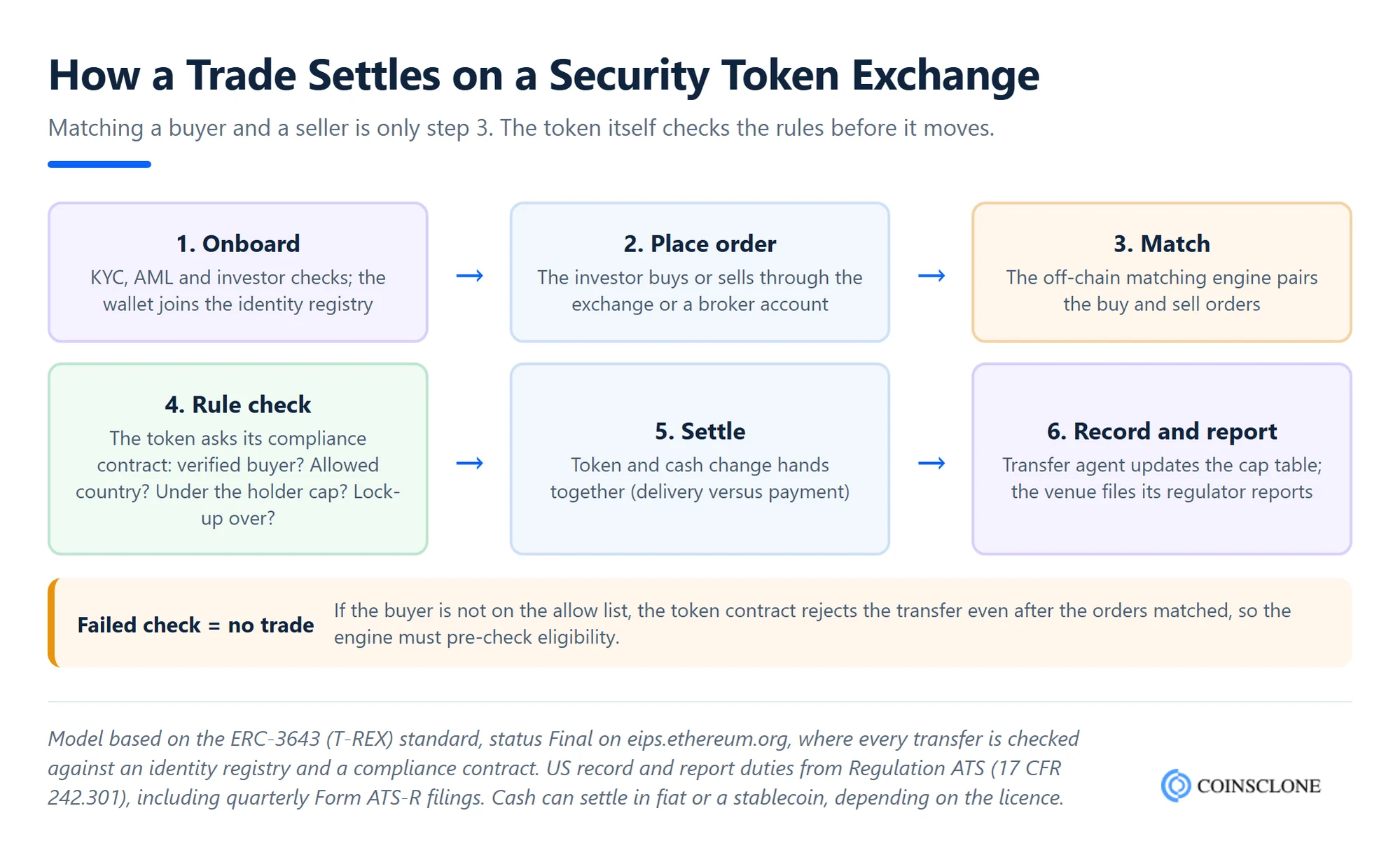
So your matching engine and your token contracts must agree. If the engine pairs two orders but the buyer is not on the allow list, the token will refuse the transfer. That is why good platforms check eligibility before an order reaches the book. Our ERC-3643 token development team builds the identity registry and the rule contracts for this setup.
Ways to Build a Security Token Exchange
There are many ways to build a security token exchange. Two are the most popular with startups: building from scratch, or starting from white-label security token exchange software. Let us look at both.
Developing from Scratch
Building from scratch means a full team designs every part of the platform: the layout, the features and the modules. You get full control, but it takes the most time and money. Published 2026 cost guides put a full custom exchange at 9 to 14 months of work.
Using White-label Software
A white-label security token exchange is tested software that you brand and adjust with extra features and designs to fit your needs. The trading core can be ready in 4 to 6 weeks, or 7 to 10 weeks with fiat rails. A full platform with a closed resale market takes 6 to 9 months on our own timelines. The rule checks, custody and reports take longer than the trading core.
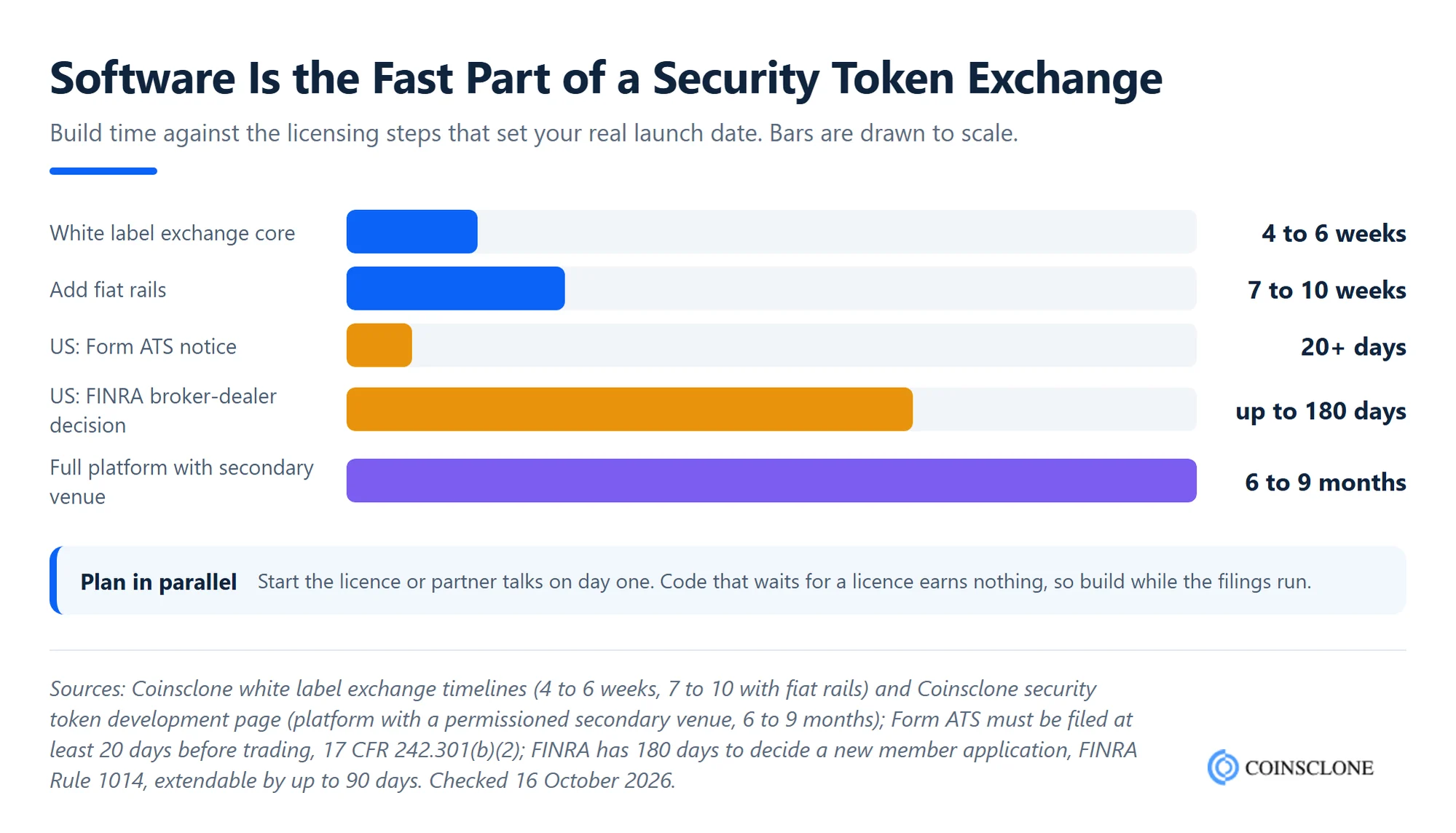
We suggest the white-label route for most startups. It costs less, it uses tested code, and you can spend the saved time on the licence and your first listings.
Top-notch Features of a Security Token Exchange
We at Coinsclone build security token trading platforms to fit each client’s needs. These are the must-have features for every exchange.
Simple, Easy Screens
Clean, simple screens bring more traders to the platform and keep them there. More active traders also means better liquidity.
Investor Sign-up and Checks
The exchange checks each buyer’s ID, runs AML checks and confirms their status, such as a wealth test for some deals. It then adds the wallet to the ID list, so the token knows who may hold it.
Transfer Rules in the Token
Rules such as country limits, holder caps and lock-up periods live in the token contract. The issuer can also freeze tokens or force a transfer when a court or regulator orders it.
Powerful Matching Engine
The trading engine matches buy and sell orders without delay. It should also pre-check eligibility, so orders that would fail the token’s rules never reach the book.
Multi-Lingual Support
The platform supports popular languages such as Chinese, German and French, so you can serve investors in many regions.
Multi-Currency Support
Besides euros and dollars, the platform can take stablecoins and coins such as Bitcoin and ether, where your licence allows it.
Cap Table and Corporate Actions
Issuers can pay dividends or interest, run votes and see their holder list in real time. The transfer agent keeps the legal record in step with the chain.
Regulator Reporting
Built-in reports cover trade data, holder lists and audit trails. So your team can file what the rules ask for, such as the quarterly Form ATS-R in the US.
Cost to Create a Security Token Exchange Platform
The cost of building a security token exchange depends on how you build it and how many regulated parts you need. These are software costs only. Legal work, licences, audits and custody fees come on top.
| Build route | Cost range (2026) | Time | Best for |
| White label exchange core | $15,000 to $60,000 | 4 to 10 weeks | Testing one market fast |
| Tokenization platform with trading | $100,000 to $250,000 | 6 to 9 months | One region, a few asset types |
| Full custom exchange | $250,000 to $500,000+ | 9 to 14 months | Funded firms that need full control |
These ranges come from published 2026 cost guides for crypto exchanges and tokenization platforms. The main cost drivers are the number of countries, the token standard and chains, the custody setup, the KYC and payment tools you plug in, and how many reports you must file. For a detailed look at the white label side, see our guide to white label crypto exchange cost.
When you weigh both time and cost, white-label software is the best fit for most new venues. For this, you need the right development partner. Coinsclone is one of them, and here is why.
Create A Security Token Exchange Platform
Cost-effective, White-Label Solution, Premium Features, Customizable. Live Demo Available.
Challenges to Plan For
Building the platform is only half the job. These are the problems that sink new venues, and how to plan for them:
- Thin trading: Many security tokens barely trade after they are issued. Sign issuers with an existing investor base, and add a market maker before launch.
- Slow licensing: A licence can take longer than the build. Run the filings and the build at the same time, or start with a licensed partner.
- Small markets: The EU pilot caps the size of the assets you can list, and ESMA’s latest list names only six venues with a permission.
- Many rulebooks: Each country has its own buyer limits and report rules. Launch in one market, then add others one by one.
- Custody and keys: Lost keys mean lost securities. Use a qualified custodian, and make sure the issuer can recover tokens through the token’s built-in tools.
If you also plan to issue tokens yourself, our guide to security token offering development covers the raise that comes before trading.
Why Choose Coinsclone for Security Token Exchange Platform Development?
We at Coinsclone provide white-label software for all types of exchanges. We use modern tech, test each release many times, and study your business plan so the platform can earn what you expect. We also plan for future needs, such as new chains, new asset types and new markets.
Since 2018, we have delivered 350+ platforms for 200+ clients across 20 industries. Our team works with your lawyers from day one, so the token rules, the trading engine and the reports match your licence. Talk to us and build a secure security token exchange for your business now.
See How Our MVP System Can Help You Create a Security Token Exchange Faster
Security Token Exchange Development — done right.
- MVP System: Launch your STO-ready exchange 90% faster.
- Compliance First: KYC/AML, investor accreditation, and smart contract auditing pre-integrated.
- Liquidity & Wallets: Multi-asset wallets with seamless security token trading.
- Brand & Customization: Your platform, your branding, your markets.
- Revenue Engine: Earn from listings, trading fees, and tokenized asset sales.
See a free branded demo of your STO exchange in 48 hours — before you invest a cent.
Book a Free Demo to discover how our Security Token Exchange Development Platform can take you from idea to launch in just 2–4 weeks.
Frequently Asked Questions
How do security tokens work?
A security token is a blockchain token that stands for a share, a bond, a fund unit or another asset. So the law for stocks and bonds applies to it. The token holds rules about who may own it. When someone tries to send it, the token checks that the buyer is verified and allowed, and only then does the transfer go through.
What is the difference between a security token and a utility token?
A security token gives the holder a money right, such as a share of profits, interest or a claim on an asset. So it must follow the law for stocks and bonds. A utility token gives access to a product or service, such as paying fees on a network. If a token is sold with a promise of profit from someone else’s work, the law tends to treat it as a security, whatever its name.
What is the difference between a security token and a tokenized security?
The terms often overlap. A tokenized security most often means a share or bond that already exists and is now recorded on a blockchain. A security token can also be a new instrument created on chain from day one. In both cases the same securities rules apply, as SEC staff and MAS have both said.
What are examples of security tokens?
Well-known ones include BlackRock’s BUIDL fund, which Securitize issues, and Franklin Templeton’s BENJI fund. Banks have also put bonds on chain, and Securitize put its own SECZ shares on chain on its listing day. Property tokens and private company shares are common too.
Is tZERO publicly traded?
Not as of mid-October 2026. tZERO announced plans for a public listing in October 2025, and in September 2026 it announced a new private funding round, but its shares are not listed on an exchange. Its ATS still runs as a regulated venue for security tokens in the US.
Do I need a licence to run a security token exchange?
Yes. Because the tokens are securities, the venue must hold a securities trading licence or work through a licensed partner. In the US that means a broker-dealer running an ATS. In the EU it means a MiFID II venue or a DLT Pilot permission. In Singapore it means an approved exchange or a licensed market operator.
How long does it take to create a security token exchange?
A white label trading core can be ready in 4 to 6 weeks. A full platform with a permissioned secondary venue takes about 6 to 9 months. In the US, the broker-dealer and ATS approvals can take about as long, so start the legal work on day one.