
An Aave clone script is ready-made software for launching your own DeFi lending and borrowing platform, built on the same pooled lending model that made Aave the largest lending protocol in crypto. This guide explains what the script is, how an Aave-style protocol works, and where Aave itself stands in October 2026.
You will also see the parts most guides skip: which Aave code you may fork, how Aave forks have done, the hacks that hit them, and what a build costs. By the end, you will know if an Aave-style platform fits your plan and what it takes to launch one safely.
In this guide:
- Aave’s live numbers: $17.18 billion locked in Aave V3 on 21 networks, and how V4 changed the design in 2026.
- How pools, aTokens, rates, loan safety and flash loans fit together.
- Where the money goes: $37.13 million of borrower interest in 30 days, and the 13% Aave kept.
- Which Aave code is free to fork today and which is not, checked in each licence file.
- Fork outcomes, security lessons, build steps, cost ranges and timelines.
What Is an Aave Clone Script?
An Aave clone script is a pre-built set of smart contracts, a web app and an admin panel that copies how Aave works. Users can supply crypto to earn interest, borrow against their deposits and repay at any time. The code sets the rates, checks the collateral and closes risky loans, with no bank in the middle.
“Clone” means the same model and features, not the same brand. You launch under your own name, choose your own chains and assets, and set your own risk rules and fees. A good script also lets you add what Aave does not have, such as a new collateral type, a local stablecoin or a fixed-rate market.
The script saves you from building the hardest parts from zero: the pool logic, the rate curve, the price feed hookup and the liquidation engine. You still need audits, liquidity and a launch plan, which we cover below.
What Is Aave?
Aave is an open-source DeFi lending protocol. It started in 2017 as ETHLend, a peer-to-peer loan board. It took the Aave name in 2018 and launched its pooled lending protocol in January 2020. Instead of matching one lender with one borrower, Aave puts all deposits for an asset into a shared pool. Anyone can borrow from that pool by posting collateral worth more than the loan.
Aave runs on Ethereum and many other networks. Users can supply, borrow and earn on each one, and holders of the AAVE token vote on new assets, risk settings and fees. It also has its own stablecoin, GHO. About $698 million of GHO was in use on 16 October 2026, per DefiLlama.
See How Our MVP System Can Launch Your Lending Platform Faster
Aave Clone Script — DeFi Lending & Borrowing Platform Development.
- MVP System : Launch your Aave-like lending protocol 90% faster.
- Smart Contracts Ready: Lending, borrowing, and collateral modules pre-built
- Brand & Customization : Your tokens, interest model, and governance system.
- Revenue Engine : Earn from lending spreads, protocol fees, and staking rewards..
Get a free branded demo of your Aave-like platform in 48 hours — before you Invest a single cent.
Book a Free Call to discover how our Aave Clone Script can take you from idea to a live Defi Lending Protocol in just 8–12 weeks.
Aave in October 2026: Status Check
Aave is active and still the leader in DeFi lending. Here is where it stands today:
- Size: Aave V3 held $17.18 billion on 16 October 2026, per DefiLlama, with $11.87 billion out on loan. That is about a third of the $52.29 billion locked in all lending apps.
- Reach: DefiLlama lists Aave V3 on 21 networks, such as Ethereum, Base, Arbitrum and BNB Chain. Ethereum alone holds $14.25 billion, or 83% of the total.
- Down from its peak: The whole Aave protocol held $45.81 billion at its peak on 7 October 2025, against $18.21 billion now. TVL is counted in dollars, so it moves with crypto prices as well as with deposits.
- Aave V4: V4 went live on Ethereum on 30 March 2026. It uses a hub and spoke design: shared liquidity hubs (Prime, Core and Plus) lend to separate spokes, and each spoke has its own assets and risk rules. In September 2026, Aave V4 on Base began to accept tokenized US stocks as collateral for USDC loans for non-US users.
- The Kelp shock: On 18 April 2026, an attacker took about $292 million of rsETH from Kelp DAO’s bridge. Aave’s own contracts were not hacked. However, the attacker posted the unbacked rsETH on Aave and borrowed ETH against it. Aave froze its rsETH markets and had to plan how to cover the bad debt.
The takeaway for founders: the pooled lending model is proven at scale, and it keeps evolving. Your clone should start from the lessons of 2026, not the design of 2020.
How an Aave-Style Lending Protocol Works
Every Aave clone runs the same loop. Suppliers fill the pools, borrowers draw from them, and bots keep the loans safe.
Supplying and aTokens
A user deposits an asset, such as USDC, into its pool. In return, the protocol mints a receipt token called an aToken (aUSDC in this case). The aToken balance grows each block as interest builds up. When the user withdraws, the aTokens are burned and the deposit plus interest comes back.
Borrowing Against Collateral
To borrow, a user first supplies collateral. Each asset has a loan-to-value (LTV) ratio, which caps how much can be borrowed against it. For example, Aave V3 let users borrow up to 80.5% of the value of ETH on Ethereum in early October 2026. Loans are always overcollateralized, so the pool holds more value than it lends out.
How Rates Are Set
Rates follow utilization, the share of a pool that is lent out. Below a target level, rates rise slowly. Above it, they jump sharply. This curve pulls in new deposits and pushes borrowers to repay when a pool runs short of cash.
Health Factor and Liquidation
Each loan has a health factor: the collateral value, times its liquidation threshold, divided by the debt. Above 1, the loan is safe. Below 1, anyone can repay part of the debt and take some of the collateral at a discount, called the liquidation bonus. Bots do this within seconds. For a worked example with real numbers, see our guide to DeFi lending and borrowing platform development.
Flash Loans
A flash loan lets a user borrow any amount with no collateral, as long as it is repaid in the same transaction. If it is not repaid, the whole transaction reverts as if nothing happened. Traders use flash loans for arbitrage, collateral swaps and paying off loans in one step. The Aave flash loan guide sets the fee at 0.05% by default, and governance can change it. We explain the trading side in our guide to flash loan arbitrage bot development.
Risk Modes: E-Mode and Isolation Mode
Aave V3 added two risk tools that a modern clone should copy. E-Mode allows higher loan limits between assets whose prices move together, such as two stablecoins, or ETH and staked ETH. Isolation mode lets you list a new, riskier asset with a hard debt ceiling, so it cannot put the whole platform at risk.
Why Launch a Lending Platform Like Aave?
Lending is one of the largest and steadiest parts of DeFi. Lending apps held $52.29 billion on 16 October 2026, per DefiLlama. Borrowers pay interest each block, in good markets and bad.
There is still room for new players. Aave is built for broad, global markets. That leaves gaps that a focused platform can fill:
- Local markets: A platform built around one region’s stablecoins, languages and rules.
- New collateral: Tokenized real-world assets, liquid staking tokens or a new chain’s native tokens that Aave has not listed.
- New chains: Fast-growing networks often launch before Aave arrives. Early lending apps there can win the first users.
- Business lending: Credit lines for trading firms, payment companies or a partner’s own users.
- Own stablecoin: Like Aave with GHO, a platform can mint its own stablecoin and earn on each loan of it.
If you would rather start with a simpler model, our Compound clone script covers the other leading pooled lending design.
How an Aave Clone Makes Money
Aave earns mostly from a share of borrower interest. Each asset has a reserve factor, the slice of interest that goes to the treasury instead of to suppliers. Here is how that played out over the last 30 days.
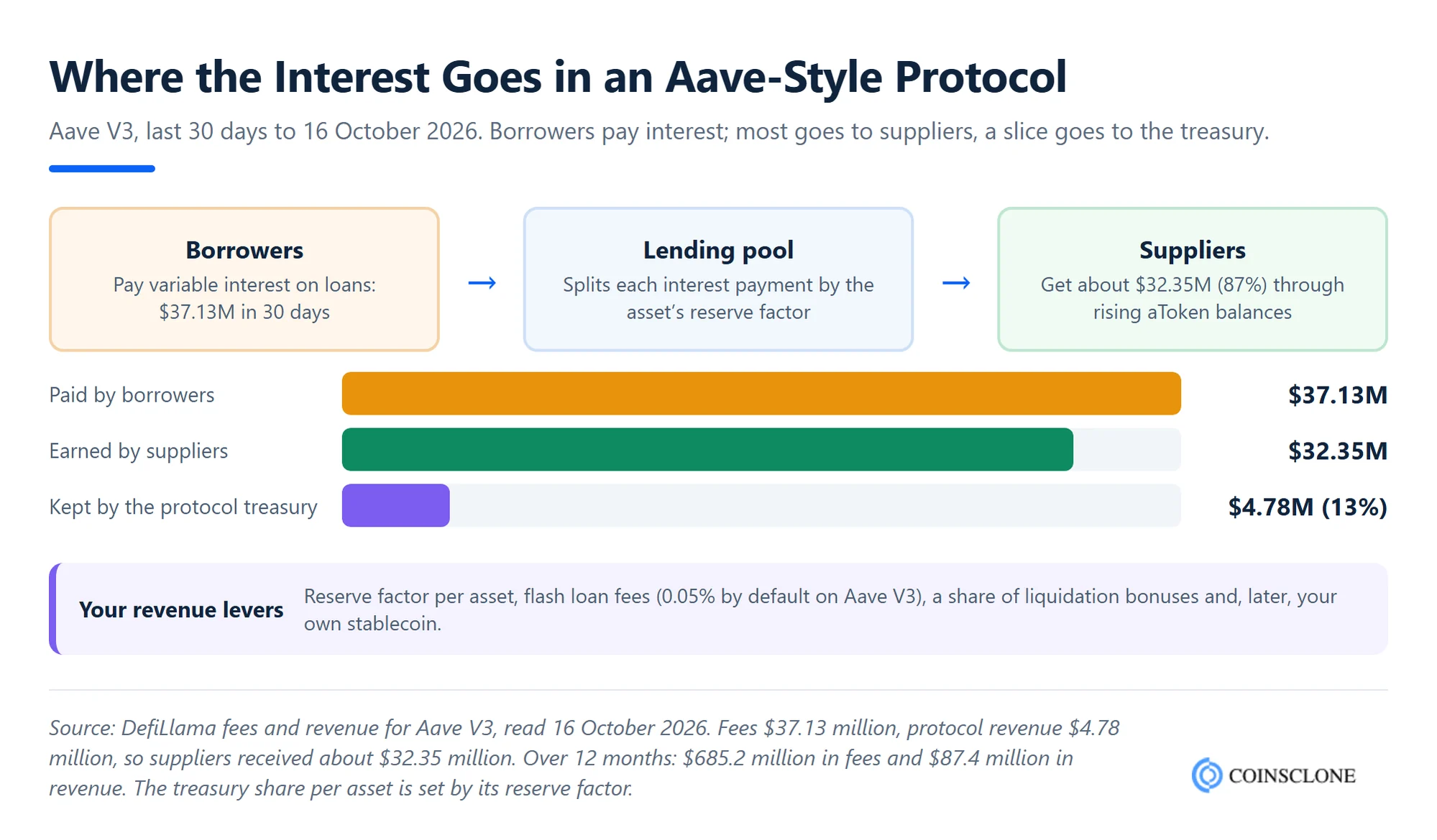
Over 12 months, Aave V3 borrowers paid $685.2 million and Aave kept $87.4 million, per DefiLlama’s fee data. Your own platform can earn from several sources:
- Reserve factor: A set share of the interest on each asset, tuned per market.
- Flash loan fees: A small fee on every flash loan, such as Aave’s 0.05% default.
- Liquidation share: Part of each liquidation bonus can go to your treasury.
- Own stablecoin: If you mint your own stablecoin, the interest paid on it is yours.
- Listing and partner deals: Projects that want their token listed may fund rewards or liquidity.
Features of the Aave Clone Script
There are two types of features from the Top DeFi Lending Platforms like Aave. One is for the users, and the other is for the administrator.
User Features
- User dashboard: One view of supplied assets, loans, earned interest and health factor.
- Buy option: A fiat on-ramp, such as the Transak payment gateway, so new users can buy crypto in the app.
- Staking portal: Users stake the platform token to earn rewards and back the safety reserve.
- DeFi wallet access: Connect MetaMask, WalletConnect wallets or smart accounts.
- Blockchain network switch: Move between supported chains in one click.
- Account history: Each past deposit, loan and payment in one list.
- APY/APR calculator: Shows what a deposit will earn or a loan will cost before the user signs.
- Health factor alerts: Warnings before a loan nears liquidation.
- Multi-lingual support: Serve users in their own language.
These are all the features your users stand to gain from the platform you create using the Aave clone script. But what tools do you get as the administrator?
Admin Features
- Admin dashboard: Live view of deposits, loans, pool use, revenue and user growth.
- Wallet portal access: Manage treasury and fee wallets with multisig controls.
- Governance: Token voting on assets, rates and upgrades, with a timelock before changes go live.
- TVL tracker: Total value locked by asset and by chain.
- Smart contract tools: Set LTV, liquidation thresholds, bonuses, reserve factors, supply and borrow caps.
- Blockchain bridge connectivity: Move liquidity and messages between chains.
- Charts and reports: Rate trends, liquidations and risk reports.
- Site management toolkit: Manage content, banners, languages and listings.
Security and Risk Features
- Oracle setup: Chainlink or Pyth price feeds with a backup and sanity checks.
- Supply and borrow caps: Limits per asset so one thin market cannot drain the pools.
- Pause guardian: A role that can freeze a market fast but cannot move funds.
- Timelocked upgrades: Users see every change before it takes effect.
It is no longer a task to build a DeFi business, especially with the Aave clone software. Every build is tailored to the client’s assets, chains and risk rules.
Can You Fork Aave’s Code? The Licence Question
Aave publishes its smart contracts on GitHub, so a clone can start from real Aave code. That is legal only if you follow the licence attached to each version, and the versions differ. We checked each licence file on 16 October 2026.
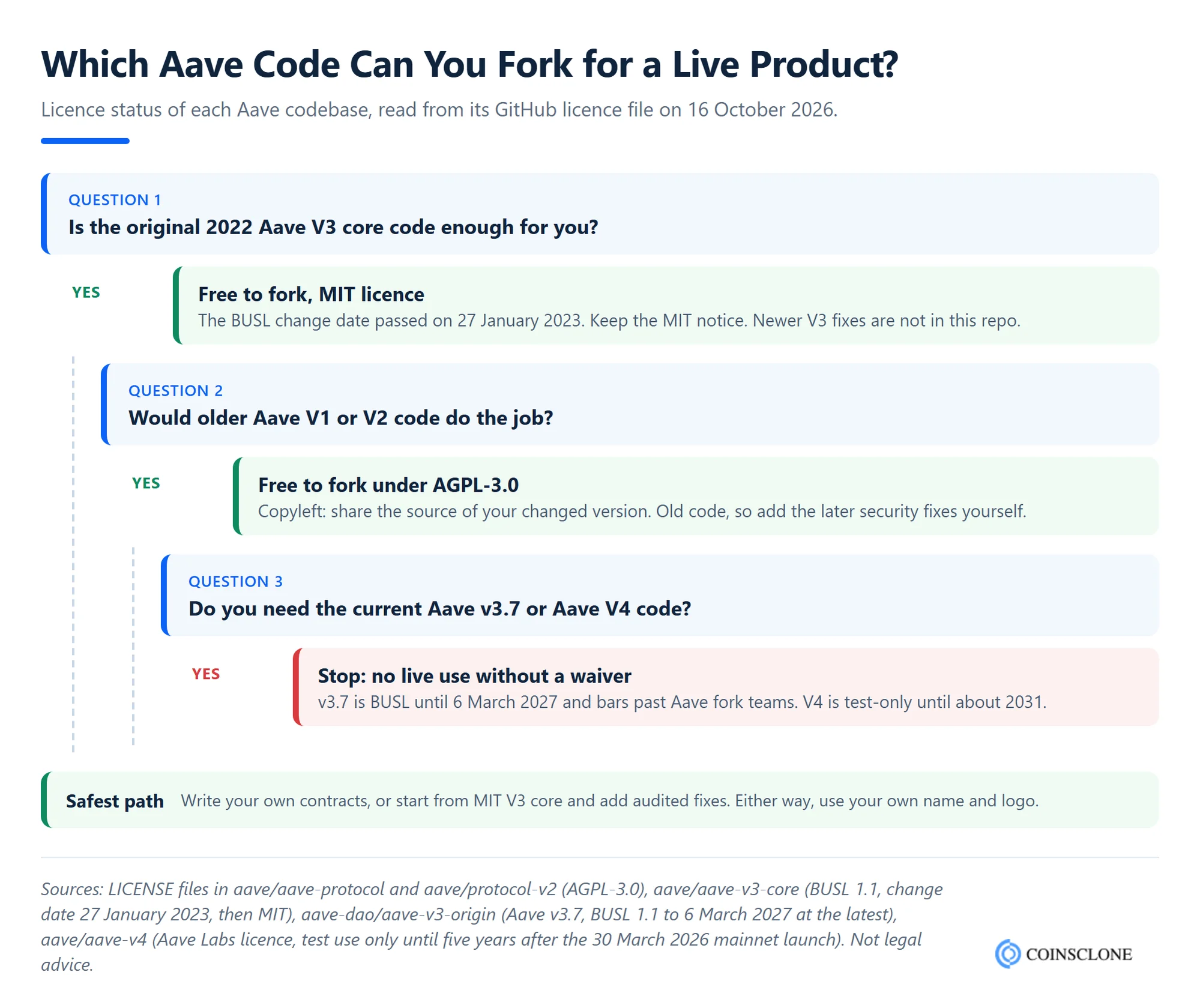
| Aave codebase | Licence today | What it means for a clone |
| Aave V1 and V2 | AGPL-3.0 | Free to fork, but you must share the source of your changed version |
| Aave V3 core (2022) | BUSL 1.1 until 27 January 2023, now MIT | Free to fork with the MIT notice; the repo is archived |
| Aave v3.7 (current V3) | BUSL 1.1, change date 6 March 2027 at the latest | No live use that pulls users or funds from Aave, and no use by teams that ran a rival Aave fork in the past four years |
| Aave V4 | Aave Labs Business Source License | Test use only; live use needs a waiver until five years after the 30 March 2026 launch |
In plain terms, the 2022 Aave V3 core code is the newest Aave code you may run live without permission. It lacks the fixes and features Aave added after 2022, so a safe clone either adds audited fixes on top or uses its own contracts built on the same model.
The licence also covers only the code. “Aave” and its ghost logo are brands, and the V4 licence says plainly that it grants no rights in them. Your platform needs its own name, logo and site. For the wider rules on copyright, trademarks and code licences, read our guide on whether clone scripts are legal to use. This is general information, not legal advice.
How Aave Forks Have Fared: Lessons From the Data
Forking Aave is common. DefiLlama tracks 101 lending protocols built on Aave V1, V2 or V3 code. Together they held $5.69 billion on 16 October 2026, but the value is far from even.
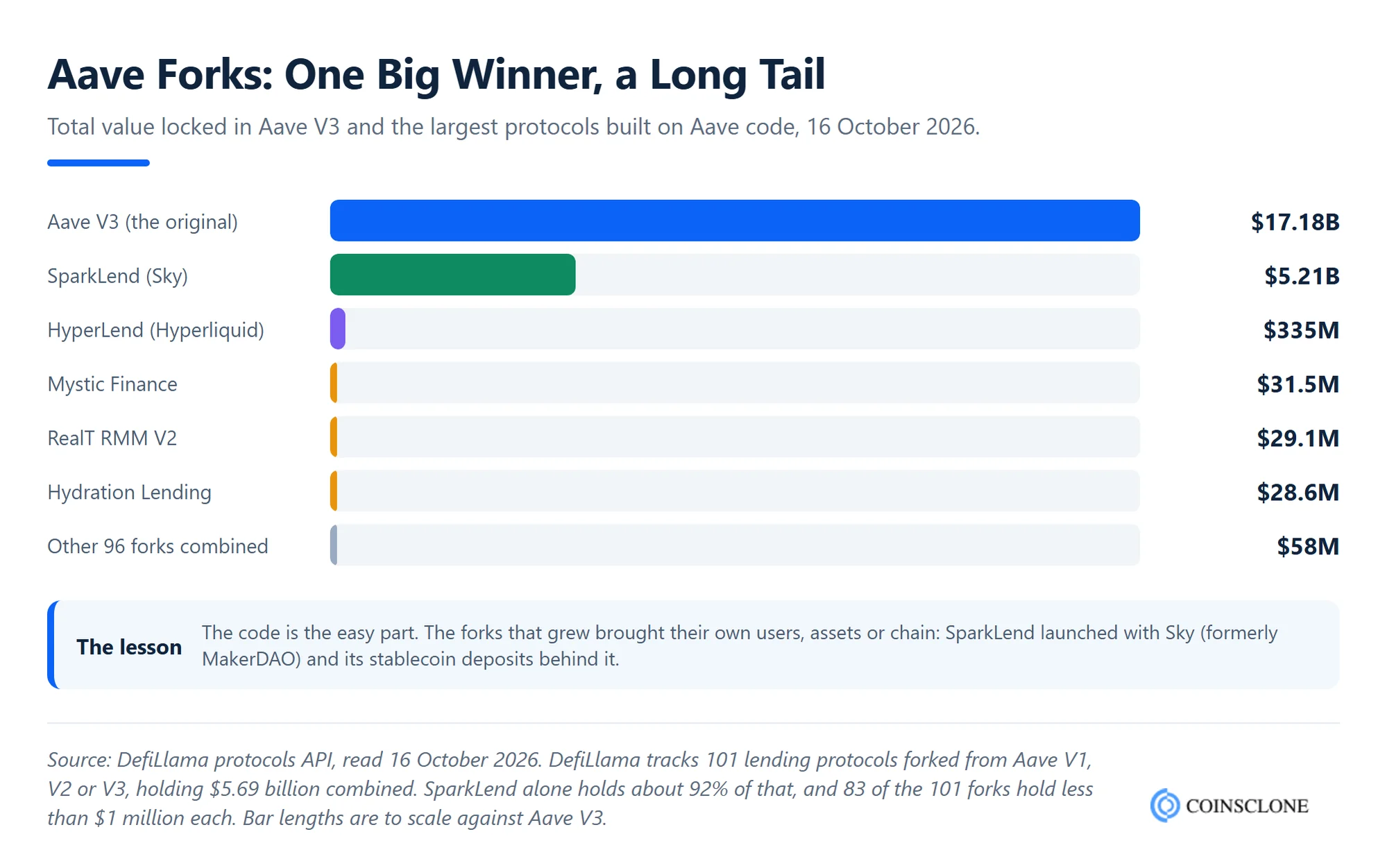
SparkLend holds about 92% of all fork value, and 83 of the 101 forks hold less than $1 million each. The pattern is clear:
- Built-in users win: SparkLend had Sky (once MakerDAO) and its cash behind it from the start. It did not need to find its first users.
- New chains help: HyperLend, the second largest fork with $335 million, serves Hyperliquid’s own chain, where Aave V3 is not deployed.
- Niche assets work: RealT RMM lends against tokenized real estate, a market Aave does not serve.
- Copies alone fail: A fork with the same assets on the same chain as Aave has no reason to exist. Users pick the deeper pool.
So plan your edge before you plan your code. Ask what market, asset or chain you will serve better than Aave, and how you will bring the first $10 million of deposits.
Security Risks to Plan For
Lending apps hold large sums, so attackers study them closely. Aave forks have their own track record of failures:
- Copied bugs: In January 2024, Radiant Capital, a fork of Aave V2, lost about $4.5 million on Arbitrum. The attacker used a known rounding flaw in a new, empty market that Aave had already fixed. A fork must copy the fixes, not just the code.
- Key theft: In October 2024, Radiant lost about $50 million. Malware on three team members’ devices let hackers sign multisig payments that looked normal on screen. Strong admin key controls matter as much as audits.
- Bad collateral: The April 2026 Kelp rsETH exploit hit Aave through an asset it accepted, not through its code. Cap new or wrapped assets, list them in isolation mode first and watch them around the clock.
- Price feed tricks: A cheap or one-source price feed lets hackers pump collateral for one block and borrow against it.
A practical launch plan looks like this:
- Seed every new market: Deposit a small amount yourself when a market opens, so it is never empty.
- Use strong oracles: Chainlink or Pyth, with a backup feed and caps for thin assets.
- Get two audits: One before launch and one after any change to the core contracts.
- Lock admin keys: Multisig with hardware wallets, a timelock and a guardian that can only pause.
- Watch everything: Run your own liquidation bot, price alerts and a public bug bounty from day one.
How to Build a Lending Platform Like Aave: Step by Step
- Pick your edge: Choose the market, chain and assets you will serve better than Aave.
- Choose your code path: MIT V3 core plus audited fixes, a white label script, or a fresh build.
- Set risk rules: LTV, liquidation thresholds, bonuses, caps, rate curves and reserve factors for each asset.
- Build the contracts: Pools, aTokens, debt tokens, the rate model, price feeds, liquidations and flash loans, through our DeFi smart contract development team or your own.
- Build the app and admin panel: Wallet connect, dashboards, alerts and the risk controls above.
- Test hard: Unit tests, fuzz tests, a testnet launch and price-crash drills.
- Audit: At least one outside audit before mainnet, and a public bug bounty.
- Launch small: Start with low caps, a few blue-chip assets and seeded liquidity.
- Grow with care: Add assets in isolation mode, add chains one at a time and hand rules to governance over time.
Aave Clone Script Cost and Timeline
The cost depends on your chains, assets, features and audits. Published 2026 agency cost guides give these market ranges for a lending platform:
| Build scope | What you get | Typical market cost |
| MVP | One chain, a few assets, pooled lending, basic admin | $80,000 to $120,000 |
| Mid-scale | More assets, governance, analytics, mobile app | $120,000 to $250,000 |
| Enterprise | Multi-chain, own stablecoin, institutional features | $250,000 to $450,000+ |
| Security audits | One or two outside audits of the core contracts | $40,000 to $120,000 |
A custom build with audits usually takes about 20 to 36 weeks. An Aave clone script is faster and cheaper, since the core is already built and tested. Our Aave-style white label build takes about 8 to 12 weeks.
Also budget for what comes after launch: oracle feeds, servers for bots and alerts, a bug bounty, and rewards to attract the first suppliers. A pool with no deposits earns nothing, so liquidity planning is part of the cost.
Why Choose Coinsclone for Developing the Best Lending Platform Like Aave?
Coinsclone has built blockchain software since 2018, with 350+ platforms delivered for 200+ clients across 20 industries. We build DeFi lending platforms, exchanges, wallets and tokens for startups and established firms.
Our in-house team covers each part of the build: blockchain and smart contract coders, UI designers, testers and support staff. We tailor the Aave clone script to your assets, chains and risk rules, and we set up audits, oracles and admin key controls before launch. We are more than a DeFi Development Company; we stay your tech partner after launch too. If you want a wider DeFi product around your lending pools, see our DeFi platform development service.
Our Clone scripts similar to Aave Clone scripts are:
Launch a High-Performance PancakeSwap Clone Script: fast, scalable and low cost
White-Label Uniswap Clone Script for busy DeFi exchanges
Advanced 1inch Exchange Clone Script for next-level DeFi aggregation
See How Our MVP System Can Launch Your Lending Platform Faster
Aave Clone Script — DeFi Lending & Borrowing Platform Development.
- MVP System : Launch your Aave-like lending protocol 90% faster..
- Smart Contracts Ready: Lending, borrowing, and collateral modules pre-built.
- Brand & Customization : Your tokens, interest model, and governance system.
- Revenue Engine : Earn from lending spreads, protocol fees, and staking rewards.
Get a free branded demo of your Aave-like platform in 48 hours — before you Invest a single cent.
Book a Free Call to discover how our Aave Clone Script can take you from idea to a live DeFi Lending Protocol in just 8–12 weeks.
Frequently Asked Questions
What is an Aave clone script?
An Aave clone script is ready-made software that copies Aave’s lending model. It includes the lending pool smart contracts, a user app and an admin panel. You launch it under your own brand, with your own assets, chains and risk rules.
Can I build my own Aave-like platform?
Yes. You can build one with your own contracts, start from Aave V3 core code under its MIT licence, or use a white label script. You cannot use the Aave name or logo, and the current Aave v3.7 and V4 code is barred from live use without a waiver. You also need audits, liquidity and any licences your market requires.
Does an Aave clone script have to run on Ethereum?
No. DefiLlama lists Aave V3 on 21 networks. An Aave clone script can run on any EVM chain, such as Ethereum, Base, Arbitrum or BNB Chain. Non-EVM chains such as Solana need the contracts rewritten in that chain’s language.
Can an Aave clone script support cross-chain lending and borrowing?
Yes, but with care. Most platforms run one market on each chain and use bridges to move cash between them. Aave V4’s hub and spoke design is one way to share liquidity across markets. Every bridge adds risk, as the 2026 Kelp exploit showed, so cap bridged assets.
What types of tokens can be listed on an Aave-like platform?
You can list stablecoins, ETH and BTC wrappers, liquid staking tokens, governance tokens and tokenized real-world assets. Each needs a reliable price feed and its own risk settings. List riskier assets in isolation mode with a debt ceiling first.
How does flash loan functionality benefit traders?
Flash loans let traders borrow large sums with no collateral, as long as they repay in the same transaction. They use them for arbitrage, collateral swaps and closing loans in one step. The platform earns a fee on each one, such as Aave’s 0.05% default.
What role do governance tokens play in an Aave clone platform?
Governance token holders vote on new assets, risk settings, fees and upgrades. Holders can also stake the token as a safety reserve and earn rewards for it. Many new platforms keep admin control at launch and hand it to token holders over time.