

A Yearn Finance clone script is ready-made software for launching your own DeFi yield aggregator: a platform where users deposit crypto into vaults and smart contracts move it to the best yield they can find. This guide explains what the script is, how Yearn’s vaults work today, and where Yearn stands in October 2026.
You will also see the parts most guides skip: which Yearn code you may fork, what a vault platform earns, how rival aggregators have fared, the hacks that hit this model, and what a build costs. By the end, you will know if a Yearn-style platform fits your plan and what it takes to launch one safely.
In this guide:
- Yearn’s live numbers: $154.7 million locked on 7 chains, down from a $6.91 billion peak in 2021.
- How V3 vaults and strategies move money, and who keeps what from every $100 of profit.
- Which Yearn code is free to fork, checked in each licence file on GitHub.
- The hacks that hit Yearn’s older products, and the lessons for your launch plan.
- Build steps, market cost ranges and timelines.
See How Our MVP System Can Launch Your DeFi Yield Aggregator Faster
Yearn Finance Clone Script — Automated Yield Aggregator Development.
- MVP System : Build your Yearn Finance-like DeFi yield optimizer 90% faster.
- DeFi-Ready Modules : Vaults, strategies, and auto-compounding contracts ready to deploy.
- Brand & Customization : Your tokens, fee model, and yield logic.
- Revenue Engine : Earn from performance fees, strategy rewards, and staking.
Get a free branded demo of your Yearn-like Yield Platform in just 48 hours — before you invest a cent.
Book a Free Demo to discover how our Yearn Finance Clone Script can take you from idea to a fully functional live yield aggregator in just 8–12 weeks.
What Is a Yearn Finance Clone Script?
A Yearn Finance clone script is a pre-built set of smart contracts, a web app and an admin panel that copies how Yearn works. Users deposit one token, such as USDC or ETH, into a vault. The vault spreads that money across strategies on other DeFi apps, collects the yield and adds it back, so the deposit grows on its own. Nobody approves each move by hand; the code does it.
“Clone” means the same model and features, not the same brand. You launch under your own name, pick your own chains and tokens, and set your own strategies and fees. A good script also lets you add what Yearn does not offer, such as a vault for a local stablecoin, a real-world asset strategy or a vault built for one partner app.
The main reason to use a clone script is time. The vault logic, share accounting, strategy hooks and fee engine are the hardest parts to get right. A tested script gives you all of them on day one, so your team can focus on strategies, security and growth. You still need audits, liquidity and a launch plan, which we cover below.
What Is Yearn Finance?
Yearn Finance is an open-source yield app. Andre Cronje launched it on Ethereum in early 2020 as iearn, a tool that moved stablecoins between lending apps to chase the best rate. Its YFI voting token followed in July 2020 with no pre-sale, and supply is capped at 36,666 YFI, per CoinGecko.
Yearn’s big idea was the vault. Instead of each user moving funds by hand and paying gas every time, everyone pools money in one vault. The vault runs the strategy for all of them and splits the gas cost. That idea shaped almost every yield app that came after it.
Over the years Yearn has shipped three vault versions. Its yVaults docs describe V1 as mostly phased out, V2 as the workhorse still used for Curve pools (up to 20 strategies per vault), and V3 as the new, more open design.
Yearn Finance in October 2026: Status Check
Yearn is active and still ships new code, but it is much smaller than at its peak. Here is where it stands today:
- Size: Yearn Finance held $154.7 million on 16 October 2026, per DefiLlama. Ethereum holds $135.3 million of that, and Katana, a newer DeFi chain, holds $15.0 million. Its Yearn Curating arm holds $48.3 million more.
- Down from its peak: Yearn peaked at $6.91 billion on 4 December 2021. It held $562.5 million a year ago, so deposits have fallen by about 72% in twelve months. TVL is counted in dollars, so it moves with crypto prices as well as with deposits.
- Earnings: Yearn vaults made $8.23 million in fees over the past year, and the protocol kept about $541,000 of it as revenue, per DefiLlama.
- Current code: V3 was approved by token holders in YIP-75 in 2023. The latest release, v3.1.1, landed for vaults on 10 August 2026 and for strategies on 12 October 2026, per Yearn’s GitHub releases.
- New products: yvUSD is a V3 vault that takes deposits on Ethereum and sends funds to strategies on other chains through native bridges such as Circle’s CCTP. Yearn also curates Morpho lending vaults.
- Governance: Yearn has moved from veYFI locking to stYFI staking. Stakers keep their votes, face a 14-day cooldown to exit, and earn rewards paid in a Yearn USDC vault token.
- YFI token: YFI traded at about $2,321 on 16 October 2026, a market value of $83.7 million, against an all-time high of $90,787 in May 2021, per CoinGecko.
The takeaway for founders: the vault model works and keeps evolving, but deposits now go to platforms with a clear edge. Your clone should copy the V3 design and add that edge, not copy the 2020 product list.
How a Yearn-Style Yield Aggregator Works
A Yearn-style platform has a few moving parts. Each one maps to a module in a good clone script.
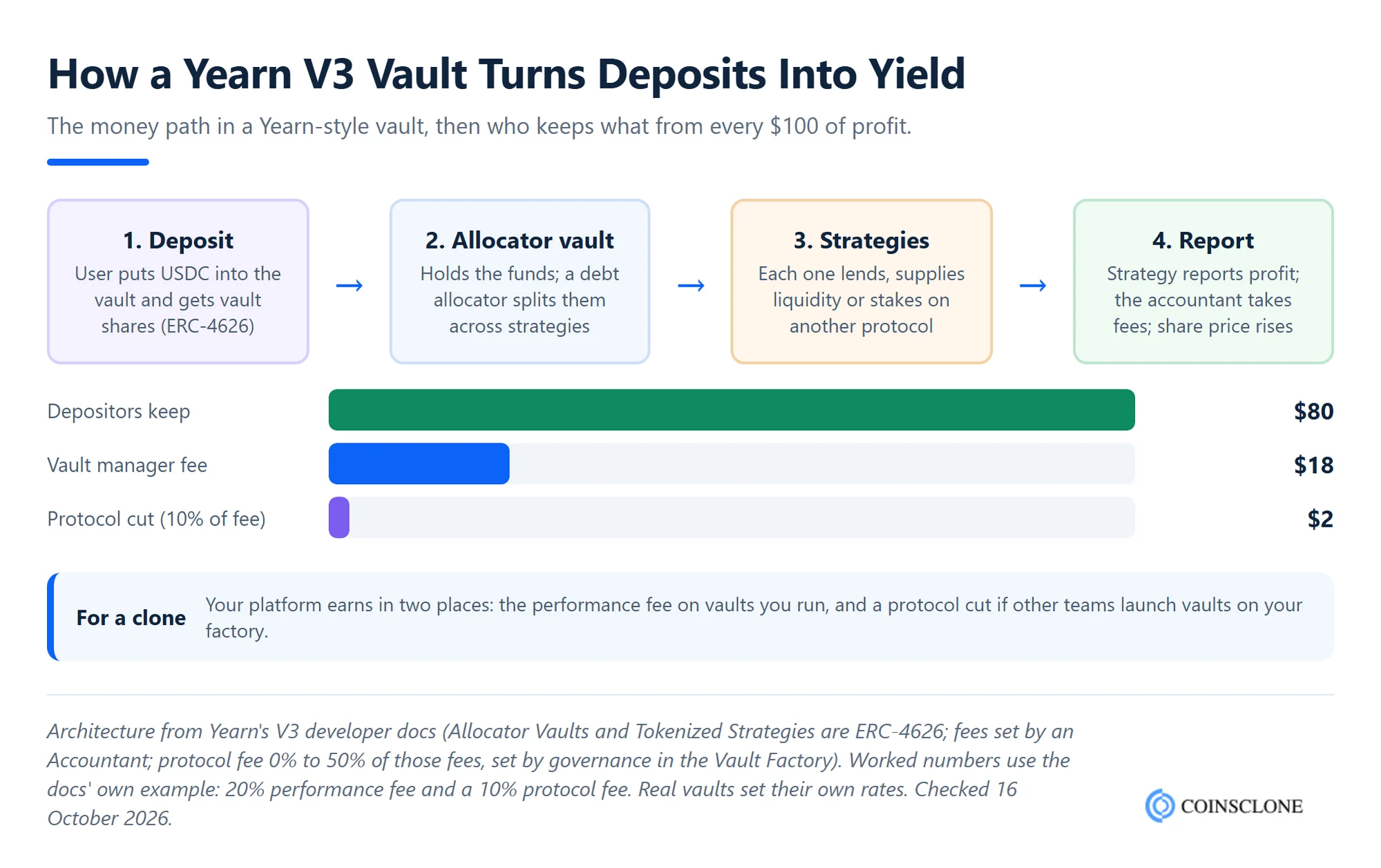
Vaults
A vault holds one token and issues shares to each depositor. In Yearn V3, vaults follow ERC-4626, the Ethereum standard for tokenized vaults, so wallets and other DeFi apps can read and use them with ease. As the vault earns, each share is worth more of the underlying token. Users withdraw by burning shares.
Yearn V3 has two kinds. An Allocator Vault spreads money across many strategies. A Tokenized Strategy runs just one plan. It can take user funds itself or plug into many vaults at once, per Yearn’s V3 docs.
Strategies
A strategy is the contract that does the work. It might lend USDC on a lending market, add liquidity to a Curve pool, or stake ETH. A debt allocator decides how much of the vault’s money each strategy gets, and the team can shift funds as rates change.
Reports and Compounding
From time to time each strategy “reports”. It sells reward tokens, counts its profit and hands the gains back to the vault. That raises the share price for everyone, which is how the yield compounds without users doing anything.
Fees
An Accountant contract sets the vault’s fees, such as a performance fee on profit. The Vault Factory can add a protocol fee. This is a cut of those fees, from 0% to 50%, that goes to the main treasury, per the V3 protocol fee docs. Take the docs’ own example: $100 of profit, a 20% fee on profit and a 10% protocol cut. Users keep $80, the vault team gets $18 and Yearn gets $2.
What Happened to Earn, Zap and Cover?
Older guides, including the first version of this one, list Earn, Zap and Cover as Yearn’s core products. Those 2020 products are no longer part of Yearn’s lineup. Earn was the first iearn contract set, now old code. Two of its old vaults were drained in 2023 and 2025, as the security section explains. Today Yearn’s docs list vaults, yLockers (such as yCRV) and curated vaults instead. A 2026 clone should copy that lineup, not the 2020 menu.
Benefits of Using a Yearn Finance Clone Script
A clone script is not the only path, but it suits most first launches. Here is what it gives you.
- Faster launch: The core vault, strategy and fee contracts are already built and tested. A white label yield platform takes weeks, not the months a fresh build needs.
- Automated yield: Strategies move funds and compound gains on their own. Users deposit once and the platform does the rest.
- Lower gas for users: One vault runs the strategy for everyone, so users share the gas cost instead of paying for each step alone.
- Fully customizable: You choose the chains, tokens, strategies, fees, theme and design. The time and cost depend on how much you change.
- Proven model: The vault design has run on mainnet since 2020 and is now an Ethereum standard (ERC-4626). Users and code reviewers know how it works.
- Easy integrations: ERC-4626 vaults plug into wallets, lending markets and other DeFi apps with little extra work.
- Many ways to earn: Fees on profit, fees on deposits, a cut from vaults that other teams run and your own token can all bring in money.
How a Yearn Finance Clone Makes Money
A vault platform earns a slice of the yield it produces. The main streams are:
- Performance fee: A share of the profit each strategy reports. In Yearn’s docs example it is 20%, but each vault sets its own rate.
- Management fee: An optional yearly fee on the money in a vault. You can set it to zero to win deposits early on.
- Protocol fee: If other teams launch vaults through your factory, your treasury takes a share of their fees, as Yearn does.
- Governance token: A token like YFI can give holders votes and a share of revenue. It helps you reward early users and partners.
- Partner and white label vaults: Wallets, exchanges and fintech apps want built-in yield. You can run vaults for them and share the fees.
Keep the numbers real. Yearn made $8.23 million in fees over the past year on about $150 million to $560 million of deposits, and kept about $541,000 as protocol revenue. Fees scale with deposits and yield, so growth in assets is the main lever.
Features of the Yearn Finance Clone Script
A complete script covers three groups of features.
User Features
- Vault list: Every vault with its token, live APY, risk score and total deposits.
- One-click deposit and withdraw: Deposit a token, get vault shares, withdraw at any time.
- Zap-in: Deposit with any common token; the app swaps it into the vault token in the same step.
- Personal dashboard: Balances, earnings over time and history in one place.
- Wallet connect: MetaMask, WalletConnect, Coinbase Wallet and other common wallets.
- Staking and governance: Stake the platform token, vote on proposals and claim rewards.
Admin Features
- Vault factory: Launch a new vault for any token in a few clicks.
- Strategy manager: Add, remove and rank strategies, and set how much each one can hold.
- Fee settings: Set the fee on profit, the yearly fee and the protocol cut for each vault.
- Deposit limits: Cap new vaults while they prove themselves.
- Real-time analytics: TVL, APY, fees, user counts and strategy health.
- Pause controls: Stop new deposits or pull funds out of a strategy if it goes wrong.
Security and Risk Features
- Role keys: Each job, such as vault admin, strategy writer, keeper bot or pause key, gets its own key.
- Health checks: Block a report if profit or loss looks wrong, so a broken strategy cannot drain the vault.
- Multisig and timelock: Big changes need several signers and a wait.
- Audited contracts: At least one outside audit before launch, and a public bug bounty.
Can You Fork Yearn’s Code? The Licence Question
Yearn publishes its smart contracts on GitHub, so a clone can start from real Yearn code. That is legal only if you follow the licence attached to each repository. We checked each one on 16 October 2026.
| Yearn codebase | Licence today | What it means for a clone |
| V3 vaults (yearn-vaults-v3) | AGPL-3.0 | Free to fork and run live; you must share the source of your changed version |
| V3 tokenized strategies (tokenized-strategy) | AGPL-3.0 | Same terms as the vaults |
| V3 periphery (accountant, debt allocator, router) | AGPL-3.0 in each file header | Same terms; the repo itself has no separate licence file |
| V2 vaults and V1 protocol | AGPL-3.0, repos archived | Free to fork, but archived code gets no fixes |
| 2020 iearn front end | MIT, repo archived | Free to reuse with the MIT notice |
In plain terms, Yearn’s current V3 code is open to fork and run live. That sets it apart from Aave’s newest code and Compound III, which came out under business source licences that limit live use for a time. The catch is AGPL-3.0: if you change the code and offer it to users, you must publish your changed source under the same licence. Most DeFi teams publish their contract code anyway, so this rarely hurts. Still, plan for it before you add private logic.
The licence covers only the code. “Yearn”, “yearn.finance” and the YFI brand are not yours to use. Your platform needs its own name, logo, token and site. For the wider rules on copyright, trademarks and code licences, read our guide on whether clone scripts are legal to use. This is general information, not legal advice.
How Yearn Forks and Rival Aggregators Have Fared
Yearn’s 2020 success set off a wave of copies. Most faded fast. ForkLog reported that one fork token, YFFI, lost 99% of its value in two days. YFII, the best-known fork, holds about $460,000 today, per DefiLlama.
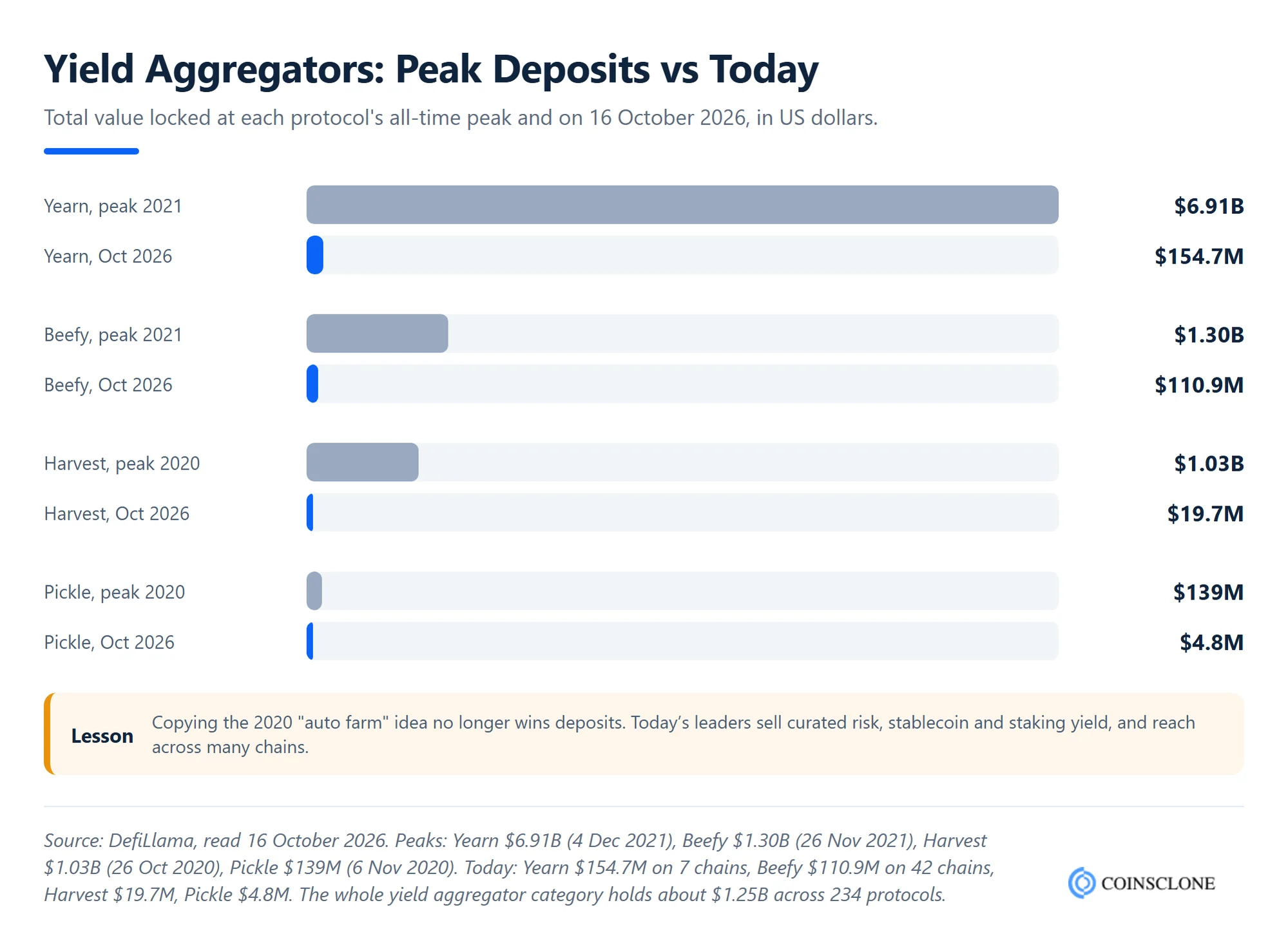
The wider yield aggregator market has also shrunk. DefiLlama lists 234 yield aggregators holding about $1.25 billion in total on 16 October 2026. Yearn ranks third behind CIAN Yield Layer ($291.9 million) and Fluid Lite ($211.7 million), with Beefy ($110.9 million on 42 chains) close behind.
Three lessons stand out for a new platform:
- A copy alone does not win deposits. Forks that only matched Yearn’s 2020 features lost their users within months.
- Focus wins. Today’s leaders each have a clear edge: staking yield, leveraged ETH, or reach across dozens of chains.
- Trust takes time. Users move large sums only to vaults with audits, a clean record and open risk scores.
Security Risks to Plan For
Vaults hold pooled money and call many outside apps, so a single flaw can drain a whole pool. Yearn’s own record shows where the danger lies:
- Price tricks: On 5 February 2021, an attacker used flash loans to skew a Curve pool and drain Yearn’s V1 DAI vault. The vault lost about $11 million, per DefiLlama’s hack records.
- Old, misconfigured code: On 13 April 2023, a wrong setting in the old iearn yUSDT contract let an attacker mint huge amounts of tokens and take about $11.5 million.
- Maths errors: On 30 November 2025, a flaw in the yETH pool’s solver let an attacker mint near-endless LP tokens and take about $9 million. Yearn’s disclosure says V2 and V3 vaults were not affected.
- Attacks on old vaults: In December 2025, an old iearn TUSD vault lost about $300,000. It was the second attack on Yearn that month.
Notice the pattern: the losses hit old or side products, not the audited V3 core. A practical launch plan looks like this:
- Start from current code: Use V3-style contracts, not archived V1 or V2 code.
- Retire old products cleanly: Close and empty legacy vaults instead of leaving them running.
- Use strong price feeds: Never value assets from a single pool’s spot price.
- Add health checks: Block reports with odd profit or loss, and cap each strategy.
- Get audits and a bounty: One audit before launch, one after any core change, and a public bug bounty from day one.
- Lock admin keys: Multisig with hardware wallets, a timelock and an emergency role that can only pause.
How to Build a Yield Aggregator Like Yearn: Step by Step
- Pick your edge: Choose the users, tokens and yield sources you will serve better than Yearn, such as stablecoins in one region or one partner’s ecosystem.
- Choose your blockchain: Ethereum has the deepest yield sources. Arbitrum, Base and other networks cut gas costs for smaller users. Many teams start on one chain and add more later.
- Choose your code path: Fork the AGPL V3 contracts with audited changes, use a white label script, or build fresh contracts on the ERC-4626 standard.
- Write and test strategies: Build each strategy, test it against live forks of mainnet and set its limits. Our DeFi smart contract development team can handle this step.
- Build the app and admin panel: Vault list, dashboards, wallet connect, analytics and the risk controls above.
- Audit: At least one outside audit before mainnet, plus a public bug bounty.
- Launch small: Open a few blue-chip vaults with deposit caps and seed them yourself.
- Attract the first users: Offer launch rewards in your token, partner with wallets and apps for built-in yield, and publish risk scores and audits so users can trust you.
- Grow with care: Add vaults and chains one at a time and hand decisions to governance over time.
Yearn Finance Clone Script Cost and Timeline
The cost depends on your chains, strategies, features and audits. Published 2026 agency cost guides give these market ranges for a yield aggregator, and audit prices come from Sherlock’s 2026 audit pricing reference:
| Scope | What it covers | Typical market cost |
| Custom yield aggregator or vault platform | Vaults, strategy contracts, auto-compounding, links to several protocols | $85,000 to $220,000 |
| Audit of a mid-sized DeFi protocol | One outside review of the core contracts | $40,000 to $100,000 |
| Each re-review after fixes | Checking that issues were fixed correctly | $5,000 to $20,000 |
| Price feeds (running cost) | Oracle subscriptions | About $500 to $4,000 a month |
| Keeper bots (running cost) | Automated reports, harvests and rebalancing | About $300 to $2,500 a month |
Timeline: The same guides put a custom yield aggregator at about 14 to 30 weeks. A Yearn Finance clone script is faster and cheaper, since the core is already built and tested. Our Yearn-style white label yield platform takes about 8 to 12 weeks.
Also budget for liquidity. A vault with no deposits earns no fees, so launch rewards and partner deals are part of the cost, not an extra.
Why Choose Coinsclone for Developing the Best DeFi Yield Platform Like Yearn Finance?
Coinsclone has built blockchain software since 2018, with 350+ platforms delivered for 200+ clients across 20 industries. As a DeFi yield farming development company, we build vaults, strategies and staking apps for startups and large firms.
Our in-house team covers each part of the build: smart contract coders, UI designers, testers and support staff. We tailor the Yearn Finance clone script to your chains, tokens and strategies, and we set up audits, price feeds and admin key controls before launch. Our Yearn Finance clone script runs on the Ethereum blockchain. We are more than a DeFi development company. We stay your tech partner after launch and keep you updated at every stage.
For other DeFi models, we also offer a feature-rich Aave Clone Script, a Compound clone script, a Curve Finance clone script, a Uniswap clone script, a Sushiswap clone script, a Binance DEX Clone Script and many more.
See How Our MVP System Can Launch Your DeFi Yield Aggregator Faster
Yearn Finance Clone Script — Automated Yield Aggregator Development.
- MVP System : Build your Yearn Finance-like DeFi yield optimizer 90% faster.
- DeFi-Ready Modules : Vaults, strategies, and auto-compounding contracts ready to deploy.
- Brand & Customization : Your tokens, fee model, and yield logic.
- Revenue Engine : Earn from performance fees, strategy rewards, and staking.
Get a free branded demo of your Yearn-like Yield Platform in just 48 hours — before you invest a cent.
Book a Free Demo to discover how our Yearn Finance Clone Script can take you from idea to a fully functional live yield aggregator in just 8–12 weeks.
Frequently Asked Questions
What is a Yearn Finance clone script?
It is ready-made software that copies how Yearn works: users deposit tokens into vaults, and strategies move the money to the best yield and compound the gains. You launch it under your own brand, with your own chains, tokens and fees.
Is it profitable to start a Yearn Finance clone platform?
It can be, but profit depends on deposits. A vault platform earns a share of the yield it produces, so fees grow with the money users trust you with. Yearn made $8.23 million in fees over the past year, per DefiLlama. A new platform needs a clear edge, audits and launch rewards to attract deposits first.
Can I add my own governance token to the platform?
Yes. Most yield platforms launch a token like YFI for voting and rewards. You set its supply, how it is shared and what it controls. Yearn itself now uses stYFI staking, where holders stake YFI to vote and earn rewards.
How does a yield platform attract its first users?
Seed your first vaults yourself, offer launch rewards in your token, and partner with wallets or apps that want built-in yield. Publish your audits and risk scores. Users move real money only to vaults they can check.
Can I run the platform under my own brand?
Yes, and you must. A clone script copies the model and features, not the brand. “Yearn” and YFI belong to Yearn, so you need your own name, logo, token and website.
Which blockchain should I choose for a DeFi yield platform?
Ethereum has the deepest yield sources and most users, so Yearn keeps most of its deposits there. Layer 2 networks such as Arbitrum and Base cut gas costs for smaller users. Pick the chain where your target users and yield sources already are, and add more later.
How much does it cost to develop a DeFi protocol like Yearn Finance?
Published 2026 agency cost guides put a custom yield aggregator at about $85,000 to $220,000, plus $40,000 to $100,000 for an outside audit. A clone script costs less and launches faster, since the core is already built and tested.
Can I scale the platform in the future?
Yes. The V3 design lets you add new vaults and strategies at any time, and ERC-4626 vaults plug into other apps easily. You can add chains, tokens and partner vaults step by step as deposits grow.
Do you provide technical support after launch?
Yes. Once the project is live, our developers help you fix issues, add features and keep the platform secure, and we keep you updated on every change.