

Want to buy and sell cryptocurrency but not sure where to start? This guide walks you through the whole trip: picking a platform, opening and securing an account, placing your first buy order, storing your coins, and selling them back into cash in your bank. Along the way, you will see what each step really costs, which mistakes trip up new traders, and how taxes work when you sell.
Then we take one step further. Every trade you make pays a fee to the exchange that runs it, and some traders end up owning that exchange. So the last part of this guide shows why founders like Changpeng Zhao built exchanges instead of trading on them, and how you can launch your own crypto exchange in a few weeks.
In this guide:
- The 5 steps to buy crypto, and the 4 steps to sell it and cash out
- Which platform to use: central exchange, DEX, P2P or ETF
- What a $1,000 buy and sell really costs on Binance, Coinbase and Kraken
- How selling crypto is taxed, with the 2026 rules in the US and India
- How a trader becomes an exchange owner, and how long the build takes
How to Buy and Sell Cryptocurrency
To buy and sell cryptocurrency, you open an account on a crypto exchange, verify your identity, add money from your bank or card, and place a buy order. To sell, you place a sell order for the coins you hold and withdraw the cash to your bank. The whole first purchase can take less than an hour, although bank deposits may take one to three days to clear.
Crypto markets never close, so you can trade at any hour, on any day. However, the market is also known for big price swings. In fact, bitcoin traded at about $82,000 on 16 October 2026, giving it a market value of about $1.65 trillion, according to CoinGecko. It was above $120,000 just a year earlier. So, start small and only use money you can afford to lose.
Here is how each step works.
Step 1: Choose Where to Buy
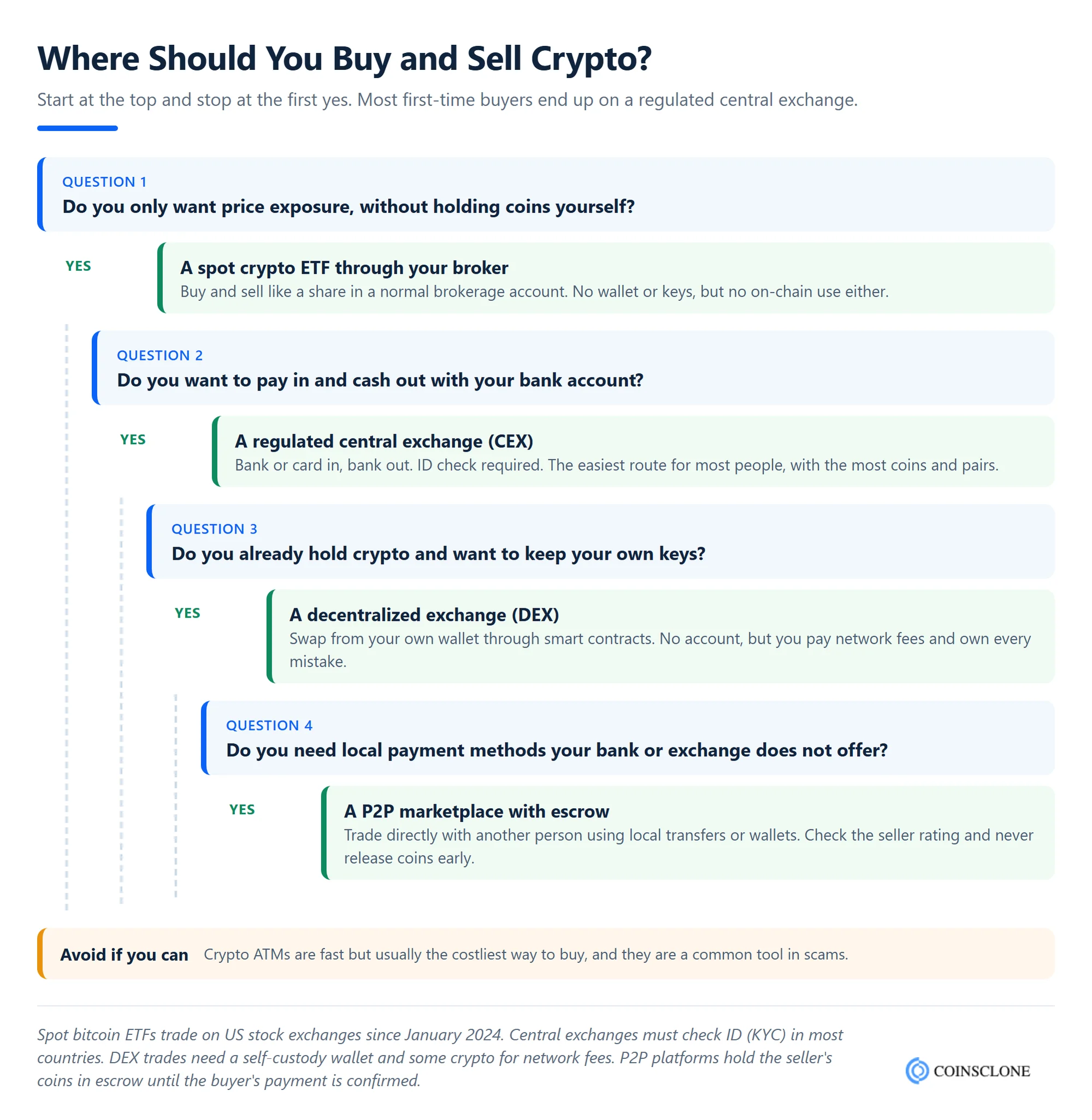
First, find out the best cryptos for your goals and a trusted platform that sells them. Compare platforms on their fees, security record, licences in your country, coin list, ease of use and API options. Most beginners start on a regulated central exchange, because it lets you pay with your bank account and cash out the same way.
Our list of the best cryptocurrency exchanges compares the leading platforms on fees and safety. The decision tree below shows which type of platform fits you.
Step 2: Create and Secure Your Account
Next, sign up with your email and phone number. Then complete the identity check, known as KYC (Know Your Customer). You usually upload a government ID and a selfie, and sometimes proof of address. Regulated exchanges must do this under anti-money laundering rules, so be wary of any platform that skips it.
After that, turn on two-factor authentication (2FA) with an authenticator app rather than SMS. Also set a withdrawal address whitelist and an anti-phishing code if the exchange offers them. These small steps block most account takeovers.
Step 3: Fund Your Account
Now add money. You can usually choose a bank transfer, a debit or credit card, or a local payment app. A bank transfer is normally the cheapest way, though it can take a day or two. Cards are instant, but they often add a fee of a few percent on top of the trading fee. If you already own crypto, you can also deposit coins from another wallet.
Step 4: Place a Buy Order
Pick the coin and the trading pair, such as BTC/USD or ETH/USDT. Then choose an order type:
- Market order: Buys right away at the best price on offer. It is simple, but you pay the higher “taker” fee and may get a slightly worse price in a fast market.
- Limit order: Buys only at the price you set or better. It may not fill at once, but it often earns the lower “maker” fee.
- Recurring buy: Buys a fixed amount every day, week or month. This is called dollar-cost averaging, and it smooths out price swings.
Before you confirm, check the full cost on the order screen. The simple “Buy” button in many apps shows one price that already includes a spread, a markup over the market price.
Step 5: Store Your Crypto
Once your order fills, the coins appear in your exchange account. You then have three choices:
- Leave them on the exchange: Easy for small amounts and active trading. However, you rely on the exchange to keep them safe.
- A software wallet: An app on your phone or computer where you hold the keys. Good for moderate amounts you want to use.
- A hardware wallet: A small device that keeps your keys offline. Best for larger sums you plan to hold.
If you hold your own keys, write down the seed phrase on paper and keep it somewhere safe. Anyone with that phrase can take your coins, and no one can recover it for you. Our guide to the best crypto wallets compares the main options.
How to Sell Cryptocurrency and Cash Out
Selling works like buying in reverse. You cannot send crypto straight to a bank account, so you sell first and withdraw second.
- Move your coins to the exchange: If your coins sit in a personal wallet, send them to your exchange deposit address. Check the network carefully (for example, USDT on TRC-20 is not the same as USDT on ERC-20), and send a small test amount first.
- Place a sell order: Choose the coin and the amount, then use a market order to sell now or a limit order to sell at your target price.
- Withdraw the cash: Send the money to your linked bank account. Bank transfers are usually cheap or free, while wire transfers cost more. Most exchanges ask you to withdraw to an account in your own name.
- Save your records: Download the trade history. You will need the buy price, sale price, dates and fees for your tax return.
You can also sell on a P2P marketplace, where a buyer pays you directly by bank transfer or a local app while the platform holds your coins in escrow. Only release the coins once the money is in your account, not when the buyer sends a screenshot.
What It Costs to Buy and Sell Crypto
Fees are where most beginners lose money without noticing. There are four kinds to watch:
- Trading fees: A percentage of each trade. Order book exchanges charge a “maker” fee for orders that wait in the book and a “taker” fee for orders that fill at once.
- Spreads: The gap between the buy and sell price. One-tap buy screens often hide their main cost here.
- Funding fees: Card purchases and wire transfers often cost extra. Bank transfers are usually the cheapest.
- Network and withdrawal fees: You pay these when you move coins off the exchange, and they change with how busy the blockchain is.
Trading fees alone vary a lot between platforms. For example, regular users on Binance pay 0.10% maker and 0.10% taker on spot trades, or 0.075% when they pay fees in BNB, per the Binance fee schedule. Kraken charges from -0.02% for makers to 0.80% for takers depending on volume, according to its support page on trading fees (updated 1 October 2026). Coinbase earned $734 million from $56 billion of consumer trading in the last quarter of 2025, or about 1.3% of every dollar traded, per its Q4 2025 shareholder letter.
Here is what that means for one round trip, buying $1,000 of bitcoin and selling it again:
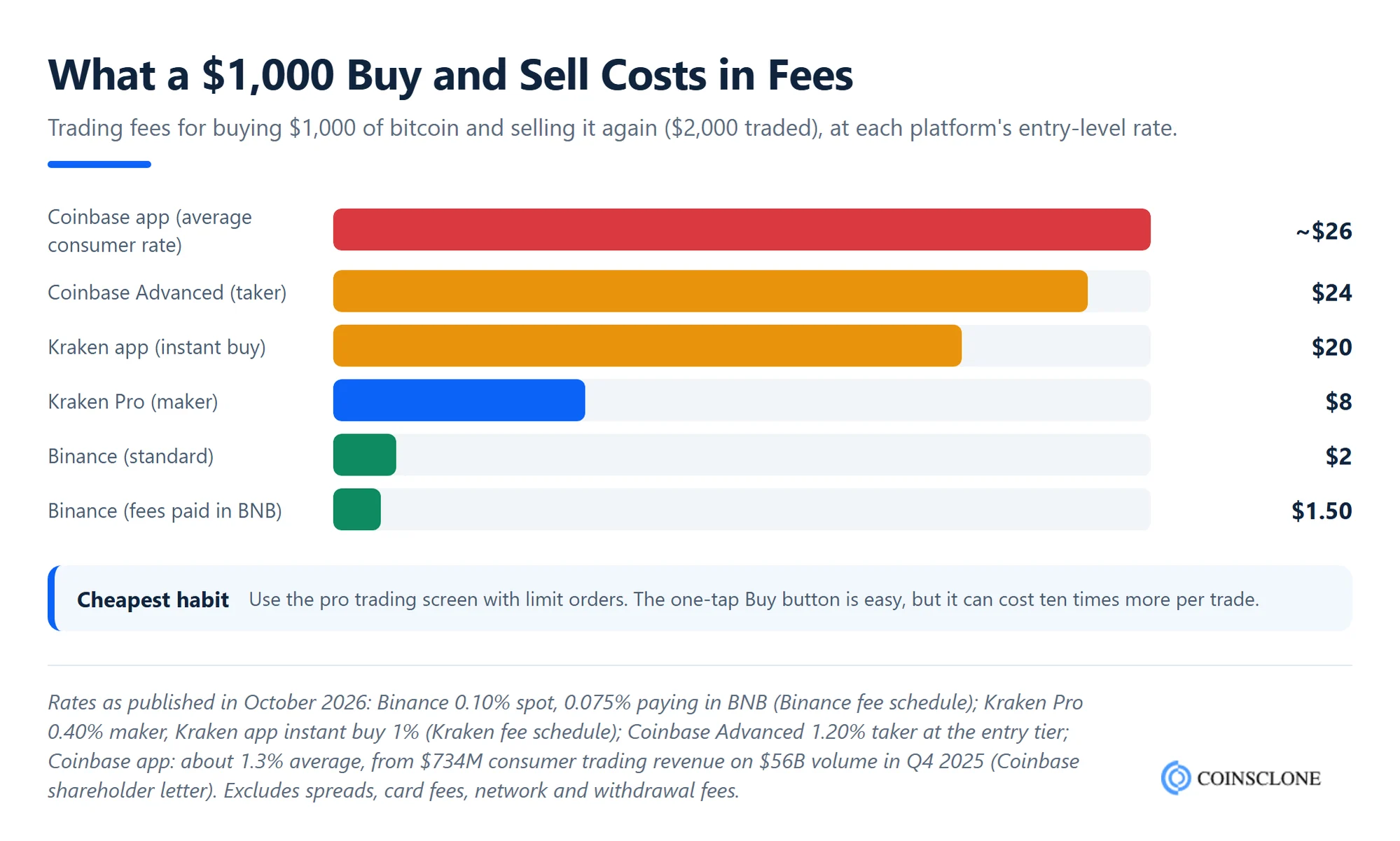
As the chart shows, the same trade can cost $2 or $26 in fees alone. So the cheapest habit is simple: use the pro trading screen with limit orders, fund by bank transfer, and avoid moving coins back and forth more than you need to.
How Selling Crypto Is Taxed
In most countries, selling crypto is a taxable event. If you sell for more than you paid, the profit is a capital gain. Swapping one coin for another, or spending crypto, can also count as a sale. Rules differ by country, so here are two large markets as examples:
- United States: The IRS treats crypto as property. Since 1 January 2025, US brokers report your gross sale proceeds on the new Form 1099-DA, and from 1 January 2026 they also report your cost basis on many sales, per the IRS digital assets page. Your Form 1040 also asks whether you sold or disposed of any digital asset during the year.
- India: Gains on crypto are taxed at a flat 30%, losses cannot be set off against other income, and a 1% TDS applies to transfers. Budget 2026 kept these rules unchanged, Decrypt reported.
Either way, keep a record of every buy, sell and fee from day one. A crypto tax tool or a local tax adviser can then work out your gains quickly.
How Does Crypto Trading Benefit Users?
In the fast-paced digital market, many people see crypto as a new kind of asset that sits outside the banking system. Here is what draws them in.
Potential Returns
Users who buy and sell cryptocurrency can earn strong returns from a small start. Even so, the crypto market is volatile, so losses can be just as large as gains.
Secure by Design
Blockchain records are very hard to change once a transaction is confirmed, which builds trust between strangers. However, exchanges and wallets can still be hacked. In February 2025, attackers took about $1.5 billion from the Bybit exchange in a single attack, Chainalysis reports. The blockchain is secure; the weak point is usually the platform or the user.
Decentralization
On a decentralized exchange or with your own wallet, you do not need anyone’s approval to send or receive crypto. Transfers settle on the blockchain within minutes, at any hour.
Global Accessibility
Crypto traders can trade from any corner of the world, with 24/7 market access. Anyone with an internet connection and a phone can join, subject to the rules in their country.
Common Mistakes to Avoid
These perks are real, but new traders often lose money in the same few ways:
- Chasing hype: Buying a coin because it is trending, after the price has already jumped.
- Ignoring fees: Using the costliest buy button and trading too often.
- Weak security: Reusing passwords, skipping 2FA or sharing a seed phrase.
- Falling for scams: Fake support agents, “guaranteed return” schemes and romance scams. Crypto ATMs are a common tool here, and the US Federal Trade Commission warns that no real business or agency will ask you to pay in crypto.
- Over-using leverage: Margin and futures trades can wipe out your deposit in minutes.
These are the valuable perks and the real risks of trading digital assets. Still, crypto trading is like standing at the edge of the sea.
Do you want to stand at the shore, or are you eager to explore the depth of the crypto ocean? If you want more than trading, give your business mind a refreshing twist.
Picture yourself: As a seasoned trader, you chase the best crypto exchange, with the lowest fees and the most coins. But what if you created your own? Then you would earn a fee on every trade, instead of paying one. At first, this may sound like a big leap for fellow investors.
Yet, look at the founders of the biggest exchanges. Changpeng Zhao built trading systems for Bloomberg Tradebook and his own high-frequency trading firm before he launched Binance in 2017. Brian Armstrong was a software engineer at Airbnb when he co-founded Coinbase in 2012, and Jesse Powell started Kraken in 2011 after watching the Mt. Gox exchange struggle. Each of them saw that the platform, not the single trade, was the real business. One day, you can also turn out to be like them, with the right Web3 Clone Scripts For Blockchain Startups that let people buy and sell cryptocurrencies on your platform. Here, we are responsible for clarifying one thing. Trading can bring you good returns, but owning an exchange can be far more profitable, because it earns on every trade, whether prices rise or fall.
Here, you may come up with a query…
Why Choose Cryptocurrency Exchange Creation over Trading?
“Creating is better than investing” is one of the modern sayings in the crypto market. When a trader chooses to build an exchange instead of only trading, it can be the start of a long-lasting success story. Creating a cryptocurrency exchange offers you the following.
Many Revenue Streams
A crypto exchange can be far more profitable than crypto trading. You collect trading fees, spreads, withdrawal fees, listing fees, staking commissions and subscription fees. For a sense of scale, Coinbase reported $7.18 billion in revenue and $1.26 billion in net income for 2025. The same company posted a net loss in the second quarter of 2026 when trading slowed, which shows why a mix of income streams matters. Our guide on how crypto exchanges make money explains each stream.
Market Growth
The crypto market is a place for growth, new ideas and new technology. The total value of all cryptocurrencies stood at about $2.78 trillion on 16 October 2026, with more than 22,000 coins tracked, per CoinGecko. Binance alone reported more than 320 million registered users at its ninth anniversary in July 2026. Every one of those users needs a place to buy and sell.
Complete Ownership
Unlike crypto trading, you are the boss of your own crypto exchange. You set the fees, choose the coins, write the policies and shape the user experience. Also, building a crypto exchange lets you grow a strong crypto community around your brand.
Brand Creation
In the dynamic crypto world, a well-run exchange can become a trusted local brand. Many successful exchanges win by serving one country or one niche better than the global giants do, with local currency, local payment methods and local support.
Of course, an exchange has real costs too: licences, liquidity, security and marketing. So it pays to run the numbers first. Our guide on whether owning a crypto exchange is profitable works out how much daily trading you need to break even.
Hope you got a clear idea about creating a cryptocurrency exchange. Many myths surround exchange development, so here are the facts about the main ways to build one.
Crypto Exchange Development Methods
The buzz in the crypto industry is that building a crypto exchange will break the bank. Yet, several build options now suit newbie startups. Here are the main ones.
Custom Solutions
If you want a fully unique platform, a custom solution is for you. This means building a crypto exchange from scratch. The admin and user panels, system design, UI/UX, features and security are all created from the beginning, so the platform carries your identity from creation to launch.
As it is built from the ground up, the cost is the highest and the timeline the longest. So, this method suits established firms with large budgets and unusual needs.
White Label Software
White label crypto exchange software is a ready-made, tested platform that comes with the core features, admin and user panels, wallets and security tools. You add your brand, choose your coins and fees, and customize it to fit your business. You can also bring your own ideas, marketing plans and extra revenue streams.
The cost and time to launch are affordable for startups. So, this is a go-to option for new founders.
Clone Script Options
In simple terms, a clone script copies the proven features and flow of a well-known crypto exchange. If you want your crypto business to launch quickly and at a lower cost, a crypto exchange clone script is a better option. At first, you may only be thinking of trading, but when you shift to the mindset of building an exchange, copying a model that already works will help you a lot.
For example, if you like the features and user panel of Binance, you can choose a Binance clone script. The revenue streams, features and trading flow follow the same model, and you can still customize the exchange to fit your needs. Like a pearl on the crown, the cost and time are lower than other methods. So, newbies with a limited budget often start here.
Here is how long each route usually takes:
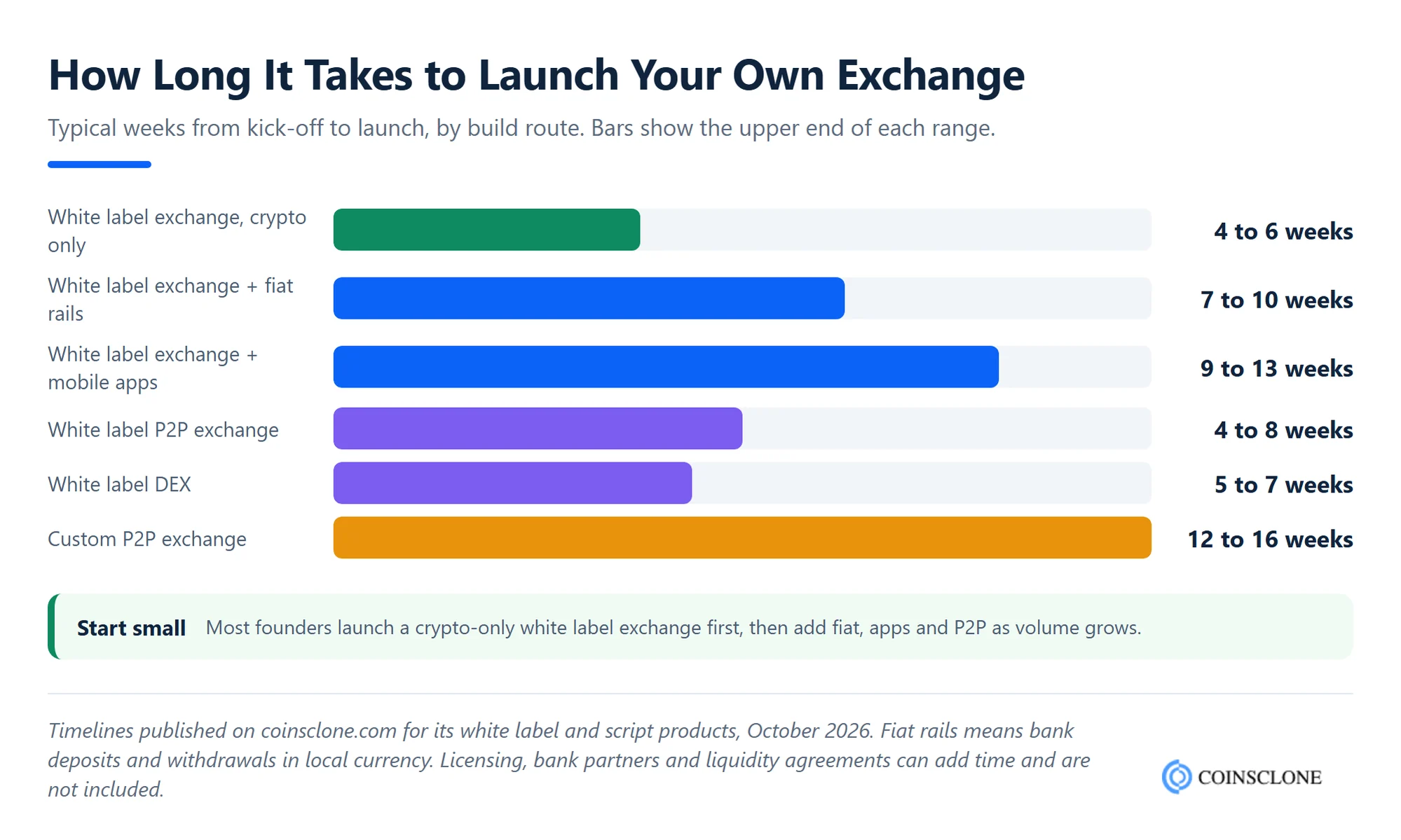
So, grab the chance to turn your trading know-how into an exchange of your own. Many crypto exchange clone script providers offer these services. Among them, Coinsclone stands out for its delivery record and full-cycle support.
Conclusion
Buying and selling cryptocurrency is simple once you know the steps: choose a trusted platform, secure your account, fund it cheaply, use limit orders, store your coins safely and keep records for tax. Most of the cost hides in spreads and fees, so a little care saves real money on every trade.
And if you are ready to move from paying fees to earning them, Coinsclone can help. Coinsclone is a leading Cryptocurrency Exchange Development Company that has been building crypto products since 2018, with more than 350 platforms delivered for 200+ clients across 20 industries. Our team builds centralized exchanges, DEX platforms, P2P exchanges and crypto wallets, as custom solutions, white label software or clone scripts. Don’t settle for less. Contact our experts today.
Turn your short dreams into big ones by becoming an entrepreneur!
Become a Crypto Exchange Owner and Lead the Market
High-Performance, Scalable Solutions for Investors. Get a Free Consultation.
Frequently Asked Questions
How much money do I need to start buying crypto?
Very little. Most large exchanges let you buy a fraction of a coin, so you can start with $10 to $50. You do not need to buy a whole bitcoin. Starting small helps you learn how orders, fees and wallets work before you put in more.
What is the difference between a market order and a limit order?
A market order buys or sells right away at the best price available, and it usually pays the higher taker fee. A limit order only fills at the price you set or better. It may take longer to fill, but it gives you price control and often a lower maker fee.
Do I have to verify my identity to buy crypto?
On regulated exchanges, yes. They must check your ID under anti-money laundering rules before you can deposit money or withdraw to a bank. Decentralized exchanges do not ask for ID, but you need crypto in a self-custody wallet to use them.
Should I keep my crypto on the exchange after buying?
For small amounts and active trading, keeping coins on a large, regulated exchange is convenient. For larger sums you plan to hold, a hardware wallet is safer, because you control the keys and are not exposed if the exchange is hacked or fails.
Can you buy and sell crypto the same day?
Yes. Crypto trades 24 hours a day, and most exchanges let you sell coins right after you buy them. This is called day trading. Keep in mind that each trade pays a fee, and some exchanges hold newly deposited bank funds for a few days before you can withdraw them.
How do I cash out crypto to my bank account?
Sell your crypto for your local currency on an exchange, then withdraw the money to a bank account in your own name. Bank transfers are usually cheap or free and take one to three working days. You can also sell on a P2P marketplace and receive the money directly from the buyer.
Do you pay taxes when you sell crypto?
In most countries, yes. Selling crypto for a profit is usually a taxable capital gain, and swapping one coin for another can count too. In the US, brokers now report sales on Form 1099-DA. In India, gains are taxed at a flat 30% with 1% TDS. Keep records of every trade and check your local rules.