

This guide covers the best cryptocurrencies to invest in 2026, based on size, age, real use and risk. For each of the 10 coins you get what it does, its market value and how far it sits below its record high, all checked on CoinGecko on 9 October 2026. You also get the coins we dropped from our older list and why.
The second half shows how to buy and hold crypto with less risk: how to judge a coin, how much to put in, where to store it and how it is taxed. This is education, not financial advice. Crypto prices can fall by half or more, so only invest money you can afford to lose.
In this guide:
- The 10 best cryptocurrencies to invest in 2026, with market cap, drop from peak and main risk side by side
- Why Bitcoin and Ethereum make up about 70% of the whole market
- Three coins that left our list (Polygon, EOS and NEO) and what happened to them
- A three-question check to run before you buy any coin
- How crypto is taxed in India, the US, the UK and the EU in 2026
10 Best Cryptocurrencies to Invest in 2026
The 10 best cryptocurrencies to invest in 2026 are Bitcoin, Ethereum, BNB, XRP, Solana, TRON, Chainlink, Cardano, Bitcoin Cash and Litecoin. Each one ranks in the top 25 on CoinGecko, has run for at least five years and has a job you can name. None of them is a sure thing. In fact, every coin on this list trades below its all-time high today.
- Bitcoin (BTC): the original cryptocurrency and a store of value
- Ethereum (ETH): the largest smart contract network
- BNB: the coin behind BNB Chain and Binance fee discounts
- XRP: a payments coin used for fast transfers
- Solana (SOL): a fast, low-fee chain for apps and trading
- TRON (TRX): the second-largest network for stablecoins
- Chainlink (LINK): data feeds that link blockchains to real-world prices
- Cardano (ADA): a research-led proof-of-stake chain
- Bitcoin Cash (BCH): a Bitcoin fork built for cheap payments
- Litecoin (LTC): one of the oldest payment coins
The Best Cryptocurrencies Compared
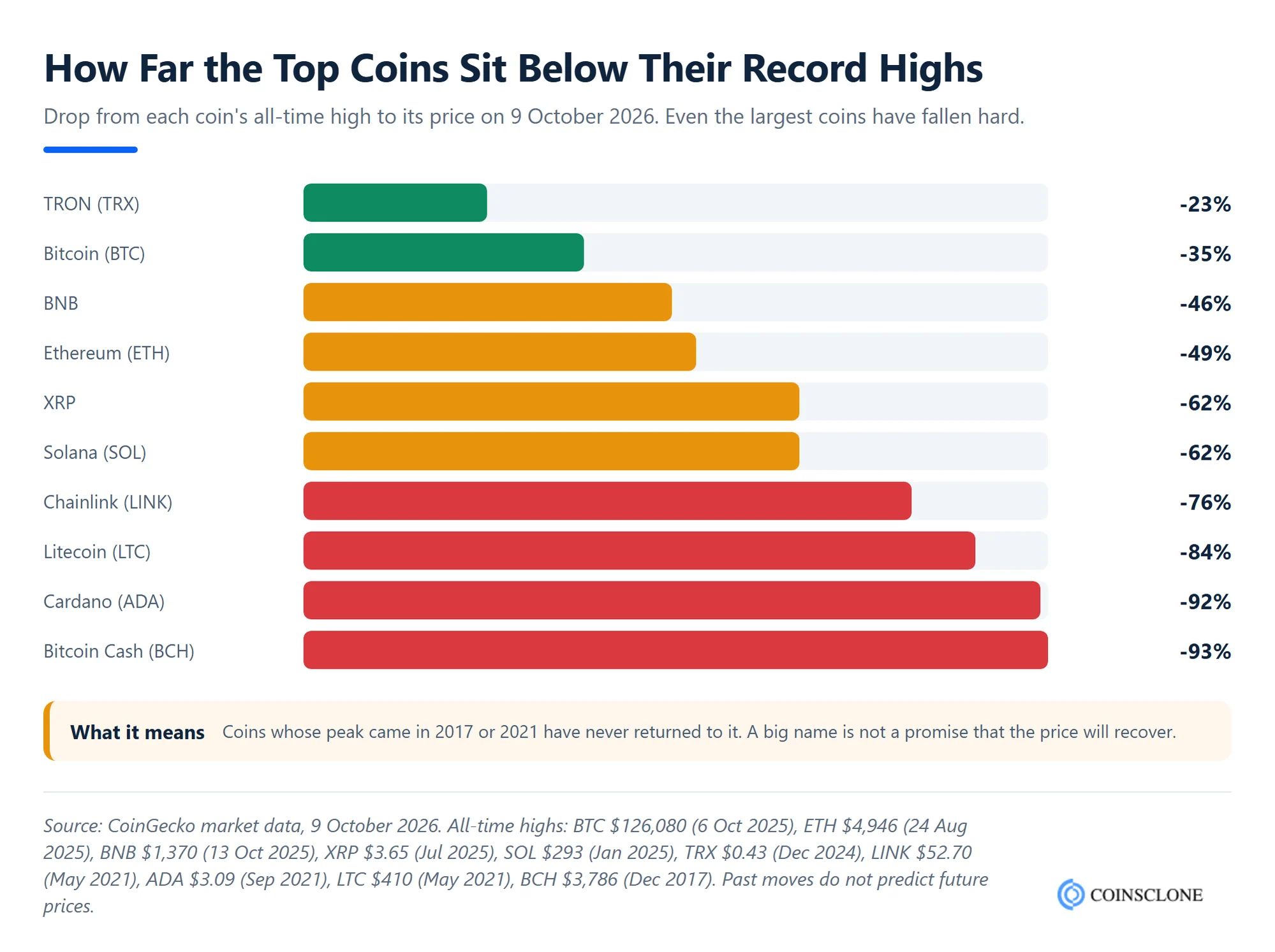
The table puts the 10 side by side. “Drop from peak” shows how far each price sits below its record. It is the clearest single sign of how much a coin can fall.
| Coin | Rank | Market cap | Drop from peak | Launched | Main risk |
| Bitcoin (BTC) | 1 | $1.66 trillion | -35% | 2009 | Large swings tied to global markets |
| Ethereum (ETH) | 2 | $306 billion | -49% | 2015 | Rival chains and layer 2s take fees |
| BNB | 4 | $99 billion | -46% | 2017 | Tied to one company, Binance |
| XRP | 5 | $88 billion | -62% | 2012 | Ripple holds a large share of supply |
| Solana (SOL) | 7 | $65 billion | -62% | 2020 | Past network outages |
| TRON (TRX) | 8 | $31.5 billion | -23% | 2017 | Only 27 block producers |
| Chainlink (LINK) | 16 | $9.6 billion | -76% | 2017 | Token value depends on fee demand |
| Cardano (ADA) | 17 | $8.9 billion | -92% | 2017 | Little app activity for its size |
| Bitcoin Cash (BCH) | 22 | $5.6 billion | -93% | 2017 | Low use as payments shift to stablecoins |
| Litecoin (LTC) | 23 | $5.0 billion | -84% | 2011 | Few new uses beyond payments |
Data: CoinGecko, 9 October 2026. Ranks include stablecoins. Prices change every minute, so check live figures before you act.
1. Bitcoin (BTC)
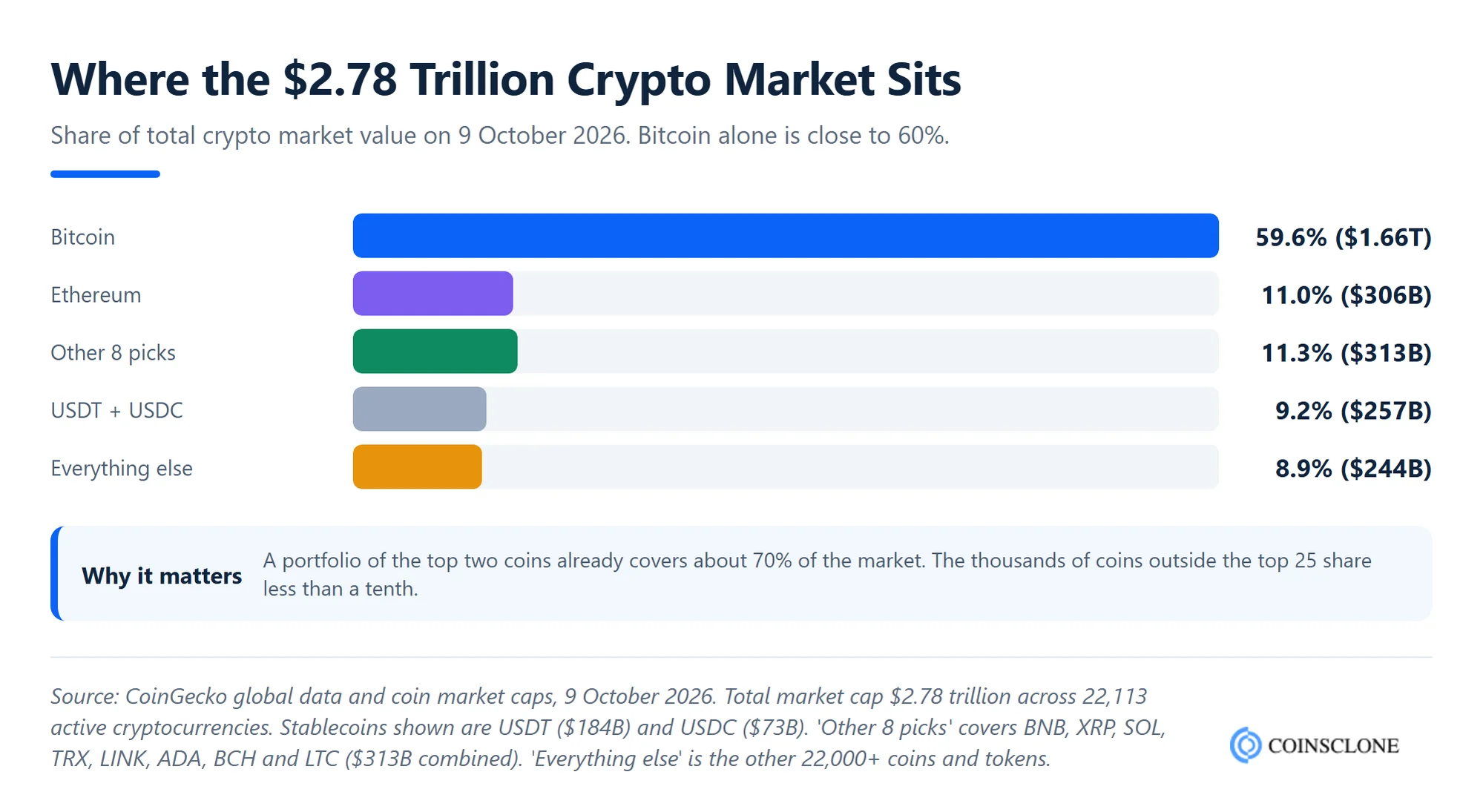
Bitcoin is our first choice because it is the largest, oldest and most widely held cryptocurrency. It launched in January 2009, created by someone using the name Satoshi Nakamoto, with a reward of 50 BTC per block. Today Bitcoin is worth about $1.66 trillion, close to 60% of the whole crypto market.
Its main appeal is a fixed supply. Only 21 million BTC will ever exist, and about 20.1 million are already mined. Every four years the “halving” cuts the new supply in half. The latest halving came in April 2024 and dropped the block reward to 3.125 BTC. The next is due around 2028.
Big investors now hold Bitcoin through regular brokers. The US SEC approved spot Bitcoin ETFs in January 2024, so pension funds and wealth managers can buy it like a stock.
Even so, Bitcoin still swings hard. It hit a record $126,080 on 6 October 2025 and traded near $82,560 on 9 October 2026, a fall of about 35%. For a long view of past cycles, see our Bitcoin price outlook.
2. Ethereum (ETH)
Ethereum is the second-largest cryptocurrency, worth about $306 billion. Vitalik Buterin and a small team launched it in 2015 as a blockchain that runs smart contracts: code that moves money when set rules are met. As a result, most tokens, NFTs, stablecoins and DeFi apps run on Ethereum or on networks built on top of it.
Ethereum moved from mining to proof of stake in September 2022. Holders can now “stake” ETH to help secure the network and earn a reward. Since then, upgrades have cut fees for the layer 2 networks that settle on Ethereum. The Fusaka upgrade went live on 3 December 2025. The next one, Glamsterdam, reached a test network on 6 October 2026 and aims for mainnet in late 2026, with no fixed date yet. You can follow it on the Ethereum roadmap.
The risk is competition. Solana and other chains want the same users, and layer 2s keep part of the fees. ETH peaked at $4,946 in August 2025 and traded near $2,500 in October 2026, about 49% lower.
3. BNB
BNB is the coin of the BNB Chain and of Binance, the largest crypto exchange by trading volume. Binance launched it in 2017 as a discount token for trading fees. Today BNB also pays gas fees on BNB Chain, which hosts DeFi apps and about $13 billion of stablecoins, according to DefiLlama.
Binance burns (destroys) part of the supply every quarter. The supply started at 200 million and is now about 133 million, with a long-term target of 100 million. Fewer coins can support the price if demand holds.
The main risk is that BNB depends on one company. In November 2023 Binance agreed to pay $4.3 billion to settle US charges, and any new legal trouble would hit BNB fast. BNB traded near $742 in October 2026, about 46% below its October 2025 peak.
4. XRP
XRP is the coin of the XRP Ledger, a payment network that went live in 2012. Transfers settle in a few seconds for a tiny fee. Ripple, the company that helped build it, sells payment and stablecoin services to banks and payment firms, and some of them use XRP to move value across borders.
For years the biggest cloud over XRP was the US SEC lawsuit against Ripple. That case ended in 2025 when both sides dropped their appeals, and spot XRP ETFs launched in the US later that year.
Still, there are risks. Ripple holds a large share of the 100 billion supply in escrow and releases it over time, which adds selling pressure. XRP traded near $1.40 in October 2026, about 62% below its July 2025 high.
5. Solana (SOL)
Solana is a fast, low-fee blockchain that launched in 2020. It handles thousands of transactions per second, so it suits trading apps, payments and games. Many new tokens launch on Solana, and much of the meme coin trading happens there. It also hosts about $16 billion of stablecoins.
US spot Solana ETFs started trading in late 2025, which gave larger investors a regulated way in. Meanwhile, new validator software aims to make the network faster and harder to knock offline.
That matters because Solana’s main weakness is its record of outages. The network stopped several times in 2022, and again for about five hours in February 2024. SOL traded near $110 in October 2026, about 62% below its January 2025 high.
6. TRON (TRX)
TRON is a blockchain that launched in 2017 and became a main road for USDT transfers in Asia, Africa and Latin America. It holds about $94 billion of stablecoins, second only to Ethereum, according to DefiLlama. Fees are low, so people use it to send dollars across borders.
TRX pays for network resources, and holders can vote for the 27 “Super Representatives” that produce blocks. That small group is also the main risk: the network is more centralised than Bitcoin or Ethereum, and it leans heavily on one founder. TRX held up better than most this year, about 23% below its December 2024 peak.
7. Chainlink (LINK)
Chainlink is not a payments coin. Instead, it is the largest “oracle” network, which feeds real-world data such as asset prices into smart contracts. Lending apps need those prices to know when a loan is unsafe. Chainlink also runs CCIP, a tool for moving tokens between blockchains, which banks and market firms have tested for tokenized funds.
LINK pays the node operators who supply the data. So the case for LINK depends on whether apps and banks keep paying for those feeds. The token peaked at $52.70 in 2021 and traded near $12.89 in October 2026, about 76% lower.
8. Cardano (ADA)
Cardano is a proof-of-stake blockchain founded by Charles Hoskinson, a co-founder of Ethereum. It launched in 2017 and builds each upgrade from peer-reviewed research. Smart contracts arrived in 2021. Then the Chang upgrade in September 2024 started on-chain voting, so ADA holders now help decide on budgets and changes.
Cardano keeps a large, loyal community, and anyone can stake ADA from their own wallet. The weak point is use. Far fewer apps and stablecoins run on Cardano than its size suggests. ADA traded near $0.24 in October 2026, about 92% below its 2021 high, and it fell about 71% over the past year.
9. Bitcoin Cash (BCH)
Bitcoin Cash split from Bitcoin in August 2017. Its backers wanted bigger blocks so more payments fit in each one, which keeps fees low. It shares Bitcoin’s 21 million cap and its four-year halving schedule.
Bitcoin Cash is still one of the larger coins, worth about $5.6 billion. However, everyday crypto payments have largely moved to stablecoins, and that weakens its main use. BCH traded near $278 in October 2026, about 93% below its December 2017 high.
10. Litecoin (LTC)
Litecoin is one of the oldest cryptocurrencies. Charlie Lee, a former Google engineer, launched it in October 2011 as a lighter version of Bitcoin. Blocks come every 2.5 minutes instead of 10, so payments confirm faster. The supply is capped at 84 million LTC, and about 77.7 million exist today, according to Litecoin.org and CoinGecko.
Litecoin has run for 15 years with almost no downtime, and most exchanges and payment apps support it. On the other hand, it has added few new uses, so it mostly tracks Bitcoin. LTC traded near $64 in October 2026, about 84% below its 2021 high.
How We Chose These Cryptocurrencies
CoinGecko now tracks more than 22,000 active cryptocurrencies. Most will never matter, so we used four plain rules to cut the list down.
- Size: a top 25 rank by market cap on CoinGecko. Big coins are easier to buy and sell, and harder to push around.
- Age: at least five years of live operation. Older networks have survived at least one full crash.
- Real use: a job you can name, such as fees, payments, collateral or data.
- Access: listed on major regulated exchanges, so ordinary buyers can reach it.
We also left out some large coins on purpose:
- Stablecoins (USDT, USDC): they aim to stay at $1, so they are a parking spot, not an investment for growth.
- Meme coins such as Dogecoin: their price rests on attention more than use.
- Privacy coins such as Zcash and Monero: they rank high, but the EU’s new anti-money laundering rules bar exchanges from handling them from July 2027, and many exchanges already delist them.
- Young coins such as Hyperliquid and Sui: they are growing fast but have not yet run for five years.
Coins That Left Our List
Our older version of this guide included Polygon, EOS and NEO. All three have dropped out of the top 25, and two of them changed names.
- Polygon (MATIC, now POL): MATIC moved to the new POL token in September 2024. The network is still in use, but POL ranks about 78th, worth roughly $1 billion.
- EOS (now Vaulta): EOS rebranded as Vaulta in 2025 and swapped to a new token. It is now worth about $170 million, and the old EOS ticker no longer trades as a top coin.
- NEO: NEO ranks around 206th, worth about $170 million, and sits 99% below its 2018 high.
These three show why a “best crypto” list needs a check every year. Coins that looked strong in 2021 can fade within a few years.
What Are Cryptocurrencies?
A cryptocurrency is digital money that runs on a blockchain, a shared record kept by thousands of computers instead of a bank. You can use it to trade, pay, send money abroad or raise funds. Bitcoin was the first. Every coin other than Bitcoin is called an altcoin.
The word “crypto” comes from cryptography, the maths that secures each payment and proves who owns what. No government or company can quietly edit the record, which is why the original Bitcoin white paper described it as a peer-to-peer electronic cash system.
There are two kinds of crypto asset. A coin runs on its own blockchain (BTC on Bitcoin). A token runs on someone else’s chain (LINK on Ethereum). Our guide to crypto coins vs tokens explains the difference in more detail.
Cryptocurrencies power every part of the industry: wallets, DeFi, NFTs, exchanges, payment gateways and tokenized real-world assets. As a result, large firms now hold and use them. For example, banks and payment firms settle in stablecoins, and listed companies keep Bitcoin on their balance sheets.
Why People Invest in Cryptocurrencies
People buy crypto for a few clear reasons. Some see Bitcoin as “digital gold”, a scarce asset that no central bank can print. Others want a stake in networks they use, such as Ethereum or Solana. Many simply want an asset that does not move in step with stocks and bonds, although in practice crypto often falls when stocks fall.
Access is also easier than ever. Spot Bitcoin and Ether ETFs, and newer ones for Solana and XRP, let people invest through a normal brokerage account. Meanwhile, rules are getting clearer. The US GENIUS Act set rules for stablecoins in July 2025, and the EU’s MiCA rules now license crypto firms across the bloc.
The Risks You Need to Know
However, the risks are real, and 2026 shows them clearly. Every coin on our list fell over the past 12 months. Bitcoin is down about 32% and Cardano about 71%. Keep these points in mind:
- Price swings: a 50% fall is normal in crypto, and some coins never recover their old high.
- Hacks and failed firms: when an exchange fails or gets hacked, users can lose funds held there.
- Scams: fake coins, “guaranteed return” schemes and copycat apps target new buyers.
- Rules can change: tax and trading rules differ by country and still shift.
- No safety net: crypto is not a bank deposit, so no deposit insurance covers it.
How to Invest in Cryptocurrency Safely
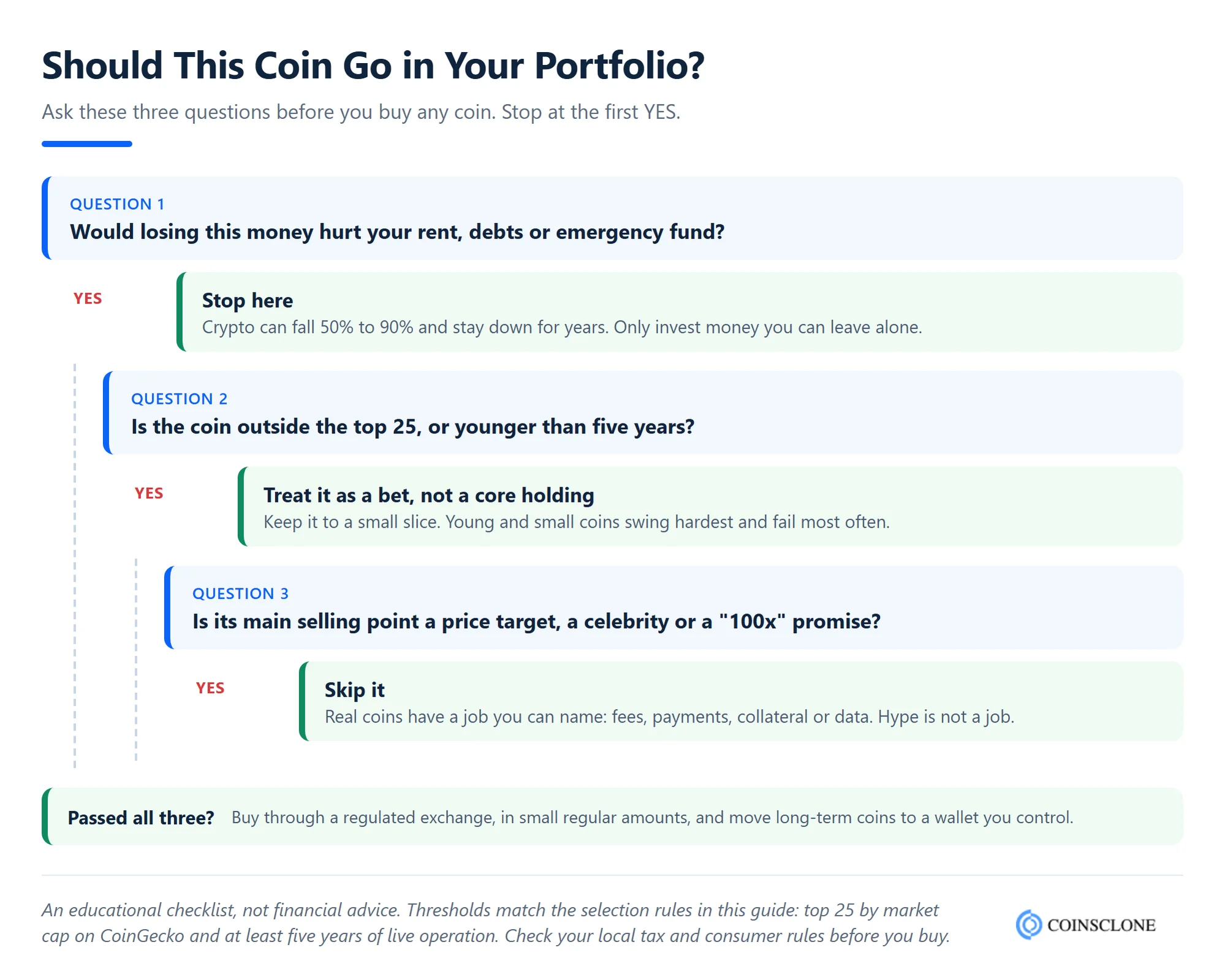
A good list is only half the job. How you buy and hold matters just as much. Follow these steps to cut the most common risks.
- Set your amount first: decide how much you can afford to lose and keep it a small share of your savings.
- Pick a regulated exchange: use a licensed exchange in your country. Our list of the best cryptocurrency exchanges compares fees and safety, and Indian buyers can see the best crypto exchanges in India.
- Buy in small, regular amounts: buying a fixed sum each month (dollar-cost averaging) means you do not have to guess the bottom.
- Spread your money: a mix of Bitcoin and Ethereum with a smaller slice of other coins is less risky than one small coin.
- Move long-term coins to your own wallet: a hardware or self-custody wallet keeps coins safe if an exchange fails. See our guide to the best crypto wallets.
- Turn on two-factor login and keep records: you will need every buy and sell for your tax return.
Some coins can also earn a yield. For example, you can stake ETH, SOL or ADA to help secure the network. Our list of the best DeFi staking platforms explains how staking works and where the risks lie.
How Crypto Is Taxed in 2026
Tax is part of your real return, so check the rules where you live before you buy. Here is the position in the largest markets as of October 2026.
- India: gains are taxed at a flat 30%, and a 1% TDS applies when you sell. Losses cannot be set off against other income. The February 2026 Budget kept these rules and added penalties for missed reports.
- United States: the IRS treats crypto as property, so each sale can trigger capital gains tax. Brokers now report sales on Form 1099-DA. See the IRS digital assets page.
- United Kingdom and EU: gains fall under capital gains rules. From 1 January 2026 exchanges began collecting user data under the OECD’s crypto reporting rules (CARF in the UK, DAC8 in the EU), so tax offices see more trades.
Build the Platforms Behind These Coins
Investors buy these coins through exchanges, wallets and payment apps, and each one is a business in its own right. If you would rather run the platform than trade the coins, Coinsclone builds them. The team has delivered 350+ platforms for 200+ clients since 2018, and our cryptocurrency exchange development service can launch a white label exchange in 4 to 6 weeks.
Conclusion
The best cryptocurrencies to invest in 2026 are the ones with size, age and a real job: Bitcoin, Ethereum, BNB, XRP, Solana, TRON, Chainlink, Cardano, Bitcoin Cash and Litecoin. Even so, each of them trades below its record high today, and some have fallen more than 90%.
So treat this list as a starting point for your own research, not a buy list. We are not financial advisors, and nothing here is financial advice. Check live prices, volume and liquidity, invest only what you can afford to lose, and keep your long-term coins in a wallet you control.
Invest in the top cryptocurrencies of 2026
Secure your future with strategic crypto investments today
Frequently Asked Questions
Which crypto will boom in 2026?
No one can know which coin will rise next, and anyone who promises a “boom” is guessing. In fact, most large coins fell over the past year. Bitcoin is down about 32% and Solana about 51% as of October 2026. Instead of chasing a boom, look for size, a long track record and a real use.
Which crypto should I buy today for long-term?
For a long-term holding, most investors start with the largest and oldest coins, Bitcoin and Ethereum. Together they make up about 70% of the crypto market. They have the most liquidity, ETF access and history. This is not advice, so match any choice to your own goals and risk.
Is it better to buy one coin or diversify across all 10?
Spreading your money lowers the damage if one coin fails. However, buying 10 coins in equal parts also adds a lot of small-coin risk. A common middle path is a core of Bitcoin and Ethereum with a smaller slice spread across a few others.
Are stablecoins included in the top 10?
Stablecoins such as USDT and USDC rank in the top 10 by market cap, but we left them off this list. They aim to stay at $1, so they do not grow in value. People use them to park cash, pay and move money between exchanges.
What’s the safest way to store these cryptocurrencies?
The safest way is a wallet where you hold the keys, such as a hardware wallet, with the recovery phrase written down offline. Keep only what you trade on an exchange. Never share your recovery phrase with anyone, including “support” staff.
How is Bitcoin taxed in India?
In India, gains from Bitcoin and other crypto are taxed at a flat 30%, plus 4% cess. A 1% TDS is deducted when you sell above the set limits, and losses cannot be set off against other income. Budget 2026 kept these rules.