

This guide covers the top 10 DeFi use cases in 2026, from lending and trading to stablecoin payments, tokenized assets and prediction markets. For each one, you will see what it does, which live apps lead it, and how big it is today, using DefiLlama and other public data checked in October 2026.
Decentralized finance (DeFi) lets people lend, borrow, trade and pay through smart contracts instead of banks or brokers. Some use cases now move billions of dollars a day, while others are still small. So this guide also shows the risks, how DeFi compares with a bank, and which use case fits a new business.
In this guide:
- The 10 DeFi use cases that matter in 2026, with a side by side table of size and leading apps.
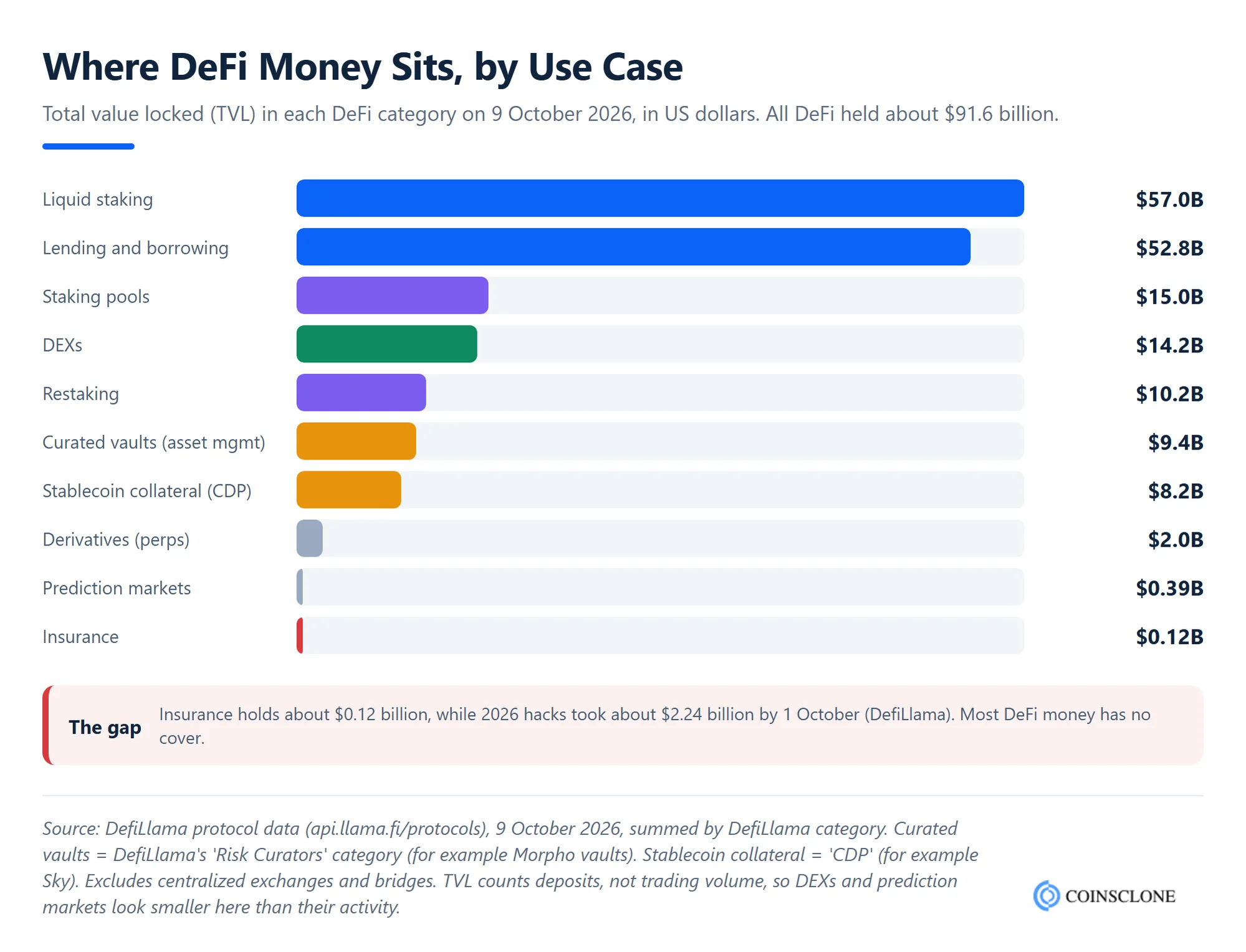
- Where the money really sits: a chart of value locked by use case, from DefiLlama.
- How DeFi works, and how it compares with traditional finance.
- The main risks, including 2026 hack losses, before you use or build a DeFi app.
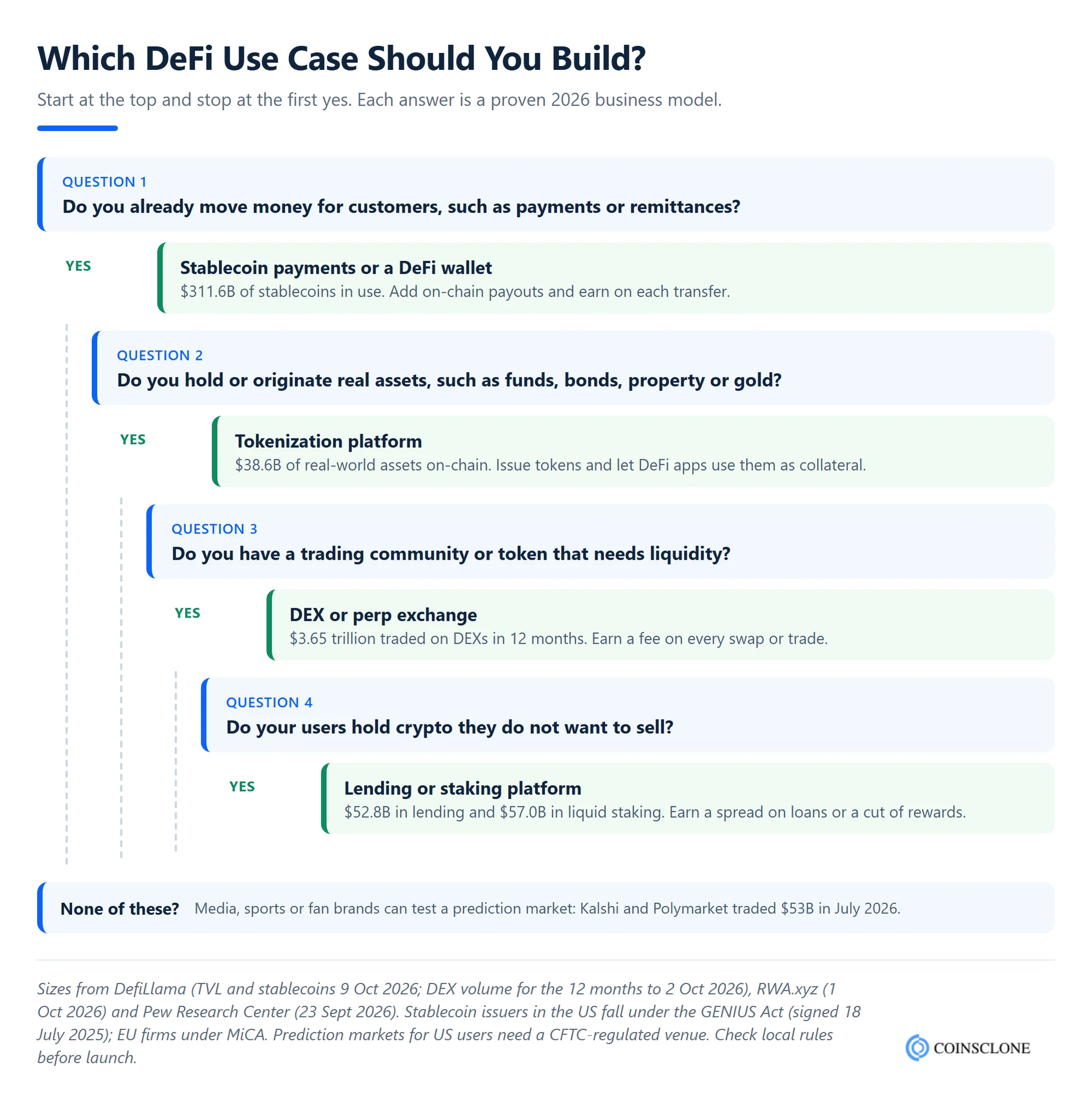
- A simple decision tree to pick the right DeFi use case for your business.
See How Our MVP System Can Help You Explore Real Use Cases of DeFi
Use Cases of DeFi — turning blockchain into real-world finance.
- MVP System : Experience lending, trading, staking, and payments in one ecosystem.
- DeFi-Ready Modules : Real use-case templates ready to customize and deploy.
- Brand & Customization : Tailor each module for your business model.
- Revenue Engine : Monetize every transaction through DeFi rewards and fees.
Get a free DeFi use-case demo in 48 hours — before investing!
Book a Free Demo to see how our MVP System helps you unlock real DeFi applications fast.
Top 10 DeFi Use Cases in 2026
The top 10 DeFi use cases in 2026 are:
- Lending and borrowing
- Decentralized exchanges (DEXs)
- Stablecoins and payments
- Staking and yield farming
- Tokenization of real-world assets
- Asset management
- Prediction markets
- DAOs (decentralized autonomous organizations)
- DeFi insurance
- DeFi wallets
The table sets them side by side. Sizes come from DefiLlama on 9 October 2026, unless we name another source. On that day, all DeFi apps together held about $91.6 billion.
| # | Use case | What it does | Size in October 2026 | Leading apps |
| 1 | Lending and borrowing | Earn interest, or borrow against crypto | $52.8 billion locked | Aave, Morpho, Spark |
| 2 | DEXs | Swap tokens and trade perps without a middleman | $3.65 trillion traded in the 12 months to 2 Oct | Uniswap, Hyperliquid, PancakeSwap |
| 3 | Stablecoins and payments | Digital dollars for trading, saving and paying | $311.6 billion in supply | USDT, USDC, USDS |
| 4 | Staking and yield farming | Earn rewards for securing a chain or adding liquidity | $57.0 billion in liquid staking | Lido, ether.fi, Jito |
| 5 | Tokenized real-world assets | Put funds, bonds and gold on-chain | $38.6 billion (RWA.xyz) | BlackRock BUIDL, Ondo |
| 6 | Asset management | Vaults that move money between strategies | $9.4 billion in curated vaults | Morpho vaults, Yearn |
| 7 | Prediction markets | Trade on the outcome of real events | $53 billion a month (July 2026, Pew) | Polymarket, Kalshi |
| 8 | DAOs | Run a protocol or treasury by token vote | Govern most top protocols | Uniswap DAO, Aave DAO |
| 9 | DeFi insurance | Cover against hacks and protocol failure | $0.12 billion locked | Nexus Mutual |
| 10 | DeFi wallets | Hold keys and connect to every app above | Entry point for all users | MetaMask, Phantom, Rabby |
Before the details, it helps to see where the money really sits. Most value is in staking and lending. In contrast, insurance and prediction markets hold very little, even though prediction markets trade huge volumes.
1. DeFi Lending and Borrowing
DeFi lending and borrowing is one of the biggest use cases of DeFi. Lenders put their coins into a shared pool and earn interest. Borrowers then take loans from that pool by locking up other coins as collateral. There is no credit check and no loan officer. Instead, a smart contract sets the rate, holds the collateral and sells it if its value falls too far.
Decentralized lending has clear advantages over a bank loan, such as:
- Instant settlement: Loans are paid out in seconds, at any hour.
- Crypto as collateral: You can borrow without selling your BTC or ETH.
- No credit check: Anyone with enough collateral can borrow.
- Open records: Every loan and rate is visible on the blockchain.
The sector is large. Lending apps held about $52.8 billion on 9 October 2026, per DefiLlama, and Aave V3 alone held about $17.2 billion. Aave also launched V4 on Ethereum in March 2026, so one pool of cash can feed many markets with their own risk rules. For a ranked list, see our guide to the top DeFi lending platforms.
These DeFi lending and borrowing services run fully on public blockchains, so users do not have to trust a middleman. As a result, lending becomes faster and cheaper for more people across the globe.
2. Decentralized Exchange
A decentralized exchange (DEX) lets users swap tokens straight from their own wallets. Unlike a central exchange (CEX), there is no sign-up and no company holding your coins. Instead, most DEXs use liquidity pools: users deposit pairs of tokens, and a formula sets the price for each trade. Those depositors then earn a share of the trading fees.
DEXs are among DeFi’s busiest products. They handled about $3.65 trillion in trades in the 12 months to 2 October 2026, per DefiLlama’s DEX dashboard, and Uniswap alone processed about $758 billion. In addition, perpetual futures (perps) have moved on-chain. On 2 October 2026, Hyperliquid showed about $5.78 billion in daily volume. If you want to build in this space, see our Hyperliquid clone script.
A DEX can earn steady fee income and draw heavy user traffic. To launch one, pick a skilled DEX development team. Coinsclone builds white label DEXs in 5 to 7 weeks, or a standard DEX in 10 to 14 weeks.
Start Your Dream Venture By Creating Your Own Decentralized Exchange!
Cost-effective, White-Label Solution, Premium Features, Customizable. Live Demo Available.
3. Stablecoins and Payments
A stablecoin is a token pegged to a real-world asset, most often the US dollar. Because its price stays steady, it works as the cash of DeFi. Traders price in it, lenders lend it and businesses pay with it. About $311.6 billion of stablecoins were in use on 9 October 2026, per DefiLlama’s stablecoin tracker. USDT and USDC are the two biggest.
Payments are now a major use case of their own. Stablecoins move across borders in minutes, at any hour, often for a few cents. For example, since June 2025 Shopify merchants can accept USDC on Base. Rules have also caught up. The US signed the GENIUS Act for stablecoins on 18 July 2025, and the EU’s MiCA law has applied in full since 30 December 2024.
If you want to issue your own coin, our stablecoin development service covers the token, reserves reporting and wallet support.
4. DeFi Staking and Yield Farming
DeFi staking means locking tokens to help secure a blockchain, then earning rewards for it. With liquid staking, you get a token back, such as stETH, that you can still trade or lend. This makes staking the largest DeFi category by value. Liquid staking held about $57.0 billion on 9 October 2026, per DefiLlama, and Lido alone held about $24.3 billion.
Yield farming is a close cousin. Here, users add tokens to liquidity pools or lending markets and earn fees plus extra token rewards. However, the rewards can fall fast, and token prices can drop, so the real yield is often lower than the headline rate.
For instance, Lido, ether.fi and Jito are popular DeFi staking platforms. For the farming side, see our guide to DeFi yield farming development.
5. DeFi Tokenization
DeFi tokenization turns real assets, such as bonds, funds, property, gold or art, into digital tokens. These tokens can then be traded, lent or used as collateral in DeFi apps. As a result, buying and selling the underlying asset becomes faster and more open.
The big plus is fractional ownership: many people can own one asset. Instead of buying the whole thing, investors can buy a small share of it. This opens up deals that were once only for large investors.
Growth is real. About $38.6 billion of real-world assets sat on public blockchains on 1 October 2026, per RWA.xyz. Tokenized US Treasury funds, such as BlackRock’s BUIDL, are the biggest slice. DeFi apps are also starting to accept these tokens. For example, Aave now lets non-US users borrow USDC against tokenized US stocks on Base. To launch a platform like this, see our RWA tokenization platform development service.
6. DeFi Asset Management
In a normal fund, you hand your money to a fund manager. DeFi asset management keeps the money in the investor’s control instead. Funds sit in smart contracts called vaults, and the vault’s rules decide where the money goes. Every move is on-chain, so anyone can check it.
Today, most of this happens through curated vaults. A risk team, such as Gauntlet or Steakhouse on Morpho, sets the rules, and the vault spreads deposits across lending markets. Vaults like these held about $9.4 billion on 9 October 2026, per DefiLlama. Yield aggregators such as Yearn, and on-chain index funds, do a similar job on a smaller scale.
This use case matters for businesses too. Crypto startups and DAOs now use DeFi vaults to earn a yield on idle stablecoins in their treasury.
7. DeFi Prediction Market
Prediction markets let users trade on the outcome of real events, such as elections, sports, awards and product launches. Each share pays out if an event happens. So the price shows what the crowd thinks the odds are, and traders profit by being right.
Growth in 2026 has been huge. Combined monthly volume on Kalshi and Polymarket rose from $4.5 billion in September 2025 to $53 billion in July 2026, per Pew Research Center. Polymarket runs on-chain with stablecoins, while Kalshi is a US exchange under CFTC rules. To build one, read how to launch a Polymarket like Web3 prediction platform.
8. DAO (Decentralized Autonomous Organization)
A decentralized autonomous organization (DAO) is a group run by rules written in code, with no central boss. Members hold its tokens and vote on proposals, such as fee changes or treasury spending. The DAO runs on smart contracts, and its code is open for anyone to read.
In DeFi, DAOs govern most of the top protocols. For example, Uniswap token holders voted in late 2025 to turn on protocol fees and burn 100 million UNI. In the same way, Aave and Sky set their risk rules through public votes. To set one up, follow our guide on how to start a DAO.
9. DeFi Insurance
DeFi insurance uses smart contracts to cover users against risks such as hacks, smart contract bugs or a stablecoin losing its peg. Members put money into a shared pool, buy cover for a fee and vote on claims. As a result, there is no single insurance company in the middle.
However, this use case is still small. All DeFi insurance apps held only about $0.12 billion on 9 October 2026, per DefiLlama. Nexus Mutual held most of it. By contrast, DeFi hacks took about $2.24 billion in the first nine months of 2026. So cover is limited, and users should not count on it for large sums. That gap is also a chance for new builders.
10. DeFi Wallet
A DeFi wallet stores your crypto and connects you to every app above. Since it is non-custodial, only the person with the private key, or a recovery phrase, can move the funds. The wallet signs each trade, loan or vote, and the blockchain records it.
Wallets are also getting easier to use. Smart accounts, live on Ethereum through EIP-7702 since May 2025, add spending limits, account recovery and app-paid gas fees. In addition, MPC wallets split the key into shares, so no single device holds the full key.
As a startup, a DeFi wallet is a sound way to build a user base and earn swap and service fees. Coinsclone is a DeFi wallet development company that builds white label wallets in 3 to 5 weeks, or custom wallets in 8 to 12 weeks.
More DeFi Use Cases Worth Knowing
A few smaller use cases did not make the top 10, but they show where DeFi is heading:
- Flash loans: Loans that are taken and repaid in one transaction, with no collateral. Traders use them for arbitrage and to refinance debt.
- Decentralized identity: Users prove facts about themselves, such as age or KYC status, without sharing all their data.
- Crowdfunding and launchpads: New projects raise money by selling tokens to a community.
- Synthetic assets: Tokens that track the price of stocks, gold or currencies.
What Is DeFi?
Decentralized finance (DeFi) is a set of financial apps built on public blockchains. It lets users lend, borrow, trade, pay and manage assets without banks or brokers. Smart contracts run the rules, and users keep control of their own funds in their wallets.
How DeFi Works
Three building blocks power almost every DeFi use case:
- Smart contracts: Code on the blockchain that runs the rules, such as when to pay interest or sell collateral.
- Oracles: Services such as Chainlink that bring outside data, like prices, onto the chain.
- Liquidity pools: Shared pools of tokens that users trade against or borrow from.
DeFi vs Traditional Finance
| Feature | DeFi | Traditional finance |
| Who holds your money | You, in your own wallet | The bank or broker |
| Opening hours | 24/7, every day | Business hours, with delays on weekends |
| Access | Anyone with a wallet and internet | Needs ID, credit checks and minimum balances |
| Settlement | Seconds to minutes | Hours to days |
| Records | Public on the blockchain | Private to the bank |
| Protection | Little or none if a hack happens | Deposit insurance and courts |
Benefits Of DeFi Use Cases
DeFi makes financial services faster, more open and easier to check. Here are the key benefits that drive its use.
Borderless Transactions
DeFi lets you send and receive money anywhere in the world without a bank. All you need is the internet and a crypto wallet. This opens up global markets without the usual barriers.
Full Control Of Assets
Users own their funds directly, so no bank can freeze the account. They manage their money through secure blockchain networks, which gives them more privacy and control.
High Transparency
Every transaction is recorded on a public blockchain, so it is easy to track and verify. This builds trust and makes fraud harder to hide, as anyone can view the history.
Open Access To Financial Services
DeFi is open to anyone, wherever they live. There are no credit checks or minimum balances, so more people can take part.
Cost-Effective Solutions
By cutting out middlemen, DeFi can lower fees. On low-cost chains, a swap or transfer often costs a few cents. As a result, users keep more of their money.
Risks and Limits of DeFi
Every DeFi use case carries risk, and 2026 has been a costly year. DefiLlama logged 285 hacks worth about $2.24 billion between 1 January and 1 October 2026, per its hacks list. Most losses came from stolen keys and bridge flaws, not clever code bugs.
The main risks to know are:
- Smart contract bugs: Even audited code can have flaws that attackers find.
- Liquidation: If your collateral falls in value, the app sells it, often with a penalty.
- Stablecoin depegs: A stablecoin can lose its link to the dollar if its backing fails.
- No safety net: No one insures your deposit, and most mistakes cannot be undone.
- Changing rules: Laws differ by country and keep changing, especially for lending and prediction markets.
For a business, the fix is good design. Use audited code, multisig or MPC admin keys, trusted oracles and clear limits on each market.
Which DeFi Use Case Fits Your Business?
Each use case fits a different kind of firm. The decision tree below helps you pick a starting point based on what you already have.
For a step by step build plan, read our guide on how to create a DeFi app. To see where the market is heading next, see our top DeFi trends for 2026.
What Makes Coinsclone A Unique DeFi Development Company?
Anyone entering the DeFi space needs a trusted partner. Coinsclone is a DeFi development company that has built crypto and blockchain products since 2018. Our team has delivered 350+ platforms for 200+ clients across 20 industries, from DEXs and lending apps to wallets and tokenization platforms.
We help you pick the right DeFi use case, then build it with audited smart contracts, clear risk controls and a design your users will enjoy. With Coinsclone, you can launch faster and grow with confidence in the fast-changing DeFi market.
Frequently Asked Questions
What are the main use cases of DeFi?
The main DeFi use cases are lending, trading on DEXs, stablecoins and payments, staking, tokenized assets, asset management, prediction markets, DAOs, insurance and wallets. Together, DeFi apps held about $91.6 billion on 9 October 2026, per DefiLlama.
What is the most popular DeFi use case?
By value locked, liquid staking and lending lead, with about $57.0 billion and $52.8 billion on 9 October 2026, per DefiLlama. By activity, decentralized exchanges lead, with about $3.65 trillion traded in the past 12 months. Stablecoins are the most widely used asset across all of them.
Is DeFi safe to use?
DeFi is not risk-free. Hacks took about $2.24 billion in the first nine months of 2026, per DefiLlama, and there is no deposit insurance. To lower risk, use large, audited apps, keep keys safe in a hardware or MPC wallet, avoid high leverage and only put in what you can afford to lose.
Is DeFi legal in the US?
Using DeFi apps is generally legal in the US, and gains are taxed like other crypto. However, rules depend on the product. Stablecoins fall under the GENIUS Act. Prediction markets and derivatives for US users may need a licensed exchange. Check local rules before you launch.
How do I start using DeFi in 2026?
First, set up a non-custodial wallet such as MetaMask or Phantom and back up the recovery phrase. Next, buy a stablecoin or ETH on an exchange and send it to the wallet. Then connect to a large, audited app, such as Aave or Uniswap, and start with a small amount.
Why are real-world assets important in DeFi?
Tokenized real-world assets bring outside yield, such as US Treasury bill interest, into DeFi. They also give lending apps safer collateral. About $38.6 billion of these assets were on public blockchains on 1 October 2026, per RWA.xyz.
See How Our MVP System Can Help You Explore Real Use Cases of DeFi
Use Cases of DeFi — turning blockchain into real-world finance.
- MVP System : Experience lending, trading, staking, and payments in one ecosystem.
- DeFi-Ready Modules : Real use-case templates ready to customize and deploy.
- Brand & Customization : Tailor each module for your business model.
- Revenue Engine : Monetize every transaction through DeFi rewards and fees.
Get a free DeFi use-case demo in 48 hours — before investing!
Book a Free Demo to see how our MVP System helps you unlock real DeFi applications fast.