
This guide ranks the top 10 DEX clone scripts for startups in 2026, from Uniswap and PancakeSwap to Hyperliquid, Raydium and Curve. For each DEX clone script, you see what it copies, its core features, who it suits and how it makes money. We also checked how each original DEX is doing today, using DefiLlama data and the platforms’ own APIs from 16 October 2026.
Why does that check matter? Because a decentralized exchange (DEX) clone copies a business model, and some models have faded. Balancer voted to wind itself down in September 2026, and BakerySwap now holds under $4 million. So after the list, we compare the scripts side by side and explain how to pick one, what it takes to launch, and what the code licences allow.
In this guide:
- The top 10 DEX clone scripts in 2026, each with features, business model and best fit
- Live status of every original DEX, with dated volume and value-locked figures
- Two older models to handle with care: BakerySwap and Balancer
- A decision tree to match a DEX model to your business
- Launch steps, timelines, code licences and how to choose a provider
See How Our MVP System Can Launch Your DeFi Exchange Faster
DEX Clone Scripts — Next-Gen DEX Development for Global Traders
- MVP System : Deploy your Uniswap- or PancakeSwap-like DEX 90% faster.
- Smart Contracts Ready : Built-in swapping, liquidity pools, and staking modules
- Brand & Customization : Your design, your token pairs, your liquidity rules.
- Revenue Engine : Earn from trading fees, staking rewards, and liquidity farming.
Get a free branded DEX demo in 48 hours — ready for your tokens and ecosystem.
Book a Free Demo to see how our Decentralized Exchange Clone Scripts can help you launch a DEX in 8 -12 weeks.
Top 10 DEX Clone Scripts in 2026
Here is the list of top DEX clone scripts that founders choose in 2026. Each one copies a different way of trading, so the right pick depends on your chain, your users and how you plan to earn.
- Uniswap clone script: the leading Ethereum AMM, now with hooks in v4
- PancakeSwap clone script: a BNB Chain AMM with hooks, farms and a big retail crowd
- Hyperliquid clone script: an on-chain order book for perpetual futures
- Raydium clone script: Solana’s main AMM with a token launchpad
- Curve clone script: a stable-swap DEX for stablecoins and pegged assets
- 1inch clone script: a multi-chain DEX aggregator
- Jupiter clone script: Solana’s largest DEX aggregator
- SushiSwap clone script: a community AMM that runs on 30+ chains
- QuickSwap clone script: a low-fee AMM on Polygon and Base
- dYdX clone script: a perpetual futures DEX on its own chain
Coinsclone builds every model on this list, so you can pick by fit, not by what a vendor happens to sell.
The Original DEXs in October 2026
Before you copy a model, check how the real platform is doing. The table uses DefiLlama’s protocol data, pulled on 16 October 2026. Volume moves every day, so treat it as a size guide, not a fixed rank.
| Clone of | Model | Main chains | Value locked | 30-day volume | Status, October 2026 |
| Uniswap | AMM with v4 hooks | Ethereum + 40 more | ~$3.9B | ~$79.2B | Active, the largest DEX |
| PancakeSwap | AMM with Infinity hooks | BNB Chain, Base + more | ~$2.0B | ~$24.5B | Active |
| Hyperliquid | On-chain order book perps | Hyperliquid L1 | n/a | ~$7.2B perps in 24h | Active, perp DEX leader |
| Raydium | AMM + launchpad | Solana | ~$1.2B | ~$8.1B | Active |
| Curve | Stable-swap AMM | Ethereum + 31 more | ~$1.2B | ~$2.9B | Active, smaller than its peak |
| 1inch | Aggregator | Many EVM chains | n/a | ~$3.3B | Active |
| Jupiter | Aggregator | Solana | n/a | ~$14.3B (9 Oct) | Active |
| SushiSwap | AMM | 30+ chains | ~$99M | ~$240M | Active, much reduced |
| QuickSwap | AMM | Polygon, Base | ~$72M | ~$509M | Active |
| dYdX | Order book perps | dYdX Chain | ~$101M | ~$37M perps in 24h | Active, team focus moved to Arcus |
Hyperliquid and dYdX figures are 24-hour perp volume from their own public APIs on 16 October 2026, so they are not a like-for-like match with the spot numbers. Here is the same spot data as a chart.
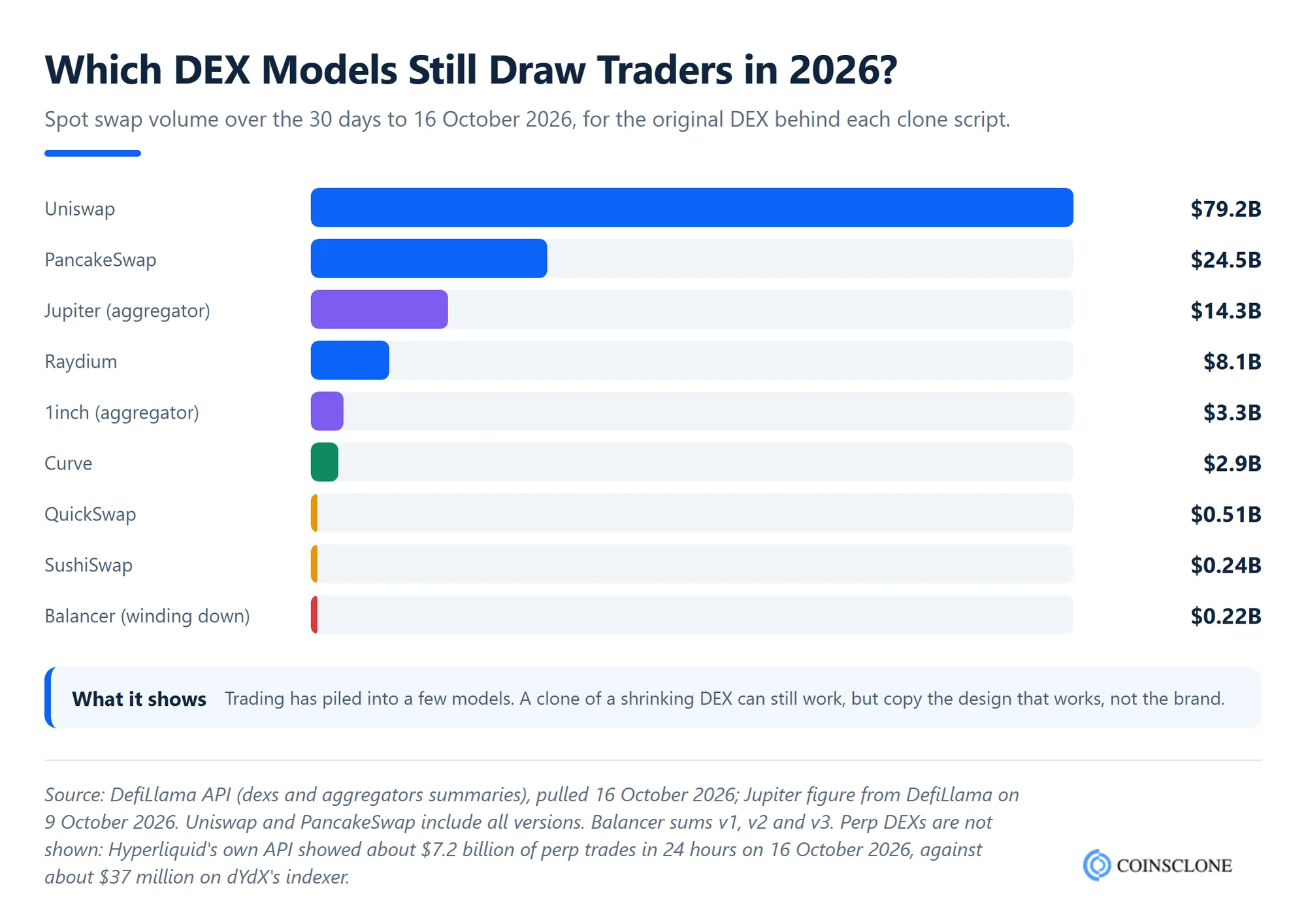
The gap is huge. Uniswap alone traded more in 30 days than the next four combined. But a new DEX does not need Uniswap’s size. It needs a niche, such as one chain, one region or one asset group that the big venues serve badly. Now let us look at each script one by one.
1. Uniswap Clone Script
A Uniswap clone script is ready-made DEX software that copies the core of Uniswap, the automated market maker (AMM) that started the DeFi swap boom on Ethereum. Users trade straight from their wallets against liquidity pools, and liquidity providers earn a share of every swap.
Uniswap is still the clear leader. It held about $3.9 billion and traded about $79.2 billion in the 30 days to 16 October 2026, per DefiLlama. Its v4 release, live since January 2025, added “hooks”: small plug-in contracts that let a pool run its own logic, such as dynamic fees or limit orders. In December 2025, UNI holders also passed the UNIfication proposal, which switched on a protocol fee and burned 100 million UNI. For a deeper build plan, read our guide on how to create a DEX like Uniswap.
Core Features
- Instant token swaps from the user’s own wallet
- Concentrated liquidity pools with custom price ranges
- Hook support for dynamic fees, limit orders and custom pools
- Multi-chain deployment on Ethereum and Layer 2 networks
- Liquidity provider dashboard and position tracking
- Multiple wallet support
Best For: Founders who want a general-purpose spot DEX on Ethereum or an EVM Layer 2.
Business Model
- Swap fees on every trade
- Protocol fee share, set by governance
- Interface fees on your own front end
- Fees from hook-based features such as limit orders
Why Choose This Script? It copies the most proven DEX design, with hooks that let you add features the big venues do not offer.
2. PancakeSwap Clone Script
When it comes to DEX solutions on BNB Chain, the PancakeSwap clone script ranks near the top. PancakeSwap is the leading DEX on BNB Chain, known for cheap swaps, farms, staking and a large retail community. A clone lets you launch a swap exchange like it under your own brand.
PancakeSwap held about $2.0 billion and traded about $24.5 billion in the 30 days to 16 October 2026, per DefiLlama. Its newest version, PancakeSwap Infinity, went live on BNB Chain at the end of April 2025 and on Base in July 2025, as The Defiant reported. Like Uniswap v4, it uses hooks. Infinity alone traded about $5.9 billion in those 30 days.
Key Features
- Instant swaps with an AMM
- Concentrated and hook-based pools
- Yield farming and staking pools
- Token launch module (IFO)
- Multiple wallet support
- Multilingual interface
Best For: Startups that target retail traders on BNB Chain and want farms and staking from day one.
Business Model
- Swap fees on every trade
- Token launch and listing fees
- A share of farm and staking rewards
- Native token buybacks funded by fees
Why Choose This Script? It suits teams that want a full DeFi hub on a low-fee chain, not just a swap page.
3. Hyperliquid Clone Script
A Hyperliquid clone script is software for building an on-chain perpetual futures exchange like Hyperliquid. Unlike an AMM, it runs a full order book on its own blockchain. Users trade from their own wallets with leverage, and the chain matches every order.
Hyperliquid is the fastest-growing model on this list. Its own public API showed about $7.2 billion of perp trades in 24 hours on 16 October 2026, and about $11.7 billion in open positions. On 15 October 2026, it handled about 42% of all on-chain perp volume, per the Castle Labs daily ranking. Its base fees are 0.045% for takers and 0.015% for makers. To learn how it works, read our guide to Hyperliquid’s architecture.
Core Features
- On-chain central limit order book
- Perpetual futures with leverage limits per asset
- Wallet sign-in with no custody of user funds
- Liquidation engine and community liquidity vault
- Trading APIs for bots and market makers
- Advanced security controls
Best For: Founders who want a self-custody futures exchange for crypto-native traders.
Business Model
- Maker and taker trading fees
- Builder fees from partner front ends
- Market listing fees
- Liquidity vault returns
Why Choose This Script? It lets you enter the busiest corner of DeFi trading without holding user funds. Our guide on how to create a perpetual DEX like Hyperliquid covers the full build.
4. Raydium Clone Script
A Raydium clone script copies Raydium, the main AMM on the Solana blockchain. Solana’s fast blocks and low fees make it a busy home for new tokens, and Raydium sits at the center of that trade.
Raydium held about $1.2 billion and traded about $8.1 billion in the 30 days to 16 October 2026, per DefiLlama. It now mixes classic AMM pools, concentrated pools and LaunchLab, a token launchpad it added in April 2025. New tokens launch on LaunchLab and then move into Raydium pools, which keeps a steady stream of fresh pairs coming in.
Core Features
- AMM and concentrated liquidity pools
- Token launchpad with a bonding curve
- Fast, low-fee trades on Solana
- Farms and staking
- Multiple Solana wallet support
- Strong security controls
Best For: Teams that want to serve Solana’s token launch and memecoin traders.
Business Model
- Swap fees on every trade
- Launchpad fees on new tokens
- Pool creation fees
- Token buybacks funded by fees
Why Choose This Script? It pairs a DEX with a launchpad, so new projects bring their own traders to your pools.
5. Curve Clone Script
A Curve Finance clone script copies Curve, the DEX built for assets that should trade near 1:1, such as stablecoins and staked ETH tokens. Its StableSwap math keeps slippage very low on those pairs, which a normal AMM cannot do.
Curve is live and busy, though much smaller than at its peak. It held about $1.2 billion on 16 October 2026 and traded about $71.4 billion over the past 12 months, per DefiLlama’s Curve data. It also runs its own stablecoin, crvUSD, and a lending product, so a modern clone often bundles lending with swaps.
Core Features
- StableSwap pools for pegged assets
- Crypto pools for volatile pairs
- Vote-locked governance token and reward gauges
- Lending markets as an add-on
- Multi-chain deployment
- Multiple wallet support
Best For: Founders who want to serve stablecoin issuers, payment firms or a chain with thin stable pools.
Business Model
- Swap fees, shared with token lockers
- Lending interest
- Stablecoin minting fees
- Partner pool incentives
Why Choose This Script? Every new stablecoin needs a deep, low-slippage market, and that need keeps growing.
6. 1inch Clone Script
1inch is a well-known DEX aggregator. It does not hold its own pools. Instead, it splits each trade across many DEXs to find the best price. It also offers gasless swaps through its Fusion mode, where market makers fill the order.
1inch routed about $3.3 billion of trades in the 30 days to 16 October 2026, per DefiLlama. Our 1inch clone script copies its routing engine, so you can launch a multi-chain aggregator under your own brand. To see how the top aggregators compare today, read our ranking of the best DEX aggregators.
Core Features
- Smart routing across many DEXs
- Gasless, intent-based swaps
- Limit orders
- Multi-chain support
- Multiple wallet connections
- Secure API links
Best For: Teams that want a swap product without having to fill their own pools first.
Business Model
- A small fee on each routed swap
- Positive slippage capture
- API fees from wallets and apps
- Partner and referral fees
Why Choose This Script? You skip the hardest part of a new DEX, which is attracting liquidity on day one.
7. Jupiter Clone Script
A Jupiter clone script copies Jupiter, the largest DEX aggregator on Solana. It routes each swap across Solana DEXs and market makers, and it has grown into a full trading app with perps, lending and limit orders.
Jupiter handled about $14.3 billion of swaps in the 30 days to 9 October 2026, per DefiLlama. That was about 48% of all Solana aggregator volume. Its swap fees are tiny, so most of its income now comes from the products built on top of the swap engine.
Core Features
- Swap routing across Solana DEXs
- Request-for-quote market maker routes
- Limit orders and dollar-cost averaging
- Perpetual futures add-on
- Lending and liquid staking add-ons
Best For: Founders who want a Solana trading app, not just a swap page.
Business Model
- Small swap fees on most pairs
- Perp trading fees
- Lending spreads
- Liquid staking fees
Why Choose This Script? It gives you Solana’s busiest swap model and room to add higher-margin products over time.
8. SushiSwap Clone Script
People who want a simple, community-run DEX on many chains can go with our SushiSwap clone script. SushiSwap began in 2020 as a fork of Uniswap and grew into a multi-chain AMM. Since this script is built for EVM chains, your users can add and swap ERC-20 tokens quickly and safely.
SushiSwap is still live, but much smaller. It held about $99 million and traded about $240 million in the 30 days to 16 October 2026, per DefiLlama. Its leadership also changed hands in December 2025. Even so, the model still works for one reason: it runs the same AMM on more than 30 chains, which makes it easy to follow users to new networks.
Key Features
- User and admin dashboards
- Instant token swaps
- Add and remove liquidity
- Staking and yield farms
- Liquidity migration tools
- Multi-chain deployment
Best For: Teams that want to launch fast on several new chains with one codebase.
Business Model
- Swap fees, with a share to stakers
- Farm and launch partner fees
- Cross-chain swap fees
Why Choose This Script? It is a simple, well-known AMM design that ports to new chains with little extra work.
9. QuickSwap Clone Script
QuickSwap is a well-known DEX on the Polygon network, offering fast trades and very low gas fees. It uses an AMM model for swaps and liquidity, and it has since expanded to Base. In July 2026, it retired its first perps product and moved perps to a new engine.
QuickSwap traded about $509 million in the 30 days to 16 October 2026 and held about $72 million, per DefiLlama. Our QuickSwap clone solution copies its swap, pool and farm features, so you can build a cost-efficient DEX on Polygon or any low-fee EVM chain.
Core Features
- AMM token swaps
- Concentrated liquidity pools
- Ultra-low gas fees on Polygon
- Farms and staking
- Perps module as an add-on
- Multiple wallet connections
Best For: Startups that want a low-cost DEX on Polygon, Base or a similar Layer 2.
Business Model
- Swap fees on every trade
- Farm partner fees
- Perp trading fees, if you add them
Why Choose This Script? It keeps costs low for both you and your users, which helps on chains where trades are small.
10. dYdX Clone Script
dYdX is a DeFi derivatives platform known for perpetual contracts, margin trading and a full order book. Since 2023, it has run on its own blockchain, the dYdX Chain. Our dYdX clone script copies that design, so you can launch a pro-grade futures DEX under your own brand.
Be clear-eyed about its status, though. On 1 July 2026, dYdX Labs launched a new exchange called Arcus on Robinhood Chain, as Cointelegraph reported. The dYdX Foundation says the dYdX Chain is unaffected and still sends fees to stakers. But activity is thin: its public indexer showed about $37 million of trades in 24 hours on 16 October 2026, against about $7.2 billion on Hyperliquid.
Core Features
- Perpetual futures with an order book
- Margin and leverage trading
- Its own app-chain with validators
- Multi-wallet support
- Trading APIs for market makers
- Strong security controls
Best For: Teams that want a futures DEX on their own chain, with full control over fees and governance.
Business Model
- Maker and taker fees
- Fees shared with stakers or used for buybacks
- Market listing fees
Why Choose This Script? The app-chain design still suits a focused futures venue, but study Hyperliquid’s numbers before you choose this model.
Two Older Models to Handle With Care: BakerySwap and Balancer
Some DEXs that topped older lists have faded. You can still copy their designs, but not their momentum.
BakerySwap: a BNB Chain AMM with a built-in NFT marketplace. It held under $4 million on DefiLlama on 16 October 2026, and we found no new product news in 2026. Our BakerySwap clone script still makes sense if you want swaps and NFT sales in one app, but plan your own growth.
Balancer: the DEX known for weighted pools with up to eight tokens. Its token holders voted on 29 September 2026 to wind it down, under BIP-928. From 30 October 2026, its pools that can be paused only allow withdrawals. Weighted pools still work as a design, and our Balancer clone software page explains what still works in that model.
Thus, these are the top DEX clone scripts on the market in 2026. To get a better view of the 10 above, here is a…
Comparison Of Top Decentralized Exchange Clone Scripts
For startups and investors, choosing a DEX clone script is not just about features. It is about your chain, your users, your income plan and how hard the build is.
| DEX Clone Script | Market Positioning | Revenue Potential | Build Difficulty | Growth Outlook (2026) |
| Uniswap Clone | General EVM spot DEX with hooks | Very High | Medium | Very High |
| PancakeSwap Clone | BNB Chain DeFi hub for retail | High | Medium | High |
| Hyperliquid Clone | On-chain perp exchange | Very High | Very High | Very High |
| Raydium Clone | Solana AMM plus launchpad | High | Medium | High |
| Curve Clone | Stablecoin and pegged-asset swaps | Moderate to High | Medium to High | Stable |
| 1inch Clone | Multi-chain aggregator | Moderate | Medium | High |
| Jupiter Clone | Solana aggregator and trading app | High | Medium to High | High |
| SushiSwap Clone | Multi-chain community AMM | Moderate | Low to Medium | Moderate |
| QuickSwap Clone | Low-fee Layer 2 AMM | Moderate | Low to Medium | Moderate |
| dYdX Clone | App-chain futures DEX | High | Very High | Uncertain |
Thus, from this comparison, here are some insights for startups like you:
- Broad spot DEX: the Uniswap or PancakeSwap models offer the most room to grow.
- Futures and pro traders: the Hyperliquid model leads; the dYdX model suits teams that want their own chain.
- Solana users: pick Raydium for pools and launches, or Jupiter for routing.
- Fast, low-cost start: an aggregator such as 1inch, or a simple AMM such as QuickSwap or SushiSwap.
What is a DEX Clone Script?
A DEX clone script is ready-made DEX software that copies the core features of a known decentralized exchange. It comes with smart contracts for swaps and pools, a user interface, an admin panel and wallet links. It can run on many chains, such as Ethereum, BNB Chain, Solana, Polygon, Base and Arbitrum.
It is not a basic template but a full, working trading system. Users swap tokens from their own wallets, so you never hold their funds. You can still change the features, design, fees and supported tokens to fit your business. It copies features, not the original’s brand, name or logo.
In simple terms, a DEX clone script speeds up your launch without cutting core trading features. In that case, you might be wondering…
Why Start A Decentralized Exchange Using A Clone Script Instead of Building From Scratch?
Building a DEX from scratch needs deep blockchain skills, a long timeline and a large budget. Smart contracts, a trading interface and audits can take many months. That can be a real hurdle for startups. A DEX clone script, by contrast, offers these benefits:
- Faster launch: a white label DEX can go live in 5 to 7 weeks, and a standard build in 10 to 14 weeks, based on Coinsclone’s published DEX timelines.
- Lower cost: spend less on coding, testing and servers, while still getting a strong, feature-rich system.
- Ready trading core: get AMM pools, token swaps, wallet links and an admin dashboard from day one.
- Easy to customize: change the design, supported tokens, rewards, governance and fees to fit your plan.
- Less technical risk: start from contracts that already work in the real world instead of untested code.
So a clone script lets you focus on growth, liquidity and users, not on rebuilding basics. Still, the right script depends on your business, which is what we look at next.
How to Choose the Right DEX Clone Script for Your Business
The ten scripts above fall into a few clear models. Pick the model first, then the brand to copy. This tree walks you through it.
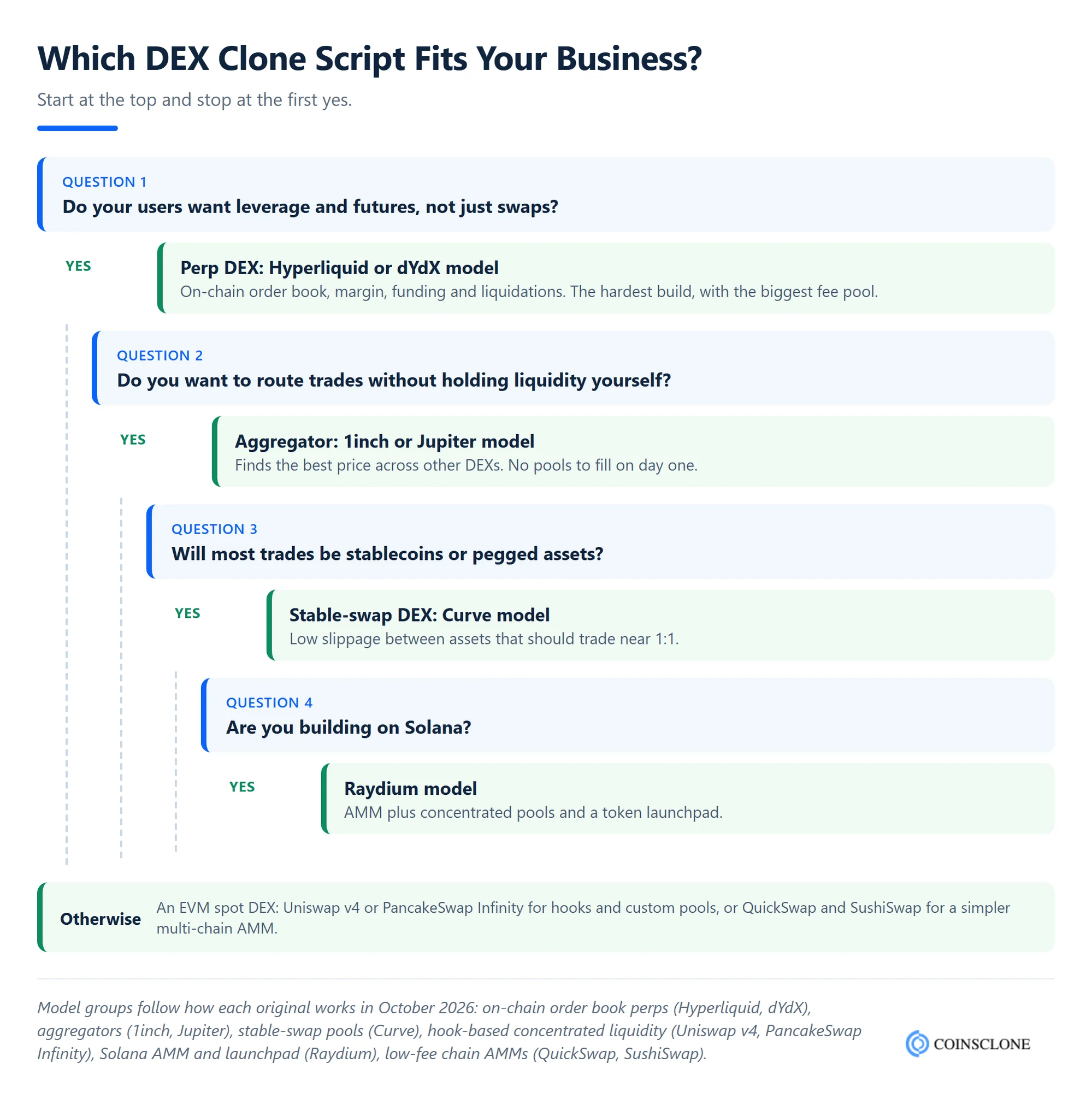
A few points help at each step:
- Perps need the most work: an order book, a price oracle, a liquidation engine and market makers all have to be right on day one.
- Aggregators need no pools: they earn small fees on volume, so they need many users to pay off.
- Stable-swap needs partners: a Curve-style DEX grows when stablecoin issuers place their pools with you.
- Spot AMMs need incentives: plan farms or rewards to attract your first liquidity providers.
If you are unsure, start with a white label DEX and add modules later. Our white label decentralized exchange suits that path.
How to Launch a DEX With a Clone Script: Step by Step
Every model above follows the same basic path from idea to launch. Here are the steps, in order:
- Pick your model and chain: use the tree above, then choose the chain where your users already trade.
- Set your fees and token plan: decide swap fees, reward rules and whether you need a native token.
- Brand and customize: change the design, token list, pool types and admin rules.
- Audit the contracts: get every changed contract reviewed by an outside firm before launch.
- Test on a testnet: run swaps, pool changes and edge cases with real users before mainnet.
- Seed liquidity: fund your first pools yourself or with partners, and line up market makers for perps.
- Launch and monitor: go live with alerts on large trades, price feeds and admin actions.
- Grow and update: add chains, pools and features based on real usage.
Step 6 is where most new DEXs fail. A clean script with empty pools gives traders bad prices, and they leave. So budget for liquidity from the start, not after launch.
How Much Does a DEX Clone Script Cost and How Long Does It Take?
The price depends on the model and scope more than on the brand you copy. A simple AMM on one chain costs far less than a perp DEX with its own chain, oracles and market maker tools. These are the main cost drivers:
- Model: a spot AMM or aggregator is the simplest; a perp order book is the most complex.
- Chains: each extra chain adds deploy work, testing and monitoring.
- Custom features: hooks, launchpads, lending or a native token all add time.
- Audits: published 2026 audit price guides put a simple token audit at roughly $5,000 to $15,000, with complex DeFi systems costing far more.
- Liquidity and running costs: seed liquidity, rewards, servers, price feeds and support come on top.
As for time, Coinsclone’s DEX timelines are 5 to 7 weeks for a white label build and 10 to 14 weeks for a standard build. Perp DEXs and extra chains take longer. Share your plan with our team for a fixed quote.
Is a DEX Clone Script Legal?
Yes. A clone script copies features, not a brand’s name, logo or trademarks, so the software itself is legal to buy and use. We cover this in detail in our post on whether clone scripts are legal to use. Still, two points need care with DEXs:
- Code licences: some DEX code is open to fork, and some is not yet. Uniswap v4’s core contracts use the Business Source License, which blocks commercial copies until 15 June 2027, unless Uniswap governance sets an earlier date. Uniswap v3’s licence opened in April 2023. PancakeSwap’s Infinity core is under a GPL licence. A good provider writes or licenses the code properly.
- Rules where you operate: a DEX with a company behind its front end, fees or admin keys may still need a licence in some places. In the EU, MiCA covers crypto services run by an identifiable provider. Get local legal advice before launch.
How To Choose The Right DEX Clone Script Provider?
The success of your DEX does not depend only on the script. It also depends on the skills, track record and long-term support of the provider. Weigh these factors before you sign:
- Experience: ask how many live DEXs the provider has built, and on which chains.
- Audits: ask for recent third-party audit reports on the exact contracts you will use.
- Code licence: confirm the code is cleanly licensed and that you own your changes.
- Source code: check whether you get full access after launch.
- Customization: make sure you can change pools, fees and features, not just colours and the logo.
- Liquidity help: ask how they help you seed pools or connect market makers.
- Support: get post-launch support, upgrades and response times in writing.
By weighing these points, you can pick a provider that fits your goals. One such provider in the market is Coinsclone.
Get The Best Decentralized Exchange Clone Script From Coinsclone!
Being a reputable Decentralized Exchange Development Company, Coinsclone has built crypto platforms since 2018. We have delivered 350+ platforms for 200+ clients across 20 industries. Our team can build and deploy every clone script discussed above, shaped around your chain, your users and your income plan.
We do not just hand over software. We help you pick the right model, audit the contracts, plan liquidity and launch. A white label DEX goes live in 5 to 7 weeks, and a standard build in 10 to 14 weeks. Our team is available 24/7 for technical and customer support after launch.
Take the next step. Launch your DEX with confidence.
See How Our MVP System Can Launch Your DeFi Exchange Faster
DEX Clone Scripts — Next-Gen DEX Development for Global Traders
- MVP System : Deploy your Uniswap- or PancakeSwap-like DEX 90% faster.
- Smart Contracts Ready: Built-in swapping, liquidity pools, and staking modules
- Brand & Customization : Your design, your token pairs, your liquidity rules.
- Revenue Engine : Earn from trading fees, staking rewards, and liquidity farming.
Get a free branded DEX demo in 48 hours — ready for your tokens and ecosystem.
Book a Free Demo to see how our Decentralized Exchange Clone Scripts can help you launch a DEX in 8-12 weeks.
Frequently Asked Questions
What is a DEX clone script?
A DEX clone script is ready-made software that copies the features of a known decentralized exchange, such as Uniswap, PancakeSwap or Hyperliquid. You add your brand, tokens and fees, then launch your own DEX in weeks instead of months.
Which is the best DEX clone script in 2026?
It depends on your plan. A Uniswap or PancakeSwap clone suits a broad spot DEX. A Hyperliquid clone suits futures trading. Raydium and Jupiter clones suit Solana, Curve suits stablecoins, and 1inch suits a multi-chain aggregator.
How long does it take to launch a DEX with a clone script?
With Coinsclone, a white label DEX takes 5 to 7 weeks and a standard build takes 10 to 14 weeks. Perp DEXs, extra chains and full audits can add time.
Can I legally copy Uniswap’s code?
You can copy Uniswap’s features, but not its brand. Uniswap v4’s core code is under a Business Source License that blocks commercial copies until 15 June 2027, unless governance sets an earlier date. Older v3 code is now open. A provider should write or license the code properly.
Is Balancer still running in 2026?
Balancer is winding down. Its token holders approved the BIP-928 plan on 29 September 2026, and its pausable pools allow only withdrawals from 30 October 2026. Its weighted-pool design can still be built under a new brand.
How does a DEX clone script make money?
Most DEXs earn a small fee on every swap and share part of it with liquidity providers. Other income comes from listing and launchpad fees, perp trading fees, interface fees and token buybacks.