
To create a DEX like Uniswap, you pick the Uniswap version to copy, check its licence, choose a chain and a build route, then audit the smart contracts and seed liquidity. A white label Uniswap clone can go live in about 5 to 7 weeks, while a custom build takes 10 to 14 weeks or more.
The Uniswap DEX is still the biggest decentralized exchange, with about $65 billion traded in the 30 days to 25 October 2026, so many founders use it as their model. This guide covers how Uniswap works, which version you can legally copy, the main ways to build, and real cost, time and liquidity plans. By the end, you will know which route fits your budget.
In this guide:
- How Uniswap v2, v3 and v4 differ, with October 2026 volume data
- Which Uniswap code you can fork, and when the v4 licence opens up
- How Uniswap v4 hooks work, and when a hook beats a full DEX
- MVP, white label, fork and custom builds compared, with timelines
- How a swap and its fee move through a Uniswap-style DEX
- Costs, audit prices, liquidity plans and the main revenue streams
Create a Decentralized Exchange Like Uniswap — Faster Than Ever!
Build a powerful, scalable DEX like Uniswap without starting from scratch.
- Launch Fast with MVP : Go live in weeks with a ready-to-scale Uniswap-style platform
- Liquidity & Wallets: Pre-integrated liquidity pools, AMM smart contracts & wallet connect — no heavy coding.
- Brand & Customization : Your UI, your tokens, your pools, your protocol rules.
- Revenue Engine : Earn from swap fees, protocol fees, liquidity incentives, staking & governance tokens.
See a free branded demo of your Uniswap-like DEX in 48 hours — before you invest a cent.
Book a Free Demo and learn how to create a Decentralized exchange like Uniswap in just 8-12 weeks.
How to Create a DEX Like Uniswap
To create a DEX like Uniswap, you pick the Uniswap version you want to copy, check its licence and choose a blockchain. Then you choose a build route (MVP, white label, fork or custom), build and audit the AMM smart contracts, add a swap app and wallet links, and seed liquidity before launch. Here is what Uniswap is today, and then each step in detail.
What Is the Uniswap DEX and How Does It Work?
Uniswap is a decentralized exchange (DEX) that lets anyone swap tokens straight from their own wallet. There is no order book and no company holding funds. Instead, traders swap against liquidity pools, which are smart contracts that hold two tokens. An automated market maker (AMM) formula sets the price from the balance of the two tokens in the pool.
People who add tokens to a pool are called liquidity providers (LPs). They earn a share of every trade fee in that pool. Uniswap’s own docs explain this model step by step.
Uniswap is still the market leader. Over the 30 days to 25 October 2026, it handled about $65 billion in trades across all its versions, according to DefiLlama. That is nearly three times PancakeSwap, the next biggest DEX, at about $23 billion. Uniswap pools also hold about $4 billion in tokens. More broadly, DEX spot volume hit a record 24% of centralized exchange volume in July 2026, The Block reported.
Is Uniswap a DEX or a CEX?
Uniswap is a DEX, not a CEX. No company holds your coins or matches your orders. You trade from your own wallet, and smart contracts settle each swap on-chain. A centralized exchange (CEX) such as Coinbase holds user funds, runs an order book and checks ID before you trade.
Uniswap is also not a DEX aggregator in the classic sense. Its app routes trades across its own v2, v3 and v4 pools. On top of that, its UniswapX system lets outside “fillers” compete to fill an order from any source of liquidity. So when you copy Uniswap, you copy an exchange with its own pools, not a price search tool. If you want the aggregator model instead, see our guide to the best DEX aggregators.
Uniswap v2, v3 and v4: Which Model Should You Copy?
“A DEX like Uniswap” can mean three quite different designs. So decide which version you are copying first, because it shapes your code, your cost and your licence.
- Uniswap v2 (2020): The classic model. Each pool spreads liquidity across all prices using the x × y = k formula, with one 0.3% fee. It is simple, well tested and easy to audit. PancakeSwap and SushiSwap both began as v2-style forks.
- Uniswap v3 (2021): Adds concentrated liquidity, so LPs choose a price range for their funds and the same money works much harder. It also adds fee tiers (0.01%, 0.05%, 0.30% and 1%). It is more complex for both builders and LPs.
- Uniswap v4 (January 2025): Puts every pool inside one contract, the PoolManager, which cuts gas costs. It also adds hooks: small add-on contracts that run custom logic before or after a swap or a liquidity change. Hooks enable dynamic fees, limit orders, custom pricing curves and rewards.
The chart below shows how traders and LPs used each version in early October 2026. Since then, v4 has moved slightly ahead: over the 30 days to 25 October 2026, DefiLlama shows about $32 billion of v4 volume against $31 billion on v3. That is a fast rise for a version that is less than two years old.
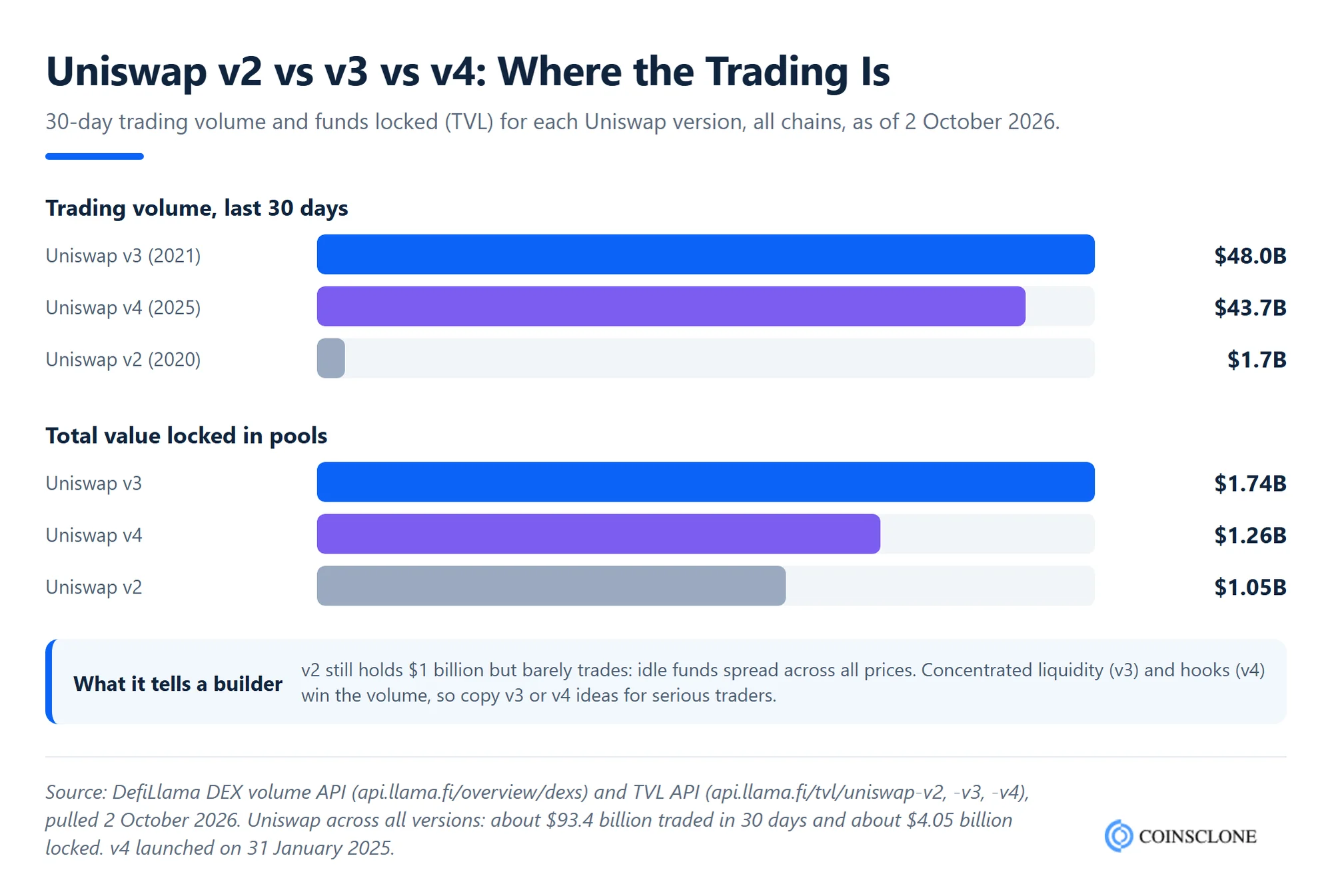
For most new DEXs, a v2-style AMM is the fastest and safest start. A v3-style design suits teams that want serious traders and stablecoin pairs. A v4-style design with hooks suits teams that want new features.
Can You Legally Fork Uniswap?
Yes, but it depends on the version. Uniswap’s code is public, yet each version has its own licence:
- Uniswap v2: Open source under the GPL-3.0 licence. You can fork and use it in production.
- Uniswap v3: The core launched under a Business Source License (BUSL) that blocked commercial copies. That licence changed to GPL-2.0-or-later on 1 April 2023, so v3 forks are now allowed.
- Uniswap v4: The core is under a Business Source License 1.1 until the earlier of 15 June 2027 or a date the Uniswap DAO sets. Then it becomes MIT. Until that date, you cannot run a copy of v4 core in production unless the DAO grants an exception.
The timeline below shows when each version opened up.
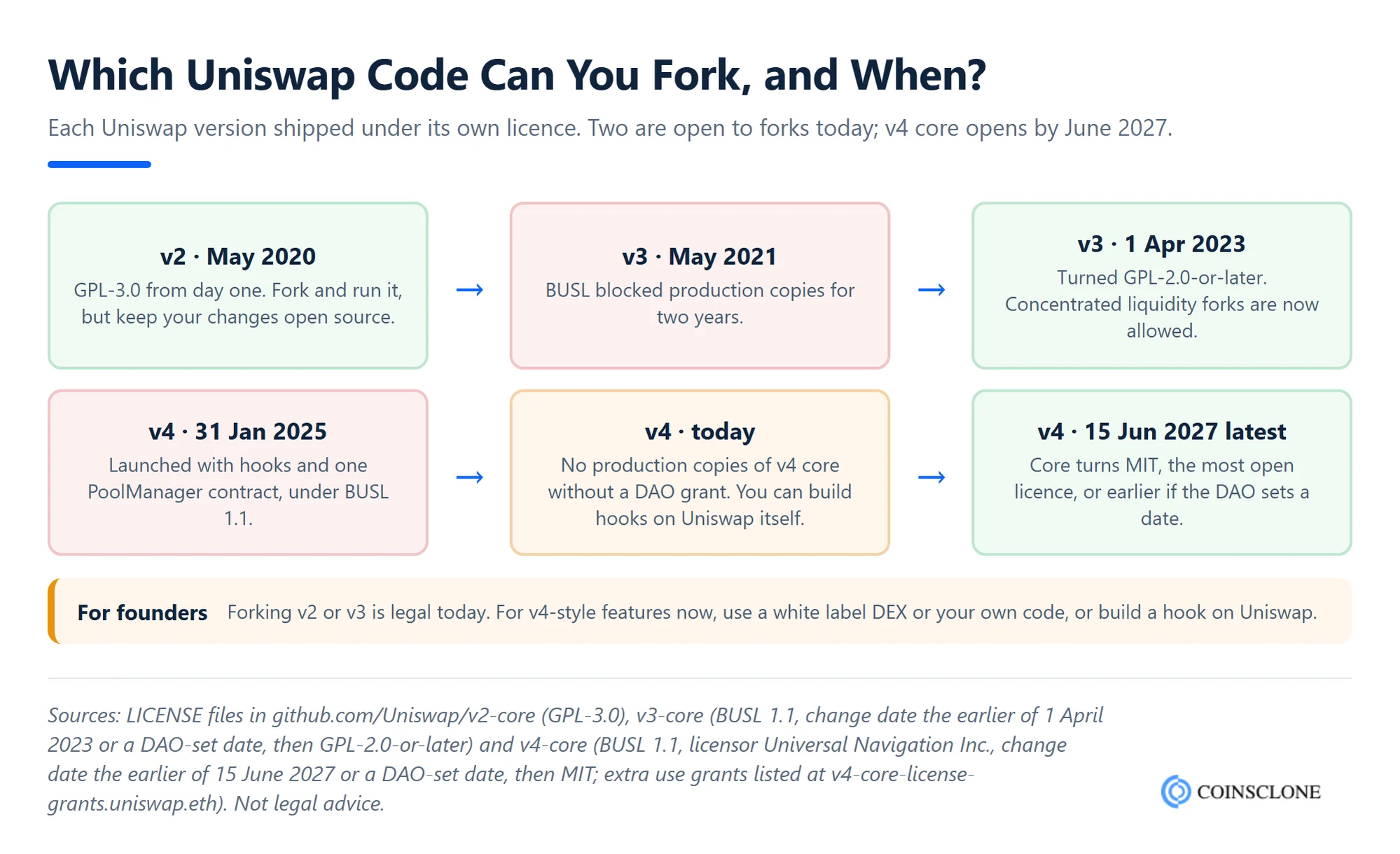
Two more points matter. First, GPL code comes with duties: your changes to it must stay open under the same licence. Second, a fork is only as safe as your changes to it. Every line you edit needs its own audit.
Now that you know what you are copying, let’s look at why the model is worth copying.
Why Should You Create a DEX Like Uniswap?
Launching a DEX in 2026 is about more than DeFi hype. It is a way to build on the weak spots of traditional finance with a model that has run for years.
Rising Demand for Decentralized and Non-Custodial Trading
More users now want to hold their own assets, after years of exchange hacks and frozen accounts. DEXs give instant, borderless access without long sign-up steps. Every trade is visible on-chain, which builds a level of trust that a closed system cannot match.
Uniswap’s Proven Business and Liquidity Model
Uniswap’s AMM model keeps a market open at all times, with no need for a buyer and seller to meet. It also turns users into stakeholders, because LPs earn trading fees. In December 2025, UNI holders passed the UNIfication plan, which turned on a protocol fee. So the model now earns for the protocol as well as for LPs.
Is There Still Room for a New DEX Like Uniswap?
Yes, if you pick a niche. New founders are winning by launching a native DEX on a fast Layer 2 or an app-specific chain. For example, Aerodrome on Base handled about $16 billion over the 30 days to 25 October 2026, DefiLlama data shows. There is also room for pools that trade tokenized real-world assets, such as treasury bills, and for pools built for big firms. Finally, trading bots and AI agents need DEXs with clean APIs.
Now that you know why a DEX like Uniswap is worth building, let’s look at how to build one.
How Do You Build a Decentralized Exchange Like Uniswap?
Building a DEX like Uniswap needs a clear grasp of AMMs, liquidity pools, smart contracts and non-custodial design. Unlike a central exchange, a DEX like Uniswap lets users swap tokens straight on the blockchain, with no middleman holding their funds.
You can take four main routes, based on your budget, time and long-term goals: an MVP, a white label Uniswap clone, a fork of Uniswap’s open code, or a custom DEX built from scratch. A fifth option, building a hook on Uniswap v4, is covered at the end of this section.
Create a Uniswap-Like DEX MVP
An MVP (minimum viable product) is the smallest version of your DEX that real users can trade on. It should include:
- Token swaps: Core AMM logic for instant swaps between any two tokens.
- Liquidity tools: Simple screens to create a pool, add funds and withdraw them.
- Web3 wallet links: MetaMask, Trust Wallet and WalletConnect support.
- Standard token support: ERC-20 tokens (or the matching standard on your chain).
- Clear UI: A simple app that makes swaps and liquidity easy, with price impact shown before each trade.
Why an MVP Makes Sense
Launching an MVP helps you:
- Enter the DeFi market faster
- Test how users trade and how liquidity flows
- Win early investors and partners
- Keep build and audit costs low
For startups and first-time DeFi founders, an MVP is the most practical way to get a DEX live while you plan to grow.
White Label Uniswap Clone Development
A White Label Uniswap Clone is a ready-made DEX built on Uniswap’s tested design. You add your brand, set your fees and pick your chains, and the core swap, pool and farming features are already in place. It is the fastest way to launch a DEX without the cost of original research.
Key Advantages of a White Label Uniswap Clone
- Reliability: The smart contracts have already been tested and audited.
- Fast launch: You go from idea to live DEX in weeks, not months.
- Your own brand: You control the design, colors and fee settings.
- Multi-chain ready: It can run on Ethereum, BNB Chain and Layer 2 networks such as Arbitrum and Base.
Why White Label Is Popular in DeFi
White label Uniswap clones are popular because they let you:
- Launch in weeks instead of months
- Spend a fraction of the cost of a custom build
- Use a proven AMM model
- Spend your budget on growth and liquidity
At Coinsclone, a white label DEX goes live in about 5 to 7 weeks. This route suits founders who want a fast, low-risk launch in a busy DeFi market.
Fork Uniswap’s Open-Source Code
A fork means you copy Uniswap’s public code and change it yourself. Many big DEXs started this way. PancakeSwap began as a Uniswap v2 fork on BNB Chain and grew into the second-largest DEX.
A fork gives you full control of the code at a low starting cost. However, it has limits:
- Licence rules: v2 and v3 are fine to fork under the GPL. v4 core is not, until its licence change date.
- Safety: Any bug you add is yours to fix, so each change needs testing and an audit.
- No ready product: You still need the app, indexer, admin tools and liquidity plan.
Is Forking Uniswap Enough to Launch a DEX on a New Chain?
No. A fork gives you working contracts, but not a working business. On a new chain, you must redeploy and verify the contracts and set the right wrapped native token. Then you point the app, router and indexer at the new addresses. Then you need a fresh audit of every change and, above all, liquidity. Uniswap’s code moves to a new chain, but Uniswap’s traders and LPs do not.
Uniswap itself may also be your rival there. It deploys its own contracts on many chains, and Uniswap Labs has run its own Layer 2, Unichain, since February 2025. So check whether official Uniswap pools already exist on your target chain before you fork. If they do, you need a clear reason for traders to pick your pools instead.
Custom Development from Scratch for a DEX Like Uniswap
Custom development gives you the most freedom. It suits teams that want trading features that do not exist yet.
What Custom DEX Development Offers
- New pricing logic: Your own AMM formulas or mixed liquidity models that get more out of each dollar.
- Pro trading tools: On-chain limit orders, fees that change with the market, and concentrated liquidity.
- Your own rewards: Custom voting and token rules that keep your community loyal.
- Built to scale: Architecture shaped around your own traffic and security needs.
Challenges of Custom Development
- Higher build and audit costs
- Longer time to market (often 4 to 6 months or more)
- Needs deep blockchain and DeFi skills
Custom builds suit large firms and well-funded startups that want long-term control.
Build a Uniswap v4 Hook Instead of a Full DEX
There is one more option that most guides skip. Instead of running a separate exchange, you can build a hook and attach it to Uniswap v4 pools. You add your feature on top of Uniswap’s own contracts, and you never fork its code. The next section explains how hooks work and when this route makes sense.
Uniswap v4 Hooks: How They Work and When to Build One
A Uniswap v4 hook is a smart contract that a pool calls at set points, such as just before or after a swap. It lets you change how one pool behaves without touching Uniswap’s core code. Many teams now launch a “DEX like Uniswap” as a set of hooked v4 pools rather than as a full fork.
How Do Uniswap v4 Hooks Work?
Every v4 pool lives inside one contract, the PoolManager. When a pool is created, it can name one hook contract. The PoolManager then calls that hook at up to ten points, Uniswap’s hook docs explain:
| Moment | Hook call before | Hook call after |
| Pool creation (runs once) | beforeInitialize | afterInitialize |
| Add liquidity | beforeAddLiquidity | afterAddLiquidity |
| Remove liquidity | beforeRemoveLiquidity | afterRemoveLiquidity |
| Swap | beforeSwap | afterSwap |
| Donate to LPs | beforeDonate | afterDonate |
Four extra “return delta” permissions let a hook change the amounts in a swap or a liquidity change. That is how a hook can charge its own fee or replace the pricing curve.
Which calls a hook uses is written into its address. Each permission maps to a bit in the hook’s contract address. So builders “mine” an address that fits the calls they need. If a flag is missing, the PoolManager never calls that function.
What Can You Build With a Uniswap v4 Hook?
Hooks turn a plain pool into a product. Common uses include:
- Dynamic fees: Fees that rise when prices swing and fall when markets are calm.
- Limit orders: Orders that fill when the price crosses a level you set.
- Custom pricing curves: Pricing beyond the x × y = k formula, for example for stablecoins.
- Liquidity rewards: Extra rewards for LPs who keep funds in range.
- Access rules: Pools where only approved wallets can add or remove liquidity, which suits tokenized real-world assets.
- Token launches: Launch pools with set rules for price and supply in the first hours.
What Is the Simplest Dynamic Fee Hook to Build?
The simplest dynamic fee hook sets one fee for the pool and changes it on a schedule or from a single signal, such as recent price swings. Builders ask this often, for example in this r/UniSwap thread.
First, create the pool as a dynamic fee pool, because you cannot change this choice later. Then the hook can update the fee in one of two ways, Uniswap’s dynamic fee docs say. It can call updateDynamicLPFee on the PoolManager at set times, or it can return a new fee from beforeSwap on each trade. The scheduled method is simpler and costs less gas, so start there.
Can You Add a Hook to an Existing Uniswap v4 Pool?
No. The hook is part of the pool’s key, so it is fixed when the pool is created. To use a hook on Arbitrum, Base or any other chain, you create a new pool with your hook on that chain’s PoolManager. A builder asked exactly this in r/ethdev. The good news is that one hook contract can serve many pools.
How Do You Check Which Hooks a v4 Pool Uses?
Look up the pool’s hook address. It appears in the pool key and in the Initialize event that the PoolManager emits when the pool is created. The last bits of that address show which callbacks the hook can run. Then read the hook’s verified source code on a block explorer. Traders ask this too, as this r/ethereum thread shows, because a hook can change fees or block withdrawals.
Are Uniswap v4 Hooks Safe?
A hook is only as safe as its own code, and Uniswap’s audits do not cover it. The clearest warning is Bunni, a DEX built on v4 hooks. An exploit drained about $8.4 million from two of its pools in September 2025, The Block reported. Bunni then shut down in October 2025 because a safe relaunch would cost too much.
So treat a hook like any DeFi contract. Keep the logic small, test edge cases such as rounding and flash loans, and get an independent audit before real funds go in.
Should You Build a Hook or Your Own DEX?
Build a hook if your edge is one feature, such as a new fee model or launch format. You save time and use Uniswap’s contracts. However, you do not own the exchange, and Uniswap’s own app may not route trades to your pool. Also, since 27 July 2026, Uniswap takes a protocol fee on some v4 pools on seven chains, the governance record shows.
Build your own DEX if you want your own users, brand, fee income and chain choice. Our guide to decentralized exchange development compares a hook, a fork, a white label and a full build side by side.
These are the main routes every founder should know. Next, let’s compare the two ends of the scale in more detail.
MVP vs Custom DEX Development: Which Is the Better Choice?
Choosing between an MVP and a fully custom DEX affects your budget, launch date, growth and long-term plans. Both serve different stages of a DeFi business. Here is a detailed comparison.
| Comparison Factor | MVP DEX Development | Custom DEX Development |
| Primary Goal | Test the DEX idea quickly with core features | Build a fully scalable, unique DEX |
| Development Approach | Lean, feature-focused build | Full build from scratch |
| Time to Market | About 5 to 7 weeks (white label) or 10 to 14 weeks (standard build) | Often 4 to 6 months or more |
| Initial Development Cost | Low to moderate | High upfront cost |
| Feature Scope | Basic AMM swaps, liquidity pools, wallet links | Advanced trading logic, custom AMMs, governance, staking |
| Customization Level | Limited | Full control |
| Architectural Complexity | Simple and minimal | Complex and modular |
| Scalability | Fine for early users and moderate volume | Built for heavy volume |
| Performance Optimization | Basic tuning | Advanced gas and speed tuning |
| Security Requirements | Standard smart contract audit | Several deep audits |
| Risk Level | Low business and technical risk | Higher money and technical risk |
| Market Validation | Ideal for testing real demand | Needs strong confidence before launch |
| Flexibility for Changes | Easy to pivot and improve | Changes are costly after launch |
| Liquidity Handling | Basic pool management | Advanced liquidity and reward systems |
| Governance and Tokenomics | Usually left out at first | Fully custom governance |
| Ownership and IP Control | Partial control at first | Full ownership of code and IP |
| Maintenance and Upgrades | Lower upkeep | Constant upgrades needed |
| Best Suited For | Startups, early-stage DeFi projects | Large firms and big DeFi platforms |
Once you have picked a route, the next step is the feature set that makes your DEX like Uniswap competitive.
Key Features of a Uniswap-Like DEX Platform
To build a competitive DEX like Uniswap in 2026, plan for these features:
- Automated market maker (AMM): The core engine that prices trades from pool balances, so trading runs 24/7 with no order book.
- Liquidity pools and rewards: Users add token pairs to pools and earn a share of the trading fees, plus extra rewards if you offer farming.
- Fee tiers: A set fee for each kind of pair, such as 0.05% for stablecoins and 0.30% or 1% for riskier tokens, as on Uniswap v3.
- Concentrated liquidity: LPs can focus funds on a price range, so pools give better prices with less money.
- Non-custodial wallet links: MetaMask, Trust Wallet and WalletConnect, so users keep full control of their keys.
- Multi-chain and cross-chain support: Swaps on several networks, and bridges between them, for deeper liquidity and lower gas fees.
- Slippage and MEV protection: Slippage limits and private order flow protect users from price swings and “sandwich attacks” by bots.
- Hooks or plug-in modules: Add-ons for dynamic fees, limit orders or rewards without rewriting the core contracts.
- DAO governance: Token holders vote on upgrades, fee levels and new features.
- Live analytics: A dashboard with total value locked (TVL), volume and price history.
- Clean, mobile-friendly UI: A simple design that makes swaps as easy as a banking app.
With the features set, the next question is cost.
How Much Does It Cost to Create a DEX Like Uniswap?
The cost to create a DEX like Uniswap depends on your build route, the number of chains, your features, the team’s hourly rate and how many audits you need. Published 2026 agency cost guides fall in these broad ranges:
| Build route | Typical market cost | Typical time |
| White label Uniswap clone or MVP | About $10,000 to $50,000 | 1 to 2 months |
| Custom single-chain AMM DEX | About $40,000 to $100,000+ | 3 to 5 months |
| Uniswap fork with custom features | About $120,000 to $250,000 before audits | 3 to 6 months |
| Custom multi-chain or advanced DEX | $100,000 to $250,000+ | 6 to 12 months |
| Smart contract audit (each) | $25,000 to $100,000 | 2 to 8 weeks |
1. White Label or MVP with Basic Features
This is the lowest-cost way to launch a working DEX on a ready-made Uniswap-style base. It includes token swaps, liquidity pools, a basic UI and wallet links. It suits quick market entry and early testing.
2. White Label with Custom Features
Here you start from the same tested base, then add your own features. Cost goes up with UI changes, liquidity model changes and the number of chains you support, such as Ethereum and Layer 2 networks.
3. Building from Scratch
Building from the ground up costs the most, but you own all the code and can create features no one else has. It covers your own AMM formulas, custom smart contracts and advanced liquidity logic. It suits teams creating new DeFi products or aiming for institutional-grade security.
Costs People Forget
Two costs often get left out of the budget. First, the audit: a 2026 market review by audit firm Sherlock puts most DeFi audits at $25,000 to $100,000, with re-audits at $5,000 to $20,000 per pass. Second, your starting liquidity. It is your own capital, not a fee, but you still need it on day one.
Cost is only half the picture, since time to market matters just as much.
How Long Does It Take to Build a DEX Like Uniswap?
The time to build a DEX like Uniswap depends on how much you customize and how many audits you need.
- White label or MVP with basic features: The fastest route. At Coinsclone, a branded white label DEX goes live in about 5 to 7 weeks on pre-tested code.
- Standard build with custom features: About 10 to 14 weeks to add your own core features and design.
- Fully custom or advanced build: Often 4 to 6 months or more, because new smart contracts need longer testing and several audit rounds.
With time and cost clear, here is the full build process step by step.
Step-by-Step Process to Create a DEX Like Uniswap
Building a DEX like Uniswap needs a clear flow that balances decentralization, speed, security and ease of use. Here are the steps.
Step 1: Choose the Uniswap Version and Licence
Decide whether you are building a v2-style, v3-style or v4-style DEX. Then confirm the licence for any code you reuse, as covered above. This choice sets your contract design, audit scope and timeline.
Step 2: Choose the Right Blockchain Network
Pick a chain such as Ethereum, BNB Chain, Base, Arbitrum or Polygon. These EVM chains all use Solidity, so one codebase can deploy on all of them. Solana uses Rust and needs a separate build.
Look at where traders already are. In the 30 days to 25 October 2026, Solana, Ethereum, Base and BNB Chain led DEX volume on DefiLlama. Many teams launch on one EVM chain, then add more once they have users. If you plan swaps between chains from day one, see how a cross-chain DEX works.
Step 3: Design and Build the AMM Smart Contracts
A Uniswap-style DEX has a small set of core contracts:
- Factory: Creates a new pool for each token pair.
- Pool (pair) contract: Holds the two tokens, runs the pricing formula and mints LP tokens to liquidity providers.
- Router: Finds the best path for a trade, checks slippage limits and calls the pools.
- Fee and treasury logic: Splits each trading fee between LPs and your protocol.
- Optional extras: Staking, farming or hook contracts for rewards and new features.
The diagram below shows how one swap moves through these parts, and where the fee goes.
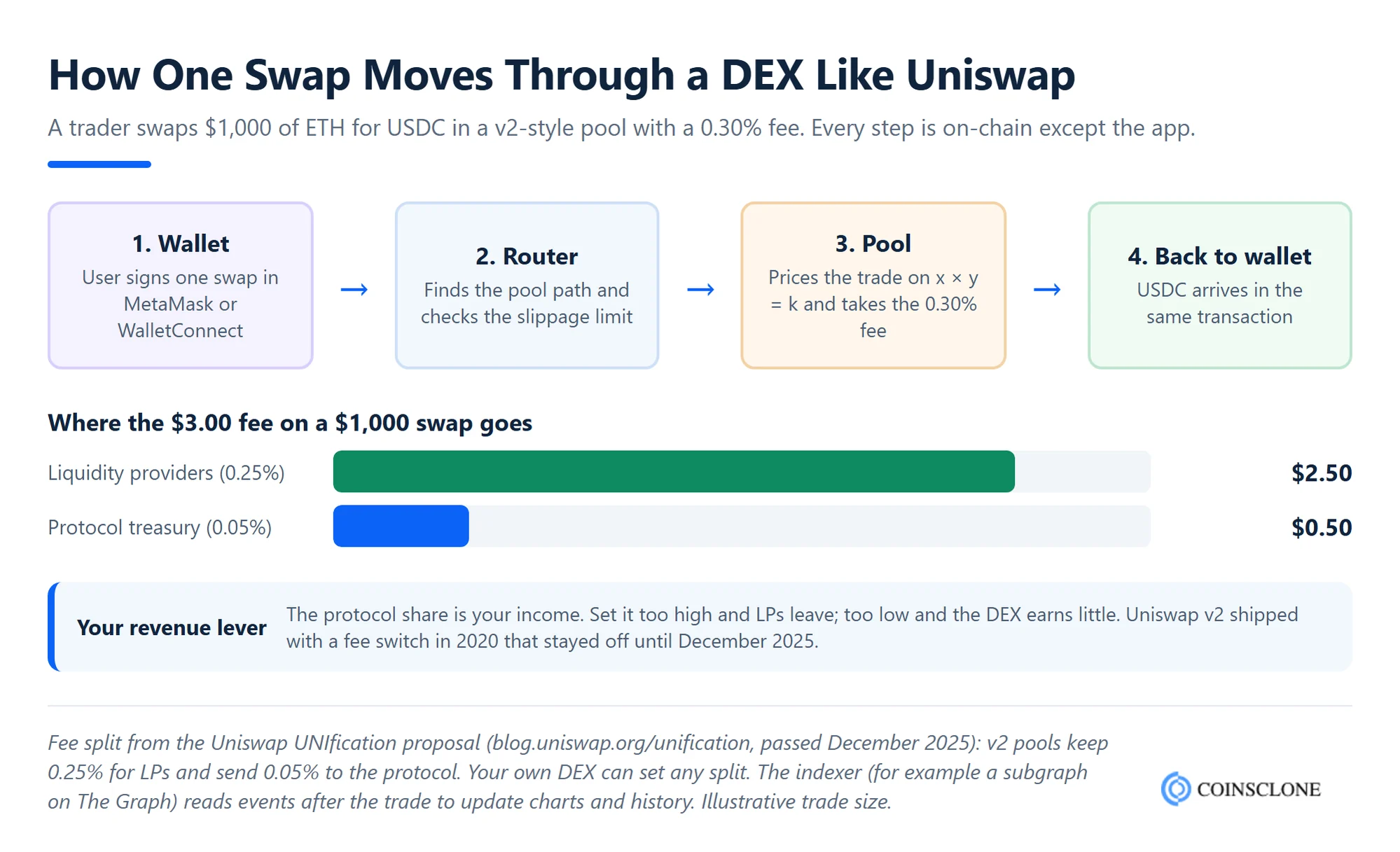
Make these contracts as gas-efficient as you can, because gas is a cost your users feel on every trade. Also keep admin powers small, put upgrades behind a timelock and add an emergency pause.
Step 4: Build the DEX Frontend and Web3 Integration
A clean frontend lets users connect a wallet such as MetaMask and swap in a few clicks. Show the price impact, the fee and the minimum amount they will receive before they confirm. Live data, a mobile-friendly layout and clear slippage settings all build trust.
Step 5: Set Up the Backend and Indexing
Tools such as The Graph read on-chain data and sort it for charts, pool stats and trade history. This layer keeps the app fast, even when the network is busy. You will also need reliable RPC nodes for each chain you support.
Step 6: Plan Your Liquidity Before Launch
A DEX with empty pools is a ghost town. Traders get poor prices, so they leave. Plan liquidity before launch:
- Seed your own pools: Add funds to the main pairs, such as your token with ETH or USDC. Our guide on how to create a liquidity pool for a token walks through the setup.
- Reward early LPs: Offer a share of fees or token rewards to people who add liquidity in the first months.
- Partner with token projects: New tokens need a home for their pools, so offer them one.
- Get listed on aggregators: Aggregators send trades to your pools once your prices are good.
Also explain impermanent loss to your LPs. It is the value an LP can lose when the two token prices move apart, and clear docs build trust.
Step 7: Test, Audit and Deploy
Test everything on a local setup such as Hardhat or Foundry, then on a public testnet like Sepolia. Test swaps, liquidity, wallet flows, admin tools and heavy load.
Next, get at least one independent smart contract audit. This matters because a single bug can drain a pool. Chainalysis counted over $3.4 billion in crypto stolen in 2025. Launch a bug bounty as well, so researchers report issues to you instead of exploiting them. Then deploy to mainnet with a few strong trading pairs rather than dozens of thin ones.
Step 8: Check the Legal Side
Rules depend on how decentralized your DEX is and who you serve. In the US, the SEC closed its probe of Uniswap Labs in February 2025 with no action. Still, a team that runs a front end or charges fees must plan for sanctions and money transfer rules. In the EU, MiCA does not cover services run in a fully decentralized way, but a company that runs the front end or controls funds may still need a licence. Many DEX front ends also block sanctioned wallets. Get legal advice for your target markets before launch.
If you want to create your own DEX on a model other than Uniswap, such as an order book, see our guide on how to create a decentralized exchange.
How Does Uniswap Make Money?
Before you plan your own revenue, it helps to see how Uniswap earns today. Its traders paid about $90 million in fees over the 30 days to 25 October 2026, DefiLlama data shows. Most of that goes to LPs. But since the UNIfication fee switch went live in December 2025, a slice now goes to the protocol:
- v2 pools: The 0.3% fee now splits into 0.25% for LPs and 0.05% for the protocol.
- v3 pools: On a set of busy Ethereum v3 pools, the protocol takes one quarter of LP fees on the 0.01% and 0.05% tiers, and one sixth on the 0.30% and 1% tiers.
- Rollout: Fees started on Ethereum mainnet. On 27 July 2026, a DAO vote added v4 fees on seven chains, such as Ethereum, Base, Arbitrum and BNB Chain. They apply to v4 pools without hooks, launch-auction pools and aggregator hook pools.
- Where it goes: The protocol’s share feeds a system that burns UNI tokens. It brought in about $7 million over the same 30 days.
Revenue Streams and Business Benefits of a DEX Like Uniswap
Beyond being open to all, a DEX like Uniswap gives you many ways to earn and room to grow. Here are the main ones.
Transaction Fees and Swap Commissions
Your protocol earns a small fee on every trade in its pools. As volume grows, this revenue grows with it, without more staff or overhead.
Liquidity Provider Fee Sharing Model
Sharing fees with LPs pays users to keep their funds in your pools. This creates a self-sustaining system in which users help the platform grow.
Governance Tokens and Other Income
A governance token lets your community vote on changes and can help you raise funds. You can also earn from listing fees, launchpad tools and premium trading features.
Global Market Reach Without Intermediaries
A DEX works worldwide without banks or brokers. This cuts out middlemen and lowers running costs, though you still need to follow the rules in the markets you serve.
Long-Term Room to Grow in DeFi
A DEX can grow by adding staking, yield farming and cross-chain swaps. Its modular design lets it keep up as DeFi changes. For example, PancakeSwap grew from a simple fork into a platform with many products, which our PancakeSwap clone script is modelled on.
Challenges When You Build a DEX Like Uniswap
Building a DEX like Uniswap is very doable, but plan for these hurdles:
- Smart contract security: Bugs, price tricks and flash loan attacks can drain pools in minutes.
- Liquidity: New DEXs struggle to attract enough funds, and rivals may lure LPs away with bigger rewards. The classic case is SushiSwap’s 2020 “vampire attack,” which lured LPs away from Uniswap with token rewards.
- MEV and front-running: Bots can trade ahead of your users and worsen their prices. New token pools face sniper bots too, so plan how to stop snipers on a token launch before you list.
- Competition: Uniswap, PancakeSwap and Aerodrome hold most of the volume, so you need a clear niche to win users.
- Changing rules: Laws on DeFi and tokens keep changing across countries.
A tested, audited base handles many of these risks for you, which is why most first-time founders start with a white label.
Uniswap Clone Development With Coinsclone
Coinsclone is a trusted Decentralized Exchange Development Company that has built crypto platforms for founders since 2018. In that time, we have delivered 350+ platforms for 200+ clients across 20 industries. Our blockchain team builds DEXs on Ethereum, BNB Chain, Base, Polygon and more, with audit-ready smart contracts.
To build a DEX like Uniswap in 2026, you must get safety, liquidity and ease of use right at the same time. You can start with our white label decentralized exchange in about 5 to 7 weeks, or choose a standard build with custom features in about 10 to 14 weeks. Either way, we help you pick the right Uniswap model, chain and features, so your DEX launches safely and keeps growing. If you want a ready Uniswap-style base, our Uniswap clone script comes with the core swap, pool and farming features in place.
Create a Decentralized Exchange Like Uniswap — Faster Than Ever!
Build a powerful, scalable DEX Like Uniswap without starting from scratch.
- Launch Fast with MVP : Go live in weeks with a ready-to-scale Uniswap-style platform
- Liquidity & Wallets: Pre-integrated liquidity pools, AMM smart contracts & wallet connect — no heavy coding.
- Brand & Customization : Your UI, your tokens, your pools, your protocol rules.
- Revenue Engine : Earn from swap fees, protocol fees, liquidity incentives, staking & governance tokens.
See a free branded demo of your Uniswap-like DEX in 48 hours — before you invest a cent.
Book a Free Demo and learn how to create a Decentralized exchange like Uniswap in just 8-12 weeks.
Frequently Asked Questions
Can I legally fork Uniswap?
Yes, for v2 and v3. Uniswap v2 is GPL-3.0, and v3 core moved to GPL-2.0-or-later on 1 April 2023. So you can fork both if you follow the GPL. Uniswap v4 core stays under a Business Source License until the earlier of 15 June 2027 or a date the DAO sets.
Is Uniswap open source?
Uniswap’s code is public on GitHub, and v2 and v3 are open source under GPL licences. The v4 core code is public too, but its Business Source License blocks production copies until it turns into MIT by 15 June 2027 at the latest.
How much does it cost to create a DEX like Uniswap?
Published 2026 market estimates put a white label Uniswap clone at about $10,000 to $50,000 and custom builds from about $40,000 to $250,000 or more. Add $25,000 to $100,000 for each smart contract audit, plus your own starting liquidity.
How long does it take to build a DEX like Uniswap?
A white label DEX can go live in about 5 to 7 weeks. A standard build with custom design and features takes about 10 to 14 weeks. A fully custom or multi-chain DEX with new mechanics often takes 4 to 6 months or more, including audits.
What is a Uniswap v4 hook?
A Uniswap v4 hook is a smart contract that a v4 pool calls before or after key actions, such as a swap or a liquidity change. Hooks add features like dynamic fees, limit orders and custom pricing without forking Uniswap. Each pool picks its hook when it is created, and the hook needs its own audit.
Is Uniswap a DEX or a CEX?
Uniswap is a DEX. You trade from your own wallet against liquidity pools, and smart contracts settle every swap on-chain. No company holds your funds, and there is no order book or account sign-up as on a centralized exchange.
Do I need my own token to launch a DEX?
No. A DEX works without its own token, since users swap existing tokens and LPs earn fees in those tokens. Many teams add a governance or reward token later to attract liquidity and let the community vote on changes.
How does Uniswap make money?
Traders pay a fee on every swap, mostly 0.01% to 1% of the trade. LPs keep most of it. Since the UNIfication fee switch, the protocol takes a share, such as 0.05% of the 0.3% fee on v2 pools, and uses it to burn UNI tokens.
Which blockchain is best for a DEX like Uniswap?
It depends on your users. Ethereum, BNB Chain, Base and Arbitrum all run Uniswap-style code written in Solidity, so one set of code covers them all. Solana also has heavy DEX volume but needs a separate Rust build. Many teams start on one EVM chain and add more later.
How do I attract liquidity to a new DEX?
Seed your main pools with your own funds, reward early LPs with fees or tokens, partner with token projects and get listed on DEX aggregators. Deep pools give better prices, and better prices bring more traders.