A Hyperliquid clone script is ready-made software that lets you launch your own perp DEX, built on the same ideas that made Hyperliquid the biggest on-chain futures venue. It gives you an order book, a fast matching engine, margin and risk tools, and a branded trading app. So you skip the year it takes to build those parts from scratch.
This guide explains what the script includes and how Hyperliquid really works and earns. It also covers the three ways to launch a Hyperliquid-style exchange in 2026, how liquidations keep the platform safe, and what a launch costs in time and money. We checked each number against Hyperliquid’s own docs, its public API and DefiLlama in October 2026, so you can plan with real data.
In this guide:
- What a Hyperliquid clone script includes for traders, admins and risk teams
- How Hyperliquid drew about $972 million in trading fees in 2025, and which revenue streams you can copy
- When to build your own DEX, and when HIP-3 or a builder-code front end fits better
- How the liquidation waterfall works, with lessons from the JELLY squeeze and the October 2025 crash
- Real build costs, launch timelines and a worked fee example
See How Our MVP System Can Launch Your Perpetual DEX Faster
Hyperliquid Clone Script — High-Performance Perpetual DEX Development Done Right.
- MVP System : Launch your Hyperliquid-style perpetual DEX up to 90% faster.
- Pre-Built Trading Engine & Risk System : Order-book matching, perpetual logic, and liquidation modules pre-integrated — no complex development required.
- Brand & Customization : Your UI, your markets, your fee structure, your ecosystem.
- Revenue Engine : Earn from trading fees, funding rates, liquidation fees, and advanced trader features.
Get a free branded demo of your Hyperliquid-like perpetual DEX in just 48 hours — before you invest a cent.
Book a free call to discover how our Hyperliquid Clone Script can take you from concept to a live, high-performance perpetual DEX in just 8–12 weeks.
What Is a Hyperliquid Clone Script?
A Hyperliquid clone script is ready-made software for launching a fast perp futures DEX like Hyperliquid. It copies the core trading design of Hyperliquid, such as its order-book perp system. At the same time, you can change any part of it to match your business.
With this ready-to-deploy software, you get working perp logic and all the core parts. Everything from futures trading to risk checks is tuned for heavy, fast trading. The script supports many trading pairs, pro trading tools and a setup that grows with your users. That makes it much easier to launch a serious DEX.
In plain terms, the script gives you three engines in one box:
- Matching engine: Pairs buy and sell orders on a central limit order book in real time.
- Margin and risk engine: Tracks every account’s margin, funding and liquidation price, block by block.
- Settlement layer: Records trades, profits and losses on-chain, so users keep custody of their funds.
What Is Hyperliquid, and Why Copy It?
Before you copy a platform, it helps to know what makes it work. Hyperliquid is a Layer 1 blockchain built for trading. Its core, called HyperCore, holds the order books, margin and matching state right inside the chain. A second layer, HyperEVM, runs normal smart contracts on the same chain. For a full breakdown, read our guide to Hyperliquid architecture.
The speed is the headline. According to the HyperCore docs, mainnet handles about 200,000 orders a second. For traders close to its servers, the median time from order to confirmed trade is 0.2 seconds. A custom consensus called HyperBFT, based on HotStuff, keeps one shared order of trades across all validators.
The scale is just as striking. Hyperliquid’s public API showed 178 live perp markets on 2 October 2026, with about $6.3 billion of 24-hour volume and $12.9 billion of open interest in its own markets. Max leverage is 40x on BTC, 25x on ETH and 20x on SOL.
The money follows the volume. DefiLlama tracks Hyperliquid’s fees at about $972 million in 2025 and $614 million in the first nine months of 2026. A 21Shares report on H1 2026 found gross fees up 31% year on year, to $419 million, on $1.29 trillion of trading volume.
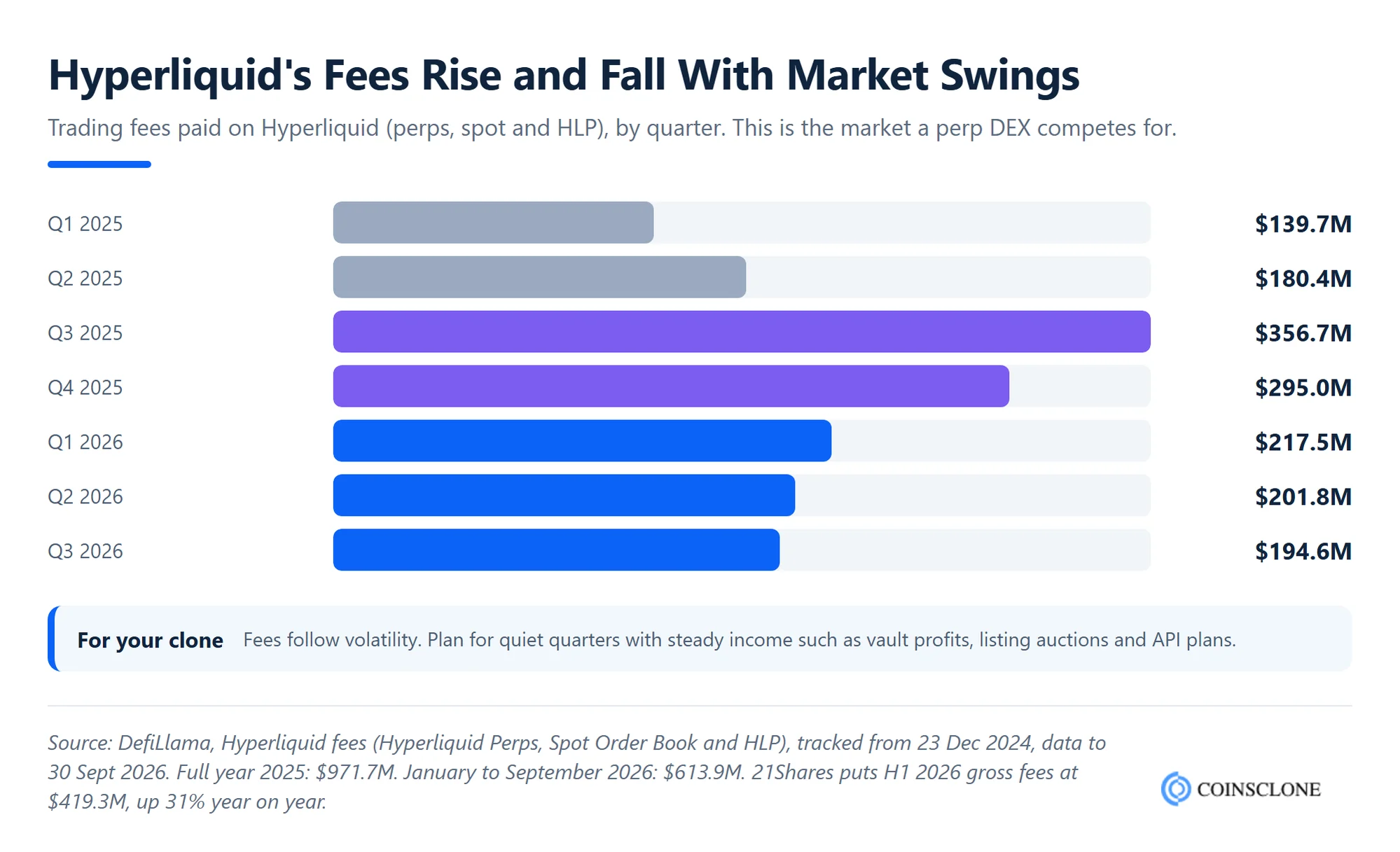
The chart shows one clear lesson. Fees peak when markets are wild, as in Q3 2025, and cool when trading calms down. Even so, a quiet quarter still brought in close to $200 million. That is the size of the prize a well-run perp DEX competes for.
Why Should You Build a DEX Platform Like Hyperliquid?
Building a DEX like Hyperliquid is a smart move for businesses that want to join the next stage of on-chain trading. Traders now expect CEX-level speed on a DEX, and Hyperliquid proved it can be done. Here are the main reasons to build one:
- Perps are where the volume is: Perp contracts draw far more activity than spot trading, thanks to leverage, funding and nonstop markets. Hyperliquid alone handled $266.5 billion of trades in June 2026.
- Proven speed draws pro traders: Hyperliquid showed that a DEX can match orders in a fraction of a second with deep books. A similar platform attracts pro traders who want speed and fair fills.
- Users want to keep their keys: After years of exchange failures and frozen funds, traders keep moving to self-custody venues. A Hyperliquid-style DEX lets them trade straight from their wallets.
- New markets keep coming: In 2026, perps on gold, oil and stocks such as Nvidia and Tesla hit a record $3.6 billion of open interest on Hyperliquid, per CoinDesk. A new DEX can target these niches from day one.
- Many ways to earn: Trading fees, vaults, listing auctions and a native token all add income. Our Hyperliquid-like DEX gives you a full revenue stack.
These reasons make it clear why Hyperliquid is the model to follow. But there is more than one way to follow it, so let’s compare the options next.
Three Ways to Launch a Hyperliquid-Style Perp DEX in 2026
In 2026, you no longer have just one route. Hyperliquid now lets outside teams build on top of it, so it pays to compare all three paths before you choose.
1. A builder-code front end on Hyperliquid. You build your own trading app, but orders go to Hyperliquid’s books. Per the builder code docs, you need just 100 USDC in a perps account, and you can add a fee of up to 0.1% on perps. Users approve that fee from their own wallet. This is the fastest start, but you own the app, not the exchange.
2. A HIP-3 perp DEX on Hyperliquid. HIP-3 lets a builder deploy its own perp markets on Hyperliquid’s engine. The catch is the stake. The HIP-3 rules ask for 500,000 HYPE, held for at least 183 days. At $89.7 per HYPE on 2 October 2026, that is about $45 million locked up. Validators can also vote to slash up to all of that stake if the deployer runs its markets badly, for example by sending price inputs that stall or break the network.
3. Your own perp DEX with a Hyperliquid clone script. You run your own matching engine, risk engine, chain or rollup, and token. You set every fee and keep every fee. You also need to bring your own liquidity, which is the real work.
| Path | Upfront need | You control | Best for |
| Builder-code front end | 100 USDC in a perps account | The app and a fee up to 0.1% | Wallets, bots and trading apps |
| HIP-3 perp DEX | 500,000 HYPE stake (about $45M) | Your markets, oracle and fee share | Well-funded teams with a niche market |
| Own DEX (clone script) | Build budget plus liquidity | Everything: chain, fees, token, rules | Exchanges and founders who want full ownership |
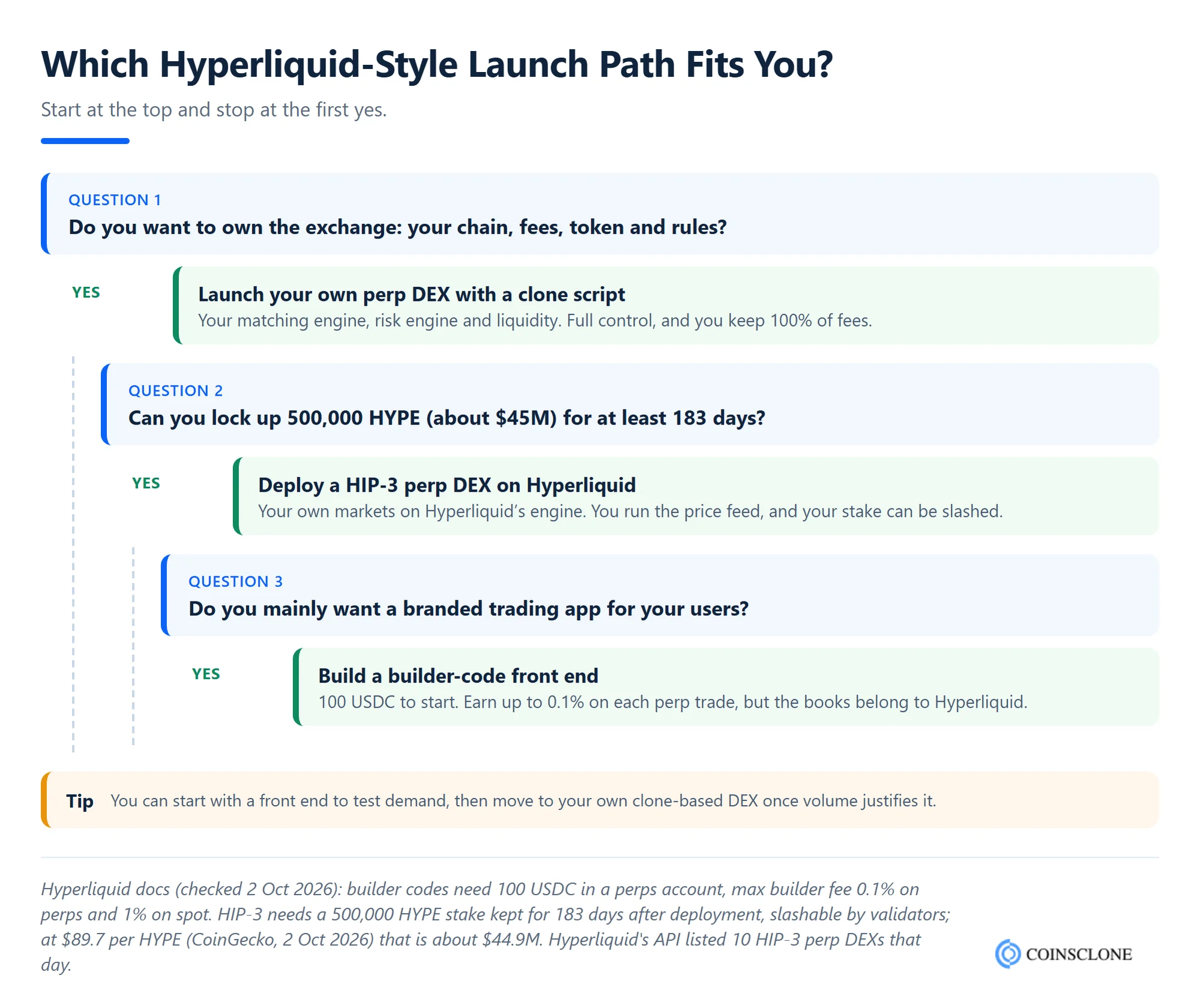
HIP-3 has real traction. Hyperliquid’s API listed 10 HIP-3 perp DEXs on 2 October 2026. However, one of them, XYZ, handled about $2.45 billion of the day’s volume, while most of the others traded close to nothing. In short, sharing someone else’s chain does not bring users on its own. That is why most exchanges and founders still choose to own their platform outright with a clone script.
Built-In Features Of Our Hyperliquid Clone Script
Our Hyperliquid clone solution supports a wide range of features. As a leading Decentralized Exchange Development company, we offer user, admin and trading tools that suit both new and pro traders.
User Features
- Non-Custodial Wallet Login: Users trade straight from their wallets and keep full control of their funds.
- Perp Futures Trading: Users can open, manage and close leveraged positions with a few clicks.
- Live Market Data: Live prices, order book depth and funding rates help traders make informed calls.
- Advanced Order Types: Market, limit, stop-loss and take-profit orders give precise control.
- Portfolio Dashboard: A clear view of open positions, profit and loss, margin use and balance.
- Any Device: The Hyperliquid clone works well on the web and in phone apps.
Admin Features
- Market and Pair Control: Add, remove or change trading pairs and leverage limits.
- Fee Settings: Set and adjust every fee, from taker fees and funding caps to liquidation rules.
- User and Risk Controls: Manage user access, KYC rules (if needed) and risk limits.
- Ticketing System: Gives users a simple way to raise queries, report issues and get help inside the platform.
- Liquidity and Market Watch: Track book depth, spreads and odd trading behavior.
- Reports: Track volume, income and user trends to guide your plans.
Trading Features
- Market Orders: Buy or sell at once at the best price on the book. Ideal when speed matters more than price.
- Limit Orders: Let traders set an exact buy or sell price. The trade runs when the market reaches that level.
- Stop Orders: Fire a market order once a set price is hit, to limit losses or lock in profits.
- Stop Limit Orders: Give traders more control over how their orders fill, especially in fast, wild markets.
- Take-Profit Orders: Close positions on their own when a target price is reached.
- Reduce-Only Orders: Make sure an order only shrinks an open position and never opens a new one. This is key for risk control.
- Leverage Choice: Traders pick their leverage based on how much risk they want.
- Margin Mode Choice: Isolated or cross margin, so traders can use their funds their way.
- Liquidation Triggers: Keep the exchange stable when markets turn wild.
Add-Ons That Enhance The Hyperliquid Clone Software
Here are extra modules that boost your Hyperliquid clone software. Adding them helps your platform stand out on speed, depth and reach:
- Fast Trading Engine: Matching held in memory and tuned for fills in under a second.
- Advanced Risk Engine: Live margin checks, open interest caps and auto-deleveraging.
- On-Chain or Hybrid Order Book: Full on-chain books for trust, or off-chain matching with on-chain settlement for speed.
- Liquidity Vault: A shared vault, like Hyperliquid’s HLP, that makes markets and backs up liquidations.
- Market Maker Tools: Maker rebates, fast APIs and crypto market making software to fill the books from day one.
- Funding Rate Logic: Hourly funding with caps, so perp prices stay close to spot.
- Pro Trader Screens: Depth charts, split chart views and hotkeys.
- High-Uptime Setup: Backup nodes and failover so trading never stops.
- API Trading Support: REST and WebSocket APIs for bots and trading firms.
- Cross-Chain Funding: Bridges so users can fund accounts from Ethereum, Arbitrum, Solana and more.
Together, these add-ons turn a standard clone into a next-gen perp DEX.
How Does a Hyperliquid Clone Script Work?
The Hyperliquid clone software follows a simple flow that gives traders a smooth perp trading experience. Here is a quick look at each step.
Step 1: Wallet Connection and Account Setup. Users connect their own wallets and add funds, most often USDC. Funds stay under user control, giving instant access to perp markets.
Step 2: Pick a Market and Place an Order. Traders choose a perp pair, set leverage and place orders using any of the supported order types. Each order then goes to the fast matching engine.
Step 3: Order Matching and Execution. The matching engine pairs buy and sell orders in real time. Filled trades show up at once in the user’s open positions and dashboard.
Step 4: Risk Checks. The system keeps checking margin needs, funding rates and liquidation prices. A price oracle, built from the median of major exchange prices, keeps the mark price fair during wild swings.
Step 5: Liquidation and Payout. If an account falls below its margin needs, the liquidation engine steps in to cut risk. Profits, losses and funding payments are then settled openly on-chain.
Step 6: Admin Platform Control. Admins watch trading, liquidity, fees and system health from one dashboard, so they can keep operations smooth and risk in check.
In short, the clone links what traders do with risk checks that run on their own, to give you a fast perp DEX that grows with you.
How Liquidations and Risk Controls Protect Your DEX
Speed brings users, but the risk engine keeps them. On a leveraged DEX, one bad liquidation can wipe out a vault in minutes. So it pays to copy how Hyperliquid handles it.
Its liquidation docs set the maintenance margin at half the starting margin at max leverage. That is 1.25% for a 40x market. When an account drops below it, the system works through a clear order of steps:
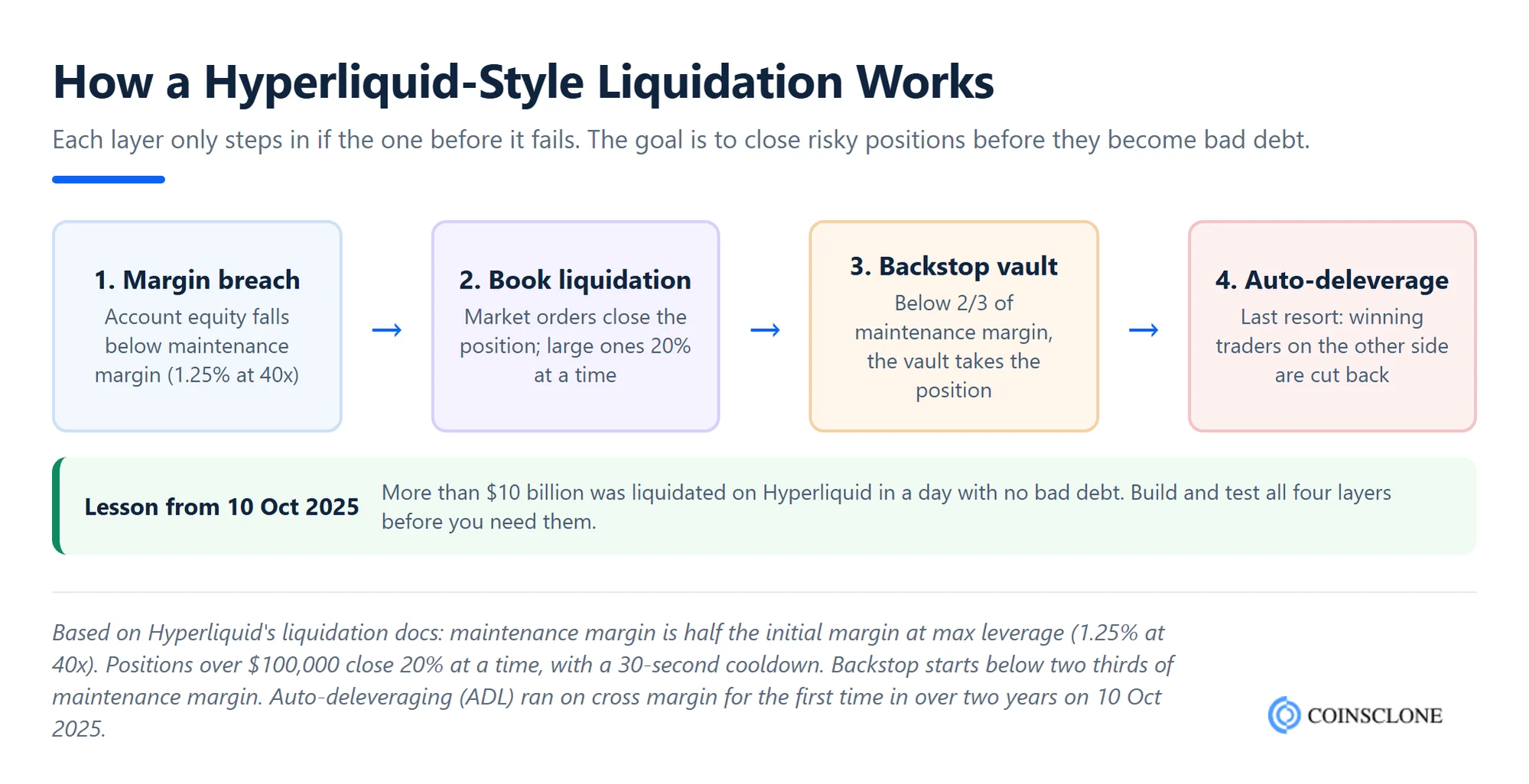
First, the engine sends market orders to the book. For positions over $100,000, it closes only 20% at a time, which stops one big account from crashing the price. If that fails and equity falls below two thirds of the margin need, a backstop vault takes over the position. As a last resort, auto-deleveraging (ADL) closes winning positions on the other side.
Funding rules matter too. On Hyperliquid, funding is paid every hour and is capped at 4% an hour. The oracle uses a weighted median of spot prices from big exchanges, so one thin market cannot move it.
Two real events show why these layers matter:
- The JELLY squeeze (March 2025): A trader shorted a thin meme token, then pumped its spot price so the backstop vault inherited a losing short. Validators voted to delist the market and settle it at $0.0095, as CoinDesk reported. The lesson: cap open interest on thin tokens.
- The 10 October 2025 crash: About $19 billion was liquidated across crypto in a day, with more than $10 billion on Hyperliquid. Its cross-margin ADL kicked in for the first time in over two years, yet the platform took on no bad debt. The lesson: build and test ADL before you need it.
Our clone script ships with these guards: partial closes, a backstop vault, ADL, open interest caps for each market and price feed checks.
Security Practices Built Into the Script
A perp DEX holds pooled collateral and pays out leveraged profits, so it is a prime target. Here is how we lock it down:
- Smart Contract Audits: Every bridge, vault and settlement contract is reviewed before launch, and again after major changes.
- Multi-Sig Admin Controls: No single key can change fees, list markets or move funds.
- Price Feed Guards: Prices come from many sources, with limits on how far they can jump in one update.
- Bot and Front-Running Defense: Fair order sequencing and rate limits stop spam and order games.
- Secure APIs: Signed requests, API wallets with limited rights, and rate limits for every user.
- Live Monitoring: Alerts on odd trades, sudden open interest spikes and node health.
Extras That Come With the Hyperliquid Clone
A Hyperliquid clone solution doesn’t stop at basic trading features. It also comes with extras that make launching a Hyperliquid-like DEX much easier.
White Label Hyperliquid Software
This is ready-to-deploy software that lets you launch a Hyperliquid-like platform fast. Our white label decentralized exchange software lets you launch your own branded platform. From logos and brand colors to the full trading flow, you can change every part to fit your needs. With this ready-made base, you can focus on growth instead of build hurdles.
Hyperliquid Clone App
With a Hyperliquid clone app, you can reach traders who live on their phones. We build native or hybrid apps for Android and iOS. A smooth trading screen, push alerts for fills and liquidation warnings, and mobile-first charts give traders a great experience on the go.
These extras speed up your Decentralized Exchange Development journey, so you can compete in the live market sooner. Next, let’s look at what your brand gains.
Business Perks Of Our Hyperliquid Clone Script
- Quick Deployment: Launch a working perp DEX without building complex systems from scratch.
- Proven Trading Design: Built on the order-book perp model that Hyperliquid proved at scale.
- Fast Matching Engine: Handles fast, heavy trading for pro and large traders.
- Lower Build Cost: A Hyperliquid clone costs far less than building a DEX from the ground up.
- Fully Custom: Change anything, from the user screens to fee tiers, to match your brand.
- Room to Grow: The software handles more users, higher volume and new markets as you expand.
Looking to build a perpetual DEX like Hyperliquid? Get started with Coinsclone and launch your DEX faster.
Cost-effective | White-Label Solution | Premium Features | Fully Customizable | Live Demo Available
How a DEX Like Hyperliquid Makes Money
A DEX like Hyperliquid has many revenue streams built in. Here are the main ways a Hyperliquid-like DEX makes money:
- Trading Fees: The main income source. Hyperliquid’s fee schedule starts at 0.045% for takers and 0.015% for makers, falling to 0.024% and 0% for the biggest traders.
- Vault Profits: A shared trading vault, like HLP, earns from market making and backstop liquidations. Your DEX can take a share of its profits.
- Liquidation Fees: You can keep a small part of each liquidation for the vault or an insurance fund. Note that Hyperliquid itself charges no clearance fee, which traders like.
- Listing Auctions: Hyperliquid sells new market and token slots through auctions. You can do the same for new perp markets.
- Builder and Partner Fees: Let wallets and trading apps route orders to you and add their own small fee, so they bring you volume.
- Premium Features: Pro traders will pay for advanced analytics, faster API limits, sub-accounts and custom risk tools.
So what can trading fees alone bring in? Here is a worked example at Hyperliquid’s base rates (0.045% taker plus 0.015% maker on each trade), before rebates and discounts:
| Daily volume on your DEX | Fees per day | Fees per month (30 days) |
| $5 million | $3,000 | $90,000 |
| $20 million | $12,000 | $360,000 |
| $100 million | $60,000 | $1.8 million |
For context, Hyperliquid’s own native markets did about $6.3 billion in a single day in October 2026. Even a small slice of that market can support a healthy business.
How Much Does a Hyperliquid Clone Script Cost?
The cost of a Hyperliquid clone script depends on your goals. A typical quote covers the trading engine, perp logic, risk engine, smart contracts, admin dashboard and basic security. However, the price is not fixed. These factors move it most:
- Planned Time Frame: Tight deadlines need a bigger team.
- Special Business Needs: New market types, such as stock or gold perps, need extra price feed and risk work.
- Team Skill: Perp DEXs need engineers who have built matching and risk engines before.
- Planned Features: Vaults, mobile apps, copy trading and APIs each add scope.
- Chain Choice: Your own appchain costs more than deploying on an existing L2.
- Compliance Needs: Geo-blocking, KYC options and legal reviews.
- Security Audits: Each contract and bridge needs an outside audit.
- Post-Launch Support: Upgrades, running nodes and round-the-clock checks.
For a rough guide, published 2026 agency price lists for Hyperliquid-style DEXs start at about $35,000 for a basic build and pass $120,000 for a premium build with more markets and support. A fully custom chain built from scratch usually takes 3 to 6 months and costs far more.
Time matters as much as money. At Coinsclone, a white label DEX launches in 5 to 7 weeks, while a standard custom DEX takes 10 to 14 weeks.
Also budget for running costs after launch:
- Liquidity: Market maker deals or rebates to fill the books from day one.
- Servers and Nodes: Chain nodes, RPC endpoints and backup servers.
- Oracle Feeds: Price data for every listed market.
- Vault Seed: Funds so the backstop vault can take on early liquidations.
- Audits and Bug Bounties: Repeat audits after each big upgrade.
How to Launch Your Hyperliquid Clone, Step by Step
Here is the launch path we follow with clients. Each step has a clear output, so you always know where the project stands.
- Plan the market: Pick your niche, such as crypto majors, stock perps or a regional market, and your target traders.
- Pick the chain model: Choose your own appchain, a rollup or an existing L2. This sets your speed and cost.
- Set up the engines: Configure the order book, matching engine, margin tiers and funding rules.
- Wire up the oracle and vault: Connect price feeds and seed the liquidity vault and insurance fund.
- Brand the front end: Add your logo, colors, web app and mobile apps.
- Test and audit: Run load tests, liquidation drills and outside smart contract audits.
- Check the rules: Leveraged perps for retail traders are regulated in many places, such as by the CFTC in the US. Get legal advice and set geo-blocks before launch. For Europe, see our guide to a MiCA-compliant perp DEX like Hyperliquid.
- Launch and grow: Go live with a few deep markets, then add pairs as liquidity grows.
Why Should You Choose Coinsclone for Hyperliquid Clone Script?
Coinsclone is a leading Decentralized Exchange Development Company, known for deep tech skill and a strong grasp of the market. Since 2018, we have delivered 350+ platforms for 200+ clients across 20 industries. What truly sets us apart is our end-to-end approach. From strategy to launch, we take care of everything.
Our DEX know-how helps you launch a secure Hyperliquid clone script that grows with you. We have proven skill in DEX design, fast trading engines and non-custodial systems. In short, we bring the tech depth, market know-how and track record to build a Hyperliquid-style perp DEX that holds up in real markets.
If you want to see it working first, our team can show you a live demo of the Hyperliquid clone script and map out the fastest route to launch for your business.
Frequently Asked Questions
What is a Hyperliquid clone script?
A Hyperliquid clone script is pre-built software that lets a business build a perp DEX much like Hyperliquid. It includes order-book trading, perp contracts, wallet login and risk tools. You can change it to support different markets, fees and designs.
Is a Hyperliquid clone decentralized or centralized?
A Hyperliquid clone is non-custodial, so users trade from their own wallets and never hand over their funds. How decentralized it is depends on your setup. Hyperliquid runs matching inside its own validator-run chain, while some DEXs match orders off-chain and settle on-chain. We help you pick the right balance of speed and decentralization.
How long does it take to launch a Hyperliquid clone?
At Coinsclone, a white label DEX takes 5 to 7 weeks and a standard custom DEX takes 10 to 14 weeks. Extra markets, your own chain or mobile apps add time.
How much does a Hyperliquid clone script cost?
Published 2026 agency price lists start at about $35,000 for a basic build and pass $120,000 for a premium one. Also budget for liquidity, audits, nodes and oracle feeds after launch.
Can a Hyperliquid clone handle high trading volumes?
Yes. A Hyperliquid clone uses a fast matching engine and lean order-book logic to handle high volume. It processes many orders at once with low delay, so it can serve busy markets and pro traders.
How do liquidations work on a Hyperliquid clone?
When an account falls below its maintenance margin, the engine first closes the position with market orders on the book. Large positions close in parts. If that fails, a backstop vault takes over, and auto-deleveraging is the last resort.
How are prices and funding rates updated?
The mark price comes from an oracle that takes a weighted median of spot prices from major exchanges. Funding is usually paid every hour and capped, so perp prices stay close to spot.
Can I launch on Hyperliquid itself instead of building my own DEX?
Yes, through HIP-3, but it needs a stake of 500,000 HYPE, about $45 million in October 2026, held for at least 183 days. A builder-code front end is cheaper, but you only earn a small fee and do not own the exchange.
How does a Hyperliquid clone work?
A Hyperliquid clone combines an order-book matching engine, perp futures logic and a risk system. Users connect their wallets, place leveraged trades, and the platform handles margin, funding and liquidations on its own. The goal is CEX-level speed in a non-custodial setup.
What features are included in a Hyperliquid clone script?
A Hyperliquid clone script includes order-book perp trading, wallet login, leverage and margin tools, funding rate logic, liquidation handling and live market data. It suits both new and pro traders.
See How Our MVP System Can Launch Your Perpetual DEX Faster
Hyperliquid Clone Script — High-Performance Perpetual DEX Development Done Right.
- MVP System : Launch your Hyperliquid-style perpetual DEX up to 90% faster.
- Pre-Built Trading Engine & Risk System : Order-book matching, perpetual logic, and liquidation modules pre-integrated — no complex development required.
- Brand & Customization : Your UI, your markets, your fee structure, your ecosystem.
- Revenue Engine : Earn from trading fees, funding rates, liquidation fees, and advanced trader features.
Get a free branded demo of your Hyperliquid-like perpetual DEX in just 48 hours — before you invest a cent.
Book a free call to discover how our Hyperliquid Clone Script can take you from concept to a live, high-performance perpetual DEX in just 8–12 weeks.