
There are now hundreds of decentralized exchanges (DEXs) across Ethereum, Solana, BNB Chain, Base and dozens of other networks. The same token can trade at a different price on each one. Checking them all by hand is slow, and picking the wrong one costs you money.
A DEX aggregator does that work for you. It checks many exchanges at once, finds the best price, and can split your trade across several of them in one transaction. Aggregators routed about $68 billion in swaps in the 30 days to 23 October 2026, according to DefiLlama. This guide ranks the eight busiest, compares them side by side on chains, fees, routing and security, explains how they protect you from MEV bots, and shows what it takes to build one.
Looking For The Next Crypto Opportunity?
We’re selecting 10 people this month.
If accepted, you’ll receive:
- Personalized crypto startup recommendation
- Founder roadmap
- Revenue model breakdown
- Market validation report
- Up to $5,000 worth of planning and software development support Free
No commitment required.
Applications close this week.
8 Best DEX Aggregators in 2026
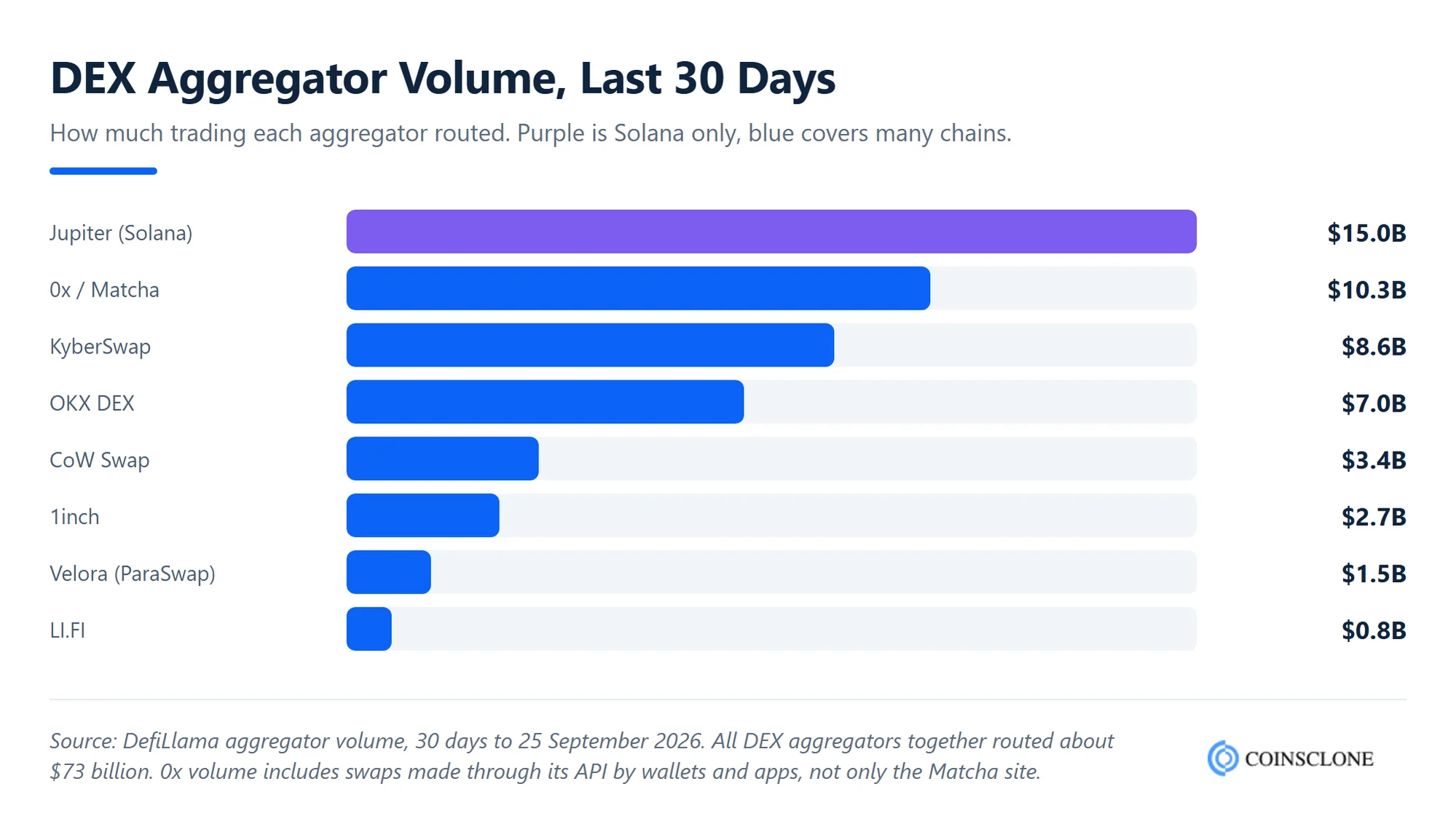
We ranked aggregators by 30-day volume on DefiLlama in September 2026 and rechecked every figure on 23 October 2026. The best DEX aggregator for you still depends on your chain and how much you trade, so the full swap aggregator comparison with fees, routing and security follows the list.
| Aggregator | Chains | Standout feature | Best for |
| Jupiter | Solana | Deepest Solana routing | Solana traders |
| 0x / Matcha | 15+ EVM chains | API behind many wallets, gasless swaps | Beginners on EVM chains |
| KyberSwap | 19 chains | 420+ liquidity sources, wide token coverage | Long-tail tokens |
| OKX DEX | 30+ chains | Quotes from 400+ DEXs and other aggregators | Comparing everything at once |
| CoW Swap | 8 chains | Batch auctions with MEV protection | Large or MEV-sensitive trades |
| 1inch | 19 chains | Pathfinder routing and Fusion mode | Split routing on EVM chains |
| Velora (ParaSwap) | 10+ EVM chains | Gasless Delta trading, cross-chain | Gas-free and cross-chain swaps |
| LI.FI | 58+ chains | Swaps plus bridges in one route | Moving tokens between chains |
1. Jupiter
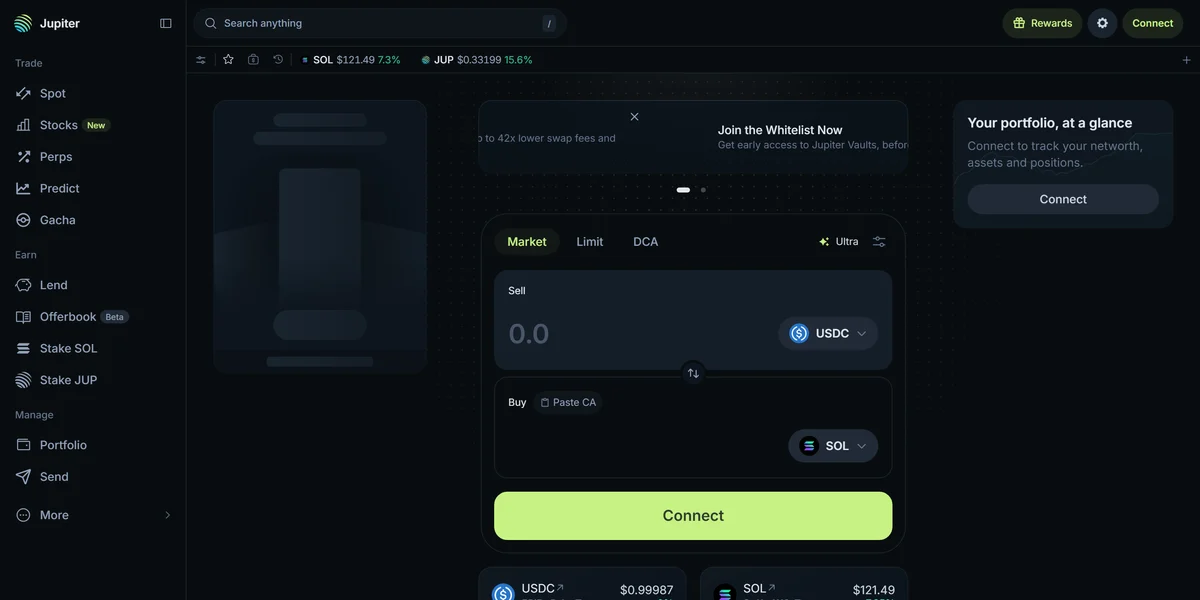
Jupiter is the main DEX aggregator on Solana and the busiest aggregator on any chain by volume. It routes swaps across Raydium, Orca, Meteora, PumpSwap and other Solana DEXs, and splits large trades to cut price impact. Jupiter has grown into a full trading app, with limit orders, DCA, perpetuals, lending and a JUP token.
What sets Jupiter apart is depth on one chain. Other aggregators cover many chains; Jupiter goes deeper on Solana than anyone. Build a similar platform with a Jupiter clone script.
- Best for: anyone trading Solana tokens.
- Watch out for: it only covers Solana, so use a different tool for EVM chains.
2. 0x and Matcha
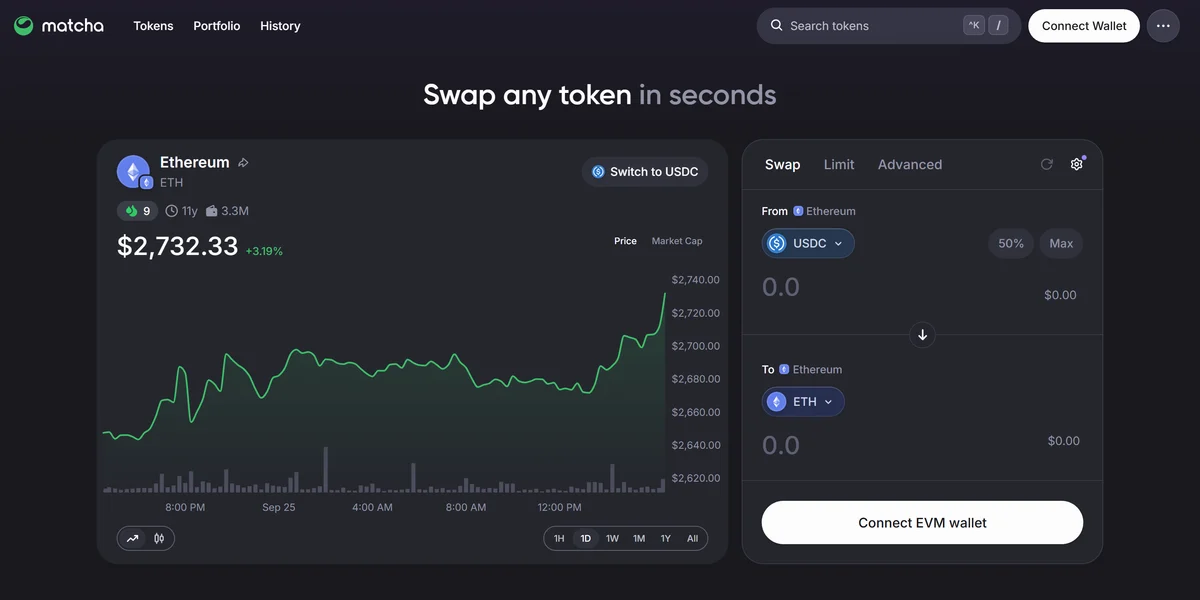
0x is a swap API used by many wallets and apps, and Matcha is its own trading site. A large share of 0x volume comes from apps that plug in its API, so you may already use 0x without knowing it. Matcha offers a clean swap screen, limit orders and gasless swaps on supported networks, where the fee comes out of the token you sell instead of needing ETH for gas.
- Best for: beginners who want a simple, trusted swap screen.
- Watch out for: gasless mode is not available for every token or chain.
3. KyberSwap
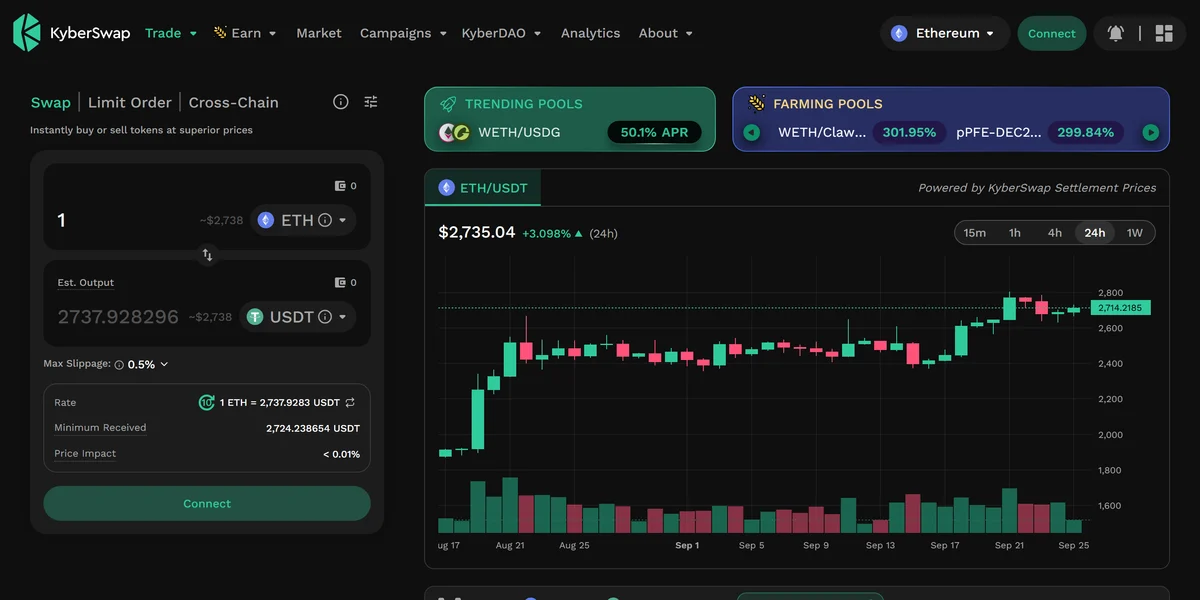
KyberSwap is a multi-chain aggregator that covers 19 networks and a very wide range of tokens. Its aggregator checks more than 420 liquidity sources, and it also offers limit orders, cross-chain swaps and liquidity tools. KyberSwap is a common pick for tokens that other aggregators do not list well.
- Best for: smaller and newer tokens across many chains.
- Watch out for: in November 2023 KyberSwap’s separate Elastic pools were hacked for about $48 million. The aggregator itself was not the target, but it is a reminder to check any contract you approve.
4. OKX DEX
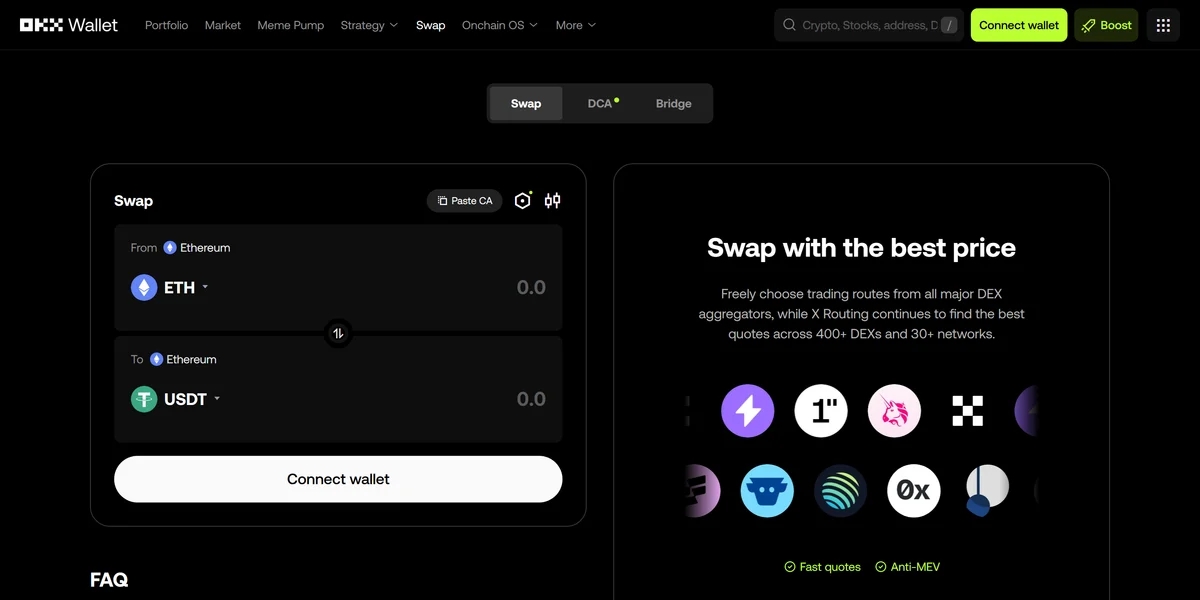
OKX DEX is the swap tool inside OKX Wallet. It is an “aggregator of aggregators”: it pulls quotes from more than 400 DEXs and from other aggregators, then picks the best across more than 30 chains. It also shows anti-MEV options and a bridge in the same screen.
- Best for: traders who want one screen that compares everything.
- Watch out for: OKX services are restricted in some countries, so check your region.
5. CoW Swap
CoW Swap works differently. Instead of sending your trade straight to a DEX, it collects orders into batch auctions. Solvers then compete to fill them at the best price. When two users want the opposite trade, CoW Swap matches them directly (a “coincidence of wants”), which skips DEX fees completely.
Because orders never sit in the public queue, bots cannot front-run them. That makes CoW Swap a favourite for large trades.
- Best for: big swaps and anyone worried about MEV.
- Watch out for: trades settle in batches, so fills are not instant.
6. 1inch
1inch is one of the best-known DEX aggregators. Its Pathfinder algorithm searches hundreds of liquidity sources and often splits one trade across several DEXs for a better price. Fusion mode turns your swap into an order that “resolvers” compete to fill, so you pay no gas and get MEV protection. Fusion+ extends this to swaps between chains. Launch a similar service with a 1inch clone script.
- Best for: EVM traders who want smart split routing.
- Watch out for: compare Fusion quotes with classic mode on small trades.
7. Velora (formerly ParaSwap)
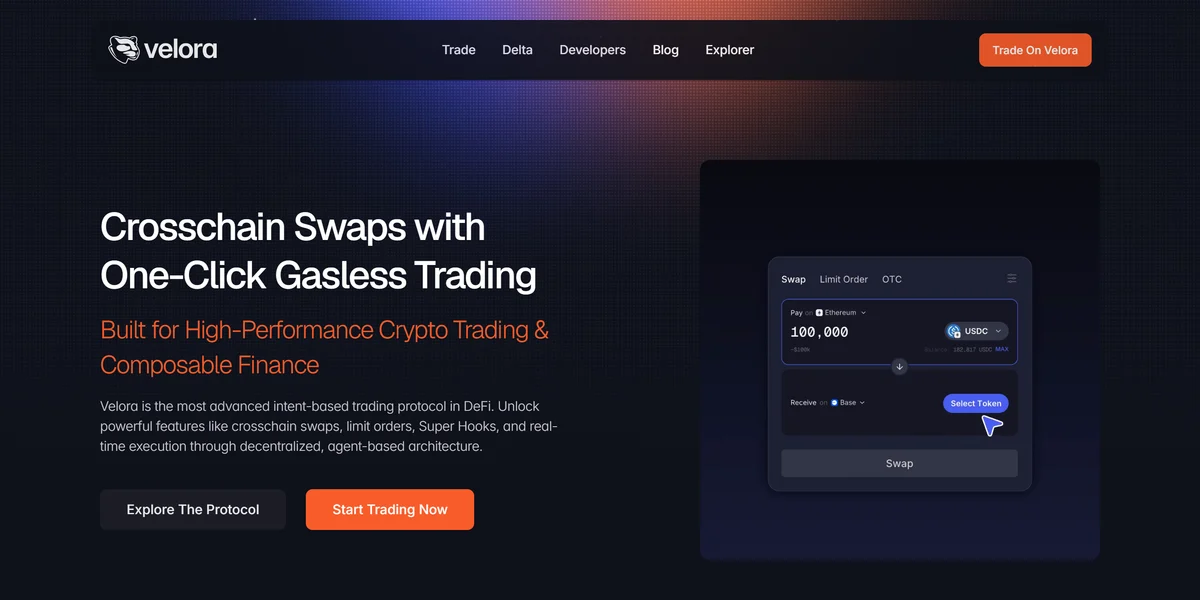
Velora is the new name for ParaSwap, one of the longest-running DeFi aggregators. Its Delta mode lets you sign an order and have agents fill it, with no gas to pay and protection from MEV. Velora also supports cross-chain swaps and limit orders, and its API powers swaps inside many wallets. Build your own with a ParaSwap clone script.
- Best for: gas-free trading and wallet developers.
- Watch out for: older guides and wallets may still call it ParaSwap.
8. LI.FI
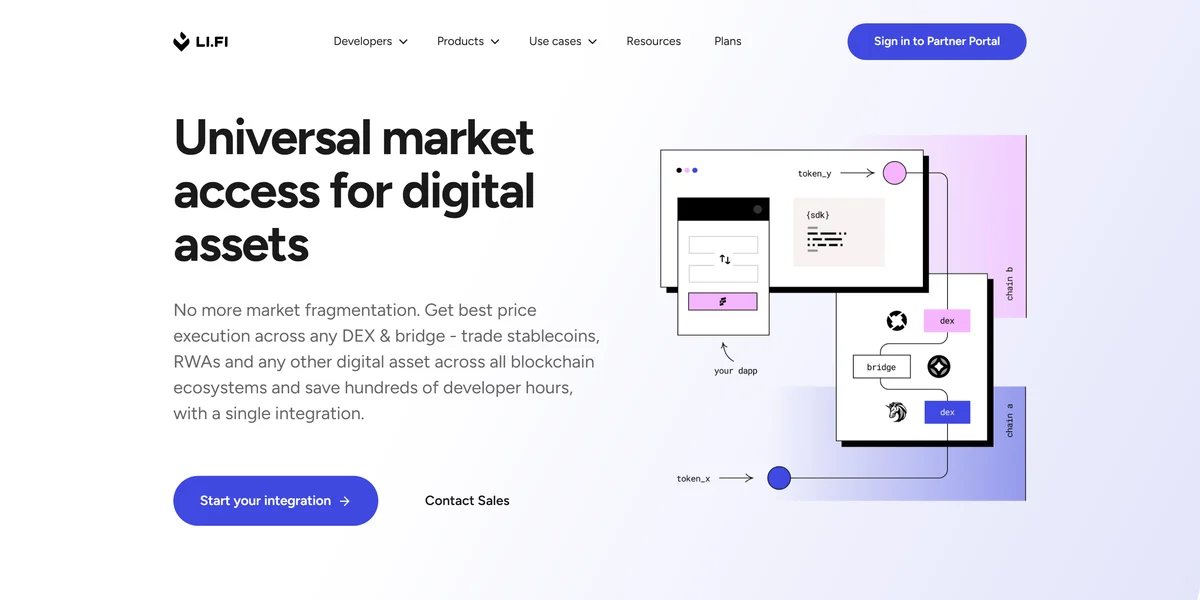
LI.FI combines DEX aggregators and bridges, so one route can swap a token on one chain and deliver a different token on another. It covers 58+ chains, including Solana, Bitcoin, Sui and Tron as well as EVM networks. Most people use LI.FI without visiting its site, because wallets and apps build its API into their own swap and bridge screens.
- Best for: moving value between chains in one step.
- Watch out for: cross-chain routes add bridge risk and can take minutes.
Swap Aggregator Comparison 2026: Chains, Fees, Routing and Security
Use this table when you need to pick one quickly. Volume tells you where the liquidity and the routing data are; the fee column tells you what the aggregator itself keeps, which is separate from pool fees and gas.
| Aggregator | Chains | 30-day volume | Routing model | Aggregator fee | MEV protection |
| Jupiter | Solana | $13.2B | Metis split routing; Ultra adds a live slippage estimator | 0.05% to 0.10% on Ultra swaps | Private routing through Jupiter Beam until the trade lands on chain |
| 0x / Matcha | 15+ EVM | $6.8B | 0x API routing plus RFQ market makers | 0.15% on select token pairs through the API | Gasless mode on supported chains |
| OKX DEX | 30+ | $6.5B | X Routing across 400+ DEXs and other aggregators | Not published on the swap page | Anti-MEV option in the swap screen |
| KyberSwap | 19 | $5.7B | Meta-aggregator over 420+ liquidity sources plus its own pools | None for users on KyberSwap.com or its API | Smart Settlement compares pools at execution |
| 1inch | 19 | $3.1B | Pathfinder split routing; Fusion and Fusion+ intents | No fixed fee; infrastructure fees can apply and positive slippage is kept | Fusion orders are filled by resolvers, off the public queue |
| CoW Swap | 8 | $3.1B | Batch auctions settled by competing solvers | 0.02% volume fee (0.003% on correlated assets) plus 50% of any quote improvement, capped at 0.98% | Uniform clearing prices; orders never enter the public mempool |
| Velora | 10+ EVM | $1.2B | Market mode split routing; Delta intents | Not published on its docs landing page | Delta orders are filled by agents, off the public queue |
| LI.FI | 58+ | $0.9B | Swap plus bridge routes built over other aggregators | Set by the integrator, taken from the source token | Depends on the route and bridge used |
Volumes: DefiLlama aggregators dashboard, 30 days to 23 October 2026. Chains: DefiLlama for Jupiter, 1inch and CoW Swap; the 0x pricing page, KyberSwap docs, OKX DEX page, Velora docs and LI.FI docs for the rest. Fees: Jupiter developer docs (Ultra), 0x pricing page, KyberSwap fee schedule, 1inch help centre, CoW DAO fee page and LI.FI docs, all read 23 October 2026.
Two things the table cannot show. First, a 0% aggregator fee does not mean the cheapest trade: the fee is tiny next to the price difference between routes, so always compare the final amount you receive. Second, the ranking is moving. DFlow on Solana ($8.9 billion) and Uniswap’s own aggregator ($3.5 billion) both posted more 30-day volume than 1inch in October 2026, mostly through wallet integrations rather than their own sites.
How Does a DEX Aggregator Work?
When you ask for a swap, the aggregator:
- Asks for quotes: it checks prices and pool depth on every DEX it connects to.
- Finds the best route: it may trade through a middle token, such as USDC, or split the order across several pools.
- Adds up the costs: it weighs gas and fees against the better price, so a complex route is used only when it pays.
- Sends one transaction: you approve once, and the smart contract runs every part of the route together.
Newer aggregators add a fifth step. Instead of trading straight away, they let solvers compete to fill your order, which can beat the best public price and hide your trade from bots.
How Aggregators Protect You From MEV
MEV stands for “maximal extractable value”. It is profit that bots make by reordering trades, and it is the hidden cost of trading on public blockchains. The most common version is the sandwich attack.
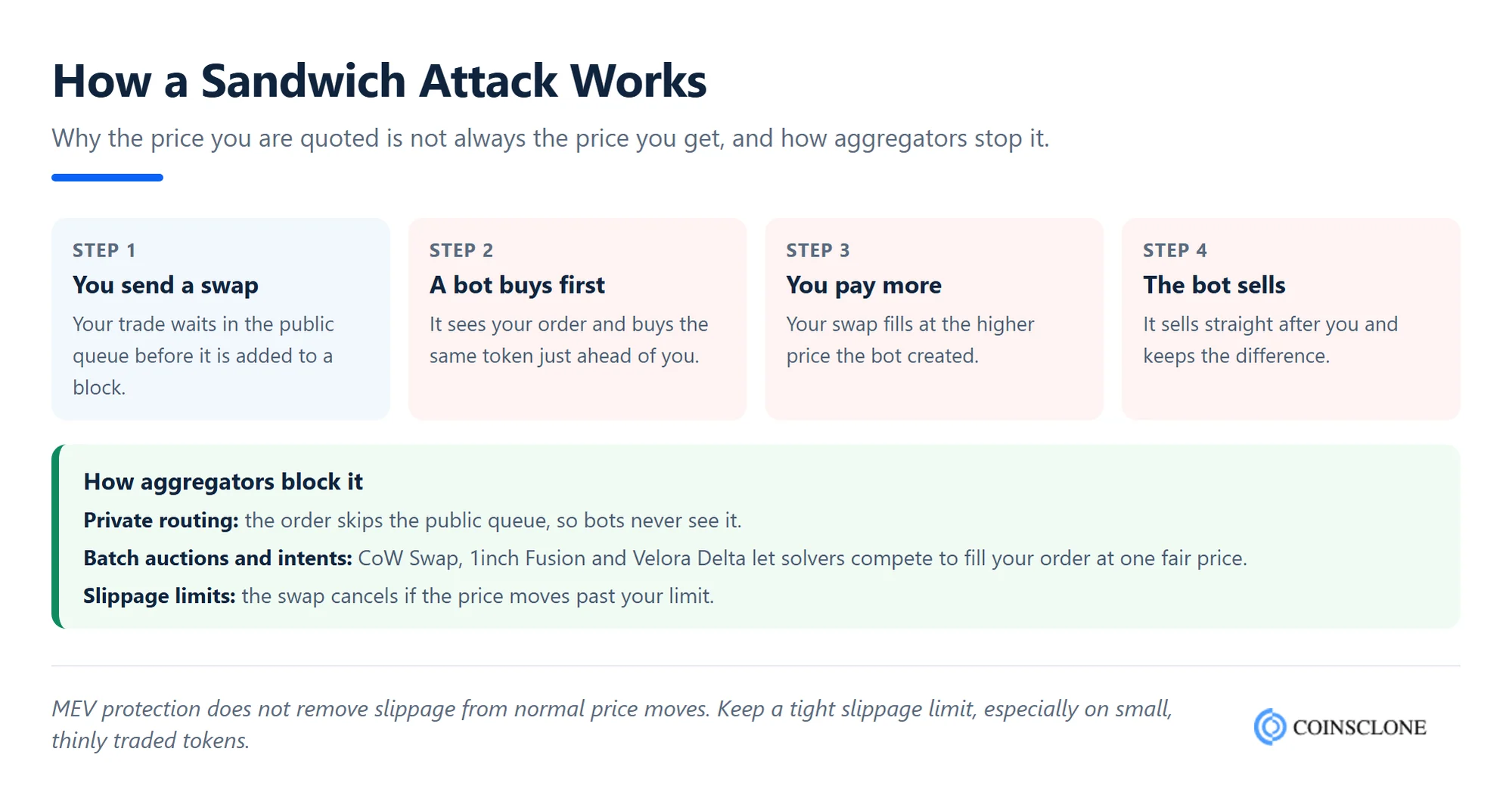
If you trade large amounts on Ethereum, use an aggregator with MEV protection turned on, such as CoW Swap, 1inch Fusion or Velora Delta.
DEX Aggregator Security: What Can Go Wrong and How to Stay Safe
An aggregator adds one more smart contract between you and the pools. The big names are audited and non-custodial, so most losses come from a handful of places you can control.
1. Contract and resolver bugs. Three dated cases show where the risk sits:
- KyberSwap, November 2023: a maths bug in KyberSwap’s separate Elastic pools let an attacker drain about $48 million, per Halborn’s post-mortem. The pools were hit, not the aggregator router.
- 1inch, March 2025: resolvers still running the old Fusion v1 settlement contract lost about $5 million to a calldata bug, as Halborn explained. 1inch said user funds were not affected and most of the money was returned for a bounty.
- TrustedVolumes, 2026: a 1inch resolver was drained of about $6.7 million through its own swap proxy, The Defiant reported. 1inch said its own contracts and user funds were untouched, and other resolvers kept filling orders.
The pattern is clear: the losses sat in pools and resolver contracts, not in the routing contracts users sign. That is why approval hygiene matters more than the brand name.
2. Token approvals. Every swap starts with an approval that lets the aggregator’s contract spend your token. An unlimited approval to an old or wrong contract is how most “aggregator hacks” actually reach users. Approve only the amount you are trading, prefer permit-based swaps that expire, and revoke approvals you no longer use.
3. Fake front-ends and bad tokens. Phishing copies of aggregator sites rank in ads and social links, and anyone can list a token with the same name as a real one. Type the address yourself, check the token contract, and use the aggregator’s own checks where they exist: Jupiter exposes a token security endpoint, and most swap screens flag high price impact.
4. Cross-chain routes. A swap that also bridges inherits the bridge’s trust model. LI.FI, for example, audits every release, runs a bug bounty of up to $1,000,000 and has Hexagate watch its contracts. The bridge it routes through is still a separate contract with its own risk. For large cross-chain moves, split the amount.
What the best aggregators do about it. 1inch lists OpenZeppelin, Consensys Diligence, SlowMist, CertiK and Hacken among its auditors. CoW Swap removes front-running by design: trades in a batch clear at one price, so the order of transactions no longer matters, and orders are not exposed to the public mempool. Jupiter’s Ultra mode keeps transactions private until they execute. None of this makes a contract risk-free, but it is the difference between a venue that has planned for failure and one that has not.
Security checklist before you swap:
- Open the aggregator from a bookmark, never from an ad or a message.
- Check the token contract address against the project’s own site.
- Approve the exact amount, not unlimited, and revoke old approvals monthly.
- Set a slippage limit and turn on MEV protection for anything large on Ethereum.
- On cross-chain routes, send a small test amount first.
- Compare the final quote on two aggregators for trades above a few thousand dollars.
If you are building an aggregator, the same list is your spec: an audit for each release, bonded solvers, scoped approvals, live monitoring and a pause switch that someone is on call to use.
DEX Aggregator vs DEX: What Is the Difference?
A DEX is where the trade actually happens: it holds the liquidity pools. An aggregator is a search and routing layer on top of many DEXs. It does not hold liquidity itself; it finds the best mix of DEXs for your trade and sends the order to them in one transaction.
That means an aggregator usually gets you an equal or better price than any single DEX, but it adds one more smart contract to trust. For small trades on a single chain, the difference is often tiny. For large trades, or tokens spread across many pools, an aggregator can save a lot.
What Is Intent-Based Trading?
Intent-based trading is the newest way aggregators work. Instead of sending an exact swap route, you sign an “intent”: the tokens you want to sell, the tokens you want to receive and the lowest price you will accept. Professional solvers then compete to fill it.
- Better prices: solvers can use private liquidity and match users directly.
- No gas for the user: the solver pays gas and builds it into the price.
- MEV protection: the order never sits in the public queue.
CoW Swap, 1inch Fusion and Velora Delta all use this model. It is quickly becoming the default for larger trades on Ethereum.
Benefits of Using a DEX Aggregator
- Better prices: the aggregator compares every connected DEX in real time.
- Less slippage: splitting large orders reduces how far each pool’s price moves.
- Lower costs: routes weigh gas against savings, and some modes cover gas for you.
- MEV protection: private routing and auctions keep bots away from your order.
- Saves time: one screen replaces checking many exchanges.
- More tokens: you reach tokens that only trade on smaller DEXs.
How to Choose the Best DEX Aggregator
- Match your chain: Jupiter for Solana, and 0x, 1inch, KyberSwap, CoW Swap or Velora for EVM chains.
- Check MEV protection: it matters most for large trades on Ethereum mainnet.
- Compare two quotes: for big trades, check at least two aggregators before you sign.
- Look at gas options: gasless modes help when you do not hold the chain’s gas token.
- Check the contract: only approve spending for the official aggregator contract, and remove old approvals you no longer need.
For beginners, Matcha and Jupiter have the simplest screens, and most wallets, such as MetaMask and OKX Wallet, include an aggregator in their built-in swap.
Top Features of a DEX Aggregator
These are the features that separate the best DEX aggregators from the rest, and the ones to plan for if you build one:
- Multi-chain support: swap on Ethereum, BNB Chain, Solana, Base and more from one app.
- Smart routing: split and multi-hop routes worked out in milliseconds.
- Cross-chain swaps: swap and bridge in one step, without a separate bridge site.
- Limit orders and DCA: trade at a set price or buy in small amounts over time.
- Intent-based trading: users sign what they want, and solvers compete to deliver it.
- Wallet integration: support for MetaMask, Phantom, Trust Wallet and others.
- Security: audited contracts, MEV protection and clear approval limits.
- Analytics: price charts, route details and trade history.
Reading about DEX Aggregators?
Most people don’t realize there are still profitable crypto businesses that can be launched without building the next Binance.
We’ve put together a free opportunity scanner that shows:
- Which crypto niches are growing
- Startup cost range
- Revenue potential
- Time to launch
- Technical complexity
How to Build a DEX Aggregator
A DEX aggregator has four main parts:
- Liquidity connectors: adapters that read prices and pool depth from each DEX, on each chain you support.
- Routing engine: the service that finds the best split and multi-hop route, usually off-chain for speed.
- Execution contracts: audited smart contracts that run the route in one transaction and enforce slippage limits.
- Front end and API: a swap screen for users, and an API so wallets and apps can plug in.
From there, you can add MEV protection, gasless swaps and cross-chain routes. Budgets depend on how many chains and DEXs you connect, whether you build solvers, and the audit scope. Most of the cost sits in the routing engine and security audits, not the interface.
Why Choose Coinsclone to Build Your DEX Aggregator?
Coinsclone is a DeFi DEX aggregator development company that builds secure, multi-chain aggregators for startups and businesses. We cover routing engines, execution contracts, MEV protection and the user interface, from planning through launch.
Whether you target one ecosystem, like Solana, or many EVM chains, our team brings both the technical skill and the market knowledge to get your platform live. If you would rather list your own exchange first, see our guide to the best decentralized exchanges and our PancakeSwap clone script.
Frequently Asked Questions
What is the best DEX aggregator in 2026?
Jupiter is the best DEX aggregator on Solana and the busiest overall by volume. On Ethereum and other EVM chains, 0x (through Matcha and many wallets), KyberSwap and 1inch lead, while CoW Swap is the top choice for MEV-protected trades.
What is a DEX aggregator?
A DEX aggregator is a tool that checks prices on many decentralized exchanges at once and routes your swap to the best one, or splits it across several. You get a better price in one transaction without comparing exchanges yourself.
Which DEX aggregator has the lowest fees?
Jupiter on Solana is cheapest for network fees, because Solana gas costs a fraction of a cent. On EVM chains, gasless modes such as 1inch Fusion, Velora Delta and Matcha’s gasless swaps can remove the gas cost for the user.
Are DEX aggregators safe to use?
Well-known aggregators use audited contracts and are generally safe, but no smart contract is risk free. The losses in the KyberSwap (2023) and 1inch resolver (2025 and 2026) incidents sat in pools and resolver contracts, not in user swaps. Only approve the official contract for the amount you trade, set a slippage limit, and use MEV protection for large trades.
Do DEX aggregators charge fees?
Some do. Jupiter charges 0.05% to 0.10% on Ultra swaps, 0x charges 0.15% on select pairs through its API, and CoW Swap takes a 0.02% volume fee plus half of any price improvement. KyberSwap charges nothing on its own site, and 1inch has no fixed fee but may keep positive slippage. You always pay the pool fees and network gas on top, unless a gasless mode covers gas for you.
Do wallets integrate DEX aggregators like 1inch or ParaSwap?
Yes. Many wallets build aggregators into their swap screens. OKX Wallet, MetaMask and others compare quotes from several aggregators and DEXs, and APIs from 0x, 1inch, Velora and LI.FI power swaps inside many apps.
What is the best HyperEVM aggregator?
Several multi-chain aggregators now support Hyperliquid’s HyperEVM, including 0x, KyberSwap, 1inch and LI.FI. Compare quotes from two of them, as liquidity on HyperEVM is still thinner than on older chains.
How much does it cost to build a DEX aggregator?
The cost depends on the number of chains and DEXs you connect, whether you add solvers or cross-chain routes, and how deep your security audits go. Share your scope with a development team for a fixed quote.
Looking For The Next Crypto Opportunity?
We’re selecting 10 people this month.
If accepted, you’ll receive:
- Personalized crypto startup recommendation
- Founder roadmap
- Revenue model breakdown
- Market validation report
- Up to $5,000 worth of planning and software development support Free
No commitment required.
Applications close this week.