
In the past, developing a decentralized exchange involved sacrificing either performance or decentralization. However, platforms such as Hyperliquid today illustrate how businesses can develop both without compromising on them.
Hyperliquid satisfies what modern traders want: speed, liquidity, advanced trade tools, and total control of assets, demonstrating both the future of DeFi and the DEX market. As interest rises in trading decentralised derivatives, there is an increasing number of opportunities for both enterprises and startups to develop a DEX that resembles Hyperliquid.
This blog guides every founder about how to develop a DEX like Hyperliquid, including its features, the development process of a DEX-like Hyperliquid, and what business gains through Hyperliquid DEX development.
See How Our MVP System Can Launch Your Perpetual DEX Faster
Perpetual DEX Development — built for speed and scalability.
- MVP System: Launch a Hyperliquid-like perpetual exchange up to 90% faster.
- Trading & Liquidity Infrastructure: Pre-integrated perpetual contracts, order book engine, liquidity modules, wallet connectivity, and risk management tools
- Brand & Customization:Your branding, trading pairs, leverage settings, fee structure, and governance model.
- Revenue Engine : Earn through trading fees, liquidation fees, staking programs, liquidity incentives, and native token utilities.
Get a free branded demo of your Hyperliquid-style perpetual DEX within 48 hours — before You invest a cent.
Book a Free Demo to discover how to create a Perpetual DEX like Hyperliquid and launch your perpetual DEX Platform in just 8 -12 weeks.
Why should you Create a Perpetual DEX like Hyperliquid
Hyperliquid has changed the way of trade by integrating the speed of a Centralized Exchange with the transparency of DeFi. Its growing popularity reflects the rising demand for advanced, high-performance trading platforms.
- High-Speed Trading Performance
- Advanced On-Chain Order Book
- Growing Demand for Decentralized Perpetual Trading
- Deep Liquidity and Better Capital Efficiency
The success of Hyperliquid shows the emerging market opportunity for decentralized perpetual trading. Businesses that create a perpetual DEX like Hyperliquid can attract active traders, create sustainable revenue, and become a dominant force in the rapidly growing DeFi ecosystem.
Hyperliquid Market Growth and Industry Statistics
Hyperliquid has become one of the top leaders within the perpetual DEX sector and has achieved many milestones regarding trading volume, user adoption, and market share.
- According to data published by Binance Square,Hyperliquid is recorded as one of the largest decentralized perpetual exchanges across the globe, recording an average liquidity volume of estimated $6.4 – $6.7 billion in Q2 2026.
- Market analytics from Hyperscreener reveals that Hyperliquid processed approx. $190.3 billion of trades in April 2026, indicating continued growth in the overall crypto derivatives ecosystem.
- Data from DefiLlama further shows that Hyperliquid has generated over $4.15 trillion in total cumulative perpetual trading volume through 2022 by creating the most active decentralized derivatives trading platform in the world.
- Although they continued to be positively impacted by general market volatility, According to CoinGecko,the top decentralized perpetual exchanges (perpetual trading) produced an average monthly liquidity volume of $611.6 billion in 2020.
The above statistics illustrate a clear opportunity for other startups and companies wishing to develop a DEX that resembles Hyperliquid.
Core Features of a Hyperliquid -like DEX Platform
Businesses need to include the following features in their Hyperliquid-like DEX platform to foster user engagement, liquidity, and grow their platform’s overall usage.
|
Features |
Purpose |
| Decentralized Perpetual Futures Trading | Enable non-custodial perpetual futures trading with leverage |
| On-Chain Order Book Infrastructure | Support transparent price discovery with an on-chain order book |
| Ultra-Fast Trade Execution | Ensure low-latency order processing for seamless trading |
| Cross-Margin and Isolated Margin Trading | Offer flexible margin options for better risk management |
| Advanced Trading Charts and Analytics | Provide real-time charts and technical analysis tools |
| Liquidity Management Engine | Maintain deep liquidity for smooth trade execution and minimal slippage. |
| Wallet Integration | Support secure connectivity with popular Web3 wallets. |
| Risk Management System | Protect traders with advanced risk controls and liquidation mechanisms. |
| Referral and Reward Programs | Boost user growth through referral incentives and trading rewards. |
| Governance Framework | Enable community-driven decision-making through decentralized governance. |
All of these features serve as the foundation for the successful development of a Hyperliquid DEX and should therefore be integrated into a scalable and competitive decentralized trading solution.
Technical Components Required to Build a DEX Like Hyperliquid
A DEX like Hyperliquid has an architecture that allows for fast-paced trading with minimal delays and safe execution of trades on-chain. The following elements make up the backbone of a perpetual DEX.
Layer-1 Infrastructure
Choose a high-performance Layer-1 blockchain capable of supporting fast transactions, low fees, and high throughput for seamless trading.
Validator Network
A decentralized validator network verifies transactions, secures the blockchain, and maintains the integrity of the trading ecosystem.
On-Chain Order Book
An on-chain order book enables transparent order matching, accurate price discovery, and advanced trading functionalities.
Matching Engine
The matching engine processes buy and sell orders in real time, ensuring fast execution with minimal latency.
Settlement Layer
The settlement layer securely finalizes trades, updates balances, and records transactions on-chain for transparency and reliability.
As the tech behind perpetual DEX is clear, let’s move ahead to know how to build the Perpetual DEX with clear steps.
How to Create a Perpetual DEX Like Hyperliquid: Step-by-Step Development Process
Developing a Hyperliquid-like DEX is simple by following our streamlined development approach.
Step 1: Define Business Goals and Trading Model
Start by defining your target market, the types of assets you will trade, the features of your trading platform, and how you will make money (e.g., trading fees, etc.). All of these items are part of a business strategy that builds alignment between development efforts and the market that you are trying to serve. In addition, the above-mentioned items will help you develop a long-term growth strategy for your platform.
Step 2: Conduct Market and Competitor Research
Market research and competitor analysis are key components of the development of a successful trading platform. Analyzing existing DEX platforms, understanding trader preferences, and identifying emerging market trends will help you identify areas of opportunity and develop a unique value proposition and competitive advantage in the decentralized trading ecosystem.
Step 3: Select Blockchain Infrastructure
The choice of blockchain infrastructure for a trading platform is critical. Characteristics such as scalability, low transaction costs, and reliability of service are all critical to developing a successful trading platform. The type of blockchain platform selected will have a direct impact on the speed at which transactions are processed, the quality of the user experience, and the ability of the platform to grow over time.
Step 4: Design the Platform Architecture
Building a strong architecture for the DEX or trading platform is critical as it supports trading activity, liquidity management, wallet connectivity, and security. A well-designed architecture will provide for smooth scalability and increased liquidity as trading activity increases.
Step 5: Develop Smart Contracts
Building secure and reliable smart contracts will provide the backbone of the trading platform. Smart contracts will automate trading, settlement, management of liquidity, and governance by the platform. To ensure the long-term success of the trading platform, the smart contracts must be efficient and secure in design.
Step 6: Build the Order Matching Engine
Create a matching system to handle buy/sell orders quickly and efficiently based on the volume and type of order placed, and that will keep up to date on real-time execution of orders to provide a professional trader experience.
Step 7: Integrate Liquidity Mechanisms
Use liquidity pools, market makers, and incentive programs to create liquidity in your exchange to keep buyers and sellers trading regularly; this decreases slippage and increases the performance of trades.
Step 8: Develop the Trading Interface
Develop an interface for users that will make it simple to use while offering advanced trading functionality through tools like charts, order books, and portfolios to encourage user engagement.
Step 9: Implement Security Measures
Install encryption, access controls, monitoring, and risk management tools throughout the trading platform. A significant amount of security will create user confidence in your product and protect against possible attacks or threats.
Step 10: Conduct Testing and Audits
Perform extensive function, performance, and security testing on your trading platform before launch. Having an independent auditor assess your functionalities for weaknesses will also ensure that your platform meets the industry standards for security.
Step 11: Deploy and Launch the Platform
Deploy your Hyperliquid-like DEX trading platform into a real-world production environment and continue to monitor after the initial launch. Continue to provide periodic updates; enhance features for your users; and create avenues for user interaction to achieve long-term success.
With this clear roadmap, businesses can launch a secure and scalable DEX like Hyperliquid platform that grows in the DeFi space.
Ready to capitalize on the next wave of decentralized trading?
Launch a Hypeliquid-like DEX with Coinsclone!
Tech Stack Needed to Build a Hyperliquid-Like Perpetual DEX
Selecting the right technology stack is essential for building a secure, scalable, and high-performance perpetual DEX.
- Blockchain Infrastructure: EVM-compatible blockchains
- Smart Contract Development: Solidity, Rust
- Front End: Next.js, node/express
- Back End: Node.js
- Wallet Integration: MetaMask
- Stablecoin & Payment Infrastructure: Circle (USDC)
- Cloud & DevOps: AWS, Google Cloud
- Oracle Network: Chainlink
A modern tech stack ensures efficient trading operations and long-term platform growth.
How Hyperliquid-Like DEXs Differ from Traditional DEX Platforms
The DEX-like Hyperliquid is more advanced and offers unique functionalities than traditional DEX. Here’s the detailed comparison of them.
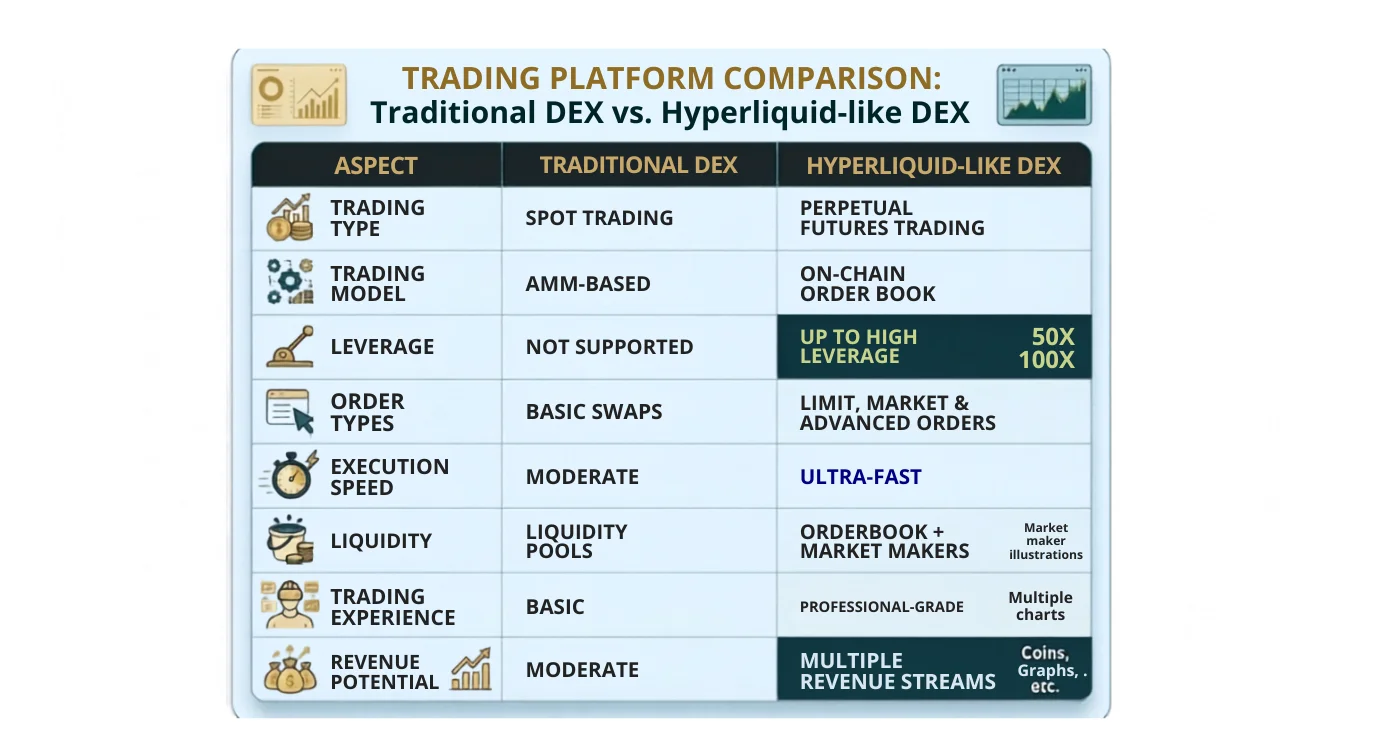
Hyperliquid-like DEX inspires startup founders to build one as it offers broader functionalities and drives a competitive edge. If you are wondering about the required investment to develop a DEX like the Hyperliquid platform, look at the upcoming section.
Cost and Timeline to Build a DEX Like Hyperliquid
The cost to create a Hyperliquid-like DEX ranges from $25,000 to $150,000. It can vary based on platform complexity, customization needs, scalability requirements, and business goals. Whether you are choosing an MVP or scratch development, selecting the suitable development approach is significant to balance investment with business requirements.
Based on Platform Type,
- Minimum Viable Product: $25,000 to $50,000 takes around 8-12 Weeks.
- Customized White Label Solution: $50,000 to $100,000 delivered in 12-16 Weeks.
- Enterprise-Grade Development from Scratch: $100,000 to $150,000 typically takes 16-24 Weeks.
The final development cost & timeline may vary depending on your business needs, integrating features, and the level of complexity & customization in the platform.
Business Advantages of Developing a DEX Like Hyperliquid
Beyond benefiting traders, Hyperliquid-like DEX platform development also offers significant growth opportunities for both startups & enterprises. Here are some,
- Startups can capitalize on the growing market demand of both decentralized perpetual trading and non-custodial finance.
- Blockchain lets businesses build credibility as all transactions are recorded on-chain, allowing users to take custody of their funds.
- An effectively built DEX can accommodate increasing trading volumes, list new assets, and expand into new user communities.
- The scalability of the DEX allows businesses to adapt to an ever-changing marketplace and take advantage of opportunities for future growth.
- Stand out in a competitive space with a feature-rich trading platform that has advanced capabilities, such as the ability to trade perpetual futures and on-chain order books.
Businesses that build a DEX like Hyperliquid achieve new revenue sources, enhance their competitive advantage, and develop a world-class trading environment in the fast-growing DeFi space.
Revenue Models of a Hyperliquid-Like DEX
Startups and enterprises can reap revenue from multiple streams through Hyperliquid-like DEX development. Here are some revenue-generating ways,
- Trading Fees: Generate high revenue from the execution of trades.
- Listing Fees: Charge for listing tokens and/or trading pairs on the exchange.
- Liquidity and Market-Making Services: Monetize the liquidity and market-making services to create more liquidity, improving trading efficiency.
- Premium Trading Features: Offer premium trading features, such as advanced analytics and enhanced trading tools, through paid subscriptions.
- Native Token Ecosystem: Drive value through governance participation, staking programs, and incentive rewards for users.
- Strategic Partnerships and Ecosystem Collaborations: Increase revenue through collaborating with liquidity providers and Web3 businesses.
These collaborations can also help to build market adoption and increase the visibility of the Hyperliquid-like DEX platform.
Why Choose Coinsclone to Build a Hyperliquid-like DEX Platform
Coinsclone is a Top Decentralized Exchange Development Company leading the crypto market and helping businesses for over 7+ years. We help startups to launch a DEX like Hyperliquid with customization opportunities for better brand positioning and long-term growth. We manage the entire DEX development lifecycle from design to deployment & maintenance, and gained 80% repetitive clients.
Our White Label solutions are highly secure, incorporating rigorously tested smart contracts, risk management protocols, and robust security standards. We deliver ongoing support, upgrades, and technical assistance to ensure the platform’s security and scalability. Coinsclone empowers startups and enterprises to launch scalable, secure, and feature-rich decentralized trading platforms that thrive in the evolving DeFi ecosystem.
FAQs
1)What does it cost to build a DEX like Hyperliquid?
The cost typically ranges from $25,000 to $150,000, depending on the platform’s features, customization, and complexity.
2)How long does it take to develop a Hyperliquid-like DEX?
A Hyperliquid-like DEX can typically be developed in 8 to 24 weeks, depending on the project scope and technical requirements.
3)What blockchain is best for perpetual DEX development?
High-performance blockchains such as Arbitrum, Solana, Cosmos SDK, or a custom Layer-1 are ideal for building scalable perpetual DEXs.
4)What technologies are required to build a Hyperliquid-like DEX?
The platform requires smart contracts, a matching engine, wallet integration, oracle networks, backend and frontend frameworks, and stablecoin infrastructure like Circle.
5)What are the core features of a Hyperliquid-inspired DEX?
Key features of a Hyperliquid-like DEX include perpetual futures trading, an on-chain order book, fast trade execution, margin trading, liquidity management, and risk controls.
6)How does a Hyperliquid-like DEX generate revenue?
Startups can generate revenue through trading fees, listing fees, premium features, liquidity services, and native token utilities.
7)What are the biggest challenges in building a perpetual DEX?
Some of the challenges include building a secure trading engine, maintaining liquidity, and ensuring fast, reliable trade execution are the biggest challenges.
8)Can startups launch a Hyperliquid-like DEX platform?
Yes. Startups can begin with an MVP and later scale into a fully customized perpetual DEX as their business grows.
See How Our MVP System Can Launch Your Perpetual DEX Faster
Perpetual DEX Development — built for speed and scalability.
- MVP System: Launch a Hyperliquid-like perpetual exchange up to 90% faster.
- Trading & Liquidity Infrastructure: Pre-integrated perpetual contracts, order book engine, liquidity modules, wallet connectivity, and risk management tools
- Brand & Customization:Your branding, trading pairs, leverage settings, fee structure, and governance model.
- Revenue Engine : Earn through trading fees, liquidation fees, staking programs, liquidity incentives, and native token utilities.
Get a free branded demo of your Hyperliquid-style perpetual DEX within 48 hours — before You invest a cent.
Book a Free Demo to discover how to create a Perpetual DEX like Hyperliquid and launch your perpetual DEX Platform in just 8 -12 weeks.
References
[1] Binance Square — Hyperliquid Market Statistics (Q2 2026)
[2] Hyperscreener — Hyperliquid Trading Volume Data
[3] DefiLlama — Hyperliquid Cumulative Trading Volume Metrics
[4] CoinGecko — Decentralized Perpetual Exchange Market Data