Most decentralized exchanges have historically faced a difficult challenge. Improving transparency and self-custody often came at the expense of speed, liquidity, and trading efficiency. As a result, many traders continued to rely on centralized platforms for a smoother experience.
But today, despite that. Hyperliquid has processed over $1 trillion in cumulative trading volume according to the bidget Report, and has become one of the largest perpetual DEXs in the market.
Those numbers are impressive on their own. But they raise a more interesting question: how does an on-chain exchange achieve this performance? How does it deliver a trading experience that rivals many centralized exchanges?
The answer lies in the architecture powering this perpetual DEX like Hyperliquid. So let’s start with…
See How Hyperliquid-Inspired Architecture Can Power Your DEX
Hyperliquid-Like DEX Development — built for performance.
- Advanced Trading Infrastructure: Launch a Hyperliquid-like perpetual exchange up to 90% faster.
- High-Speed Order Execution: Pre-integrated perpetual contracts, order book engine, liquidity modules, wallet connectivity, and risk management tools
- Custom Branding & Features:Your branding, trading pairs, leverage settings, fee structure, and governance model.
- Revenue-Driven Ecosystem: Earn through trading fees, liquidation fees, staking programs, liquidity incentives, and native token utilities.
Get a free consultation and explore how a Hyperliquid-inspired DEX can be tailored to your business requirements
Book a Free Demo to discover how our Hyperliquid Clone script can help you launch a high-performance perpetual DEX in just 8 -12 weeks.
What Is Hyperliquid and Why Its Architecture Matters
Hyperliquid is a decentralized perpetual futures exchange built on its own Layer 1 blockchain. Unlike most DEXs that rely on automated market makers (AMMs) and liquidity pools, Hyperliquid uses a fully on-chain Central Limit Order Book (CLOB), allowing traders to place and execute orders much like they would on a centralized exchange.
This approach has helped Hyperliquid gain significant interest among traders looking for the speed and trading experience typically associated with centralized platforms while maintaining self-custody of their assets.
But Hyperliquid’s success isn’t driven by its order book alone. Behind every trade is a custom-built architecture designed specifically for high-performance perpetual trading. That’s why the underlying infrastructure plays a critical role in the overall trading experience.
Now let’s see how the components of hyperliquid work to complete the trade…
Hyperliquid DEX Architecture Overview
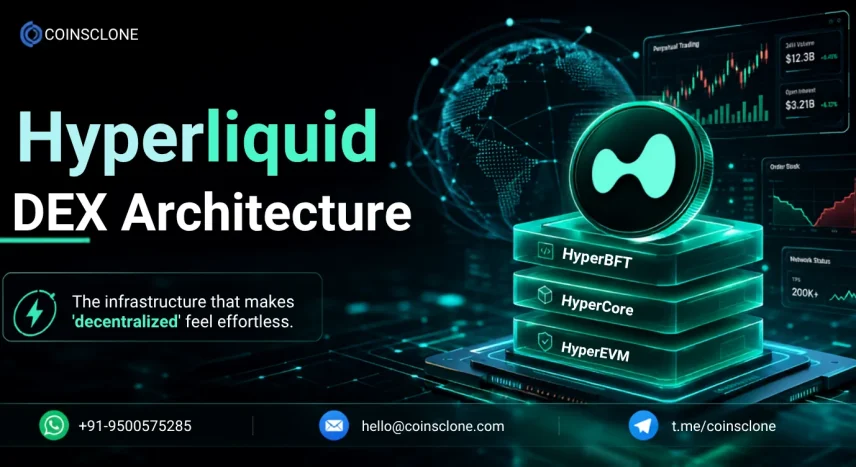
Hyperliquid’s infrastructure is built around three tightly integrated components that work together to power its trading ecosystem. Rather than treating consensus, trading, and smart contracts as separate systems, Hyperliquid integrates them into a unified framework. The three pillars include
- HyperBFT – The consensus layer responsible for transaction validation and fast finality.
- HyperCore – The trading engine that manages the on-chain order book, trade matching, settlements, and liquidations.
- HyperEVM – The smart contract environment that enables developers to build decentralized applications on the network.
Unlike many blockchain ecosystems where these functions operate independently, Hyperliquid integrates them within a unified architecture. This design helps deliver fast order execution, low latency, and seamless interaction between trading operations and smart contracts.
Before exploring each component in detail, it helps to visualize how they fit together within the broader system. It highlights the relationship between the three core modules (HyperCore, HyperBFT, and HyperEVM).
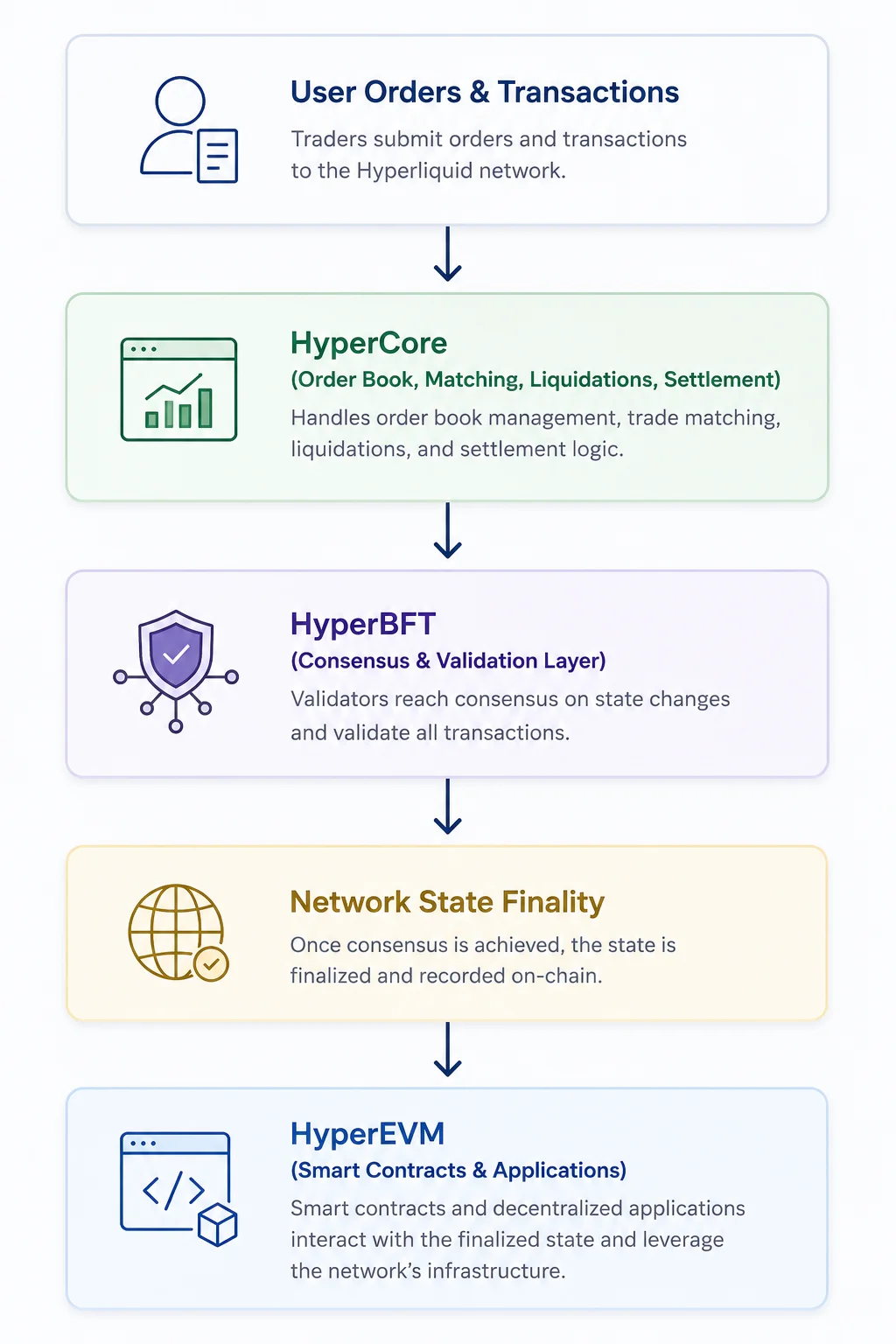
The following sections examine each layer in greater detail and explain how each contributes to Hyperliquid’s performance.
HyperBFT Explained: The Consensus Engine Powering Hyperliquid
High-performance trading requires more than an efficient order book. Behind every transaction, the network must quickly validate data, reach agreement among validators, and finalize state changes. This responsibility falls to HyperBFT (Hyperliquid – Byzantine Fault Tolerance), Hyperliquid’s custom consensus mechanism.
What Is HyperBFT?
HyperBFT is the consensus algorithm that ensures safety for the Hyperliquid network by ensuring that all validators agree on the state of the blockchain. This consensus layer was specifically designed for low-latency perpetual trading. In simple terms, HyperBFT can be described as the coordination mechanism that maintains synchronization of the network.
How HyperBFT Achieves Fast Finality
The key features of HyperBFT include fast transaction finalization. This provides traders with less room for uncertainty and enables the market to be recorded on the blockchain immediately. Hyperliquid Reports a 99th-percentile latency below 0.9 seconds, enabling traders to receive confirmation of their orders in well under a second.
Validator Communication and Consensus Flow
Every time a transaction is sent, the validators interact to ensure the transaction is legitimate and to determine the state transition it causes.
The process generally follows these steps
- Transaction submission
- Validator verification
- Consensus formation
- State update and finalization
According to Hyperliquid, the network currently supports over 21 permissionless validators selected through staking, providing a decentralized validation layer while preserving the fast finality required for perpetual trading.
Understanding HyperBFT gives you the foundation. The next piece of the puzzle is HyperCore—the real magic happens here which is responsible for matching and processing trades.
HyperCore Explained: The Engine Behind Hyperliquid’s On-Chain Order Book
If HyperBFT serves as the network’s consensus engine, HyperCore is where trading actually happens. It is the core execution layer responsible for processing orders, matching trades, managing positions, and maintaining the on-chain order book that powers Hyperliquid’s markets.
What Is HyperCore?
HyperCore is Hyperliquid’s own trading engine and a crucial element in the architecture of the platform. The operational mechanism that enables perpetual trading is executed through the use of the HyperCore trading engine. With all these functions provided within the protocol itself, Hyperliquid offers a streamlined trading process without heavy dependency on external systems.
Now, let us compare Hypercore with traditional order books in order to understand its usage.
|
Feature |
HyperCore |
Traditional Order Books |
| Infrastructure | Built directly into Hyperliquid’s blockchain | Typically operated by centralized exchanges on private servers |
| Transparency | Fully on-chain and publicly verifiable | Internal and not publicly auditable |
| Trade Execution | Executed through blockchain consensus | Executed by centralized matching engines |
| Custody | Users maintain control of assets | Exchanges hold user funds |
| Security Model | Secured by decentralized validators | Secured by the exchange’s infrastructure |
| Market Access | Permissionless and open to anyone | Requires exchange accounts and approvals |
| Failure Risk | No single point of failure | Vulnerable to server outages or exchange downtime |
How the Central Limit Order Book Works
Unlike AMM-based exchanges that rely on liquidity pools, HyperCore operates on the Central Limit Order Book (CLOB) mechanism. Orders for buying and selling are done at set prices. This is what enables the market to determine prices according to the forces of supply and demand.
This approach offers several advantages
- More precise price discovery
- Greater control over trade execution
- Reduced slippage in liquid markets
- Familiar trading mechanism for experienced traders
As all orders are maintained on-chain, the process remains transparent and verifiable.
Order Matching Architecture
When traders submit orders, HyperCore continuously evaluates the order book to identify matching buy and sell positions. Once compatible orders are found, the system executes the trade and updates the network state accordingly.
The matching process generally involves
- Order submission
- Order book placement
- Match detection
- Trade execution
- Settlement recording
This streamlined architecture helps maintain fast execution speeds even during periods of elevated market activity.
Margin and Liquidation Management
Perpetual futures trading depends heavily on effective risk management. HyperCore is responsible for monitoring collateral levels, margin requirements, and open positions across the network.
To maintain market stability, HyperCore automatically manages
- Margin calculations
- Position monitoring
- Risk assessments
- Liquidation processes
- Collateral updates
These mechanisms help reduce systemic risk while ensuring markets continue to function efficiently during volatile conditions.
Real-Time Trading at Scale
The system is designed to process large volumes of orders while maintaining low latency and consistent execution quality. Hyperliquid support for approximately 200,000 orders per second with a median order latency of around 0.2 seconds, helping deliver a trading experience that closely resembles centralized exchanges.
This capability enables Hyperliquid to deliver
- Fast order processing
- High throughput
- Low-latency execution
- Efficient market operations
- A CEX-like trading experience on-chain
So… The next question is, how does the ecosystem support developers and decentralized applications? The answer lies in HyperEVM.
HyperEVM Explained: Bringing Smart Contract Functionality to Hyperliquid
While HyperBFT and HyperCore form the foundation of Hyperliquid’s trading infrastructure, HyperEVM (Hyperliquid Ethereum Virtual Machine) expands the network beyond trading. It introduces smart contract functionality, enabling developers to build decentralized applications that can leverage Hyperliquid’s underlying liquidity and performance.
What Is HyperEVM?
HyperEVM is Hyperliquid’s Ethereum Virtual Machine-compatible execution environment. It allows developers to deploy Ethereum-style smart contracts while benefiting from the network’s native infrastructure. This compatibility lowers the barrier to entry for builders already familiar with the Ethereum ecosystem.
How HyperEVM Integrates With HyperCore
Unlike many blockchain ecosystems where trading infrastructure and smart contracts operate separately, HyperEVM is designed to work alongside HyperCore. This integration allows applications to interact more directly with Hyperliquid’s native trading environment. As a result, developers can build products that tap into the platform’s liquidity and execution capabilities.
Applications Built on HyperEVM
HyperEVM opens the door for a new generation of applications built around Hyperliquid’s infrastructure. According to Onekey reports, HyperEVM achieved over 700,000 deployed contracts with hundreds of protocols actively building on it.
By combining EVM compatibility with native access to Hyperliquid’s on-chain trading, developers can create applications without relying on fragmented infrastructure or additional bridging layers.
As adoption grows, HyperEVM can support a wide range of applications, including
- Decentralized finance (DeFi) protocols
- Automated trading and strategy platforms
- On-chain trading vaults
- Lending and borrowing applications
- Yield generation products
- Prediction markets
- Risk management solutions
- Analytics and data platforms
By introducing smart contract programmability while maintaining close integration with its trading infrastructure, HyperEVM positions Hyperliquid as more than just a perpetual exchange. It lays the foundation for a broader ecosystem of decentralized financial applications.
If you’re interested in knowing how Hyperliquid is built from the ground up, explore our detailed guide on How to Develop a Perpetual DEX Like Hyperliquid: Development Process, Features & Cost.
We’ve covered the architecture. Now let’s put it to work. It’s time to watch them in action and see what actually happens when a trader clicks “Buy” or “Sell.”
How a Trade Executes on Hyperliquid: Step-by-Step Workflow
A trader’s interaction with Hyperliquid may seem instantaneous, but every trade passes through a carefully orchestrated sequence of events behind the scenes. From order placement to final settlement, multiple components of the architecture work together to ensure speed, accuracy, and security.
Before going into the process, take a look at the illustration represented below in order to have a better understanding of the complete workflow,
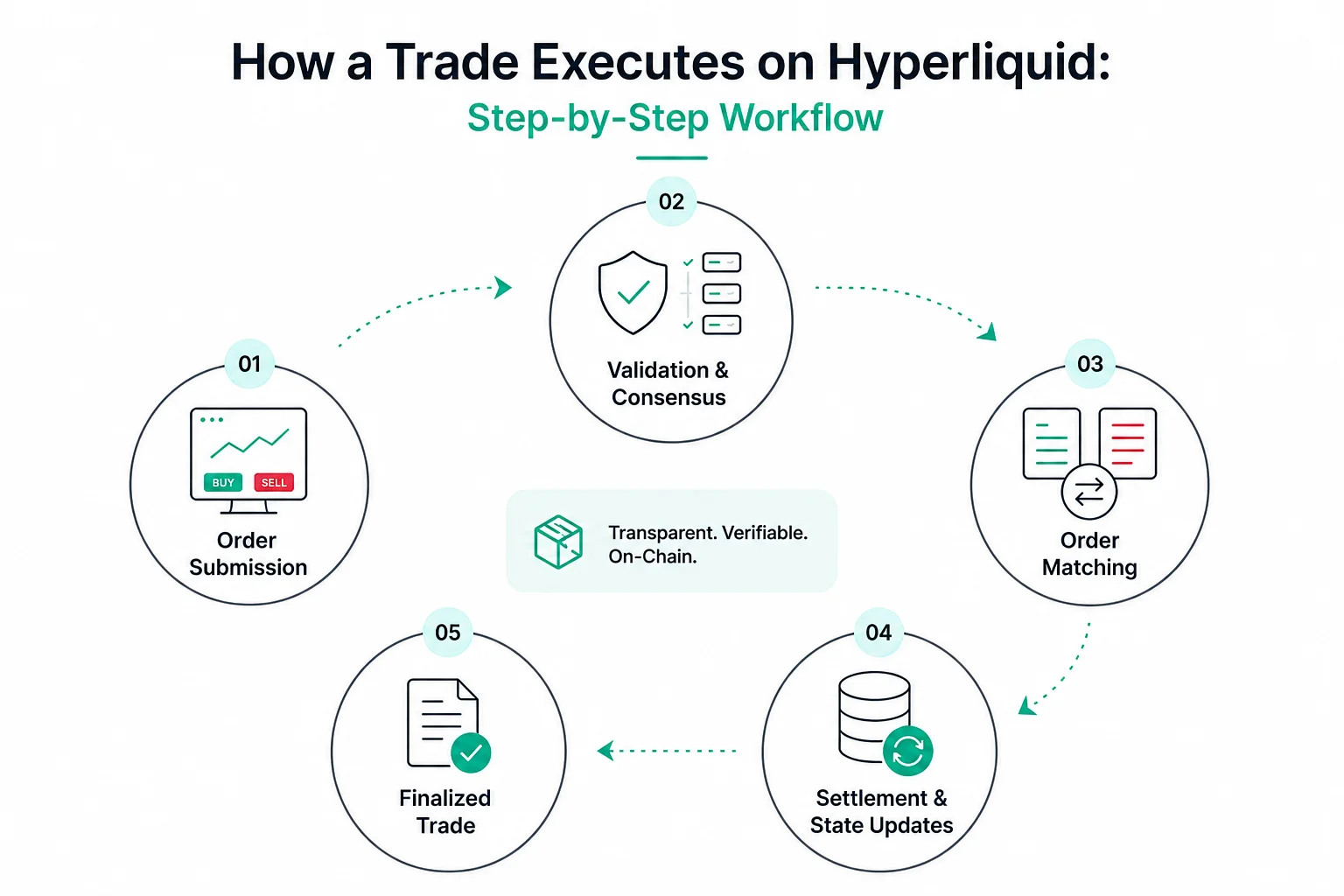
The workflow generally follows these steps:
- Order Submission – A trader places a buy or sell order through the Hyperliquid interface. The order is forwarded to the network for processing.
- Validation and Consensus – Validators verify the transaction, check account balances and margin requirements, and coordinate through HyperBFT to agree on the resulting state changes.
- Order Matching – HyperCore processes the order within the on-chain order book, identifies compatible buy and sell orders, and executes trades when matching conditions are met.
- Settlement and State Updates – Account balances, positions, and margin data are updated across the network, ensuring all validators maintain a consistent record of the new state.
- Finalized Trade – The completed transaction becomes part of the blockchain’s official state, providing a transparent and verifiable record of the trade.
Together, these five steps demonstrate how HyperBFT and HyperCore work in tandem to transform a simple order request into a finalized trade. This tightly integrated workflow is one of the key reasons Hyperliquid can deliver a fast and seamless trading experience while remaining fully on-chain.
Let us explore what the future of hyperliquid could look like…
Future of Hyperliquid DEX Architecture
Hyperliquid’s current architecture has already proven its ability to support high-performance trading. But the story doesn’t end here. As adoption grows and new use cases emerge, the network will need to evolve to meet the demands of a much larger ecosystem. Here is the future of Hyperliquid…
-
Ecosystem Expansion
As more applications, protocols, and users join the network, Hyperliquid’s architecture will serve as the foundation for a growing range of financial services beyond trading.
-
HyperEVM Adoption
One of the biggest areas to watch is HyperEVM. As developers become more familiar with the platform, we can expect to see new DeFi applications, trading tools, and financial products built directly on Hyperliquid in the future.
-
Infrastructure Improvements
No blockchain architecture remains static forever, and Hyperliquid is no exception. Future upgrades will likely focus on improving scalability and maintaining the low-latency performance that has become one of the platform’s defining strengths.
-
The Long-Term Vision for On-Chain Finance
The long-term vision is to create infrastructure capable of supporting a new generation of on-chain financial applications. If that vision continues to materialize, Hyperliquid could play an important role in shaping how decentralized finance evolves in the years ahead.
Key Takeaways from Hyperliquid Architecture
Hyperliquid’s performance isn’t the result of a single breakthrough feature. It comes from the way every piece of the architecture works together. Individually, each component is important. Together, they form the foundation of what makes Hyperliquid unique.
More importantly, this architecture reveals a much larger ambition. Hyperliquid isn’t just trying to build another perpetual DEX. It is attempting to create an ecosystem where high-performance trading, deep liquidity, and smart contract programmability exist within a single integrated network.
For businesses inspired by that model and looking to build a perpetual DEX of their own, having the right technical partner can make all the difference. An Experienced Decentralized Exchange Development Company like Coinsclone can help navigate the complexities of development and bring a high-performance trading platform to life.
Frequently Asked Questions
1. Can Hyperliquid’s Architecture Scale Beyond Perpetual Trading?
Yes. With the introduction of HyperEVM, the network can support a broader range of decentralized applications, including lending protocols, trading vaults, analytics platforms, and other DeFi products that can leverage Hyperliquid’s liquidity and infrastructure.
2. How Does Hyperliquid’s Shared-State Architecture Benefit Developers?
Hyperliquid’s shared-state design allows HyperCore and HyperEVM to operate within the same ecosystem. This reduces friction between trading infrastructure and smart contracts, enabling developers to build smoother applications.
3. How Are Cross-Chain Bridges Handled in Hyperliquid?
Hyperliquid operates on its own Layer 1 blockchain, so assets from other networks typically need to be transferred through supported cross-chain bridges. These bridges enable users to move funds into the Hyperliquid ecosystem while maintaining access to external liquidity.
4. How Decentralized Is the Hyperliquid Validator Network?
Hyperliquid operates as an independent Proof-of-Stake (PoS) Layer 1 blockchain secured by a network of permissionless validators. While anyone can participate in validation through staking, the network is designed to balance decentralization with the performance requirements of high-frequency trading.
5. How Has Hyperliquid’s Architecture Been Audited for Security Vulnerabilities?
Hyperliquid’s bridge architecture and core protocol components have been audited by security firms such as Zellic. The platform also operates a public bug bounty program, encouraging independent researchers to help strengthen network security.
See How Hyperliquid-Inspired Architecture Can Power Your DEX
Hyperliquid-Like DEX Development — built for performance.
- Advanced Trading Infrastructure: Launch a Hyperliquid-like perpetual exchange up to 90% faster.
- High-Speed Order Execution: Pre-integrated perpetual contracts, order book engine, liquidity modules, wallet connectivity, and risk management tools
- Custom Branding & Features:Your branding, trading pairs, leverage settings, fee structure, and governance model.
- Revenue-Driven Ecosystem: Earn through trading fees, liquidation fees, staking programs, liquidity incentives, and native token utilities.
Get a free consultation and explore how a Hyperliquid-inspired DEX can be tailored to your business requirements
Book a Free Demo to discover how our Hyperliquid Clone script can help you launch a high-performance perpetual DEX in just 8 -12 weeks.
References
1)Bitget News – Hyperliquid Fundamentals
2)Hyperliquid Docs – HyperCore Overview