
RWA tokenization platform development is the work of building the software that turns real assets, such as bonds, gold, funds or buildings, into tokens that people can buy, hold and trade on a blockchain. The market is no longer a test. Securitize listed on the New York Stock Exchange in July 2026, and Ondo’s tokenized stocks passed $1 billion in value in under eight months. As a result, more firms now want a platform of their own.
This guide is for founders, fintech teams and fund managers who plan to build one. It explains what the platform must do, how the parts fit together, which build route suits you, and what the work costs and how long it takes in 2026. It also covers the rules and the risks, with real cases of what worked and what failed.
In this guide:
- The parts: An RWA platform has an ID layer, a rules engine and a token contract on-chain, plus onboarding, custody and payouts off-chain.
- The standard: Most new platforms use ERC-3643, which checks each buyer’s ID before any token moves.
- The route: A white label build can go live in 4 to 6 weeks; a custom platform with a trading venue takes 6 to 9 months.
- The cost: Published 2026 estimates run from about $40,000 for an MVP to $250,000 or more for a full platform, before legal fees.
- The risks: Legal work, custody and thin trading sink more projects than code does, as the RealT case shows.
RWA Tokenization Platform Development
RWA tokenization platform development means building a blockchain platform that turns real-world assets into tokens. The platform lets users in many countries issue, buy, hold, trade and manage those tokens. Behind the scenes, it also checks who each buyer is, enforces the legal rules for each asset and pays out income to holders.
There are three common ways to build one: a custom platform built from scratch, a white label RWA platform that you brand as your own, or an RWA clone script based on a known platform. Some of the leading RWA platforms that show what works today are:
- Ondo Finance: The top issuer of on-chain US Treasury funds, and since 2025 a major home for token-based US stocks.
- Securitize: The platform behind BlackRock’s BUIDL fund. Securitize itself began trading on the New York Stock Exchange in July 2026.
- Maple Finance: An on-chain lender that said it held about $4.8 billion in assets in September 2026.
- Franklin Templeton (Benji): One of the first big fund firms to run a fund whose share register lives on public blockchains.
If you want the market picture first, such as what is on-chain today and who issues it, read our guide to real world asset tokenization. This page focuses on the build.
View the RWA Tokenization Platform Full Demo
See How Our MVP System Can Launch Your RWA Tokenization Platform Faster
RWA Tokenization Platform Development — done right.
- MVP System: Launch your Real-World Asset tokenization platform 90% faster.
- Asset Tokenization Modules: Integrated KYC/AML, smart contracts, and regulatory-ready architecture.
- Compliance & Security: Your platform, your asset classes, your tokenomics.
- Brand & Customization: Your platform, your asset classes, your marketplace.
- Revenue Engine: Earn from token issuance, trading fees, asset listings, and platform commissions.
See a free branded demo of your tokenization platform in 48 hours — before you invest a cent.
Book a Free Demo to discover how our RWA Tokenization Platform solution can take you from idea to live marketplace in just 3–5 weeks.
What Is an RWA Tokenization Platform and How Does It Work?
An RWA platform links a legal claim on a real asset to a token on a blockchain. It keeps that link honest with checks, contracts and audits. Each token can stand for a share of the asset or a right to the income it earns.
The platform works by moving an asset through a set path, from first review to payouts. Here is the usual process:
Asset Checks
The process starts by picking the real-world asset to tokenize and checking it. Real estate, bonds, gold, private equity and funds are common picks. The team checks who owns it, what it is worth and whether the law lets it be split into tokens.
Legal Structuring
Next, lawyers set up the legal link between the asset and the tokens. Most often a special purpose vehicle (SPV), fund or trust owns the asset, and the tokens are shares in that wrapper. This step gives token holders real legal rights, and it usually takes the longest.
Token Creation
Next, the team writes the smart contracts for the token and deploys them on the chosen blockchain. The contract sets who can hold the token, how it moves and what happens when a holder cashes out. For assets under securities law, it uses a permissioned standard, not a plain ERC-20.
Asset Token Issuance
The platform then sells the tokens to buyers in a first sale. Buyers first pass KYC and AML checks, and the platform links each approved wallet to their ID. Only then can they pay and receive tokens for their share of the asset.
Secondary Market Trading
Many platforms also run a secondary market, where holders can sell tokens to other approved buyers. This can make slow, hard-to-sell assets easier to trade. However, trading only works if there are enough buyers, so plan for that from day one.
Revenue Distribution
The asset earns income, such as rent from a building or interest from a bond. The payout contract splits that income among holders based on how many tokens each one owns. Payouts can arrive in stablecoins within minutes.
In short, the platform joins a legal frame with blockchain code, so it is easy to prove, move and pay out who owns what.
Core Architecture of an RWA Tokenization Platform
Every serious RWA platform has two halves. The on-chain half holds the token and its rules, so no transfer can break them. The off-chain half handles people, money and paperwork: sign-up, payments, reports and links to the custodian. Most build problems come from the seams between the two.
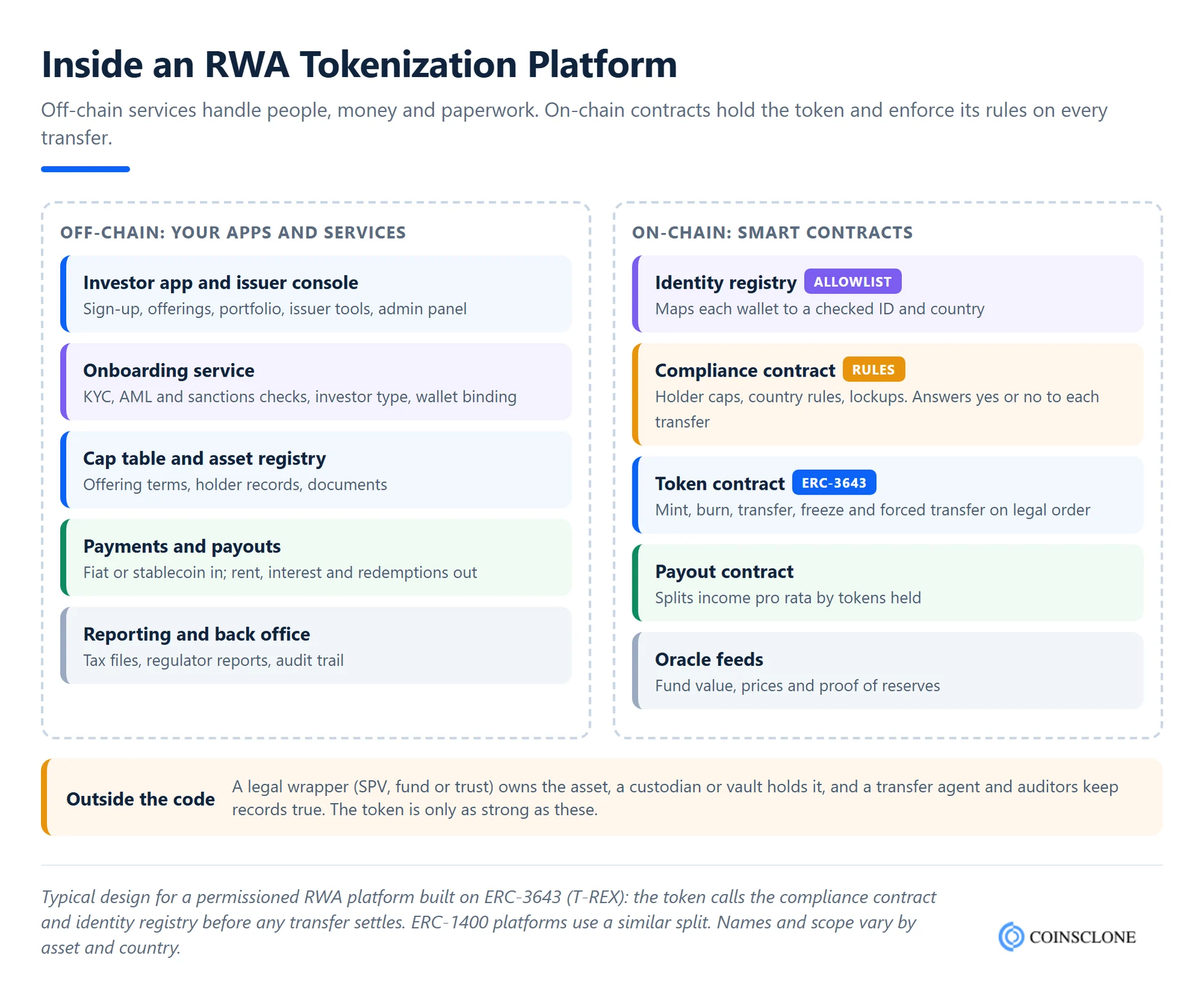
Here is what each core part does:
- ID registry: Links each wallet to a checked buyer ID and country. It is the on-chain allowlist.
- Compliance contract: Holds the sale rules, such as holder caps per country, lockups and buyer types. It says yes or no to each transfer.
- Token contract: Mints, burns and moves tokens. When a court or watchdog orders it, it can freeze or force-move them.
- Payout contract: Splits income and cash-outs across holders in stablecoins or other tokens.
- Oracles: Bring fund values, prices and proof of reserves on-chain, so the token stays matched to the asset.
- Off-chain services: KYC and AML checks, the cap table, payment rails, the issuer console and buyer reports.
Token Standards for RWA Platforms
Most RWA platforms now use a permissioned token standard. ERC-3643, also called T-REX, is final and widely used. Its ID registry and compliance contract check each wallet before any transfer goes through. ERC-1400 is an older family of security token standards, with tools such as split balances and linked legal files. ERC-7943, which became final in May 2026, sets a small shared base so RWA tokens can work in more apps. If you need a permissioned token, see our ERC-3643 token development service.
Types of RWA Tokenization Platforms
RWA platforms are built for one or more asset classes, based on your model and the buyers you serve. Here are the main types.
Real Estate Tokenization Platform
A real estate tokenization platform lets owners turn a building into tokens that people can trade. Each token stands for a share of the building, so many buyers can put money into one home or office. Rent is then paid out to holders. Note that real estate is still a small slice of on-chain assets, and it needs strong upkeep and a good manager behind it.
Commodity Token Platform
These platforms turn gold, silver, oil or farm goods into asset-backed tokens. Gold leads this group by far. Tether Gold and Paxos Gold alone had a combined market value of about $5.2 billion in early October 2026, per CoinGecko. Each token is backed by metal stored in a vault and checked by audits.
Debt Token Platform
Debt platforms turn bonds, loans and credit deals into tokens. Buyers earn fixed or floating interest, based on the debt behind the token. This is the largest RWA group today, led by tokenized Treasuries and private credit.
Art Tokenization Platform
An art tokenization platform lets costly art, rare items and luxury goods be split into tokens. Unlike most other models, the asset here earns no income, so value comes from price gains and a clean record of who owns each share.
Equity Token Platform
An equity platform lets firms issue their shares as blockchain tokens. Dividends, profit shares and voting rights can all be built into the token. In 2026 this is the fastest growing group. Ondo alone offers more than 260 token-based US stocks and ETFs.
Top Blockchain Networks for RWA Tokenization Platforms
Picking the right blockchain is a key step in RWA tokenization platform development. The chain shapes your safety, speed, fees and reach. It also decides which wallets, custodians and DeFi apps your token can work with. Here is where the value sat on 1 October 2026, based on RWA.xyz data:
- Ethereum: The most used chain for RWAs, with about $16.7 billion of the $38.55 billion total. It has the deepest set of tools, audits and token standards.
- BNB Chain: About $5.7 billion. It has low fees and full EVM support, so Ethereum tools work on it.
- Solana: About $4.3 billion. It is known for high speed and very low fees, and it hosts many token-based stock products.
- Stellar: About $3.4 billion. It hosts fund tokens such as Franklin Templeton’s Benji.
- Avalanche: About $1.8 billion. Its custom chains (L1s) let firms run their own closed network.
- Polygon: About $506 million. It is a low-fee EVM chain that teams often use for pilots.
Most issuers start on Ethereum or another EVM chain and add more chains later as buyers ask for them.
Key Features of the RWA Tokenization Platform
An RWA platform needs a full set of features to keep tokens safe and legal. The user side must be simple, while the admin side needs strong tools to run and watch the platform. Here are the core RWA tokenization platform features:
- Token engine: Turns real assets into blockchain tokens that stand for a share or a claim.
- Asset checks: Lists assets only after checks on title, value and legal status.
- Smart contract logic: Runs token sales, transfers and payouts through smart contracts.
- Fractional shares: Splits high-value assets into small token shares that more people can afford.
- Multi-asset support: Handles many asset classes, such as real estate, gold, bonds and private equity.
- Built-in wallets: Let users store, send and receive tokens through linked wallets, with recovery options.
- Secondary marketplace: Lets approved buyers buy, sell or trade tokens, which helps hard-to-sell assets move.
- Compliance tools: Enforce KYC, holder limits and country rules, and produce reports for watchdogs.
- Multi-chain support: Works across chains like Ethereum and Solana for reach and lower fees.
- APIs: Link to payment gateways, custodians, KYC firms and fund admins.
- Trade history: Keeps a full, tamper-proof record of each trade for audits.
Why Are Entrepreneurs Launching RWA Tokenization Platforms?
Founders now see clear proof that RWA platforms can grow. Real firms are posting real numbers. Let’s look at the main reasons.
Strong Buyer Interest
Buyers want more than plain stocks and bonds, and tokens let them get in with less money. The numbers back this up. Securitize had $4.3 billion in token assets at the end of June 2026 and $5.3 billion of transaction volume in that quarter, up 147% year on year, in its first earnings report as a public company.
DeFi Growth
RWA tokens are now used across DeFi to lend, borrow and back loans. T-bill fund tokens, for one, back stablecoins and trading accounts. This drives demand for platforms that issue tokens DeFi apps accept.
Global Reach
RWA platforms can reach buyers in many countries at once, within the rules of each market. Tokens also trade around the clock. Ondo Stocks passed $1 billion in total value in May 2026, less than eight months after launch. It serves approved buyers outside the US.
Key Benefits of Launching an RWA Platform
Beyond the market demand, an RWA platform helps a firm do more with less. Here are the main gains.
Enhanced Liquidity
The platform turns slow, hard-to-sell assets into tokens that can be bought and sold faster on blockchain markets. In turn, this helps the platform build a strong, active user base.
Growing Demand
Demand comes from both retail buyers and large funds. BlackRock, Franklin Templeton, Apollo and KKR all run token-based funds, which gives new platforms a ready market of products and buyers.
Revenue Streams
Like other Web3 firms, an RWA platform can earn from many sources. These include issue fees, trading fees, listing fees, custody fees and paid plans. We cover each one below.
Lower Running Costs
The platform cuts paperwork and admin work. Smart contracts handle cap tables, transfers and payouts, so fewer staff hours go into each deal.
How To Create an RWA Tokenization Platform in 2026?
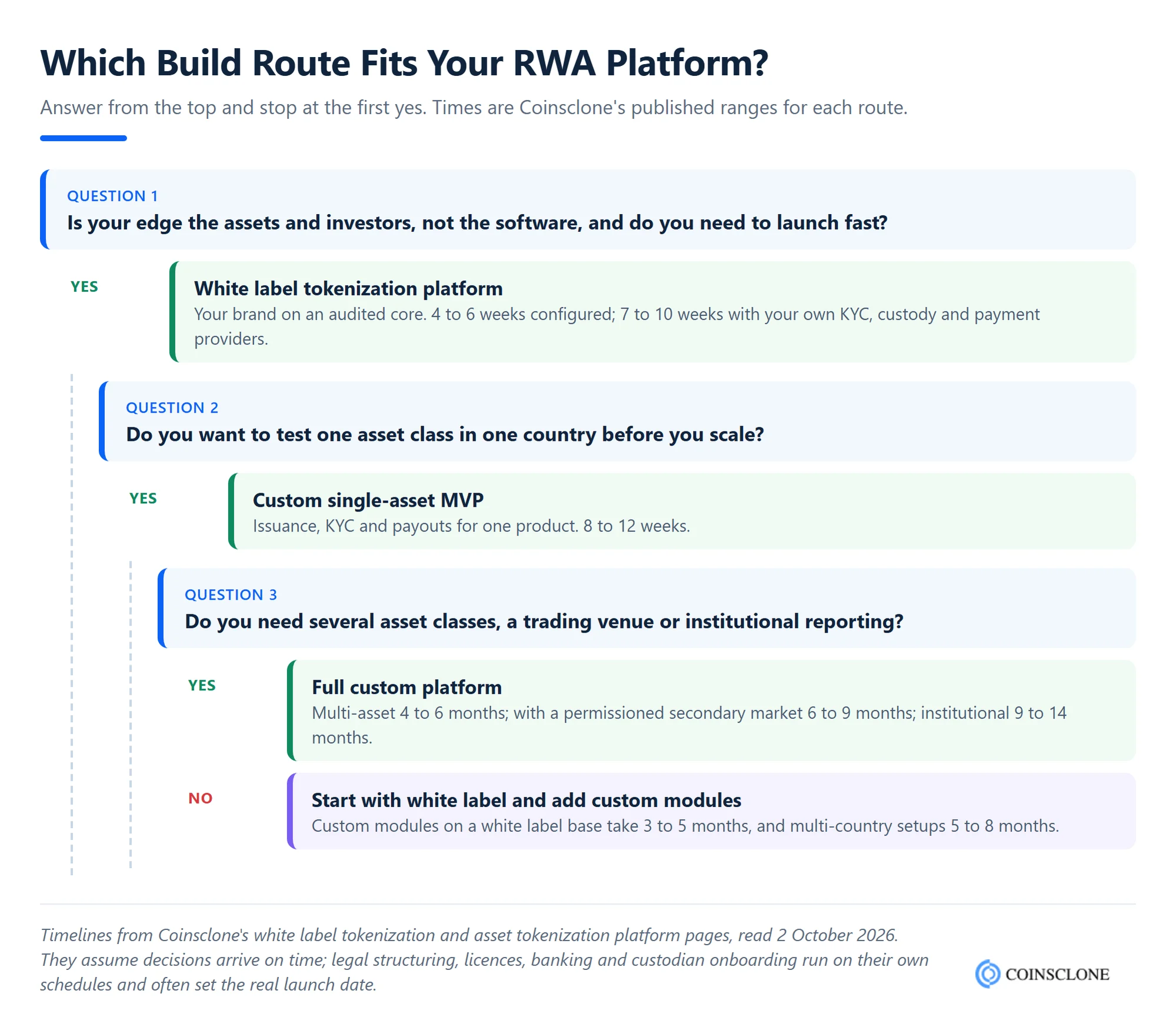
Creating an RWA tokenization platform means building safe systems that link legal, money and blockchain parts. Firms planning a full platform should first pick the build route that fits their goals, budget and launch date.
Launch an RWA Platform MVP
Launching an MVP, or minimum viable product, is a smart way to start without a large outlay. An MVP covers one asset class in one country, with core token sales, KYC and payouts. It lets you test your model, prove demand and hear from users before you scale.
Development From Scratch
Building from scratch means creating the whole platform from the ground up. This route gives you full control over design, features, safety and growth. You can shape each part to your needs, which suits big firms and complex, multi-asset products. However, it takes longer and costs more.
White Label RWA Platform
A white label RWA platform is ready-made, tested software that you brand and set up as your own. Because the core contracts and parts already exist and have been audited, you can launch in weeks rather than months, at a lower cost. The trade-off is less freedom over the base design.
RWA Tokenization Clone Script
An RWA clone script copies the core features and model of a known platform. For example, if you want a platform like Ondo Finance, an Ondo Finance clone script gives you the same core flows to start from. You can then add your own features and brand.
Whatever route you pick, work with a team that has built licensed platforms before. Coinsclone builds both: a white label tokenization platform that goes live in 4 to 6 weeks, and a fully custom asset tokenization platform for multi-asset and large-fund needs.
Step-by-Step Process to Build an RWA Tokenization Platform
Building an RWA platform follows a clear process that joins blockchain code, money flows and legal rules. Each stage matters, from choosing the asset to launching the market. Here are the steps.
Define the Asset Type
First, decide which real-world asset you will tokenize. Real estate, gold, bonds, funds and private equity are the most common. This choice shapes how you earn, who you sell to, the legal wrapper and the features you need.
Choose the Blockchain Infrastructure
Next, pick the blockchain. Look at fees, speed, safety and, above all, where your buyers and custodians already are. Ethereum, BNB Chain and Solana are common picks.
Design the Platform Architecture
Then design the platform’s parts: the buyer app, the issuer console, the admin panel and the smart contract set. The design must support token sales, buyer sign-up, payouts and trading. Map where each rule lives, on-chain or off-chain, at this stage.
Smart Contract Development
Developers then write the smart contracts in Solidity or Vyper for EVM chains, or Rust for Solana. These contracts run token sales, transfers and payouts, and they enforce the rules with no manual steps.
Add Compliance and Safety Checks
Next, plug in KYC and AML checks, sanctions screening and buyer checks. Add strong key control for the issuer and admin wallets, such as multisig or MPC. Together, these keep the platform legal and protect user data.
Testing and Audits
Test each flow before launch: sign-up, token sales, transfers, payouts and edge cases like frozen wallets. Then have the smart contracts audited by an outside firm. Keep watching the platform after launch so you can fix issues fast.
Launch the Platform
Finally, deploy the platform to the mainnet and open it to users. Bring on your first asset issuers, run the first sale and promote the platform to buyers.
A clear process helps you build a platform that is safe, legal and ready to grow.
How Much Does It Cost to Develop an RWA Tokenization Platform?
The cost to build an RWA tokenization platform is not fixed. It depends on the build route, the number of asset classes, the countries you serve, the chains you support and whether you run a trading market. Here are the ranges that build firms published in 2026:
| Platform scope | Typical cost range |
| White label, configured | From about $15,000 |
| MVP, one asset and one country | $40,000 to $70,000 |
| Production platform | $100,000 to $250,000 |
| Enterprise, multi-chain and multi-asset | $150,000 to $300,000 or more |
So where does the money go? The chart below breaks a custom build into its parts.
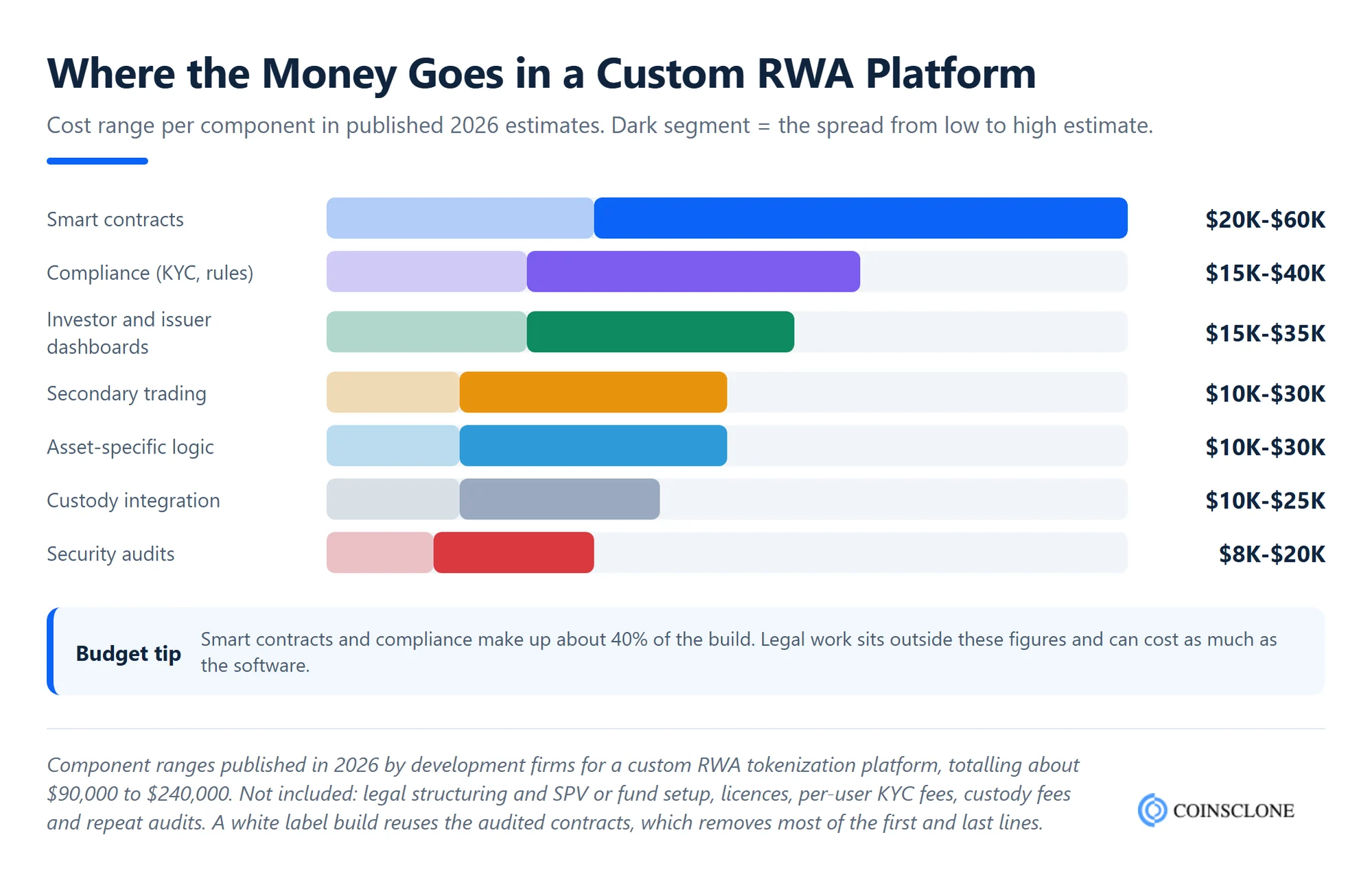
Also budget for costs outside the build. These include legal work and the SPV or fund setup, licences where needed, KYC checks per user, custody fees, oracle fees and repeat audits after each contract change. For many projects, legal work costs as much as the software. A white label platform cuts the build cost the most, because the audited core already exists.
How Long Does It Take to Develop an RWA Tokenization Platform?
Like cost, the timeline depends mostly on the build route and the scope. Coinsclone publishes its own timelines for each route:
| Build route and scope | Timeline |
| White label, configured deployment (one asset class) | 4 to 6 weeks |
| White label with your own KYC, custody and payment providers | 7 to 10 weeks |
| White label with custom modules | 3 to 5 months |
| Custom single-asset issuance platform | 8 to 12 weeks |
| Custom multi-asset platform | 4 to 6 months |
| Custom platform with a permissioned secondary market | 6 to 9 months |
| Institutional platform with full reporting | 9 to 14 months |
In practice, legal work and custodian sign-up often take longer than the code. Licences, banking and outside audits run on their own schedules, so start them early, alongside the build.
Regulations & Compliance to Ensure When Creating an RWA Tokenization Platform
Most RWA tokens count as securities, so the platform must follow the rules in each market it serves. Getting this right avoids legal risk and builds trust with buyers. Here are the key areas to cover:
- KYC and AML checks: Verify each user’s identity and screen for money laundering and sanctions before they can hold tokens.
- Securities law: Make sure each token follows the rules for securities in its market.
- Licences: Get the right licences from local watchdogs to issue, hold or trade token assets.
- Smart contract audits: Run regular safety and rules audits so the contracts meet industry standards.
The rules also moved in 2026. In the US, the SEC adopted an Innovation Exemption on 17 Sept 2026. It gives venues that trade token-based stocks on public blockchains a five-year exemption, with conditions. In the EU, MiCA covers crypto-assets but not token-based securities. Those fall under current securities law and the DLT Pilot Regime. Our team builds the rules into the platform, but your lawyers should set the licence route for each market.
Best Countries to Launch an RWA Tokenization Platform in 2026
Where you set up the platform shapes its long-term success. In 2026, a few countries offer clear rules, buyer safeguards and real support for tokens. Here are some of the top countries to launch an RWA tokenization platform.
- Singapore: The central bank (MAS) runs a clear licence system and leads Project Guardian, which tests token-based funds and bonds with major banks.
- Switzerland: Its DLT Act gives token-based securities legal standing and lets shares move on a blockchain.
- Germany: Its e-securities law (eWpG) lets firms issue bonds and fund shares as crypto securities. EU-wide, MiCA covers other crypto-assets and the DLT Pilot Regime covers trading venues.
- Hong Kong: It has set up licences for crypto platforms and runs pilots for token-based deposits, bonds and funds.
Challenges to Plan For Before You Launch
Tokens solve some problems, but they do not remove business risk. These are the issues that most often hurt RWA platforms:
- Thin trading: A token is only as easy to sell as its market. Without market makers or a cash-out path, holders may be stuck.
- Custody and title: The token is only as good as the legal claim behind it. Weak setups or poor asset care can wipe out value.
- Cross-border rules: Each country has its own laws, so one sale may need more than one legal setup.
- Smart contract risk: A bug in a contract that holds real money is costly. Audits and upgrade controls are a must.
- Buyer know-how: Permissioned tokens work in other ways than normal crypto, which confuses some buyers.
RealT is a clear warning. It was the best-known real estate token platform, with about 700 homes in Detroit. After the city sued over code breaches, a court put an outside fiduciary in charge of those homes in April 2026, as Michigan Public reported. Then, in July 2026, RealT announced the liquidation of its US structures. The tokens worked as designed. The asset management and legal setup did not.
Revenue Streams of RWA Tokenization Platforms
When planning an RWA platform, most founders ask the same thing: “How will the platform make money?” The good news is that RWA platforms have many ways to earn. Here they are.
Asset Tokenization Fees
Platforms charge asset owners and funds a fee to tokenize their assets. This covers asset checks, token creation and contract setup.
Transaction Fees
The platform collects a fee each time users buy, sell or transfer tokens. For a busy platform, this is a main revenue stream.
Listing Fees
Firms that want to list their token assets on the platform pay a listing fee, often a share of the amount raised, to get seen.
Secondary Market Trading Fees
If the platform runs a secondary market, it earns trading fees much like a crypto exchange.
Platform Subscription
Users who want extra tools, such as deeper charts, early access to new sales or portfolio tools, can pay for a monthly plan.
Custody and Wallet Service Fees
Platforms that hold token assets for users can charge for storage and safekeeping.
Fees on large volumes add up. Securitize, for example, earned $14.4 million in revenue in the second quarter of 2026.
Tech Stack for RWA Tokenization Platform Development
A strong RWA platform needs a solid tech stack: chains, smart contract languages, tools and code libraries. Here are the main parts.
Blockchain Networks
Ethereum, BNB Chain, Solana and Stellar are the main choices. They give the open, tamper-proof record that RWA tokens rely on.
Smart Contract Development
Smart contracts are written in Solidity or Vyper on EVM chains and in Rust on Solana. Clean, audited code keeps transfers, rules and payouts working as planned.
Backend Technologies
Backend tools like Node.js, Python or Java run the server side: APIs, payments, KYC flows and core logic.
Frontend Development
Modern frontend tools, such as React.js, Next.js or Vue.js, power clean, easy dashboards for buyers and issuers.
Databases
Databases like PostgreSQL, MongoDB or MySQL store user data, trade records and asset details safely.
Oracles and Data Feeds
Oracle networks such as Chainlink bring prices, fund values and proof of reserves on-chain. APIs link the platform to KYC firms, custodians and payment rails.
A well-planned tech stack helps you build a fast, solid RWA platform.
Why Coinsclone Is the Right Choice for RWA Tokenization Platform Development?
The right RWA tokenization platform development partner lays the base for your success. Coinsclone gives startups and firms the tech base, ready-made parts and launch support they need to go from idea to live platform.
We have built blockchain products since 2018 and delivered 350+ platforms for 200+ clients across 20 industries. Our team helps you enter the token asset market with a solid, compliant and future-ready platform. Partnering with Coinsclone helps you create an asset tokenization platform that stays ahead of your competitors.
We build on the leading chains, such as Ethereum, BNB Chain, Polygon and Solana, so you can choose the one that fits your plans. We also offer product advice, audits, upgrades after launch and 24/7 support to keep your platform running smoothly. We are engineers, not lawyers, so we work alongside your legal team, who set the licence route for each market.
RWA Tokenization Platform Development Services We Offer
At Coinsclone, we offer full RWA tokenization platform development services for startups, large firms, banks and funds. We build platforms that tokenize real estate, gold, bonds, funds and shares, and that scale as your volume grows.
Our team puts compliance, data safety and scale first. Each platform we ship has KYC and AML checks, built-in crypto wallets, smart contract payouts, payment gateway links and an asset dashboard. As a result, issuers can run their tokens with ease, and buyers get new ways to invest.
Ready-Made RWA Platform Solutions
Firms that want to enter the market fast can start from ready-made RWA platforms. These come with proven models and tested blockchain parts, which makes the build faster and smoother.
RWA Platform Like Securitize
A platform like Securitize puts the rules first. It gives issuers tools to issue and run token securities, with transfer agent records and buyer checks built in.
RWA Platform Like Maple Finance
Platforms based on Maple Finance bring DeFi lending to real-world credit. Lenders add stablecoins to a pool, and checked firms borrow against pledged assets, with interest paid back to the pool.
RWA Platform Like Ondo Finance
A platform like Ondo Finance tokenizes high-grade assets, such as T-bill funds and US stocks, and turns them into simple products. It bridges classic finance and DeFi.
Real Estate Token Platform
A real estate platform lets buyers own slices of rental homes and receive rent in tokens. Learn from RealT’s collapse: pair the token tech with strong upkeep, clean title and a legal wrapper that protects holders.
Frequently Asked Questions
How much does it cost to build an RWA tokenization platform?
Published 2026 estimates start at about $15,000 for a set-up white label platform and $40,000 to $70,000 for an MVP. A full platform runs $100,000 to $250,000, and large multi-chain builds can pass $300,000. Legal setup, licences, audits and custody are extra.
How long does it take to develop an RWA tokenization platform?
A white label platform can go live in 4 to 6 weeks, or 7 to 10 weeks with your own KYC, custody and payment providers. A custom single-asset platform takes 8 to 12 weeks, and a platform with a secondary market takes 6 to 9 months.
Is XRP a RWA?
No. XRP is the native coin of the XRP Ledger, and its value does not come from an off-chain asset. Still, the XRP Ledger is used to issue RWA tokens. It held about $499 million of real-world assets on 1 Oct 2026, per RWA.xyz.
What are the top RWA platforms?
For on-chain T-bill funds, the top platforms in October 2026 were Ondo, Franklin Templeton’s Benji, Circle, Securitize and WisdomTree, per RWA.xyz. Maple Finance is a leader in on-chain private credit, and Ondo leads token-based stocks.
What are the top 10 tokenization companies?
Leading names include Securitize, Ondo Finance, Franklin Templeton, Circle, WisdomTree, BlackRock (through Securitize), Maple Finance, Centrifuge, Paxos and Tether for gold tokens. The right partner for you depends on whether you need an issuer, a platform licence or custom software.
Which blockchain is best for RWA tokenization?
Ethereum holds the most RWA value, at about $16.7 billion in October 2026, and has the most mature tools and standards such as ERC-3643. BNB Chain, Solana and Stellar are also strong choices. Pick the chain your buyers and custodians already use.
Is RWA tokenization legal?
Yes, in many countries, but most RWA tokens are treated as securities. You need the right legal wrapper, buyer checks and, often, a licence in each market you serve. Rules vary by country, so get local legal advice before launch.
Conclusion
RWA tokenization is changing how real-world assets are owned, run and traded. Firms like Securitize and Ondo have shown the model can scale, while failures like RealT show that the legal and asset side must be just as strong as the code. To launch your own RWA tokenization platform, you need a tech partner that has built licensed platforms before.
At Coinsclone, we build custom and white label RWA platforms that you can launch fast and grow with confidence. If you need tech help, contact our team anytime and start your build with a clear plan.
See How Our MVP System Can Launch Your RWA Tokenization Platform Faster
RWA Tokenization Platform Development — done right.
- MVP System: Launch your Real-World Asset tokenization platform 90% faster.
- Asset Tokenization Modules: Integrated KYC/AML, smart contracts, and regulatory-ready architecture.
- Compliance & Security: Your platform, your asset classes, your tokenomics.
- Brand & Customization: Your platform, your asset classes, your marketplace.
- Revenue Engine: Earn from token issuance, trading fees, asset listings, and platform commissions.
See a free branded demo of your tokenization platform in 48 hours — before you invest a cent.
Book a Free Demo to discover how our RWA Tokenization Platform solution can take you from idea to live marketplace in just 3–5 weeks.