

A Balancer clone script is ready-made software for launching your own DEX with pools that hold many tokens in custom weights, the idea Balancer made famous. While most DEXs stuck to 50/50 pools, Balancer let a pool hold up to eight tokens in any mix, such as 80/20 or 60/20/20. That one idea still powers voting-token pools, index-style baskets and fair token launches today.
There is also big news you need before you build. Balancer’s own token holders voted on 29 September 2026 to close it down. From 30 October 2026, its pools only allow withdrawals. So this guide covers what happened, what still works in the weighted-pool model, and how to launch a safer version of it under your own brand.
In this guide:
- Balancer’s real status in October 2026: the wind-down vote, the key dates and what happens to the code.
- A worked example of how 80/20 pools cut impermanent loss, and what they cost traders.
- The lessons from the November 2025 v2 exploit that every clone must build in.
- Features, add-ons, revenue streams, build steps and tech stack.
- What drives the cost, and how long a launch takes.
See How Our MVP System Can Launch Your AMM DEX Faster
Balancer Clone Script — Advanced DeFi DEX Development Done Right
- MVP System: Launch your Balancer-like DEX up to 90% faster with a proven AMM framework.
- Multi-Token Liquidity Pools: Pre-built AMM engine supporting weighted pools and ERC-20 tokens — no complex development required.
- Brand & Customization: Your design, your pools, your governance model.
- Revenue Engine: Earn through swap fees, liquidity incentives, and protocol fees.
Get a free branded demo of your Balancer-like DEX in just 48 hours — before you invest a cent.
Book a free call to discover how our Balancer Clone Script can take you from concept to a live, Ethereum-compatible AMM DEX in just 8–12 weeks.
What Is a Balancer Clone Script?
A Balancer clone script is a ready-made, fully custom software package for launching a decentralized exchange (DEX) like Balancer. With it, you run your own automated market maker (AMM) that supports pools of many tokens with custom weights. You can deploy it on Ethereum and other EVM-compatible chains such as Arbitrum, Base, Polygon or BNB Chain.
The script gives you a pre-built DeFi framework with the core parts already in place. From weighted pools to voting controls, everything is built in and ready to brand. It supports ERC-20 tokens, so any standard token can join a pool. As a result, you keep full control over fees, pools and voting rules, without writing an AMM from scratch.
Before going further, though, you should know where the original stands today.
Balancer in 2026: Wind-Down Approved, Pools Withdrawal-Only From 30 October
Balancer is closing. On 14 September 2026, BIP-928 went up on Balancer’s forum. It asked to wind the project down and pay the treasury out to BAL holders. The vote closed on 29 September 2026, and it passed with about 17.1 million BAL in favour and only about 140,000 against, per the Snapshot vote record.
Here is what the approved plan says will happen:
- 30 October 2026: Pools that can be paused move to withdrawals only. Pools that cannot be paused keep running, with the protocol fee set to zero where the contracts allow it.
- 30 November 2026: v3 pools that partners asked to keep open for migration close, and the v3 Vault is paused.
- From 1 November 2026: Support shrinks to a simple withdrawal page and public docs.
- End of May 2027: The first treasury payout to BAL holders opens. The plan valued the treasury at $9 million or more when it was posted.
Why did it come to this? The proposal says most revenue still came from the older v2 pools, and v3 never grew enough to replace it. The November 2025 exploit of v2 pools also hurt trust. On DefiLlama, Balancer’s locked value fell from about $768 million on 1 November 2025 to about $44 million on 15 October 2026. Even so, it still handled about $18 billion of trades in the 12 months to mid-October 2026.
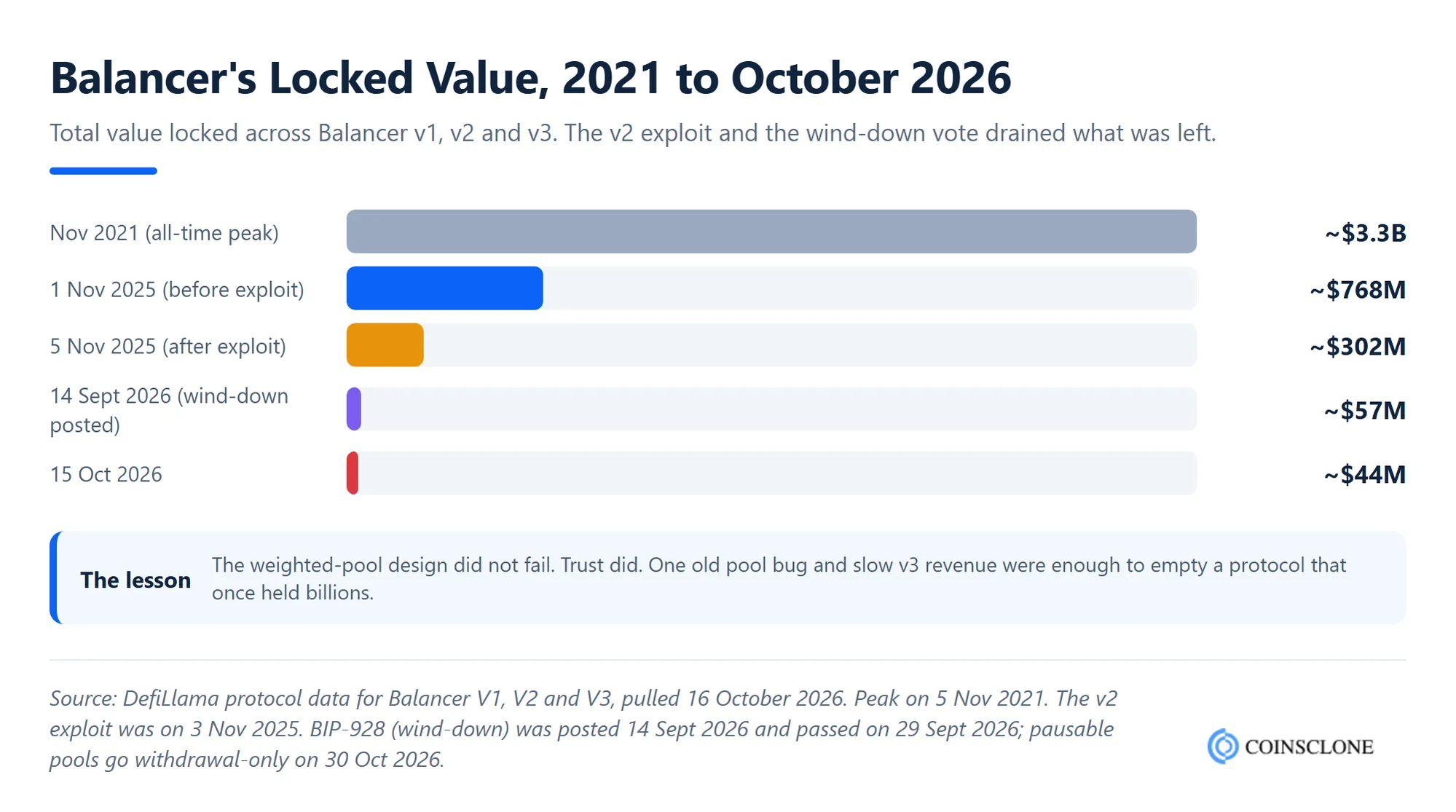
One more detail matters for builders. On 13 October 2026, BAL holders also backed BIP-932, which blesses a separate, formal fork of the code by a team called MAXYZ. That fork must use its own name and logo, and no Balancer trademarks pass to it.
So is a clone still worth building? Yes, if you copy the right thing. The business closed, but its pool design did not fail. Weighted pools, 80/20 voting pools and launch pools are still useful, and BAL holders have just approved a formal fork of the code. Your clone should keep that model, fix what went wrong, and run on a leaner cost base.
How Balancer’s Weighted Pools Work
Most AMMs, like Uniswap v2, hold two tokens at a fixed 50/50 value split. Balancer changed that rule. Each token in a pool gets a weight, and the weights add up to 100%. The pool keeps a simple product of balances raised to their weights constant, so prices move to keep each token’s share of value at its weight.
According to Balancer’s v3 docs, a weighted pool can hold up to 8 tokens, each token needs at least a 1% weight, and swap fees can be set from 0.001% to 10%. A single swap cannot take more than 30% of a token’s balance, which protects the pool from extreme trades.
Why does the weight matter? Because it changes who carries the risk. With a heavier weight on one token, its holders lose less to impermanent loss when its price moves. However, the light side of the pool gets thin, so traders pay more slippage. Here is the trade-off in real numbers:
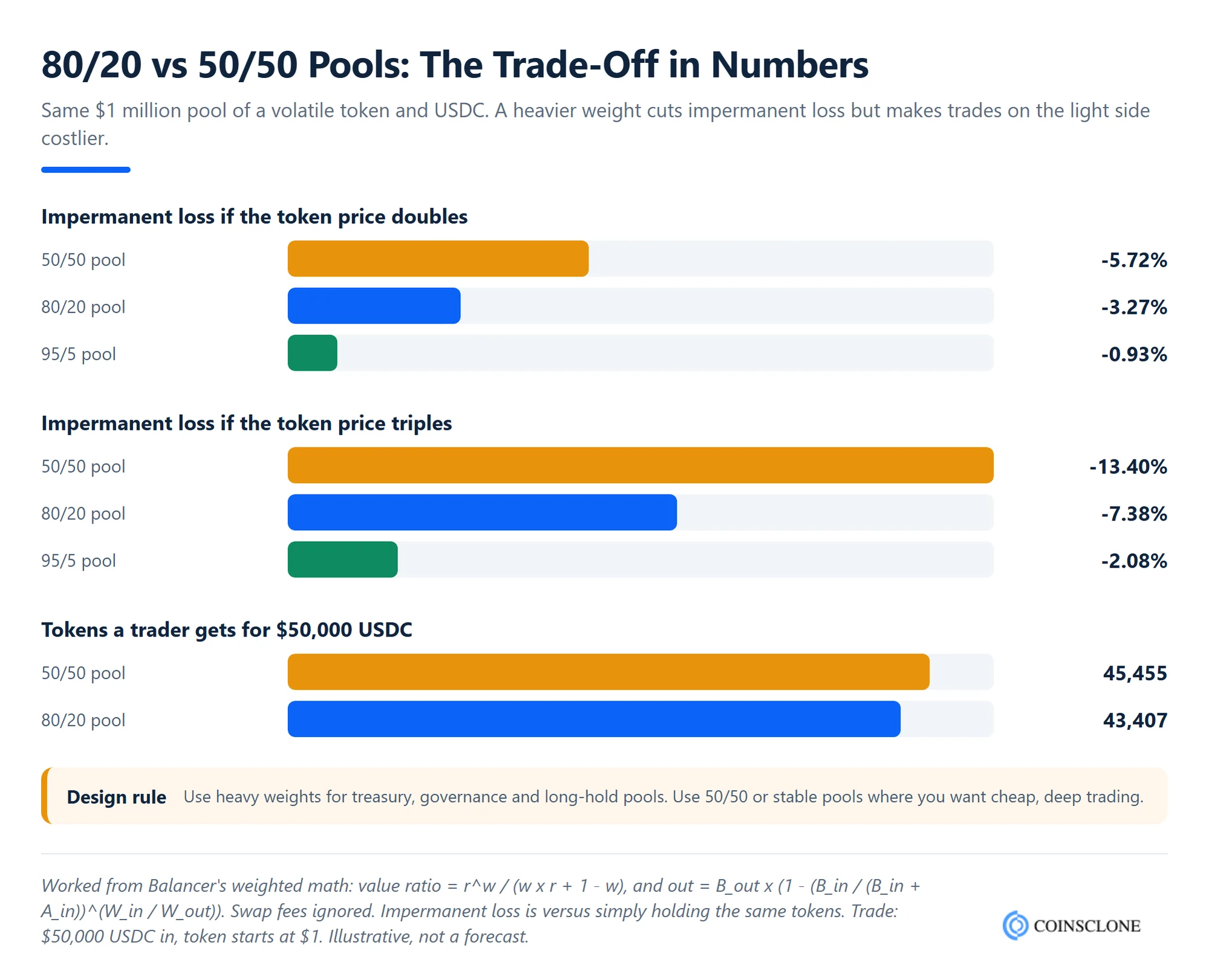
In short, if a token doubles in price, a 50/50 pool loses 5.72% against simply holding. An 80/20 pool loses only 3.27%. On the other hand, a trader putting $50,000 USDC into the 80/20 pool gets about 2,000 fewer tokens. That is why projects use 80/20 pools for their own token and keep trading pairs at 50/50.
What Still Works in the Weighted-Pool Model in 2026
The shutdown does not erase the demand for these pool types. These are the use cases that still make sense for a new DEX:
- 80/20 governance pools: A project pairs its token 80/20 with ETH or a stablecoin. Holders keep most of their exposure and still earn fees. Even veBAL, the original’s voting system, was built on an 80/20 BAL/WETH pool.
- Index-style baskets: A pool with 3 to 8 tokens works like a self-rebalancing portfolio. Instead of paying a fund manager, holders let traders rebalance the pool, and those traders pay fees for the privilege.
- Liquidity bootstrapping pools (LBPs): Weights shift over time, for example from 90/10 to 50/50, so the token price starts high and drifts down. This makes it harder for bots to buy a whole launch in the first block. It is a natural fit next to a crypto launchpad.
- Treasury pools: DAOs place treasury funds in weighted pools to earn fees while keeping a target mix.
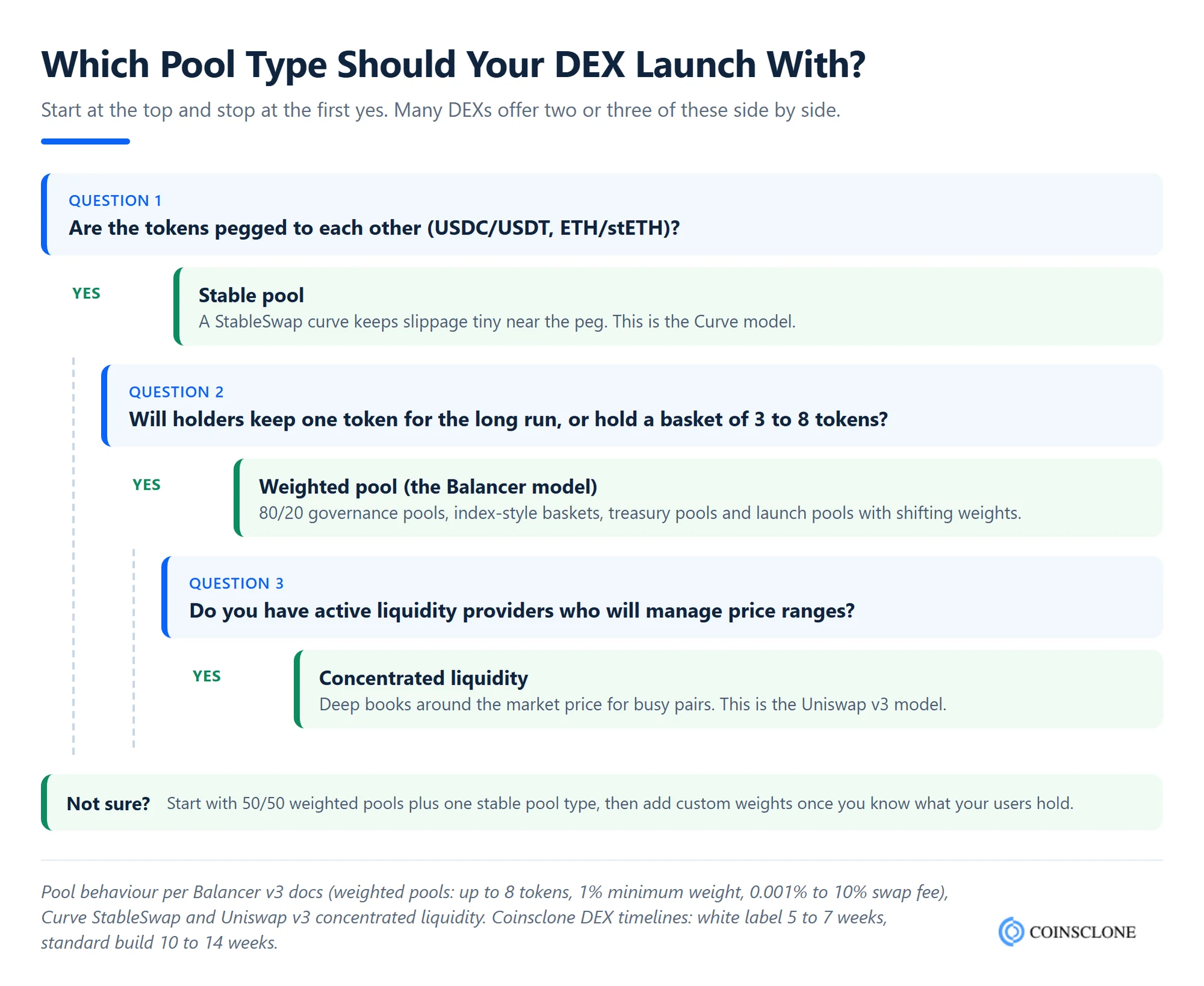
- Mixed pool menus: Many DEXs now combine weighted pools with stable pools and concentrated liquidity, so each pair gets the right curve.
Not every DEX needs weighted pools, so pick your pool types first:
Why Should You Develop a DeFi Exchange like Balancer?
This kind of exchange gives you flexible control of pool funds. Simple DEXs rely on two-token pools. A weighted-pool DEX lets each pool hold more tokens in any mix. Here is why the model is still a sound business:
- Open niche: With Balancer closing, projects that rely on 80/20 pools, LBPs and multi-token baskets need a new home. A focused weighted-pool DEX can take that demand.
- Easy to plug in: Weighted pools connect well with lending markets, yield vaults, aggregators and cross-chain bridges. This suits DEXs that run on many chains.
- Many income streams: Swap fees, pool creation fees, protocol fees and token rewards all add income.
- Broad audience: The model serves traders, pool providers, DAOs, token launch teams and funds alike.
Building this kind of exchange can be a strong move. But why choose a clone script over other methods?
Why DeFi Startups Should Choose the Balancer Clone Script Over Other Methods?
For DeFi startups that want to launch quickly and safely, a clone script is a smarter path. Here is why:
- Faster launch: A clone script lets you enter the market quickly without cutting corners on quality.
- Tested base: The script is pre-built and tested, so you skip long build cycles.
- Lower cost: It is a cost-effective way to launch a feature-rich DeFi exchange.
- Stand-out features: Custom pool weights and multi-token pools help you stand out in a crowded DEX market.
- Your own brand: A clone script is not a plain copy. You can customize it and add branding to match your business goals.
Now, let’s look at what comes with the software.
Key Features of Our Balancer Clone Script
Our solution comes packed with the tools both users and admins need.
User Features
- Multi-Asset Liquidity Pools
- Automated Market Maker Trading
- Custom Pool Creation & Management
- Liquidity Provider Rewards
- Portfolio Rebalancing
- Token Swap Interface
- Governance Participation
- Wallet Integration
Admin Features
- Liquidity Pool Control Panel
- Fee Configuration Management
- Governance Management
- Protocol Treasury Management
- Smart Contract Monitoring
- User Activity & Analytics Dashboard
- Security & Access Controls
- Upgrade & Maintenance Support
With these core features, users get one smooth place to trade. To make it more distinct, Coinsclone offers some add-on features as well.
Add-On Integrations of Our Balancer Clone Software
Customizable Pool Weights
Unlike fixed AMM models, our clone lets pool creators set custom token weights, from 50/50 to 80/20 or multi-token mixes. You can set limits on which weights and tokens are allowed.
Automated Rebalancing
Weighted pools rebalance themselves. Every trade pushes the pool back toward its target mix, so a pool works like a self-balancing crypto index. This draws in traders and strategists who want smarter portfolio tools.
Lower Impermanent Loss for Heavy-Weight Pools
Pools with a heavy weight on one token reduce impermanent loss for that token’s holders, as the worked example above shows. This gives pool providers better risk control and makes your DEX more appealing to long-term holders and token teams.
Liquidity Bootstrapping Pools
Add pools whose weights shift on a schedule for fair token launches. This module pairs well with a launchpad and brings in new projects.
Cross-Chain Asset Swapping
This lets users swap tokens across different blockchains. It turns your platform into a modern cross-chain dex.
Advanced Analytics
Give users and admins clear views of pool results, trading volume, where funds sit and returns.
Yield Farming & Liquidity Incentives
Add more reward programs to bring in deposits. This add-on helps you keep funds in your pools for the long term.
DAO & Advanced Governance Modules
Go beyond basic voting with auto-run proposals, quorum rules, vote delegation and multi-sig sign-off. With these tools, you can run a mature DAO.
With all these features in mind, let’s see how they work together.
Working Mechanism of Our Balancer Clone
Our clone runs on an automated market maker (AMM) model. Here is how a pool goes from setup to trading.
Step 1: Liquidity Pool Creation
Users or firms create liquidity pools by putting several ERC-20 tokens into a smart contract. These pools can hold multiple assets with custom weights.
Step 2: Smart Contract Pool Configuration
Smart contracts set each pool’s token weights, swap fee and rules. Once set, these rules run on their own, so every trade follows the same open logic.
Step 3: Pricing Each Trade
When a user starts a swap, the AMM sets the price from the pool balances and their weights. The price of one token in terms of another is its balance divided by its weight, compared with the other token’s balance divided by its weight.
Step 4: Token Swaps
Traders swap tokens directly through the pools. Each trade pays a swap fee, which is split between pool providers and the platform.
Step 5: The Pool Rebalances Itself
As trades happen, the pool’s token amounts shift, and arbitrage traders keep pushing prices back in line with the market. As a result, the pool stays close to its target weights.
Step 6: Rewards for Pool Providers
Providers get pool tokens that show their share of the pool. These tokens earn them fees and rewards, which encourages long-term participation.
Step 7: DAO Voting and Control
A DAO runs the platform. Token holders vote on upgrades, fee changes and key choices.
Ready to launch your own AMM-powered DEX today? Get started with our fully customizable Balancer clone script!
Cost-effective | White-Label Solution | Premium Features | Live Demo Available
Security Lessons From the Balancer v2 Exploit
On 3 November 2025, an attacker drained one type of Balancer v2 stable pool on many chains. Balancer’s own post-mortem put the theft of user funds at about $94.8 million. The cause was a rounding error: the pool code rounded amounts in the wrong direction, and the attacker repeated tiny gains many times inside batch swaps.
Forks suffered too. Projects that had copied the same pool code on other chains were hit the same day. The OpenZeppelin analysis of the exploit put the combined loss across Balancer and its forks above $120 million. The faulty code dated back to 2021, which shows that years of use do not prove code is safe.
For a clone, these are the lessons to build in:
- Do not copy pool code blindly: Every pool type you ship needs its own review, including rounding in every math path.
- Audit the whole system: Audit the vault, every pool type, routers and the frontend, not only the token. Published 2026 audit price guides put a simple token audit at roughly $5,000 to $15,000, with complex DeFi systems costing far more.
- Keep pause and recovery tools: Balancer could pause newer pools within minutes, while older ones stayed exposed. Build pause windows and a recovery mode that always lets users withdraw.
- Limit trade sizes and watch in real time: Use swap caps, invariant checks and on-chain monitoring with alerts.
- Run a bug bounty: Pay outside researchers to find bugs before attackers do.
Our smart contract development services team builds these checks into the pool contracts from day one.
Can You Fork Balancer’s Code? The Licence Question
Yes, with conditions. Balancer’s v3 contracts repository and its v2 repository are published under the GPL-3.0 licence. GPL-3.0 allows you to use, change and deploy the code, but if you share a changed version, you must share your source code under the same licence. Since smart contract code is public on chain anyway, most DEXs accept this.
However, the licence covers code only. You cannot use the Balancer name, logo or brand, and BIP-932 confirmed that even the DAO-approved fork must trade under a new name. A clone script gives you a third option: a fresh, branded codebase built on the same weighted-pool math, with the known bugs designed out.
Extra Options With Our Balancer Clone Script
Our script comes with extra options that help you launch faster and stand out.
White Label Balancer Clone Software
Our white label software is a ready-to-launch base for your own exchange. You enter the market with your own branded platform, including the UI, smart contracts, dashboards and voting tools. You can customize the logo, color theme and domain to match your goals. This approach cuts build time and cost while you keep full ownership and control of the platform.
Balancer Clone App
The clone app is a ready-made base for launching a decentralized exchange on iOS and Android. It gives users a smooth and secure way to manage DeFi trades from their phones, with the same pools and rewards as the web platform.
Business Gains From Our Balancer Clone
Launching our clone script brings these gains:
- Faster Revenue Generation
- Puts you ahead of slower rivals
- Multiple Monetization Opportunities
- Scalable Business Expansion
- Reduced Manual Intervention
- Flexible, Modern Pool Design
How a Balancer Clone Makes Money
The software comes with several built-in ways to earn. This lets you earn steady income while trading stays open and on chain.
- Swap Transaction Fees: Each swap pays a fee, which creates a steady revenue stream. Balancer earned about $6.7 million in total fees on about $18 billion of volume in the 12 months to October 2026, per DefiLlama, so plan for fees near a few basis points of volume.
- Liquidity Pool Creation Fees: You can charge a fee to create custom pools. Advanced users will pay for tailored setups.
- Protocol Fee Sharing: A share of pool fees can go to the protocol treasury. The platform then earns from every active pool without hurting LP rewards.
- Governance Token Utility: With a native governance token, demand can grow as usage grows. This adds indirect income and long-term value.
- Launch Services: Charge projects for running liquidity bootstrapping pools on your platform.
- Premium Features: Offer advanced analytics or tools on a subscription plan.
- Partner Deals: Your clone can earn through deals with lending apps, yield vaults and other DeFi projects.
How to Build a DEX Like Balancer: Step by Step
Here is the path from idea to launch:
- Pick your pools: Decide which pool types you need (weighted, stable, LBP) and the weight limits you allow.
- Choose your chains: Start where your users and their funds already are, then expand.
- Design your tokenomics: Set swap fees, the protocol share and any governance or reward token.
- Customize the script: Brand the UI, configure contracts and connect wallets.
- Test hard: Run unit, fuzz and invariant tests, then a public testnet.
- Audit: Get at least one independent audit, and fix every finding before launch.
- Seed liquidity: Line up market makers or partner projects for the first pools.
- Launch and monitor: Go live with pause tools, alerts and a bug bounty in place.
Tech Stack for a Balancer Clone
| Layer | Common choices |
| Smart contracts | Solidity, with Foundry or Hardhat for testing |
| Chains | Ethereum, Arbitrum, Base, Polygon, BNB Chain and other EVM chains |
| Frontend | React or Next.js with wagmi and viem |
| Wallets | MetaMask, WalletConnect, Rabby and other EVM wallets |
| Data | Subgraph or custom indexer for pools, prices and volume |
| Pricing and safety | Chainlink price feeds, on-chain monitoring and alerts |
How Much Does It Cost to Build a Balancer Clone?
The cost of a clone depends on scope, so a fixed public price would mislead you. These are the main cost drivers:
- Pool types: Weighted pools alone cost less than weighted, stable and LBP pools together.
- Chains: Each extra chain adds deployment, testing and monitoring work.
- Tokenomics and governance: A plain swap DEX costs less than one with a reward token, vote-locking and a DAO.
- Audit: As noted above, complex DeFi audits cost far more than simple token audits, and multi-pool systems need deep review.
- Mobile apps and design: Native iOS and Android apps and custom UI add to the budget.
- Liquidity: Seed liquidity and launch rewards often cost more than the software itself.
As for time, Coinsclone’s DEX timelines are 5 to 7 weeks for a white label build and 10 to 14 weeks for a standard build. Share your plan with our team for a fixed quote.
Why Choosing Coinsclone’s Balancer Clone Script is the smartest choice?
Coinsclone is a leading decentralized exchange development company that has been building since 2018. We have delivered 350+ platforms for 200+ clients across 20 industries. Our team has hands-on DEX and AMM work behind it. We built this script for firms that want long-term growth without needless risk.
We offer clear, predictable pricing with no hidden costs. With a streamlined process, we help you launch your DEX ahead of competitors. If you want other AMM models too, see our DeFi exchange clone script, Uniswap clone script and Curve Finance clone script.
Frequently Asked Questions
What is a Balancer clone script?
It is ready-made software for launching a DEX with Balancer-style weighted pools. Pools can hold up to eight tokens in any weight mix, and you run it under your own brand, fees and rules.
Is Balancer shutting down?
Yes. BAL holders approved the BIP-928 wind-down on 29 September 2026. Pools that can be paused allow only withdrawals from 30 October 2026. Partner v3 pools close on 30 November 2026. The treasury will be paid out to BAL holders from the end of May 2027. Users can still withdraw directly from the contracts.
Why launch a DeFi exchange like Balancer if Balancer is closing?
Balancer is closing because v3 revenue did not grow enough and the 2025 exploit hurt trust, not because weighted pools stopped working. Projects still need 80/20 pools, token baskets and fair-launch pools, and a lean new DEX can serve them.
How does a Balancer clone work?
Users deposit tokens into pools with set weights. The AMM prices each trade from the pool’s balances and weights, charges a swap fee and shares it with pool providers and the platform. A DAO or admin team manages fees and upgrades.
What technologies are used in Balancer clone development?
Most builds use Solidity smart contracts on EVM chains and Foundry or Hardhat for tests. The web app runs on React or Next.js with wallet links. A subgraph tracks pool data, and price feeds plus alerts keep it safe.
How long does it take to launch a Balancer-like DEX?
With Coinsclone, a white label DEX takes 5 to 7 weeks and a standard build takes 10 to 14 weeks. Extra chains, mobile apps and a full audit can add time.
See How Our MVP System Can Launch Your AMM DEX Faster
Balancer Clone Script — Advanced DeFi DEX Development Done Right
- MVP System: Launch your Balancer-like DEX up to 90% faster with a proven AMM framework.
- Multi-Token Liquidity Pools: Pre-built AMM engine supporting weighted pools and ERC-20 tokens — no complex development required.
- Brand & Customization: Your design, your pools, your governance model.
- Revenue Engine: Earn through swap fees, liquidity incentives, and protocol fees.
Get a free branded demo of your Balancer-like DEX in just 48 hours — before you invest a cent.
Book a free call to discover how our Balancer Clone Script can take you from concept to a live, Ethereum-compatible AMM DEX in just 8–12 weeks.