
A ParaSwap clone script is ready-made software that lets you launch a DEX aggregator like ParaSwap under your own brand. This guide explains what ParaSwap is today, how its swaps work, what the clone script includes, how it makes money and how long a launch takes.
There is one big change most guides miss. ParaSwap now runs under the name Velora, and its old PSP token was replaced by VLR in September 2025. The protocol still routes swaps across 10 EVM chains, and it added gasless, intent-based trading on top of classic routing. So this guide shows you the 2026 model to copy, with real volume and fee numbers to plan with.
In this guide:
- What ParaSwap (now Velora) does in 2026, with its volume, chains and products
- How its two swap modes work: classic routing and gasless intents
- The full user, admin and security feature set of our ParaSwap clone script
- Worked fee revenue at real rates, and how partner fees are split
- Clone script vs custom build vs Velora’s API, plus a realistic launch timeline
See How Our MVP System Can Launch Your Aggregator Faster
ParaSwap Clone Script — Multi-DEX Aggregator Development
- MVP System : Launch your ParaSwap-like DeFi aggregator 90% faster.
- Liquidity & Integration: Aggregate prices and liquidity from top DEXs — no coding required.
- Brand & Customization : Your design, your routing logic, your trading engine.
- Revenue Engine : Earn from transaction fees, affiliate routes, and premium user features.
Get a free branded demo of your ParaSwap-like platform in just 48 hours — before investing a cent.
Book a Free Demo to discover how our ParaSwap Clone Script can take you from concept to a live multi-chain aggregator in 8–12 weeks.
What Is a ParaSwap Clone Script?
A ParaSwap clone script is DEX aggregator software that copies the core features, workflow and plugins of the ParaSwap platform. It is already built, tested and ready to customize. So instead of building an aggregator from scratch, you launch your own branded version in weeks.
The script gives you a routing engine, a swap screen, wallet links and an admin panel. You can change the fees, tokens, chains, design and user flow to fit your business. The smart contracts are audited before launch, and after launch you get bug fixes, updates and tech support.
Here is the key point. ParaSwap is not an exchange with its own pools. It is an aggregator. It checks prices across many DEXs, such as Uniswap and Curve, and then sends each trade through the cheapest path. A good ParaSwap clone script copies that routing brain, not just the swap button.
Want to compare the market first? See our guide to the best DEX aggregators in 2026.
ParaSwap in 2026: Now Velora, Status and Key Numbers
Before you copy a platform, check that it still works as a business. ParaSwap is active, but it has a new name and a new token. Here is where it stands, per Velora’s docs and DefiLlama data on 16 October 2026.
| Item | ParaSwap (Velora) today |
| Status | Active. ParaSwap rebranded as Velora in 2025 and calls itself a DEX aggregator and intents protocol |
| Token | VLR replaced PSP on 16 September 2025, with a 1:1 upgrade on Base (The Block) |
| Chains | 10 EVM chains: Ethereum, Arbitrum, Base, BNB Chain, Optimism, Polygon, Avalanche, Gnosis, Unichain and Robinhood Chain |
| Liquidity | 100+ liquidity sources, per Velora’s docs |
| Swap volume | $1.15 billion in the last 30 days; $25.3 billion in the last year; about $101 billion all time on DefiLlama |
| Rank | 12th among DEX aggregators by 30-day volume |
| Products | Market swaps, gasless Delta swaps, cross-chain swaps, limit orders, TWAP orders, OTC trades, a swap widget and an SDK |
| Router | Augustus v6.2 for classic swaps; AugustusRFQ for OTC orders |
Two points stand out for anyone planning a clone. First, Velora moved beyond simple routing. Its Delta mode lets users sign one message and have solvers compete to fill the trade, with no gas to pay. Second, volume has fallen since the token switch. It peaked at $7.88 billion in August 2025 and ran at $1.35 billion in September 2026.
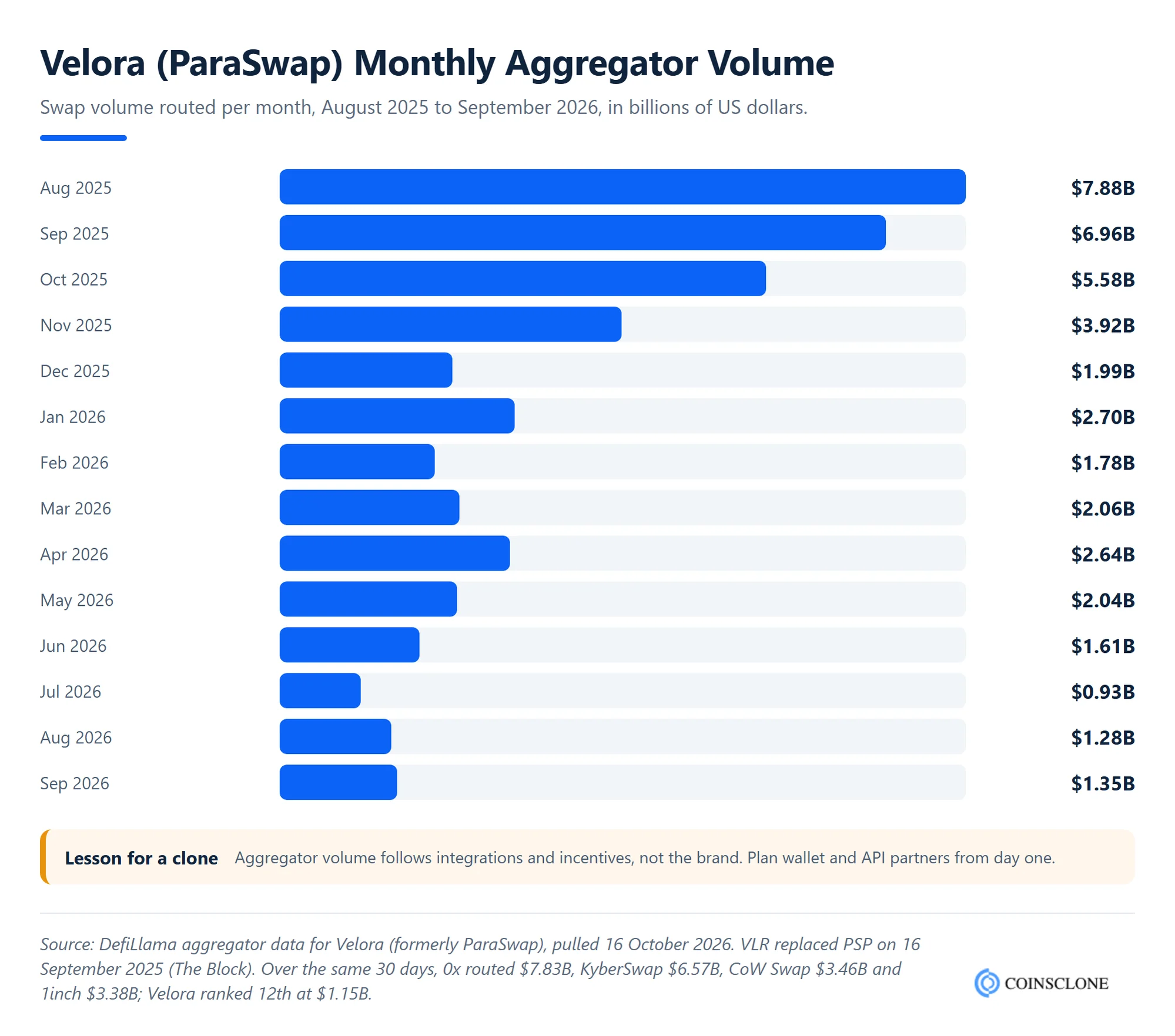
So the lesson is clear. Aggregator volume follows integrations, wallet partners and incentives, not the brand alone. The model still works, and rivals such as 0x, KyberSwap, CoW Swap and 1inch each routed $3 billion to $8 billion over the same 30 days. However, your launch plan needs a partner strategy, not just a good router.
What Is a DEX Aggregator?
A DEX aggregator is a platform that pulls prices from many decentralized exchanges and sends each trade through the best route. Users trade from one screen instead of checking each DEX by hand.
This matters because liquidity is spread thin. One token pair may sit in pools on Uniswap, Curve, PancakeSwap and many more. A single big trade in one pool moves the price a lot. An aggregator can split that trade across several pools, or hop through a middle token, so the user gets more out.
Why traders use a DEX aggregator:
- Better prices: It compares every connected pool and picks the highest output.
- Less slippage: Split routes cut the price impact of large trades.
- One screen: Users swap on many DEXs without leaving the app.
- Self-custody: Users trade from their own wallet, so the platform never holds their funds.
ParaSwap helped make this model a hit on Ethereum from 2019. Today, the same idea also powers cross-chain DEX apps that move value between networks in one step.
Working Process of ParaSwap DEX Aggregator
As many DEX markets are linked into one screen, the working flow of a ParaSwap-style DEX is simple for the user. Behind the scenes, though, Velora now runs two swap modes side by side. A strong clone should offer both.
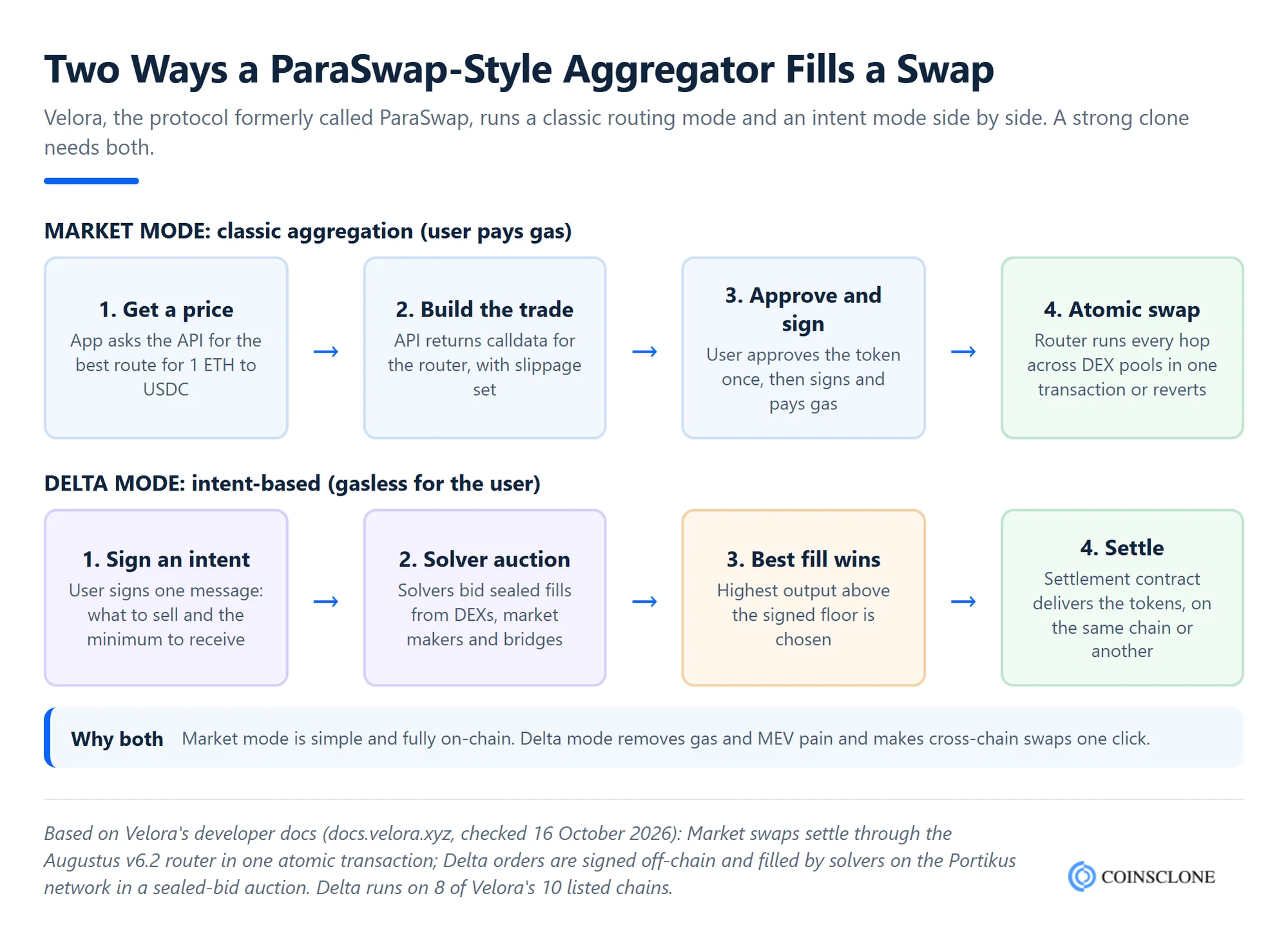
Market Mode: Classic Routing
- Get a price: The user enters the token pair and amount. The platform asks its routing engine for the best path.
- Build the trade: The engine checks many DEX pools, compares price, depth and fees, and returns the route with a slippage limit.
- Approve and sign: The user approves the token once, then signs the swap and pays the network fee.
- Atomic swap: The router runs each hop in one go. Either the whole trade completes at the agreed price, or it reverts.
Delta Mode: Gasless Intents
- Sign an intent: The user signs one off-chain message that says what they sell and the least they will accept.
- Solver auction: Solvers compete in a sealed-bid auction to fill the order from DEXs, market makers or bridges.
- Best fill wins: The highest output above the user’s floor is chosen.
- Settle: A settlement contract delivers the tokens, on the same chain or on another one. The user pays no gas, and the trade is shielded from MEV bots.
Like this, swaps execute at low cost with less slippage. The ParaSwap clone script also shows trending tokens, live prices and the fee for each route, just like the original.
Exponential Features of ParaSwap Clone Software
Like the ParaSwap platform, our ParaSwap clone script has the same core features. You can also add more safety tools, add-ons and ways to earn to suit your plans.
User Features
- Token Swapping: Users swap any pair at the best price the router finds, with split and multi-hop routes across many DEXs.
- Gasless Swaps: Users sign an intent and solvers pay the gas, so new users can trade without holding the chain’s gas token.
- Cross-Chain Swaps: Users move from a token on one chain to a token on another in a single flow.
- Limit Orders and TWAP: Users set a target price, or split a large trade into timed slices, without watching the chart.
- Non-custodial Wallet Integration: Users link wallets such as MetaMask or Rabby and keep full control of their funds.
- Slippage and Price Impact Controls: Users see the expected price impact and set the worst price they will accept.
- Real-time Analytics: Live prices, route details and trade history for every swap.
- Push Notifications: Alerts on filled orders, price moves and failed trades.
- iOS and Android Apps: Mobile apps to reach traders on the go.
Admin Features
- Liquidity Source Control: Add or remove DEXs, market makers and bridges, and switch off sources that fail.
- Fee Settings: Set platform fees by chain, pair or partner, or choose a surplus-sharing model.
- Partner and API Management: Issue API keys, set rate limits and track partner volume and fees.
- Token List Control: Approve tokens, flag risky contracts and warn users about new or unknown tokens.
- Reports: Track volume, fees earned, top pairs, route speed and user growth in one place.
Advanced Add-ons
- On-chain RFQ (Request for Quote): Market makers quote firm prices for large trades, as ParaSwap’s AugustusRFQ does for OTC deals.
- Multi-chain Support: Route swaps on Ethereum, Arbitrum, Base, BNB Chain, Polygon and other EVM chains.
- API, SDK and Swap Widget: Let wallets, bots and dApps plug your routing into their own apps and share fees with you.
- Yield Optimizer: Swap straight into a lending or yield position in one step.
- Numerous Payment Options: Fiat on-ramp links so new users can buy crypto before they swap.
Apart from these, you can add any revenue stream that suits your business. Next, let’s look at why this pays off for your business.
Business Perks of ParaSwap Clone Script
Among the various ways to build, many startups choose the ParaSwap clone for its strong benefits. If you are unaware of them, we are here to explain.
- Flexibility: The clone is easy to change. So you can shape the DEX with your own features, fees and chains.
- Affordable: A clone script costs less than a build from scratch, because you pay for a proven base. The final cost depends on the features you add.
- Secure for launch: Blockchain experts build and test the clone, and the contracts are audited before launch. Pick a trusted decentralized exchange development team so safety is not left to chance.
- Time efficient: The core is already built and tested, so the time to launch is far shorter. A white label ParaSwap clone usually goes live in about 5 to 7 weeks.
- Proven model: ParaSwap has routed about $101 billion of swaps since launch, per DefiLlama. Users already trust this kind of product, which makes your pitch easier.
With these perks, a ParaSwap clone script is a smart choice for launching your own DEX aggregator.
Security Lessons From ParaSwap
An aggregator never holds user funds between trades. However, users give its router contract permission to spend their tokens. That approval is the main risk, and ParaSwap learned it the hard way.
In March 2024, ParaSwap found a bug in its new Augustus V6 contract two days after release. The team paused the API and ran a white-hat rescue of at-risk funds. Even so, an attacker took about $24,000, and 386 addresses were affected, as crypto.news reported. The DAO later voted to repay the users who lost funds.
What our ParaSwap clone script builds in because of this:
- Audited contracts: Independent audits before launch and after every router upgrade
- Exact approvals: Users approve only the amount they swap, not unlimited spending
- Pause switch: Admins can stop the router and API at once if a bug appears
- Atomic swaps: Each trade settles in full in one transaction, or fails with nothing lost but gas
- Slippage limits: The trade stops if the market moves past the user’s floor
- MEV protection: Intent orders and private sending cut sandwich and front-running attacks
- Admin login guards: 2FA and role-based access for the admin panel
- Web attack prevention: DDoS, XSS and SQL injection defences, plus signed API requests
To see how we secure the on-chain side, read about our DeFi smart contract development services.
How a ParaSwap Clone Script Makes Money
A DEX like ParaSwap gives you many ways to earn:
- Swap fees: A small platform fee on each trade, set by pair or chain
- Surplus sharing: A share of positive slippage, when a trade fills better than quoted
- Partner and API fees: Wallets and apps that use your routing pay you per swap
- Pro API plans: Monthly plans for partners that need higher rate limits
- Premium tools: Paid limit orders, TWAP or advanced charts
- Token listing promotions: Paid featured spots for new projects
Velora shows how this works in practice. Partners can charge a fixed fee or take surplus, not both. On Market swaps the partner keeps 85% of its fee and Velora keeps 15%. On Delta swaps the partner keeps the whole fee, and surplus is split 50/50, according to Velora’s monetization docs. Its paid API plans run from $500 to $5,000 a month and price throughput, not trades.
Swap fees are thin at scale, so it helps to run the numbers. DefiLlama tracked about $2.45 million of Velora fees on $25.3 billion of volume over the past year, close to 1 basis point (0.01%). Here is what that means for a new aggregator:
| Monthly swap volume | At 1 bp (Velora’s real average) | At 10 bps platform fee | At 25 bps platform fee |
| $50 million | $5,000 | $50,000 | $125,000 |
| $250 million | $25,000 | $250,000 | $625,000 |
| $1 billion | $100,000 | $1,000,000 | $2,500,000 |
Gross fees only, before hosting, RPC nodes, audits, support and partner payouts. Velora rates from DefiLlama, 16 October 2026.
The gap between the columns is the whole business case. Big routers keep fees near zero to win wallet partners. A new aggregator usually earns more per trade through its own wallet, app or niche chain, where users value the convenience.
Clone Script, Custom Build or Velora’s API?
You have three ways to offer ParaSwap-style swaps. Velora’s API lets any app add a swap box for free with a partner ID, and charge its own fee. That works when swaps are a small feature. However, if swaps are your core business, you will want your own routing, your own fee rules and your own brand.
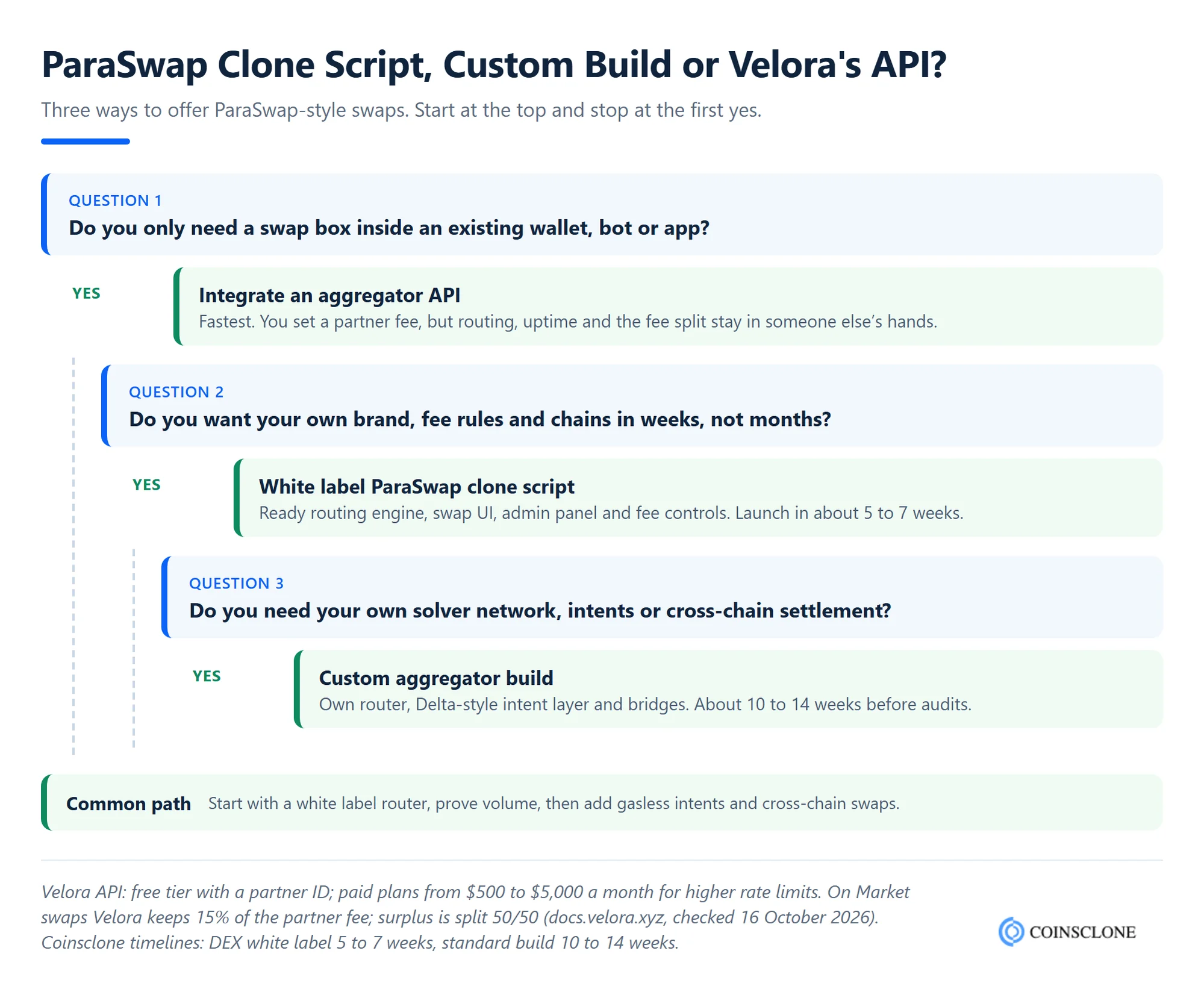
| Path | Best for | Control | Launch time |
| Velora’s API | A swap box inside a wallet, bot or app | Low: Velora sets routing and keeps 15% of Market partner fees | Days |
| White label ParaSwap clone script | A branded aggregator with your own fees | High: your routing, fees, tokens and chains | About 5 to 7 weeks |
| Custom aggregator build | Your own solver network, intents or bridges | Full | About 10 to 14 weeks |
How To Create a DEX Aggregator Like ParaSwap?
Creating a DEX aggregator like ParaSwap is not a daunting task, but you need a clear plan. Here is the path we follow with clients:
- Plan the model: Pick your chains, target users, fee rates and first products. Decide whether you will add gasless intents or cross-chain swaps later.
- Choose liquidity sources: List the DEXs, market makers and bridges you will connect on each chain.
- Customize the script: Apply your brand, set up the routing engine, wallet links and the user and admin dashboards.
- Build the contracts: Adapt the router, fee and settlement contracts, then add limit orders, RFQ and other features.
- Test and audit: Run route tests on mainnet forks, load tests and a third-party security audit.
- Launch and grow: Go live, sign wallet and API partners, and add chains and products as volume grows.
With a white label ParaSwap clone, a launch takes about 5 to 7 weeks. A standard build with more custom work takes about 10 to 14 weeks. Audits and partner deals can add time, so plan for them early.
The key step is to pick the right DeFi DEX aggregator development company for your clone. There are many ParaSwap clone script providers in the crypto market, and we at Coinsclone excel in this field. Our skilled team guides you from the first plan to a live DEX aggregator. Still in confusion?
Create Your DEX Aggregator like Paraswap
Cost-effective, White-Label Solution, Premium Features, Customizable. Live Demo Available.
Supported Chains and Tokens
Velora supports 10 EVM chains today, and our ParaSwap clone script can run on the same networks or on new ones you pick:
- Ethereum and its rollups: Ethereum, Arbitrum, Base, Optimism and Unichain
- Other EVM chains: BNB Chain, Polygon, Avalanche, Gnosis and newer chains such as Robinhood Chain
- Tokens: Any ERC-20 or BEP-20 token with liquidity on a connected DEX, plus native coins such as ETH and BNB
If you also want Solana, our Jupiter clone script covers the same aggregator model there. For an EVM router with a different design, see our 1inch clone script.
Factors That Affect the Cost of a ParaSwap Clone Script
The cost of a ParaSwap clone script depends on what you build on top of the base. The main factors are:
- Number of chains: Each chain needs its own contracts, nodes and liquidity connectors.
- Swap modes: Classic routing alone costs less than routing plus gasless intents and a solver auction.
- Extra products: Limit orders, TWAP, OTC, cross-chain swaps and mobile apps each add work.
- Security audit: A third-party audit of the router and settlement contracts is a must, and its price grows with code size.
- Running costs: RPC nodes, price indexing servers, monitoring and support after launch.
Ask for a quote based on your exact feature list. A clear scope keeps both cost and timeline under control.
Use Cases for a ParaSwap-Like DEX Aggregator
A ParaSwap clone script fits more than one kind of business:
- Crypto wallets: Add a built-in swap that earns a fee on every trade.
- Trading bots and AI agents: Bots use your routing API to fill trades fast and at the best price.
- DeFi apps: Lending and yield apps let users swap straight into a position in one click.
- New chains: Bring strong routing to a chain that has no good aggregator yet.
- Exchanges and fintech apps: Offer on-chain swaps next to a centralized order book.
Why Choose Coinsclone?
We hope you now have a clear view of the ParaSwap clone and its features. Coinsclone has built crypto platforms since 2018, and we have delivered 350+ platforms for 200+ clients across 20 industries. Our team builds the ParaSwap clone with rich features, and you can change any part of it, from safety tools to the look and feel. We offer DeFi build services at a fair cost.
To clear up any doubts, we offer a free live demo. Through it, you get a clear view of your DEX aggregator before you commit. We also build AMM exchanges, such as our Uniswap clone script, PancakeSwap clone script and SushiSwap clone script. Our ParaSwap clone script is worth your money and energy.
Frequently Asked Questions
1. What is a ParaSwap clone script?
A ParaSwap clone script is pre-built DEX aggregator software that copies the features of ParaSwap, now called Velora. It lets you launch a similar swap platform quickly, with your own brand, fees, chains and features.
2. Is ParaSwap now Velora?
Yes. ParaSwap rebranded as Velora in 2025. On 16 September 2025, the VLR token replaced PSP, and PSP holders can upgrade 1:1 on Base. The protocol, its routing and its API still work under the Velora name.
3. Is ParaSwap safe?
ParaSwap has run since 2019. In March 2024, a bug in its new Augustus V6 contract put user approvals at risk. The team paused the API and rescued most funds, but about $24,000 was stolen, and the DAO voted to repay users. For any aggregator, approve only what you swap and revoke old approvals.
4. What is the difference between ParaSwap and 1inch?
Both are EVM DEX aggregators that route swaps across many DEXs. ParaSwap, now Velora, offers classic routing plus gasless Delta intents and cross-chain swaps. 1inch offers its own routing plus Fusion mode for gasless swaps. Over the 30 days to 16 October 2026, 1inch routed about $3.4 billion and Velora about $1.15 billion, per DefiLlama.
5. What is the difference between ParaSwap and Uniswap?
Uniswap is a DEX with its own liquidity pools. ParaSwap is an aggregator that has no pools of its own. It finds the best price across Uniswap and many other DEXs, then routes your trade there.
6. Does ParaSwap have an API?
Yes. Velora offers a REST API, an SDK and a swap widget. Apps can start free with a partner ID and set their own partner fee. Paid plans from $500 to $5,000 a month lift the rate limits. A clone script is the better choice when you want your own routing and want to keep all your fees.
7. How long does it take to launch a ParaSwap clone?
A white label ParaSwap clone usually takes about 5 to 7 weeks to launch. A standard build with more custom work takes about 10 to 14 weeks. Testing, audits and partner integrations can add time.
See How Our MVP System Can Launch Your Aggregator Faster
ParaSwap Clone Script — Multi-DEX Aggregator Development
- MVP System : Launch your ParaSwap-like DeFi aggregator 90% faster.
- Liquidity & Integration: Aggregate prices and liquidity from top DEXs — no coding required.
- Brand & Customization : Your design, your routing logic, your trading engine.
- Revenue Engine : Earn from transaction fees, affiliate routes, and premium user features.
Get a free branded demo of your ParaSwap-like platform in just 48 hours — before investing a cent.
Book a Free Demo to discover how our ParaSwap Clone Script can take you from concept to a live multi-chain aggregator in 8–12 weeks.