
Planning to launch your own NFT marketplace? Then the first thing you need is a real number. In 2026, NFT marketplace development cost runs from about $10,000 for a white label launch to $150,000 or more for a custom, multi-chain platform. Where you land depends on how you build, which chain you pick, the features you add and where your team sits.
This guide breaks that number down. You will see the price of each build path, what each part of the platform costs, what it costs to run each month, and how much trading you need to pay it back. We also share the tips we use to keep budgets lean without cutting the parts that keep users safe.
In this guide:
- Price by build path: white label, MVP, mid-tier and enterprise, with time to launch.
- Cost by part: smart contracts, audit, design, back end, wallets, KYC and apps.
- Running costs: hosting, storage, KYC checks and upkeep each month.
- Payback: how much trading volume covers your costs at a 2% fee.
- Savings: the cheapest safe way to start and grow.
NFT Marketplace Development Cost in 2026
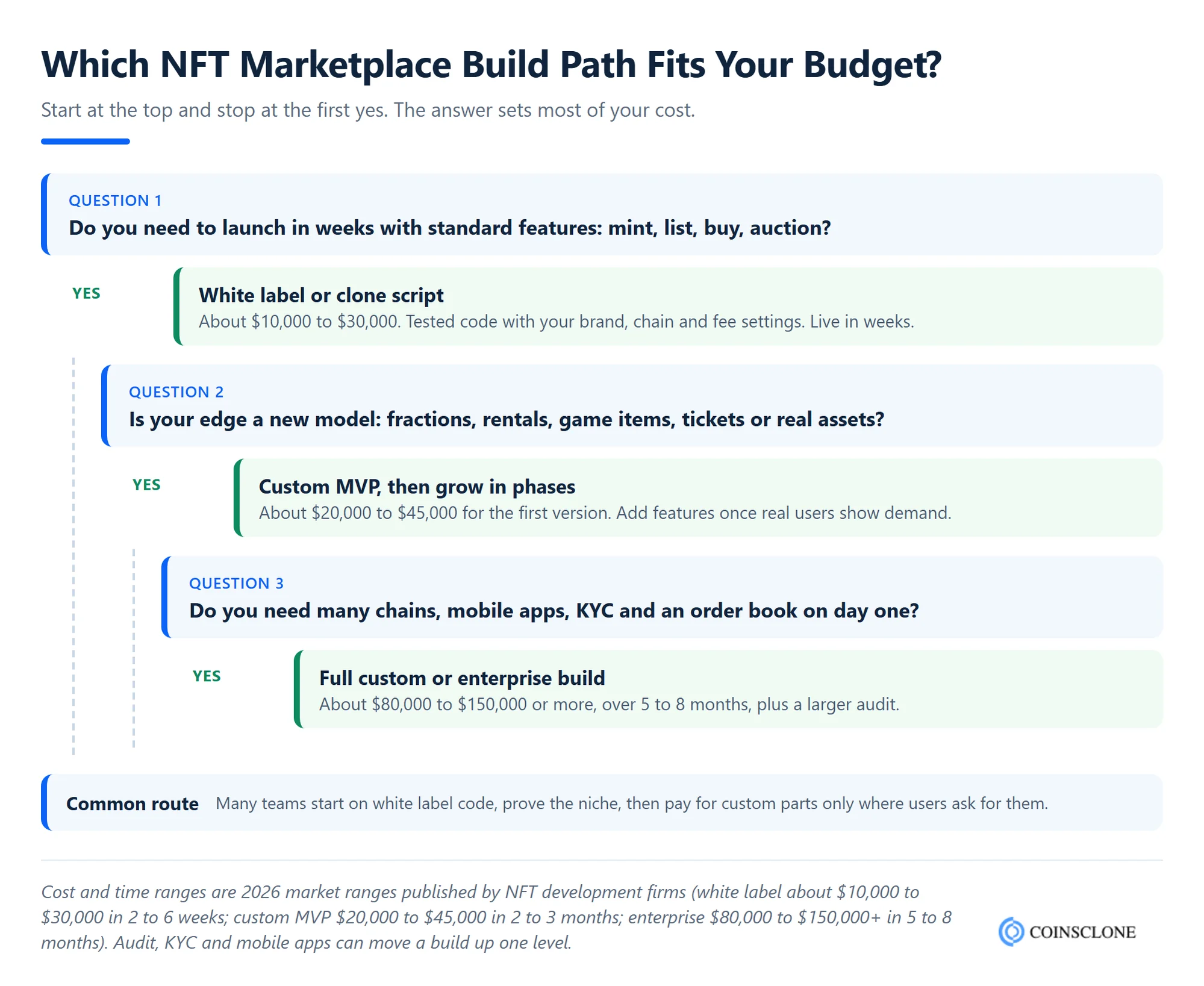
In 2026, NFT marketplace development cost starts at about $10,000 to $30,000 for a white label build. A custom build costs about $20,000 to $150,000 or more. The build method, the tech stack, the chain and the features you add decide where you fall in that range.
Here is how the main build paths compare, based on the price ranges NFT development firms publish for 2026:
| Build path | Typical cost | Time to launch | What you get |
| White label or clone script | $10,000 to $30,000 | 2 to 6 weeks | Tested code with your brand, chain and fee settings |
| Custom MVP | $20,000 to $45,000 | 2 to 3 months | Wallet connect, minting, fixed price sales |
| Mid-tier platform | $40,000 to $80,000 | 3 to 5 months | Auctions, royalties, many wallets, search and filters |
| Enterprise platform | $80,000 to $150,000+ | 5 to 8 months | Many chains, KYC, mobile apps, larger audit |
| Large open marketplace | $150,000 to $500,000+ | 8 to 12 months | OpenSea-scale trading, order book, deep data tools |
Keep in mind that the market itself has changed. NFT sales fell 37% to $5.63 billion in 2025, while the number of NFTs grew to 1.34 billion and the average sale dropped to $96, according to CryptoSlam data. So buyers now want cheap, fast trades in a clear niche. That is why most new platforms start small, pick a focus, and grow from there.
Discover NFT Marketplace Development Cost and Launch Your Platform Smartly
NFT Marketplace Development — cost-efficient and reliable.
- Transparent Pricing : Get to know NFT marketplace development costs.
- Feature-Rich Solutions : Supports multi-chain, minting, bidding, and UI/UX.
- Brand & Customization : Your design, your tokens, your marketplace.
- Revenue Engine : Earn via trading fees, listings, and NFT drops.
See a free branded demo of your NFT marketplace in 48 hours — before you invest a cent.
Book a Free Demo to explore how understanding NFT Marketplace Development Cost can save you time and money while launching your platform in just 8–12 weeks.
NFT Marketplace Cost Breakdown by Component
A total price is easier to trust when you can see the parts. This table shows what each part of a typical platform costs. The low end fits a lean MVP. The high end fits a full platform with custom logic.
| Part | What it covers | Typical cost |
| Smart contracts | Minting, listing, sales, auctions, royalties | $5,000 to $40,000 |
| Smart contract audit | Outside security review before launch | $5,000 to $25,000 |
| UI and UX design | Screens, user flows, brand look | $5,000 to $25,000 |
| Front end (web) | The site users see and click | $5,000 to $40,000 |
| Back end and API | Data, search, alerts, indexing chain events | $8,000 to $35,000 |
| Wallet connection | MetaMask, Phantom, WalletConnect, email wallets | $3,000 to $10,000 |
| Storage setup | IPFS pinning for images, video and metadata | $2,000 to $8,000 |
| Admin panel | Fees, users, reports, takedowns | $4,000 to $15,000 |
| KYC and AML | ID checks and screening through a provider | $5,000 to $15,000 |
| Mobile apps | iOS and Android apps | $15,000 to $60,000 |
Two lines in this table are easy to skip and costly to miss. The audit protects every user’s assets, so do not cut it. KYC is only needed if you take card payments, hold user funds or serve places that ask for it, so check your rules before you pay for it.
Key Factors that Influence NFT Marketplace Development Costs
You need a clear plan and the right guidance to build an NFT marketplace. The build can be hard and even risky. But if you plan for each cost driver early, you avoid surprise bills later. Here are the main factors that shape your budget.
Type of NFT Marketplace
The niche you pick shapes your brand and your build. For example, an art platform needs strong image handling and a record of who made each piece. A gaming platform, on the other hand, needs smooth links to game engines and fast, cheap trades.
The platform you want to create can be a web solution through NFT Marketplace Website Development, a mobile solution via NFT Marketplace App Development, or both. A platform that works on every device needs more build and test time. As a result, each platform type changes both the budget and the launch date.
Development Method
The first and biggest cost factor is how you build. You can either build from scratch or start with white label NFT marketplace software.
When you build from scratch, you own every choice, from the user dashboard to the security rules. You write the whole site from the ground up, so it takes longer. It also costs the most, since more months of work means more of your budget and energy.
White label software is a ready platform that already has the core features and security in place. You buy it, then shape it to fit your brand and business. This is the fastest and cheapest way to launch.
Blockchain Technology
Blockchain is the backbone of any NFT marketplace. You can use an existing network like Ethereum, Solana, Base, Polygon or BNB Chain, or build your own chain. Either way, smart contracts run the core trades.
Your chain choice changes both build cost and user cost. Fees on Ethereum are far lower than they used to be. On 1 October 2026, an NFT sale cost about $0.61 in gas on the Etherscan gas tracker. Solana and layer 2 chains like Base cost even less per trade. However, each chain has its own wallets, tools and NFT standards, so each extra chain adds build time.
Your blockchain setup should support:
- Basic Features: Wallet connection, NFT minting and listing.
- Advanced Features: Bids, royalty payouts and analytics.
- Security Features: Two-factor login, SSL and anti-phishing checks.
A well-planned chain setup keeps the platform fast, safe and ready to grow, and that has a direct effect on your NFT marketplace development cost.
Also Read: Choose the Right Blockchain to Create an NFT Marketplace
Complex Feature Integration
Your feature list drives a large share of the cost. Basic and advanced features improve the user’s journey. Strong security builds trust. Both add to the bill.
To stand out, you can add unique modules and extra security layers, but each one needs more budget. Each also needs skilled hands, so work with experienced NFT developers. Without the right guidance, features that do not fit together can cost more to fix later.
Also Read: Essential Features of NFT Marketplace
Tech Stack Implementation
The tools you pick shape what the platform can do, how far it can grow, how safe it is and how it feels to use. Think through each choice, from the chain to the test tools. Proven tools, such as audited contract libraries, cost less to build on and less to secure. So your tech stack is a key choice that shapes your total spend.
Development Team & Size
A full NFT marketplace needs a skilled team. You need blockchain developers, testers, UI and UX designers, a project lead and a security expert. The bigger the team, the higher the cost. So choose an NFT marketplace development company with proven, audited work.
On that note, get expert advice before you add modules. It helps you avoid paying for features your users will not need.
Additional Factors that Affect NFT Marketplace Development Cost
Beyond the main factors above, a few more items add to the cost of building an NFT marketplace. They are:
Smart Contract Development
Writing and deploying smart contracts is a core part of any NFT platform, even a ready-made one. Shaping these contracts to your business rules takes careful planning and code.
On top of that, an outside audit checks the contracts for flaws before launch. It adds to the cost, but it is what keeps trust in the platform. Using tested libraries like OpenZeppelin Contracts cuts both build and audit time.
Also Read: A Complete Guide to NFT Smart Contract Development
Multi-Chain Compatibility
Supporting many chains, such as Ethereum, Base and Solana, can grow your user base. But it also makes the build harder. Cross-chain bridges, wallet support for each chain and syncing assets across networks all need more time and money.
Wallet Integration
Users need to connect their own wallets to buy, sell and store NFTs. More teams now add email or social login wallets too, so new users can start without a seed phrase. Each wallet type you support adds build, test and security work.
Scalability and Performance
Plan for growth in users and trades from day one. A good setup handles busy drops without slowing down.
This may mean paying for faster data indexing, better hosting or a layer 2 chain. These steps add cost up front, but they keep the platform smooth when demand spikes.
Off-Chain Storage Solutions
Most NFTs keep their images, video and 3D files off-chain, on IPFS or on cloud storage like AWS or GCP. Storage is cheap to run. For example, Pinata’s IPFS plans cost $20 a month for 1TB or $100 a month for 5TB. The bigger cost is building a reliable upload and pinning flow.
NFT Standards & Metadata Handling
Pick the right NFT standard and shape your metadata well, so tokens work in other wallets and platforms. ERC-721 suits one-of-one items, while ERC-1155 suits editions and game items. If you want royalties to show up on other platforms, also add the ERC-2981 royalty standard. Dynamic or media-rich NFTs need more custom work, which raises the cost.
Legal and Regulatory Compliance
You must follow the law where you operate. That covers NFTs, crypto, payments and data privacy, so you will need legal advice and ongoing checks. For example, the EU’s MiCA regulation leaves out truly unique NFTs. However, NFTs sold in large series or as fractions can fall inside its rules. Card payments, user custody and fraction sales usually bring KYC and AML duties too. All of this adds to both launch and running costs.
SEO, Community Building & Marketing
Building the platform is only one part of the journey. People also need to find it and come back. SEO-friendly pages, social sharing tools and analytics help users discover you. A strong community and steady marketing keep them active.
This includes budget for:
- Analytics tools
- Community management
- Engagement campaigns
- Influencer partnerships
- User growth plans and more
These efforts draw active users and build a lively platform, so plan and fund them from the start.
Each of these factors adds to the work and cost of a platform that meets both tech and legal needs while still giving users a smooth ride.
NFT Marketplace Development Cost by Team Location
Where your team works changes the bill as much as what you build. The same hours can cost three times more in one country than another.
Clutch’s 2026 pricing guide lists these average agency rates for software development:
| Region | Average hourly rate | Example countries |
| North America | $50 to $149 | United States $50 to $99, Canada $100 to $149 |
| Europe | $25 to $99 | Poland $50 to $99, Spain and Ukraine $25 to $49 |
| Asia | $25 to $49 | India and the Philippines |
| Australia | $100 to $149 | Australia |
| Latin America | $25 to $49 | Mexico |
Rates in the Middle East and Africa vary widely from city to city, so ask each team for a rate card. Below is what those rates mean for one lean build.
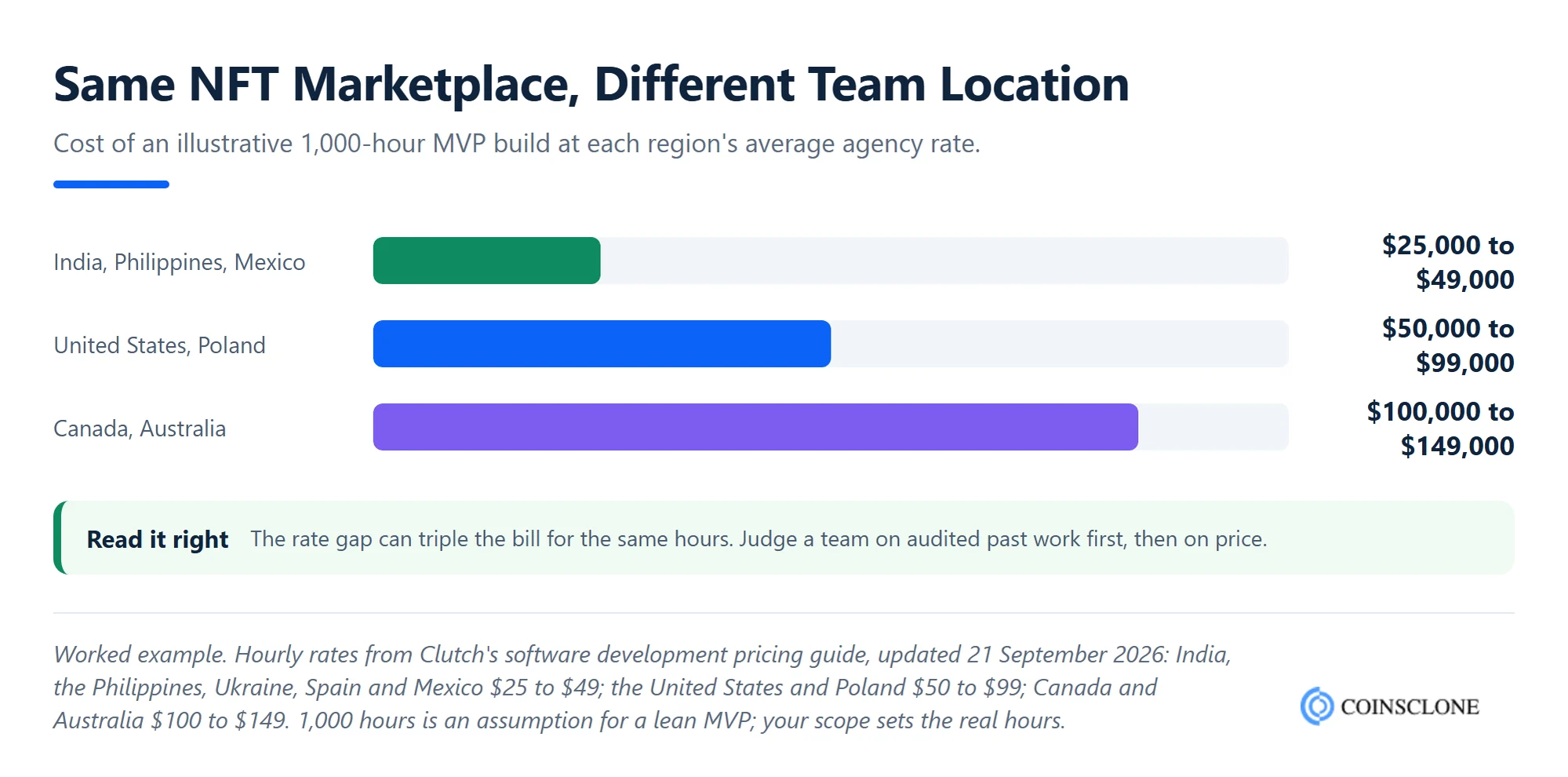
A lower rate is only a saving if the work is good. So check audited past projects, live client platforms and who owns the code before you compare prices.
Ongoing Costs After Launch
Launch day is not the last bill. Plan for these running costs from the start:
- Hosting and servers: About $500 to $5,000 a month, based on traffic and data tools.
- IPFS storage: $20 to $100 a month on Pinata’s paid plans for most new platforms.
- KYC checks: $1.35 to $1.85 per check on Sumsub’s published plans, with a $149 to $299 monthly minimum.
- Upkeep: About 15% to 25% of the build cost each year for fixes, updates and security patches.
- Gas you pay yourself: Lazy minting and relayers move gas costs onto you, so budget for it if you offer free minting.
- Marketing: Often the largest line in year one, and the one most teams under-fund.
The real question is whether fees can pay for all this. Most platforms earn a fee on each trade. Today, Blur and OKX NFT charge 0%, OpenSea charges about 1%, Magic Eden takes a 2% taker fee on Solana and SuperRare takes 15% on first sales. As a result, a new platform needs a niche where users will pay a fair fee.
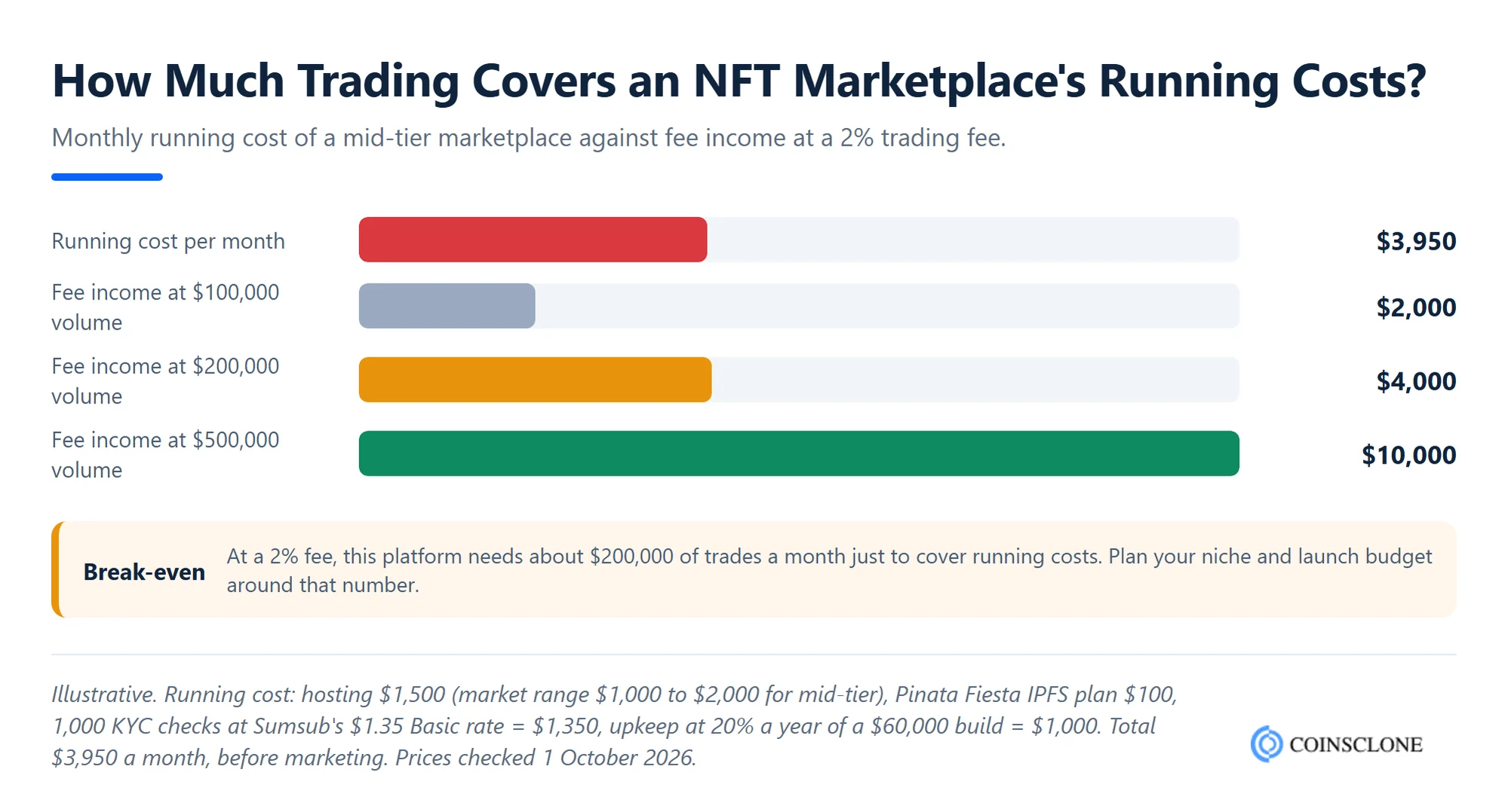
Big names show the risk. Binance closed its NFT marketplace in July 2026, and Magic Eden cut back to Solana only. In short, volume follows a clear niche and strong liquidity, not just good code. You can read more about fees, royalties and other income in our guide to the NFT marketplace revenue model.
Tips to Reduce the Cost to Create an NFT Marketplace
You might be wondering if all these features will cost you a fortune. They can, if you build everything at once.
But “where there is a will, there is a way!” With good planning and a smart team, you can cut the cost a lot. Here is how.
Proper Roadmap: First, be clear about your idea and your build stages before you start. A clear plan stops you from spending on things you do not need yet.
Choose a White Label or Clone Script: Second, start with white label software or an NFT marketplace clone script. Both are ready-made, so they cut cost and launch time by a wide margin.
For example, if you want to create an NFT Marketplace like OpenSea, you can buy the OpenSea Clone Script. It copies OpenSea’s trading, staking, minting and auction options.
Launch in Phases: Ship the core features first: minting, listing, buying and a wallet. Then add auctions, apps and extra chains once users ask for them. This keeps your first bill small.
Pick a Low-Fee Chain: A chain like Solana, Base or Polygon keeps user fees low and makes testing cheaper. You can add Ethereum or other chains later.
Use Audited Building Blocks: Tested contract libraries and proven wallet tools cost less to build and less to audit than custom code.
Choice of Development Company: Choose a team based on skill, past work and reputation. Then compare price. A cheap team that ships weak code costs more in the end.
Simple User Interface: A good dashboard draws users in, but simple wins. So skip extra screens and design only what users need.
If you follow these tips, you can cut your NFT marketplace development cost and still launch a safe, solid platform. Our step-by-step guide on how to build an NFT marketplace walks through the full process.
Propel Your NFT Marketplace Launch with Minimal Cost!
Tailored Solution. Budget-friendly. High Quality. Expert Guidance.
Choose Coinsclone to Build NFT Marketplace Cost-effectively!
Coinsclone is a trusted NFT Marketplace Development Company that has been building blockchain platforms since 2018. We have delivered 350+ platforms for 200+ clients across 20 industries. Our team of blockchain developers is always eager to turn your NFT marketplace idea into reality. Because we have built for many NFT niches, from art and music to gaming and real estate, we understand your market quickly.
To help you launch fast, we offer white label solutions and clone scripts at a budget-friendly cost. Share your niche, chain and must-have features, and we will map out the cheapest safe route to launch, with a live demo to try first.
Frequently Asked Questions
How much does it cost to develop an NFT marketplace?
A white label NFT marketplace costs about $10,000 to $30,000. A custom MVP costs about $20,000 to $45,000, a mid-tier platform $40,000 to $80,000, and an enterprise build $80,000 to $150,000 or more. Your build method, chain, features and team location set the final price.
Which is more cost-effective: white label or custom NFT marketplace?
White label NFT marketplace software is the most cost-effective choice. It uses an existing, tested base, so you do not rebuild your product from scratch. You also launch much faster, which means you can open for business sooner.
Can I upgrade my NFT marketplace without big costs?
Yes. A white label NFT marketplace solution allows step-by-step upgrades. You can add features and improvements without rebuilding the whole platform. This lets your platform keep up with market trends.
What are the must-have features of an NFT marketplace?
The core features are user wallets, NFT minting, safe transfers, auctions or fixed-price listings, search and filters, and an admin panel. You can also add analytics and social sharing to make the platform easier to use.
Is it possible to launch an NFT marketplace with zero coding knowledge?
Yes. White label NFT marketplace solutions give you a ready platform with easy settings, so you need no coding skill. You can focus on your brand, business, marketing and community.
Do NFT marketplaces need ongoing maintenance after launch?
Yes. After launch, an NFT marketplace still needs regular updates, security patches and admin support to keep users safe. Plan for about 15% to 25% of the build cost each year, plus hosting and storage. Steady upkeep also helps you add features and stay ahead.
How long does it take to build an NFT marketplace?
A white label launch takes about 2 to 6 weeks. A custom MVP takes 2 to 3 months, and a full enterprise build takes 5 to 8 months. Audits, KYC and mobile apps add time to each path.
How much does it cost to create an NFT?
Creating a single NFT is cheap in 2026. On Ethereum, an NFT sale cost about $0.61 in gas on 1 October 2026, and a mint costs a similar small amount. On Solana, Base or Polygon it costs even less. Many platforms also offer lazy minting, where the buyer pays the gas at the first sale.
Is an NFT marketplace still profitable in 2026?
It can be, but only with a clear niche. NFT sales fell 37% to $5.63 billion in 2025, so general-purpose platforms face tough fee competition. Platforms that serve one group well, such as games, tickets, music, loyalty or real assets, can charge a fair fee. Check the break-even volume for your fee before you build.
Discover NFT Marketplace Development Cost and Launch Your Platform Smartly
NFT Marketplace Development — cost-efficient and reliable.
- Transparent Pricing : Get to know NFT marketplace development costs.
- Feature-Rich Solutions : Supports multi-chain, minting, bidding, and UI/UX.
- Brand & Customization : Your design, your tokens, your marketplace.
- Revenue Engine : Earn via trading fees, listings, and NFT drops.
See a free branded demo of your NFT marketplace in 48 hours — before you invest a cent.
Book a Free Demo to explore how understanding NFT Marketplace Development Cost can save you time and money while launching your platform in just 8–12 weeks.