
A white label NFT minting platform is the quickest way to give creators, fans or customers a place to turn files into NFTs under your own brand. You start from tested software, add your logo, chains and fees, and go live in weeks instead of months. This guide explains how these platforms work in 2026, which minting options and standards to offer, and what it really costs.
The NFT market has changed a lot since the 2021 boom. Sales are lower, several big art sites have closed, and the platforms that still grow serve a clear niche such as games, tickets, loyalty or music. So we also show what still works, how a minting platform makes money, and the steps to launch one.
In this guide:
- What a white label NFT minting platform is, and who uses one in 2026
- How minting works from upload to wallet, with a simple flow chart
- Lazy, gasless and batch minting, and when to use each
- The NFT standards and chains to support, with real 2026 fees
- Market cost ranges, launch time and the revenue model
Launch Your Custom White Label NFT Minting Platform Quickly
White Label NFT Minting Platform — build a scalable, cross-chain minting site.
- Creator-Friendly: Upload assets, set royalties, and mint with ease and securely.
- Wallet Integration: Supports popular wallets for seamless user transactions.
- Advanced Search: Filters and metadata management for easy asset discovery.
- Admin Controls: Manage users, minting, listings, and revenue effectively.
See a free branded demo of your NFT platform in 48 hours — before you invest a cent.
Book a Free Demo to discover how White Label NFT Minting Platform can help you launch in just 8–12 weeks.
What Is a White Label NFT Minting Platform?
A white label NFT minting platform is ready-made software that turns digital files into NFTs on a blockchain. You rebrand it and run it as your own product. Your users upload art, music, tickets or game items, add a name and details, sign with their wallet, and the smart contract creates the NFT for them.
The “white label” part means the core is already built and tested. You do not pay a team to write the contracts, wallet links, storage and admin panel from scratch. Instead, you set your brand, fees, royalty rules and chains, and launch.
A minting platform is not the same as a marketplace. Minting creates the NFT. A marketplace is where people buy and sell it later. Many products do both, but some brands only need minting. For example, a concert firm may mint tickets and let fans resell them on OpenSea.
Here is who uses these platforms today:
- Brands and retailers: loyalty passes, digital twins of real products and member rewards.
- Game studios: in-game items and skins that players truly own.
- Event firms: tickets and proof of attendance that cannot be faked.
- Music and media: limited releases, fan clubs and backstage perks.
- Creator tools and agencies: a no-code minting studio for their own clients.
- Real-world assets: title records and certificates tied to physical goods.
The NFT Minting Market in 2026: What Changed
Before you build, it helps to know the market you are entering. NFT sales fell 37% to $5.63 billion in 2025, according to CryptoSlam data. At the same time, the number of NFTs grew to 1.34 billion and the average sale dropped to about $96. In short, more NFTs are being minted, but each one sells for less.
That shift has hit general art sites the hardest. Nifty Gateway shut in February 2026, Foundation in April 2026 and Binance NFT in July 2026. MakersPlace and KnownOrigin closed earlier. Mintable now shows a “Sunsetting Mintable & Mintology” notice on its own site, with no closing date yet. Rarible was bought by a firm called IMPOSSIBLE in 2026, which also sells a white label toolkit to brands.
Meanwhile, the leaders cut fees. OpenSea charges 1% on NFT sales and 10% on mints in a primary drop, per the OpenSea Help Center. Blur and OKX NFT charge 0%. So a new platform cannot win on low fees alone.
What still works: minting for a clear group of users. Tickets, loyalty, game items, music and real-world assets all need a branded way to mint, and they do not depend on art speculation. That is where a white label minting platform pays off in 2026.
Reasons to Choose White Label NFT Minting Platform
Even though there are many ways to enter Web3, a white label NFT minting platform is often the better choice. Treat this section as a short checklist. Here are 4 strong reasons to build one.
Steady Income From Fees
A minting platform can earn from every NFT made on it. You can charge a mint fee, take a cut of first sales, and add a small fee on resales. On top of that, you can sell premium plans, featured spots and brand partnerships. Because fees are set in your smart contract and admin panel, you can change them as you grow.
Also Read: NFT Marketplace Revenue Model
A Business Built for What Comes Next
The NFT space keeps moving. In 2026 the growth is in useful NFTs, such as tickets, game items, loyalty and real-world assets, rather than pure art trading. A minting platform lets you serve that demand early. Also, since the white label core is ready, you can test a niche fast and adjust before you spend big.
Your Own Brand
You can build your brand in a crowded market by adding features that set your platform apart. A custom setup gives you full control over the look, the user flow and the rules. As a result, users see your name, not a third party’s, every time they mint. White label solutions make that possible without building the whole stack yourself.
A Path to Your Own NFT Marketplace
Many minting platforms also work as an NFT marketplace, where NFTs are traded. So building one opens the door to a full marketplace that links creators and collectors. That doubles the benefit: creators get a place to make, show and sell their NFTs to a global audience, and you earn on both the mint and the trade.
Also, the NFT space is still young, which leaves room to try new ideas. A minting platform lets you build use cases that push NFT technology further.
However, these reasons would have made you wonder how the platform actually works.
How Does a White Label NFT Minting Platform Work?
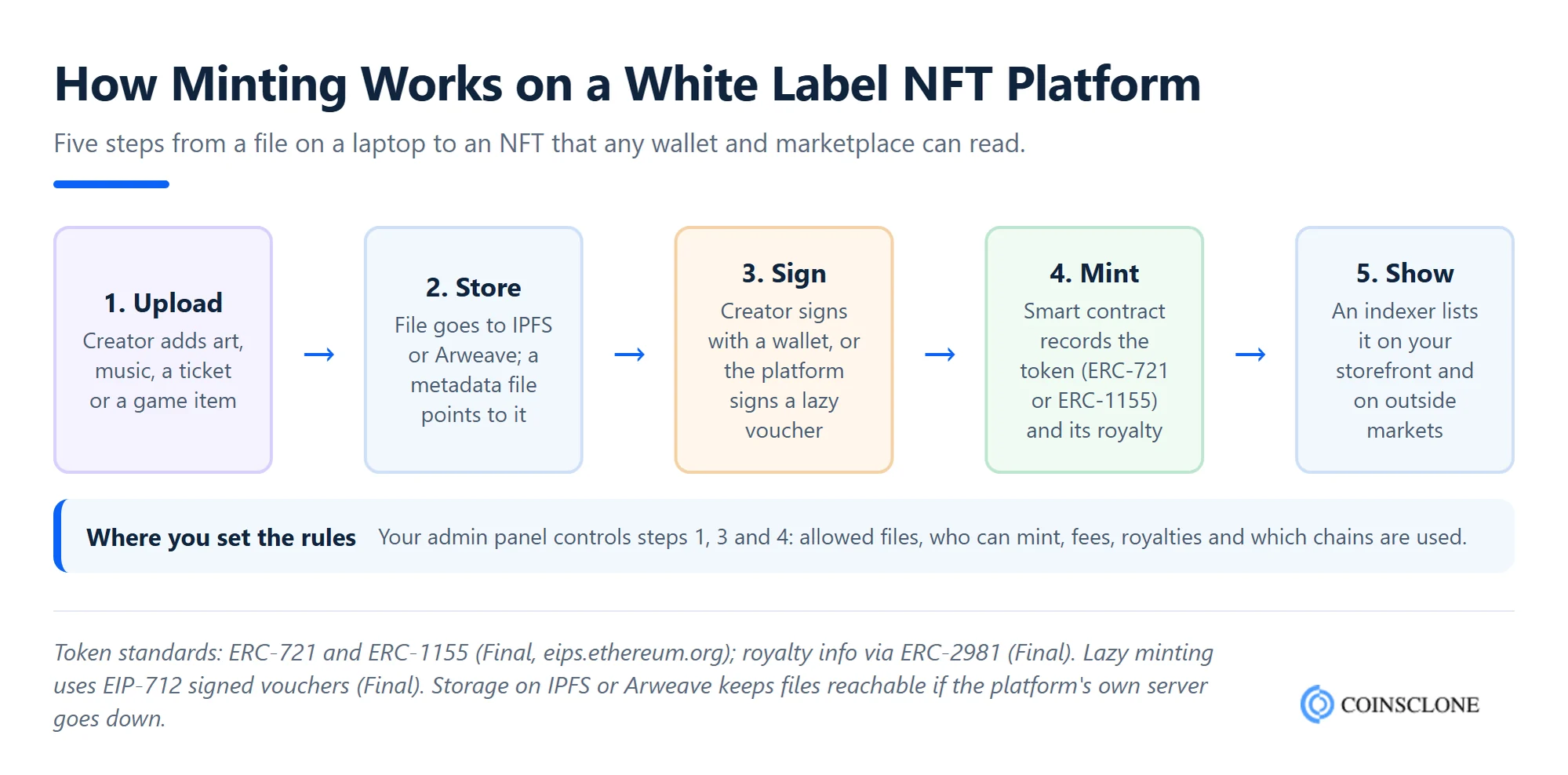
Minting sounds complex, but smart contracts do most of the work. To see the full picture, look at it from both sides: the admin who runs the platform and the user who mints.
Admin Perspective
- The admin of the NFT minting platform sets the rules, such as fees, royalties, allowed file types and supported chains.
- Next, the platform gives users a simple minting screen to upload content, add details and mint NFTs.
- The admin can review user content against the platform rules before minting, and can verify creators to reduce fakes and copied art.
- The smart contracts then mint the NFTs and send them to the user’s chosen wallet.
User Perspective
- First, choose the file you want to turn into an NFT and upload it to the platform.
- Then add a name, description and traits, check the fees, and make sure the content follows the platform rules.
- Next, sign with your wallet and set your royalty so you earn on future resales.
- Finally, the smart contract mints the NFT. It shows up in your wallet and on the platform, ready to sell or trade.
Under the hood, the file goes to lasting storage such as IPFS or Arweave. The platform then writes a small metadata file that points to it. The contract records the token, and an indexer picks it up so it shows on your storefront and on outside marketplaces.
To see this in action, look at a few platforms where creators mint today:
- OpenSea: creators launch drops and collections, with a 10% fee on primary drop mints.
- Rarible: now owned by IMPOSSIBLE, with its own minting tools and a white label toolkit.
- SuperRare: a curated art market that takes 15% on first sales.
- Manifold: a creator studio where artists deploy and own their own contracts.
These platforms show how minting and trading can live in one product. So your plan to build an NFT minting website with a white label solution is a sound one. Next, let’s look at the minting options your users will expect.
Minting Options: Standard, Lazy, Gasless and Batch Minting
The way you mint decides who pays the gas fee and when. This matters because gas is the main cost a new creator sees. A good white label platform lets you switch each option on or off.
- Standard minting: the creator pays gas up front and the NFT is on-chain right away. It is simple and best for one-off, high-value pieces.
- Lazy minting: the creator signs a mint voucher off-chain using the EIP-712 signing standard. Nothing is written to the chain until someone buys, and the buyer’s payment covers the gas. So creators can list for free, and unsold items cost nothing.
- Gasless minting: the platform pays the gas for the user through a relayer or a smart account with a sponsor. Users do not need crypto at all, which helps brands and games reach new users. However, you pay that gas, so set a budget and limits.
- Batch minting: many NFTs are minted in one transaction. ERC-721A and ERC-1155 make this far cheaper, so it suits large collections, tickets and game items.
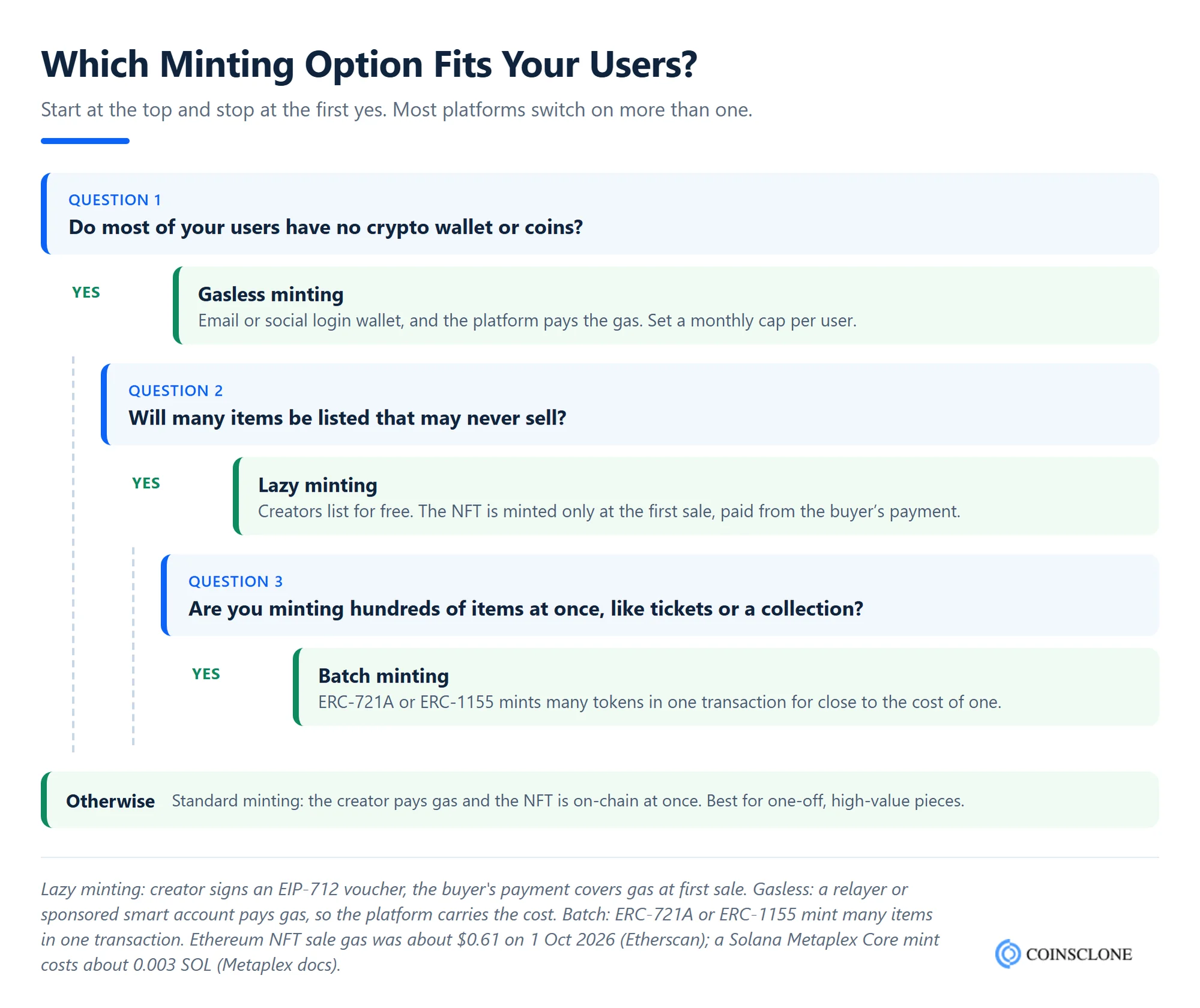
In practice, most platforms mix these. For instance, a ticketing brand might batch-mint seats, then use gasless minting so fans with no wallet can claim them.
Which NFT Standards and Blockchains Should It Support?
Your platform should mint on standards that every wallet and marketplace can read. Otherwise, your users’ NFTs will not show up or sell elsewhere. Here are the ones that matter in 2026, as covered in our guide to NFT standards:
| Standard | What it does | Status |
| ERC-721 | One-of-a-kind NFTs, each with its own ID | Final |
| ERC-1155 | Many token types and editions in one contract, with batch transfers | Final |
| ERC-721A | Gas-saving way to write ERC-721 for cheap batch mints | Open code, not a separate EIP |
| ERC-2981 | Tells marketplaces the royalty on each sale | Final (payment is up to each marketplace) |
| ERC-721C | Lets creators block marketplaces that skip royalties | Limit Break standard, not an official ERC |
| Metaplex Core | Solana’s newer NFT standard with one account per asset | Live on Solana mainnet |
| CIP-68 | Cardano NFTs with data you can update | Active on Cardano |
Status checked on Ethereum Improvement Proposals, the Metaplex docs and the Cardano CIP site.
For chains, most platforms start with one or two and add more later. Ethereum gives the most trust and buyers, and fees are far lower than they were. On 1 October 2026, an NFT sale cost about $0.61 in gas on the Etherscan gas tracker. Base, Polygon and Arbitrum run the same contracts at an even lower cost. Solana is also cheap: per the Metaplex Core docs, a Core mint costs about 0.003 SOL against roughly 0.022 SOL for the older Token Metadata standard.
Tip: each extra chain adds wallets, tools and testing. So pick the chain your users already use, then grow from there.
Features of the White Label NFT Minting Platform
Here are the common features to build into a white label NFT minting platform:
Storefront: a clean, easy storefront to show the minted NFTs for sale.
Admin Dashboard: a dashboard to run the platform, set fees and manage users.
Advanced Search Filters: lets buyers narrow results by chain, price, traits or creator.
Wallets: links to popular wallets, plus optional email or social login wallets for new users.
Flexible Minting: single, batch, lazy and gasless minting that you can switch on per collection.
Customer Service Chatbot: a smart chatbot to answer common user questions fast.
Cross-Chain Support: lets the platform work with more than one blockchain network.
Ticketing System: a help desk to raise and fix customer issues for a smooth user experience.
Royalty Management: tools to set royalty rates, using ERC-2981 or enforced royalties where needed.
Payment Gateway Integration: crypto and card payments between buyers and sellers.
User Authentication: makes sure only approved users can mint, for safety.
Creator Verification and Moderation: checks creators and flags copied or harmful content before it goes live.
Lasting File Storage: uploads to IPFS or Arweave so the art does not vanish if a server goes down.
Community Engagement: comments, forums and allowlists that help build a loyal community.
Analytics and Reporting: dashboards to track mints, sales and fees.
Security Features: audited contracts, two-factor login and protection against common web attacks.
Together, these features give creators, artists and businesses a full solution. Since you do not build from scratch, you can launch your own NFT minting platform quickly and at a lower cost.
Now, let’s set aside the features. A white label NFT minting platform also brings clear business advantages.
Advantages of Using White Label NFT Minting Platform
Using a white label solution to build an NFT minting platform has several benefits.
Customization
White label solutions are very flexible. You can shape the platform to your brand and business needs, so it fits your vision and goals. As a result, you get a distinct NFT minting platform that stands out in the market.
Time-Saving
A white label solution cuts build time sharply compared with building from scratch. Because the core features are already built, you can launch your NFT minting platform quickly. Even with extra features, a white label NFT minting website goes live much sooner.
Security
A proven white label solution comes with built-in security. Its code has already been tested and used in the market, which lowers the risk of bugs, weak spots or missing functions. Still, no code is risk-free, so ask for a fresh audit of any contract you change.
Scalability
Slow speed under heavy use is a common problem for blockchain platforms. White label solutions are designed to handle more users, trades and data as the platform grows. So you can meet rising demand without slowdowns or downtime.
More Time for Growth
With a skilled team handling your white label NFT minting platform, you do not need to worry about the complex build. Most white label providers support you from idea to launch. Thus, you can spend your time and money on marketing and growing your community.
Knowing the benefits and features, the next step is the launch plan.
How to Launch a White Label NFT Minting Platform: Step by Step
Here is the usual path from idea to live platform:
- Pick your niche and users: decide who will mint and why. Art, tickets, games and loyalty each need different features.
- Choose chains and standards: match the chain your users already use, then pick ERC-721, ERC-1155 or a Solana standard.
- Set your minting options: decide on standard, lazy, gasless or batch minting, plus fees and royalties.
- Brand the platform: add your logo, colours, domain and user flow.
- Set up and audit contracts: deploy on a test network first, then get an audit before mainnet.
- Test and launch: run real user tests, fix issues, then go live and invite your first creators.
As a guide, a white label launch takes about 2 to 6 weeks. A custom MVP takes 2 to 3 months, and a full enterprise build takes 5 to 8 months. Audits, KYC and mobile apps add time to each path.
What is the Cost of White Label NFT Minting Platform?
Low cost is a big reason businesses pick white label. Based on published 2026 agency cost guides, and in line with our NFT marketplace development cost breakdown, here are typical market ranges:
| Build path | Typical cost (2026) | Time to launch |
| White label or clone script | $10,000 to $30,000 | 2 to 6 weeks |
| Custom MVP | $20,000 to $45,000 | 2 to 3 months |
| Mid-tier platform | $40,000 to $80,000 | 3 to 5 months |
| Enterprise, multi-chain | $80,000 to $150,000+ | 5 to 8 months |
The final price depends on a few key factors:
- Tech stack used
- Time frame you need
- Number of features and integrations
- Complexity of the project
- How much you customize
- Security work, such as audits
Also plan for running costs after launch. These include file storage and pinning, hosting, gas if you offer gasless minting, contract audits when you add features, and support staff. Gas for gasless minting can grow fast, so set a monthly cap per user.
How a White Label NFT Minting Platform Makes Money
A minting platform can earn in several ways. Most mix two or three of them:
- Mint fees: a flat fee per NFT minted, or a cut of primary sales. OpenSea, for example, takes 10% on primary drop mints.
- Resale fees: a small cut of each resale on your own market. OpenSea charges 1%, while curated art sites such as SuperRare take 15% on first sales.
- Plans for creators and brands: monthly plans for extra storage, analytics, custom domains or gasless minting.
- Featured spots and launches: paid homepage placement or a launchpad for new collections.
- Services for brands: setup, design and campaign support for companies that mint at scale.
Because general fees are so low in 2026, the best results come from a niche where users value your tools. A ticket or loyalty platform, for instance, can charge brands a monthly fee rather than relying on trading volume.
Well then, you can now see why the white label NFT minting platform is the most efficient route. As long as brands, games and creators need NFTs, the demand for minting platforms will continue.
Want to Capitalize NFTs? Choose Coinsclone for reliable and unparalleled results.
Empower Your NFT Business with Our White Label NFT Minting Platform!
Time Saving. Simplified Solutions. Improvised Branding. Get A Free Consultation.
Final Commentary!
We hope this article has given you a clear view of every factor around NFT minting platform development. To get these benefits in a single package, working with a White Label NFT Marketplace Software provider like us will help in many ways.
At Coinsclone, we will work with you to turn your vision into a working product. We have been building since 2018 and have delivered 350+ platforms for 200+ clients across 20 industries. Our NFT minting platform development team builds branded minting platforms, scopes the minting modes your launch needs, and pairs them with audited contracts and the chains you choose. We also offer ready-made NFT marketplace clone scripts to launch your NFT business faster, such as:
So, partner with Coinsclone to push boundaries and see what’s possible in the world of NFTs.
Launch Your Custom White Label NFT Minting Platform Quickly
White Label NFT Minting Platform — build a scalable, cross-chain minting site.
- Creator-Friendly: Upload assets, set royalties, and mint with ease and securely.
- Wallet Integration: Supports popular wallets for seamless user transactions.
- Advanced Search: Filters and metadata management for easy asset discovery.
- Admin Controls: Manage users, minting, listings, and revenue effectively.
See a free branded demo of your NFT platform in 48 hours — before you invest a cent.
Book a Free Demo to discover how White Label NFT Minting Platform can help you launch in just 8–12 weeks.
Frequently Asked Questions
What is a White Label NFT Minting Platform?
A white label NFT minting platform is a ready-made NFT solution that businesses can rebrand and launch as their own. It lets users create and mint NFTs without the business building the software from scratch.
How long does it take to launch a white label NFT minting platform?
A white label launch usually takes about 2 to 6 weeks. A custom MVP takes 2 to 3 months, and a full enterprise build takes 5 to 8 months. Audits, KYC and mobile apps add time to each path.
How much does a white label NFT minting platform cost?
Based on published 2026 agency cost guides, a white label build costs about $10,000 to $30,000. A custom MVP costs $20,000 to $45,000, a mid-tier platform $40,000 to $80,000, and an enterprise build $80,000 to $150,000 or more. Features, chains and audits set the final price.
Who can use a white label NFT minting platform?
Brands, startups, artists, game studios, event firms, music labels and digital content creators can all use one. It lets them launch a branded NFT platform quickly.
What are the benefits of using a white label NFT minting platform?
It gives you a faster launch, lower build costs, room to scale, simple NFT creation for users, and full ownership of your brand.
Can I enable lazy minting or gasless options?
Yes. With lazy minting, the creator signs a voucher and the NFT is only minted when someone buys it, so the buyer’s payment covers the gas. With gasless minting, the platform pays the gas through a relayer or sponsored smart account. You can switch each option on per collection.
What NFT standards should a minting platform support?
Most platforms support ERC-721 for one-of-a-kind NFTs and ERC-1155 for editions, both Final standards. Add ERC-2981 for royalty info, and Metaplex Core if you mint on Solana. See our guide to ERC-721 token development for the build steps.
Can the platform support multiple blockchains?
Yes. A white label platform can mint on Ethereum, Base, Polygon, Arbitrum, BNB Chain, Solana and others. However, each chain adds wallets, tools and testing, so most teams start with one or two and add more later.
Is NFT minting free?
Not always. Standard minting costs a gas fee, which is small on most chains in 2026. Lazy minting is free for the creator until the first sale, and gasless minting is free for the user because the platform pays.
How much does it cost to mint an NFT?
It depends on the chain. On Ethereum, an NFT sale cost about $0.61 in gas on 1 October 2026, and a mint costs a similar small amount. On Solana, a Metaplex Core mint costs about 0.003 SOL. Base and Polygon cost even less. Platform fees, such as OpenSea’s 10% on primary drop mints, come on top.