
A Solanart clone script is ready-made software that lets you launch an NFT market like Solanart, the first full NFT market on Solana. It comes with minting, listing, offers, auctions, wallet login and an admin panel, so you can go live under your own brand in weeks instead of building every part from scratch.
This guide explains what the script includes, how it works, and where Solanart stands in 2026 next to Magic Eden and Tensor. You will also see the Solana NFT standards to support, the tech stack, real mint costs and fees, how the market earns money, and what a build costs and takes. By the end, you will know if a Solanart clone fits your plan and how to start.
In this guide:
- What you get: The admin, user and security features a Solanart clone script should ship with, plus the add-ons worth paying for.
- Where Solanart stands: It is still live in October 2026, but it is now a small, older brand. Magic Eden and Tensor now lead, at 2% per sale each.
- Real Solana costs: Minting 10,000 NFTs costs about 220 SOL on the old standard, 30 SOL on Metaplex Core and under 1 SOL as compressed NFTs.
- How it earns: A worked example of one 10 SOL sale split between seller, creator and market.
- Time and budget: 4 to 6 weeks for a white label build, 9 to 13 weeks for a standard one.
Launch a Next-Gen NFT Marketplace with Our Solanart Clone Script
Your NFT Platform — powered by Solana’s speed and scalability.
- Solana Advantage: Ultra-fast transactions with negligible gas fees.
- Built for Creators & Collectors: Enable minting, auctions, and instant NFT sales.
- Brand Ownership: Fully customizable UI, theme, and market parameters.
- Business Ready: Integrated wallets, royalty models, and revenue dashboards.
See a free branded demo of your NFT marketplace in 48 hours — before you invest a cent.
Book a Free Call to explore how our Solanart Clone Script can help you dominate the Solana NFT space in just 8–12 weeks.
What Is a Solanart Clone Script?
A Solanart clone script is a ready-made kit that helps you build an NFT market like Solanart on the Solana chain. It includes the core parts, such as NFT minting, listing, offers, bidding and wallet login, all set up to match Solanart’s flow. With it, a team can run a fast, low-fee NFT trading site on Solana’s network without writing the whole product first.
Most scripts are white label. That means you get the full product, then add your own name, logo, colours, fee rates and rules. Since the core is already tested, your team can focus on what sets you apart. That means your niche, the creators you sign and the features users ask for.
A Solanart clone is one type of NFT marketplace clone script, tuned for Solana. For a base that runs on Ethereum, Base or Polygon as well, look at a white label NFT marketplace.
What Is Solanart? Its Status in October 2026
Solanart is an NFT market on Solana. It went live in mid-2021 as the first full NFT market on the chain. Early hits such as Degenerate Ape Academy traded there. It is still live today. On 26 October 2026, its site offers trading, a launchpad for new drops, on-chain chat between buyers and sellers, and quick loans against your NFTs.
Here is where Solanart stands now, checked on 26 October 2026:
- Status: Live at solanart.io, with its trading, launchpad and loan pages up. We found no notice of a shutdown, sale or move.
- Fees: Solanart began with a 3% fee on each sale. Today it calls itself the lowest-fee market on Solana, and each set can edit its own market and creator fees.
- Team: A small team that has never gone public with its names.
- Official channels: The site links only to its X account (@SolanartNFT) and its Discord.
- Market weight: Small. DefiLlama tracks Tensor and Magic Eden on Solana, but it does not list Solanart at all. A 2026 review on CryptoAdventure calls it a “legacy” brand.
In short, Solanart still works, but most Solana NFT trading now flows through Tensor and Magic Eden. Magic Eden ended its Bitcoin and EVM markets on 9 March 2026 to focus on Solana alone. So the chain is still busy, but the leaders are pro trading tools, not the first movers.
| Marketplace | Launched | Trading fee (Oct 2026) | Best known for |
| Solanart | 2021 | Editable fees per collection (began at 3%) | First Solana marketplace, launchpad, NFT loans, on-chain chat |
| Magic Eden | 2021 | 2% taker fee, free to list | Largest brand and launchpad; Solana only since March 2026 |
| Tensor | 2022 | 2% taker, 0% maker | Pro traders: bids, sweeps, pools and live charts |
Is Solanart Legit and Safe?
Yes, Solanart is a real market that has run since 2021. It is non-custodial, so you trade from your own wallet and it never holds your keys. Even so, Solana Compass notes that no public third-party audit report exists. Use only solanart.io and the X and Discord links on that site. The site lists no Telegram group or trading bot, so be careful with any “Solanart” bot or group you find there. Never share your seed phrase with anyone.
Which Is the Biggest Solana NFT Marketplace in 2026?
Magic Eden and Tensor are the two biggest Solana NFT marketplaces in 2026. Magic Eden is the largest brand, with the main launchpad. Tensor is the pick for traders who want bids, sweeps and pools. Collectors say the same thing on Reddit. In a 2025 Reddit thread, one user said they use Magic Eden to find new sets and mints, and Tensor to sweep floors at tighter spreads. In a later thread, a collector who had used both asked which one is the go-to now. For the full ranked list, see our guide to the best Solana NFT marketplaces.
What this means for you: a Solanart clone is a good base, but copying Solanart alone is not enough. The NFT market is smaller than it was. Sales fell 37% to $5.63 billion in 2025, according to CryptoSlam data. The winners in 2026 serve a clear niche, such as a game, a brand, a music label or a regional market. They also add pro tools like collection bids and sweeps. The rest of this guide shows how to build that.
What Still Works in Solanart’s Model in 2026
Solanart became the go-to NFT market on Solana because it gave users fast trades, tiny fees and a clean design. Those strengths still hold in 2026, and Tensor added a sixth: pro trading tools. Building a market like Solanart lets new founders tap into all of them.
1. Solana’s Speed and Low Fees
Solana confirms trades in under a second. Its base fee is 5,000 lamports, or 0.000005 SOL, per signature, as Solana’s fee docs show. As a result, a market like Solanart gives users near-instant trades for a fraction of a cent. That suits gaming items, collectibles and large collections where people trade often.
2. Proven Demand for Solana NFTs
Solana has a large base of creators and buyers, with well-known sets such as Okay Bears and Mad Lads. Moreover, its low mint costs make it a top chain for game assets, loyalty points and large drops. Magic Eden’s 2026 move back to Solana alone shows where it sees the demand. A Solanart clone plugs you into that active base from day one.
3. Creator-Friendly Workflow
Built-in minting, listing and royalty tools help creators get started fast. This cuts friction and keeps fresh sets flowing into your market.
4. Multiple Revenue Streams
You can earn from:
- Trading fees: A share of each sale.
- Minting fees: A charge on each new NFT or drop.
- Launchpad drops: A cut of primary sales for projects you host.
- Featured spots: Paid space for new drops on your home page.
Together, they make this model both profitable and easy to grow.
5. A Familiar Look Wins Users
Solanart’s clean layout set the early look for NFT sites on Solana. So when you use familiar patterns, users trust the site faster and learn it with no help.
6. Pro Trading Tools Like Tensor’s
Tensor passed the first movers by building for active traders. It added collection bids, floor sweeps, AMM pools and live charts. Today, serious Solana buyers expect these tools, so plan for them in your first or second release.
Benefits of a White Label Solanart Clone Script
For a startup, a tested white label script brings these perks.
- Fast Launch and Custom Branding: Launch a full white label NFT marketplace within weeks. You can apply your own brand and pick the network your platform runs on.
- Wallet Support and a Smooth Flow: The script works with the main Solana wallets, such as Phantom, Solflare and Backpack. Users can log in and trade with one click.
- Powerful, Easy Admin Dashboard: Manage listings, users, trades, fees and settings from one clear admin panel.
- Fully Custom and Ready to Grow: You can change the features, design, fees and flows to fit your plan, and still keep Solana’s speed.
- Lower Cost, Revenue Ready: A white label script cuts build cost and time. Built-in fee tools then help you earn from the first trade.
Features of Our Solanart Clone Script
Admin Features
- Collection Approval: Admins check and approve new NFT sets before they go live.
- Revenue and Fee Control: Set trading fees, royalty rules and launchpad charges in a few clicks.
- User Manager: Track, check and manage creators, buyers and project teams.
- NFT Listing Moderation: Approve, reject or delist NFTs to keep the market clean.
- Live Stats Panel: Watch trading volume, user activity and growth in real time.
- Launchpad Management: Control drops, allowlist rules, mint dates and spotlight slots.
- Royalty Payouts: Pay creators their cut on each resale, with no manual work.
- Banner and Home Page Controls: Change featured drops and home page blocks with no code.
- Wallet and Trade Watch: Track wallet links, token flows and any odd activity.
User Features
- Instant NFT Buying and Selling: Users trade NFTs in seconds thanks to Solana’s fast confirmations.
- Creator Minting Tools: Upload artwork, set traits and mint NFTs right on the platform.
- Built-In Wallets: Phantom, Solflare, Backpack and other top wallets for quick login.
- Advanced Filter and Search: Users find NFTs fast by traits, rarity, collection or price.
- Collection Offers and Sweeps: Bid on any NFT in a collection, or buy a batch of floor NFTs in one go, as on Tensor.
- Favourites and Watchlist: Save NFTs and track price or floor changes.
- Collection Pages: Clean pages that show floor price, traits, volume and charts.
- Royalty Checks: Each resale reads the creator’s rule and pays their cut.
- Profile and Portfolio: Users see all the NFTs they own, live listings and past trades.
- Real-Time Alerts: Alerts for bids, sales, drops and listing approvals.
Security Features
- Metaplex Standards: Each NFT uses the same data format as the rest of Solana.
- Secure Wallet Login: Users sign in with their own non-custodial wallet, so the site never holds their keys.
- On-Chain Trade Checks: Each buy and sell is checked on Solana, so no one can change it.
- Fake NFT Checks: Creator and set checks block fake or copied NFTs.
- DDoS and Bot Shielding: Protects the site from spam traffic and bad bots.
- Encrypted API Layer: Keeps traffic between the site, users and nodes safe.
- KYC/AML Ready: Optional checks for regions that need them.
- Two-Step Admin Access: Each staff role sees only what it needs.
- Risk Alerts: The system flags odd wallet moves, trades or volume spikes.
Add-On Modules of Our Solanart Clone Script
Our Solanart clone script comes with optional add-ons that help you grow faster, earn more and try new ideas. You can switch them on for creators, collectors or Web3 startups without touching the core build. Pick the modules you need when you need them.
- NFT Launchpad: Run hand-picked drops, allowlist mints and big launches. We also build a full NFT launchpad as its own product.
- Rarity Ranks: Score each NFT by how rare its traits are, so buyers spot the best ones.
- Compressed NFT Support: Mint and trade millions of low-cost compressed NFTs for games and loyalty programs.
- NFT Loans: Let holders borrow SOL against their NFTs, as Solanart now offers.
- More Chains: Add Ethereum, Base, Polygon or BNB Chain when you outgrow one chain.
- KYC/AML Checks: Add ID checks at sign-up where the law asks for them.
- Advanced Auction System: Timed auctions, Dutch auctions and reserve-price bids.
- NFT Staking and Rewards: Let users stake NFTs and earn tokens or points.
- In-App Token Payments: Accept USDC, your own token or any SPL token for trades and listings.
How Does a Solanart Clone Script Work?
A white label Solanart clone script works the same way as Solanart. Here is the full step-by-step flow.
- Connect a Wallet: Users start by linking their own Solana wallet, such as Phantom or Solflare. The wallet address becomes their account, and they can add a profile name, avatar and email for alerts.
- Hold Some SOL: Because the platform runs on Solana, users need a small amount of SOL in their wallet to pay for NFTs and network fees.
- Browse and Explore NFTs: The home page shows trending and new collections. Users can browse, view details and pick the NFTs they like.
- List an NFT for Sale: A seller sets a price and signs one transaction. On a non-custodial listing, the NFT stays in the seller’s wallet until it sells.
- On-Chain and Off-Chain Data:
- Off-chain data, kept in a fast database and indexer, powers the home page, search and charts.
- On-chain data holds the true owner, price and royalty rules of each NFT, so anyone can check it.
- Bid or Make an Offer: Users can bid in auctions, offer on one NFT, or place a collection-wide offer.
- Instant NFT Transfer: Once a trade goes through, the NFT moves to the buyer’s wallet, and the seller, creator and market each get paid in the same transaction.
Solana NFT Standards Your Clone Should Support
Your choice of NFT standard sets your users’ mint cost and how royalties work. In 2026, your market should read and trade all three main standards from Metaplex.
- Token Metadata (legacy): The first standard, used by most older Solana sets. It needs several accounts per NFT, which costs about 0.022 SOL each. Programmable NFTs (pNFTs) added royalty rules on top of it.
- Metaplex Core: The newer standard. It uses a single account per NFT, so a mint costs about 0.003 SOL. Its royalty plugin makes buyers pay creator royalties by default. Creators can also allow or block certain markets.
- Compressed NFTs (Bubblegum): NFTs stored in a Merkle tree. According to Metaplex’s Bubblegum docs, a tree for about 1 million NFTs costs about 8.5 SOL, or roughly 0.00001 SOL per NFT. This suits games, tickets and loyalty programs.
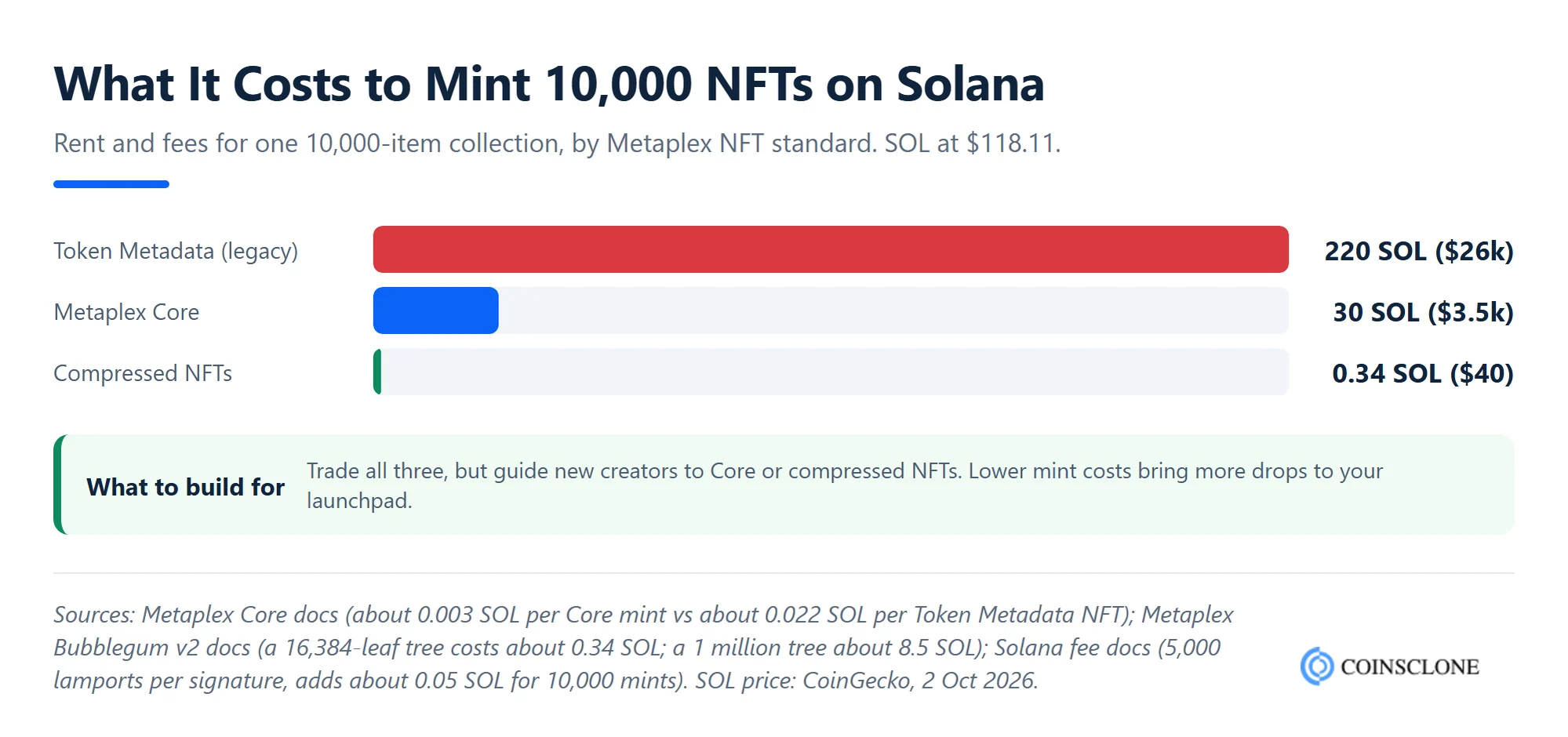
In short, support all three for trading, then guide new creators to Core or compressed NFTs. For more detail on how these compare with Ethereum options, see our guide to NFT token standards.
Tech Stack and Architecture of a Solanart Clone
An NFT market on Solana has five layers. Each one can be swapped or scaled on its own, which keeps the platform fast as volume grows.
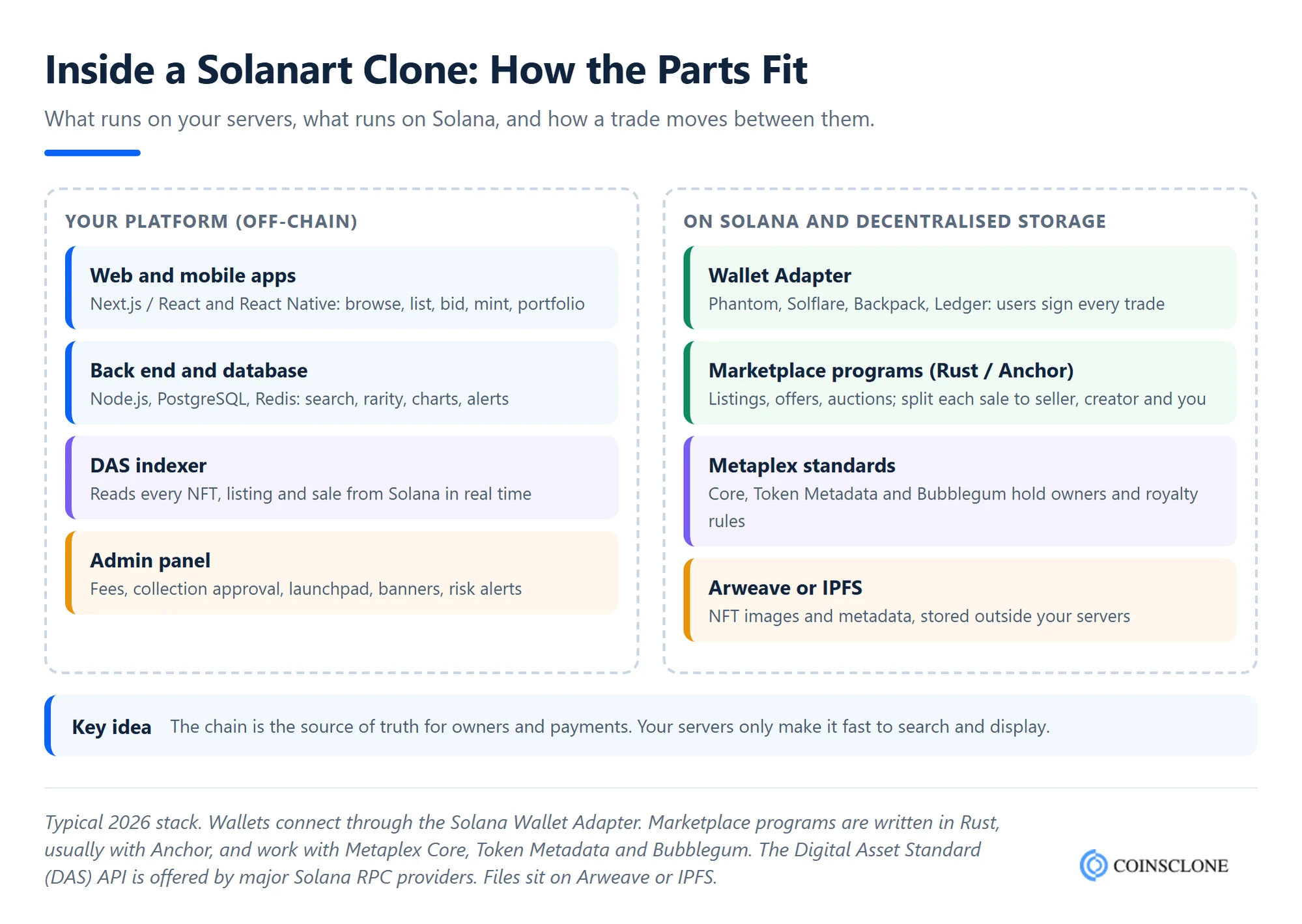
- Front end: React or Next.js with TypeScript for the web app, and React Native or Flutter for mobile apps.
- Wallet layer: The Solana Wallet Adapter, so users can connect Phantom, Solflare, Backpack and other wallets.
- On-chain programs: Rust smart contracts, usually written with the Anchor framework, for listings, offers, auctions and fee splits. They work with all three Metaplex standards.
- Indexer and back end: A DAS API (Digital Asset Standard) reads each NFT and trade from the chain. Then a Node.js back end with PostgreSQL and Redis runs search, charts and alerts.
- Storage: NFT images and metadata on Arweave or IPFS, so the files stay live even if your servers go down.
For a deeper look at each layer, read our NFT marketplace tech stack guide.
Is There Open Source Solana NFT Marketplace Code on GitHub?
Yes. Tensor made its five core programs public in 2024: marketplace, AMM, whitelist, escrow and fees. You can find them on Tensor Foundation’s GitHub under the Apache 2.0 licence. Metaplex also shares the code for its NFT standards.
Open code is a good start, but it is not a product. You still need the web and mobile apps, the indexer, the admin panel and hosting. You also need an audit of any code you change, and a team to keep it all running. Here is how the three routes compare.
| Route | What you get | Best for |
| Open source code | On-chain programs and SDKs, with no apps, admin or support | Teams with their own Solana and Rust devs |
| Clone script | A tested, branded product with apps, admin and support | Founders who want to launch in weeks |
| Custom build | Your own programs and features, built from the ground up | Funded teams with a new trading idea |
Many teams mix the routes. They start with a clone script, then add custom programs once they know what their users want.
How to Build an NFT Marketplace on Solana Like Solanart
Launching with a clone script follows a clear path. Here are the six steps most teams take.
- Pick your niche: Decide who you serve, such as gamers, artists, a brand’s fans or a local market. This shapes every later choice.
- Choose your scope: Pick the standards, features and add-ons you need at launch, and leave the rest for later.
- Brand and design: Add your name, logo, colours and home page layout to the white label script.
- Set fees and rules: Choose your trading fee, royalty policy, launchpad terms and any KYC rules.
- Test and audit: Test every flow on Solana devnet, then have the on-chain programs audited before mainnet.
- Launch and grow: Go live on mainnet, sign your first creators, and use launchpad drops and rewards to bring in traders.
What You Get With Our Solanart Clone Script
Launching an NFT market is not just about the software. It is about a complete, production-ready setup. Our Solanart clone script gives you each part you need to run, grow and earn from your own NFT market on Solana. Each part can be shaped to fit your brand, features and business model.
Solanart Clone App (Android + iOS)
A fully branded mobile NFT trading app built for fast Solana trades. Users can mint NFTs, browse collections, track their portfolio and buy right from their phones. The app includes wallet links, push alerts and a clean, easy design that keeps users coming back.
White Label Solanart Clone Script
A ready NFT market script built on Solana and Metaplex standards. It comes with creator tools, listing flows, an admin panel, trading tools, rarity filters and safety tools. The script is fully white label, so you launch under your own brand with full control over design, features and fees.
Advantages of Our Solanart Clone Script
Our Solanart clone script gives your NFT market a clear head start from day one. Every part is built to help you launch faster, scale with ease and turn visitors into traders.
1. Go Live Fast, Stay Stable
We hand over a tested, ready-to-run market that works from day one. So you can enter the market quickly without trading off stability, security or speed.
2. Built for High-Volume NFT Trading
Our design is tuned for Solana’s speed. It handles busy trading, instant confirms and low-cost trades. That is a big plus for games and collectibles.
3. Brand Ownership From Day One
You control it all: the design, features, flows, fees and brand. In other words, you grow under your own brand, not ours.
4. Built for Both Creators and Buyers
The platform is built to attract both sides of the market. Creators get simple mint tools, while buyers get clean search, rarity data and smooth checkout.
5. Modular Add-On Ecosystem
As your market grows, you can switch on add-ons like the launchpad, rarity engine, auctions or token payments. That way, you add features without rebuilding the core.
How a Solanart Clone Script Makes Money
A Solanart clone script lets your market earn from day one. It can earn each time users trade, mint, list or promote a drop. As your platform grows, these income streams grow with it.
- Trading fee commissions: Usually around 2% of each sale, the rate Magic Eden and Tensor charge.
- Royalty share: A small cut of creator payouts, or a fee for royalty tools.
- Paid promotion: Top spots on the home page and in search.
- Launchpad and minting fees: A cut of primary sales for drops you host.
- Listing and badge fees: A fee for a checked badge and a faster review.
- In-app token utility: Fee discounts and rewards paid in your own token.
- Advertising: Banner spots for projects, wallets and Web3 brands.
Here is how one sale splits when a buyer pays a 2% marketplace fee and a 5% creator royalty on top of a 10 SOL price.
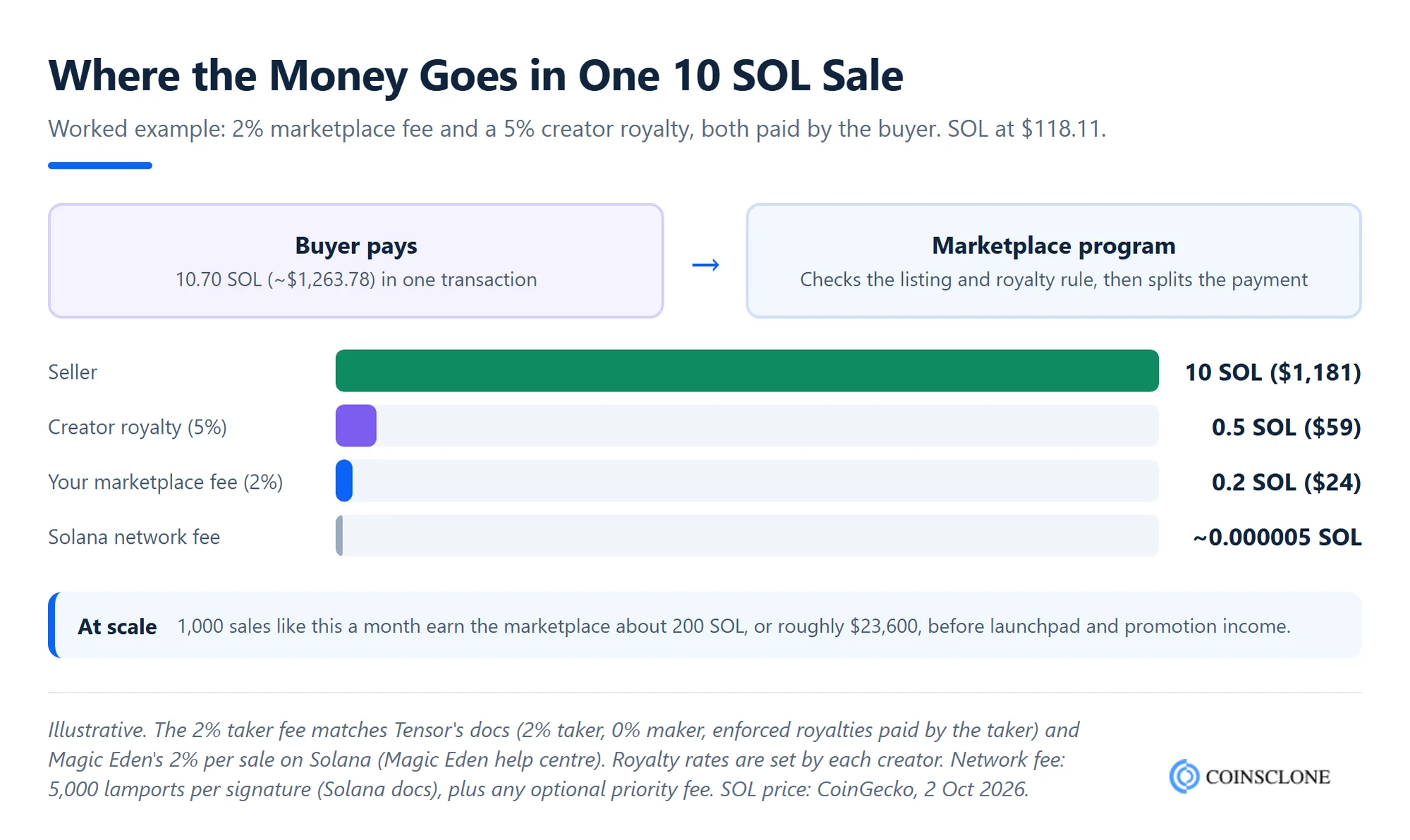
At 2 October 2026 prices, that one sale earns the market about $23.60. So 1,000 sales of that size each month would bring in about $23,600. To see how other NFT platforms mix these streams, read our guide to the NFT marketplace revenue model.
How Much Does a Solanart Clone Script Cost, and How Long Does It Take?
Cost and time depend mostly on scope. A white label marketplace on one chain is the fastest route. In contrast, a custom launchpad or several chains add months. Here are the build times Coinsclone lists for NFT markets:
| Scope | Timeline | What it includes |
| White label marketplace | 4 to 6 weeks | Rebranded platform, standard listings, one chain |
| Standard marketplace | 9 to 13 weeks | Custom listings, auctions, royalties, indexing, audit |
| Marketplace with launchpad | 4 to 7 months | Primary drops, creator vetting, advanced curation |
| Multi-chain marketplace | 6 to 11 months | Several chains, cross-chain listings, full tooling |
On budget, 2026 market guides put each build path in these ranges:
| Build path | Typical cost (2026) |
| White label or clone script | $10,000 to $30,000 |
| Custom MVP | $20,000 to $45,000 |
| Mid-tier platform with auctions, royalties and search | $40,000 to $80,000 |
| Enterprise platform with several chains, KYC and mobile apps | $80,000 to $150,000+ |
On the lower tiers, a smart contract audit adds about $5,000 to $25,000, and native mobile apps add about $15,000 to $60,000. These are market ranges, not a quote. For a full breakdown, see our guide to NFT marketplace development cost.
A tip on savings: most of the gap between a cheap build and a costly one comes from custom programs and extra chains. Start on Solana with a white label core and add modules later. That way, you launch for far less and spend only on what users ask for.
Why Choose Coinsclone for Your Solanart Clone Script?
Coinsclone is a trusted NFT marketplace development company that has been building blockchain products since 2018. Our team has delivered 350+ platforms for 200+ clients across 20 industries. Our Solanart clone script uses today’s Solana standards, such as Metaplex Core and compressed NFTs. It also works with Phantom, Solflare and Backpack out of the box.
We build Solanart-style markets as white label launches in 4 to 6 weeks, or as fully custom platforms with your own launchpad and programs. We also build related products, such as a Magic Eden clone script and Solana token development for your own market token. If you want a fast, safe NFT market on Solana that can grow with you, Coinsclone is ready to help you launch it.
Frequently Asked Questions
What is Solanart?
Solanart is the first full NFT market built on Solana. It launched in 2021 and lets users buy, sell and trade Solana NFTs. It also offers a launchpad, on-chain chat, NFT loans and editable fees for each collection.
Is Solanart still working in 2026?
Yes. Solanart was still live at solanart.io when we checked on 26 October 2026. It is now a small, older market, though. Most Solana NFT trading runs through Magic Eden and Tensor.
What is a Solanart clone script?
A Solanart clone script is prebuilt code that copies the main features of the Solanart NFT market. It includes modules for minting, listing, buying, auctions and wallet support, all built to run on Solana.
How does a Solanart clone script work?
The script gives you the front end, back end and on-chain programs an NFT marketplace needs. Your team adds its brand, links wallets like Phantom, and sets the rules and fees. Then it goes live on Solana.
What wallets does a Solanart clone script support?
It works with the main Solana wallets, such as Phantom, Solflare and Backpack, along with hardware wallets such as Ledger. You can add more wallets as your users need them.
What features does an NFT marketplace like Solanart need?
The core features are NFT minting, listing, offers, auctions, collection pages, filters, royalties, wallet login and an admin dashboard. In 2026, users also expect collection-wide offers, sweeps, rarity ranks and real-time alerts.
How long does it take to build an NFT marketplace like Solanart?
A white label marketplace takes about 4 to 6 weeks. A standard custom build takes 9 to 13 weeks, and a marketplace with its own launchpad takes 4 to 7 months.
How much does it cost to build a Solanart-like NFT marketplace?
Market guides in 2026 put a white label NFT marketplace at about $10,000 to $30,000 and a custom MVP at about $20,000 to $45,000. A mid-tier platform costs about $40,000 to $80,000, and an enterprise build about $80,000 to $150,000 or more. The final price depends on your scope.
Is a Solanart clone script legal to use?
Yes. A clone script copies the features and flow of Solanart, not its brand, name or code. So use your own name and logo, and never present your site as Solanart. Also check the rules where you operate, since some regions ask NFT markets to run KYC or AML checks.
What is the revenue model of a Solanart clone script?
Most income comes from trading fees, often about 2% of each sale. Other streams include launchpad and minting fees, featured listings, verification fees, ads and in-app token utility.
Can you change a Solanart clone script?
Yes. You can change the design, add new trading features, support more wallets, add analytics or write custom on-chain logic to fit your market.
What tech stack is used in a Solanart clone script?
Most teams use Rust and Anchor for the on-chain code and Metaplex standards for NFTs. The front end is TypeScript with React or Next.js, wallets link through the Solana Wallet Adapter, and NFT files sit on Arweave or IPFS.
Can I clone a Solana token for my marketplace?
You can make your own SPL token with the same setup as an existing Solana token, such as its supply and fee rules. You cannot copy the original token itself, since each token has its own mint address. Many markets launch a token for fee discounts and rewards. See our Solana token development service for how that works.
How secure is a Solanart clone script?
Security depends on audited programs and a well-built back end. A good script follows Solana’s safety advice and uses tested code. It also keeps NFTs in users’ own wallets and blocks fakes, bots and false listings.
Launch a Next-Gen NFT Marketplace with Our Solanart Clone Script
Your NFT Platform — powered by Solana’s speed and scalability.
- Solana Advantage: Ultra-fast transactions with negligible gas fees.
- Built for Creators & Collectors: Enable minting, auctions, and instant NFT sales.
- Brand Ownership: Fully customizable UI, theme, and market parameters.
- Business Ready: Integrated wallets, royalty models, and revenue dashboards.
See a free branded demo of your NFT marketplace in 48 hours — before you invest a cent.
Book a Free Call to explore how our Solanart Clone Script can help you dominate the Solana NFT space in just 8–12 weeks.