
NFT music marketplace development means building a platform where artists mint and sell songs, albums, tickets and fan passes as NFTs, and fans buy, play and resell them. In 2026, a white label music NFT marketplace costs about $10,000 to $30,000 and can launch in 4 to 6 weeks. A custom platform with audio streaming and split royalties usually costs $40,000 to $80,000 or more.
This guide shows how a music NFT sale works, the three ways to build a platform, and the features artists and fans expect. You will also see how royalty splits pay every person on a track, and which rights and rules to settle before launch. The music NFT space has changed a lot. Sound.xyz, Catalog, Opulous and Nina Protocol all closed in 2026, while Audius, OpenSea and Zora kept running. So this guide uses current facts and shows what those closures teach a new founder.
In this guide:
- What NFT music marketplace development covers, and how it differs from a general NFT marketplace
- How one music NFT sale splits money between the artist, producer, featured artist and your platform
- What each build route costs, and Coinsclone’s published delivery times
- The copyright, royalty and token rules to check before you list a single track
- What the 2026 shutdowns of Sound.xyz, Catalog, Opulous and Nina Protocol teach new music NFT platforms
Launch a Music NFT Marketplace to Empower Artists and Fans
NFT Music Marketplace Development — designed for musicians, collectors, and fans.
- Tokenize Music Assets: Mint NFTs for tracks, albums, and concert tickets.
- Interactive Features: Auctions, limited editions, and fan engagement tools.
- Secure & Scalable: Robust platform with admin control and wallet integration.
- Monetization Opportunities: Earn via NFT sales, royalties, and premium experiences.
See a free branded demo of your NFT marketplace in 48 hours — before you invest a cent.
Book a Free Demo to discover how our NFT Music Marketplace Development can help you launch a profitable and engaging music NFT platform in just 8–12 weeks.
What Is NFT Music Marketplace Development?
NFT music marketplace development is the process of building a platform where artists mint, sell, trade and manage music NFTs (non-fungible tokens). These NFTs can hold a single track, a full album, cover art, a concert ticket, a rare collection or a fan membership. If you are new to the idea, our guide on NFTs in music explains the basics first.
A music NFT is a token on a blockchain that proves who owns a piece of music content and what comes with it. The music file itself usually sits on decentralized storage, while the token points to it. The token also carries the rules: who gets paid, how much and when.
Here are the music NFT types a marketplace usually supports:
| NFT type | What the fan gets | Good for |
| Limited edition track or album | A numbered copy, often with bonus art or stems | New releases and superfan drops |
| 1 of 1 collectible | A single unique piece, such as an unreleased demo | High-value auctions |
| Ticket NFT | Entry to a live or virtual show, with resale rules | Concerts and festivals |
| Membership or access pass | Gated content, early drops, private community | Ongoing fan clubs |
| Royalty-share NFT | A share of a song’s streaming or sales income | Fan funding (needs legal review) |
The development work covers the smart contracts, the web and mobile apps, the audio player, wallet and payment links, storage and the admin tools. The way you build it shapes your cost, time to market and long-term growth.
How a Music NFT Marketplace Differs From a General NFT Marketplace
A music platform needs more than a general art marketplace. These are the parts that set it apart:
- Audio player and previews: Fans want to listen before they buy. So the platform streams a short preview to everyone and unlocks the full, high-quality file only for holders.
- Split payouts: A track often has an artist, a producer, a songwriter and a featured singer. Each one needs an automatic share of every sale, not just one creator wallet.
- Rights and licence terms: Buyers need to know if they get a collectible only, or also the right to use the music. This must be written into the listing.
- Fan-friendly checkout: Many music fans have never used a crypto wallet. Card payments and email sign-in lower that barrier.
- Live event tools: Ticket NFTs need scanning at the door, resale price caps and anti-fraud checks.
How Does an NFT Music Marketplace Work?
An NFT music marketplace lets artists turn their music into NFTs and sell them straight to listeners. Here is how it works:
1. Prepare the Digital Asset: Artists start by getting their content ready, such as a track, an album or a live set. They also agree on the split with everyone who worked on it.
2. Connect the Wallet: The artist connects a crypto wallet to the marketplace, or the platform creates one for them on sign-up. This wallet stores NFTs, handles payments and holds earnings.
3. Mint the Music NFT: The musician uploads the file and turns it into an NFT through minting. This step records the music on the blockchain, so anyone can check who made it and who owns it.
4. List the NFT for Sale: The new NFT is listed with its price, supply limit, royalty rate and licence terms. Collectors can now find and buy it on the marketplace.
5. Purchase and Ownership Transfer: Fans pay in crypto or by card, based on what the platform supports. Once the payment clears, ownership moves straight to the buyer’s wallet.
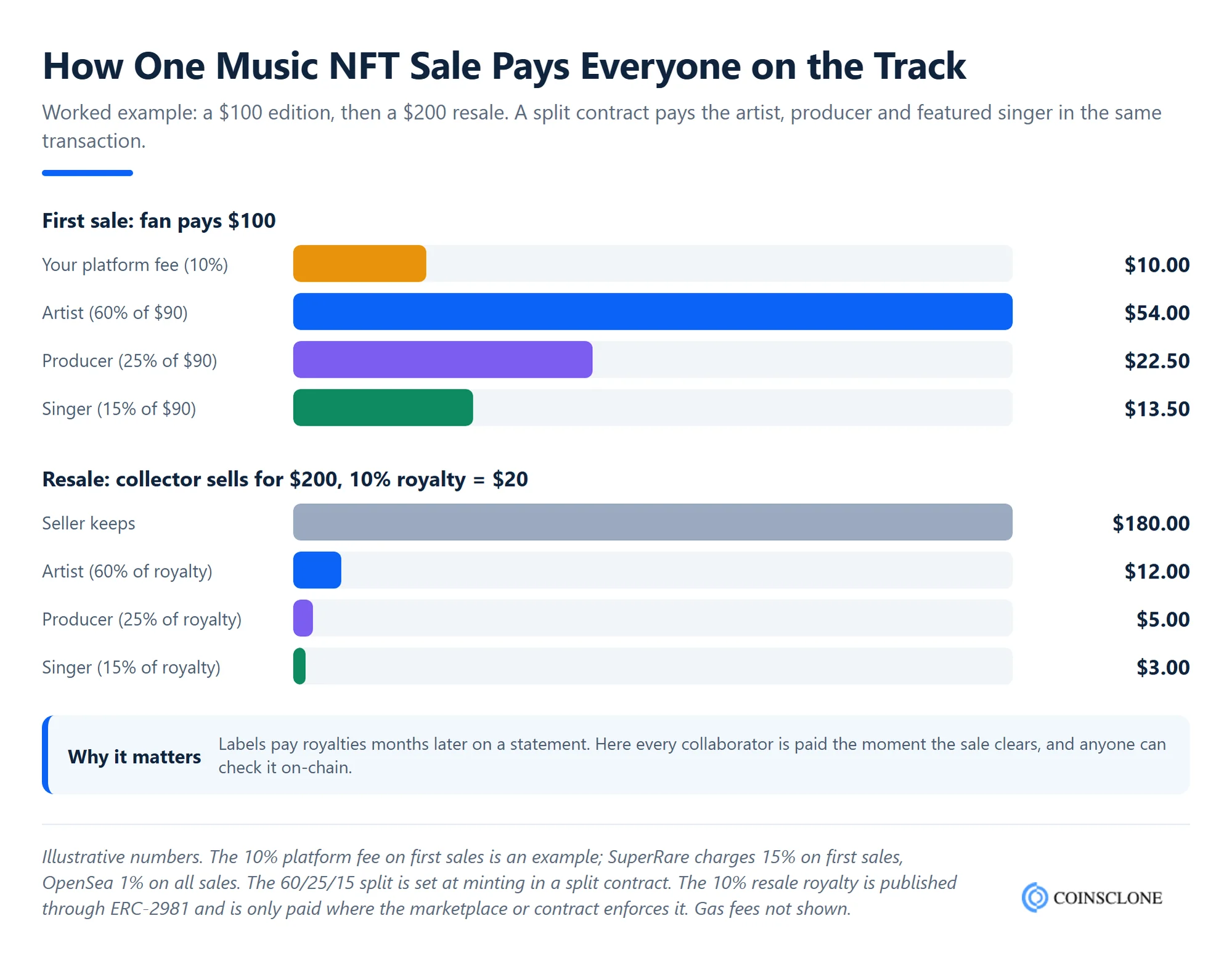
6. Earn Royalties on Resales: If the NFT is resold later, the artist and the team can earn a cut of the sale. This creates income long after the first release.
The diagram below follows the money in a worked example, from the first sale to a later resale.
Now that you know how a music NFT marketplace works, let’s look at the ways to build one.
3 Ways to Build an NFT Music Marketplace
There are three common ways to build a music NFT platform. Each one differs in cost, build time and how much you can change.
Custom Build (From Scratch)
The first way is to build the platform from scratch. Here, the team designs each part from the ground up. From the screens to the smart contract logic, all of it is made just for you. This route gives you the most control and a long-term edge, but it also takes the most time, money and skill.
A custom build with your own contracts, audio streaming and several chains is a large project. Coinsclone’s published range for a multi-chain platform is 6 to 10 months. In 2026, an enterprise build of this kind costs about $80,000 to $150,000 or more.
White Label NFT Marketplace Solution
A white label platform is a quick and solid route for startups. The features, tools and plugins are already built and well tested. So you add your brand, music tools and chosen chain, then launch without the hassle of a full build.
White label software also saves a lot of time. Coinsclone’s published timeline is 4 to 6 weeks for a standard white label build, or 7 to 10 weeks with creator minting. That is why many founders pick a ready-made white-label NFT Marketplace Software from a trusted provider and then add music tools on top.
| Factors | Custom Development (From Scratch) | White Label NFT Marketplace Solution |
| Approach | The platform is built from the ground up (UI, backend, smart contracts). | A ready-made marketplace that you customize and rebrand. |
| Launch Time | 9 to 13 weeks for a standard custom build, up to 6 to 10 months on many chains (Coinsclone’s published range) | 4 to 6 weeks, or 7 to 10 weeks with creator minting (Coinsclone’s published range) |
| Market Cost Range | About $20,000 to $150,000+, based on scope | About $10,000 to $30,000 |
| Best For | Businesses that want fully custom features and scale. | Startups that want a fast entry with a lower budget. |
| Advantages | Full control and unique branding. | Fast launch, lower cost and tested code. |
| Limitations | Takes more time, costs more and needs expert skills. | Less room to deeply change core functions. |
Hire NFT Marketplace Developers
Hiring a team gives you a balance between custom work, cost and speed. When you hire NFT marketplace developers, you get skilled builders who can add minting, split payouts, wallet links and support for more chains. They do this without building each part from zero. So this route cuts your time to launch and still gives you a safe platform that can grow with you.
How Much Does NFT Music Marketplace Development Cost?
NFT music marketplace development costs about $10,000 to $30,000 on white label software, and $20,000 to $150,000 or more as a custom build. Most music platforms land in the $40,000 to $80,000 band, because audio streaming and split royalty payouts add real work. The ranges below come from published 2026 agency cost guides. They match the figures in our full NFT marketplace development cost guide.
| Build type | Cost range | What you get |
| White label music NFT marketplace | $10,000 to $30,000 | Your brand, listings, minting and sales on one chain, with music tools added on top |
| Custom MVP | $20,000 to $45,000 | Wallet connect, minting, fixed price sales and artist profiles |
| Mid-tier music platform | $40,000 to $80,000 | Audio streaming, split royalty payouts, auctions, card checkout, search and filters |
| Enterprise or multi-chain platform | $80,000 to $150,000+ | Many chains, KYC, mobile apps, ticketing and a larger audit |
A few music parts push the price up. A media server or CDN streams previews. Split payout contracts need a careful audit, since they move money to many wallets at once. And a rights check on each upload takes admin time.
On top of the build, plan for running costs. Hosting and servers often cost $500 to $5,000 a month, based on traffic. Audio files are large, so storage matters too: Pinata’s IPFS plans cost $20 a month for 1TB or $100 a month for 5TB. Then add card payment fees and marketing.
How Long Does It Take to Build an NFT Music Marketplace?
A white label NFT music marketplace takes 4 to 6 weeks to launch, and a custom platform takes from 9 weeks to 10 months. Here are Coinsclone’s published build times:
| Build route | Time to launch | Good for |
| White label NFT marketplace | 4 to 6 weeks | A fast launch on proven code |
| White label with creator minting | 7 to 10 weeks | Music platforms where artists mint their own tracks |
| Standard custom platform | 9 to 13 weeks | Your own design and feature mix |
| Marketplace with launchpad | 4 to 6 months | Curated drops with artist vetting and revenue splits |
| Multi-chain platform | 6 to 10 months | Large platforms on many chains |
Your feature list, the audit and any app store review can move the final date.
Key Features of an NFT Music Marketplace
In a crowded NFT market, a music platform wins users with features built for listening and fans. Here are the key features to include:
- User and Admin Panel: A clean dashboard for fans and a strong control panel for your team. Admins manage listings, fees, artists and reports in one place.
- Audio Player and Previews: A built-in player streams short previews to all visitors and the full track to holders. This turns browsing into listening.
- Safety Tools: Rare music NFTs are worth real money, so the platform needs strong protection. Two-step login, wallet recovery, outside wallet support and audited contracts build trust.
- Catalogs: One shared catalog helps fans find tracks, albums and sets fast, sorted by artist, genre or release.
- Ratings: Ratings tell buyers more about a music NFT and help them decide faster.
- Rankings: Rankings show trending tracks and albums based on sales, price and plays.
- Bundles: Bundles let users group several NFTs, such as a full album or a set of 30+ tracks, into one listing.
- Auctions: Auctions suit rare, high-priced pieces. The seller sets a starting price and a reserve, and the top bid wins.
- Split Payouts: Each sale pays the artist, the producer and the rest of the team at once, based on shares set at minting.
- Card Checkout and Email Sign-In: Fans can pay by card and log in with email, while the platform creates a wallet in the background.
Beyond these core features, you can add cross-chain support, push alerts, detailed stats, more ways to pay, a custom design and a code audit. You can also tune each feature to your business needs.
Also Read: Tech Stacks Needed to Build an NFT Marketplace
Now, let’s look at the add-on modules that make a music platform stand out.
Top Add-On Modules for a Music NFT Platform
- Auto Royalty Payouts: Shares income with artists, producers and their team on each first sale and resale. Smart contracts do the math, and anyone can check it.
- Shared Ownership: Splits a high-priced music NFT into parts, so many fans can co-own a song or album. Our guide to fractional NFT marketplace development covers how this works.
- Fan Passes and Gated Access: Gives NFT holders and paying fans access to special releases, private groups, studio clips and early drops.
- Staking and Fan Rewards: Lets users stake music NFTs or platform tokens to earn rewards, such as bonus tracks, discounts, VIP access or voting rights.
- Concert Tickets: Sells NFT tickets for live shows and online concerts. It adds fraud checks, resale price caps and a cut for the artist when tickets change hands. Our guide to NFT ticketing marketplace development covers this module in depth.
- Artist Stats: Gives artists and admins live data on sales, payouts, plays and fan habits, so they can make better choices.
Copyright, Royalties and Legal Rules for Music NFTs
Most music NFT problems are not about code. They come from unclear rights, unpaid royalties or tokens that fall under finance laws. So settle these points before your first drop.
Copyright does not move with the token. Buying a music NFT does not give the buyer the copyright in the song. A joint report on NFTs and intellectual property by the US Copyright Office and the USPTO (March 2024) found that many buyers and sellers do not know which rights an NFT sale includes. It asked for clearer terms, not new laws. So your listing page should state in plain words what the buyer gets: a collectible only, the right to listen at home, or a written licence for business use.
Royalties are a signal, not a guarantee. The ERC-2981 royalty standard lets an NFT tell marketplaces who should get a royalty and how much. However, paying it is up to each marketplace. If resale royalties matter to your artists, enforce them in your own NFT smart contracts or limit trading to venues that honor them.
NFTs that share income can count as securities. An NFT that promises buyers a share of streaming income looks a lot like an investment. In the US, it may be judged under the Howey test. In the EU, MiCA leaves unique NFTs out of scope, but large series or fractions of one asset can fall back in. Get legal advice before you sell income rights.
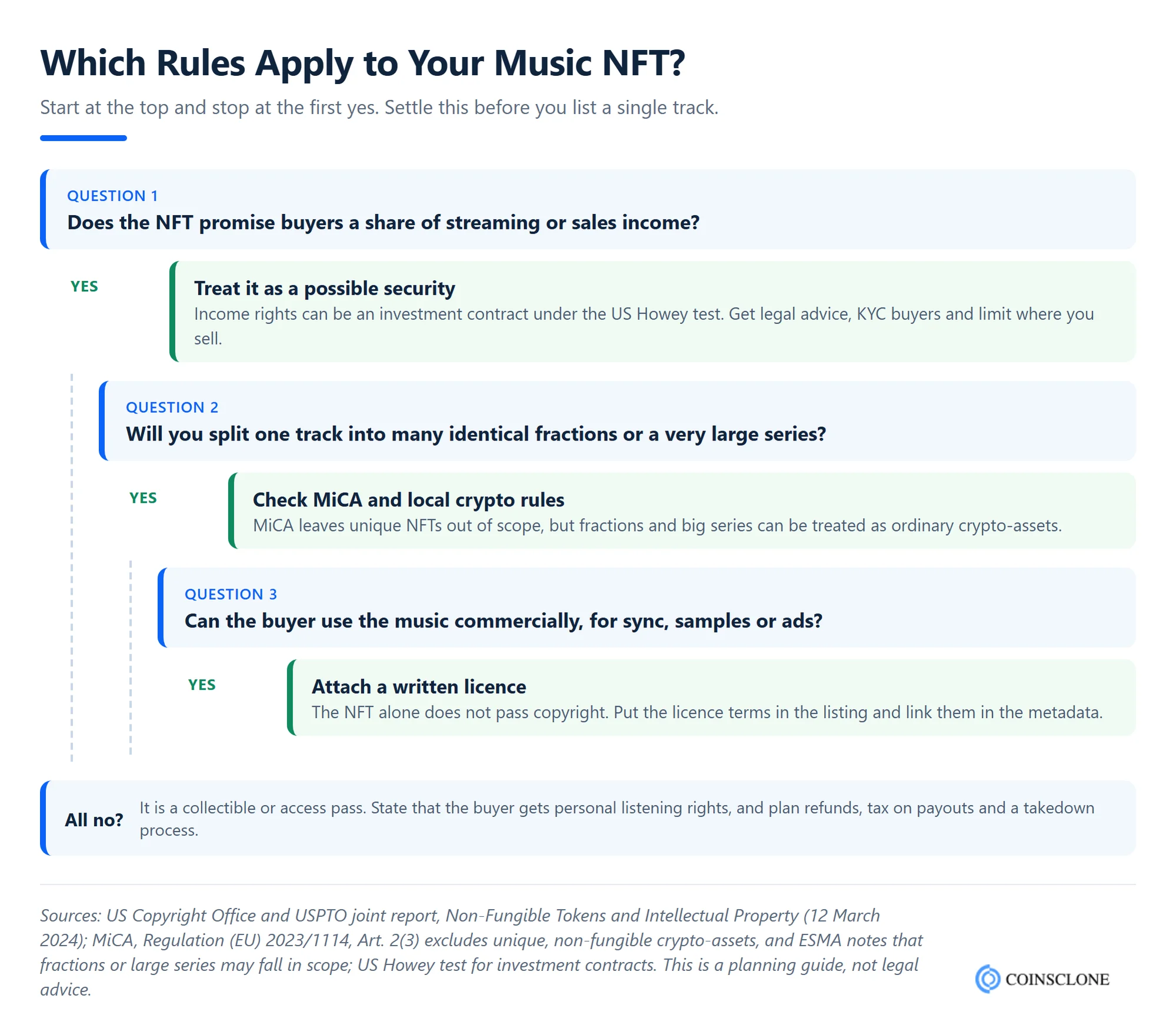
Other checks to plan for include ID and money laundering checks for card payments, tax on artist payouts and a takedown process for uploads that copy someone else’s music.
Best Blockchains and Tech Stack for a Music NFT Marketplace
For most music platforms, a low-fee chain such as Base, Polygon or Solana is the best place to start, since fans buy cheap editions and tickets. Ethereum adds reach for high-value 1 of 1 pieces. Beyond the chain, a music marketplace needs the usual NFT stack plus tools for audio. Here are the main parts:
- Blockchain: Ethereum gives the widest reach. Base and Polygon keep the cost of cheap editions low. Solana suits fast, low-fee trading, and Tezos has a long-standing art and music scene.
- Token standards: ERC-721 for 1 of 1 pieces, ERC-1155 for editions and tickets, and ERC-2981 for royalty data. Our guide to NFT standards compares the options.
- Storage: IPFS for content addressing, with paid pinning so files stay online, or Arweave for permanent storage. Catalog kept its music on Arweave, so those records stayed online after it closed in 2026.
- Audio delivery: A media server or CDN for streaming previews, with signed links so only holders reach the full file.
- Wallets and payments: Browser and mobile wallets, embedded wallets for email sign-in, and a card payment provider.
- Indexer and backend: A service that reads on-chain sales and keeps prices, profiles and charts up to date.
Support for several chains lets artists pick the network that fits their fans and price point. It also gives your platform more reach and a backup if one network gets busy or costly.
Music NFT Marketplace Clone Scripts: Build Like OpenSea, Rarible or SuperRare
Many founders model their platform on a proven one, then add music tools on top. Here are the leading NFT platforms that still list music NFTs in 2026, and how a clone script can help.
OpenSea
OpenSea is the best-known NFT platform, and it lists audio NFTs next to art and other items. It charges a 1% fee on sales across all its chains. If you want to create an NFT Marketplace like OpenSea, a white label OpenSea clone gives you the same core flows with your own music features.
Rarible
Like OpenSea, Rarible lists a wide range of NFTs, and music is one of them. In May 2026, a company called IMPOSSIBLE bought the Rarible brand and core platform, while the RARI token stays with the RARI Foundation. Rarible runs on several chains and added Solana in August 2026. Many new founders want to create a Rarible-like NFT Marketplace that draws in music lovers.
SuperRare
SuperRare is known for top-end digital art and also lists hand-picked audio and video pieces. It takes 15% of first sales and gives artists 10% of each resale. Startups that plan a hand-picked, artist-first music platform often build an NFT Marketplace like SuperRare, with checked artists and auction sales.
Enjin
Enjin is an NFT platform with its own blockchain and its own market, NFT.io, best known for game items. Its low fees and easy wallet make it a good base for music NFTs linked to games and online worlds. That is why some startups build an Enjin-like NFT marketplace that supports music NFT minting, royalties and smooth trading.
Is a Music NFT Marketplace Still Worth Building in 2026?
Yes, but only with a clear niche and more than one income line. The wider NFT market has cooled: CryptoSlam data reported by Cointelegraph shows NFT sales fell 37% to $5.63 billion in 2025. At the same time, Technavio forecasts the music NFT market will grow by $6.48 billion from 2025 to 2029, at a 32.3% CAGR. So there is room to grow, but only for platforms that give fans real value, not just a bet on price.
Music NFT Platforms Still Live in 2026
As of October 2026, these platforms are live and serve music fans in different ways:
- Audius: A free, community-run streaming platform. Artists upload for free and run fan clubs, paid downloads and remix contests, as its 2026 product update explains.
- OpenSea: The biggest NFT marketplace for all kinds of items. It lists audio NFTs next to art and charges a 1% fee on sales.
- Zora: Started as an art and creator platform. Today it is a social app where creators’ posts can be traded as coins.
Our list of the best NFT marketplaces compares fees and chains across the wider market.
Music NFT Platforms That Closed in 2026
Four platforms built for music went offline in 2026, along with one large art platform that also listed music:
- Sound.xyz: Went offline on 16 January 2026. Its team now runs a new fan app, Vault.fm.
- Catalog: Stopped sales on 2 March 2026 and switched off on 9 March, after paying more than $3 million to artists.
- Opulous: Sold shares of song royalties as tokens. After a bridge exploit in March 2026, it shut down its platform, and services went offline after 30 April 2026.
- Foundation: The art platform went offline on 27 April 2026 after a planned sale fell through.
- Nina Protocol: Turned off uploads and sales in May and went fully offline on 15 July 2026, as Resident Advisor reported. It said it could not find a revenue model that worked at its size. SoundCloud then bought Nina’s assets on 22 July 2026, and Nina artists can choose to move their music to SoundCloud.
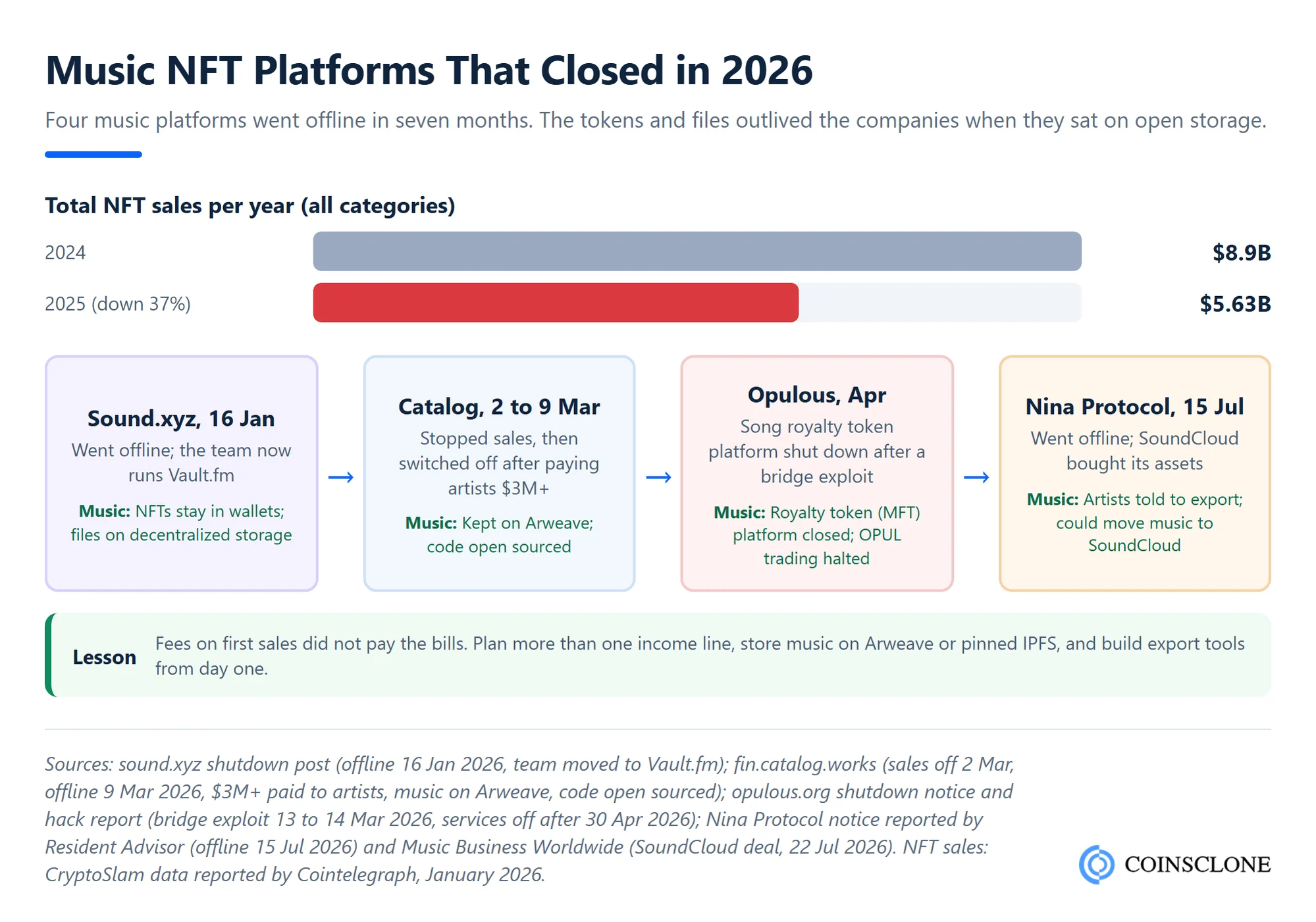
The lesson is clear. Platforms that lived mainly on first-sale fees could not survive when trading fell. Opulous also shows how a token tied to royalties can sink a whole platform once its market breaks. So plan several income lines from day one, such as memberships, tickets and B2B services for labels. Our guide to the challenges and opportunities of creating an NFT marketplace covers these risks in more depth.
What Happens to Music NFTs When a Platform Shuts Down?
The NFTs stay in the buyers’ wallets, and the music stays online if it sits on open storage. When Nina Protocol announced its closure in May 2026, users on its Reddit community asked how to download or export their favourites. Nina gave users six weeks to withdraw earnings and export releases and purchases. Sound.xyz told its fans that the tokens and music data live on-chain and on open storage, so they still show in wallets such as OpenSea.
What fans lose is the platform itself: the player, the feed, the perks and the fan community. So build your platform so it can close gracefully, even if you never plan to:
- Store audio and art on Arweave or pinned IPFS, and put the content hash inside the token.
- Pay artists through on-chain splits, so no earnings sit stuck in a company account.
- Give artists and fans one-click export of releases, purchases and earnings.
Benefits of Building a Music NFT Platform
Music connects with people in a way few other assets can. That is why music NFTs stand out from other NFTs. Building a music NFT platform offers several benefits for startups and founders.
Multiple Income Streams
A music NFT platform can earn from sales fees, listing fees, fan passes, tickets and ads. You can adjust each one as your user base and marketing plan grow.
Global Reach
Music fans live everywhere, and a blockchain platform works across borders from day one. Fans in any country can buy a drop with a wallet or a card, without a local label deal.
Fan Funding
Artists can fund an album or a tour by selling early-access NFTs to fans. This replaces part of the old label advance and gives fans a real stake in the release.
Stronger Fan Communities
Rare tracks and gated perks create a loyal fan base around each artist. That leads to repeat visits, more time on site and more traffic on your platform.
Fairer Pay for Artists
Smart contracts pay each person on the track their share the moment a sale clears. Artists see each payment on-chain instead of waiting months for a label report.
These benefits are real, but they only pay off when fans get lasting value, such as access, tickets and perks, not just a bet on price.
How an NFT Music Marketplace Makes Money
- Sales Fee: The platform takes a small share of each sale, which brings in steady income. You can adjust the rate based on market rules and rivals.
- Listing Fees: You can charge artists to list their NFTs. Prices can change by NFT type or promo level, which gives artists choice and brings in more income.
- Paid Extras: VIP accounts, featured listings, sales stats and special promo slots.
- Fan Plans: Special content or perks for a monthly fee. This model keeps users active and brings in steady income.
- Brand and Label Deals: Paid deals with brands, labels or other artists to promote content, with ads aimed at the right fans.
For more ways to earn, see our guide to the NFT marketplace revenue model. Next, let’s look at the steps to build an NFT music marketplace.
How to Build an NFT Music Marketplace in 5 Steps
Building an NFT music marketplace takes five steps: plan the business, pick the tech, design the screens, build the core and then test and launch. Here is how our team runs each step:
- Plan the Business: We map your target users, goals, income streams and core features, such as minting, split payouts and trading.
- Pick the Tech: We choose the right blockchain, token standards, wallets and storage for safe music NFTs that can scale.
- Design the Screens: We design simple screens and flows for artists and fans, so sign-up and browsing feel easy.
- Build the Core: We write the smart contracts for minting, transfers and split payouts. Then we add listings, auctions, the audio player and payments.
- Test, Launch and Support: We run safety tests and audits, launch on the main network and keep the platform up to date.
Build Your Own NFT Music Marketplace – Empower Artists, Fans & Collectors!
Single Track NFTs, Music Album Drops, Tokenized Concert Tickets, and Exclusive Collector Editions — all in one platform. Get A Free Consultation!
How to Choose an NFT Music Marketplace Development Company
Pick a company that has built music features before, not just a generic NFT shop. Music adds audio, splits and rights work that a basic marketplace never needs. Use this checklist when you compare teams:
- Music features in past work: Ask to see an audio player with holder-only files, split payouts and ticket NFTs in a live demo.
- Audited split contracts: Payout contracts move money to many wallets, so check who audits them and ask for the report.
- A rights workflow: The team should build licence terms into each listing and a takedown process for copied tracks.
- Lasting storage: Ask where the audio will live. Arweave or pinned IPFS keeps music online even if your platform changes.
- Fan-friendly checkout: Card payments and email sign-in should be standard, not an add-on.
- Clear times and support: Get a written timeline per build route and a support plan for after launch.
Why Choose Coinsclone for NFT Music Marketplace Development?
Coinsclone is a trusted NFT music marketplace development company. We have been building blockchain products since 2018 and have delivered 350+ platforms for 200+ clients across 20 industries. Our team offers full NFT Marketplace development services, and our NFT music marketplace development services include:
- White label music NFT marketplace solution: Ready, tested code with your brand, an audio player and split payouts, built on our tested marketplace software.
- Custom music NFT platform development: Your own design, chains and features, from fan passes to royalty-share drops.
- Smart contracts and audits: Minting, split payout, auction and ticket contracts, tested before launch.
- Apps and support: Web and mobile apps, plus upkeep and updates after launch.
We tailor each NFT platform for music, with a dashboard built for artists and fans.
We focus on your business goals and on a smooth launch. Along with the build, we give you support and upkeep after launch. Coinsclone can launch a white label music NFT marketplace in 4 to 6 weeks, or build a custom platform around your own model. Talk to our team to plan your NFT music marketplace today.
Frequently Asked Questions
What is NFT music marketplace development?
NFT music marketplace development is the process of building a platform where artists mint, sell and trade music NFTs, and fans buy, collect and resell them. It includes smart contracts, an audio player, wallets, payments and an admin panel.
How much does it cost to develop an NFT music marketplace?
A white label NFT music marketplace costs about $10,000 to $30,000. A custom MVP costs about $20,000 to $45,000, a mid-tier music platform with audio streaming and split payouts $40,000 to $80,000, and an enterprise build $80,000 to $150,000 or more. Audits, hosting and marketing are extra.
How long does NFT music marketplace development take?
Coinsclone’s published times are 4 to 6 weeks for a white label build and 7 to 10 weeks with creator minting. A standard custom build takes 9 to 13 weeks, a platform with a launchpad takes 4 to 6 months, and a platform on many chains takes 6 to 10 months. Your feature list and audit schedule can change the final date.
How do I sell my music as an NFT?
Mint your track on a general marketplace such as OpenSea, or on your own platform, then list it with a price, supply and royalty rate. Make sure you own or control the rights first, agree on splits with your collaborators, and state clearly what the buyer gets.
Which blockchain is best for a music NFT marketplace?
For most music platforms, a low-fee chain such as Base, Polygon or Solana is the best start, because fans buy cheap editions and tickets. Ethereum suits 1 of 1 pieces that sell for more. Many platforms support two or more chains so artists can pick.
What are the best music NFT marketplaces in 2026?
OpenSea is the largest marketplace that still lists music NFTs, and Zora lets creators turn their posts into coins that fans trade. Audius is a live streaming platform with fan clubs and paid downloads. Music-only sites such as Sound.xyz, Catalog and Nina Protocol closed in 2026.
Are music NFTs just DRM files you pay extra for?
No. A user on r/musichoarder asked this in 2025, and it is a fair worry. A music NFT is a proof of ownership, not a lock that ties the file to one app or device. Many platforms give holders a high-quality download, and the value comes from perks such as early access, tickets or a share of income. A good platform should never trap a fan’s music in its own player.
What is an NFT in the music industry?
In music, an NFT is a token that proves ownership of a track, album, ticket or fan pass. It can also pay the artist automatically on each sale. It gives musicians a direct way to sell to fans without a label in the middle.
How do musicians earn from music NFTs?
Artists can earn in two main ways:
- Primary sales: When the NFT is sold for the first time.
- Royalties: A share of each resale, where the marketplace or contract enforces it.
They can also earn from memberships, tickets and licensing deals linked to their NFTs.
Is NFT worthless now?
No, but the market is much smaller than at its 2021 peak. NFT sales fell 37% to $5.63 billion in 2025, per CryptoSlam, and several music NFT platforms closed in 2026. Value now comes from use, such as tickets, memberships and fan access, rather than price speculation.
What are the future trends in NFT music marketplaces?
The major trends include:
- Fan-first perks (special drops, backstage access)
- Cross-chain and multi-chain support
- Split payouts run by smart contracts
- Licence terms built into listings
- Albums, tickets and merch sold as NFTs
- Online concerts and virtual events
- Monthly fan plans
- Card payments and email sign-in for new fans
Launch a Music NFT Marketplace to Empower Artists and Fans
NFT Music Marketplace Development — designed for musicians, collectors, and fans.
- Tokenize Music Assets: Mint NFTs for tracks, albums, and concert tickets.
- Interactive Features: Auctions, limited editions, and fan engagement tools.
- Secure & Scalable: Robust platform with admin control and wallet integration.
- Monetization Opportunities: Earn via NFT sales, royalties, and premium experiences.
See a free branded demo of your NFT marketplace in 48 hours — before you invest a cent.
Book a Free Demo to discover how our NFT Music Marketplace Development can help you launch a profitable and engaging music NFT platform in just 8–12 weeks.