

Creating a crypto payment gateway is not just about integrating wallets or accepting Bitcoin at checkout. The real challenge lies in choosing the right architecture, blockchain, compliance model, and build approach decisions that can either scale your business or quietly break it six months after launch.
This guide is written for founders, startups, and businesses who want a clear, practical understanding of how to create a crypto payment gateway, from business modeling and technical architecture to security, compliance, and launch.
Instead of vague explanations, this article walks you through what actually matters at each stage, the trade-offs you’ll face, and how to avoid the most common mistakes that slow down or derail crypto payment gateway projects.
By the end of this guide, you’ll know exactly how a crypto payment gateway is built, which development approach fits your goals, and what to plan for before investing time or capital.
See How Our MVP System Can Launch Your Crypto Payment Gateway Faster
Crypto Payment Gateway Development — done right.
- MVP System : Build and launch your gateway 90% faster.
- Multi-Currency Support : Accept 100+ cryptos with zero manual setup.
- Merchant Dashboard : Full control over payments, invoices, and settlements.
- Security & Compliance : PCI-DSS level security and KYC-ready architecture.
Get a free branded demo of your payment gateway in just 48 hours — before you invest a cent.
Book a Free Demo to discover how our Crypto Payment Gateway Script can take you from concept to live gateway in just 8 to 12 weeks.
What is a Cryptocurrency Payment Gateway?
A cryptocurrency payment gateway is a digital payment processing system that enables merchants to accept crypto payments from customers in a fast, secure, and transparent way. It acts as a bridge between buyers, sellers, and blockchain networks, converting cryptocurrency transactions into equivalent fiat or crypto values seamlessly.
Unlike traditional payment gateways that rely on centralized banks or intermediaries, a crypto payment gateway uses blockchain technology to validate and record transactions on a decentralized ledger. This ensures lower transaction fees, global accessibility, and instant settlement without geographical restrictions.
Modern crypto payment gateways come with integrated merchant dashboards, API integrations, and multi-currency wallets that support leading coins like Bitcoin, Ethereum, and stablecoins.
Why Build a Crypto Payment Gateway? (Business Case for Startups)
Before kick-starting the crypto payment gateway development, it is important to know about the business perks of launching them. Here, we have illustrated the top points,
- Cross-border limitations – Unlike traditional payment gateways, the crypto payment gateway offers restriction-free global access.
- Recurring Revenue – For every successful transaction, enough revenue is generated with a small percentage or flat processing fee. This creates a consistent revenue stream that scales with merchant volume.
- First-Mover Advantage – In regions where banking infrastructure is limited, the crypto payment gateway solutions act as a first-mover with innovations.
- Ecosystem Expansion – The payment gateway acts as the foundation for building a broader ecosystem, where it paves the way to create wallet, exchange, lending platforms, subscription-billing systems, etc.
How Does a Crypto Payment Gateway Work?
A crypto payment gateway functions as a transactional layer between the customer’s crypto wallet and the merchant’s receiving account, ensuring secure payment flow and blockchain verification. Here’s how the process typically works:
-
Payment Initiation – The customer selects a cryptocurrency at checkout and triggers a transaction request.
-
Gateway Processing – The gateway generates a unique wallet address or QR code, calculates the required crypto amount, and forwards the payment details to the blockchain.
-
Blockchain Verification – The transaction is validated through the respective blockchain network (e.g., Bitcoin, Ethereum) and recorded immutably.
-
Merchant Notification – Once confirmed, the gateway notifies the merchant and updates the transaction status in the dashboard.
-
Fund Settlement – The received amount is transferred to the merchant’s crypto or fiat wallet, depending on conversion preferences.
How To Create A Cryptocurrency Payment Gateway in 6 Simple Steps
A full-fledged crypto payment gateway is built around essential features, security layers, and a modular architecture. To make the launch process seamless and cost-effective, follow this streamlined, strategic development plan:
- Decide the Type of Crypto Payment Gateway
- Regulatory & Banking Norms
- Core Architecture of a Crypto Payment Gateway
- Key Features To be Integrated
- Testing Process
- Crypto Payment Gateway Launch
STEP 1: Choose Your Crypto Payment Gateway Model
Determining the type of crypto payment gateway will be the primary and strategic move that helps you shape the entire payment ecosystem. Startups can either choose a custodial or a non-custodial model based on the core functioning and features.
|
Aspects |
Custodial Payment Gateway | Non-custodial Payment Gateway |
|
Transaction Processing |
Onchain |
Onchain/Offchain/Hybrid |
|
Asset Support |
Single-Currency |
Multi-currency |
|
Compliance Scope |
Basic KYC |
Advanced AML/KYC factors |
| Custody Model | Control private keys |
Offers complete ownership |
Picking the right crypto payment gateway model ensures that you have a clear picture before kickstarting the development process. Also, the model helps to create a crypto payment gateway with compliance needs and a scalability vision.
STEP 2: Regulatory & Banking Norms
Adhering to the regulatory and compliance norms acts as the backbone of successful crypto payment gateway development. No matter what the tech stack is, ignoring the compliance requirements may result in limited visibility and legal issues. As the crypto payment gateway interacts with the financial system, it is important to align with the local regulations, licensing mandates, and banking partnerships.
Get legal and banking guidance from the experts to understand your target jurisdiction expectations. Establishing strong relationships with the crypto-friendly banks is necessary to ensure smooth fiat on-ramps, off-ramps, and settlement services. Without the reliable bank support, even a full-fledged payment gateway struggles with liquidity management.
STEP 3: Core Architecture of a Crypto Payment Gateway
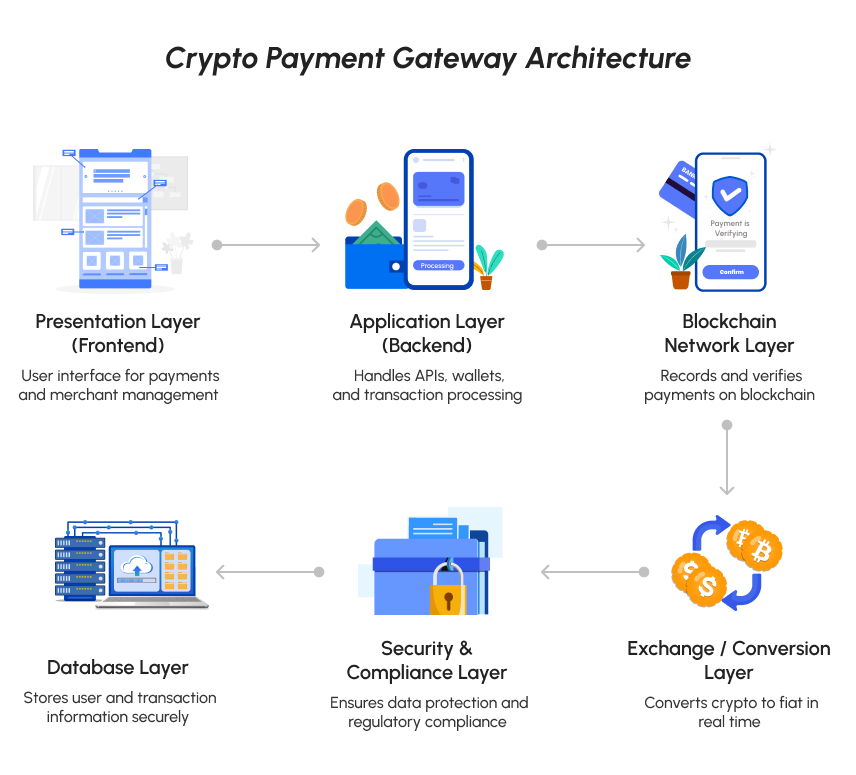
A well-structured crypto payment gateway architecture ensures high availability, real-time transaction processing, strong security controls, and smooth merchant dashboard integration. This is the phase where your UI/UX interface is designed alongside backend infrastructure.
Architectural layers of the crypto payment gateway are,
- Blockchain Integration module – Enables connecting the payment gateway with multiple blockchain networks.
- Wallet Management System – Handles the deposit address, private key storage, cold storage mechanism, etc.
- Transaction Processing Engine – Validates the incoming payments, monitors blockchain confirmations, and calculates the network fee.
- Security & Compliance Layer – Helps to protect the user assets, merchant details, and the platform from hacks.
- API & Merchant Integration Layer – Enable seamless connectivity with the websites, mobile apps, POS systems, and e-commerce platforms.
The architecture must be modular by design — this is non-negotiable for scalability, future compliance updates, and adding new blockchain support without rebuilding the core system.
Recommended Tech Stack
| Layer | Technology | Purpose |
| Frontend | React.js / Angular / Vue.js | Merchant dashboard & payment UI |
| Backend | Node.js / Python / Go | Core logic, APIs, transaction processing |
| Smart Contracts | Solidity (Ethereum) / Rust (Solana) | On-chain payment automation |
| Blockchain Libs | Web3.js / Ethers.js / BlockCypher SDK | Wallet creation & blockchain interaction |
| Database | MongoDB / PostgreSQL | Transaction logs, user data, metadata |
| Authentication | Web3 Auth / JWT / 2FA | User identity & access control |
| KYC/AML | Sumsub / Jumio / Onfido | Identity verification & compliance |
STEP 4: Key Features to Integrate
Feature integration plays a pivotal role in the creation of a crypto payment gateway. Most budding startups make the mistake of over-engineering at launch — stuffing the platform with features that confuse merchants and increase bounce rates. Focus on core features first.
- Wallet Handling – Enables the users to handle the in-built crypto wallet seamlessly with multi-currency support, hot & cold wallet strategy, address management, etc.
- Payment Confirmations – Automatically detects and verifies the blockchain confirmations to prevent fraud and ensure overall trust.
- Merchant Dashboard – Helps to view the merchant features with a simple control panel to track transactions, settlements, analytics, etc in real time.
- Webhooks/IPN – Enables instant automated payment notifications for smooth order processing and system integration.
- Security Control – Implements strong authentication, encryption, and monitoring systems to safeguard the crypto funds or data.
Apart from that, some of the features that can be integrated later after the successful crypto payment gateway deployment have been mentioned below,
- POS (Point of Sale) – Allows in-store crypto payments through QR-based or device-integrated checkout systems.
- Gift Cards – Enable crypto-to-gift card conversions, which enhances the overall user engagement and usability.
- Advanced Analytics – Allows the admin to have a deeper look at the transaction insights, performance metrics, etc to support data-driven decisions.
- Custom Plugins – The customizable plugins offer a ready-to-use integration for popular e-commerce platforms to simplify the merchant onboarding.
STEP 5: Testing Process
The testing process is the crucial phase of the crypto payment gateway development that ensures the overall functioning of the platform. A streamlined quality assurance process ensures the gateway operates securely, efficiently, and without disruptions. Usually, in the testing process, these things are followed,
- Functional Testing – The functional testing verifies that every feature works as intended across different devices, versions, and APIs.
- Security Testing – Ensures the security features are integrated properly to eliminate risks such as hacking, phishing, and unauthorized access.
- Load Testing – Evaluates the overall handling capacity of the payment processor
- Blockchain Testing – Ensures accurate transaction broadcasting, confirmation tracking, gas fee calculation, and smart contract execution.
- Compliance Testing – Validates the KYC/AML workflows, audit logs, and transaction monitoring systems with global standards.
Therefore, the testing process helps the startups to analyze the platform’s functioning, which ensures success. A thoroughly tested crypto payment gateway paves the way to build confidence and prevent operational failure.
STEP 6: Crypto Payment Gateway Launch
Launching a crypto payment gateway is more than flipping a switch. It must be coordinated with a strategy that covers compliance alignment, banking integration, infrastructure readiness, and market positioning.
Best practice launch approach:
- Beta Rollout – Onboard a limited group of merchants to test real-time transactions, identify edge cases, and validate the payment flow under live conditions.
- 24/7 Monitoring – Implement real-time monitoring dashboards to track wallet activity, server performance, transaction anomalies, and system health from day one.
- Support Infrastructure – Have a support team and incident response process in place before going public.
- Compliance Sign-Off – Ensure all KYC/AML workflows, banking integrations, and legal documentation are approved and active before full launch.
This is how a crypto payment gateway is launched in a way that sustains trust, handles merchant growth, and competes in the live market.
How Much does it cost, and How Long does it take to create a Crypto Payment Gateway?
The average cost and the timeline to create a crypto payment gateway are not fixed, but it varies based on various factors. Some of the primary factors that influence the overall cost & time duration are business model, feature integration, security requirements, compliance scope, etc.
Along with that, the choice of development methodology plays a major role in the creation of a crypto payment gateway. We have illustrated a table to get a clear understanding of that…
| Development From Scratch | White Label Clone | Clone Script |
| $100K To $150 K | $50K To $100K | $25K To $50K |
| 16 to 24 Weeks | 8 to 12 weeks | 12 to 16 weeks |
Critical Mistakes to Avoid While Developing a Crypto Payment Gateway
Knowing how to create a crypto payment gateway is only half the battle. Equally important is knowing what not to do. These are the four most common and most costly mistakes startups make:
Overbuilding Features
- Mistake: Stuffing the crypto payment gateway with a bunch of features leads to suffocation and distracts the users. Also, the complex feature integration increases the overall bounce rate for the platform.
- Solution: It is important to focus on the core features, reliable confirmation, notifications, merchant onboarding, etc., to ensure smooth usage.
Ignoring Settlement Complexity
- Mistake: Underestimating the volatility management, liquidity sourcing, tax reporting, banking integration, etc., may lead to complex problems. This may result in facing delayed payouts and accounting confusion for merchants.
- Solution: Make sure to have an expert team to monitor the tax, security auditing, and volatility management for the crypto payment gateway.
Weak Monitoring and Risk Management
- Mistake: Poor monitoring of the platform and users may impact the overall trustworthiness of the platform.
- Solution: To reduce this, it is essential to integrate advanced features like real-time transaction tracking, suspicious activity detection, and compliance screening.
Misunderstanding Merchants
- Mistake: Many startups fail to understand that merchants also have doubts about wallet addresses, gas fees, private keys, confirmations, and volatility.
- Solution: The platform can have seperate section or beginner guides about the user onboarding process, deposit/withdrawal, etc. Through this,
Make sure to avoid these mistakes and take the solutions to build your crypto payment gateway seamlessly. With the solution, your payment gateway is not only technically functional but also operationally resilient, merchant-friendly, and built for sustainable growth.
Build Your Crypto Payment Gateway with Coinsclone
Coinsclone is a reputed crypto payment gateway development company with 8+ years of experience delivering secure, scalable, and fully customizable payment solutions for startups worldwide.
Our development team helps you create a crypto payment gateway that is compliance-ready, architecturally modular, and built to handle real merchant volume from day one. Whether you choose custom development, a white-label solution, or a clone script, we deliver a bug-free, fully operational platform with ongoing post-deployment support.
- 100% customizable UI/UX, features, and branding
- Multi-currency and multi-blockchain support
- KYC/AML compliance built in from the ground up
- Dedicated support team available post-launch
- Launch in as little as 8–12 weeks with our white-label solution
Ready to lay the foundation for your success? Connect with our expert team today and get a free demo of your crypto payment gateway.
Frequently Asked Questions
1. What is crypto payment gateway development?
Crypto payment gateway development is the process of building a platform that enables merchants to accept cryptocurrency payments from customers. It involves blockchain integration, wallet management, compliance implementation, and merchant dashboard development — all working together to process transactions securely and in real time.
2. How much does it cost to create a crypto payment gateway?
The cost to create a crypto payment gateway ranges from $25,000 (clone script) to $150,000 (custom build from scratch), depending on features, blockchain integrations, compliance scope, and development methodology. A white-label solution typically costs between $50,000 and $100,000 and can be launched in 8–12 weeks.
3. What are the main challenges in building a crypto payment gateway?
The primary challenges include regulatory compliance across multiple jurisdictions, securing banking partnerships for fiat settlements, managing cryptocurrency price volatility, building high-availability infrastructure, and assembling a development team with both blockchain and payment systems expertise.
4. How does a crypto payment gateway make money?
A crypto payment gateway generates revenue through transaction processing fees, merchant subscription plans, currency conversion margins, API usage charges, and premium feature upgrades. As merchant volume scales, so does the recurring revenue, making it a highly profitable business model.
5. Is it legal to start a crypto payment gateway business?
Yes, it is legal in most jurisdictions, but compliance requirements vary significantly by country and region. Most jurisdictions require registration as a payment service provider, adherence to KYC/AML regulations, and compliance with financial service laws. Always consult a legal expert before entering a new market.
6. How long does it take to build a crypto payment gateway?
Development timelines range from 8 weeks (white label solution) to 24 weeks (full custom build). The timeline depends on feature complexity, number of supported blockchains, compliance requirements, and the development team’s experience. Using a pre-built white label or clone script significantly reduces time to market.
See How Our MVP System Can Launch Your Crypto Payment Gateway Faster
Crypto Payment Gateway Development — done right.
- MVP System : Build and launch your gateway 90% faster.
- Multi-Currency Support : Accept 100+ cryptos with zero manual setup.
- Merchant Dashboard : Full control over payments, invoices, and settlements.
- Security & Compliance : PCI-DSS level security and KYC-ready architecture.
Get a free branded demo of your payment gateway in just 48 hours — before you invest a cent.
Book a Free Demo to discover how our Crypto Payment Gateway Script can take you from concept to live gateway in just 8 to 12 weeks.