

This guide lists the features of a cryptocurrency exchange that you need in 2026, from the basics every platform must have to the security, compliance and advanced tools that set leaders apart. For each feature, we explain what it does, who it serves and when to build it. In early October 2026, the crypto market was worth about $2.78 trillion, and CoinGecko tracked around 1,500 exchanges competing for the same traders. So the right feature set is what decides whether yours wins users or loses them.
Not all exchanges are equal. The real gap shows up in how each feature works: how fast the trading engine is, how deep the liquidity runs, how well funds are guarded and how easy the app feels. A modern exchange is more than a place to trade. It is a full digital system built around speed, trust and growth.
In this guide:
- The four groups of exchange features (basic, security, add-on and advanced) and what each one does
- The compliance features that MiCA and the Travel Rule now demand
- Why futures and APIs matter, with Q2 2026 volume data
- Which features to launch with and which to add later
- Answers to the questions founders ask most
Get Top Features of a Cryptocurrency Exchange Using Our MVP System!
Build a world-class crypto trading platform with speed and precision.
- Advanced Trading Engine: Lightning-fast order matching for seamless trades.
- Multi-Currency Support: Trade Bitcoin, Ethereum, and 100+ altcoins easily.
- Secure Wallet System: Cold storage & multi-signature protection for user funds.
- Real-Time Analytics: Monitor markets and user activity instantly.
Get a free demo of your customized crypto exchange — ready in just 48 hours.
Book Your Demo and explore how fast you can go live.
Features of a Cryptocurrency Exchange
The features of a cryptocurrency exchange fall into five groups. Each group does a different job, and a strong platform needs all five working together.
| Feature group | What it covers | Who it serves | When to build it |
| Basic features | Sign up, KYC, trading engine, wallets, order book, payments, admin tools | Every user and your team | At launch |
| Security features | 2FA, cold storage, multi-sig or MPC, encryption, proof of reserves | Every user’s funds | At launch |
| Compliance features | KYC tiers, AML monitoring, sanctions checks, Travel Rule, audit logs | Regulators and banking partners | At launch in licensed markets |
| Add-on features | Liquidity tools, launchpad, staking, copy trading, referrals, branding | Retail users and growth | Months 2 to 6 |
| Advanced features | Futures, trading APIs, cross-chain swaps, AI fraud checks, HFT engine | Pro traders and institutions | When volume grows |
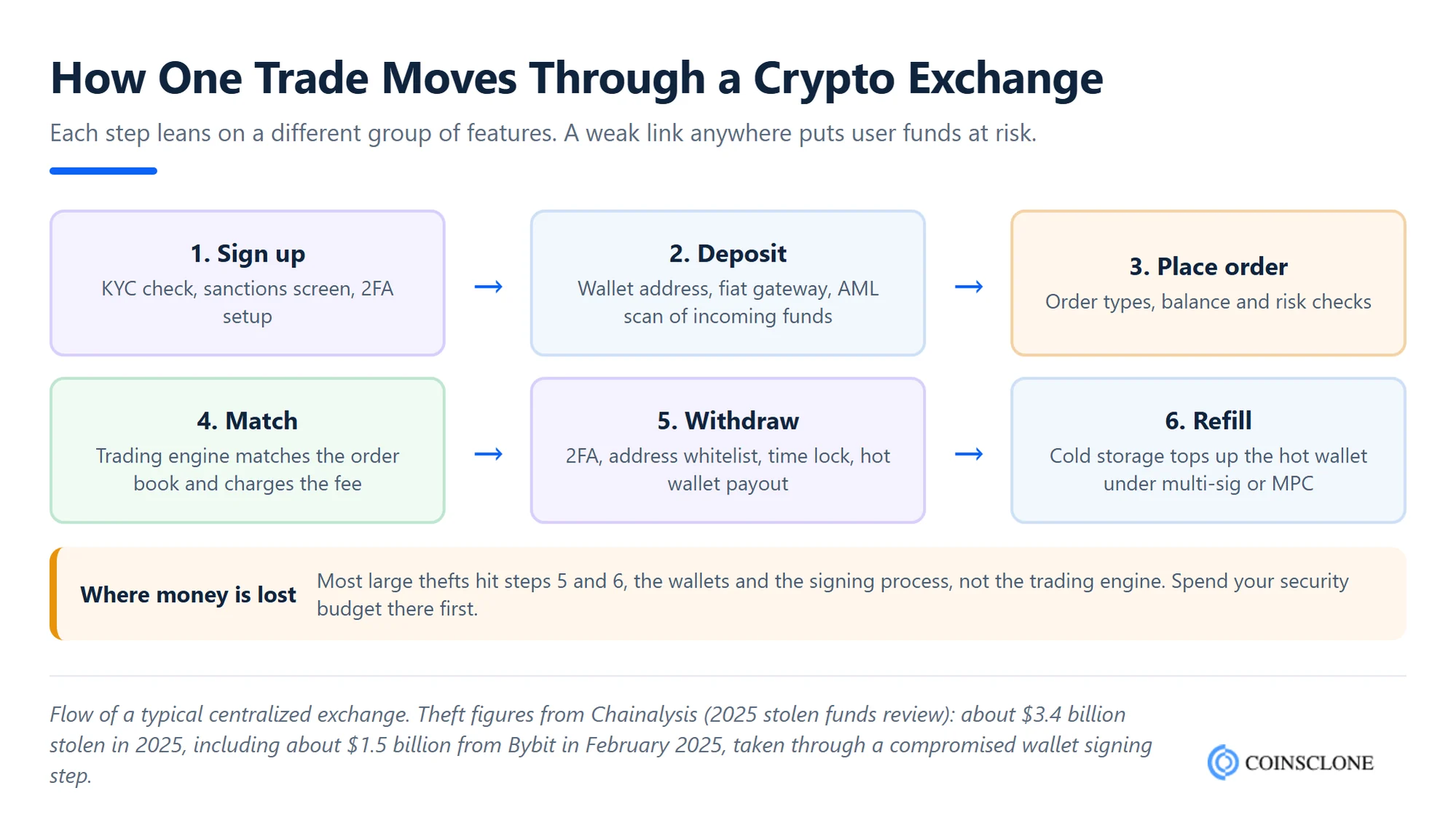
The picture below shows how these groups meet in a single trade. A user signs up, deposits, places an order, gets matched and then withdraws. At every step, a different set of features does the work.
Why Do Features Matter in a Cryptocurrency Exchange?
Each feature group plays its own role in an exchange’s growth and trust. Together, they keep users safe, make trading smooth and help the platform scale. When they line up, the exchange becomes trusted and ready for long-term success.
- Basic features: build the core of the platform, so users can sign up, trade and pay with ease.
- Security features: guard user funds and keep trust high.
- Compliance features: keep you licensed and keep banks willing to work with you.
- Add-on features: raise engagement and add new ways to earn.
- Advanced features: keep the platform ready for pro traders and the next wave of Web3.
Traders notice the gaps fast. They compare fees, check how deep the order book is, look at the security record and test the app before they deposit. So in the end, the right mix of features decides whether your exchange just runs or truly leads the market. Let’s look at each group in turn.
Basic Features In A Cryptocurrency Exchange Platform
A crypto exchange is a full system that covers tech, security and user design. Whether it is centralized, decentralized or hybrid, it needs a strong cryptocurrency exchange architecture that keeps trades flowing, holds funds safely and keeps trading open. Here are the core features every working exchange needs.
1. User Registration & KYC Verification
The first step in the user journey sets the tone. Quick sign-up, paired with automated Know Your Customer (KYC) and Anti-Money Laundering (AML) checks, makes sure only real people get access. As a result, the exchange stays within the rules and blocks fraud from day one. Most exchanges use tiers: a light check to start, and a deeper one before large withdrawals.
2. Trading Engine
The trading engine is the heart of a crypto exchange. It matches buy and sell orders in real time. A strong engine gives low delay, exact prices and steady speed even when volume spikes. Its speed shapes liquidity, user trust and how well the whole market runs.
3. Wallet Integration
Users need a safe, multi-coin wallet to store, send and receive assets. Most exchanges split funds between hot and cold wallets. Hot wallets handle daily deposits and payouts, while cold wallets keep most of the funds offline, away from hackers. This mix gives users speed and safety at the same time.
4. Order Book & Trade History
A clear order book shows live buy and sell orders, so traders can see market depth at a glance. Next to it, the trade history lists past trades, which helps users spot trends and review their results. Together, these tools make the market open and help traders decide with confidence.
5. Real-Time Market Data
Live charts, prices and volumes let users act fast and with good information. Price feeds and data APIs keep every trading pair in sync. That way, traders always see accurate, up-to-the-second numbers.
6. Payment Gateway Integration
Crypto and fiat payment gateways let users deposit and withdraw with ease. Support for bank transfers, cards and local payment apps opens the platform to people in more countries. As a result, users can trade no matter which currency or bank they use.
7. Intuitive Dashboard
An easy interface keeps users coming back. The dashboard should show live insights, open orders and wallet balances on both web and mobile. A clean design means even first-time users can find their way and trade without help.
8. Multiple Order Types
Market, limit, stop-limit, take-profit and trailing stop orders let traders run their own plans. These choices suit both casual buyers and active traders. They also give users control over timing and price.
9. Portfolio Tracking & Analytics
Portfolio tools show users their assets, gains and trade history in one place. For your team, analytics dashboards show key numbers and user habits. These insights then guide product fixes and marketing choices.
10. User & Role Management
Admins can manage user profiles, access rights and staff roles through a clear access ladder. Only approved staff can take sensitive actions, such as approving large withdrawals or listing a new coin. This keeps daily work smooth and the platform safe.
11. Revenue & Fee Management
A flexible fee panel lets admins set trading fees, withdrawal fees and affiliate payouts to suit the market. It also makes it easy to run tiered fees for high-volume users or short-term promos. In short, it turns the exchange into a business you can tune.
12. Support & Dispute Resolution
AI chatbots, ticket desks and live chat help users solve problems fast. Fair dispute handling also builds trust, which matters a great deal in a crowded market.
13. Notifications & Alerts
Users get real-time alerts on price moves, filled orders and account security. These alerts go out by web, app push or email. So traders never miss key moments and can act in time.
14. Multi-Language & Theme Options
To reach a global audience, exchanges offer the app in many languages and let users pick themes. This makes the platform easier to use, and it lets brands show their own look and feel.
15. Mobile Trading Apps
Most traders now trade on their phones, so native iOS and Android apps are no longer optional. A good app offers the full feature set, plus Face ID or fingerprint login and push alerts. Our guide to crypto exchange app development covers what goes into one.
These features give the exchange a strong base. However, no exchange can last without strong security, and that is where the next group comes in.
Essential Security Features for a Secure Cryptocurrency Exchange
Security is the one area where an exchange cannot cut corners. The numbers show why. In 2025, hackers stole about $3.4 billion in crypto, and the February attack on Bybit alone took about $1.5 billion, Chainalysis reports. Even the best trading engine will fail if it cannot keep attackers out.
1. Two-Factor Authentication (2FA)
2FA adds a second lock beyond the password, such as a code from an app or a hardware key. It stops attackers from logging in even when they steal a password.
2. Cold & Hot Wallet Separation
Exchanges use hot wallets for daily payouts and cold wallets to store most coins offline. Keeping the two apart limits what a hacker can reach, while trades and withdrawals keep flowing.
3. Multi-Signature and MPC Wallets
With multi-signature (multi-sig) or MPC wallets, no single person or server can move funds alone. Several approvals are needed for each large transfer. Still, the Bybit case shows the signing process itself must be checked too, since the attackers there tricked the people approving the transfer rather than breaking the wallet code.
4. Withdrawal Whitelists and Time Locks
Users can lock withdrawals to a list of saved addresses. New addresses can then be held for a set period, often 24 hours, before first use. If an account is taken over, this delay gives the user and your team time to react.
5. DDoS & CSRF Protection
These shields block large floods of traffic that try to knock the platform offline. They also stop forged requests that try to change data or trigger trades on a user’s behalf.
6. Anti-Phishing Tools
Anti-phishing tools spot and block fake login pages and harmful links. Many exchanges also let users set a personal anti-phishing code that appears in every real email. This protects users from credential theft and scams.
7. Encrypted Data Storage
User data and trade details are stored with strong encryption. As a result, even if someone gets into the database, the data stays unreadable and cannot be changed.
8. Smart Contract Auditing (for DEXs)
On a decentralized exchange, smart contracts hold the funds. So each contract should pass an outside audit before launch and after every major update. Regular audits lower the risk of attacks and make the platform more trusted.
9. SSL Encryption & HTTPS Protocols
SSL and HTTPS protect all data that moves between users and servers. This keeps the line safe and stops man-in-the-middle attacks.
10. Proof of Reserves
Proof of reserves shows users that the exchange holds their assets one to one. For example, Binance’s proof of reserves puts every user’s hashed balance into a Merkle tree, so users can check their own balance is counted. It then adds a zk-SNARK proof that the totals are covered. Since the FTX collapse, many traders check this before they deposit.
For a deeper look at each layer, read our guide on how to build a non-hackable crypto exchange.
Compliance Features Every Exchange Needs in 2026
Rules have caught up with crypto. Banks, payment firms and app stores now check an exchange’s compliance before they work with it. So these features are no longer a later add-on. In licensed markets, you need them on day one.
1. Tiered KYC and Ongoing Checks
Identity checks should match the risk. A new user might trade small amounts after a basic check, while higher limits need proof of address and source of funds. The system should also re-check users when their activity changes.
2. Transaction Monitoring and Sanctions Screening
AML tools scan deposits and withdrawals for links to hacks, scams or sanctioned wallets. They flag odd patterns, such as many small deposits followed by one large withdrawal. Your team then reviews each alert and files reports where the law asks for them.
3. Travel Rule Messaging
The Travel Rule says that sender and receiver details must travel with a crypto transfer between providers. The FATF standard lets countries set a USD or EUR 1,000 threshold. In the EU, the rule has applied to crypto transfers since 30 December 2024, as set out in the EBA’s Travel Rule guidelines. Your exchange needs a tool that sends and receives this data with other platforms.
4. Licensing Reports and Audit Logs
Every admin action, fee change and coin listing should leave a record that cannot be edited. Regulators ask for these logs, and so do auditors. In the EU, MiCA’s transition period ended on 1 July 2026, so exchanges serving EU users now need full approval. Our guide on launching a MiCA-compliant crypto exchange in the EU walks through the steps.
Add-On Features to Integrate into a Cryptocurrency Exchange
Once the base is set and the platform is secure, add-on features lift the user experience to the next level. They suit firms that want a strong brand and more ways to keep users engaged.
1. Liquidity Management Tools
These tools connect the exchange to cryptocurrency liquidity providers and automate market making. Deep liquidity means fast trades, steady prices and a smoother experience. For a new exchange with few users, this is often the most important add-on of all.
2. Launchpad Integration
A launchpad lets new crypto projects raise funds right on the exchange. It adds a new use for the platform and gives users early access to new tokens. It also brings in listing fees.
3. Affiliate Marketing System
A referral system rewards users who bring in friends and partners. This builds a community-driven user base and grows sign-ups at low cost.
4. Custom Branding & White-Label UI
White-label tools let you change the visuals, layout and branding fully. So a business can launch its own branded platform fast and at a lower cost.
5. AI Chatbots & Support Systems
AI chatbots give instant answers on trading and account questions. Automated replies improve service and cut the load on your support team.
6. Staking and Earn Programs
Staking lets users lock coins and earn rewards on assets that would otherwise sit idle. It keeps funds on the platform longer and gives users a reason to return. Many exchanges also offer flexible savings products next to it.
7. Copy Trading and Trading Bots
Copy trading lets new users follow the trades of skilled traders automatically. Grid and DCA bots, in turn, run simple plans for users around the clock. Both features bring in beginners and keep them active between their own trades.
These add-ons help your exchange stand out in a busy market. Next, let’s look at the advanced features that shape the future of digital trading.
Future-Ready Advanced Features for a Cryptocurrency Exchange Platform
Crypto exchanges in 2026 are smarter and more connected than ever. AI, cross-chain trading, derivatives and DeFi make trading faster, safer and easier. Here are the advanced features that lead the market now.
1. Cross-Chain Swaps
Cross-chain swaps let users trade tokens across blockchains without a middleman. This adds liquidity and lets users move assets freely between networks such as Ethereum, BNB Chain, Solana and Polygon. It shows how the industry is moving toward full interoperability.
2. AI-Powered Fraud Detection
AI in the security stack spots suspicious actions in real time. The models study trade patterns, flag odd behavior and catch fraud or money laundering attempts early. In this way, trading stays safe for both users and admins.
3. DeFi & NFT Marketplace Integration
Modern exchanges now go beyond spot trading. They add DeFi services such as staking, lending and yield farming, plus NFT trading. This turns the exchange into a full digital finance hub that serves more user groups and drives more activity.
4. High-Frequency Trading (HFT) Engine
An HFT engine lets pro traders and firms place huge numbers of orders with almost no delay. With smart matching logic, it adds liquidity, fills orders faster and supports algorithmic trading. This is a key edge in a competitive market.
5. Derivatives: Margin and Perpetual Futures
Derivatives are where most crypto trading now happens. In Q2 2026, the top 10 centralized exchanges handled $1.95 trillion in spot trades, while the top 10 perpetual futures exchanges handled $12.7 trillion, according to CoinGecko. That is about 6.5 times as much.
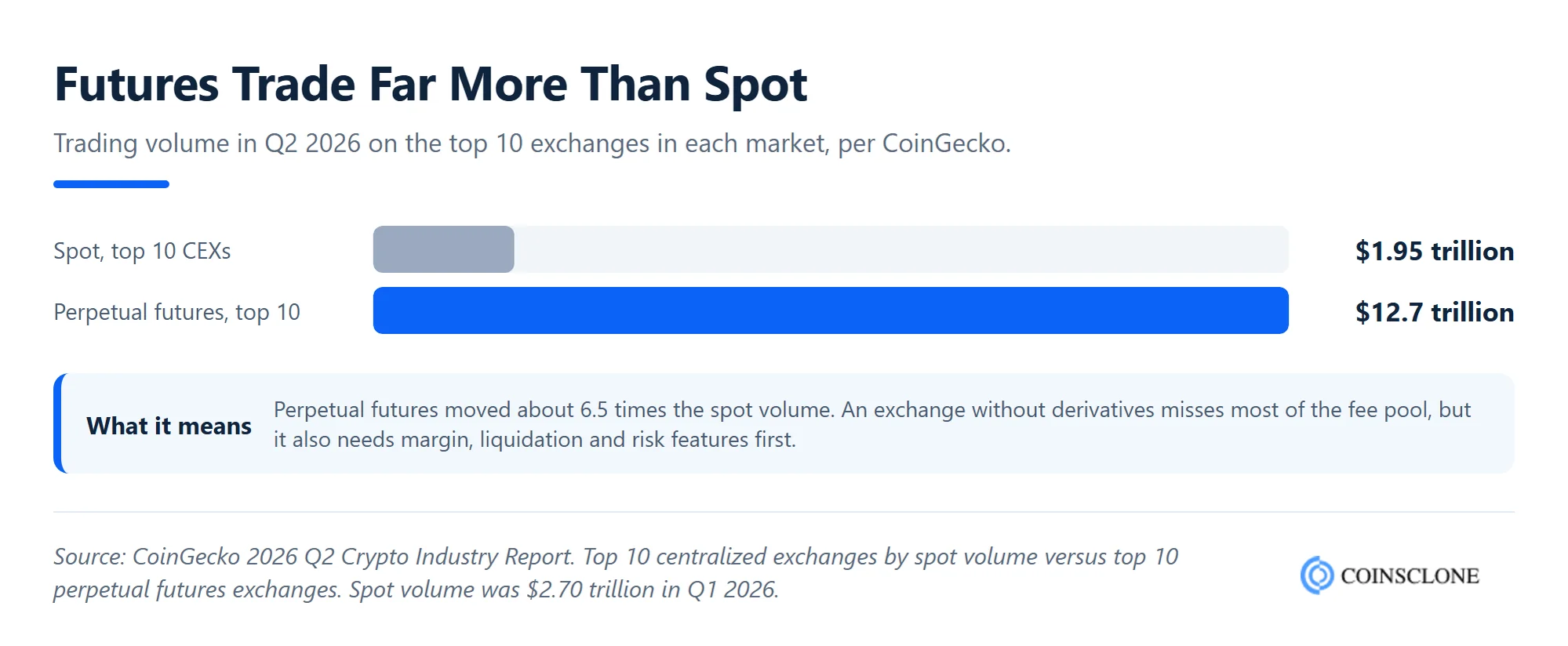
However, futures need extra features before launch: a margin system, a liquidation engine, funding rates, an insurance fund and strict risk limits. If you plan to offer them, see our page on crypto derivatives exchange development.
6. Trading APIs for Pros and Institutions
Pro traders and market makers do not click buttons. They connect bots and systems through APIs. Leading exchanges offer three kinds: REST for orders and account data, WebSocket for live price streams and FIX for institutions. Kraken, for example, offers all three. Clear API docs, rate limits and test keys make a big difference to who trades on your platform.
As tech grows, every type of exchange keeps adding to its toolset. Centralized exchanges now support cross-chain trading, while decentralized platforms use AI to boost security. With so much choice, the real question becomes which features to build first.
Which Features Should You Build First?
You do not need every feature on day one. In fact, trying to launch with everything is one of the most common reasons exchanges run late and over budget. A better plan is to launch lean and grow in stages.
- Launch set: sign up and KYC, the trading engine, order book, hot and cold wallets, fiat and crypto payments, core order types, 2FA, admin and fee panels, and the compliance tools your market requires.
- Growth set (months 2 to 6): mobile apps if you did not launch with them, liquidity tools, referrals, staking and alerts.
- Scale set: futures, trading APIs, copy trading, a launchpad, cross-chain swaps and an HFT engine.
After launch, your market should decide what comes next. The decision tree below shows a simple way to pick.
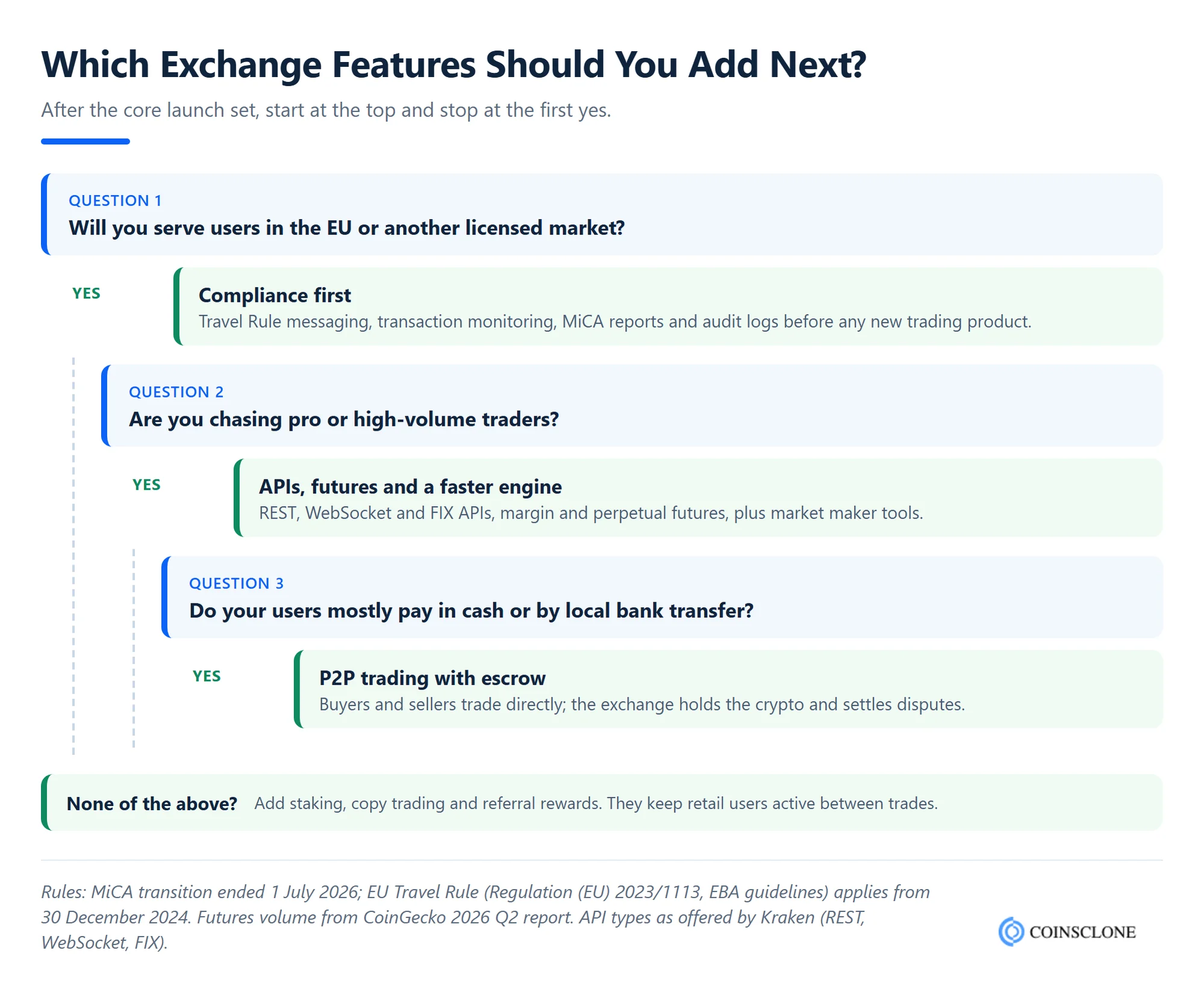
For example, if your users mostly pay with cash or local bank transfers, a P2P model with escrow often works better than an order book. A P2P crypto exchange script covers that case.
Conclusion
The right features let a crypto exchange scale, automate and stand out. Whether you are building a startup platform or an enterprise trading system, the right mix of ease, security, compliance and speed is what sets you apart in a crowded market.
When it comes to building a feature-rich exchange, Coinsclone is a trusted cryptocurrency exchange development company. We have built crypto platforms since 2018 and have delivered 350+ platforms for 200+ clients across 20 industries. Our white label crypto exchange software comes with the features in this guide and can go live in 4 to 6 weeks, or 7 to 10 weeks with fiat rails and 9 to 13 weeks with mobile apps. Whether you want a centralized, decentralized or hybrid exchange, we support you from feature planning to post-launch care.
Contact us today for expert advice and bring your crypto exchange vision to life.
Frequently Asked Questions
What are the main features of a cryptocurrency exchange?
The main features are user sign-up with KYC, a trading engine, an order book, hot and cold wallets, crypto and fiat payment options, several order types, live market data and an admin panel for fees and users. On top of that, every exchange needs security features such as 2FA and cold storage, plus the compliance tools its market requires.
What are the most important security features of a crypto exchange?
The most important are cold storage for most funds, multi-signature or MPC wallets, 2FA, withdrawal whitelists with time locks, DDoS protection, encryption and regular outside audits. Proof of reserves also matters, because it lets users check that their funds are held one to one. In 2025, hackers stole about $3.4 billion in crypto, per Chainalysis, so security is the last place to save money.
What features do professional traders look for?
Pro traders look for deep liquidity, low fees with volume tiers, advanced order types and fast, stable trading. They also want REST, WebSocket and FIX APIs to connect their bots, plus margin and perpetual futures. A clean record on security and proof of reserves helps win their trust.
What features make an exchange suitable for high-volume trading?
High-volume trading needs a fast matching engine that holds up under load, deep liquidity from market makers, and APIs with generous rate limits. It also needs cloud servers that scale with demand and strong risk controls. Some large exchanges also add an HFT engine for their biggest clients.
How much does it cost to build a crypto exchange with these features?
It depends on the build path and the features you choose. Published 2026 market ranges put a white label exchange at about $15,000 to $60,000, a custom MVP at about $100,000 to $200,000 and a full custom exchange at $250,000 to $500,000 or more. Our guide on the cost to develop a cryptocurrency exchange breaks down each part.
What are the types of crypto exchanges?
The main types are centralized exchanges (CEX), decentralized exchanges (DEX), peer-to-peer (P2P) exchanges, hybrid exchanges and derivatives exchanges. A CEX holds user funds and matches orders on its own servers. A DEX settles trades through smart contracts while users keep control of their funds. Each type needs a slightly different feature set.
Get Top Features of a Cryptocurrency Exchange Using Our MVP System!
Build a world-class crypto trading platform with speed and precision.
- Advanced Trading Engine: Lightning-fast order matching for seamless trades.
- Multi-Currency Support: Trade Bitcoin, Ethereum, and 100+ altcoins easily.
- Secure Wallet System: Cold storage & multi-signature protection for user funds.
- Real-Time Analytics: Monitor markets and user activity instantly.
Get a free demo of your customized crypto exchange — ready in just 48 hours.
Book Your Demo and explore how fast you can go live.