
The best liquidity pools in 2026 are on Uniswap, Curve, Aerodrome, Raydium, Orca, PancakeSwap, Fluid and Meteora. For low risk, stablecoin pools on Curve or Uniswap pay 1% a year or less. Busy pairs like ETH-USDC and SOL-USDC paid 20% to 60% a year in late October 2026, but with more risk.
Each swap on a DEX is paid for by someone else’s money sitting in a pool. The people who supply that money, called liquidity providers (LPs), earn a share of the trading fees. In the past 12 months, traders paid about $933 million in fees on Uniswap alone, most of it to LPs. But a high APR on a pool page does not mean a high profit. This guide shows you how to tell the two apart.
In this guide:
- The 8 best DeFi platforms for pools, with fresh size and fee data from DefiLlama.
- Real pools with their 30-day APRs, from safe stablecoin pairs to risky reward pools.
- The best Uniswap pools, the largest USDT pools and good pools for new LPs, on Polygon too.
- Why high APR pools often let you down, and what impermanent loss costs in real numbers.
- How to add funds to a pool step by step, with a PancakeSwap Infinity stablecoin guide.
See How Our MVP System Can Help You Build the Best DeFi Liquidity Pools Faster
Best DeFi Liquidity Pools — built for yield, security, and scalability.
- MVP System : Launch high-yield liquidity pools 90% faster.
- DeFi-Ready Modules : Integrated DEXs, yield farms, and liquidity protocols.
- Brand & Customization : Choose pool tokens, ratios, and reward structures.
- Revenue Engine : Earn from trading fees, farming rewards, and staking incentives.
Get a free DeFi liquidity demo in just 48 hours — before investing a cent.
Book a Free Demo to explore how we build DeFi liquidity pools designed to maximize TVL in 8–12 weeks.
8 Best Liquidity Pools and DeFi Platforms in 2026
We ranked these platforms by the liquidity they hold, the fees they generate for LPs, their security record and the range of pools they offer:
- Uniswap
- Curve
- Aerodrome (now Aero)
- Raydium
- Orca
- PancakeSwap
- Fluid
- Meteora
Liquidity Pool Platforms Compared
| Platform | Main chains | Liquidity (TVL) | Fees paid by traders, last 12 months | Best for |
| Uniswap | Ethereum, Base, Arbitrum and 40+ more | $4.1B | $933M | Blue-chip pairs, most tokens |
| Curve | Ethereum and 30+ chains | $1.17B | $56M | Stablecoins and pegged assets |
| Aerodrome and Aero | Base, plus Ethereum, Optimism, Arbitrum and more for Aero | $0.34B | $121M | Base tokens, AERO rewards |
| Raydium | Solana | $1.15B | $140M | Solana tokens and new launches |
| Orca | Solana | $0.30B | $66M | Concentrated SOL and stablecoin pairs |
| PancakeSwap | BNB Chain and 10+ more | $2.37B | $186M | BNB Chain tokens |
| Fluid | Ethereum and 4 more | $0.23B | $8M, plus lending interest | Stablecoin and ETH-staked ETH pairs |
| Meteora | Solana | $0.23B | $386M | High-volume Solana and meme pairs |
Source: DefiLlama DEX size and fees, 26 October 2026, DEX products only. All pool figures below are from the same date unless noted. For a wider view of trading venues, see our list of the best decentralized exchanges.
1. Uniswap
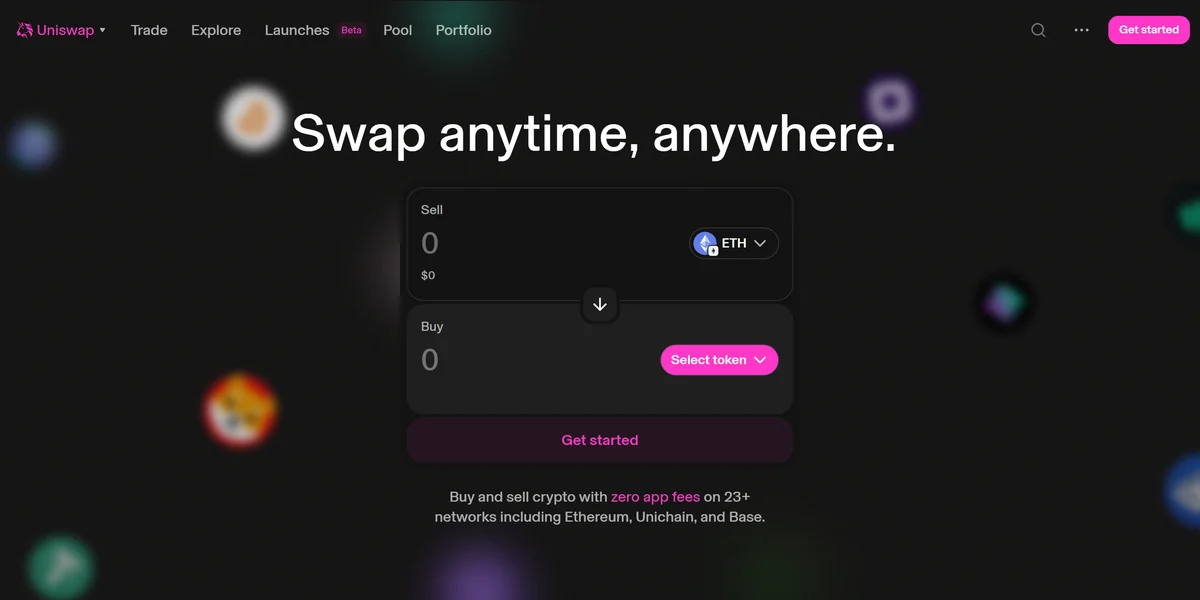
Uniswap is the largest DEX and the biggest place to be an LP. Its v3 pools brought in concentrated liquidity. You choose a price range and earn more fees per dollar while the price stays inside it. Uniswap v4, launched in January 2025, adds “hooks” that let pools run custom logic such as dynamic fees. Pools come with fee tiers of 0.01%, 0.05%, 0.30% and 1%.
Why LPs use it: Deep volume on major pairs such as ETH-USDC and WBTC-ETH, on Ethereum and on cheaper networks like Base. The WETH-USDC 0.3% pool on Base held about $159 million and paid about 53% a year in fees over the last 30 days.
Watch out for: Tight ranges need regular care. If the price leaves your range, you stop earning and hold only one token. Also, since a vote in December 2025, Uniswap takes a protocol fee on all v2 pools and some v3 pools. In a 0.30% pool, LPs now get 0.25% and the protocol 0.05%.
2. Curve
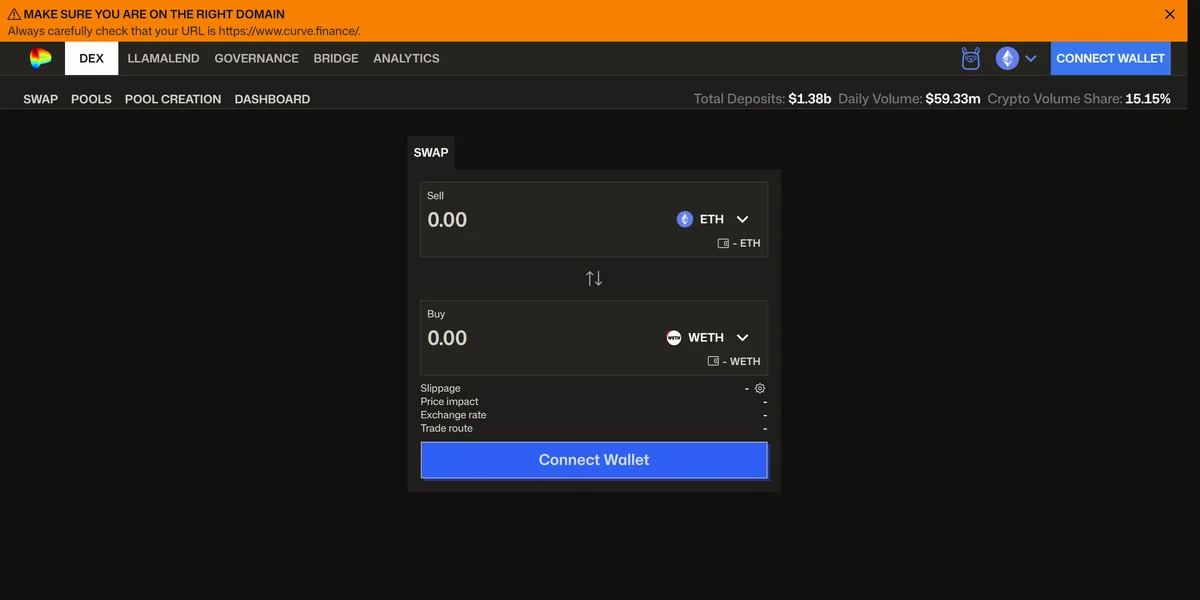
Curve is built for assets that should trade at about the same price, such as USDC, USDT and DAI, or ETH and staked ETH. Its StableSwap design keeps slippage very low on these trades, and its CRV token rewards LPs, with extra boosts for veCRV holders. Curve also runs its own stablecoin, crvUSD.
Why LPs use it: Low-risk stablecoin and correlated pools. The ETH-stETH pool, one of DeFi’s oldest, held about $90 million and paid about 1.3% a year in fees.
Watch out for: Fees are low in calm markets, and rewards depend on the CRV price. A stablecoin that loses its peg can drain a pool’s value.
3. Aerodrome (Now Aero)
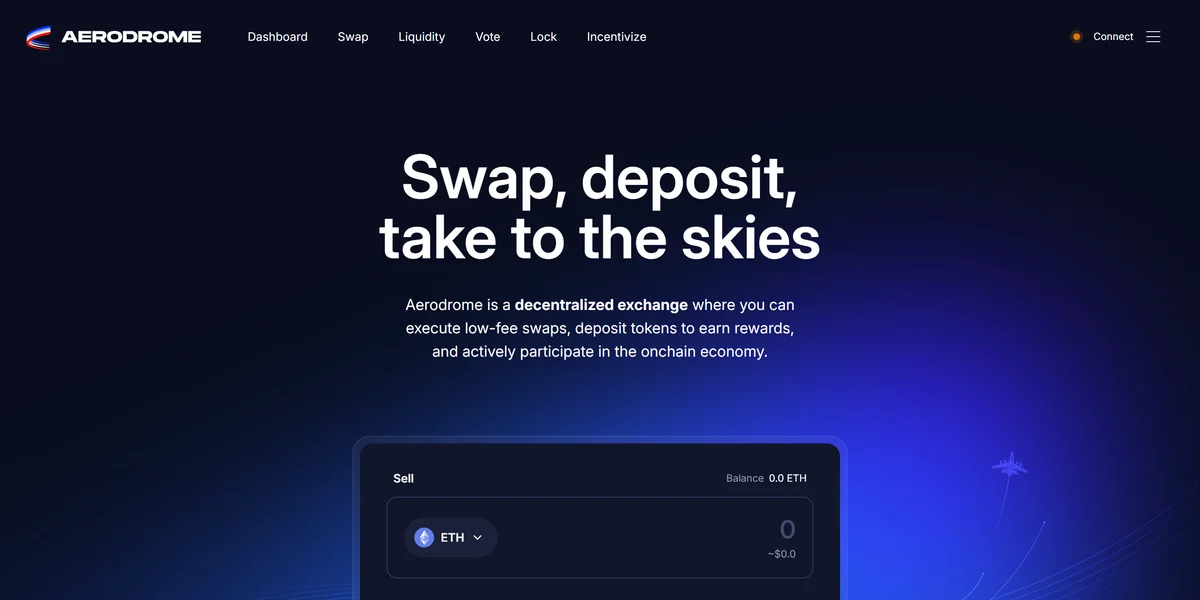
Aerodrome is the main DEX on Base, Coinbase’s layer 2. It uses a “ve(3,3)” model: LPs earn AERO token rewards, while trading fees go to veAERO holders who vote on which pools get rewards. Its Slipstream pools add concentrated liquidity.
Aerodrome is now merging with Velodrome into one DEX called Aero. DefiLlama has listed Aero pools on Base and six other chains since September 2026. They held about $150 million, and older Aerodrome pools about $180 million more.
Why LPs use it: High reward APRs on Base pairs. The USDC-AERO pool paid about 44% a year in AERO rewards over the last 30 days.
Watch out for: Most of your return is paid in AERO, so a falling AERO price cuts your real yield. During the move to Aero, check which version of a pool still gets rewards before you add funds.
4. Raydium
Raydium is one of the largest DEXs on Solana. It runs classic AMM pools, CPMM pools and concentrated liquidity (CLMM) pools, plus the LaunchLab token launchpad, which sends new tokens straight into its pools. On CPMM and CLMM pools, 84% of each trading fee goes to LPs.
Why LPs use it: Fast, cheap Solana trades and very active pairs. Its main WSOL-USDC pool held about $19 million and paid about 21% a year in fees over the last 30 days.
Watch out for: Many Raydium pools hold new tokens that can crash. Stick to known tokens unless you accept that risk.
5. Orca
Orca is a Solana DEX built around Whirlpools, its concentrated liquidity pools. It is known for a simple interface and a strong security record since 2021.
Why LPs use it: Efficient SOL and stablecoin pools. Its main SOL-USDC pool held about $29 million and paid about 60% a year in fees over the last 30 days.
Watch out for: Like any concentrated pool, a narrow range can go out of range quickly when SOL moves.
6. PancakeSwap
PancakeSwap is the largest DEX on BNB Chain and also runs on Ethereum, Base, Arbitrum and more. It offers classic pools, v3 concentrated pools and newer Infinity pools with hooks. Infinity is the name for PancakeSwap v4. CAKE farms add rewards to some pools.
Why LPs use it: Low fees on BNB Chain and a wide range of BNB Chain tokens. It holds about $2.4 billion in its pools.
Watch out for: Farm rewards in CAKE change often. Check the fee APR apart from the reward APR.
7. Fluid
Fluid, from the Instadapp team, combines lending and a DEX in one system. Its “smart collateral” and “smart debt” let the same money act as lending collateral and trading liquidity at once, so each dollar does more work.
Why LPs use it: Efficient stablecoin and ETH-staked ETH pools, with lending yield on top of trading fees. Its USDC-USDT pool on Ethereum held about $35 million and traded about $39 million in a single day. See how it compares with the top DeFi lending platforms.
Watch out for: Fee APRs on its stable pools are tiny, under 1%, so most of the return comes from lending. The design is also more complex than a simple AMM. Learn how your funds can be liquidated before you use debt features.
8. Meteora
Meteora is a Solana DEX known for DLMM (Dynamic Liquidity Market Maker) pools. Liquidity sits in price “bins”, and fees rise automatically when the market is volatile. Traders paid about $386 million in fees on Meteora’s pools over the past year. Few DEXs earn more.
Why LPs use it: Very high fee income on busy Solana pairs, including new tokens.
Watch out for: Much of that volume comes from meme and newly launched tokens, which can lose most of their value in hours.
Best Liquidity Pool Pairs to Consider in 2026
Here are real pools from DefiLlama, from lower to higher risk. APRs change daily, so we show the 30-day rate, which is steadier than a single day.
| Pool | Platform and chain | Liquidity | 30-day APR | Risk level |
| USDC-USDT | Uniswap v3, Ethereum | $34M | about 1% | Low |
| DAI-USDC-USDT (3pool) | Curve, Ethereum | $160M | near 0% | Low |
| ETH-stETH | Curve, Ethereum | $90M | about 1.3% | Low |
| WBTC-WETH | Uniswap v3, Arbitrum | $33M | about 9% | Medium |
| WETH-USDT | Uniswap v3, Ethereum | $88M | about 28% | Medium |
| WSOL-USDC | Raydium, Solana | $19M | about 21% | Medium |
| WETH-USDC | Uniswap v3, Base | $159M | about 53% | Medium |
| SOL-USDC | Orca, Solana | $29M | about 60% | Medium |
| USDC-AERO | Aerodrome, Base | $7.5M | about 44% in AERO rewards | Medium-high |
Source: DefiLlama yields, 26 October 2026. APR is the 30-day average of trading fees (and rewards, where shown), before impermanent loss and gas.
High APR Liquidity Pools: Are They Worth It?
Most often, not at the number shown. A pool page takes a short burst of fees or rewards, often one day or one week, and turns it into a yearly rate. That number only holds if the next 12 months look just like that one busy day.
You can see this in DefiLlama’s data:
- Reward spikes: The USDC-AERO pool on Aerodrome showed about 170% for the day, but about 44% over 30 days.
- Fee spikes: An Aerodrome WETH-cbBTC pool showed a 7-day fee APR of about 185%, but only about 13% on the day itself.
- Quiet pools with old highs: Three large Raydium pools showed 30-day rates of 70% to 108%, yet earned almost nothing on the day. A few busy days lifted those rates, not steady income.
So treat any APR over about 50% as a snapshot, not a promise. Check the 30-day rate, the daily volume and how much of the APR is paid in a reward token.
Are Raydium Pools Paying 100% APR Too Good to Be True?
A Solana user asked this on r/solana after a simulator showed about 100% APR on a SOL-RAY position. The fees can be real, but they are not free money. A pair of two risky tokens can lose far more to price drops and impermanent loss than it earns. A quiet month can also cut fees to a small part of the rate the tool showed.
How Much Can You Earn From a Liquidity Pool?
At a 20% fee APR, $10,000 earns about $2,000 a year, or about $167 a month, if trading volume stays the same. That is before impermanent loss and gas.
Now say ETH doubles while you are in an ETH-USDC pool. The pool’s loss against holding is about 5.7%, or about $570. Your net gain over a year is then about $1,430, minus gas. If the price swings further, the loss grows and can wipe out the fees.
A user on r/defi asked whether $50,000 in LP positions could earn $3,500 a month. That needs about 84% a year after all losses. Only risky or reward-heavy pools show rates like that, and they seldom keep them for a full year. For most LPs, a net 5% to 25% a year on blue-chip pairs is a fairer goal.
Best Uniswap Pools and the Largest USDT Pools
The best Uniswap pools pair a big token with a stablecoin or with ETH, and they trade all day. The top large pools were these three:
- WETH-USDC 0.3% on Base: About $159 million, at about 53% a year.
- WETH-USDC 0.05% on Arbitrum: About $39 million, at about 21%.
- USDC-WETH 0.05% on Ethereum: About $81 million, at about 7.5%.
The largest Uniswap pools with USDT are all on Ethereum:
| USDT pool | Version and fee tier | Liquidity | 30-day APR |
| WETH-USDT | v3, 0.30% | $88M | about 28% |
| USDC-USDT | v3, 0.01% | $34M | about 1% |
| WBTC-USDT | v3, 0.05% | $29M | about 19% |
| ETH-USDT | v4, 0.30% | $28.5M | about 28% |
| WBTC-USDT | v3, 0.30% | $24.5M | about 7.5% |
| WETH-USDT | v2, 0.30% | $14M | about 2.8% |
| WETH-USDT | v3, 0.05% | $9.2M | about 23% |
Source: DefiLlama yields, 26 October 2026. To see all USDT pools yourself, open DefiLlama Yields, choose the Uniswap project and type USDT in the search box.
Notice how the same pair can pay very different rates. The v2 WETH-USDT pool spreads its money across all prices. So each dollar earns less than in the v3 pool with the same fee.
Best Liquidity Pools for Beginners
The best pools for beginners are stablecoin pairs such as USDC-USDT on a low-gas network. Their prices barely move, so you can learn how adding funds, fees and withdrawals work without big price risk.
Follow these simple rules for your first pool:
- Start small: Use an amount you can afford to lose while you learn.
- Pick a cheap network: Base, Arbitrum, Polygon, BNB Chain or Solana, so gas does not eat your fees.
- Use full range or wide ranges: A narrow range earns more but needs daily care.
- Prefer fee income over rewards: Rewards in a platform token can fall in value quickly.
- Use a big platform: Uniswap and Orca have simple interfaces and long track records.
Top Polygon Liquidity Pools for Beginners
Polygon pools are cheap to use, but they are much smaller than pools on Ethereum, Base or Solana. The main simple options on DefiLlama were:
- QuickSwap USDC-WETH: About $2.2 million, with a 30-day APR of about 2.6%.
- Uniswap v3 WBTC-WETH 0.05%: About $1.35 million, at about 6.8%.
- Uniswap v3 WETH-USDT 0.3%: About $1.2 million, at about 17%.
- Curve’s Aave stablecoin pool: About $2.5 million, paying close to 0% at the time.
Pools this small can see their APR jump or vanish with a few large trades. For the full picture of where Polygon trading happens, see our guide to the best DEXs on Polygon.
What Are DeFi Liquidity Pools?
A liquidity pool is a smart contract that holds two or more tokens so people can trade between them. Instead of matching a buyer with a seller, like an order book does, the pool itself is the other side of every trade.
Anyone can add tokens to a pool and become a liquidity provider. In return, they earn a share of the fees that traders pay on every swap, and sometimes extra token rewards. Pools power decentralized exchanges, lending markets, stablecoin swaps and yield products across DeFi.
How Do DeFi Liquidity Pools Work?
Most pools use an Automated Market Maker (AMM), a formula that sets the price from the amounts of each token in the pool.
- LPs deposit tokens: In a classic pool, you add both tokens at equal value, for example $500 of ETH and $500 of USDC.
- You receive an LP position: A token or NFT that shows your share of the pool.
- Traders swap: When someone buys ETH with USDC, they add USDC and take ETH out, and the price of ETH in the pool rises.
- Fees build up: Each swap pays a small fee, such as 0.05% or 0.3%, which goes to the pool’s LPs.
- You withdraw: When you exit, you get your share of the pool’s tokens, including the fees earned.
There are several pool designs:
- Constant product (x × y = k): The classic Uniswap v2 model. Simple, and liquidity covers every price.
- Concentrated liquidity: You choose a price range. More fees per dollar, but more active management.
- StableSwap: Curve’s design for assets that should trade near the same price.
- Weighted and multi-token pools: Pools with more than two tokens or uneven weights.
- Dynamic pools (DLMM): Liquidity in price bins with fees that rise in volatile markets.
What Is Impermanent Loss in a Liquidity Pool?
When prices change, the pool rebalances your tokens. You end up with more of the token that fell and less of the one that rose. Compared with just holding the two tokens, you have less value. This gap is called impermanent loss.
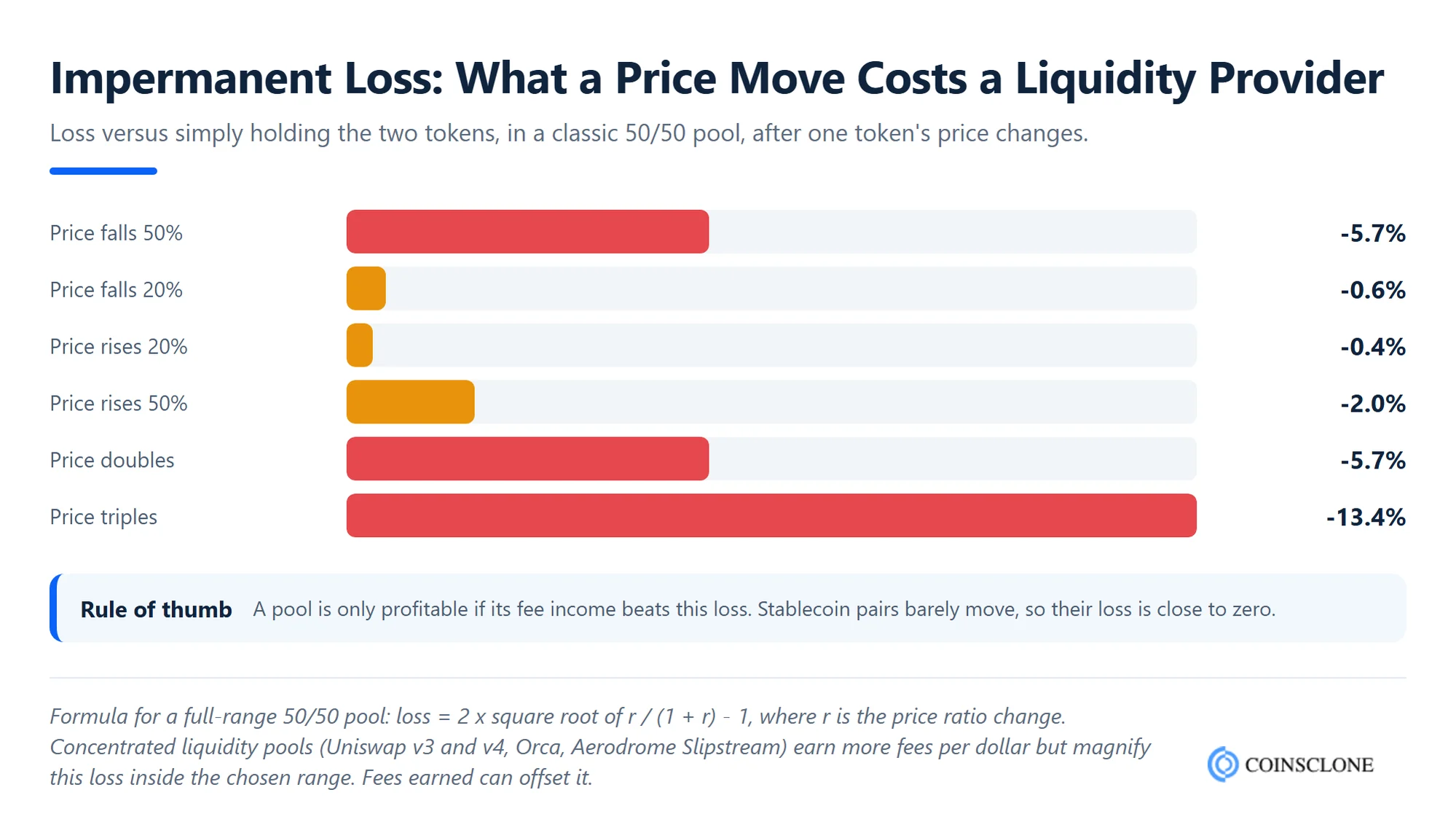
Here is a worked case. You add $500 of ETH and $500 of USDC to a classic pool. If ETH doubles, your position is worth about 5.7% less than if you had held the tokens. If the pool paid you more than 5.7% in fees over that time, you still come out ahead. If not, you would have been better off holding.
Stablecoin pools barely move, so their impermanent loss is close to zero. That is why their APRs are low, and why volatile pools must pay much more.
Which DEX Pays Liquidity Providers the Most Fees?
Another way to compare platforms is to divide the fees traders paid over a year by the liquidity each platform holds. This shows how hard each pooled dollar works:
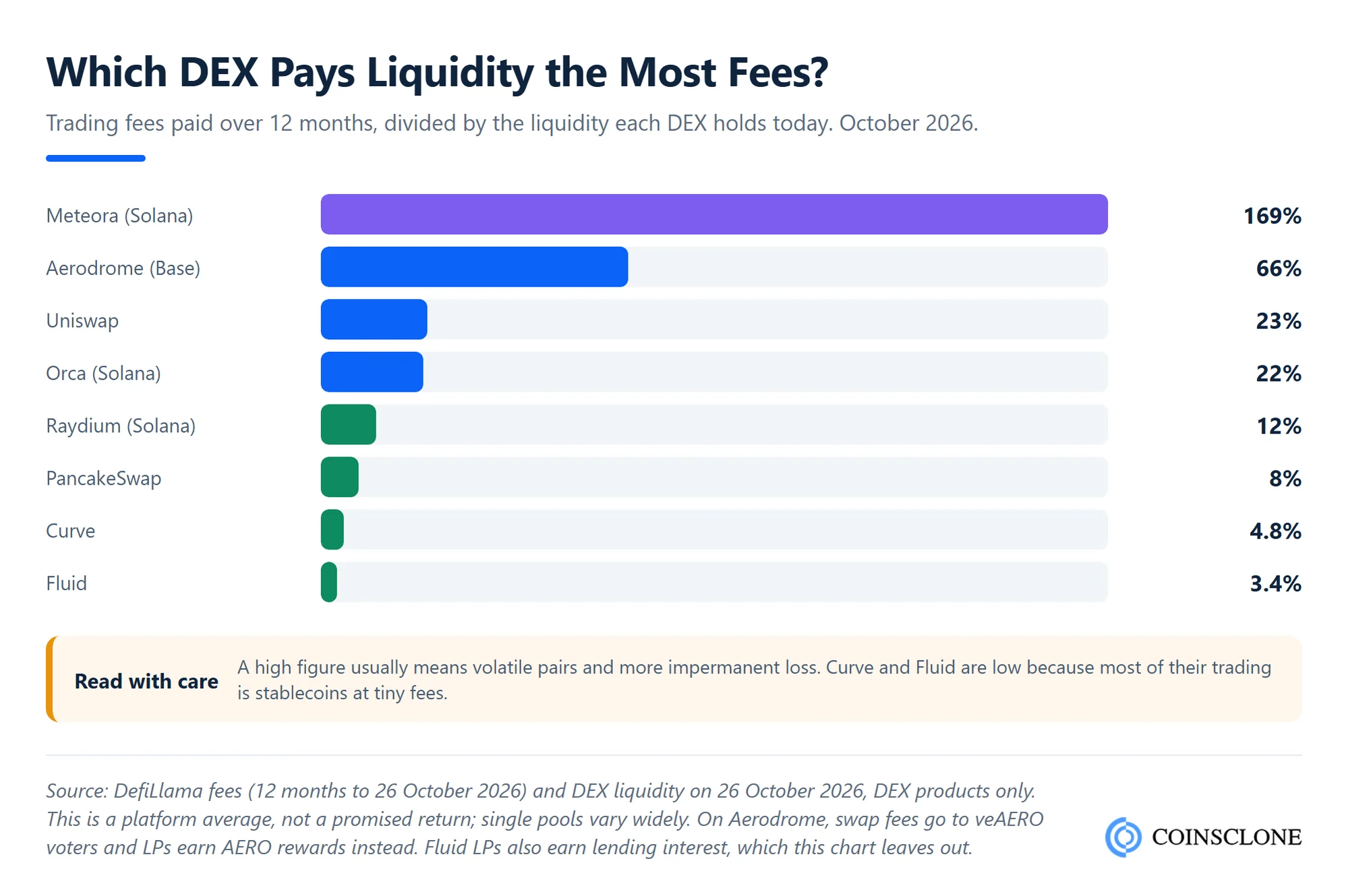
High numbers often mean jumpy pairs, so they come with more impermanent loss. Low numbers, like Curve’s and Fluid’s, reflect calm stablecoin pools with little risk.
What Are the Safest Liquidity Pools? Pool Types by Risk
Before you pick a platform, pick the kind of pool that matches your risk:
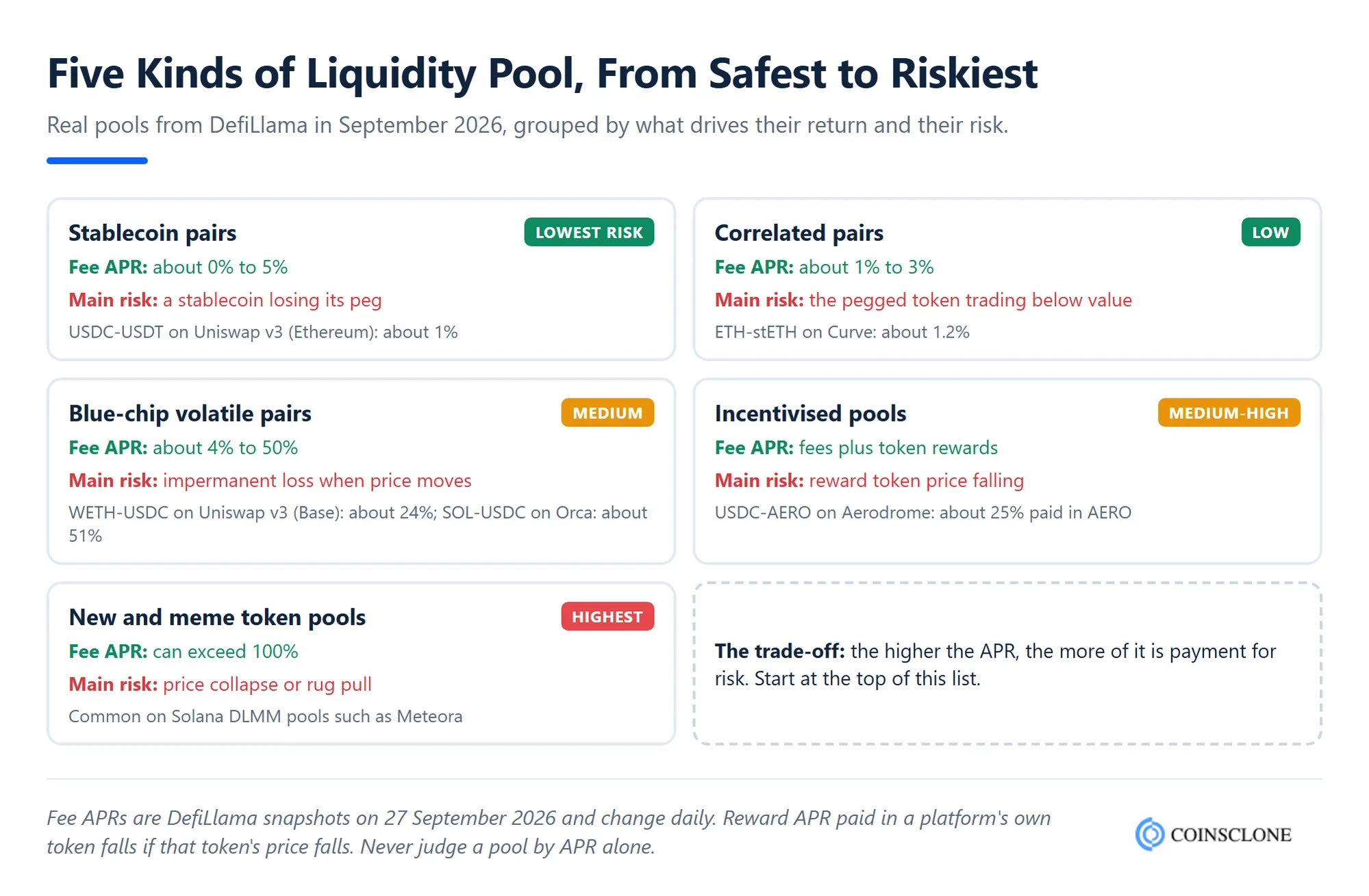
The pools named in this chart are from September 2026. The ranges still held a month later. Stablecoin pairs paid about 0% to 1%, ETH-stETH about 1.3%, and blue-chip pairs about 9% to 60% over 30 days.
How to Choose the Best Liquidity Pool
- Check the fee APR and the reward APR apart: Fees come from real trading. Rewards depend on a token that can fall.
- Look at volume, not just TVL: A pool earns from trading. High TVL with low volume pays little.
- Estimate impermanent loss: How much could the two tokens move apart during the time you stay?
- Check the platform’s safety record: Audits, time in use and past hacks.
- Know the tokens: Avoid tokens you do not understand, especially new ones.
- Mind the gas: On Ethereum, small positions can lose their profit to transaction fees. Layer 2s and Solana are cheaper.
- Plan your exit: Know how to withdraw, and whether any lock-up applies.
How to Invest in a Liquidity Pool, Step by Step
- Set up a self-custody wallet such as MetaMask, Rabby or Phantom.
- Get both tokens in the pool, usually in equal value.
- Open the platform and choose a pool, checking its fee tier, volume and APR.
- Set your range if it is a concentrated liquidity pool, or use the full range to keep it simple.
- Deposit and confirm the transactions in your wallet.
- Track your position: Watch fees earned, price range and impermanent loss.
- Claim fees or withdraw when you are ready.
How to Add Liquidity to PancakeSwap Infinity (v4) Stablecoin Pools
PancakeSwap Infinity offers two pool types. CLAMM pools are range pools like Uniswap v3. LBAMM pools spread your money across fixed price “bins”. That suits stablecoin pairs that stay near $1.
- Connect a wallet on BNB Chain, such as MetaMask or Trust Wallet, with a little BNB for gas.
- Hold both stablecoins, for example USDT and USDC.
- Open the add liquidity page on PancakeSwap and choose an Infinity pool for your pair.
- Pick the pool type and fee tier: For stablecoins, choose the lowest fee tier with the most volume.
- Set a tight range or bins around $1, such as $0.998 to $1.002, since these coins seldom move far.
- Approve and deposit both tokens, then confirm in your wallet.
- Check your share in the PancakeSwap positions list, and collect fees when you want.
Like other stablecoin pools, these pay low single-digit APRs at most. Check the live fee APR and volume on the pool page first. The main risk is a coin losing its peg.
What Is a Liquidity Pool Aggregator?
A liquidity pool aggregator is a tool that works across many pools for you. There are two kinds:
- DEX aggregators split your trades across many pools to find the best price. They do not earn you LP fees. See our list of the best DEX aggregators.
- Yield aggregators and liquidity managers take your deposit, put it into a pool, collect the rewards and reinvest them. Some also move your range when the price shifts. On DefiLlama, Beefy held about $105 million, Kamino’s Solana vaults about $71 million and Steer about $18 million.
How Does Beefy Show Higher APYs Than the Original Pool?
This came up on r/defi. A vault sells the reward token, such as CRV or AERO, for more of the pool’s tokens and puts it back in many times a day. That compounding turns a pool’s APR into a higher APY. It is not a promise, though. The vault adds its own fee and its own smart contract risk, and the APY still hangs on the pool’s rewards.
How to Find and Track a Token’s Liquidity Pools
To check where a token trades and how deep its liquidity is, search the token on DefiLlama, GeckoTerminal or DEX Screener. A DEX aggregator will also show which pools it routes your trade through. You will see each pool, its liquidity, 24-hour volume and fee tier. Always compare the token’s contract address with the one on the project’s official site, because fake tokens often copy popular names.
To compare pools, DefiLlama Yields tracks more than 15,000 pools. You can filter them by chain, platform, size and APR. To track a pool you are already in, use the platform’s own page or a wallet tracker that shows fees earned and losses.
Is Balancer Still Safe? What Happened to Balancer and Bancor
Older lists often recommend Balancer and Bancor. Both have changed:
- Balancer: Hit by a roughly $128 million exploit of its v2 stable pools in November 2025. Balancer Labs closed in March 2026. On 15 September 2026 the team proposed a wind-down, and BAL holders approved it on 29 September. Pools go withdrawal-only from 30 October 2026. If you still have funds there, take them out.
- Bancor: Its “impermanent loss protection” was a key feature, but Bancor suspended it in June 2022 during a market crash. The protocol held only about $24 million in late October 2026.
Both cases show that features and yields can change quickly. Diversify, and do not rely on any single protocol’s promises.
Benefits and Risks of DeFi Liquidity Pools
Benefits:
- Earn from trading: Fees are paid by real trading activity.
- Open to anyone: No approval or minimum is needed on most platforms.
- Self-custody: Your tokens stay in smart contracts, not with a company.
- Composable: LP positions can be used in other DeFi products.
Risks:
- Impermanent loss when prices move.
- Smart contract risk: Bugs and exploits can drain pools.
- Token risk: Tokens can crash, lose their peg or turn out to be scams.
- Reward risk: Reward tokens can lose value fast.
- Active management: Concentrated positions need regular attention.
Launch Your Own Secure, Scalable & Revenue-Driven DeFi Platform With Coinsclone’s Expert Solutions!
Cost-effective | White-Label Solution | Premium Features | Fully Customizable | Live Demo Available
How to Build Your Own Liquidity Pool or DEX
Liquidity pools are also a business. A DEX earns from the share of fees it keeps, from token launches and from partner integrations. With the right pool design, such as range pools or fees that adjust, a new DEX can draw in LPs faster.
If you are launching a token, you need a pool before anyone can trade it. Our guide on how to create a liquidity pool for a token covers how much to add, which DEX to use and how to lock LP tokens. To keep bots from buying your first trades, see how to stop snipers on a token launch.
Coinsclone is a DeFi development company that has built blockchain products since 2018. We have delivered more than 350 platforms for over 200 clients across 20 industries. Our decentralized exchange development team builds DEXs with AMM, range and stable pools, plus farms and staking. A white label DEX takes about 5 to 7 weeks, and a standard build about 10 to 14 weeks. Published 2026 agency cost guides put DEX builds at $10,000 to $50,000 for white label and $40,000 to $250,000+ for custom work.
Start from a proven model like our Uniswap clone script, Curve Finance clone script or Raydium clone script. You can also read our guide on how to create a decentralized exchange. For more on staking products, see the best DeFi staking platforms. And if you run a centralized exchange and need order book depth rather than pools, compare crypto liquidity providers instead.
See How Our MVP System Can Help You Build the Best DeFi Liquidity Pools Faster
Best DeFi Liquidity Pools — built for yield, security, and scalability.
- MVP System : Launch high-yield liquidity pools 90% faster.
- DeFi-Ready Modules : Integrated DEXs, yield farms, and liquidity protocols.
- Brand & Customization : Choose pool tokens, ratios, and reward structures.
- Revenue Engine : Earn from trading fees, farming rewards, and staking incentives.
Get a free DeFi liquidity demo in just 48 hours — before investing a cent.
Book a Free Demo to explore how we build DeFi liquidity pools designed to maximize TVL in 8–12 weeks.
Frequently Asked Questions
What is the best DeFi liquidity pool?
There is no single best pool. For low risk, stablecoin pools on Curve or Uniswap pay about 0% to 1%. For higher fees, blue-chip pairs like ETH-USDC on Uniswap or SOL-USDC on Orca paid 20% to 60% a year in late October 2026, with more risk.
Which platform has the best liquidity pools?
By size, Uniswap holds the most liquidity and earns LPs the most fees overall. Curve is best for stablecoins, Aerodrome (now Aero) for Base, Orca and Raydium for Solana, and PancakeSwap for BNB Chain.
Are liquidity pools profitable?
They can be, if the fees you earn are larger than your impermanent loss and gas costs. Stablecoin pools are steady but low. Volatile pools pay more but can lose money when prices move sharply.
How do people LP profitably?
Most LPs who make money pick pairs with steady volume and keep ranges wide enough to stay in range. They also count losses before fees. This question, asked on r/solana, drew answers about chasing new tokens on Meteora. That can work, but it is an advanced strategy where a single token crash can erase weeks of fees.
Does short-term LPing with a tight range work?
Sometimes, but it is harder than it looks. A r/defi user asked whether a very tight ETH-USDC range, pulled as soon as it goes out of range, beats impermanent loss. A tight range earns more fees per dollar, but each exit locks in the loss. Each reset also costs gas and swap fees. It needs constant care and works best on low-gas networks.
What is impermanent loss?
It is the value you lose compared with simply holding your tokens, because the pool rebalances when prices change. In a classic pool, a price that doubles creates about 5.7% impermanent loss.
How do I invest in a liquidity pool?
Use a self-custody wallet, get the two tokens, choose a pool on a DEX, set a price range if needed, and deposit. You can track and withdraw your position at any time on most platforms.
What are the safest liquidity pools?
Stablecoin pairs such as USDC-USDT and correlated pairs such as ETH-stETH on established platforms like Curve and Uniswap carry the lowest impermanent loss. They still carry smart contract and depeg risk.
What is the best liquidity pool on Solana?
Orca and Raydium are the main Solana platforms for blue-chip pairs like SOL-USDC. Meteora earns very high fees on busy pairs, but many of them involve new and risky tokens.
Are there liquidity pools for XRP and Bitcoin?
Yes. The XRP Ledger has had a built-in AMM since March 2024, so you can pool XRP with other tokens on the ledger itself. For Bitcoin, most DeFi pools use wrapped versions such as WBTC or cbBTC, for example WBTC-WETH on Uniswap or WETH-cbBTC on Base.
Can I build my own liquidity pool platform?
Yes. You can launch a DEX with AMM or range pools from a DEX clone script or a custom build. Then you draw in LPs with fees and rewards.