
Art tokenization turns the rights to a painting, sculpture or digital work into tokens on a blockchain. One token can stand for a whole piece, or many tokens can each hold a small share of it. As a result, a work that once needed one rich buyer can now have hundreds of owners, a public record of who owns what, and a way to trade those shares online.
This guide explains how art tokenization works from start to finish, who holds the real artwork, and how it differs from NFT art. You will also see real projects with their numbers, the 2026 rules in the US and EU, the main risks, and the steps to build your own platform. By the end, you will know whether it fits your goals and where to start.
In this guide:
- How it works: A legal firm owns the artwork, a vault keeps it safe, and tokens record each holder’s share.
- Real examples: A Picasso split into 4,000 tokens, a $12.9 million Banksy split into 10,000 NFTs, and how Masterworks does it with no blockchain.
- The rules in 2026: Why a single art NFT is often not a security in the US, but shares of one painting can be.
- The risks: Weak records of origin, thin trading, unpaid royalties and sites that shut down.
- How to build it: The seven steps, the chains to use, and how a platform earns money.
See How Our MVP System Can Tokenize Your Art Collection Faster
Art Tokenization Platform Development — done right.
- MVP System:Launch your art-backed investment platform 90% faster.
- Blockchain Integration:Secure, transparent, and fully compliant art asset management.
- Custom Branding:Your marketplace, your artists, your investors.
- Revenue Engine: Earn from token sales, listings, and investor onboarding.
See a free branded demo of your platform in 48 hours — before you invest a cent.
Book a Free Demo to discover how our Art Tokenization Platform can turn masterpieces into liquid digital assets in just 2–4 weeks.
What Is Art Tokenization?
Art tokenization is the process of turning a real or digital artwork into blockchain tokens that stand for rights, title or a share of its value. Smart contracts on networks like Ethereum create and track these tokens. Most projects use standards such as ERC-721 for one-off pieces or ERC-1155 for works with many copies.
The token does not replace the artwork. Instead, it is a digital claim on it. For a painting, a legal firm often owns the work, and the tokens prove each holder’s share of that firm. For a digital work, the token can itself be the record of who owns it.
Here is a simple example. Say a painting is worth $1 million. The owner splits it into 10,000 tokens worth $100 each. Now a buyer can own 0.01% of the work for $100, instead of paying $1 million for the whole thing. When the painting is later sold, each token holder gets their share of the sale.
An art tokenization firm builds the tech behind this. That means the smart contracts, the buyer checks, the wallet and the trading screens. It also means a clean link between each token and the real-world papers that prove title and origin.
NFT Art vs Tokenized Physical Art
People often use “NFT art” and “tokenized art” as if they meant the same thing. But they solve two separate problems, and the rules treat them in two ways.
| NFT art | Tokenized physical art | |
| What you own | A one-off token, often for a digital work | A share of a real artwork, held by a legal firm |
| Number of owners | Most often one per token | Hundreds or thousands per artwork |
| Where the art lives | Online, often on IPFS or Arweave storage | In an insured vault or on loan to a museum |
| Typical standard | ERC-721 or ERC-1155 | ERC-20 or ERC-1155 shares, or a permissioned token such as ERC-3643 |
| Main rules | Consumer and tax law; often not a security | Often treated as a security, with buyer checks |
| How you exit | Resell the NFT on a marketplace | Sell tokens to other holders, or wait for the artwork to be sold |
In short, NFT art proves you own a one-off digital item. Tokenized art, on the other hand, gives many people a share of one costly piece. Our guide to fractional NFTs shows how a single NFT can be split into shares too.
How Art Tokenization Works
Behind each art token sits a chain of people and contracts. The token itself is the easy part. The hard part is the work off the chain that makes the token worth something. Here is how a typical project runs.
- Check the artwork: Experts confirm who made it, who owned it before, and the state it is in. An appraiser then sets a value.
- Set up a legal wrapper: A special purpose firm (often an LLC or SPV) buys or receives the artwork. This firm holds legal title, so token holders own the art through it.
- Store and insure it: A vault, freeport or museum keeps the work safe. The insurance and storage terms are linked to the token records.
- Mint the tokens: A smart contract creates a fixed number of tokens. It also sets who may hold them, how voting works, and how sale money is paid out.
- Onboard buyers: Buyers pass ID and AML (anti-money laundering) checks, then buy tokens with cards, bank transfers or stablecoins.
- Trade and wait: Holders can sell tokens to other approved buyers, if the platform runs a market for them.
- Sell and pay out: When the artwork is sold, the firm pays its fees, and the smart contract sends each holder their share.
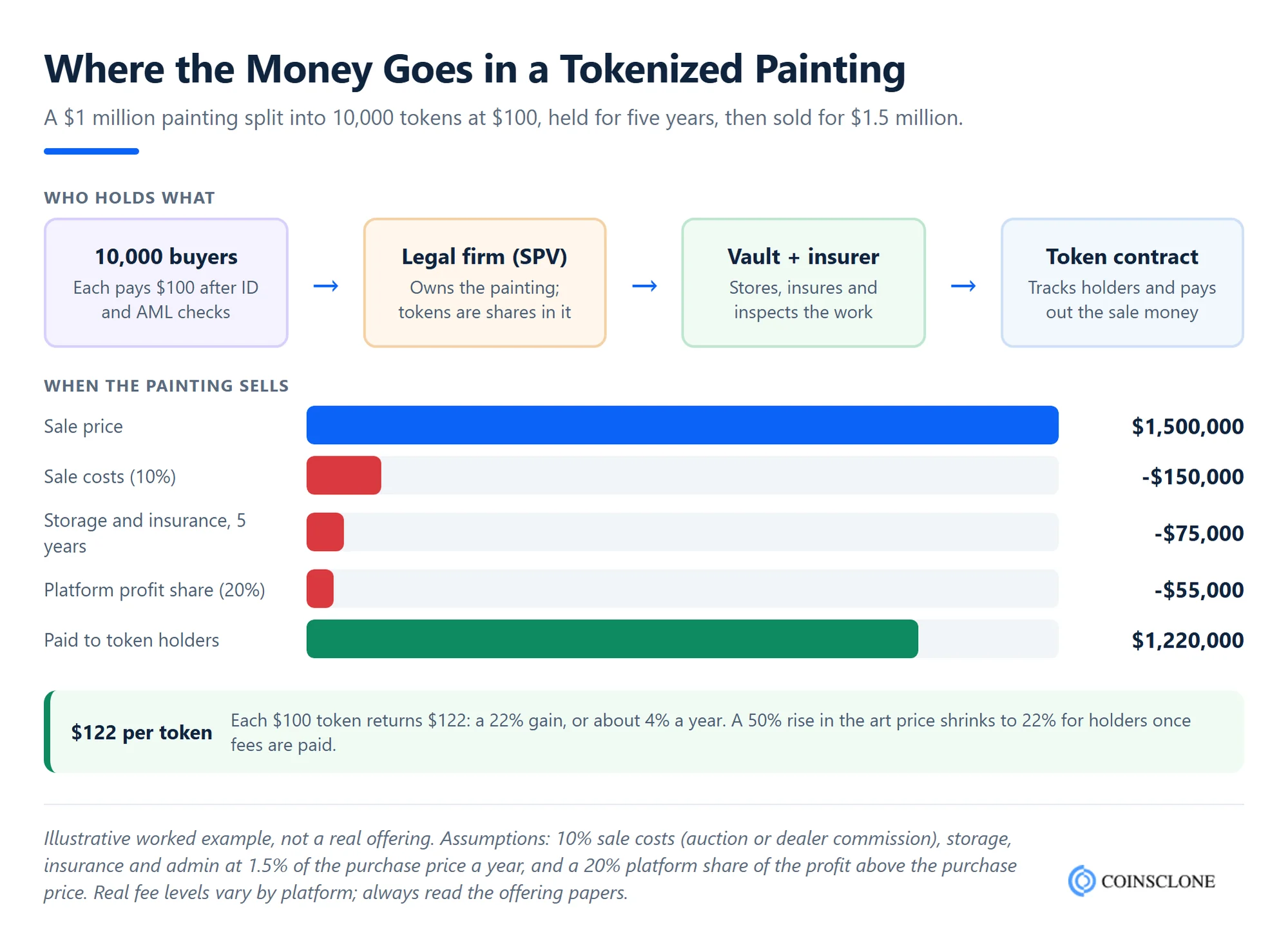
Note what the blockchain can and cannot do. It keeps a tamper-proof log of each token transfer. But it cannot check that the first facts typed in were true. If the origin file is wrong, the token simply records a wrong fact forever. That is why expert checks and good custody matter more than the choice of chain.
Our Art Tokenization Development Approaches
At Coinsclone, we follow two ways to tokenize art: full builds from scratch and hired token builders. Both follow clear, compliant methods that can grow with you.
Full Build From Scratch
We offer complete support to tokenize art from scratch. First, we define who owns what, choose the right token standard, shape the token data and deploy the smart contracts. Then we add the buyer checks, wallets, payment options and admin tools. We make sure each step is secure and clear, and that each token is easy to trace and cannot be changed.
Hire Dedicated Developers
Our token developers know the field well and have hands-on skill in turning real assets into tokens. They stay with you from custom features and smart contract setup to token rules and mainnet launch. Hiring our team suits large firms that tokenize art worth large sums and want builders inside their own process.
Benefits of NFT Art Tokenization for Artists and Collectors
Tokens let artists split their work into shares and reach a wider group of buyers. Buyers, in turn, get easier access, faster trading and a wider range of art to choose from.
For Artists
Passion to profit: Turning art or sketches into tokens helps artists earn money while keeping clear rights.
Clear records: Because tokens live on a blockchain, anyone can trace who owns a piece. This helps cut fraud and fakes.
Easier to sell: Tokens can be traded soon after launch on NFT sites or the platform’s own market. That makes them easier to sell than a painting that waits for the next auction.
Royalties: A smart contract can ask for a share of each resale for the artist through the ERC-2981 standard. But many NFT sites now treat royalties as optional, so do not count on them alone.
Funding: With a small start, such as one strong piece, an artist can raise money from fans and buyers with good promotion.
Global reach: Tokens help artists find buyers and fans all over the world. Over time, that builds a loyal circle around the artist.
Lower costs: Selling through tokens costs less than the classic route. It cuts auction fees, middlemen and some of the costs of showing the work.
For Collectors
Shared ownership: Buyers who cannot afford a whole artwork can buy a share of it. The piece is then split among all token holders.
Worldwide access: Art bought as a token can be held and traded from anywhere, with no borders.
A new kind of asset: Art tokens give buyers a fresh asset to hold next to stocks and crypto. They also let buyers back an artist they believe in.
Thanks to these perks, art tokens have become a real business idea for artists, art dealers and platforms. If you want to join them, you need to know the steps well, so you can shape your art token around your own goals.
The promise is real, but it helps to see the size of each market first. The wider art market is large but slow, while the NFT market has shrunk sharply since 2021.
According to the Art Basel and UBS Global Art Market Report 2026, global art sales rose 4% to $59.6 billion in 2025. Online sales, though, fell to $9.2 billion, their lowest level since 2019. At the same time, total NFT sales dropped 37% to $5.63 billion in 2025, with an average sale of just $96, per CryptoSlam data.
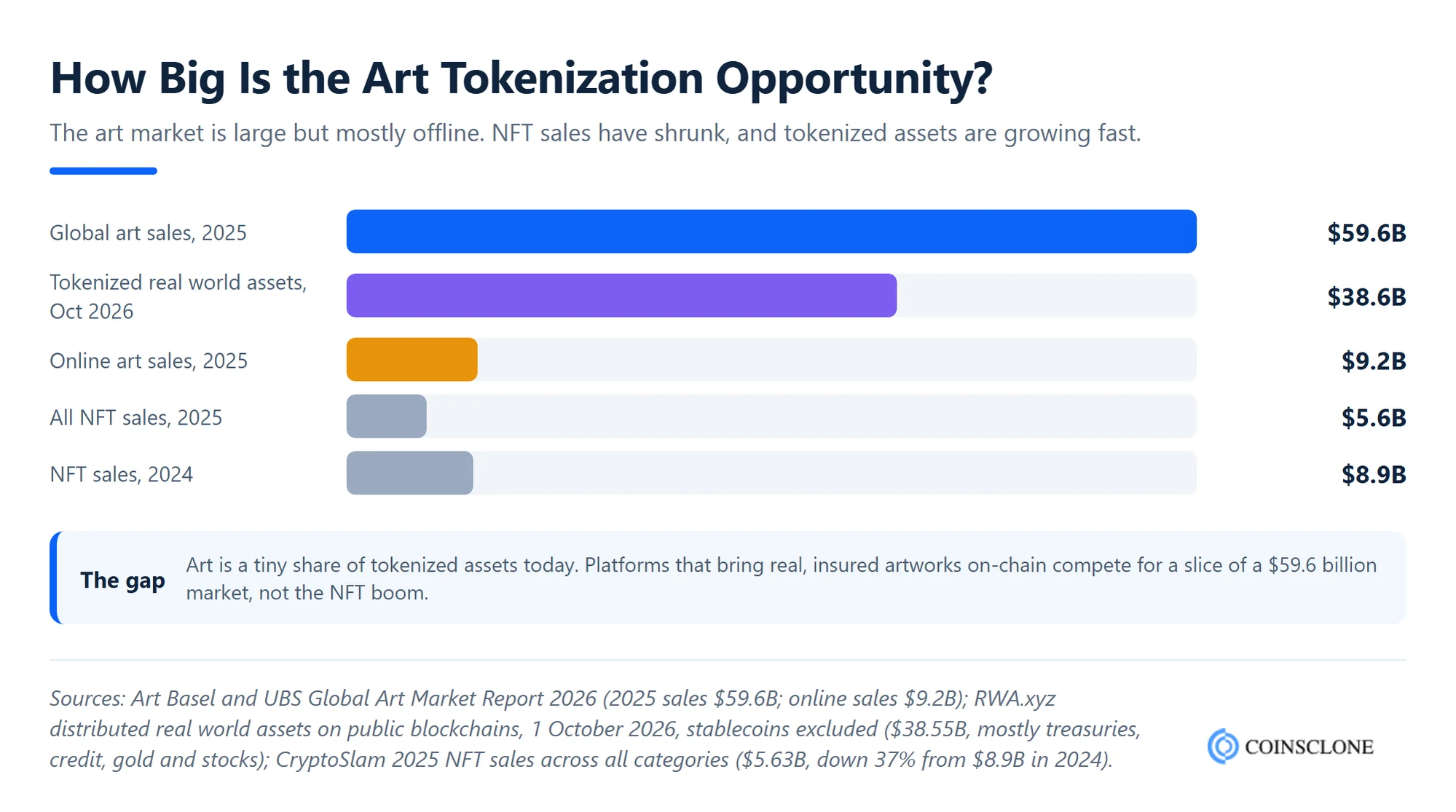
So where is the gap? Most art money still changes hands offline, through dealers and auction houses. Tokens backed by real assets, not counting stablecoins, grew to about $38.55 billion by October 2026, per RWA.xyz, but nearly all of that is bonds, loans, gold and stocks. Art is still a tiny slice. That gap is the opening: proven tools exist, buyers want access, and few art platforms do it well. Here are the main business models.
Revolutionizing the Commercial Gallery
Art dealers can offer shares in fine paintings to a wider group of buyers while following the laws that apply. Buyers own a share of a costly work, and the dealer reaches people who could never buy the whole piece.
Individual Art Tokenization
Artists can use the power of crowdfunding by turning their own works into tokens. They raise money for new projects, while fans join a circle of art lovers and backers. Our blockchain art services make buying art more open to all.
Trophy Art Tokenization
Owners of trophy art can sell part of a piece to raise money for new buys, without selling the whole work. A compliant, secure and fixed ledger gives art lovers and buyers a smooth ride and trust in their holdings.
Art-Backed Lending
Owners can also use art tokens as security for a loan. Because the token is easy to price, move and lock in a smart contract, a lender can accept it without taking the painting off the wall.
Real Examples of Art Tokenization
Real projects show what works and what to expect. Here are three well-known cases, and one of them uses no blockchain at all.
| Project | What happened | Numbers |
| Sygnum Bank and Artemundi (2021) | A Swiss bank put Picasso’s Fillette au béret (1964) on a blockchain | Priced at CHF 4 million, split into 4,000 tokens, CHF 5,000 minimum |
| Particle (2021 to 2022) | Bought Banksy’s Love Is in the Air and split it into NFTs | Bought for $12.9 million, 10,000 NFTs at about $1,500 each |
| Masterworks (since 2019) | Sells shares in single artworks as SEC-qualified offerings, not tokens | $20 per share, 530+ works bought, 32 sold, $77 million+ paid back to investors |
Sygnum and the Picasso: Sygnum Bank tokenized the Picasso in July 2021. It was the first artwork whose rights a licensed bank put on a public blockchain. Swiss law fully backed each holder’s share, which shows how much the legal setup matters.
Particle and the Banksy: Particle bought the Banksy for $12.9 million and split it into 10,000 NFTs, each tied to a part of the image, as ARTnews reported. Holders vote on things like where the work is shown. In 2023, the painting went on loan to museums.
Masterworks as the benchmark: Masterworks runs the biggest shared-art business, yet it does not issue blockchain tokens. Each painting sits in its own firm, and shares are sold under SEC Regulation A. This proves the demand is real. It also shows what a token platform must beat: faster trading, lower fees and global access.
Industries We Assist with Art Tokenization Development
At Coinsclone, we create tokens from real assets to prove who owns a work and that it is real. Art tokens follow the same ideas used in Real World Asset Tokenization, where real assets are shown as tokens on a blockchain. Our skills cover the areas below.
- Fine Art & Galleries: Art dealers can create a blockchain record for each artwork they turn into tokens. As a result, each piece is easy to track, with a clear chain of owners, without changing how they sell or show art.
- Museums & Cultural Institutions: Coinsclone helps museums scan their art and records for archives and origin checks. Tokens let museums confirm that a work is real, sound and true to its past.
- Luxury Collectibles: Costly paintings and rare items can be turned into tokens to stop copies and keep a secure record of each owner. This guards their value and makes it easier to pass them to new owners.
- Solo Artists & Art Groups: Solo artists and their circles can turn their art into tokens to create a digital record of who owns it. This way, artists can prove their work is original and show it to the world.
Building an Art Tokenization Platform: Step-by-Step
Turning art into tokens is not as hard as it sounds. You can do it smoothly with the steps below. Each one builds on the last, whether the artwork is a painting or a digital file.
- Step 1: Choose the Artwork: Start by picking a work with clear value. It can be a painting, a sculpture or a digital file, such as a high-grade JPG, PNG or video.
- Step 2: Check and Price It: Experts check the work and set its value. For a painting or sculpture, they also create sharp images or 3D scans that stand in for it online.
- Step 3: Set Up the Legal Wrapper and Custody: For shared ownership, form a firm to hold title. Then agree on a vault, insurance and the rules for a future sale.
- Step 4: Select the Blockchain: Next, pick the network you want to use. Make sure its fees, speed, wallets and token standards fit your needs.
- Step 5: Mint the Tokens: The artwork now goes through minting, which turns it into a one-off NFT or a set of share tokens. Add the key details, such as its past, origin and links to the legal papers, so title can pass cleanly.
- Step 6: Add Shared Ownership: For costly works, split title among many token holders. Build in buyer checks and limits on who may hold tokens if they count as securities.
- Step 7: Launch, Sell and Promote: List the tokens on your own platform or an art marketplace for sales and auctions. Then promote them on social media, art sites and collector groups to reach buyers.
By following these steps, from picking the artwork to promoting it, you can create art tokens with confidence. Still, if these steps seem complex, think about working with a skilled Crypto Token Development Company. Such firms have skilled builders and offer each service in one package.
How an Art Tokenization Platform Makes Money
A platform can earn from many streams at once. Common ones include:
- Listing fees: Charge owners and art dealers to tokenize and list a work.
- First sale fees: Take a share of each first sale of tokens.
- Trading fees: Earn a small fee on each resale between holders.
- Yearly fees: Charge a small yearly fee to cover storage, insurance and reports.
- Exit fees: Take a share of the profit when the artwork is finally sold.
Masterworks shows how this works in practice. It charges a yearly fee and takes a share of the profit when a painting sells, so it does not rely on trading alone.
Is Art Tokenization Legal? The Rules in 2026
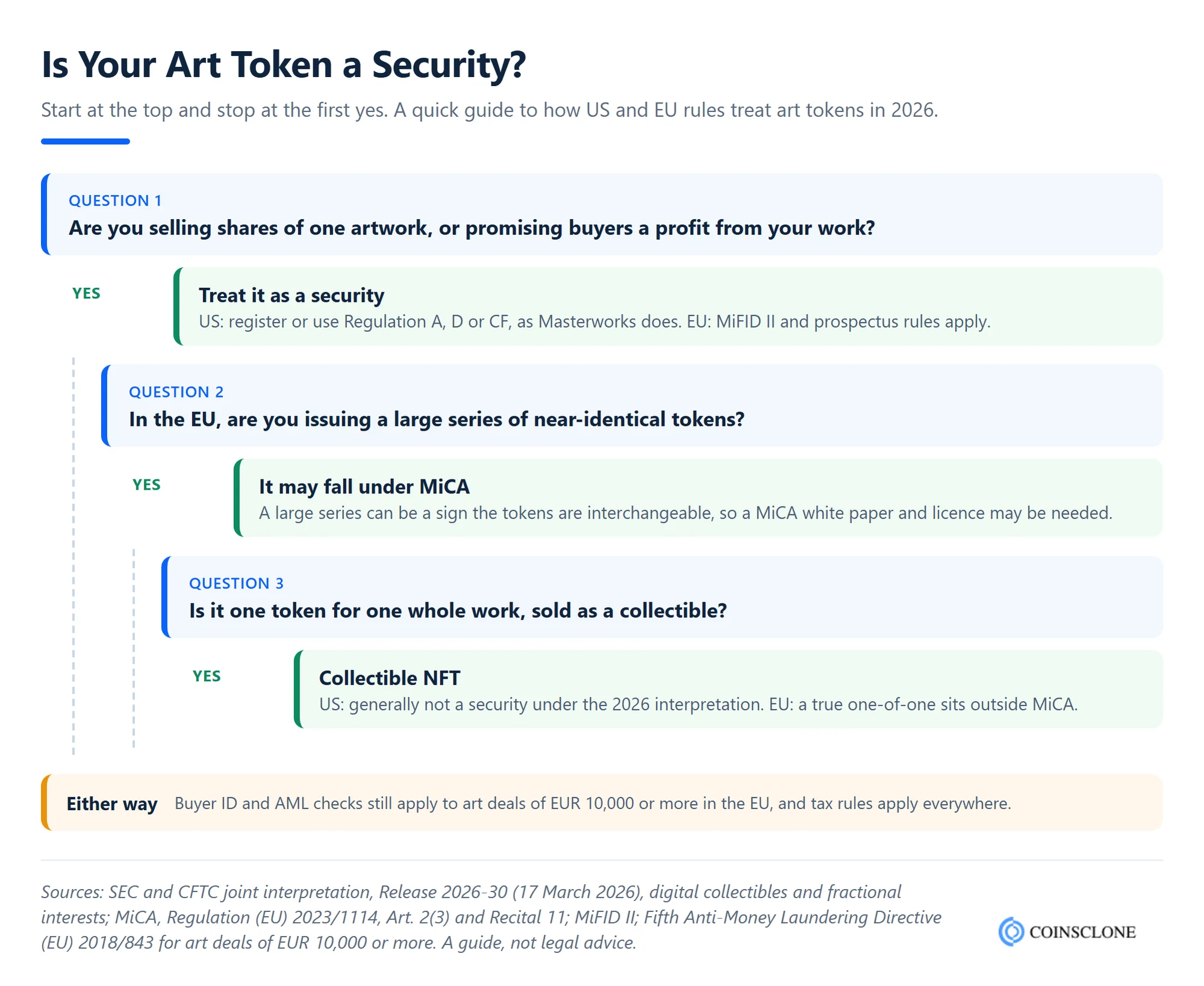
Yes, art tokens are legal in most major markets. But the rules depend on what you sell. The key question is simple: are buyers getting a collector’s item, or an asset that depends on your work to make money?
United States: On 17 March 2026, the SEC and CFTC issued a joint interpretation that sorts crypto assets into five groups, and one group is “digital collectibles”. A single NFT artwork is generally not a security. But the paper says that selling shares of one item “could constitute the offer or sale of a security”. So shared-art platforms use legal routes such as Regulation A, D or CF, as Masterworks does.
EU: The MiCA rules do not cover crypto assets that are one-off and cannot be swapped for another, so a true one-of-one art NFT sits outside them. But the law also says that parts of a one-off asset are not one-off, and that a large series of tokens can be a sign they are swappable. Shares that act like securities fall under MiFID II and prospectus rules instead.
AML checks: EU law already treats art dealers as firms that must check buyers on deals of EUR 10,000 or more, under the Fifth Anti-Money Laundering Directive. So plan ID checks into your platform from day one.
Rules change by country, so always get local legal advice before you launch. Our guide to the top countries to launch RWA tokenization compares the main hubs.
Risks and Limits of Art Tokenization
Most guides sell only the upside. Before you build or buy, though, know the downsides. Here are the main risks and how good platforms deal with them.
- Gaps in the record: The blockchain only records what it is told. Use outside experts and keep their reports linked to each token.
- Custody and damage: If the vault fails or the work is damaged, the tokens lose value. Ask for named vault firms, full insurance and yearly checks on the work’s state.
- Thin trading: Many art tokens trade rarely, so selling fast can mean selling cheap. Plan a market for holders and clear exit rules from the start.
- Pricing: Art prices are personal and move slowly. Show how values are set, by whom and how often.
- Royalties are not certain: The ERC-2981 standard only signals a royalty. NFT sites can skip it unless your own contract or platform enforces it.
- Sites that close: Many NFT art sites, such as Foundation, Nifty Gateway, MakersPlace and KnownOrigin, have closed. Keep token data on lasting storage and make sure tokens work beyond one website.
- Smart contract bugs: A flaw can freeze or leak funds. Use audited code and test each payout path.
- Rules can change: A token sold as a collector’s item can become a security if you promise returns. Get a legal review for each new sale.
Supported Blockchains for Art Tokenization Development
We build art tokens on the networks that suit your buyers, fees and rules. These include:
- Ethereum: The largest network for NFTs and real-asset tokens, with ERC-721, ERC-1155 and ERC-3643.
- Solana: Fast and cheap, with a large NFT trading crowd.
- Tezos: Low fees and a long track record with digital artists.
- BNB Chain: Low fees and a wide user base in Asia.
- Algorand: Fast final trades and built-in asset tools.
- Stellar: Built for payments and regulated assets.
- Polygon: An Ethereum-friendly network with very low gas fees.
Start Your Tokenization Journey Now!
Cost-effective, White-Label Solution, Premium Features, Customizable. Live Demo Available.
Why Choose Coinsclone for Art Tokenization Development?
Coinsclone is a leading Crypto Token Development Company that offers some of the best art token services for a wide range of business needs. We have been building blockchain products since 2018, and we have delivered 350+ platforms for 200+ clients across 20 industries. Our team lets clients shape their art tokens around their own goals, and our support team is there 24/7 to fix any tech issue.
Besides tokens, we also build crypto exchanges, wallets and payment gateways. If you plan a full platform where art dealers list works and buyers purchase shares, our asset tokenization platform development team can build it end to end. So, if you want to tokenize art, reach out to our team and take your idea to market with confidence.
Frequently Asked Questions
What is art tokenization in blockchain?
Art tokenization in blockchain means turning an artwork into tokens stored on a blockchain. Each token stands for title or a share of the artwork, and smart contracts secure it. This makes it easy to track, move and check who owns the art.
How does art tokenization work?
It works by creating a smart contract that defines who owns an artwork. For a painting, a legal firm often holds the work, and the tokens stand for shares in that firm. Details such as the artist’s name, past owners and proof that the work is real are stored on-chain or in shared online storage.
What blockchain is best for art tokenization development?
Ethereum is the most common choice because it supports NFT standards like ERC-721 and ERC-1155, plus standards like ERC-3643 that limit who can hold a token. Other chains, such as Polygon, Solana and BNB Chain, are also used for lower fees and higher speed.
What is the difference between NFT art and tokenized art?
NFT art most often stands for a single digital item that cannot be split. Tokenized art can stand for shares of a real or digital artwork. So tokenized art lets many owners hold parts of the same work.
Is NFT art worth anything?
Some is, but most is not. NFT sales fell 37% to $5.63 billion in 2025, and the average sale was just $96, per CryptoSlam. Value now depends on the artist’s name, real demand, and any rights or real artwork behind the token.
Can physical artwork be tokenized?
Yes. A painting or sculpture can be turned into tokens by linking the real piece to blockchain tokens. The token acts as proof of who owns it, while legal contracts and a vault firm make sure the work is safely stored and managed.
What is the downside of tokenization?
The main downsides are thin trading, reliance on the vault and the issuer, guesswork in pricing, legal costs, and the risk that a platform shuts down. Tokens make shares easier to split and trade, but they do not make a weak asset valuable.
How can I make money from tokenization?
Artists earn from first sales and, where enforced, resale royalties. Buyers may profit if the artwork rises in value and is sold. Platforms earn from listing, sales, trading and yearly fees.
Can I tokenize my house?
Yes, the same method works for homes. A firm or trust holds the home, and tokens stand for shares in it, under local land and securities laws. Our guide to tokenization of real estate covers the steps.
What token standards are used for art tokenization?
Art tokens mostly use ERC-721 for one-off works and ERC-1155 for editions or shares. Projects that sell shares to approved buyers often use ERC-3643, which limits transfers to checked wallets. ERC-2981 adds royalty details.
How is ownership tracked in art tokenization?
Ownership is tracked through blockchain transfers that smart contracts record. Each transfer is stored for good, which creates a public, tamper-proof record of who has owned the artwork.
See How Our MVP System Can Tokenize Your Art Collection Faster
Art Tokenization Platform Development — done right.
- MVP System:Launch your art-backed investment platform 90% faster.
- Blockchain Integration:Secure, transparent, and fully compliant art asset management.
- Custom Branding:Your marketplace, your artists, your investors.
- Revenue Engine: Earn from token sales, listings, and investor onboarding.
See a free branded demo of your platform in 48 hours — before you invest a cent.
Book a Free Demo to discover how our Art Tokenization Platform can turn masterpieces into liquid digital assets in just 2–4 weeks.