

This guide explains how a clone script for cryptocurrency startups works and which ones are worth a look in 2026. It covers what a clone script is, the top scripts for exchanges, DeFi, prediction markets, payments, wallets and NFTs, and how a clone script compares with white label and custom builds. You will also see real launch times and cost ranges, so you can plan a budget before you talk to any vendor.
The aim is to help you pick the right model and the right path, fast. By the end, you will know which script fits your idea, what it costs in time and money, which licence you may need, and how to judge a provider before you sign.
In this guide:
- What a crypto clone script is, and why it is legal when used the right way
- 25 top clone scripts across six crypto models, with newer ones like Polymarket and Hyperliquid
- Clone script vs white label vs custom build, with a decision tree
- Launch times from 3 to 16 weeks, and 2026 cost ranges by product
- The licences, risks and provider checks that matter before launch
What Is a Clone Script for Cryptocurrency Startups?
A clone script is ready-made, tested software that copies the core features of a well-known crypto platform such as Binance, Coinbase or Uniswap. You then change the brand, design, fees and features to fit your own business. In short, it gives a startup a proven base to launch a crypto exchange, wallet, payment gateway or DeFi app quickly and at a lower cost.
The crypto market is big enough to reward fast movers. The total crypto market is worth about $2.9 trillion, with close to $100 billion traded in a normal day, CoinGecko data shows in early October 2026. Still, building a platform from scratch is slow and costly. It can drain your budget and delay your launch while rivals take your users.
You might wonder, “Can’t I just use open-source code to build a crypto platform?”
It sounds tempting, but it is a risky path. Free code found online often lacks proper security layers, room to grow and any real support. Using it can expose your users’ funds to attacks and make later upgrades hard. In short, it is not a sound base for a serious crypto business.
So, what is the smarter choice? This is where a crypto clone script comes in. By choosing one, you can:
- Launch faster: start with a business model that already works.
- Start secure: get tested wallets, admin controls and security features from day one.
- Keep your brand: change the design, fees, coins and features to match your plan.
- Spend less: save build costs and put the money into marketing and liquidity.
In short, a clone script lets a startup enter the crypto market without reinventing the wheel. It blends a proven model, tested code and speed.
Why Use a Clone Script for Your Crypto Business?
A clone script helps you launch a platform by copying the features of a popular website or app. Moreover, it is a quick and clever choice for startups that want to enter the blockchain space without a large tech team.
Fully Customizable
One key highlight of a clone script is how much you can change. You can adjust the script from top to bottom to suit your needs, from the trading pairs and fee rates to the colours and the sign-up flow. Also, it comes with a strong admin panel, so you can manage users, funds, listings and reports from one place.
Affordable and Quick to Launch
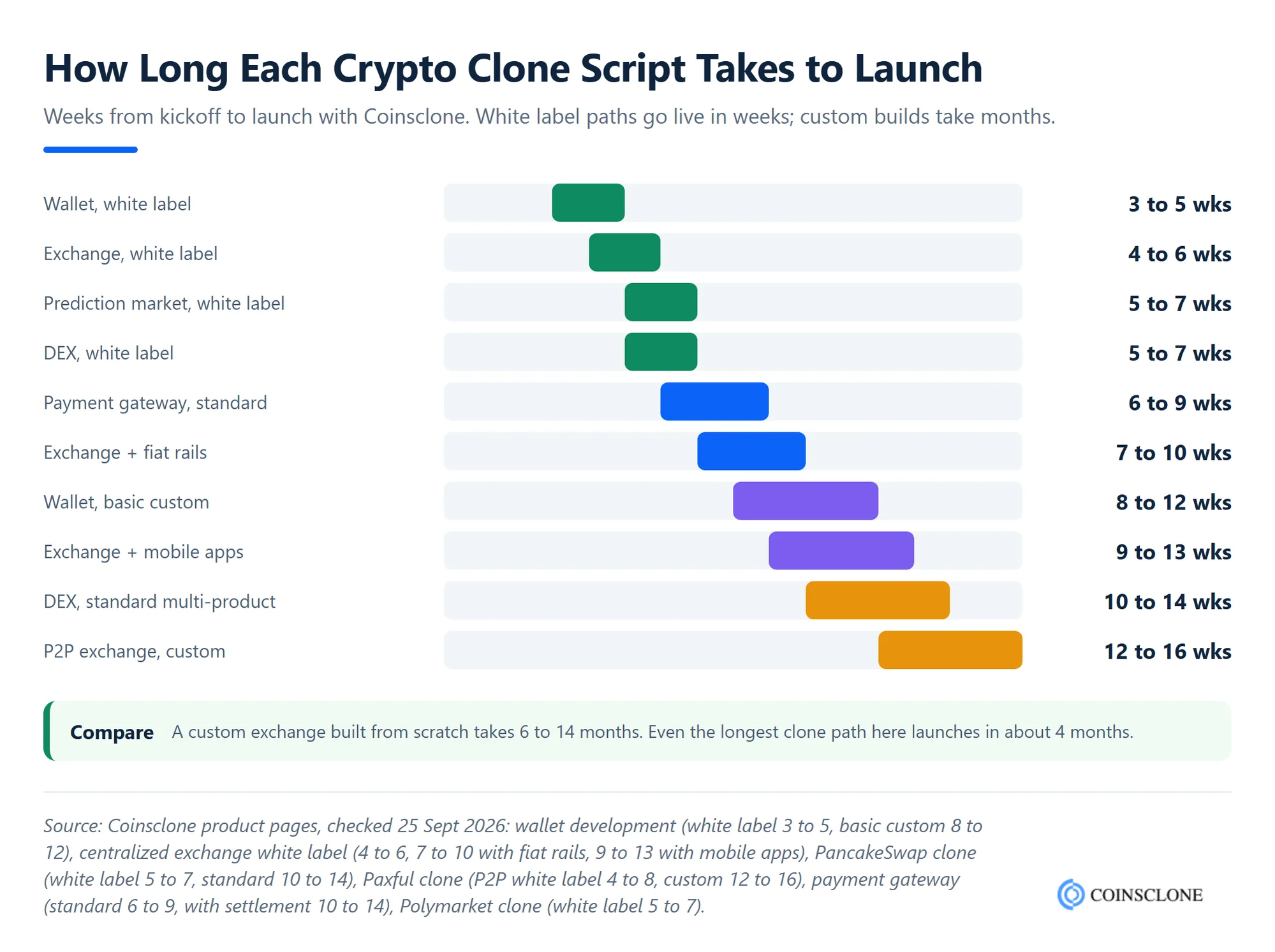
Clone scripts cost far less than a custom build, so a founder with a small budget can start a crypto venture. For example, a white label exchange can go live in 4 to 6 weeks with Coinsclone, or 9 to 13 weeks with mobile apps. Besides, you do not need deep coding skills, because the provider handles the build, setup and launch.
Legal and Unique
Some people say clone scripts are just copies of existing websites, but that is a myth. A good clone script is written by its own team, so the code is new and no one can claim it was copied.
A clone script is legal as long as you do not break the trademarks, copyright or patents of the first platform. Note that you are not copying its source code. Instead, you copy the concept and change the theme, UI/UX, structure, features and plug-ins to suit your business. So never use the original brand name, logo or design in your product.
For more detailed information on whether clone scripts are legal, check out >>> Are Clone Scripts Legal or Illegal? A Detailed Explanation
Keep in mind that a legal script is not the same as a licensed firm. If your platform holds user funds, you will likely need a licence too. We cover that in the licensing section below.
In short, clone scripts offer a good balance of new ideas, low cost and tested code. That makes them a smart launchpad for crypto founders.
Top Clone Scripts for Crypto Startups in 2026
The crypto space runs on many models, from exchanges and DeFi apps to wallets and NFT stores. Each model has a clone script built for it, which copies the success of the leading platform in that space.
For instance, crypto exchange clone scripts like Binance or Coinbase clones help startups launch secure trading platforms with spot trading, KYC and liquidity tools built in.
In the same way, each model has its own top clone scripts. Here is the full list, grouped by type.
Clone Scripts for Crypto Exchange Startups
Crypto exchanges are the backbone of the digital asset economy. They link buyers, sellers and market makers around the world. Since building an exchange from scratch is costly, many founders start with a clone script. The most popular ones are:
- Binance Clone Script: Copies the structure of the world’s largest exchange by volume, with spot, margin and futures trading, many trading pairs and strong security. Ideal for a large central exchange (CEX) that can grow.
- Coinbase Clone Script: Ideal for a simple, rules-first platform that suits beginners, with easy buy and sell flows and bank payment options.
- Kraken Clone Script: Built for active traders, with futures, margin trading and APIs for large clients.
- KuCoin Clone Script: Build a global exchange with a wide range of altcoins, spot, margin and futures trading and many languages.
- Bitget Clone Script: Copies Bitget’s derivatives trading and copy trading, where users follow the trades of top traders.
- Bybit Clone Script: A derivatives-first exchange with perpetual contracts, leverage and a fast matching engine.
- OKX Clone Script: Pairs an exchange with a built-in Web3 wallet, so users can trade on the exchange and use DeFi apps in one place.
Older lists still name P2P sites like Paxful and LocalBitcoins as models to copy. Both have closed: LocalBitcoins in 2023, and Paxful wound down by 1 November 2025. The P2P model still works, but study live players before you copy one.
Also Read: Top Centralized Exchange Clone Scripts for an Easy Launch!
Clone Scripts for DeFi Applications
Decentralized Finance (DeFi) has changed the way people trade, lend and earn in crypto. Smart contracts hold the funds, so users keep control of their coins. For startups, DeFi clone scripts are a strong shortcut to launch new platforms without starting from zero. Some of them are:
- Uniswap Clone Script: Build a DEX like Uniswap, where users swap tokens, add funds to pools and earn a share of trading fees. Uniswap v4 adds “hooks” that let you plug custom logic into each pool.
- PancakeSwap Clone Script: A DEX first built on BNB Chain, with token swaps, yield farming, staking and lotteries that reward active users.
- Hyperliquid Clone Script: Launch a perpetual futures DEX with an on-chain order book, fast trades and self-custody. This is one of the fastest-growing DeFi models of 2025 and 2026.
- Aave Clone Script: Create a lending app where users lock more crypto than they borrow, with rates that move with demand. Aave is the largest lending app, with about $19 billion locked, per DefiLlama in October 2026.
- Compound Clone Script: A lending protocol clone that lets users earn interest or take loans through smart contracts.
- Pump.fun Clone Script: Start a meme coin launchpad where anyone can create a token on a bonding curve, which then moves to a DEX once it sells out.
For a wider list, see our guide to the top DEX clone scripts.
Clone Scripts for Prediction Market Startups
Prediction markets let users trade on the outcome of real events, from elections to sports and crypto prices. They became one of the hottest crypto models in 2025 and 2026. Polymarket bought QCEX, a CFTC-licensed exchange, to return to the US, while Kalshi runs as a US exchange regulated by the CFTC.
- Polymarket Clone Script: Build a crypto prediction market where users buy “Yes” or “No” shares with stablecoins. An order book matches trades, and an oracle settles each result.
- Kalshi Clone Script: Launch an event trading platform built around rules, KYC and fiat payments, for markets that need a regulated setup.
Compare more options in our list of top prediction market clone scripts.
Clone Scripts for Payment Gateway Apps
More shops now accept crypto, mostly stablecoins such as USDT and USDC. In the US, the GENIUS Act of July 2025 set clear rules for payment stablecoins, which adds to this demand. Launching a crypto payment gateway lets a startup serve these merchants, and these clone scripts make it easier to build a reliable, compliant platform.
- BitPay Clone Script: Build a global crypto payment gateway like BitPay that lets merchants accept Bitcoin and other coins and get paid in fiat.
- CoinPayments Clone Script: Launch a payment platform that supports many coins and tokens, with built-in wallets and payment tracking.
- NOWPayments Clone Script: Create a payment API for coders, with auto coin swaps and repeat billing for online stores.
See all options in our list of top crypto payment gateway clone scripts.
Clone Scripts for Crypto Wallet Solutions
For startups, building a wallet from scratch is hard because of encryption, blockchain links and security layers. Wallet clone scripts make this simple with a tested base, so you can launch your own crypto wallet app fast and safely. Some of them are:
- MetaMask Clone Script: Build a browser and phone wallet for Ethereum and other EVM chains, dApps and Web3 logins, just like MetaMask.
- Trust Wallet Clone Script: Create a multi-chain, self-custody phone wallet where users store, buy and stake crypto.
- Exodus Wallet Clone Script: Offer a clean desktop and phone wallet with built-in swaps and asset tracking.
- Phantom Wallet Clone Script: Launch a Solana-first wallet that also handles other chains, with token swaps, NFTs and staking.
For more, see our top crypto wallet clone scripts.
Clone Scripts for NFT Startups
For startups, building an NFT marketplace or minting platform from the ground up can be hard and costly. These NFT marketplace clones support a quick launch with your own brand.
- OpenSea Clone Script: Create a full NFT marketplace where users can mint, buy, sell and auction digital assets across many blockchains.
- Rarible Clone Script: Build an NFT platform run with its community, with creator royalties, many chains and easy minting.
- Axie Infinity Clone Script: Build a blockchain game with NFT in-game assets, play-to-earn rewards and a built-in marketplace.
So, these are some of the most popular clone scripts, each copying the success of a leading platform in its field. Using one of them can cut your time and cost, and you can put the savings into growth.
Now, you may wonder how a clone script compares with other ways to build. Read on.
Clone Script vs White Label vs Custom Build
There are three main ways to launch a crypto platform. The terms often overlap, but each one gives you a different mix of speed, cost and control.
| Clone script | White label | Custom build | |
| What you get | Software that copies the features of a known platform | Ready platform you rebrand as your own | Software designed and coded only for you |
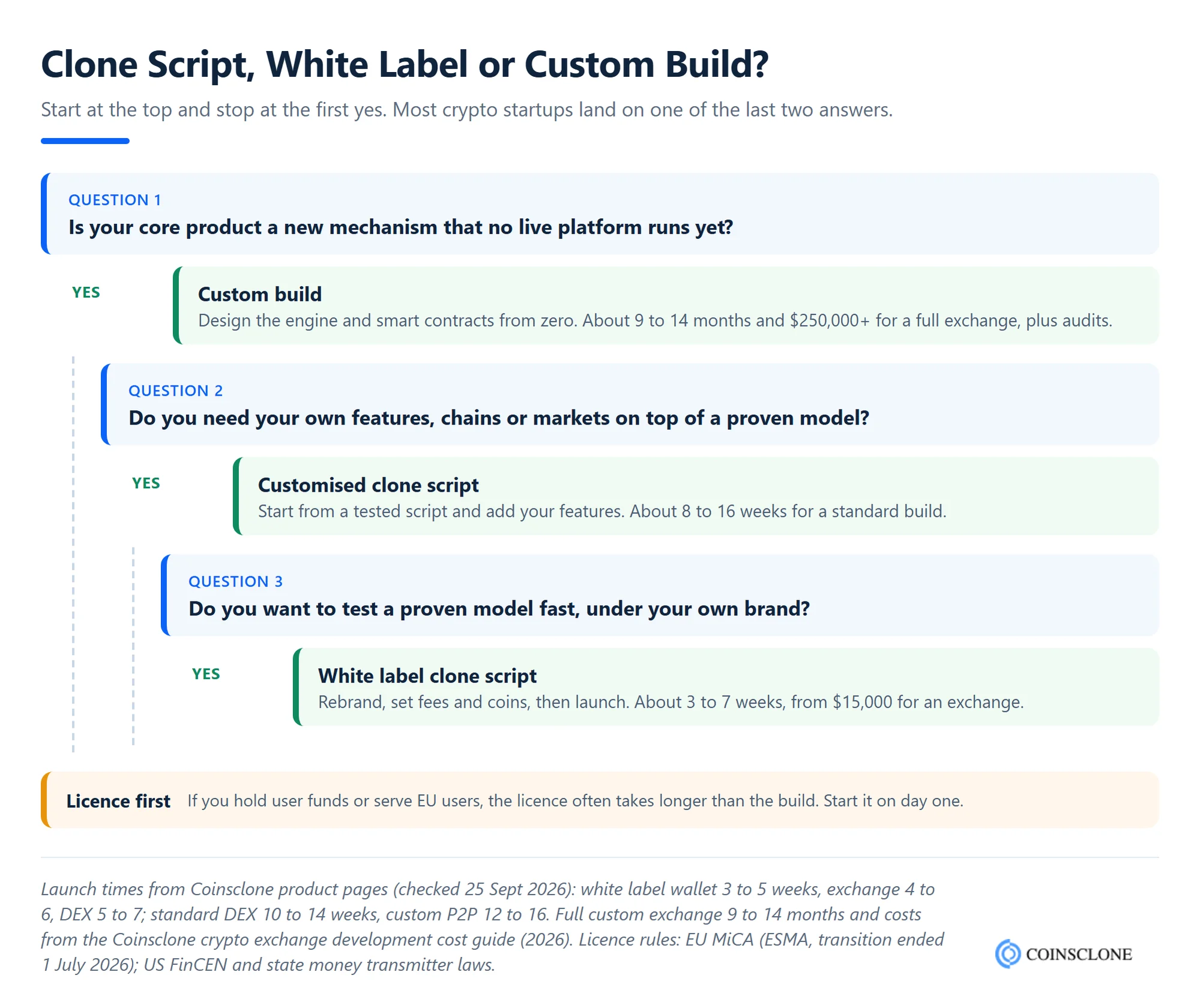
| Launch time | About 8 to 16 weeks with your own features | About 3 to 7 weeks | About 9 to 14 months for a full exchange |
| Cost range (exchange example) | $15,000 to $60,000 | $15,000 to $60,000 | $250,000 to $500,000+ |
| Control of the code | Full source code with a good provider | Varies; check the licence | Full |
| Best for | Startups using a proven model | Firms that want speed and their own brand | Funded teams with a new idea |
Cost ranges come from our crypto exchange development cost guide. In practice, many startups mix the paths. They launch with a clone script or white label base, then add custom features once real users show what they need.
The decision tree below helps you choose.
Cost of Building a Crypto Startup With a Clone Script
One of the biggest reasons startups choose clone scripts is their low cost.
Building a crypto exchange from scratch costs about $250,000 to $500,000 or more and takes 9 to 14 months. It also needs a large team, months of testing and ongoing upkeep. By contrast, a white label or clone script exchange costs about $15,000 to $60,000 and can go live in weeks.
The same pattern holds in other models. A white label crypto payment gateway costs about $20,000 to $60,000, while one built from scratch costs $100,000 to $300,000 or more, as our payment gateway cost guide shows.
Time is a cost too. Every extra month before launch is a month of team costs with no users. Here is how long each product takes to launch with Coinsclone, based on the timelines on our own product pages.
What makes the final price go up or down?
- Features: futures, margin, staking or a launchpad each add work.
- Chains: each extra blockchain adds wallet, node and testing work.
- Mobile apps: iOS and Android apps add a few weeks to the plan.
- Fiat rails: bank payments and fiat payouts need partners and more checks.
- Security audits: an outside smart contract audit or pen test is a must for anything that holds funds.
- Licence and legal costs: these sit outside the software price, and they can be large.
Licences and Rules to Plan For
A clone script gives you the software, not the right to run a business. If your platform holds user funds or swaps crypto for cash, you will most likely need a licence in each market you serve. Plan this alongside the build, because it often takes longer than the software.
- European Union: under MiCA, exchanges, custodians and brokers need a CASP licence. The transition period ended on 1 July 2026, and ESMA says firms without one must stop serving EU clients. See how to launch a MiCA-compliant white label exchange in the EU.
- United States: most platforms that hold user funds sign up with FinCEN as a money services firm and need state money transmitter licences. Prediction markets that offer event contracts fall under the CFTC.
- India: crypto firms must sign up with the Financial Intelligence Unit (FIU-IND) and follow its AML rules.
- Everywhere: build in KYC, AML screening and the Travel Rule from day one, as FATF standards expect.
Products that never hold user funds, such as a self-custody wallet or a DEX front end, often face lighter rules. Still, check with a local lawyer before you launch.
Risks of Using a Clone Script, and How to Avoid Them
Clone scripts are a smart start, but a cheap or poorly built script can cost you more later. Watch for these common risks:
- Weak security: a script reused by many buyers can share the same flaws. In February 2025, hackers took about $1.5 billion from Bybit, and Chainalysis reports $3.4 billion stolen from crypto services in 2025. Ask for audit reports, cold storage and multi-signature or MPC wallets.
- No source code: some sellers only rent you the software. Without the code, you cannot fix bugs, add features or switch vendors.
- Copying the brand: using another platform’s name, logo or design invites legal trouble. Change the look, the name and the user flow.
- Empty order books: a new exchange has no traders yet. Plan for liquidity through an API link to other exchanges or a market maker.
- Vendor lock-in: if the provider stops support, your platform stalls. Agree on updates, support hours and handover terms in the contract.
For a deeper look at the security side, read how to build a non-hackable crypto exchange.
How to Launch Your Crypto Startup With a Clone Script
Once you have picked a model, the path to launch follows the same steps for most products:
- Choose your model and market: decide which platform to copy and which users and countries you will serve.
- Check the rules: find out which licence you need, and start the process early.
- Pick a provider: use the checklist in the next section, and ask for a live demo.
- Customise the script: set your brand, coin list, fees, languages and extra features.
- Connect partners: add KYC, liquidity, fiat payment and price feed providers.
- Test and audit: run load tests, a security audit and a smart contract audit where needed.
- Launch and grow: go live with a small group first, then scale your marketing and listings.
Coinsclone handles steps 3 to 7 for each model above, from a crypto exchange clone script to wallets, DEXs and prediction markets.
How to Choose the Right Clone Script Provider?
Choosing the right clone script provider can make or break your crypto startup. A good provider does not just hand over code. They give you speed, safe code and room to grow. Here are the key points to check:
- Security Standards: make sure the script includes strong encryption, KYC/AML tools and smart contract audits.
- Customization Scope: you should be able to change features, UI/UX and branding to fit your plan.
- Tech Stack: check support for major blockchains (Ethereum, BNB Chain, Solana, Base, Polygon and others) and API links.
- Live Demo and Track Record: test a working demo and ask for platforms the provider has already launched.
- Post-Launch Support: pick a vendor that offers regular updates, maintenance and bug fixes.
- Licensing and Ownership: confirm that you get the full source code and the rights to your platform.
Partner with a team that meets all of the points above to give your crypto venture the best chance of success.
Concluding Thoughts
Today, clone scripts are the smartest launchpad for startups that want to enter the blockchain space without draining time or budget. The clone scripts listed above are among the most used by startups worldwide. Founders who used them to start a crypto business have reached the market in weeks, not years. The cost of each clone script varies with the features, chains and add-ons you choose.
So, choosing the right clone script partner is your next step! Among the many providers, Coinsclone stands out as a leading clone script provider trusted by crypto founders worldwide. Building since 2018, we have delivered 350+ platforms for 200+ clients across 20 industries. We build safe clone scripts for each major crypto model, from Binance and Uniswap to Polymarket, OpenSea and MetaMask.
Ready to turn your crypto idea into a real product? Launch your venture with Coinsclone, your trusted partner in blockchain.
Frequently Asked Questions
What is a clone script in crypto?
A crypto clone script is ready-made software that copies the core features of a well-known crypto platform, such as Binance, Uniswap or Polymarket. You change the brand, design, fees and features, then launch it as your own platform. It saves months of build time compared with coding from scratch.
How can a clone script help my crypto startup launch faster?
Clone scripts come with ready features and a tested structure based on successful crypto platforms. This means you skip months of coding and testing. With Coinsclone, a white label wallet can launch in 3 to 5 weeks, a white label exchange in 4 to 6 weeks, and a white label DEX in 5 to 7 weeks.
Are clone scripts legal?
Yes. Clone scripts are legal when the code is written by your provider and you do not use the original platform’s name, logo, design or patented features. Still, a crypto firm that holds user funds most often needs a licence, such as a MiCA CASP licence in the EU or money transmitter licences in the US.
How much does a crypto clone script cost?
A white label or clone script exchange costs about $15,000 to $60,000 in 2026, while a custom exchange costs $250,000 to $500,000 or more. A white label payment gateway costs about $20,000 to $60,000. The final price depends on the features, chains, mobile apps and fiat links you add.
Which is the best clone script for a crypto startup?
It depends on your market and budget. A Binance or Coinbase clone suits a trading firm. A Uniswap or Hyperliquid clone suits DeFi trading, a Polymarket clone suits event markets, and a BitPay clone suits shop payments. Wallet clones such as Trust Wallet or MetaMask are the lowest-cost way in.
Are clone scripts secure for real-world crypto transactions?
Yes, if you choose a good provider. Premium clone scripts include data encryption, 2FA, cold wallets, DDoS protection and smart contract audits. When you choose a trusted provider like Coinsclone, you get strong protection designed to keep users and their funds safe.
Do clone scripts support mobile apps?
Yes. Most clone scripts come with web platforms, and you can add native iOS and Android apps. With Coinsclone, a white label exchange with mobile apps launches in about 9 to 13 weeks.