
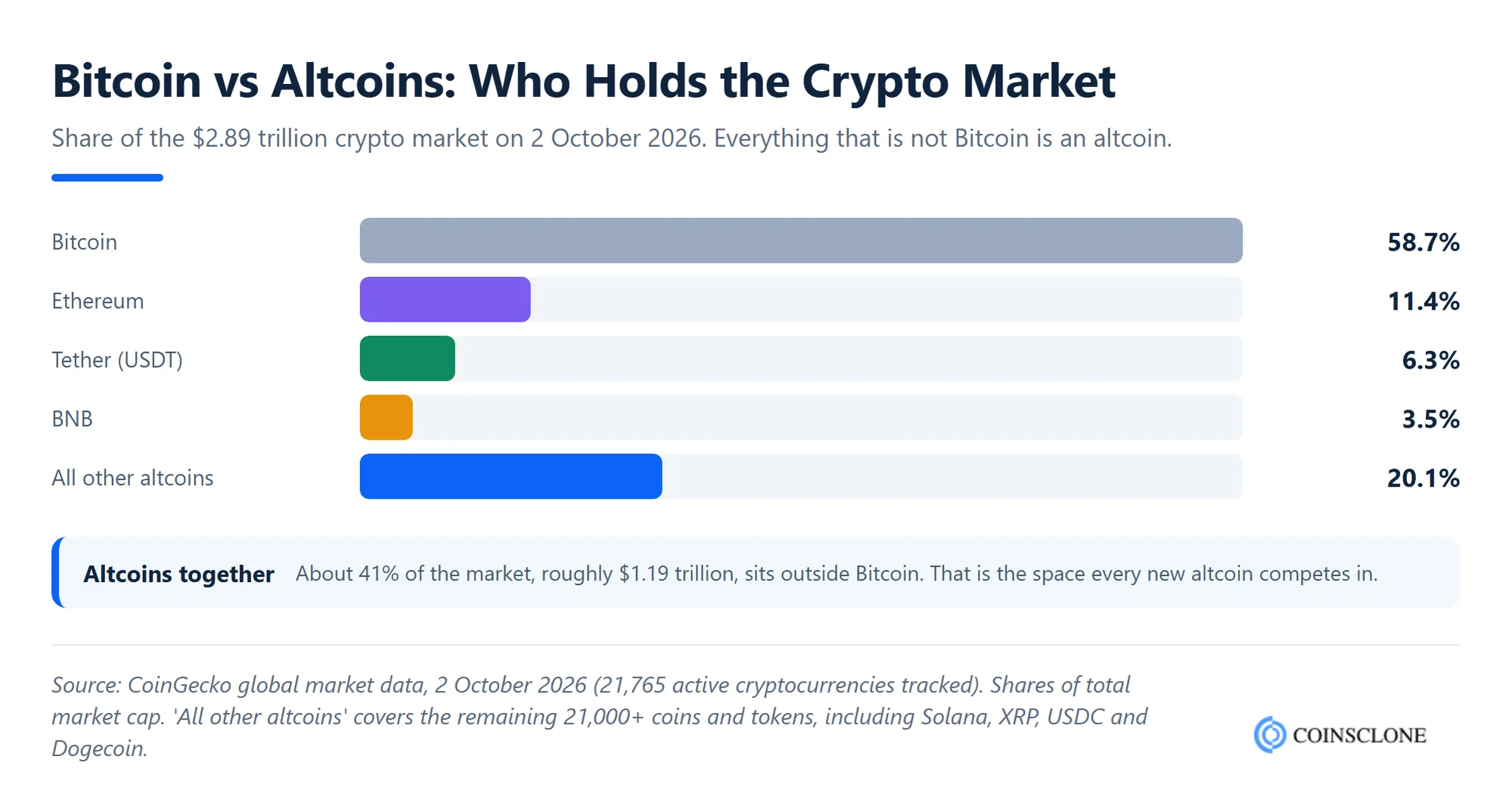
Bitcoin was the first crypto coin. Every coin that came after it is an altcoin, short for “alternative coin”. Today CoinGecko tracks more than 21,000 active ones, and they hold about 41% of the whole crypto market. If you plan to launch one for your business, the hard part is not writing code. It is picking the right route, the right rules and the right team for altcoin development.
This guide explains what altcoin development services include and how a new coin goes from idea to mainnet. It also covers what it costs and how long it takes. You will see when a simple token is enough and when you need your own blockchain. We also cover which rules apply in the US and EU in 2026 and how to judge an altcoin development company before you sign.
In this guide:
- What an altcoin development company builds for you, from coin rules to wallets.
- A quick decision tree: token, fork or your own blockchain.
- Which consensus method fits your coin, and the steps to mainnet.
- Real cost ranges by route, plus the launch costs that sit outside the code.
- The 2026 US and EU rules to check before you sell a single coin.
See How Our MVP System Can Launch Your Altcoin Faster
Altcoin Development — done right.
- MVP System : Launch your unique altcoin 90% faster.
- Blockchain & Wallets : Pre-integrated modules, no coding needed.
- Brand & Customization : Your coin, your ecosystem, your vision.
- Revenue Engine : Enable staking, transactions, and tokenomics effortlessly.
See a free branded demo of your altcoin in 48 hours — before you invest a cent.
Book a Free Demo to discover how our Altcoin Development services can take you from idea to live token in just 2–4 weeks.
Altcoin Development Services: What They Include
Altcoin development means creating a new cryptocurrency. Most new coins borrow ideas from Bitcoin or Ethereum but add their own features, rules or use case. The work mixes coding, blockchain design, economics and launch planning. That is why most startups hire a skilled altcoin developer or a full altcoin development company.
A full-service team usually covers these parts:
- Route and design: Picking a token, a fork or a new blockchain, and the way the network agrees on blocks.
- Tokenomics: Total supply, block rewards or mint rules, vesting for the team and investors, and fees.
- Core build: Node software or smart contracts, the genesis block, and network settings such as block time and address format.
- Wallets and explorer: Desktop, phone or web wallets, plus a block explorer so anyone can check payments.
- Safety: Code review, an outside audit, safe key storage and replay protection for forks.
- Testnet and mainnet: A public test network first, then a live launch with seed nodes or validators.
- Launch support: A white paper, listing on CoinGecko and exchanges, and liquidity planning.
- Ongoing care: Upgrades, node monitoring and bug fixes after launch.
Not every project needs all of these. A token on Ethereum skips the node software. A fork needs it, along with miners or validators to keep the chain alive.
How Altcoins Are Different from Bitcoin
Altcoins differ from Bitcoin in their tech, their features (like smart contracts) and their target use. Bitcoin, on the other hand, works mainly as digital gold. Even though the two are similar, there are a few clear reasons people build altcoins.
- Purpose: Bitcoin is mainly a store of value, while altcoins can run apps, pay fees, give voting rights or track real assets.
- Speed and cost: Many altcoins aim to fix specific limits, such as slow blocks, high fees or weak privacy. Litecoin, for example, makes a block every 2.5 minutes against Bitcoin’s 10.
- Consensus: Bitcoin uses Proof of Work. Most new altcoins use Proof of Stake or a variant, which needs no mining hardware. Ethereum itself moved to Proof of Stake in September 2022.
- Smart contracts: Chains such as Ethereum and Solana run smart contracts, so one altcoin can host thousands of tokens and apps.
Bitcoin still leads by a wide margin. Even so, the altcoin share is large enough to support thousands of real projects, as the chart below shows.
Now that the difference is clear, the next question is how you should build yours.
How to Develop an Altcoin: Pick Your Route
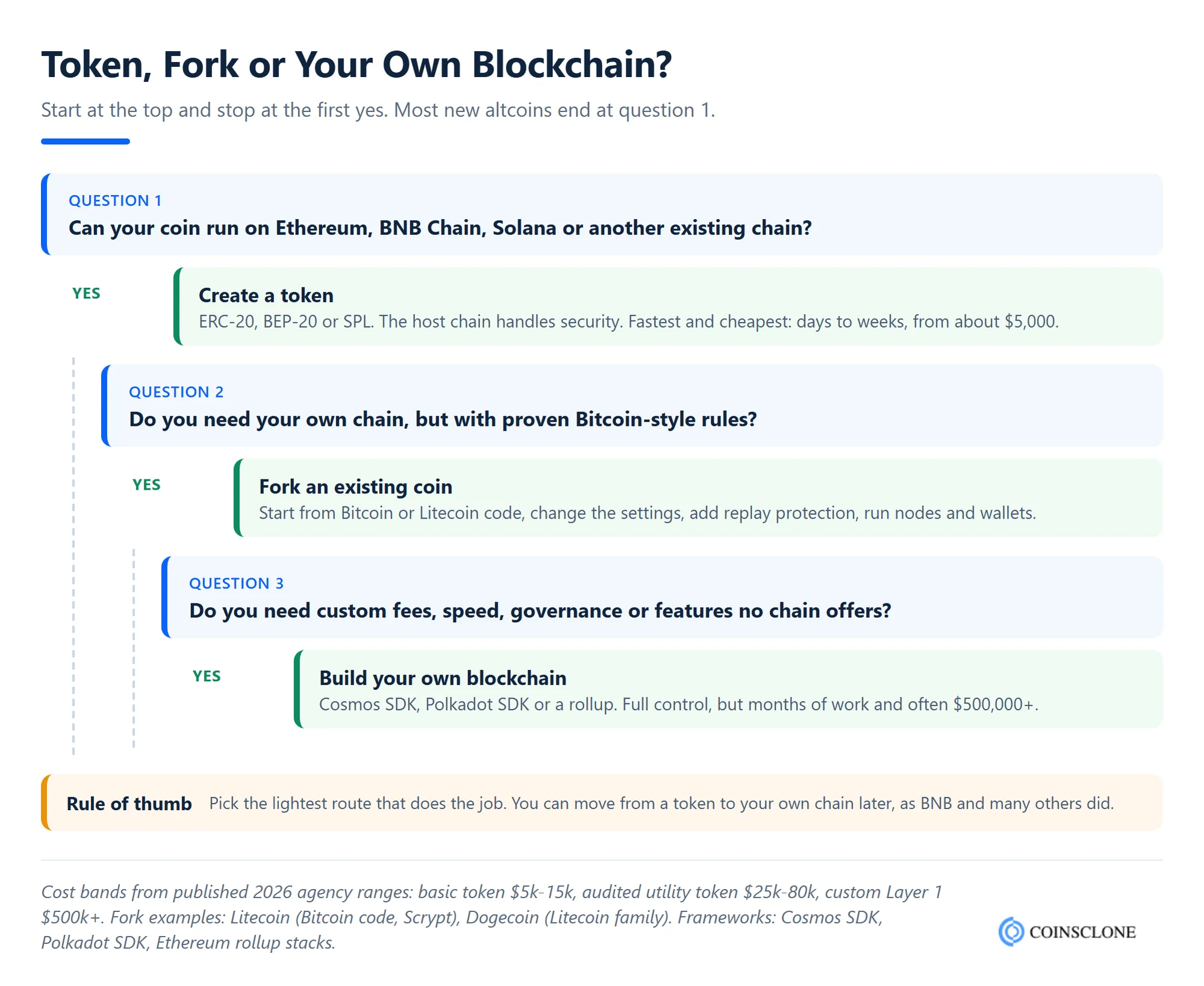
There are four ways to create an altcoin. The right one depends on what your coin must do, not on what sounds most impressive.
Create a Token on an Existing Blockchain
This is the fastest and cheapest route. You write a smart contract that follows a standard such as ERC-20 on Ethereum, BEP-20 on BNB Chain or SPL on Solana. The host chain handles security and consensus, so you only build the token logic. Most utility, governance and meme tokens launched today use this route. Our guide to crypto coins vs tokens explains the trade-off in more detail.
Fork an Existing Blockchain
If you need your own coin with its own chain, you can start from a public codebase. Bitcoin, Litecoin and many other projects post their code openly on GitHub. Charlie Lee did exactly this in 2011: he took the Bitcoin code, switched the mining algorithm to Scrypt, and launched Litecoin. Dogecoin later grew out of Litecoin’s code. A fork saves months of work, but you still need nodes, miners or validators, wallets and an explorer.
Build Your Own Blockchain
You can also write the chain from scratch or use a framework such as the Cosmos SDK, the Polkadot SDK or a rollup stack on Ethereum. This gives you full control over rules, fees and speed. It is also the slowest and costliest path. A single developer, even a seasoned one, would find it hard to build every part well, so this route needs a skilled team.
Use a Coin-Making Platform
A coin wizard is another option. WalletBuilders, for example, creates a coin based on Bitcoin, Litecoin or Blackcoin code. It offers a free tier and a paid plan of EUR 69.99 that includes the source code. This suits learning and testing, but you get a stock chain with little custom logic and no audit.
The decision tree below shows which route fits most projects.
Types of Altcoins We Develop
Several types of altcoins exist in the market. Each one serves a different job, so it helps to know which type you are building before you write any code.
- Stablecoins
- Utility tokens
- Governance tokens
- Meme coins
- Security tokens
- Privacy coins
- Stablecoins
Stablecoins are coins backed by an asset like gold or pegged to a currency like the US dollar, so their price stays steady. USDT, USDC and DAI are common examples. Stablecoins have become the main way to move value in crypto because they avoid the wild price swings of other coins.
A stablecoin’s value may be tied directly to one asset or to a basket of assets. The basket can hold gold, cash, bonds, crypto and more.
Also Read – Stablecoin development service
- Utility tokens
A utility token has a set use inside one ecosystem. It lets holders do certain things on a network, such as pay fees, unlock features or access a service.
Utility tokens are not mined like Bitcoin. Instead, they are often pre-minted, which means the whole supply is created at once and shared out in the way the project team chooses.
Also Read – Utility Token development
- Governance tokens
A governance token is a type of utility token that gives voting rights. Holders can vote on changes to a project, such as fees, upgrades or how its shared funds are spent.
- Meme coins
Meme coins start as jokes or parodies of well-known cryptocurrencies. They often grow through social media and influencers, so they can become famous very fast and fall just as fast. Dogecoin (DOGE) and Shiba Inu (SHIB) are the best-known examples. In October 2026 Dogecoin still ranked 12th by market cap on CoinGecko.
- Security tokens
Security tokens stand for a share in a real asset, such as a building, a fund or shares in a firm. Tokenization turns that value into tokens that investors can hold and trade. The asset must be kept and protected, or the tokens would be worth nothing because they would represent nothing. Security tokens follow securities law, so they need investor checks and transfer rules built into the contract.
- Privacy coins
Privacy coins hide sender, receiver or amount details. Zcash, for example, uses zero-knowledge proofs and ranked 10th by market cap in October 2026. However, many exchanges limit privacy coins, so this type needs a close legal check.
All these altcoin types have real demand. If you plan to build one, the next choice is how your network agrees on transactions.
Choosing a Consensus Method
Consensus is how a network agrees on which payments are valid. Tokens inherit this from their host chain. Forks and new chains must choose it, and the choice shapes cost, speed and security.
| Consensus | How it works | Good fit | Watch out for |
| Proof of Work (SHA-256) | Miners solve puzzles with special hardware | Bitcoin-style store-of-value coins | Small chains on SHA-256 are easy to attack with rented hash power |
| Proof of Work (Scrypt) | Same idea, different puzzle | Litecoin and Dogecoin forks | Same 51% risk; merged mining can help |
| Proof of Stake | Validators lock coins to win the right to add blocks | Most new payment and app chains | Needs a fair spread of stake from day one |
| Delegated Proof of Stake | Holders vote for a small set of block producers | Fast chains with high volume | Fewer producers means more central control |
| Proof of Authority | Known, approved nodes sign blocks | Private or enterprise chains | Not truly public or permissionless |
When you choose the algorithm, the default settings give you a block time, a starting reward per block and a halving rate. You can change all of these to suit your coin’s economics.
Our Altcoin Development Process
A good altcoin development company follows a clear set of steps. Here is how a typical project runs from idea to launch.
Step 1: Define the Purpose
Start with the problem your coin solves and who will use it. If a token on an existing chain can do the job, choose that. Your own chain only makes sense when you need custom rules, fees or control.
Step 2: Give Your Coin an Identity
Provide the full details of your coin. That means a unique coin name, a short ticker (usually three to five letters, like LTC or DOGE) and a coin icon. Check that the name and ticker are not already in use on CoinGecko or major exchanges.
Step 3: Design the Tokenomics
Set the total supply, how new coins come out, and how much goes to the team, backers, users and the shared fund. Add vesting so early holders cannot dump coins at launch. Poor tokenomics sinks more coins than poor code does.
Step 4: Build the Coin
Next, the team builds the smart contract or node software, sets the genesis block and network settings, and creates the wallets and explorer. For a fork, the team also changes network IDs so transactions on the old chain cannot replay on the new one.
Step 5: Test and Audit
Run a public testnet and invite users to break it. Then get an outside audit and fix each issue before launch. Many exchanges ask for an audit report before they list a coin.
Step 6: Launch the Mainnet
Start the live network with seed nodes or a starting set of validators. For tokens, deploy the final contract and lock or renounce admin keys where the design calls for it.
Step 7: List and Grow
List the coin on CoinGecko and CoinMarketCap. Then add funds to a trading pool on a DEX, and apply to big exchanges. A crypto exchange or wallet of your own can also give the coin a home from day one.
Step 8: Maintain the Network
After launch, the work continues. Nodes need watching, code needs upgrades, and users need news. Plan a support budget for at least the first year.
Benefits of Altcoin Development Services
Hiring a team for altcoin development brings clear gains over a do-it-yourself build.
More Choice and Competition
Altcoin developers open up the market by bringing fresh ideas, faster chains and answers to specific problems that Bitcoin was never built to solve.
Low Transaction Costs
Many altcoins charge far lower fees than Bitcoin. That makes them a better fit for small payments, in-app rewards and frequent trades.
Easier Access for Users
Proof of Stake coins need no costly mining hardware. Anyone with coins can help secure the network and earn rewards, which helps build a wider community.
Faster Time to Market
An experienced team reuses tested code, audited contracts and proven launch steps. As a result, you avoid months of trial and error and the costly bugs that come with it.
Full Ownership
With a custom build, you own the source code, the brand and the roadmap. You are not tied to a coin wizard’s limits or fees.
Knowing these benefits, the next question is what it all costs.
Cost to Create an Altcoin
There is no single price for an altcoin. Cost depends mostly on the route you choose, then on features, audits and the team you hire. Published market ranges in 2026 look like this:
| Route | Typical development cost |
| Coin wizard (stock fork, no custom code) | Free to about EUR 70 |
| Basic ERC-20 or BEP-20 token, no audit | $5,000 to $15,000 |
| Utility token with custom logic and an audit | $25,000 to $80,000 |
| DeFi protocol token with a full contract suite | $80,000 to $300,000+ |
| Custom Layer 1 blockchain | $500,000+, often seven figures |
The token and chain ranges come from published 2026 agency guides, and they broadly agree. For example, one quotes $20,000 to $30,000 for a basic fork and $100,000 to $500,000+ for advanced ones. The coin wizard price is WalletBuilders’ own.
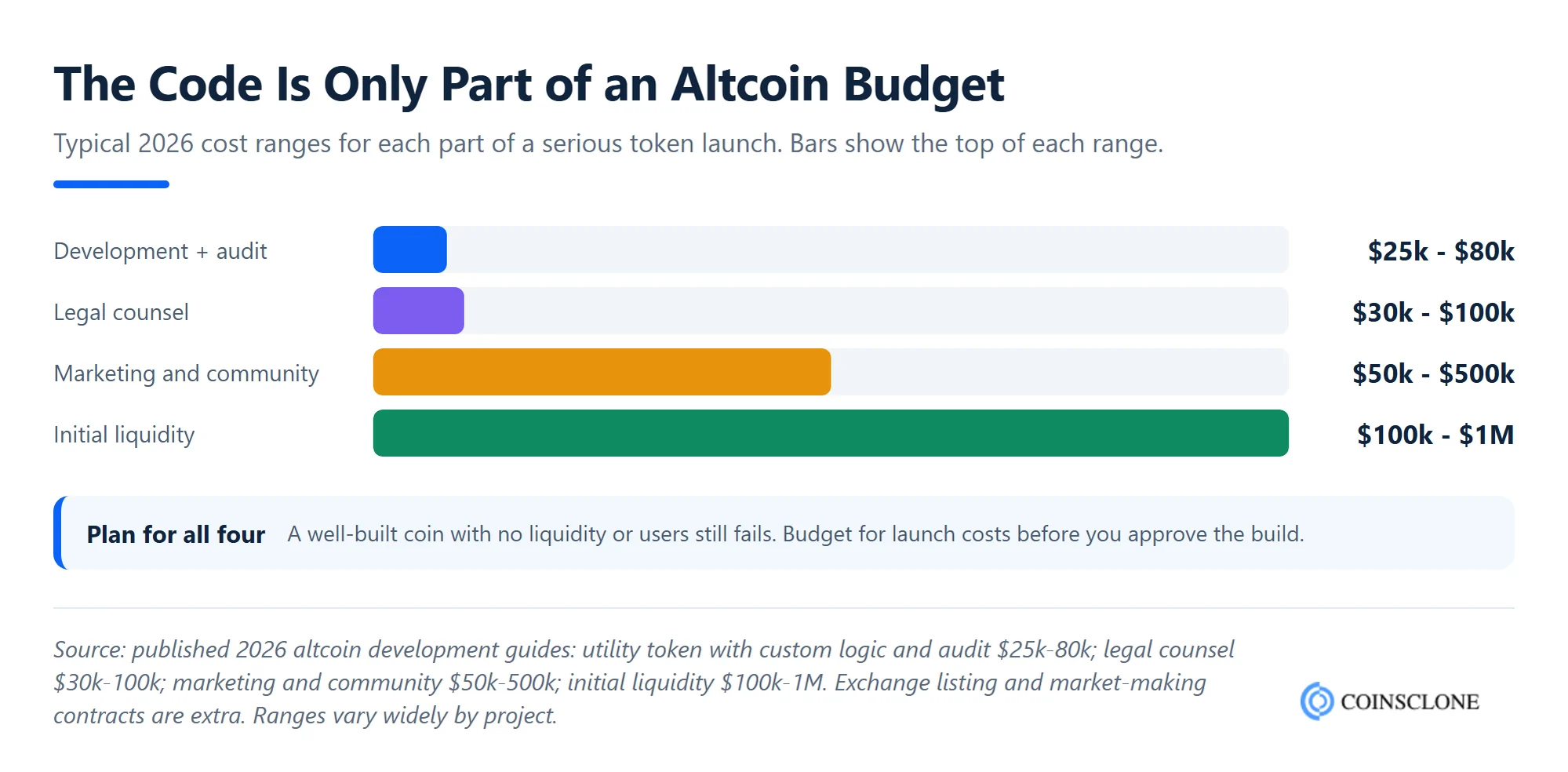
However, the code is often the smaller part of the bill. Legal work, marketing and starting liquidity can cost more than the build itself, as the chart below shows.
The choice of a crypto token development company matters too. A good partner guides you from token design to launch and helps you avoid paying twice for rushed work.
How Long Does Altcoin Development Take?
Time follows the same pattern as cost. A basic token can be live within days, but a serious launch takes longer. Agency guides put a well-run token project at about 8 to 16 weeks from kickoff to mainnet, which covers tokenomics, the build and an audit. A forked chain adds testnet rounds and node setup on top. A custom blockchain often runs for many months.
To keep the timeline short, settle the tokenomics and the legal review early. Those two items cause most delays, not the code.
Legal Rules to Check in 2026
Rules for new coins are clearer in 2026 than they were a few years ago. Still, the way you sell your coin decides which rules apply.
- United States: On 17 March 2026 the SEC, joined by the CFTC, issued an interpretation of how securities laws apply to crypto assets. It sorts coins into five groups: commodities, collectibles, tools, stablecoins and securities. Only the last group is a security by default. Still, if you sell a coin and promise buyers a profit from your team’s work, the sale itself can count as a security.
- European Union: Under MiCA, most public sales of a new coin need a white paper. The seller must also send it to the local regulator at least 20 working days before it goes out. Small sales are exempt, such as those under EUR 1 million over 12 months or to fewer than 150 people per country. Stablecoins have stricter rules of their own.
- Everywhere: Exchanges run their own checks. Expect to show an audit, the team’s identity and your token distribution before a listing.
In short, get a lawyer to review your token design and sale plan before you raise any money. This is general information, not legal advice.
How to Choose an Altcoin Development Company
Many firms offer altcoin development services, and quality varies a lot. Use these checks before you sign.
- Live work: Ask for coins, tokens or chains they built that are still running, with explorer links.
- Route advice: A good team will tell you when a token is enough, even though a full chain pays them more.
- Safety process: Check that they use outside auditors and fix all issues before launch.
- Code ownership: Make sure you get the full source code and keys at handover.
- Support after launch: Ask who runs nodes, upgrades and fixes once the coin is live.
- Clear quote: The quote should split build, audit and support costs so you can compare firms fairly.
If you would rather hire people than a whole agency, you can also hire blockchain developers to work with your own team.
Why Choose Coinsclone for Altcoin Development?
Coinsclone is a trusted token development company with a skilled team of blockchain developers and testers. We have built crypto products since 2018 and delivered 350+ platforms for 200+ clients across 20 industries. Our team builds altcoins to match your business needs, whether that is a simple token, a forked coin or a full chain with wallets and an explorer. As we provide 24/7 support, you can reach us at any time to improve your project.
Our aim is to give clients the best service in every part of the project. With our crypto token development services, you can launch your coin quickly and at a fair cost. Share your idea with us, and we will suggest the right route, timeline and budget for your altcoin.
Frequently Asked Questions
Should I create a coin or a token?
Choose a token if your project can run on an existing blockchain such as Ethereum, BNB Chain or Solana. It is faster, cheaper and safer. Choose a coin with its own chain only when you need custom rules, fees or full control of the network.
Can I launch an altcoin without building my own blockchain?
Yes. Most new altcoins are tokens built on an existing blockchain. The host chain handles security and consensus, so you only build and audit the token’s smart contract.
How much does it cost to create an altcoin?
A basic token costs about $5,000 to $15,000 to build. A token with custom logic and an audit runs about $25,000 to $80,000, and a custom blockchain usually starts around $500,000. Legal work, marketing and liquidity add to the total.
How long does it take to create an altcoin?
A simple token can go live within days. A well-planned token with tokenomics and an audit takes about 8 to 16 weeks. A forked or custom blockchain takes longer because it needs testnet rounds and node setup.
Is it legal to create an altcoin?
Creating an altcoin is legal in most countries. Selling it to the public is where the rules apply. In the US, the SEC’s 2026 interpretation decides whether your coin is a security. In the EU, MiCA requires a white paper for most public offers.
Can I fork Bitcoin or Litecoin to make my own coin?
Yes. Both projects publish their code under open licenses, and Litecoin itself began as a Bitcoin fork. You still need to change network settings, add replay protection, and run nodes and wallets for your new chain.
Who runs the network after launch?
For a token, the host blockchain runs the network. For your own chain, miners or validators keep it running. In the early months, your team or your development partner often runs seed nodes until enough outside validators join.
How do altcoins gain value?
An altcoin gains value when people need it for something real, such as paying fees, using an app, voting or earning rewards. Sound tokenomics, a fair launch, exchange listings and an active community all help. Hype alone rarely lasts.
See How Our MVP System Can Launch Your Altcoin Faster
Altcoin Development — done right.
- MVP System : Launch your unique altcoin 90% faster.
- Blockchain & Wallets : Pre-integrated modules, no coding needed.
- Brand & Customization : Your coin, your ecosystem, your vision.
- Revenue Engine : Enable staking, transactions, and tokenomics effortlessly.
See a free branded demo of your altcoin in 48 hours — before you invest a cent.
Book a Free Demo to discover how our Altcoin Development services can take you from idea to live token in just 2–4 weeks.