
NFTs in 2026 look very different from the 2021 boom. Total NFT sales fell 37% to about $5.63 billion in 2025, according to CryptoSlam, and well-known platforms such as Nifty Gateway and Foundation closed their doors in early 2026. Yet more NFTs exist than ever, over 1.34 billion, and new uses are growing fast, from tokenized trading cards to event tickets and real-world assets.
So are NFTs dead, or changing? In this guide, we look at the real numbers behind the NFT market, the top NFT trends shaping 2026, the ones that faded, the marketplaces that matter now, and what the shift means for businesses planning an NFT project.
Discover the Top NFT Trends Shaping the Market
Top NFT Trends — explore evolving innovations and new opportunities.
- Utility-Driven NFTs: Multi-use digital assets enhancing brand engagement.
- Tokenized Real-World Assets: Bridging physical and digital ownership seamlessly.
- Metaverse & Digital Fashion: Immersive experiences transforming user interaction.
- Expanding Industries: Sports, music, and luxury brands are adopting NFTs rapidly.
See a free branded demo of your NFT marketplace in 48 hours — before you invest a cent.
Book a Free Demo to discover how Top NFT Trends can help you launch in just 8–12 weeks
Is the NFT Craze Dead, or Just Changing?
The speculative craze is over, but NFTs as a technology are not. Here is what the data shows:
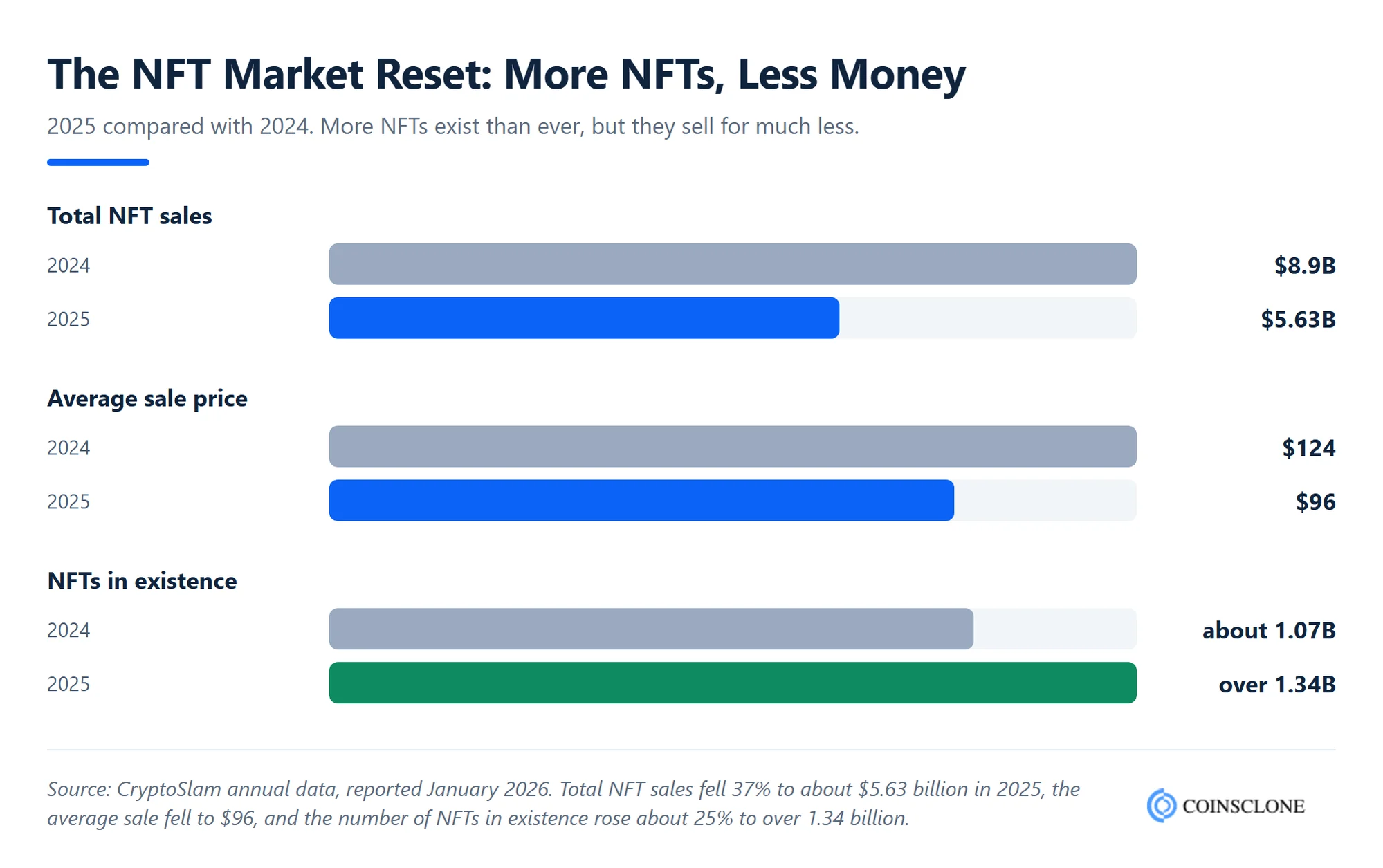
- Less money, more tokens: Sales fell from about $8.9 billion in 2024 to $5.63 billion in 2025, and the average sale dropped from $124 to $96. At the same time, the number of NFTs grew to over 1.34 billion.
- Cheaper, more frequent trades: DappRadar counted a record of more than 18 million NFT sales in the third quarter of 2025, even though dollar volume was far below the peak.
- Platforms consolidated: Many marketplaces closed, and trading moved to a few large platforms such as OpenSea and Magic Eden.
- Utility over hype: Growth is coming from NFTs that do something, such as proving ownership of a physical card, granting entry to an event or representing a real asset.
What Changed in NFTs, 2024 to 2026
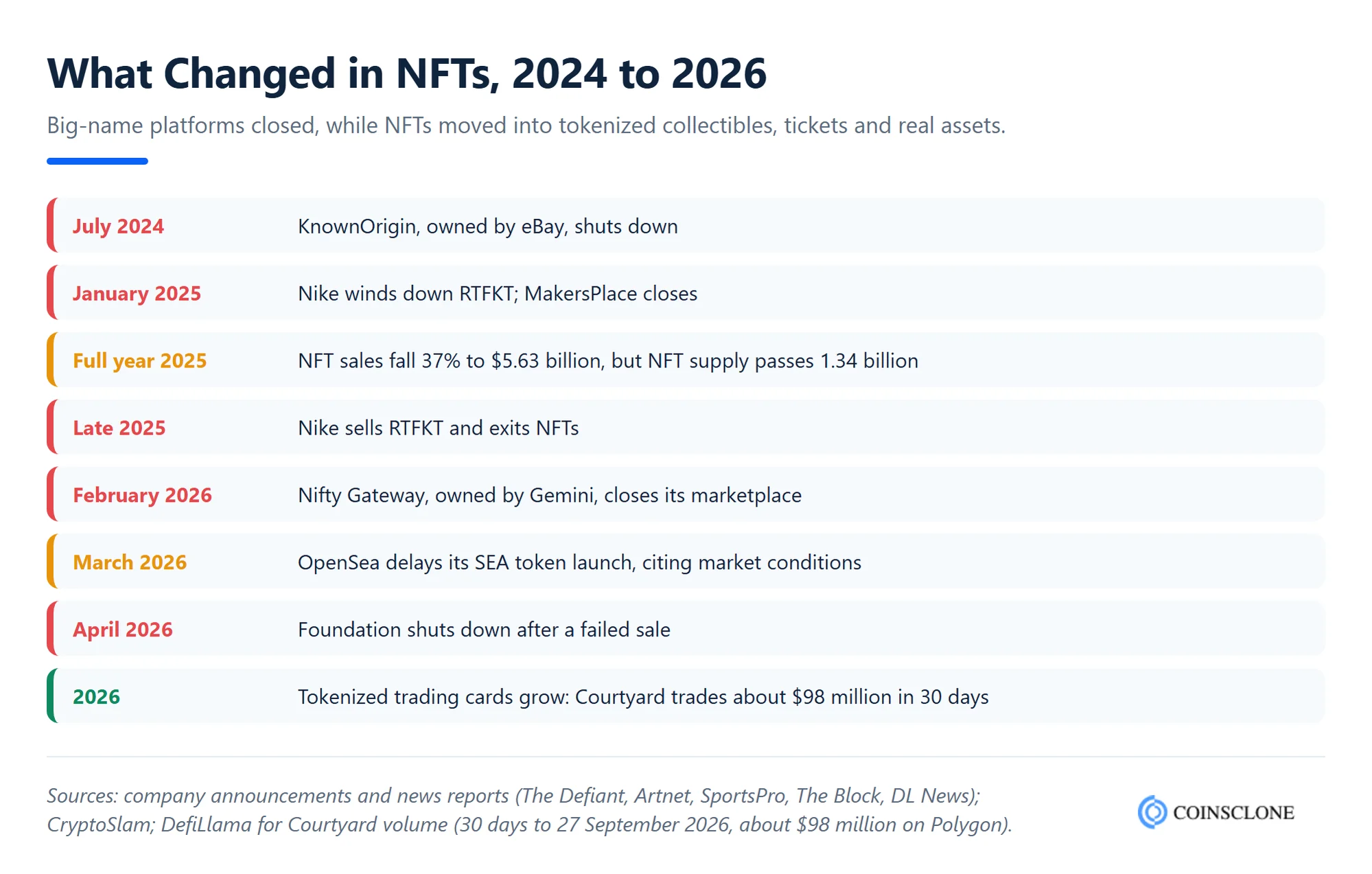
The closures of KnownOrigin, MakersPlace, Nifty Gateway and Foundation, and Nike’s exit from RTFKT, show that building a business on speculative trading alone did not last. The projects still growing in 2026 tie NFTs to real value.
Top NFT Trends Shaping 2026
- Tokenized collectibles and phygital NFTs
- Real-world asset (RWA) NFTs
- Utility NFTs: tickets, memberships and loyalty
- Gaming NFTs
- NFT art on fewer, stronger platforms
- Music NFTs
- Dynamic and hybrid NFTs
- Sports NFTs
- Onchain identity and credentials
- Metaverse and digital fashion, now in a quieter phase
1. Tokenized Collectibles and Phygital NFTs
One of the fastest-growing NFT trends is tokenized physical collectibles. Platforms such as Courtyard store real trading cards, such as Pokémon cards, in insured vaults and issue an NFT for each one. Owners can trade the NFT instantly and redeem the physical card whenever they want. Courtyard traded about $98 million in the 30 days to 27 September 2026, according to DefiLlama.
Why it matters: The NFT is backed by a real, valued item, which solves the “what am I actually buying?” problem that hurt many 2021 collections.
2. Real-World Asset (RWA) NFTs
RWA NFTs represent ownership of physical or financial assets such as property, art, luxury goods and private credit. They make it possible to own a fraction of a valuable asset and trade it faster than in traditional markets. Regulated tokens, often using standards built for compliance, are bringing banks and funds into tokenization. See our RWA tokenization platform development and fractional NFT marketplace development services.
3. Utility NFTs: Tickets, Memberships and Loyalty
Utility NFTs give holders access to something real: a concert, a club, a discount or a service. Ticketing is a strong use case, because an NFT ticket can prove authenticity, cut out fake tickets and let organisers set resale rules. Brands also use NFTs as loyalty passes, though not every program survives; Starbucks closed its Odyssey NFT program in 2024.
Also Read: How to Create Utility Tokens for Your Digital Assets?
4. Gaming NFTs
In blockchain games, NFTs represent characters, skins, land and items that players truly own and can trade. The trend in 2026 is quieter than the “play to earn” hype of 2021: games now focus on being fun first, with NFTs as an optional layer for ownership and trading.
5. NFT Art on Fewer, Stronger Platforms
Digital art is still an important NFT category, but the market has consolidated. Several art marketplaces have closed, including KnownOrigin (2024), MakersPlace (January 2025), Nifty Gateway (February 2026) and Foundation (April 2026). Artists now mostly sell through large marketplaces such as OpenSea and Magic Eden, curated platforms such as SuperRare, and chain-specific marketplaces such as Objkt on Tezos.
Famous moments still shape the category. Beeple’s “Everydays: The First 5000 Days” sold at Christie’s for about $69 million in 2021, the record that put NFT art on the map. For builders, see NFT art marketplace development.
6. Music NFTs
Music NFTs let artists sell songs, albums, royalties or fan access directly to their audience. Artists can reach their most loyal fans without a label taking most of the income. The market is small but steady, and it works best when the NFT unlocks something fans value, such as early access or exclusive content. Learn more about music NFT marketplace development.
7. Dynamic and Hybrid NFTs
Dynamic NFTs change over time, for example a game character that levels up or artwork that reacts to data. Hybrid designs combine features of different standards, such as NFTs that own their own wallet with ERC-6551 token-bound accounts. These designs make NFTs more useful than static images.
8. Sports NFTs
Sports NFTs turn highlights, player cards and fan experiences into collectibles. Platforms such as NBA Top Shot and Sorare built large fan communities, and clubs use NFTs for memberships and rewards. The category now focuses on fan engagement rather than fast profits.
Also Read: NFT Sports Marketplace Development | Create NFT Platform for Sports
9. Onchain Identity and Credentials
NFTs are also used as certificates, memberships and proof of achievements. Soulbound tokens, which cannot be transferred, can represent a degree, a course completion or event attendance. See our soulbound token development services.
10. Metaverse and Digital Fashion: A Quieter Phase
Virtual worlds and digital fashion were big NFT themes in 2021 and 2022, with brands such as Gucci, Adidas and Nike all taking part. Many of those projects have since slowed down or closed. Nike wound down RTFKT in January 2025, faced a lawsuit from RTFKT NFT holders, and sold the business in late 2025. Digital fashion still exists in games and avatar platforms, but it is now a niche rather than a mass trend.
Top NFT Marketplaces in 2026
Trading has consolidated into a handful of marketplaces:
| Marketplace | Main chains | Known for |
| OpenSea | Ethereum, Base, Solana and more | The largest general marketplace; planned SEA token, delayed in 2026 |
| Magic Eden | Solana, Bitcoin, Ethereum and more | Multi-chain trading and the ME token |
| Blur | Ethereum | Fast trading for professional NFT traders |
| Tensor | Solana | Pro trading on Solana |
| SuperRare | Ethereum | Curated one-of-one digital art |
| Courtyard | Polygon | Tokenized physical trading cards |
For a head-to-head comparison, see OpenSea vs Blur.
NFT Security in 2026
As trading moved to fewer platforms, scams moved to users’ wallets. The most common threats are phishing sites, fake mint links and “signature drainers” that trick users into signing a transaction that gives away their NFTs. Marketplaces now warn about suspicious collections and links, and wallets show clearer signing screens. For users, the rules are simple: use official links, read every signature request, and keep valuable NFTs in a separate wallet or hardware wallet.
Which NFT Trend Fits Your Business?
| If you are a… | Consider this NFT model | Why it works now |
| Collectibles or trading card seller | Phygital NFTs backed by vaulted items | Instant trading with real, redeemable value |
| Event organiser | NFT tickets with resale rules | Fewer fakes and a share of resales |
| Brand or retailer | Loyalty and membership NFTs | Rewards customers can own and trade |
| Asset owner or fund | RWA and fractional NFTs | Wider access and faster settlement |
| Game studio | In-game item NFTs | Real ownership and player trading |
| School or employer | Soulbound credentials | Certificates that cannot be faked or sold |
| Artist or musician | Direct-to-fan drops on a large marketplace | Access to buyers without running a platform |
What These NFT Trends Mean for Businesses
The lessons from 2024 to 2026 are clear for anyone planning an NFT business:
- Tie NFTs to real value: A physical item, an asset, a ticket or a service.
- Build for utility, not hype: Collections that depend only on resale prices rarely last.
- Pick a clear niche: Trading cards, tickets, music or credentials, rather than a general marketplace.
- Plan for compliance: RWA and financial NFTs may be regulated as securities in some countries.
- Put security first: Protect users from phishing and bad signatures.
Build Your NFT Platform With Coinsclone
If you are planning an NFT project, Coinsclone can help you build it around the trends that are working today. As an NFT token development company that has delivered more than 350 blockchain platforms for over 200 clients, we build NFT marketplaces, tokenized collectible platforms, ticketing systems and RWA platforms, with white label solutions and clone scripts for a faster launch.
Whether you need NFT marketplace development or a custom NFT product, our team can turn your idea into a working platform. For budgets, see our guide to NFT marketplace development cost.
Also Read: How to Create an NFT Platform Like Bored Ape Yacht Club?
Discover the Top NFT Trends Shaping the Market
Top NFT Trends — explore evolving innovations and new opportunities.
- Utility-Driven NFTs: Multi-use digital assets enhancing brand engagement.
- Tokenized Real-World Assets: Bridging physical and digital ownership seamlessly.
- Metaverse & Digital Fashion: Immersive experiences transforming user interaction.
- Expanding Industries: Sports, music, and luxury brands are adopting NFTs rapidly.
See a free branded demo of your NFT marketplace in 48 hours — before you invest a cent.
Book a Free Demo to discover how Top NFT Trends can help you launch in just 8–12 weeks
Frequently Asked Questions
What are the best NFT use cases for businesses in 2026?
The strongest business uses tie NFTs to real value: tokenized collectibles backed by physical items, event tickets with resale rules, loyalty and membership passes, certificates and credentials, and fractional ownership of real-world assets. Projects that depend only on resale prices are much harder to sustain.
What are the top NFT trends in 2026?
The biggest trends are tokenized collectibles such as trading cards, real-world asset NFTs, utility NFTs for tickets and memberships, gaming NFTs, dynamic NFTs and onchain credentials.
Are NFTs dead in 2026?
No, but the speculative boom is over. NFT sales fell 37% to about $5.63 billion in 2025, yet more NFTs exist than ever and new uses, such as tokenized trading cards, are growing.
What is the NFT market size in 2025?
CryptoSlam recorded about $5.63 billion in total NFT sales in 2025, down from about $8.9 billion in 2024, with an average sale of $96.
Which NFT marketplaces closed?
KnownOrigin closed in 2024, MakersPlace in January 2025, Nifty Gateway in February 2026 and Foundation in April 2026. Nike also wound down and sold its RTFKT NFT business.
What are the top NFT marketplaces in 2026?
OpenSea and Magic Eden are the largest general marketplaces, Blur and Tensor serve pro traders, SuperRare focuses on curated art, and Courtyard leads tokenized trading cards.
What are phygital NFTs?
Phygital NFTs are linked to a physical item, such as a trading card or sneaker. The NFT proves ownership, and the owner can redeem the physical item.
What happened to Nike’s NFTs?
Nike launched Nikeland on Roblox in 2021 and bought the NFT studio RTFKT the same year. It wound RTFKT down in January 2025 and sold the business in late 2025.
Is it still worth building an NFT platform?
Yes, if it solves a real problem, such as proving ownership of a physical item, selling tickets or tokenizing assets. Speculation-only projects are much harder to sustain.