
This guide ranks the top 10 centralized exchange clone scripts in 2026, from Binance to Gate. For each one, you see the exchange you would copy: what it does well, who it suits, and how it is doing today. We checked each exchange’s age, trust score, trading volume and recent news on CoinGecko and in public reports on 2 October 2026.
A CEX clone script lets you skip years of build work. But the exchange you copy shapes your fees, your licence and your launch date. So after the list, we explain what sits inside a good script, how an exchange makes money, what recent hacks teach buyers, and what a launch costs in time and money.
In this guide:
- The 10 best centralized exchange clone scripts, with a side by side table of the real exchanges
- Which clone fits your market, as a simple decision tree
- What a good script must include, and how your exchange earns from day one
- Four exchange failures from 2024 to 2026, and the control that stops each one
- Licences, cost and launch time, from a 4 week white label to a custom build
Launch Faster with the Top Centralized Exchange Clone Script.
Build your crypto exchange the smart way — secure, scalable, and market-ready.
- Rapid Deployment : Go live in weeks, not months.
- Advanced Trading Engine : High-speed, seamless order execution.
- Powerful Admin Control : Manage users, fees, liquidity & listings easily.
- Ready-to-Scale Architecture : Built for growth and heavy trading volume.
Get a free branded demo of your exchange within 48 hours — before you invest anything.
Book a Free Demo and see how Centralized Exchange Script can turn your idea into a fully functional live trading platform in just 8 – 12 weeks.
Top 10 Centralized Exchange Clone Scripts in 2026
The top 10 centralized exchange clone scripts in 2026 copy Binance, WazirX, Bybit, OKX, Kraken, Bithumb, ZebPay, Crypto.com, Bitget and Gate. Each one copies a different business, so the right pick depends on your market, your users and the products you want to offer.
- Binance clone: a full exchange with spot, futures, earn and P2P at large scale
- WazirX clone: an INR-first exchange for the Indian market
- Bybit clone: a derivatives exchange built around perpetual contracts
- OKX clone: an all-in-one exchange with a built-in Web3 wallet
- Kraken clone: a rules-first exchange with strong fiat rails
- Bithumb clone: a KRW exchange built for the Korean market
- ZebPay clone: a simple, beginner-friendly exchange for India
- Crypto.com clone: an exchange, wallet and card app in one
- Bitget clone: derivatives plus copy trading
- Gate clone: a long coin list with spot, futures and earn products
The Original Exchanges Compared
The table shows the business behind each clone. Trust scores and 24 hour spot volume come from CoinGecko’s exchange rankings, checked on 2 October 2026 with bitcoin at about $86,200. Volume moves every day, so treat it as a size guide, not a fixed rank.
| Clone of | Founded | Model | CoinGecko trust score | 24h spot volume | Best for |
| Binance | 2017 | Full exchange, global | 10/10 | ~$12.9B | Large scale, many products |
| WazirX | 2018 | INR exchange, India | 5/10 | ~$0.3M | Indian retail traders |
| Bybit | 2018 | Derivatives first | 9/10 | ~$2.0B | Futures and perpetuals |
| OKX | 2017 | Exchange plus Web3 wallet | 10/10 | ~$3.4B | Pro traders, DeFi users |
| Kraken | 2011 | Licensed, fiat heavy | 10/10 | ~$1.7B | Regulated markets |
| Bithumb | 2014 | KRW exchange, Korea | 8/10 | ~$0.5B | Local fiat markets |
| ZebPay | 2014 | Simple INR exchange | 3/10 | ~$1.4M | First-time buyers |
| Crypto.com | 2019 (exchange) | Exchange, app and card | 9/10 | ~$1.0B | Super app plans |
| Bitget | 2018 | Derivatives and copy trading | 10/10 | ~$0.9B | Social trading |
| Gate | 2013 | Long coin list, global | 10/10 | ~$2.0B | Altcoin traders |
1. Binance Clone Script
A Binance clone script is a full-featured trading platform modelled on Binance, the world’s largest crypto exchange. Binance carries about $12.9 billion in daily spot volume on CoinGecko, and its homepage counts more than 330 million users. It is the top choice for founders who want deep order books, many products and a large user base.
Key Features
- Spot trading with many pairs and deep order books
- Advanced charts and order types
- Futures and margin trading add-ons
- KYC and AML checks built in
- Earn, staking, launchpad and P2P modules
Ideal for: businesses that want large user numbers and high trading volume from one platform.
2. WazirX Clone Script
A WazirX clone script is ready-to-launch software that copies the core features of WazirX, the Indian exchange. It focuses on rupee deposits, fast sign-up and simple trading. WazirX is also a lesson in recovery: it was hacked for about $230 million in July 2024, rebuilt under a Singapore court-approved plan, and reopened trading on 24 October 2025. In June 2026 it added futures trading.
Key Features
- Fast sign-up and KYC flow
- Quick INR deposits and withdrawals
- Built-in P2P trading module
- Mobile-first design
- Admin dashboard with reports
Ideal for: businesses that want a simple, local fiat exchange for Indian users, without giving up security.
3. Bybit Clone Script
A Bybit clone script is pre-built software modelled on Bybit, a derivatives-first exchange. It centres on perpetual contracts with high leverage, plus spot, copy trading and earn products. Bybit trades about $2 billion a day in spot on CoinGecko. It also survived the largest crypto theft on record, about $1.5 billion on 21 February 2025, which the FBI tied to North Korea. In Europe, Bybit EU holds a MiCA licence from Austria.
Key Features
- Fast matching engine for futures
- Perpetual and dated contracts with leverage limits
- Risk controls, liquidation engine and insurance fund
- Pro-grade charts and trading APIs
- Web and mobile apps
Ideal for: founders who want a futures exchange with margin trading and high volume.
4. OKX Clone Script
An OKX clone script copies the OKX exchange and its main parts. OKX blends spot, futures and options with a built-in Web3 wallet and DeFi access. It trades about $3.4 billion a day in spot on CoinGecko and holds a MiCA licence through Malta.
Key Features
- Spot, margin, futures and options
- Built-in Web3 wallet and DEX access
- Staking and savings products
- Strong trading APIs for bots
- Layered encryption and wallet controls
- Mobile-friendly design
Ideal for: businesses that want to win pro traders and DeFi users with one full-service platform.
5. Kraken Clone Script
A Kraken clone script is pre-built software modelled on Kraken, one of the oldest exchanges still running. Kraken has operated since 2011 and holds a MiCA licence from the Central Bank of Ireland. Its strengths are fiat rails, rules and proof of reserves, which is why it keeps a 10 out of 10 trust score.
Key Features
- Multi-factor sign-in and account locks
- Deposits and withdrawals in many fiat currencies
- Cold storage for most funds
- OTC desk for large trades
- Detailed audit logs
- Fast order matching
Ideal for: companies that put safety, rules and trust first, and plan to apply for licences in strict markets.
6. Bithumb Clone Script
A Bithumb clone script copies the parts and workings of Bithumb, one of South Korea’s largest exchanges. It is built around Korean won trading, fast settlement and a simple app. Bithumb also shows why ledger checks matter. On 6 February 2026, a staff member typed “BTC” instead of “won” in a promotion and credited 620,000 bitcoin that did not exist to 249 users. Bithumb froze the accounts within 35 minutes and got back 99.7% of the coins. Korea’s regulator then ordered every exchange to check its ledger against real holdings every five minutes.
Key Features
- Local fiat (KRW) trading
- Simple, clear user interface
- Fast trades and instant settlement
- SSL, 2FA and anti-DDoS protection
- Ledger and wallet checks on a short cycle
Ideal for: businesses that want a high volume exchange for one local currency, with users who stay for the long term.
7. ZebPay Clone Script
A ZebPay clone script is ready-to-deploy software that mirrors ZebPay, one of India’s oldest exchanges. ZebPay lists 160+ coins and says it serves more than 6 million users. Its draw is a clean app that first-time buyers can use without help.
Key Features
- Clean, simple user interface
- Secure wallet system
- Mobile app with push alerts
- Fast deposits and withdrawals
- Recurring buy plans
Ideal for: startups that want a simple, rules-ready exchange for first-time users.
8. Crypto.com Clone Script
A Crypto.com clone script is exchange software modelled on Crypto.com. It joins three services in one app: an exchange, a wallet and crypto payments with cards. Crypto.com Exchange trades about $1 billion a day in spot on CoinGecko and holds a MiCA licence through Malta. You can shape every feature to your own plan.
Key Features
- Crypto debit card program
- Staking, DeFi and rewards
- Mobile-first design
- Payment gateway for merchants
Ideal for: businesses that want a full crypto ecosystem, not just a trading screen.
9. Bitget Clone Script
A Bitget clone script is pre-built crypto derivatives exchange software that copies the features of Bitget. Bitget pairs futures with copy trading, where users follow top traders automatically, and says it has about 120 million users. In late September 2026, attackers took about $387.5 million from its hot and warm wallets through flaws in third-party security devices. Cold storage was untouched, and Bitget’s user protection fund covered the loss.
Key Features
- Futures and margin trading
- Copy trading for spot, futures and bots
- Risk controls with alerts
- Web, mobile and API trading
- Analytics dashboard
- Affiliate program
Ideal for: businesses that target active traders and influencers, and want to grow through a trading community.
10. Gate Clone Script
A Gate clone script copies the features of Gate, the global exchange formerly known as Gate.io. It moved to the gate.com domain with a new brand in May 2025. Gate is known for a very long coin list, plus spot, margin, futures and earn products. It trades about $2 billion a day in spot on CoinGecko, with a 10 out of 10 trust score.
Key Features
- Spot, margin and futures trading
- Long list of coins and new token listings
- Easy-to-use trading screen
- Staking, lending and earn options
- Strong wallet security
Ideal for: businesses aiming at global altcoin traders who want new coins early.
Other CEX Clone Scripts Worth a Look
Three more models come up often. A Coinbase clone script suits a rules-first, beginner-friendly exchange for the US. A KuCoin clone script copies a large altcoin exchange with trading bots. An Upbit clone script copies Korea’s largest KRW exchange.
Which CEX Clone Script Should You Choose?
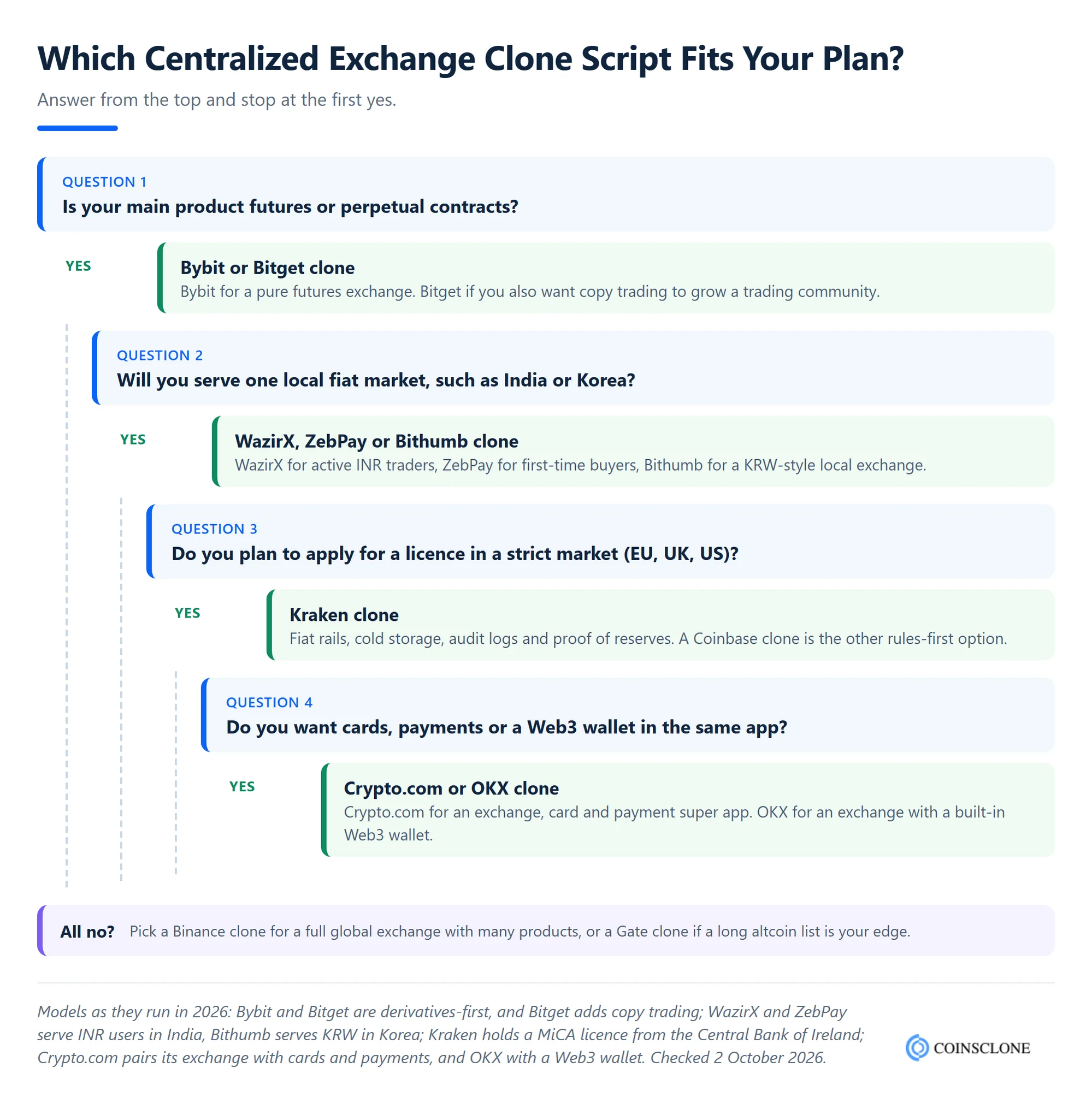
Start with your market and your main product, not the brand name. A futures exchange and a rupee exchange need very different licences, banking partners and risk tools. Use the decision tree below to narrow the list, then compare the two or three that fit.
What Is a Centralized Exchange Clone Script?
A centralized exchange clone script is pre-built, customizable software that copies the core features of a known crypto exchange such as Binance, Coinbase or Kraken. Unlike a build from scratch, a script is already tested and ready to brand. That saves months of work and a large part of the budget.
A good script includes everything an exchange needs: a matching engine, wallets, liquidity links, payment options and compliance tools. So you can spend your time on users, growth and new markets. Now let’s look at why so many businesses choose this route.
Why Do Modern Startups Choose CEX Clone Scripts?
Few founders now build an exchange from scratch. The reasons are simple:
- Customizable: you can change the brand, design and features to fit your business goals.
- Faster launch: a white label exchange can go live in weeks, not months, which helps you reach users first.
- Lower cost: a script removes most of the cost of a full build, yet still gives you a strong platform.
- Scalable: the platform can grow with more users, more trading volume, new regions and new add-ons.
That said, a script is not risk-free. Shared code, weak wallet design and a vendor who will not hand over the source code can all hurt you later. The sections below show what to check.
What a Good CEX Clone Script Must Include
Every centralized exchange runs on the same core parts. The brand you copy mostly changes the products on top. Check each part in a live demo before you buy.
- Matching engine: pairs buy and sell orders by price, then time. It should handle thousands of orders a second without lag.
- Wallets: hot wallets for daily withdrawals and cold or MPC storage for most funds, with withdrawal limits and whitelists.
- Ledger checks: the internal ledger must match the real coins on chain, checked automatically and often.
- Liquidity: links to outside order books or market makers, so new users see tight prices on day one. Read our guide to crypto liquidity providers for the options.
- KYC and AML: identity checks, wallet screening and Travel Rule data on transfers.
- Admin panel: fees, coin listings, user reviews, limits and reports in one place.
- APIs and apps: REST and WebSocket APIs for traders and bots, plus iOS and Android apps.
For a deeper look at the build itself, see our step-by-step guide on how to create a centralized exchange.
How a Centralized Exchange Makes Money
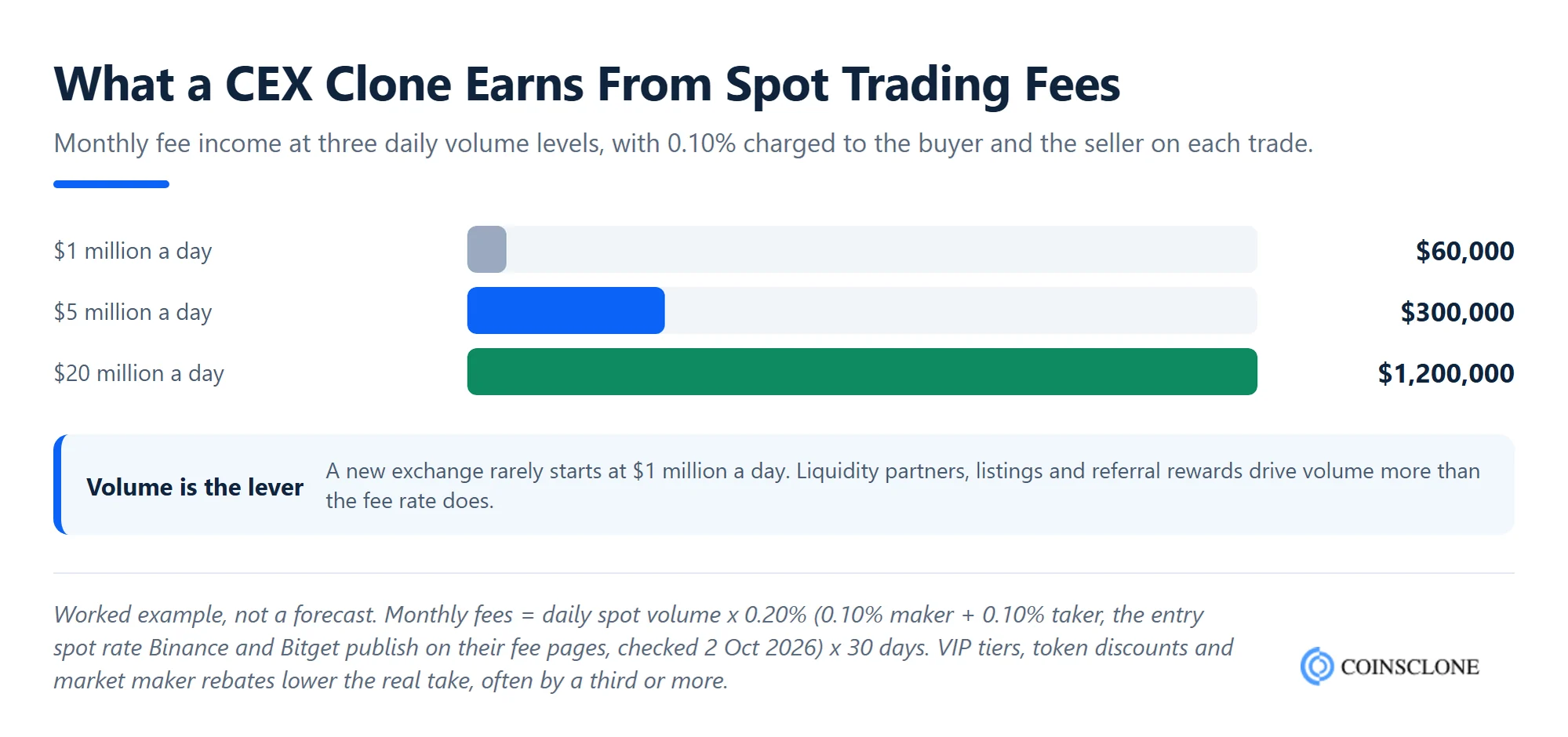
Your clone earns the same way the original does. The main stream is a small fee on every trade. Binance charges 0.10% to both sides at its entry spot tier, and Bitget charges the same. So volume matters more than the fee rate.
- Trading fees: maker and taker fees on spot and futures trades.
- Withdrawal fees: a flat fee per coin when users move funds out.
- Listing fees: projects pay to list their token.
- Futures income: funding and liquidation fees on leveraged trades.
- Earn products: a share of staking and lending rewards.
- Extra services: copy trading profit share, launchpads, OTC and API plans.
What Recent Exchange Failures Teach Script Buyers
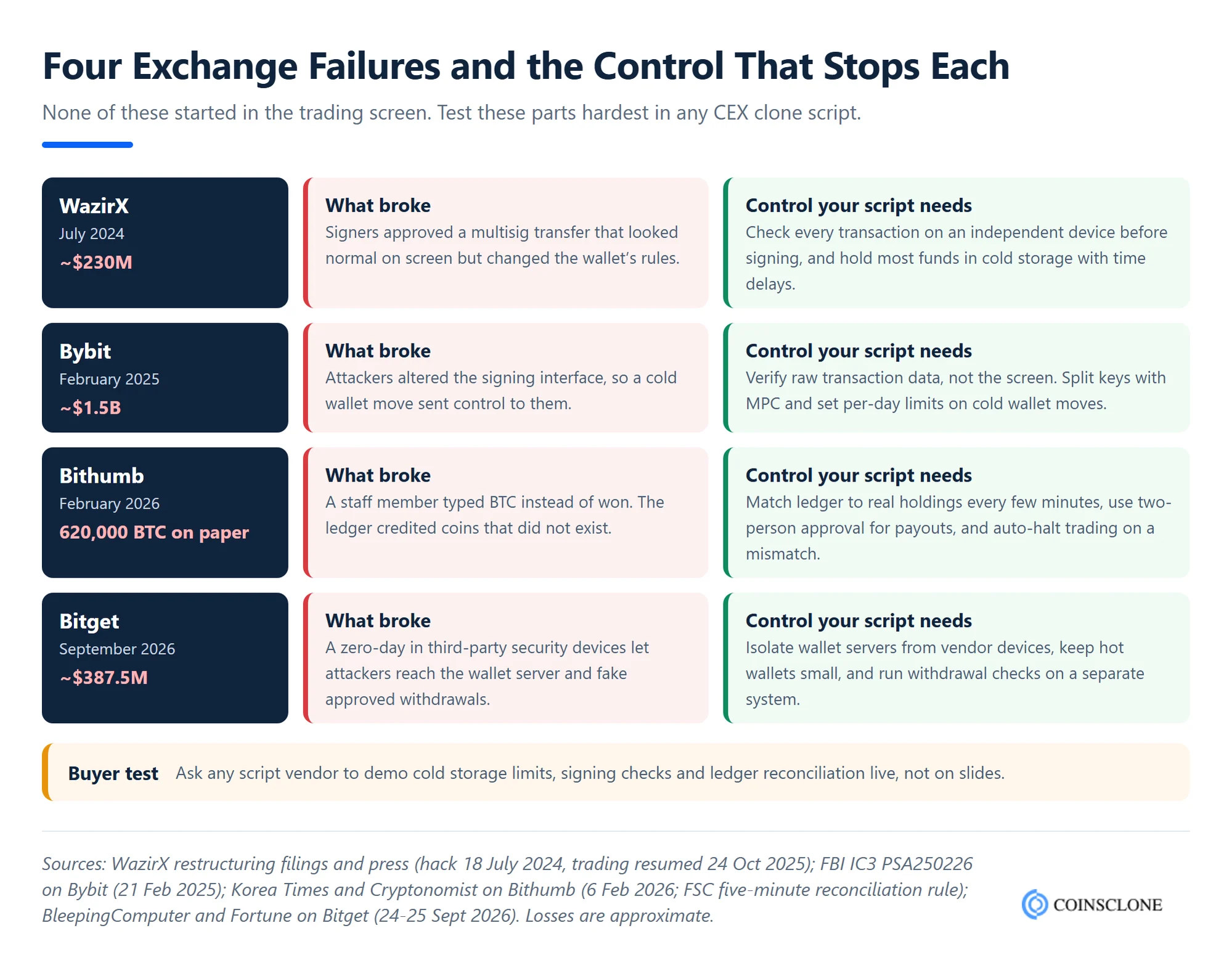
Four of the exchanges in this list had serious incidents between 2024 and 2026. None of them failed because of the trading screen. They failed in wallets, signing tools, outside devices and the ledger. So these are the parts to test hardest in any script.
- WazirX (July 2024): about $230 million left a multisig wallet after its signing flow was tricked. Trading stopped for 16 months.
- Bybit (February 2025): about $1.5 billion was stolen after attackers tampered with the screen used to sign a cold wallet transfer.
- Bithumb (February 2026): a typing error credited 620,000 bitcoin that did not exist. Fast freezes saved 99.7%.
- Bitget (September 2026): attackers broke in through third-party security devices and drained hot and warm wallets of about $387.5 million.
Clone Script vs White Label vs Custom Build
These three terms get mixed up. In practice, most providers build clone scripts and white label exchanges on the same base. The real choice is how much you want to change and own.
| Route | What you get | Typical cost (2026 market) | Time to launch |
| Clone script | Software modelled on a named exchange, branded for you | Low tens of thousands of dollars and up | Weeks |
| White label exchange | A ready, tested platform you rebrand and extend | About $30,000 to $100,000 | 4 to 13 weeks |
| Custom build | Your own design and code from the ground up | About $150,000 to $300,000+, enterprise up to $1.2M+ | 9 to 14 months or more |
Costs are ranges from published 2026 agency cost guides. Timelines for white label come from Coinsclone’s own pages: 4 to 6 weeks for a core exchange, 7 to 10 weeks with fiat rails, and 9 to 13 weeks with mobile apps. Before you sign, ask who owns the source code, whether you get a recent security audit, and what support covers after launch. Our white label crypto exchange software page shows what the white label route includes.
Licences You Need Before Launch
The script is just software. Running an exchange is what needs a licence, and the rules depend on where your users live. We cover this in more detail in our post on whether clone scripts are legal, and in our crypto license guide.
- European Union: MiCA’s grace period ended on 1 July 2026, so only licensed firms can serve EU users. A trading platform needs at least EUR 150,000 in capital under MiCA.
- United States: register with FinCEN as a money services business, then get state money transmitter licences. New York adds its BitLicense.
- United Kingdom: the FCA opened its crypto licence window on 30 September 2026. It runs to 28 February 2027, and the new rules start on 25 October 2027.
- Dubai: VARA charges AED 100,000 to apply for an exchange licence and AED 200,000 a year after that.
- India: exchanges must register with FIU-IND and follow its anti-money laundering rules.
Start licence and banking work at the same time as the build. In most markets, approval takes longer than the code.
How Much Does a CEX Clone Script Cost?
The price depends on scope more than on the brand you copy. A spot exchange with one fiat currency costs far less than a futures exchange with mobile apps and several bank links. Published 2026 agency cost guides put an MVP exchange at about $15,000 to $50,000 and a white label exchange at about $30,000 to $100,000. A custom exchange runs from about $150,000 to $300,000 or more.
Plan for running costs on top. These include servers, market makers, KYC checks (Sumsub lists $1.35 per basic check), security audits and support. Our full guide on the cost to develop a cryptocurrency exchange breaks down each line.
Also Read: Top clone scripts to launch profitable crypto startups
Partner with Coinsclone to Build a Reliable Centralized Crypto Trading Platform!
The crypto market now rewards exchanges that launch with care, not just fast. After reading about the top centralized exchange clone scripts, you may still wonder which model fits your vision, and how to bring it to market.
This is where Coinsclone helps. Coinsclone is a leading centralized exchange development company that has built crypto platforms since 2018. We have delivered 350+ platforms for 200+ clients across 20 industries. We don’t just sell scripts; we deliver exchanges built for startups, growing firms and institutions.
Our centralized exchange script comes with a tested matching engine, hot and cold wallet controls, KYC and AML tools, and a full admin panel. A white label exchange goes live in 4 to 6 weeks, 7 to 10 weeks with fiat rails, or 9 to 13 weeks with mobile apps.
Choosing the right centralized exchange clone script is a long-term decision. It will shape your platform’s speed, trust and ability to grow.
Step into 2026 with a secure, future-ready CEX clone script from Coinsclone.
Frequently Asked Questions
What is a centralized exchange clone script?
It is ready-made software that copies the features of a known exchange, such as Binance or Kraken. You add your brand, coins and fees, then launch your own exchange in weeks instead of months.
Which is the best crypto exchange clone script in 2026?
It depends on your plan. A Binance clone suits a full global exchange. Bybit or Bitget clones suit futures and copy trading. Kraken suits strict, licensed markets, and WazirX or ZebPay suit Indian fiat users.
How much does a crypto exchange clone script cost?
Published 2026 agency cost guides put an MVP exchange at about $15,000 to $50,000 and a white label exchange at $30,000 to $100,000. A custom build costs $150,000 or more. Plan for running costs on top.
How long does it take to launch an exchange with a clone script?
A white label exchange takes about 4 to 6 weeks. Adding fiat rails takes it to 7 to 10 weeks, and adding mobile apps to 9 to 13 weeks. Licences can take longer, so start them early.
Are clone scripts legal?
Yes. A clone script copies features, not a brand’s code, name or logo. What needs a licence is running the exchange, under rules such as MiCA in the EU or FinCEN and state licences in the US.
Do exchange clone scripts support mobile apps?
Yes. Most scripts include iOS and Android apps, or offer them as an add-on. Apps add a few weeks to the launch.
What is the difference between a clone script and a white label exchange?
A clone script copies the features of a named exchange. A white label exchange is a ready product you rebrand. Most providers build both on the same base, so the real choice is how much you want to change.
How does a crypto exchange make money?
Mostly through trading fees, often around 0.10% per side on spot. Exchanges also earn from withdrawal fees, token listings, futures funding, staking shares and premium services.
Launch Faster with the Top Centralized Exchange Clone Script.
Build your crypto exchange the smart way — secure, scalable, and market-ready.
- Rapid Deployment : Go live in weeks, not months.
- Advanced Trading Engine : High-speed, seamless order execution.
- Powerful Admin Control : Manage users, fees, liquidity & listings easily.
- Ready-to-Scale Architecture : Built for growth and heavy trading volume.
Get a free branded demo of your exchange within 48 hours — before you invest anything.
Book a Free Demo and see how Centralized Exchange Script can turn your idea into a fully functional live trading platform in just 8 – 12 weeks.