
On 1 July 2026, the grace period ended across the European Union. Since then, any firm serving EU clients with crypto services and no MiCA license has been breaking EU law. Two days from now, on 30 September 2026, the UK opens its own application window for the first time.
The rules have caught up with crypto. A license is no longer a nice extra for a big exchange. It is the price of entry for almost any business that holds, trades or moves crypto for other people.
This guide explains which crypto license you need, what it costs and how long it takes, country by country. It covers the EU, the UAE, the US, the UK, Singapore, India, Hong Kong and lower-cost options. Figures come from regulators’ own sites, checked on 28 September 2026. Rules change fast, so treat this as a map, not legal advice.
Which Crypto License Do You Need?
Rule makers license what you do, not the app you build. The same exchange might need three permissions: one to run the order book, one to hold client coins and one to move funds. Start with what your firm does.
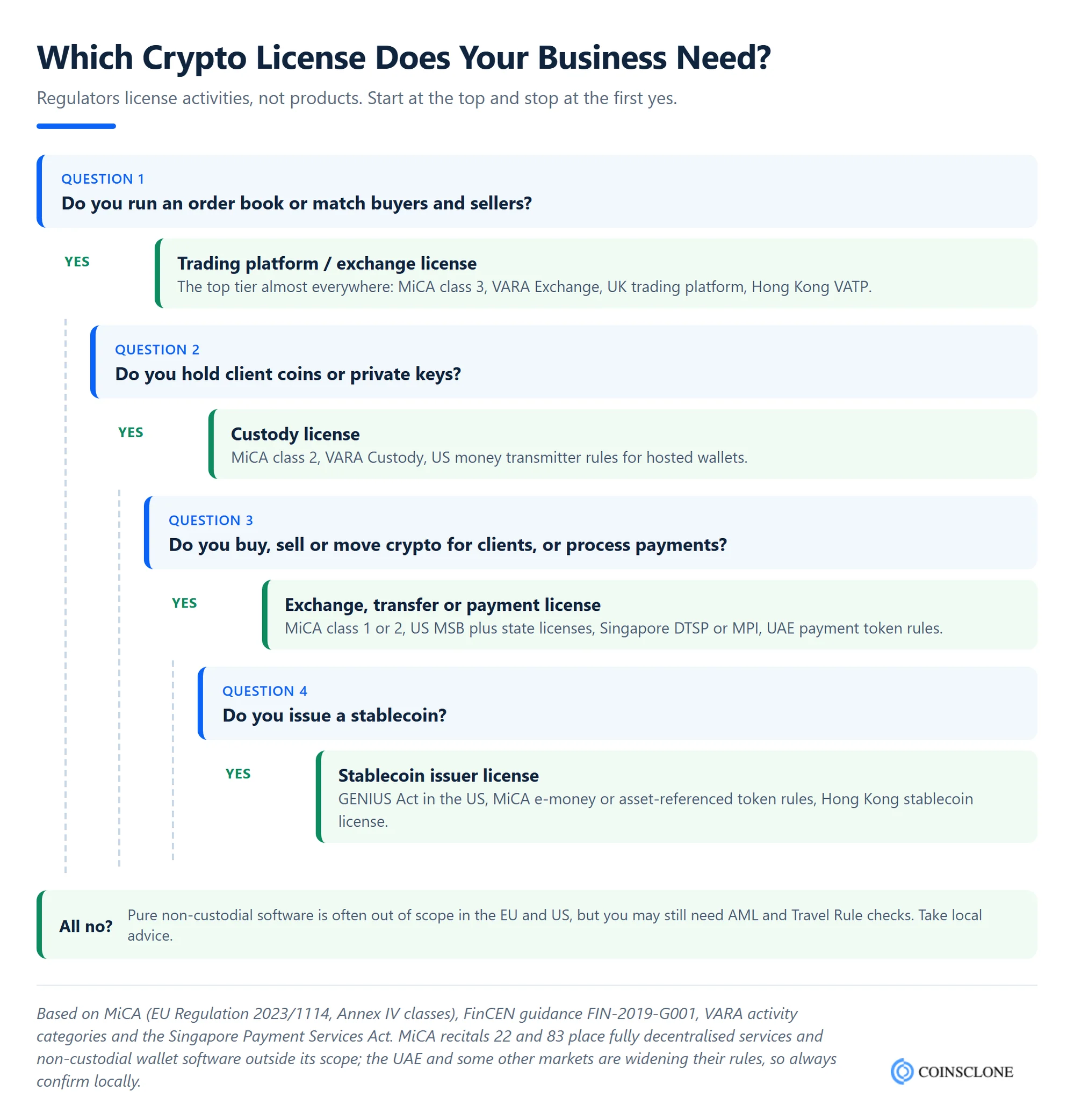
The main activity types:
- Trading platform: you match buyers and sellers on an order book. This is the top tier nearly everywhere.
- Custody: you hold client coins or private keys.
- Exchange or brokerage: you buy and sell crypto with clients, or swap crypto for cash.
- Transfer and payments: you move crypto for clients or process crypto payments for merchants.
- Stablecoin issuance: you create and redeem a stablecoin.
- Advice and portfolio management: you tell clients what to buy, or manage it for them.
If you are planning a crypto exchange, assume you need the trading platform and custody tiers. If you run a crypto payment gateway, look at transfer and payment licenses.
Crypto License Costs by Country
Here is a side-by-side view. Fees are the regulator’s own figures; the US dollar amounts are rough, at 27 September 2026 exchange rates.
| Country | License | Official fees | Minimum capital (exchange) | Timeline |
| EU (all 27) | MiCA CASP | Set by each country | EUR 50,000 to 150,000 | 25 + 40 working days after a full file |
| Dubai | VARA | AED 100,000 application + AED 200,000 a year per activity (about $27,000 + $54,000) | AED 1.5m (about $408,000) | Not published |
| Abu Dhabi | ADGM FSRA | $20,000 per activity; $125,000 for an MTF | Not published here | Not published |
| US federal | FinCEN MSB | Free | None federal | Register in days |
| New York | BitLicense | $5,000 application | Bond generally $500,000+ | Often a year or more |
| UK | FCA crypto regime | GBP 2,820 to 28,150 by activity | Not covered here | Window 30 Sept 2026 to 28 Feb 2027 |
| Singapore | DTSP / MPI | S$10,000 a year (DTSP) | S$250,000 (about $196,000) | Not published |
| India | FIU-IND registration | Not published | None set | Not published |
| Hong Kong | SFC VATP | HK$4,740 per activity | HK$5m (about $637,000) | Months to years |
| El Salvador | CNAD DASP | $5,475 | Not published | Up to 20 business days to decide |
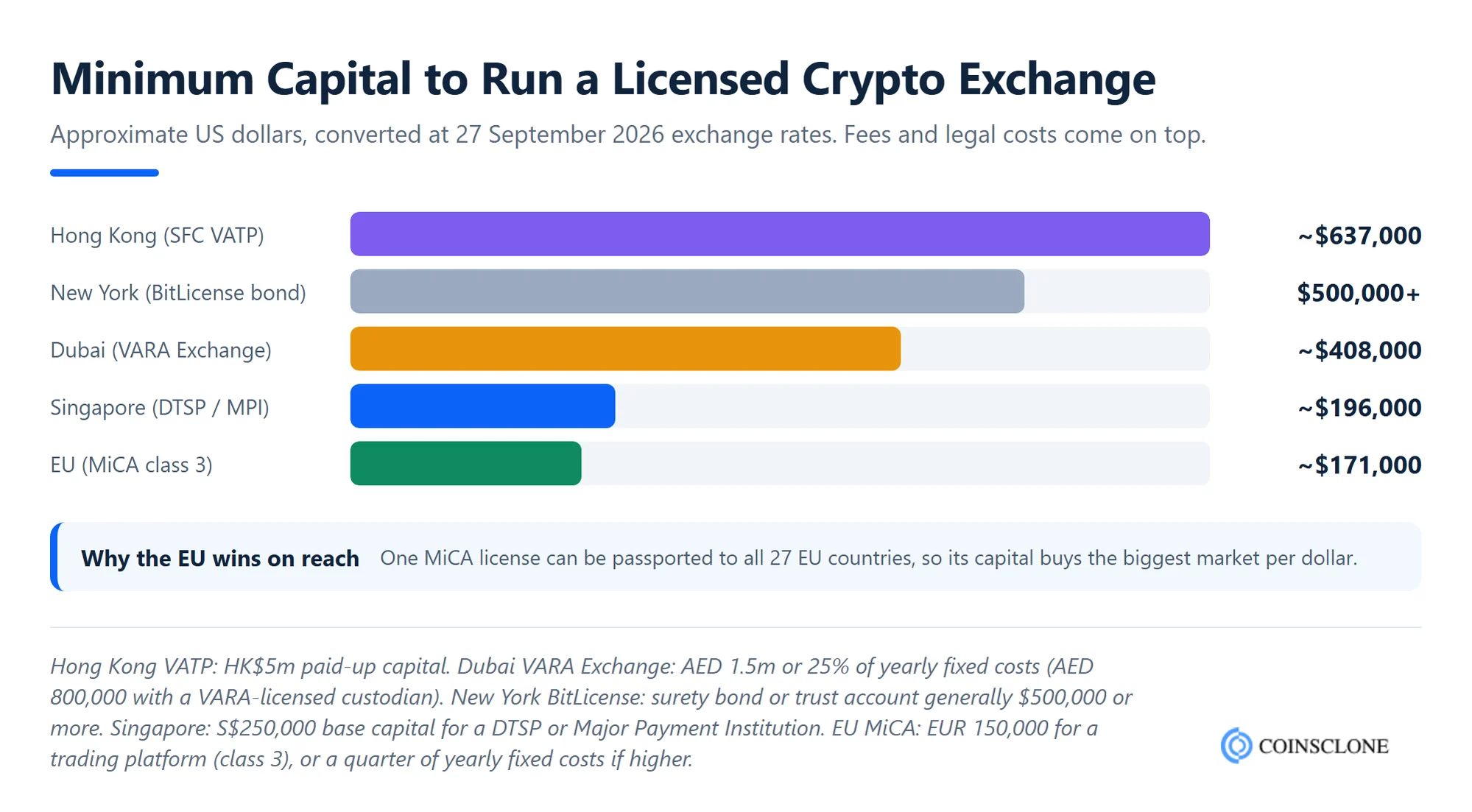
The fee is rarely the big cost. Capital, legal work, compliance staff, audits and a local office usually cost far more than the application.
EU: How to Get a MiCA License
MiCA, the EU’s Markets in Crypto-Assets rules, gives one license for all 27 countries. You apply in one country and then passport to the rest.
What changed in 2026. The transition period ended on 1 July 2026. ESMA’s statement says firms without a license must stop taking new clients and wind down. Firms from outside the EU cannot serve EU clients, except in narrow cases where the client made the first approach.
Capital by class:
- Class 1, EUR 50,000: order execution, placing, transfers, advice and portfolio management.
- Class 2, EUR 125,000: class 1 plus custody and crypto-to-cash or crypto-to-crypto exchange.
- Class 3, EUR 150,000: class 2 plus running a trading platform.
You must hold the higher of these amounts or a quarter of last year’s fixed costs, under Article 67.
Timeline. The regulator has 25 working days to confirm your file is complete, then 40 working days to decide. Once licensed, you can serve another EU country 15 days after notifying. Our guide on how to start a MiCA-compliant crypto exchange in the EU covers the build side.
UAE: How to Get a Crypto License in Dubai and Abu Dhabi
The UAE has three regulators to know.
Dubai VARA. The Virtual Assets Regulatory Authority licenses each activity on its own. Its fee list charges AED 100,000 to apply to run an exchange, a broker, custody or a similar service, then AED 200,000 a year for each one. Advisory and transfer activities cost AED 40,000 to apply and AED 80,000 a year.
The cash you must hold depends on what you do. An exchange needs the higher of AED 1.5 million or 25% of yearly fixed costs. That falls to AED 800,000 if you use a VARA-licensed custodian. A broker-dealer needs AED 600,000.
Abu Dhabi ADGM. The FSRA charges about $20,000 per crypto activity to apply and $15,000 a year, or $125,000 to apply for a standalone trading facility.
UAE Central Bank. Since July 2024, payment token services in or into the UAE need a Central Bank license or registration. Dirham stablecoins must be issued in AED only. A 2025 UAE law also gave the Central Bank more crypto services to watch, so check the latest rules if you build wallets or DeFi tools.
USA: Which Crypto License Do You Need?
The US has no single crypto license. You deal with federal and state rules at once.
FinCEN MSB registration. Businesses that exchange crypto or hold it for users are money transmitters under FinCEN guidance. Signing up as a money services business is free and lasts two years.
State money transmitter licenses. Most states also want their own license, each with its own bond and capital rules. Many states are adopting a model law to make the rules more alike.
New York BitLicense. The best known state license. The application fee is $5,000, and firms usually need a surety bond or trust account of at least $500,000. NYDFS lists about 39 regulated crypto firms.
The GENIUS Act. Signed on 18 July 2025, it sets federal rules for stablecoin issuers. It takes effect by 18 January 2027 at the latest.
The CLARITY Act. This bill would set wider market rules for crypto. It passed the House in 2025, but a Senate vote in September 2026 fell short of the 60 votes needed. It is not law.
UK: How to Get an FCA Crypto License
The UK is moving from a simple registration to a full license regime.
- The window: applications open at 7am on 30 September 2026 and close on 28 February 2027.
- The start date: the new regime begins on 25 October 2027.
- Firms on the old list: firms signed up with the FCA today are not moved across. They must apply, and those who apply in the window can keep trading while they wait.
Application fees from the FCA’s September 2026 notice:
- GBP 2,820 for arranging deals, dealing as agent or staking.
- GBP 11,260 for dealing as principal, custody or stablecoin issuance.
- GBP 28,150 for running a trading platform.
Singapore: MAS Licenses for Crypto Firms
Singapore tightened its rules in 2025. Since 30 June 2025, Singapore firms that serve only overseas clients need a Digital Token Service Provider license, and MAS said it will generally not grant one. In practice, Singapore now wants firms with real local business.
Firms serving Singapore use the Payment Services Act:
- Standard Payment Institution: S$100,000 base capital, with monthly volume caps.
- Major Payment Institution: S$250,000 base capital, plus a security deposit of S$100,000 or more.
India: How to Register a Crypto Business
India has no crypto license as such. Instead, since March 2023, crypto exchanges and firms that hold coins must sign up with the Financial Intelligence Unit (FIU-IND) under money laundering law. This applies to foreign firms that serve Indian users too.
India enforces it. FIU-IND fined Binance Rs 18.82 crore in 2024 and Bybit Rs 9.27 crore in 2025, and sent notices to 25 offshore platforms in late 2025. Tax also shapes the market: a 30% tax on crypto gains and 1% TDS on transfers. See our list of crypto exchanges in India for how local players operate.
Hong Kong: SFC and Stablecoin Licenses
A Hong Kong trading platform needs a license from the Securities and Futures Commission. The fees are small, HK$4,740 per activity, but the capital is not: HK$5 million paid-up capital, plus liquid assets to cover a year of costs. Only 13 platforms were licensed at the end of June 2026.
A separate stablecoin law took effect in August 2025, with a HK$25 million capital floor. The first issuer licenses went out in April 2026.
Lower-Cost Crypto License Options
Some countries offer cheaper or faster routes. They suit early projects, but a cheap license can limit which banks and partners will work with you.
- El Salvador: a digital asset service provider registration with CNAD costs $5,475, with a decision within 20 business days.
- Canada: FINTRAC money services business registration is free and lasts two years.
- Australia: a new AUSTRAC regime for virtual asset providers started on 31 March 2026.
- Seychelles: a license under the 2024 VASP law costs SCR 75,000 to apply, plus yearly fees of SCR 375,000 for an exchange.
- British Virgin Islands: registration costs $10,000 for an exchange or custodian.
Panama has no crypto license in force yet, despite its reputation. Lithuania, once a popular cheap option, now falls under MiCA like the rest of the EU.
Launch a Licence-Ready Crypto Exchange
Crypto Exchange Development — done right.
- White Label Exchange: Spot, P2P and wallet modules, ready to brand.
- Compliance Built In: KYC, AML screening, Travel Rule and audit logs from day one.
- Regulator-Ready Docs: Architecture, security and custody records that licence files ask for.
- Revenue Engine: Earn from trading fees, listings, staking and more.
Get a free branded demo of your exchange in just 48 hours — before spending a single dollar.
Book a Free Demo to see how our white label exchange can take you from idea to live platform in as little as 4 – 6 weeks.
Does a Non-Custodial Crypto App Need a License?
Sometimes not. MiCA says providers of non-custodial wallet software and fully decentralised services are outside its scope. FinCEN says people using their own unhosted wallets are not money transmitters, and neither are firms that only supply software.
But the line is thin. A DeFi app that accepts and sends value on users’ behalf can count as a money transmitter in the US, and the UAE is pulling more wallet and DeFi services into its rules. If your app ever touches user funds, even briefly, plan for a license. Escrow services face the same test, as our guide to how crypto escrow works explains.
What Is the Travel Rule?
Every licensed crypto firm must also follow the Travel Rule. It means sending and receiving the names and details of the people behind a transfer, much like a bank wire.
The FATF sets a USD or EUR 1,000 threshold, though the EU applies the rule to all transfers with no threshold. In July 2026, the FATF reported that 83% of the countries it surveyed now have Travel Rule laws. Build it into your platform from day one.
How to Get a Crypto License: 7 Steps
- Define your activities. List exactly what you will do: trading, custody, payments, issuance.
- Pick your markets. Choose where your users are, not only where licenses are cheap.
- Set up a local company. Most want a local firm, local directors and real staff.
- Raise the capital. Hold the minimum capital, plus enough to run for a year.
- Build compliance. KYC, AML screening, the Travel Rule, audit logs and a named compliance officer.
- Prepare the platform. They check your tech: how you store coins, how you keep them safe, and how you keep client money apart from yours.
- Apply and answer questions. Expect rounds of questions. Fast, clear answers shorten the process.
Step six is where software choices matter. A white label crypto exchange with KYC, AML screening, Travel Rule support and audit logs built in gives regulators the records they ask for. Our team has delivered 350+ crypto platforms, and a white label exchange can go live in about 4 to 6 weeks, or 7 to 10 weeks with fiat rails, while your license file moves forward. Read our guide to the cost of building a crypto exchange to budget both sides.
Frequently Asked Questions
How do I get a crypto license?
Decide what you will do, pick your country, set up a local company, hold the minimum capital, build KYC and AML controls, and apply to the regulator. In the EU that is a MiCA CASP license; in Dubai a VARA license; in the US FinCEN registration plus state licenses.
How much does a crypto license cost?
Official fees range from free (FinCEN, Canada) to AED 100,000 to apply in Dubai plus AED 200,000 a year per activity. Capital is the bigger cost: from EUR 150,000 for an EU trading platform to HK$5 million in Hong Kong.
Which country is cheapest for a crypto license?
El Salvador ($5,475), Canada (free MSB registration) and the British Virgin Islands ($10,000) have low fees. For reach, the EU is strong value, because one MiCA license covers 27 countries.
How do I get a crypto license in Dubai?
Apply to VARA for each activity you plan to run. An exchange pays AED 100,000 to apply and AED 200,000 a year, and needs AED 1.5 million in capital, or AED 800,000 if it uses a VARA-licensed custodian.
How do I get a crypto license in India?
India has no crypto license, but exchanges and firms that hold coins must sign up with FIU-IND under money laundering law. Foreign firms serving Indian users must register too, and fines for skipping it have reached Rs 18.82 crore.
Do I need a license to run a crypto exchange?
In almost every major market, yes. Running an order book and holding client funds face the strictest rules, and need the most cash on hand.
Do I need a license to run a crypto wallet app?
If the wallet holds users’ keys or funds, usually yes. Pure non-custodial wallet software is often outside MiCA and FinCEN rules, but some countries, including the UAE, are widening their scope.
How long does it take to get a crypto license?
It varies. El Salvador decides within about 20 business days. MiCA sets 25 working days to check your file and 40 to decide. A New York BitLicense or a Hong Kong platform license can take a year or more.