
Centralized exchanges (CEXs) such as Binance, Coinbase and Kraken still handle most crypto trading, because they offer what most users want: fast order books, fiat deposits, customer support and simple apps. They are also a proven business, earning from every trade, deposit and listing.
But “centralized” also means the exchange holds its users’ money, and that responsibility is where exchanges win or fail. A centralized exchange script gives you a ready-made, tested platform to build on, so you can focus on security, compliance and liquidity instead of writing a trading engine from zero. This guide covers what the script includes, how it works, the security lessons from recent exchange hacks, and how to launch.
See How Our Centralized Exchange Script Can Launch Your Exchange Faster!
Centralized Crypto Exchange Development — done right.
- MVP System: Launch your dream Centralized Exchange 90% faster.
- Liquidity & Wallets: Pre-integrated modules, no coding needed.
- Your Brand, Your Market: Custom design, tokens, and trading pairs.
- Profit from Day One: Earn via trading fees, listings, and staking.
Get a free branded demo of your centralized exchange in 48 hours — before you invest a cent.
Book a Free Demo to discover how our Centralized Exchange Script can take you from idea to live exchange in just 8–12 weeks.
What Is a Centralized Exchange Script?
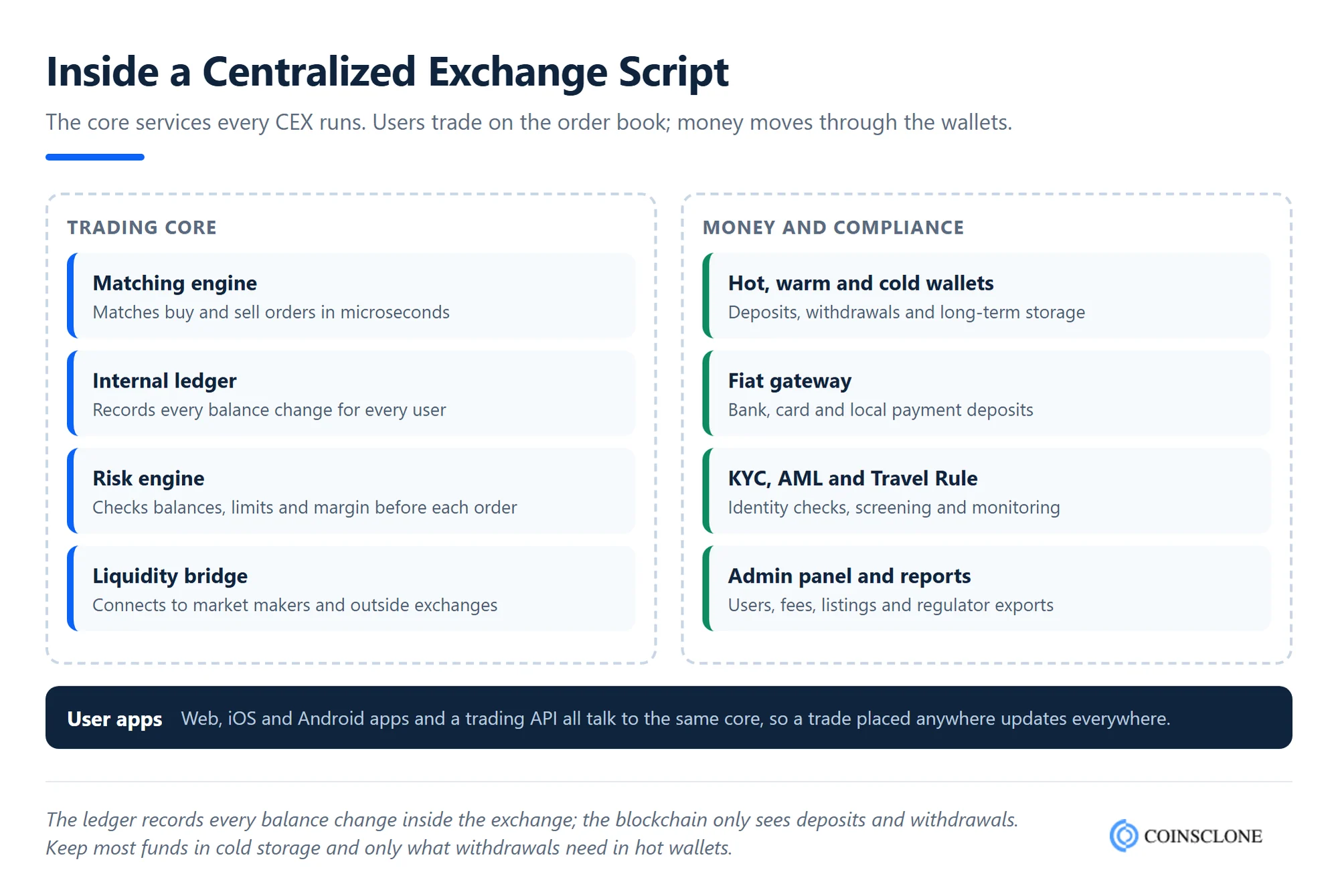
A centralized exchange script is ready-made software for building and running a cryptocurrency exchange where the platform manages user accounts, custody, liquidity and trade matching. It includes an order matching engine, a user wallet system, an admin panel, KYC and AML checks, liquidity tools and security controls.
What does CEX stand for? CEX stands for centralized exchange: a crypto exchange run by a company that holds users’ funds and matches their orders, unlike a decentralized exchange (DEX), where users trade from their own wallets through smart contracts.
Businesses use a centralized crypto exchange script to launch faster, with a platform that has already been tested with real trading, and then brand and extend it.
Why Choose a Centralized Exchange Script Over Other Methods?
- Faster launch: skip long development cycles and go live in weeks.
- Proven architecture: a pre-tested matching engine, ledger and wallet system.
- Full trading features: multiple order types, live charts and market data out of the box.
- Liquidity ready: connect market makers and outside exchanges so your order books are not empty.
- Your brand: change the design, coins, pairs and fees to fit your market.
- Room to grow: add P2P, futures, staking or OTC as your business grows.
Types of Centralized Exchange Scripts
- Spot trading exchange script: buy and sell crypto at market prices on an order book.
- P2P exchange script: users trade with each other while the platform holds crypto in escrow.
- Derivatives and futures exchange script: margin, perpetual futures and leverage for advanced traders.
- OTC exchange script: large trades handled away from the order book so they do not move the price.
- Multi-currency exchange script: many cryptocurrencies, stablecoins and fiat gateways for a wide audience.
Bitcoin Exchange Script
A bitcoin exchange script is a centralized exchange built around bitcoin: BTC trading pairs, bitcoin deposits and withdrawals, and often a BTC-to-local-currency on-ramp. It is a common starting point, because bitcoin is the most traded asset and needs only one blockchain integration at first. Most operators then add USDT and ETH pairs as the exchange grows.
Altcoin Exchange Script
An altcoin exchange script focuses on listing a wide range of tokens beyond bitcoin, often including new projects. It needs strong listing rules, token due diligence and multi-chain wallet support, because each new chain adds nodes, wallets and monitoring.
How Does a Centralized Exchange Script Work?
User Workflow
- Sign up and KYC: users create accounts and verify their identity.
- Deposit: users deposit crypto to their exchange wallet address, or fiat through a payment gateway.
- Trade: users place market or limit orders using live prices and charts.
- Order matching: the matching engine pairs buy and sell orders in microseconds, and the internal ledger updates both balances.
- Withdraw: users withdraw to their own wallets or bank accounts, after security checks.
- Track: users see balances, trade history and performance.
Admin Workflow
- User management: approve KYC, set limits and review suspicious activity.
- Liquidity and markets: list pairs, connect market makers and watch order book depth.
- Fees: set trading, deposit and withdrawal fees, and VIP tiers.
- Security: monitor wallets, withdrawals and servers in real time.
- Reports: revenue, volume, user growth and compliance exports.
- Updates: deploy new features and security fixes.
The Security Reality Check: What Recent Exchange Hacks Teach
Centralized exchanges are secure only when they are run securely. The largest losses of the last two years did not come from broken trading engines. They came from wallets, signing processes and internal accounts.
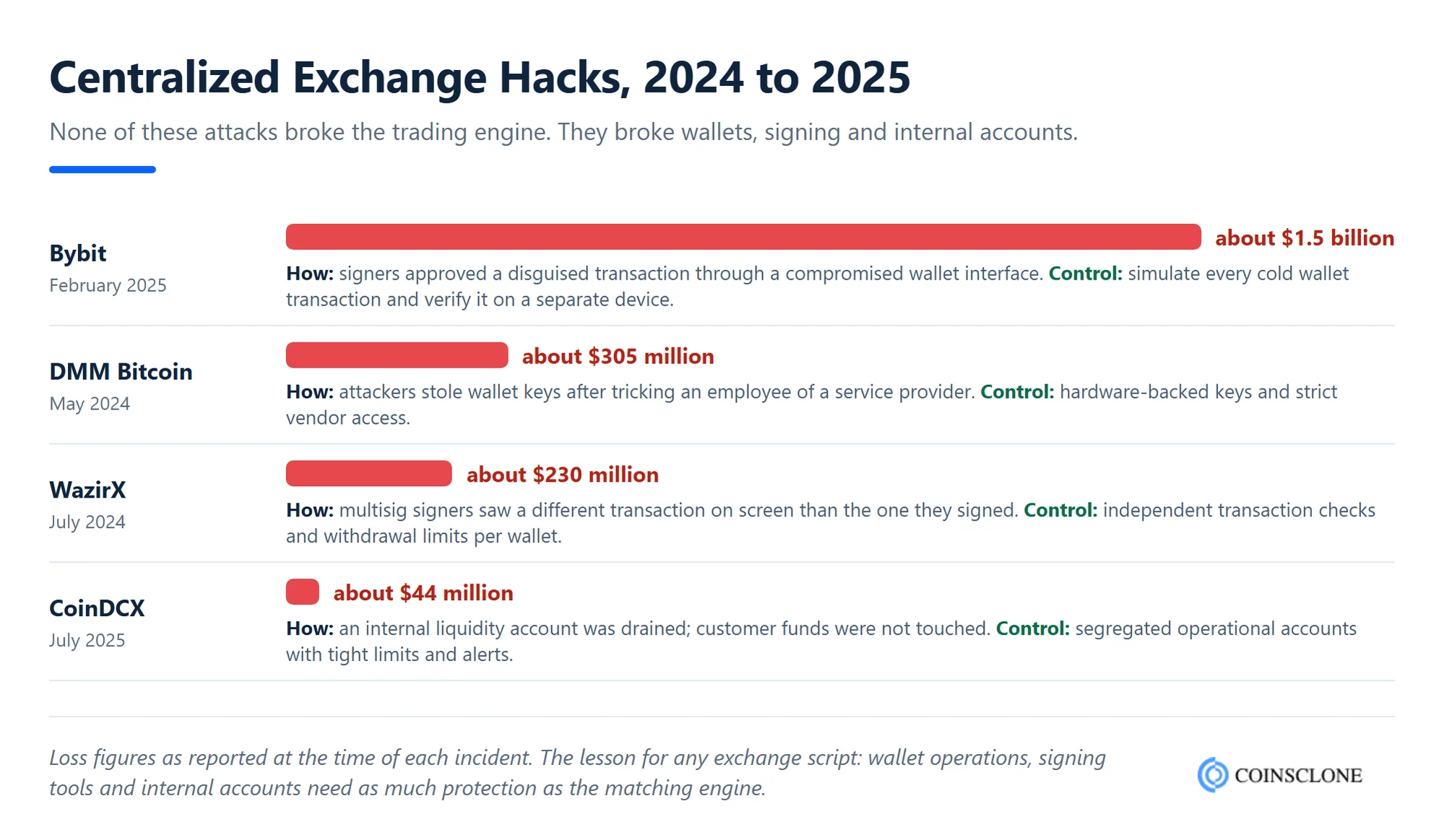
That is why a modern centralized exchange script must treat wallet operations as seriously as trading:
- Tiered wallets: keep most funds in cold storage and only what withdrawals need in hot wallets.
- Multi-party signing: no single person or server can move large amounts.
- Transaction simulation: show signers exactly what a transaction will do, checked on a separate device.
- Withdrawal limits and delays: hold large or unusual withdrawals for review.
- Proof of reserves: publish regular proof that customer balances are backed.
- Segregated accounts: keep operational funds separate from customer funds, with their own limits.
Proof of Reserves: How a New Exchange Earns Trust
After FTX collapsed in November 2022, users learned that an exchange can show balances it does not actually hold. Since then, large exchanges such as Binance, OKX and Kraken have published proof of reserves: a regular report that shows the exchange holds at least as much of each asset as its users are owed.
A proof of reserves module usually works in three parts:
- Liability snapshot: Every user balance is added to a Merkle tree, so each user can check that their balance is included without seeing anyone else’s.
- Asset proof: The exchange proves control of its wallet addresses, often by signing messages from them.
- Independent review: An auditor or public tool confirms that assets cover liabilities.
For a new exchange, publishing proof of reserves from launch is one of the fastest ways to earn trust from traders who remember FTX.
Tech Stack of a Centralized Exchange Script
- Matching engine: A low-latency engine, often written in Rust, Go, C++ or Java, that keeps the order book in memory.
- Backend services: Microservices for accounts, wallets, risk and reporting, connected by a message queue such as Kafka.
- Databases: PostgreSQL for balances and ledgers, Redis for fast order book and session data.
- Wallet infrastructure: Hot, warm and cold wallets with multisig or MPC signing and automated sweeping.
- Front end: React web app and native or cross-platform mobile apps with live price feeds over WebSockets.
- Infrastructure: Cloud or bare-metal hosting with DDoS protection, monitoring and automated backups.
Core Features of Our Centralized Exchange Script
- User dashboard: live market data, portfolio and trade history.
- Admin panel: full control over users, markets, fees and wallets.
- Matching engine: market, limit, stop and other order types, executed at high speed.
- Multi-currency wallets: hot, warm and cold wallets for secure deposits and withdrawals.
- Liquidity management: internal market making and external liquidity connections.
- Payment gateways: fiat deposits and withdrawals by bank, card and local methods.
- KYC, AML and Travel Rule: identity checks, screening and transfer data sharing.
- Reports and analytics: trades, revenue and user behaviour.
Security Features
- Two-factor authentication and anti-phishing codes
- Login throttling and account lock after failed attempts
- Data encryption at rest and in transit
- Protection against SQL injection, CSRF and SSRF attacks
- DDoS protection
- Multi-signature and MPC wallet controls
- Withdrawal whitelists and device checks
- Real-time monitoring and alerts
See How Our Centralized Exchange Script Can Launch Your Exchange Faster!
Centralized Crypto Exchange Development — done right.
- MVP System: Launch your dream Centralized Exchange 90% faster.
- Liquidity & Wallets: Pre-integrated modules, no coding needed.
- Your Brand, Your Market: Custom design, tokens, and trading pairs.
- Profit from Day One: Earn via trading fees, listings, and staking.
Get a free branded demo of your centralized exchange in 48 hours — before you invest a cent.
Book a Free Demo to discover how our Centralized Exchange Script can take you from idea to live exchange in just 8–12 weeks.
Add-On Modules for Our Centralized Exchange Script
As a crypto exchange clone script provider, we also offer modules you can add at launch or later:
- P2P trading: escrow-protected trades with local payment methods.
- Margin and futures: leveraged trading with a risk and liquidation engine.
- Staking and earn: rewards on staked or lent crypto.
- Referral and affiliate programme: rewards for bringing in new traders.
- Launchpad and token listings: new token sales and listings.
- Trading APIs: for market makers, bots and institutional clients.
- Mobile apps: native iOS and Android apps.
- OTC desk: large-order handling for high-value clients.
Best Centralized Exchange Scripts We Offer
Binance Clone Script
Our Binance clone script copies the features of the world’s largest exchange: spot and futures trading, P2P, earn and launchpad. It is the most popular choice for founders who want a full crypto ecosystem.
Bybit Clone Script
A Bybit clone script is built for derivatives: perpetual futures, leverage, copy trading and a liquidation engine.
Kraken Clone Script
The Kraken clone script focuses on a regulated, fiat-first exchange with segregated client funds, proof of reserves and staking.
Remitano Clone Script
The Remitano clone script adds P2P trading with local currencies, where users trade with each other and the platform holds the crypto in escrow.
LBank Clone Script
An LBank clone script suits exchanges that want to list many altcoins quickly and attract traders looking for new tokens.
Not sure which to choose? Our team can help you match the model to your market.
Centralized vs Decentralized Exchange Script
| Centralized exchange script | Decentralized exchange script | |
| Who holds funds | The exchange | Users, in their own wallets |
| How trades match | Order book on the exchange’s servers | Smart contracts, usually liquidity pools |
| Fiat deposits | Yes, through banks and cards | Not directly |
| KYC | Required in most markets | Usually not built in |
| Speed and features | Very fast, advanced order types, margin and futures | Limited by the blockchain |
| Main risk | Custody and wallet security | Smart contract bugs |
| Licences | Usually required | Depends on the market and the setup |
Many businesses run both: a centralized exchange for fiat users, and a DEX or on-chain wallet for DeFi users. See our decentralized exchange development guide for the other side.
How to Avoid an Empty Order Book on Day One
A new exchange with thin order books loses users fast, because every trade moves the price. Plan liquidity before launch:
- Liquidity bridge: mirror order books from larger exchanges, so your users see deep prices from the first day.
- Market makers: sign agreements with market makers who keep quotes on both sides of your main pairs.
- Start with fewer pairs: focus liquidity on BTC, ETH and USDT pairs before listing smaller tokens.
- Maker incentives: lower fees or rebates for traders who add liquidity with limit orders.
- Watch depth, not just volume: track the spread and how much can trade within 1% of the price.
Compliance Checklist for a Centralized Exchange
- Licence or registration in every market you serve
- KYC with tiered limits, and KYB for business accounts
- AML transaction monitoring and suspicious activity reporting
- Sanctions screening of users and wallet addresses
- Travel Rule data sharing for transfers where required
- Segregated customer funds and regular proof of reserves
- Record keeping and regulator reporting
- Clear terms, fee disclosures and risk warnings
How to Create a Centralized Crypto Exchange
- Pick your market and model: spot, P2P, derivatives or a mix, and the countries you will serve.
- Secure your licences: for example, a MiCA licence in the EU, FinCEN registration and state licences in the US, or FIU registration in India.
- Choose your script: pick the base platform and the modules you need at launch.
- Brand and customise: design, coins, pairs, fees and languages.
- Set up liquidity: agree market-making and liquidity provider terms before launch.
- Integrate payments and KYC: fiat gateways, KYC provider and screening tools.
- Test and audit: load tests, penetration tests and a wallet security review.
- Launch and grow: start with a closed beta, then open with referral and listing campaigns.
For the full process, read our guide on how to start a cryptocurrency exchange.
Revenue Models of a Centralized Crypto Exchange
- Trading fees (maker and taker)
- Token listing fees
- Withdrawal and fiat funding fees
- Margin interest and futures fees
- Staking and lending commissions
- Launchpad fees
- VIP and API subscriptions
- Affiliate and referral programmes
Our guide on how crypto exchanges make money explains each stream in detail.
How Much Does a Centralized Exchange Script Cost?
Cost depends on your features, markets, integrations and support needs. Coinsclone’s published timelines for a centralized exchange are:
| Scope | Timeline | Includes |
| White label exchange | 4 to 6 weeks | Rebranded platform, standard pairs, core KYC |
| Standard custom exchange | 11 to 15 weeks | Engine tuning, fiat rails, apps, compliance |
| Exchange with derivatives | 5 to 8 months | Margin, perpetuals, risk engine, surveillance |
| Institutional platform | 8 to 14 months | FIX APIs, custody tiers, OTC desk, multi-region |
The main cost drivers are the base script, customisation, security and compliance, integrations such as liquidity and fiat gateways, and support after launch. For market price ranges and hidden fees, see our white label crypto exchange cost guide.
Benefits of Coinsclone’s Centralized Exchange Script
- Launch in weeks with a tested platform.
- Lower cost than building from scratch.
- Tiered wallets, multi-party signing and two-factor login built in.
- Add modules and scale as your business grows.
- Many coins, fiat options and languages for global users.
- Live charts, multiple order types and simple fund management.
- Updates, maintenance and expert support after launch.
Why Choose Coinsclone for Your Centralized Exchange Script?
Coinsclone is a trusted centralized exchange development company that has delivered more than 350 blockchain platforms for over 200 clients. Our centralized exchange script combines a fast matching engine, secure wallet operations, compliance tools and full admin control, with the source code transferred to you.
Talk to our team for a live demo, and launch a secure, growth-ready exchange.
Frequently Asked Questions
What is a centralized exchange script?
It is ready-made software for launching a crypto exchange where the platform manages accounts, custody and order matching. It includes a matching engine, wallets, an admin panel, KYC and security features.
What does CEX stand for?
CEX stands for centralized exchange: a crypto trading platform run by a company that holds users’ funds and matches their orders, such as Binance, Coinbase or Kraken.
Is a centralized exchange script secure?
It can be, if it includes tiered cold and hot wallets, multi-party signing, transaction checks, withdrawal limits, two-factor login and monitoring. Recent hacks show that wallet operations need as much protection as the trading engine.
What is the difference between a centralized and a decentralized exchange script?
A centralized script runs an exchange that holds user funds and matches orders on its own servers. A decentralized script runs on smart contracts, and users trade from their own wallets.
What is proof of reserves?
Proof of reserves is a regular report that shows an exchange holds at least as much of each asset as its users are owed. Users can check that their own balance is included, usually through a Merkle tree.
Which programming language is best for a crypto exchange matching engine?
Most high-performance matching engines use Rust, Go, C++ or Java because they handle large numbers of orders with low, predictable delays. The rest of the platform can use any modern stack.
What is a bitcoin exchange script?
It is a centralized exchange script built around bitcoin trading and deposits, often with fiat on-ramps. Most bitcoin exchanges later add stablecoin and altcoin pairs.
How do I create a centralized crypto exchange?
Choose your market and model, secure the licences you need, pick a script and modules, customise it, set up liquidity, payments and KYC, then test, audit and launch.