
Planning to launch your own crypto exchange? Then the first thing you need is a real number. In 2026, crypto exchange development cost runs from about $15,000 for a white label launch to $500,000 or more for a custom exchange built from scratch. Where you land depends on the build path, the type of exchange, the features you add, where you get licensed and who builds it.
This guide breaks that number down so you can plan a budget you can trust. You will see the price of each build path, each type of exchange and each part of the platform. You will also see the real license fees regulators charge, what an exchange costs to run each month, and how much trading you need to cover it.
In this guide:
- Price by build path: white label, custom MVP, full custom and enterprise, with time to launch.
- Price by exchange type: CEX, DEX, P2P, OTC and hybrid, side by side.
- License fees: official fees in the US, EU, UK and Dubai, plus legal and compliance costs.
- Running costs: hosting, liquidity, KYC checks, audits and marketing each month.
- Payback and savings: the trading volume that covers your costs, and safe ways to spend less.
Crypto Exchange Development Cost in 2026
In 2026, crypto exchange development cost starts at about $15,000 to $60,000 for a white label exchange. A custom MVP costs about $100,000 to $200,000, and a full custom exchange costs $250,000 to $500,000 or more. Large, multi-region platforms can pass $1 million.
These are the ranges exchange development firms publish in their 2026 price guides. They vary so much because “an exchange” can mean a branded copy of tested software or a fully new trading system. So the build path is the first and biggest cost decision you make.
See How to Cut Your Crypto Exchange Development Cost by Up to 90%
Crypto Exchange Development — done smarter.
- MVP System : Launch your Binance-like exchange at a fraction of the usual cost.
- Liquidity & Wallets : Pre-built, secure modules — save thousands in development.
- Brand & Customization : Your logo, tokens, and UI — no extra coding fees.
- Revenue Engine : Start earning from trading fees, listings, and staking — fast.
Get a full cost breakdown and a free branded demo of your exchange — delivered in 48 hours.
Book a Free Demo to discover how our Crypto Exchange can take you from idea to live exchange in just 8-12 weeks — with 10x lower development costs.
How Much Does it Cost To Create A Crypto Exchange in 2026?
The cost to build a crypto exchange depends on how much you build yourself and how much you reuse. Here is a quick overview of the four main build paths:
| Build path | Typical cost (USD) | Time to launch | Best suited for |
| White label or clone script | $15,000 to $60,000 | 4 to 6 weeks (7 to 10 with fiat rails, 9 to 13 with mobile apps) | Startups that want to test a market fast with tested code |
| Custom MVP | $100,000 to $200,000 | 6 to 9 months | Teams with a new idea that ready-made software cannot support |
| Full custom exchange | $250,000 to $500,000+ | 9 to 14 months | Funded firms that need their own matching engine and full control |
| Enterprise, multi-region platform | $500,000 to $1,200,000+ | 12 months or more | Large firms with licenses in several regions and institutional clients |
Time to launch for white label comes from Coinsclone’s published delivery times. Custom ranges reflect 2026 price guides from exchange development firms.
White Label or Clone Script Exchange
A white label exchange is tested exchange software that carries your brand, your fee settings and your coin list. A crypto exchange clone script works the same way but copies the features of a known exchange such as Binance or Coinbase. This is the cheapest and fastest way to start. It costs about $15,000 to $60,000, and a standard launch takes 4 to 6 weeks. For a full price list of this route, see our guide to white label crypto exchange cost.
Custom MVP Crypto Exchange
A custom MVP is a small exchange built for your own idea. It has the core parts: sign up, KYC, wallets, an order book, a matching engine and an admin panel. It costs about $100,000 to $200,000 and takes 6 to 9 months. Choose this path when your model needs something white label software cannot do, such as a new kind of market.
Fully Custom Cryptocurrency Exchange
A full custom build means you design every part, including a fast matching engine, margin or futures trading, mobile apps and deep security. It costs about $250,000 to $500,000 or more and takes 9 to 14 months. In return, you get full control of the code and the roadmap.
So the build path sets your price band. Next, the type of exchange you run moves the number inside that band.
Cost To Build A Crypto Exchange Based On Business Models
The cost of a crypto exchange also changes with the business model. Each model differs in its tech, how it handles user funds, how it finds liquidity and which rules apply to it. Not all exchanges are the same.
For example, if you want to build an exchange like Binance, which is a *centralized exchange**, you need a fast matching engine, custody and strict compliance. In contrast,* *Uniswap**, a* *decentralized exchange****, runs on smart contracts. Both trade crypto, yet their parts, risks and rules differ. That is why their costs differ too.*
Let us look at each model in turn.
Centralized Exchange (CEX) development cost
A centralized exchange holds user funds and matches orders on its own servers. It is still the most popular model. In Q2 2026, the top 10 centralized exchanges handled $1.95 trillion in spot trading, with Binance alone holding 38.7% of it, according to CoinGecko. A CEX needs a strong back end, custody, KYC and deep liquidity. A custom CEX costs about $150,000 to $500,000+. A white label CEX can go live in 4 to 6 weeks for a much lower budget.
Keep in mind that a CEX costs more to run than to build. Custody, compliance and liquidity are ongoing bills.
Decentralized Exchange (DEX) development cost
A DEX runs without a central operator. Smart contracts hold the funds and settle each trade on chain. So the cost depends on the contracts, the audit, the chains you support and the features. A custom DEX costs about $50,000 to $150,000+, and an outside smart contract audit adds to that.
If you are new to DeFi, audits can feel daunting. In that case, a ready-made white label DEX with audited contracts is the safer start, and it can go live in about 5 to 7 weeks.
Peer-to-Peer (P2P) Exchange Development Cost
A P2P exchange lets users trade directly with each other. The platform holds the crypto in escrow and settles disputes. It suits local markets where people pay in cash or by bank transfer. A custom P2P exchange costs about $50,000 to $120,000, because it does not need a complex matching engine.
Fraud checks and fair dispute rules are what keep users trusting a P2P platform. So for startups, a P2P exchange script is the low-cost route, and a white label launch takes about 4 to 8 weeks.
Over-the-Counter (OTC) Exchange Development Cost
An OTC desk handles large trades directly between two parties, away from the public order book. It serves funds, firms and high-net-worth traders, so it needs strong security, request-for-quote tools and tight compliance. A custom OTC platform costs about $60,000 to $150,000+.
Since OTC desks deal in large sums, many startups begin with a tested OTC exchange solution and add custom tools later.
Hybrid Crypto Exchange (HEX) Development Cost
A hybrid exchange mixes the speed of a CEX with the self-custody of a DEX. Users may trade on an off-chain order book while their funds settle on chain. This is the hardest model to build, so it costs about $150,000 to $300,000+ and takes 10 months or more.
| Exchange type | Custom build cost (USD) | Complexity | Key parts | Best suited for |
| Centralized Exchange (CEX) | $150,000 to $500,000+ | High | Matching engine, custody wallets, KYC | High-volume trading |
| Decentralized Exchange (DEX) | $50,000 to $150,000+ | Medium to high | Smart contracts, liquidity pools, audit | DeFi users |
| P2P Exchange | $50,000 to $120,000 | Medium | Escrow, chat, disputes | Local and fiat trading |
| OTC Exchange | $60,000 to $150,000+ | Medium to high | Request for quote, settlement | Funds and large traders |
| Hybrid Exchange | $150,000 to $300,000+ | Very high | Off-chain order book, on-chain settlement | Advanced platforms |
Each model can also start on white label software, which costs far less. See the build path table above.
What Are the Key Drivers of Cryptocurrency Exchange Development Cost?
The type of exchange sets the range. Within that range, a few factors decide the final price. Here are the ones that matter most.
Features & Functional Complexity
Every feature adds design, code and testing time. A spot exchange with a few trading pairs is simple. Margin trading, futures, staking, copy trading and a launchpad each add weeks of work. So list your must-have features first, and park the rest for later releases.
Trading Engine & Performance
The matching engine is the heart of a CEX. It must match thousands of orders a second without errors or delays. A custom engine costs about $30,000 to $80,000, and more for very high speed. White label software includes a tested engine, which is one reason it costs less.
Security Infrastructure
Security is the one area you should never trim. In 2025, hackers stole $3.4 billion in crypto, and the February attack on Bybit alone took about $1.5 billion, Chainalysis reports. So budget for cold storage, multi-signature or MPC wallets, rate limits, DDoS protection and an outside audit. Security and audits cost about $20,000 to $60,000 for a new exchange. Our guide on how to build a non-hackable crypto exchange covers each layer.
Liquidity Integration
Liquidity decides how easily users can buy and sell at a fair price. A new exchange has no users yet, so it borrows liquidity. Most startups connect to other exchanges or crypto liquidity providers through an API. The setup costs about $5,000 to $20,000. After that, a market maker often charges a monthly fee, which we cover under running costs below.
Tech Stack Infrastructure
Your tech stack affects both build and running costs. Cloud servers that scale with demand, a fast database and good monitoring tools all add cost. Setup usually costs $8,000 to $25,000. Pick a stack that can grow, because moving later is costly.
Third-Party Integrations
Most exchanges rent some parts instead of building them. Common ones are KYC checks, fiat payment rails, price feeds, analytics and support desks. Each one adds setup work of about $5,000 to $15,000, plus a monthly or per-use fee. For example, a basic identity check from a provider such as Sumsub starts at $1.35 per check, with a $149 monthly minimum.
Regulatory Compliance & Licensing
Rules now shape every exchange budget. The country you serve decides the license, the capital you must hold and the reports you must file. This can range from a few thousand dollars to well over $100,000 in the first year. We break it down by country in the licensing section below.
Development Team & Location
Who builds your exchange, and where they work, changes the price a lot. Clutch reports that software developers charge $25 to $49 an hour in India, Ukraine and the Philippines, $50 to $99 in the US and Poland, and $100 to $149 in Canada, in its pricing data updated in September 2026. Yet a team with real exchange work behind it often costs less in the end, because it avoids costly rework.
| Cost factor | Impact on cost | Typical cost (USD) | Notes |
| Features & Functionality | High | $10,000 to $50,000+ | Grows with each advanced trading feature |
| Trading Engine | Very high | $30,000 to $80,000+ | Core system; included in white label software |
| Security & Audits | High | $20,000 to $60,000+ | Never the place to save |
| Liquidity Integration | Medium to high | $5,000 to $20,000 setup | Plus monthly market maker fees |
| Tech Stack & Infrastructure | Medium | $8,000 to $25,000 | Affects how well you scale |
| Third-Party Integrations | Medium | $5,000 to $15,000 each | Ongoing fees apply |
| Compliance & Licensing | High | $10,000 to $150,000+ | Depends on the country |
| Development Team | High | $25 to $149+ an hour | Depends on skill and region |
These cost drivers overall determine the investment required to build a cryptocurrency exchange. But, it is also essential to know where your budget is being allocated in each phase of your development stages.
Breaking Down the Cost of Developing Process of Crypto Exchange
Developing a crypto exchange is not a single step process, it involves a series of development phases, each contributing to the overall cost. Let’s see them too…
Requirement Analysis & Planning
This is the initial stage of building your crypto exchange, where your roadmap is defined. This process will include, finalizing the business model, feature planning and designing the platform. Overall, this phase would cost USD 3,000 – USD 8,000.
Designing UI/UX
This is the most important phase, where you should plan about the user experience and real-time branding. Mostly, crypto exchanges require intuitive and real-time interfaces. Also, a well – designed one, will improve user engagement and retention. Overall, it would cost around USD 5,000 – 15,000.
Trading Engine & Back-End Developing
This is the core development phase of launching a crypto exchange. The performance and reliability depends on your backend efficiency. Moreover, this phase decides the necessary components like order matching, database architecture, APIs to add or integrate. So, it would cost around USD 15,000 – 40,000.
Blockchain Integration + Wallet Development
Integrating blockchain and wallet into your crypto exchange is essential in terms of fund transactions. Usually, the cost of this phase varies based on the number of cryptocurrencies and its supported blockchain complexity. So, the cost would be USD 10,000 – 30,000.
Security Implementation
This phase is non-negotiable in creating a crypto exchange. Implementing security measures like data encryption, 2FA, security audits will be costing around USD 10,000 – 25,000. In that case, you should not compromise on security measures, which may lead to reputational damage.
Testing & Quality Assurance
When it comes to this phase, the entire platform is being tested for functional, performance, security testing and bug fixing. So, this process will cost around USD 5,000 – 15,000. Therefore, thorough testing ensures the smooth operation of the platform.
Deployment & Launch
This is the last stage of deploying your platform ensuring the platform is good to run and live. So, this phase involves server setup, cloud deployment and configuration to go-live. Thus, it would cost around USD 2,000 – 10,000.
| Development Stage | Estimated Cost (USD) | Importance Level | Key Outcome |
| Requirement Analysis & Planning | $3,000 – $8,000 | High | Clear project roadmap |
| UI/UX Design | $5,000 – $15,000 | High | User-friendly interface |
| Backend & Trading Engine | $15,000 – $40,000+ | Very High | Core system functionality |
| Blockchain & Wallet Integration | $10,000 – $30,000 | Very High | Secure transactions |
| Security Implementation | $10,000 – $25,000 | Critical | Platform protection |
| Testing & QA | $5,000 – $15,000 | High | Bug-free performance |
| Deployment & Launch | $2,000 – $10,000 | Medium | Platform goes live |
The factors explain why prices vary. Next, let us price each part of the platform on its own.
Cost Breakdown Based on the Core Components of Crypto Exchange
A total price is easier to trust when you can see the parts. Here is what each core part of a custom exchange costs. The low end fits a lean MVP, and the high end fits a full platform.
Trading Engine
The trading engine matches buy and sell orders and keeps the order book. A fast, reliable engine is essential for a CEX. It costs about $30,000 to $80,000+.
User Panel (Front-End)
The user panel is what traders see: sign up, dashboard, charts, order forms and history. A clean, quick interface keeps users coming back. Design and build cost about $8,000 to $40,000.
Admin Panel
The admin panel lets your team manage users, coins, fees, withdrawals and reports. It costs about $10,000 to $25,000.
Wallet Integration
Wallets store and move user funds. Each new blockchain adds work, and hot, warm and cold wallet tiers add more. Wallet work costs about $20,000 to $50,000.
Liquidity & Order-book Integration
Liquidity APIs fill your order book with real prices from day one. Without them, users face thin markets and price slippage. This costs about $5,000 to $20,000.
Payment Gateway Integration
A payment gateway lets users deposit and withdraw local money by card or bank transfer. Each payment partner adds setup work. This costs about $3,000 to $10,000.
Security Measures
Security covers 2FA, encryption, anti-DDoS tools, withdrawal checks, fraud alerts and an outside audit. It costs about $20,000 to $60,000.
KYC/AML Integration
KYC and AML tools check who your users are and watch for suspicious trades. Costs depend on the provider and the countries you serve. Setup costs about $10,000 to $40,000, plus a fee for each check.
Mobile Apps
Most traders now use their phones. Native or cross-platform apps for iOS and Android cost about $30,000 to $100,000+. A white label build with mobile apps takes about 9 to 13 weeks, while custom crypto exchange app development takes longer.
| Component | Typical cost (USD) | Importance | What it does |
| Trading Engine | $30,000 to $80,000+ | Very high | Order matching and order book |
| User Panel | $8,000 to $40,000 | High | Trading screens and account pages |
| Admin Panel | $10,000 to $25,000 | High | Platform control and reports |
| Wallet Integration | $20,000 to $50,000 | Very high | Storing and moving funds |
| Liquidity Integration | $5,000 to $20,000 | High | Deep, fair markets |
| Payment Gateway | $3,000 to $10,000 | Medium | Fiat deposits and withdrawals |
| Security Systems | $20,000 to $60,000 | Critical | Protecting funds and data |
| KYC/AML System | $10,000 to $40,000 | Critical | Meeting the rules |
| Mobile Apps | $30,000 to $100,000+ | High | Trading on the go |
Comparison Table: Crypto Exchange Development Cost by Business Model
As a startup, it helps to see cost, time and rules for each model in one place.
| Exchange model | Custom build cost (USD) | Custom build time | White label launch | Rules to plan for | Best for |
| Centralized Exchange (CEX) | $150,000 to $500,000+ | 9 to 14 months | 4 to 13 weeks | High (license, KYC/AML) | High-volume trading |
| Decentralized Exchange (DEX) | $50,000 to $150,000+ | 4 to 6 months | 5 to 7 weeks | Low to medium | DeFi platforms |
| P2P Exchange | $50,000 to $120,000 | 3 to 5 months | 4 to 8 weeks | Medium | Local and fiat trading |
| OTC Exchange | $60,000 to $150,000+ | 4 to 6 months | Varies with scope | High | Funds and large traders |
| Hybrid Exchange | $150,000 to $300,000+ | 10 to 16 months | Varies with scope | High | Advanced platforms |
Custom ranges reflect 2026 developer price guides. White label times are Coinsclone’s published delivery windows.
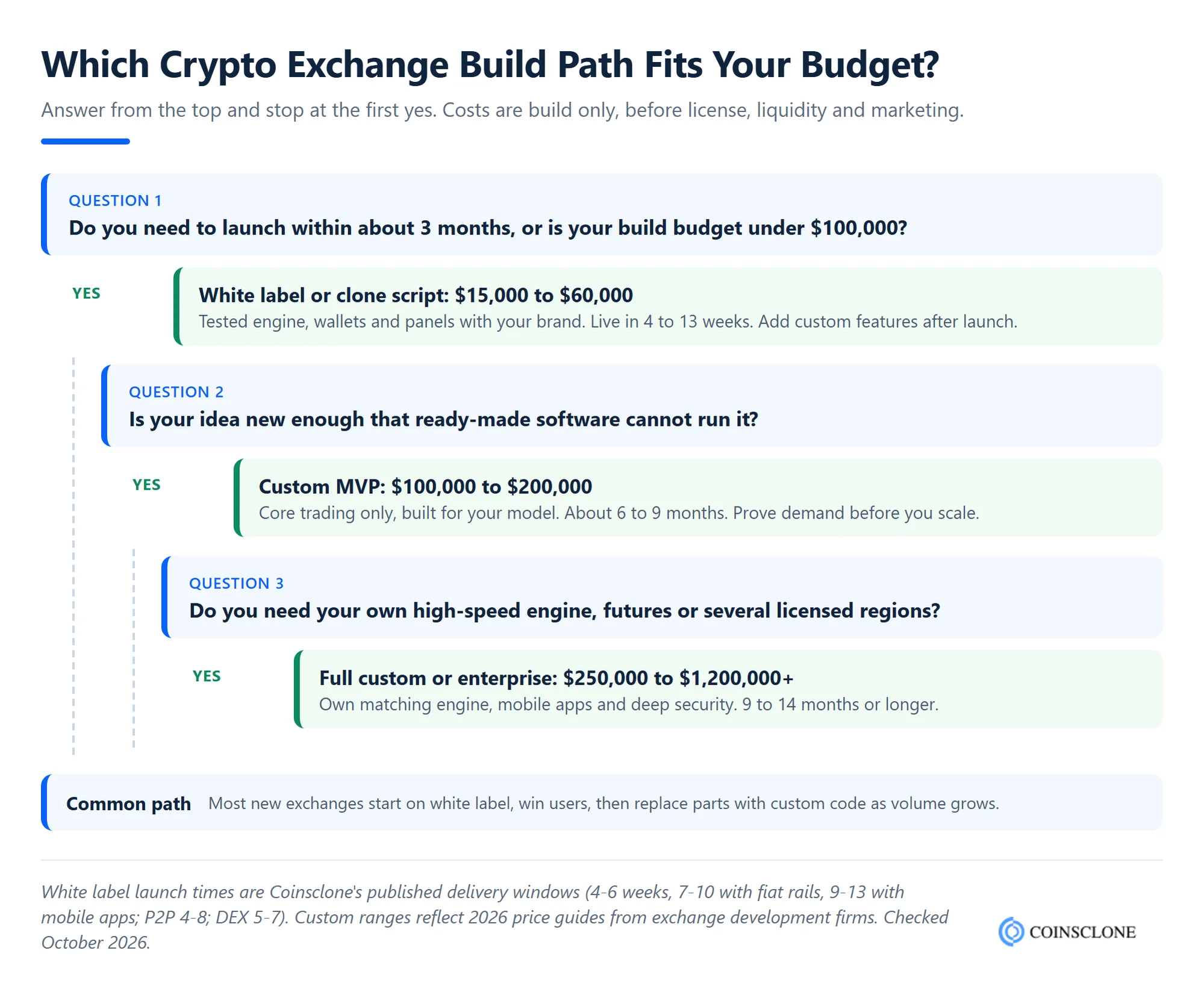
Not sure which path fits your budget? This decision tree helps you choose in under a minute.
Licensing Cost to Start A Cryptocurrency Exchange
A license is not optional for most exchanges. It lets you serve users legally, open bank accounts and win trust. It is also where budgets most often go wrong, because the official fee is only a small part of the bill.
Here are the official fees in five major markets, taken from the regulators’ own rules:
| Market | License or registration | Official fee | Other key costs |
| United States (federal) | FinCEN money services business (MSB) registration | No fee | Most states also need a money transmitter license, each with its own fees and bonds |
| New York | NYDFS BitLicense | $5,000 application fee | A surety bond or trust account set by NYDFS, plus yearly supervision charges |
| European Union | MiCA crypto-asset service provider (CASP) | Set by each national regulator | Own funds of €125,000 to exchange or hold crypto, or €150,000 to run a trading platform |
| United Kingdom | FCA cryptoasset authorisation | £28,150 to run a trading platform; £11,260 to deal or hold crypto | Gateway open 30 Sept 2026 to 28 Feb 2027; the regime starts 25 Oct 2027 |
| Dubai | VARA Exchange Services license | AED 100,000 (about $27,200) to apply | AED 200,000 (about $54,500) yearly supervision fee |
Sources: NYDFS, MiCA Annex IV, the FCA application fees (FCA 2026/58), the FCA’s gateway announcement and VARA Schedule 2. Checked October 2026.
Note the timing too. MiCA’s transition period ended on 1 July 2026, so firms serving the EU now need full CASP approval. If Europe is your market, our guide on launching a MiCA-compliant crypto exchange in the EU walks through the steps.
Beyond the official fee, plan for these licensing costs:
1. Business Registration & Legal Setup
You first need a company in the right country. Costs cover company setup, local directors where needed and legal papers.
Estimated cost: $2,000 to $10,000
2. Crypto Exchange License Cost
This covers the application fee, the business plan, policies and the regulator’s review. Offshore markets cost less, while top-tier markets such as New York, the UK and Dubai cost far more.
Estimated cost: $10,000 to $100,000+
3. KYC/AML Compliance Setup
Almost every market requires KYC and AML checks. You need a check provider, transaction monitoring and a trained compliance officer.
Estimated cost: $5,000 to $20,000 to set up
4. Legal & Consultation Fees
A good crypto lawyer helps you pick the right market, write your policies and avoid penalties.
Estimated cost: $5,000 to $25,000+
5. Compliance & Renewal Fees
A license is not a one-time cost. You pay yearly supervision fees, audits and reports to keep it.
Estimated cost: $10,000 to $50,000+ a year
| Licensing component | Typical cost (USD) | Frequency | Notes |
| Business Registration | $2,000 to $10,000 | One-time | Depends on the country |
| Exchange License Fee and Application | $10,000 to $100,000+ | One-time | Varies widely by country |
| KYC/AML Setup | $5,000 to $20,000 | Setup + ongoing | Required in most markets |
| Legal & Consultation | $5,000 to $25,000+ | Setup | Policies and filings |
| Ongoing Compliance | $10,000 to $50,000+ a year | Yearly | Supervision fees, audits and reports |
For the full country-by-country process, read our crypto license guide.
Marketing Costs for Launching a Cryptocurrency Exchange Platform
Building the exchange is only half the job. You also need traders. Without a clear marketing plan, even a great exchange struggles to gain users.
Marketing costs depend on your target market, your niche and how many rivals you face. Here is a typical budget for a crypto exchange startup:
| Marketing activity | Typical cost (USD) | Frequency | Purpose |
| Pre-Launch Marketing | $5,000 to $20,000 | One-time | Build early awareness and a waitlist |
| Paid Advertising | $10,000 to $50,000 a month | Recurring | Win new users |
| SEO & Content Marketing | $3,000 to $15,000 a month | Recurring | Grow organic traffic |
| Community Management | $2,000 to $10,000 a month | Recurring | Keep users engaged |
| Referral and Trading Rewards | $5,000 to $30,000 a month | Recurring | Turn users into repeat traders |
| Branding & PR | $5,000 to $25,000 | One-time or periodic | Build trust |
Overall, plan for $20,000 to $100,000+ of marketing in the first few months, depending on your strategy. Note that crypto ads face strict rules on Google, Meta and X, so check each platform’s policy before you spend.
Cost To Launch A Cryptocurrency Exchange Based on Country (Geographical Location)
Where your team works changes the cost of every hour of work. Here are typical developer rates by region, based on Clutch’s September 2026 pricing data and published developer price guides:
| Region | Hourly rate (USD) | Cost level | Best use case |
| United States | $50 to $99 (agency averages; senior fintech teams charge more) | High | Teams that need a US-based partner |
| Canada | $100 to $149 | Very high | Enterprise projects |
| Poland and Eastern Europe | $50 to $99 | Medium to high | Strong engineering at mid prices |
| India, Ukraine, Philippines | $25 to $49 | Low | MVPs and cost-aware startups |
| Middle East (UAE) | Varies widely | Medium to high | Teams close to a VARA license |
So picking a region is not just about cost. It is about balancing quality, skills with exchanges, time zones and long-term support.
Hidden Costs in Cryptocurrency Exchange Development
The build and license costs above get you to launch. After that, an exchange has monthly bills that many first budgets miss:
- Maintenance and updates: Bug fixes, new coins and feature updates cost about $1,000 to $5,000 a month, or 15% to 20% of the build cost each year.
- Servers and hosting: Fast, always-on cloud servers cost about $2,000 to $15,000 a month, and more as volume grows.
- Liquidity and market making: A market maker keeps your order books deep, which costs about $5,000 to $30,000 a month.
- Security monitoring and audits: Regular audits and penetration tests cost about $5,000 to $25,000 a year.
- Compliance and legal renewals: Supervision fees, reports and legal reviews cost about $10,000 to $50,000 a year. Missing them can lead to fines or a shutdown.
- Third-party services: KYC checks, price feeds and support tools add $1,000 to $10,000 a month, and KYC fees grow with every new user.
- Customer support: Traders expect help around the clock, so plan for a support team or service from day one.
So how much trading do you need to cover these bills? Here is a worked example.
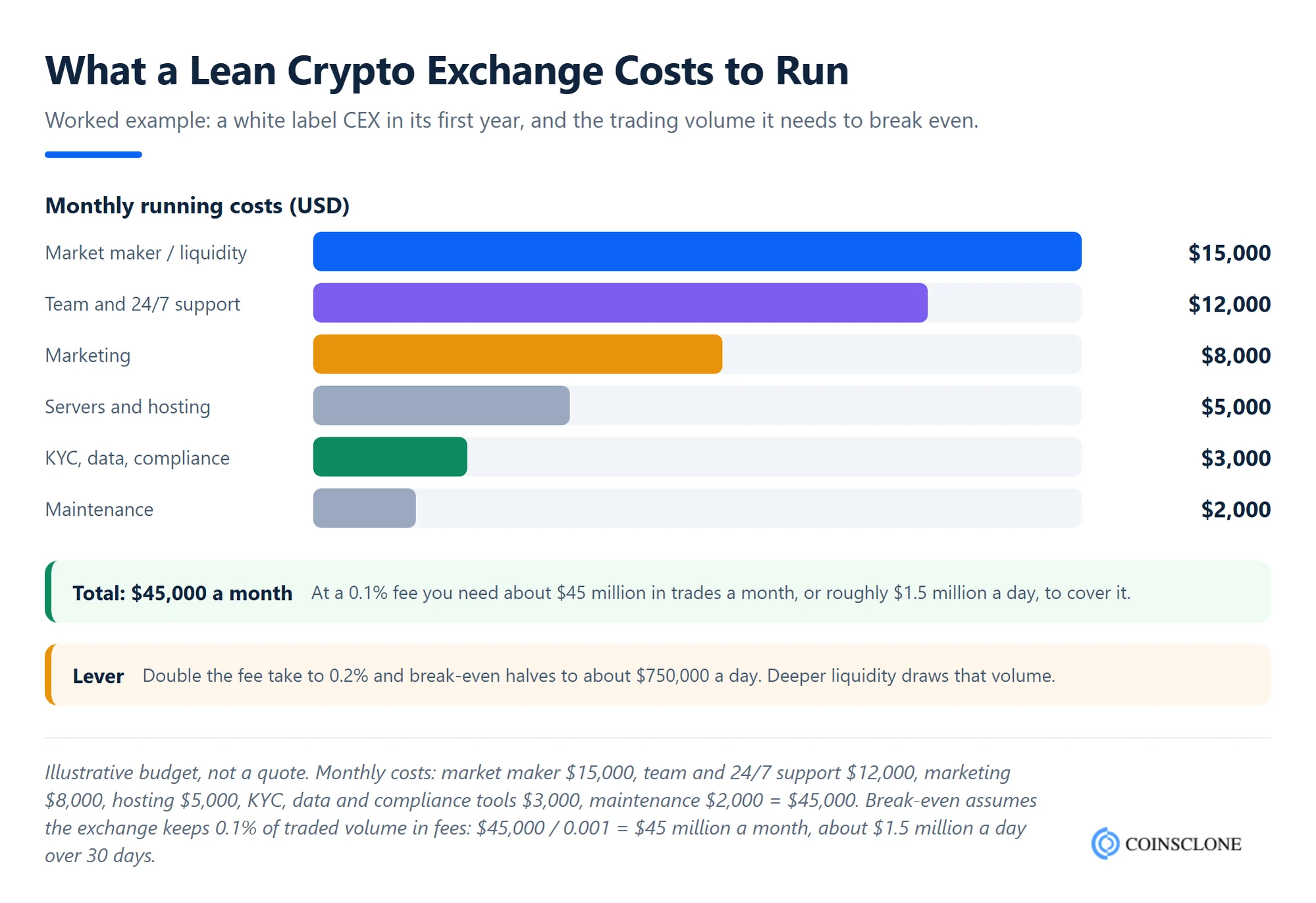
In short, a lean exchange that spends about $45,000 a month needs roughly $45 million in monthly trades, or about $1.5 million a day, to break even at a 0.1% fee. That is why liquidity and marketing matter as much as code.
Why Start A Crypto Exchange in 2026?
With the costs in view, is it still worth it? For many founders the answer is yes, for these reasons.
Growing Market Demand and User Adoption
Trading volume is huge and steady. The top 10 centralized exchanges handled $2.70 trillion in spot trades in Q1 2026 and $1.95 trillion in Q2, while the top 10 perpetual futures exchanges handled $12.7 trillion in Q2, per CoinGecko. Even in a slower quarter, that is a deep pool of fee income.
Multiple Revenue Streams
Exchanges can earn in many ways: trading fees, listing fees, withdrawal fees, staking, margin interest, launchpad fees and premium API plans. So you are not tied to a single income source.
Expansion of Web3 & Digital Assets
Tokenized real world assets, stablecoins and cross-chain trading are creating new markets. Exchanges that list these assets early can stand out from the big players.
Institutional Adoption & Regulatory Progress
Clear rules such as MiCA in the EU, VARA in Dubai and the new UK regime give firms the confidence to enter. That creates demand for licensed, secure exchanges with strong compliance.
Long-term Business Value
Once your exchange is live, you can add wallets, a launchpad, an NFT marketplace or tokenization services. Each one reuses your users and your tech, so the platform grows in value over time.
How to Reduce Crypto Exchange Development Cost: Practical Tips From Coinsclone!
Based on the exchanges we have delivered, here are proven ways to cut your crypto exchange development cost without cutting safety:
Start with an MVP approach: Launch the core features first on white label or clone script software. Then add custom features once real users show you what they want. This is the single biggest saving, often a large share of the build cost.
Choose the right exchange model: Pick the model (CEX, DEX, P2P or OTC) that fits your users. This stops you from paying for features your market does not need.
Use pre-built modules and APIs: Rent liquidity, payments and KYC from trusted providers instead of building them. This saves months of work.
Pick a cost-effective team: A skilled team in India or Eastern Europe can charge half or less of what some Western teams charge, as long as it has real exchange experience.
Plan licensing before you build: Choose your market and license first. Then your tech is built to meet those rules from day one, and you avoid costly rework.
Never skip the security audit: Cutting the audit to launch sooner is the most expensive mistake an exchange can make.
Still unsure where to start, which model to choose or how to set your budget? That is where the right development partner helps. One such partner is Coinsclone.
Connect with Coinsclone to Create Crypto exchange Cost-effectively!
Coinsclone has built blockchain products since 2018, with 350+ platforms delivered for 200+ clients across 20 industries. As a cryptocurrency exchange development company, Coinsclone helps startups and businesses launch white label or custom exchanges that fit their budget, model and market. Instead of a one-size-fits-all package, we help you make clear technical and money decisions at each stage.
With Coinsclone, you can:
- Launch a white label exchange in 4 to 6 weeks, or 7 to 10 weeks with fiat rails
- Keep build costs low without cutting security
- Add modules such as P2P, margin trading, staking or a launchpad when you are ready
- Grow on an architecture built to scale
If you want a crypto exchange with a clear cost plan and roadmap, talk to Coinsclone for a free quote based on your features and market.
Frequently Asked Questions
How much does it cost to make a crypto exchange?
A white label crypto exchange costs about $15,000 to $60,000. A custom MVP costs about $100,000 to $200,000, and a full custom exchange costs $250,000 to $500,000 or more. On top of the build, plan for license, liquidity, hosting and marketing costs.
How long does it take to build a crypto exchange?
A white label exchange takes about 4 to 6 weeks, 7 to 10 weeks with fiat rails and 9 to 13 weeks with mobile apps. A custom MVP takes 6 to 9 months, and a full custom exchange takes 9 to 14 months or more.
How much is a crypto license?
It depends on the country. FinCEN registration in the US is free, but most states need their own license. The New York BitLicense has a $5,000 application fee. Dubai’s VARA charges AED 100,000 to apply and AED 200,000 a year. The UK FCA charges £28,150 to apply to run a trading platform. In the EU, MiCA requires €125,000 to €150,000 in own funds. Legal and compliance work often costs more than the fee itself.
How do I get a crypto exchange license?
Pick your target market, set up a local company, then prepare your business plan, AML and KYC policies, security plans and proof of capital. Next, apply to the regulator, answer its questions and pass its checks. The process takes a few months in light-touch markets and a year or more in strict ones.
What is crypto exchange development?
Crypto exchange development is the process of building a platform where users can buy, sell and swap crypto. It covers the matching engine, wallets, user and admin panels, KYC, liquidity links, security and apps. You can build it from scratch or start from white label software.
Is a white label exchange cheaper than building from scratch?
Yes. White label software costs a fraction of a custom build and goes live in weeks instead of months, because the engine, wallets and panels are already built and tested. You can still add custom features later.
What are the ongoing costs of running a crypto exchange?
Plan for hosting, maintenance, market making, KYC checks, audits, compliance renewals, support staff and marketing. A lean exchange can run on about $30,000 to $60,000 a month, while large platforms spend far more.
Final Thoughts!
Building a crypto exchange in 2026 is a strong business idea, but it needs a clear plan and a realistic budget. Start with the build path that fits your money and time, pick your license early, and keep enough cash for liquidity and marketing. With the right development partner, you can launch fast, stay safe and grow your exchange step by step.
See How to Cut Your Crypto Exchange Development Cost by Up to 90%
Crypto Exchange Development — done smarter.
- MVP System : Launch your Binance-like exchange at a fraction of the usual cost.
- Liquidity & Wallets : Pre-built, secure modules — save thousands in development.
- Brand & Customization : Your logo, tokens, and UI — no extra coding fees.
- Revenue Engine : Start earning from trading fees, listings, and staking — fast.
Get a full cost breakdown and a free branded demo of your exchange — delivered in 48 hours.
Book a Free Demo to discover how our Crypto Exchange can take you from idea to live exchange in just 8 – 12 weeks — with 10x lower development costs.