

How long does it take to develop a cryptocurrency exchange? In 2026, a white label exchange can go live in 4 to 6 weeks, while a custom exchange built from scratch takes 6 to 14 months. The crypto exchange development timeline depends on the build path, the type of exchange, the features you want and, most of all, the license you need before you can open to users.
This guide shows where that time goes, so you can set a launch date you can trust. You will see the weeks for each build path and each type of exchange, the work in each phase, how long licenses take, what causes delays and how to launch faster without cutting corners on security.
In this guide:
- Time by build path: white label, clone script, custom MVP and full custom, side by side.
- Time by exchange type: CEX, DEX, P2P, OTC and hybrid exchanges.
- Phase by phase: what happens in each stage, from planning to launch day.
- License clocks: how long EU and UK regulators take to decide, and why the license often sets your real launch date.
- Speed tips: the common delays and how to avoid them.
Crypto Exchange Development Timeline
The crypto exchange development timeline runs from about 4 weeks to 14 months. White label software is the fastest route, because the trading engine, wallets and admin panel are already built and tested. A custom build is the slowest, because every part is designed, coded and tested from the ground up.
Here is the short answer by build path:
- White label exchange: 4 to 6 weeks, 7 to 10 weeks with fiat payment rails, and 9 to 13 weeks with mobile apps.
- Custom MVP: 6 to 9 months for a small exchange with the core features.
- Full custom exchange: 9 to 14 months for your own matching engine, advanced trading and apps.
- Large, multi-region platform: 12 months or more.
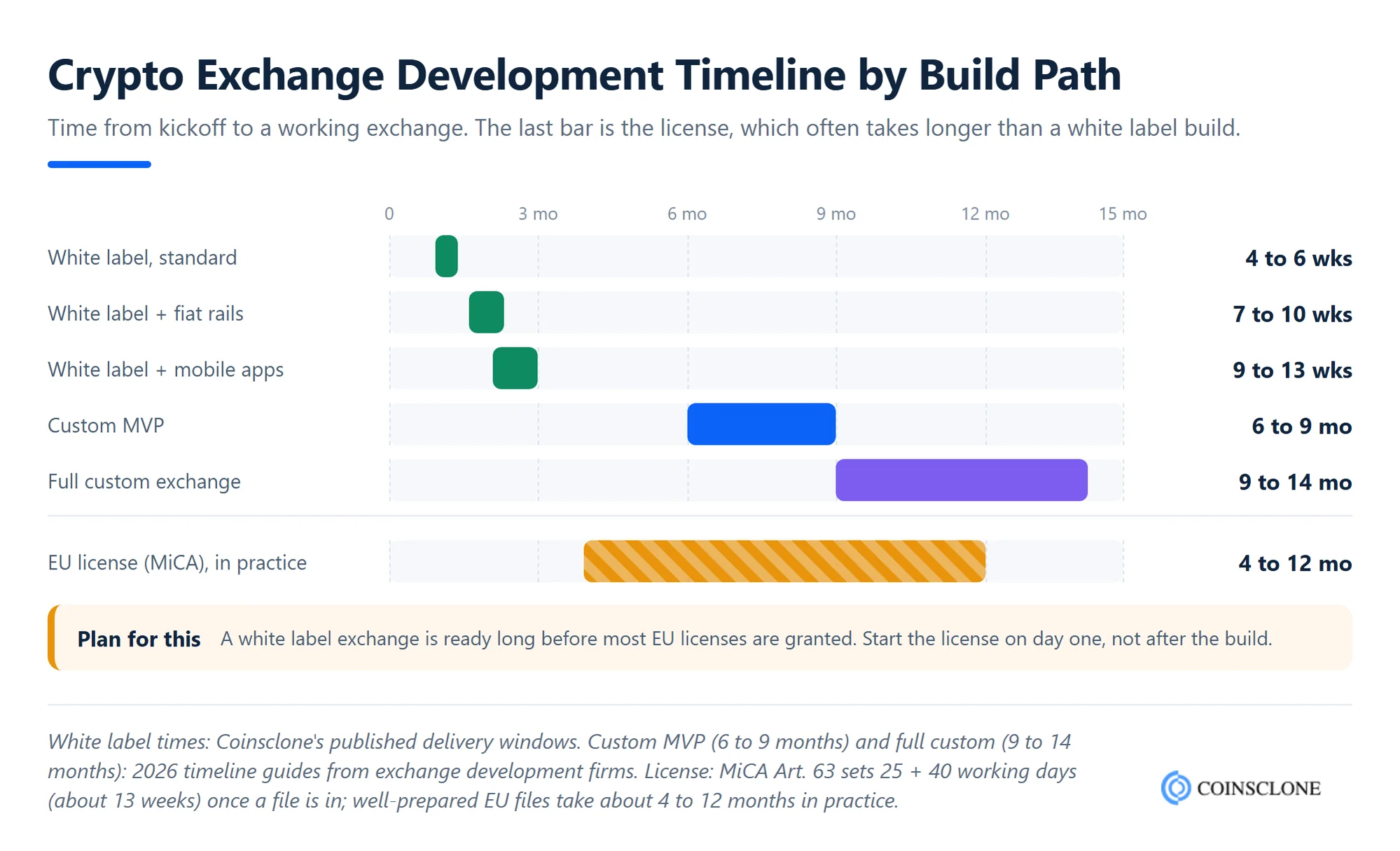
Keep one thing in mind as you plan. The code is often not the slowest part. If you serve a regulated market, the license can take longer than the build itself, so smart teams run both at the same time.
Time to Build a Cryptocurrency Exchange — Faster Than Ever!
Build your own crypto exchange in record time. From idea to live platform — in just 8-12 weeks.
- Rapid Launch: Go live 90% faster with our MVP system
- Plug & Play Modules: Wallets, trading, and liquidity prebuilt
- Custom Branding : Your logo, your tokens & Trading pairs
- Revenue-Ready : Start earning from trades, listings, and fees
See your exchange demo — free and branded — in 48 hours.
Book a Free Demo and discover how fast your exchange can go from concept to reality.
Overview of Cryptocurrency Exchange
A cryptocurrency exchange is an online platform where users buy, sell and trade digital assets such as Bitcoin and Ether. It connects buyers and sellers, holds or routes their funds and settles each trade, much like a stock exchange does for shares. Every exchange does the same basic job, yet each type is built in a very different way. That is why the type you pick has a direct effect on the time it takes to create a cryptocurrency exchange. The three main types are:
- Centralized exchanges (CEX): A company runs the platform and manages user accounts, funds and trades. Binance and Coinbase are examples. The build time is moderate to long, because a CEX needs custody, KYC and a fast matching engine.
- Decentralized exchanges (DEX): Smart contracts settle trades on the blockchain, and users keep control of their own funds. Uniswap is one example. The build time varies widely with the chain, the features and the smart contract audit.
- Hybrid exchanges: These mix the speed of a CEX with the self-custody of a DEX. The build time is usually the longest, because the team builds two systems and joins them.
Most exchanges, whatever the type, share the same core parts: user accounts, wallets, an order book or liquidity pools, a trading engine and an admin panel. So it helps to know the platform structure before you guess how long yours will take.
The business side is simple. The exchange earns a small fee on every trade, plus listing and withdrawal fees. That steady income is why so many startups want to build their own crypto exchange website and app.
Now, here comes the main question.
Is there Any Exact Time for Launching a Cryptocurrency Exchange?
The short answer is no. There is no single, fixed time to launch a cryptocurrency exchange.
The time depends on the type of exchange, the features you need, how much you customize and the build route you choose. Still, most projects fall into one of three routes.
White Label Exchange or Clone Script: 4 to 13 Weeks
A white label crypto exchange software is a ready-made exchange that carries your brand, your coin list and your fee settings. It already includes the trading engine, user panel, admin panel, wallets and security tools, so the team mainly sets it up, brands it and connects it to your partners. A crypto exchange clone script works the same way, but it copies the features of a known exchange such as Binance or Coinbase.
A standard launch takes 4 to 6 weeks. Adding fiat payment rails, so users can deposit and withdraw local money, takes it to 7 to 10 weeks. Adding iOS and Android apps takes it to 9 to 13 weeks.
This is the fastest route for startups that want to:
- Enter the market quickly
- Test their idea with a smaller budget
- Avoid the risk of building a trading engine from scratch
Custom MVP: 6 to 9 Months
A custom MVP (minimum viable product) is a small exchange built around your own idea. It has the core parts only: sign up, KYC, wallets, an order book, a matching engine and an admin panel. Choose this route when your model needs something white label software cannot do, such as a new kind of market.
This route suits:
- Founders with a new trading model
- Teams that want to own the code from day one
- Startups that can wait a few months longer to launch
Full Custom Exchange: 9 to 14 Months
A full custom build means you design every part yourself: the matching engine, margin or futures trading, mobile apps, deep security and many third-party links. Large platforms that serve several regions can take 12 months or more.
This route suits:
- Large, funded businesses
- Exchanges aiming at high-volume markets
- Platforms that need derivatives, staking or multi-chain support from launch
Custom time ranges reflect 2026 price and timeline guides published by exchange development firms. White label times are Coinsclone’s published delivery windows.
But why don’t timelines look the same for every project? Because every exchange has its own mix of type, features and rules. The table below shows how much the type alone changes the plan.
Crypto Exchange Development Timeline by Exchange Type
Each type of exchange has its own core parts, so each one takes a different amount of time. Here is how long each type takes with white label software and with a custom build:
| Exchange type | White label launch | Custom build | What takes the most time |
| Centralized exchange (CEX) | 4 to 13 weeks | 9 to 14 months | Matching engine, custody, KYC, license |
| Decentralized exchange (DEX) | 5 to 7 weeks (10 to 14 for a standard build) | 4 to 6 months | Smart contracts and the outside audit |
| P2P exchange | 4 to 8 weeks (8 to 12 for a standard build) | 12 to 16 weeks or more | Escrow, disputes and payment methods |
| OTC exchange | Varies with scope | 4 to 6 months | Quote desk, large-trade settlement, compliance |
| Hybrid exchange | Varies with scope | 10 to 16 months | Joining an off-chain engine to on-chain settlement |
White label and standard times: Coinsclone’s published delivery windows. Custom times: 2026 timeline guides from exchange development firms.
A few points stand out. A DEX skips custody and KYC, so its build can be quick, yet the smart contract audit can add weeks. A P2P exchange is fast to launch because buyers and sellers trade with each other, while the platform only holds the escrow. A hybrid exchange takes the longest, because the team builds two systems and makes them work as one.
Factors that Influence the Time to Build a Cryptocurrency Exchange Platform
Building a crypto exchange is not a one-size-fits-all job. The total time depends on several technical, business and legal factors. Once you know them, you can set fair goals and pick the right route for your business.
Choice of Crypto Exchange Type
The first step is choosing the type of exchange. As the table above shows, there are three main types of crypto exchanges: CEX, DEX and hybrid, plus P2P and OTC models. Each type has its own core parts, so each one has its own timeline. A simple spot CEX or a P2P platform is quick to launch. A hybrid or derivatives exchange takes much longer.
Development Approach
Next is the way you build. You can build from scratch or start from white label software. A custom build takes months, while white label software is the fastest way to launch. Many founders start with white label, prove demand and then add custom features in later releases.
Features & Complexity
The more features you add, the longer the build takes. As a rule, each major feature adds a few weeks of design, code and testing. These features take the most time:
- Advanced trading, such as margin, futures and staking
- Support for many coins and many blockchains
- High-frequency trading (HFT) support
- Admin dashboards with many roles and levels
- Automated market making (AMM) for DEX platforms
Unique features help you stand out. So pick the few that matter most for launch, and plan the rest for later releases.
Choice of Technology Stack
The frameworks, coding languages and blockchains you choose also change the timeline. They affect speed, how easy it is to hire developers and how long testing takes.
For example, a DEX on Ethereum or BNB Chain is faster to build because there are proven tools and code libraries. A DEX on a newer chain may need more custom work.
Legal Rules and Licensing
Every country has its own rules for crypto. So before you build, study the rules in each market you plan to serve, and work with a legal expert. This is often the step that sets your real launch date, because a license can take longer than the software. We cover the license clocks in detail below.
Liquidity, Banking and Fiat Rails
A new exchange has no traders yet, so it needs outside liquidity from day one. Most startups connect to other exchanges or crypto liquidity providers through an API. Signing a market maker, opening a bank account and setting up card or bank transfer rails each need contracts and checks on your company. Start these early, because partners run their own reviews and you cannot rush them.
Security and Audits
Security work is the one place you should never save time. In 2025, hackers stole more than $3.4 billion in crypto, and the February attack on Bybit alone took about $1.5 billion, Chainalysis reports. So plan time for cold storage, multi-signature or MPC wallets, an outside security audit and a penetration test. If the audit finds issues, you also need time to fix them and test again.
These are the main factors that shape your launch date. Location, third-party tools and any extra security layers can add more time. On the whole, there is no single timeline for every exchange, but you can predict yours once these choices are made.
How Long Does a Crypto Exchange License Take?
For many founders, the license is the longest task on the plan. The software can be ready in weeks, but you cannot open to users in a regulated market until the regulator says yes. Here are the clocks in two of the biggest markets:
- European Union (MiCA): Under Article 63 of MiCA, the national regulator has 25 working days to check that your file is complete, then 40 working days to decide. It can pause the clock for up to 20 working days to ask for more details. In practice, a well-prepared file takes about 4 to 12 months. The MiCA transition period ended on 1 July 2026, so firms serving the EU now need full approval.
- United Kingdom (FCA): The FCA opened its crypto gateway on 30 September 2026. The application window closes on 28 February 2027, and the new rules start on 25 October 2027. The FCA expects to decide applications sent in the window before the rules start.
Other markets have their own steps. In the US, an exchange registers with FinCEN and then needs licenses state by state. In Dubai, VARA licenses exchanges in stages. Each one has its own fees, which our guide to crypto exchange development cost lists by country.
The good news is that you do not have to wait for the license to start building. The smart move is to run both tracks side by side:
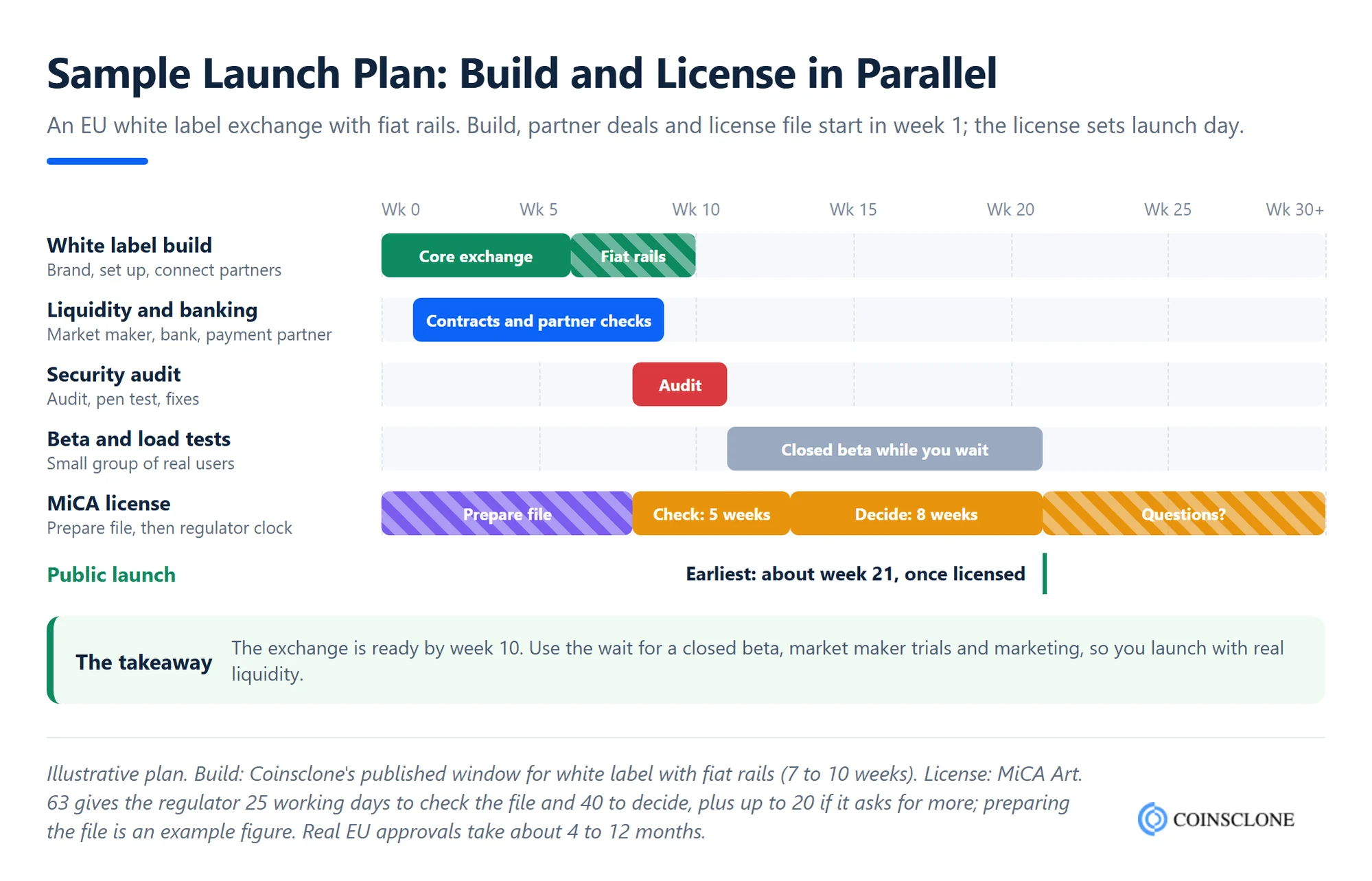
In this plan, the exchange is ready in about 10 weeks, but launch waits for the license. That spare time is not wasted. Use it for a closed beta, load tests, market maker trials and marketing. If Europe is your target, our guide on launching a MiCA-compliant crypto exchange in the EU walks through each step.
Phase-by-Phase Timeline Breakdown for Crypto Exchange Development
Every exchange project goes through the same six phases. The difference is how long each phase takes. With white label software, most of the hard work is already done, so the phases move fast. With a custom build, each phase is real design and coding work.
| Phase | White label (standard) | Custom MVP | What happens |
| 1. Planning and requirements | Up to 1 week | 2 to 4 weeks | Pick the type, features, coins, markets and partners |
| 2. UI/UX design | 1 to 2 weeks (branding) | 3 to 6 weeks | Brand the screens, or design them from scratch |
| 3. Back end and trading engine | Already built | 10 to 14 weeks | Matching engine, wallets, accounts, admin panel |
| 4. Integrations and APIs | 1 to 2 weeks (3 to 4 more for fiat rails) | 4 to 6 weeks | KYC, liquidity, price feeds, payment rails |
| 5. Testing, QA and security audit | About 1 week | 4 to 6 weeks | Functional tests, load tests, audit and fixes |
| 6. Deployment and launch | A few days | 1 to 2 weeks | Move to live servers, final checks, go live |
| Total | 4 to 6 weeks | About 6 to 9 months |
Indicative split of each route’s total time. White label total: Coinsclone’s published delivery window. Custom MVP total: 2026 timeline guides from exchange development firms.
A few notes on the phases:
- Planning: A strong plan cuts rework later. Most delays start with features that were never agreed at the start.
- Design: Custom design often needs several review rounds, so plan for feedback time.
- Back end: Margin, P2P or futures trading can stretch this phase by weeks or months.
- Integrations: Each outside service must be set up, tested and tuned. Fiat rails take the longest, because the bank or payment partner checks your company first.
- Testing: This is one of the most important phases. Never shorten it to hit a date.
- Launch: Many teams open to a small group first, fix any issues and then open to everyone.
What Slows Crypto Exchange Development Down?
Most delays have nothing to do with code. These are the most common reasons a launch slips:
- Changing scope: New features added mid-build push every later phase back.
- License delays: The regulator asks for more details, and the clock pauses until you reply.
- Banking and fiat partners: Banks and payment firms run their own checks on crypto businesses, which can take weeks.
- Liquidity deals: Without a market maker, order books look empty on day one, so launch waits for that contract.
- Audit findings: Every issue the auditor finds must be fixed and tested again.
- App store review: Apple only allows crypto exchange apps in regions where the app holds the right licenses, under its App Review Guidelines. So the app release follows the license.
Tips to Speed Up Cryptocurrency Exchange Development
With the right plan, you can shorten the build and launch much faster, without losing quality or security.
- Start from white label software: The engine, wallets and panels are ready, which saves months.
- Agree on your requirements on day one: A clear, signed scope stops costly rework.
- Keep your MVP lean: Launch with the features users need most, then add more in later releases.
- Pick a team with real exchange work behind it: An experienced team avoids the mistakes that cause rework.
- Use tested security and compliance tools: Proven KYC, AML and wallet tools save weeks of building and testing.
- Start the license and partner deals early: Run them side by side with the build, not after it.
- Build to scale from the start: A sound design saves a rebuild when trading volume grows.
Keep these tips in mind and you can start your project with confidence. Still unsure about your timeline?
Then the simplest step is to get advice from a cryptocurrency exchange development company. A team with its own tested software and skilled developers can help you launch your exchange as soon as possible. One such company is Coinsclone.
You may wonder…
How Long Does Coinsclone Take To Build Your Crypto Exchange?
When it comes to launching a crypto exchange quickly, Coinsclone is one of the most trusted partners in the industry. Since 2018, the team has delivered 350+ platforms for 200+ clients across 20 industries. Its ready-made, tested exchange software lets it deliver in far less time than a team starting from zero.
Here is how long Coinsclone typically takes, based on the route you choose:
- White label crypto exchange: A branded exchange on Coinsclone’s tested, secure software. Delivery time: 4 to 6 weeks.
- White label with fiat rails: The same exchange with local currency deposits and withdrawals. Delivery time: 7 to 10 weeks.
- White label with mobile apps: The exchange plus iOS and Android trading apps. Delivery time: 9 to 13 weeks.
- P2P and DEX exchanges: A white label P2P exchange takes 4 to 8 weeks, and a white label DEX takes 5 to 7 weeks.
- Custom exchange from scratch: For startups that want fully tailor-made features, Coinsclone also offers custom builds. The timeline depends on your scope and is agreed after a planning session.
In short, Coinsclone pairs ready-made software with an expert team, so you get a fast, secure and stable launch whichever route you choose. Want to see it in action? Contact the team for a live demo of a working crypto exchange, and judge the product for yourself.
Final Thoughts
So, how long does it take to develop a cryptocurrency exchange? Anywhere from 4 weeks to more than a year. The build path sets most of the build time, while the license often sets the launch date. Pick your route early, start the license and partner deals on day one, and keep your first release lean. With the right team, you can launch fast and still launch safely.
Time to Build a Cryptocurrency Exchange — Faster Than Ever!
Build your own crypto exchange in record time. From idea to live platform — in just 8-12 weeks.
- Rapid Launch: Go live 90% faster with our MVP system
- Plug & Play Modules: Wallets, trading, and liquidity prebuilt
- Custom Branding : Your logo, your tokens & Trading pairs
- Revenue-Ready : Start earning from trades, listings, and fees
See your exchange demo — free and branded — in 48 hours.
Book a Free Demo and discover how fast your exchange can go from concept to reality.
Frequently Asked Questions
How long does it take to build a crypto exchange?
A white label exchange takes about 4 to 6 weeks, 7 to 10 weeks with fiat rails and 9 to 13 weeks with mobile apps. A custom MVP takes 6 to 9 months, and a full custom exchange takes 9 to 14 months or more.
How long does it take to build a crypto exchange from scratch?
A crypto exchange built from scratch takes about 6 to 9 months for a small MVP and 9 to 14 months for a full platform with advanced trading and apps. Large, multi-region exchanges can take more than a year.
How quickly can I launch a white label crypto exchange?
A standard white label crypto exchange can launch in 4 to 6 weeks. Fiat payment rails add a few weeks, and mobile apps take the total to about 9 to 13 weeks. Your license may still set the date you can open to users.
What slows down crypto exchange development the most?
The license and outside partners slow most projects down, not the code. Regulator questions, bank checks, market maker contracts and audit fixes all add time. Changing the scope in the middle of the build is the other big cause of delays.
Is it faster to use a crypto exchange script?
Yes. A crypto exchange script or white label platform already has the trading engine, wallets and admin panel built and tested. So the team only brands it, sets it up and connects partners, which takes weeks instead of months.
Can I build a decentralized exchange faster than a centralized one?
Often, yes. A DEX does not need custody, a central order book or KYC for every user, so a white label DEX can launch in about 5 to 7 weeks. However, the smart contract audit can add time, and a custom DEX still takes about 4 to 6 months.
Do you need a license to launch a crypto exchange?
In most markets, yes. The EU requires a MiCA license, the UK requires FCA approval and most US states require a money transmitter license. Under MiCA, the regulator has 25 working days to check your file and 40 more to decide, but real approvals often take 4 to 12 months.