
Have you ever tried to send tokens and had the transfer fail because you had no ETH for gas? ERC865 token development set out to fix this. ERC865 is an Ethereum proposal from February 2018 that lets users pay the transfer fee in the token itself, while a third party pays the ETH. The idea was strong, but ERC865 was never finished. It never became a numbered EIP, and its proposal was closed in May 2022.
This guide gives you the honest picture. You will learn how ERC865 worked, where its design falls short, and which final standards now deliver gasless transfers. You will also see the token types, use cases, risks, build steps and costs, so you can plan a gasless token that wallets, exchanges and auditors will accept.
In this guide:
- What ERC865 is, and its real status in 2026 (an old proposal, not an adopted standard)
- How a pre-signed ERC865 transfer works, with a worked example
- The standards that do the job today: ERC-2612 permit, ERC-3009 (used by USDC), ERC-2771, ERC-4337 and EIP-7702
- A simple decision tree to pick the right gasless setup for your token
- The risks, the build process and real cost ranges
See How Our Advanced ERC865 Framework Can Simplify Your Token Launch
ERC865 Token Development — done right.
- Gasless Transactions : Let users pay fees in your token, not ETH.
- Smart Contract Efficiency : Reduce transaction costs and boost scalability.
- Custom Token Features : Build tokens with advanced permissions, staking, and utility options.
- Faster Deployment : Ready-to-launch ERC865 solutions built for your business needs.
See a live demo of your ERC865 token — ready in 48 hours.
Book a Free Demo to discover how our ERC865 Token Development Company can take you from concept to live token in just 2–4 weeks.
What Is ERC865 Token Development?
ERC865 token development is the process of building an Ethereum token that lets users send tokens without holding ETH. The user signs a transfer off the chain and adds a small fee in the same token. Then a third party, called a delegate or relayer, sends that signed message to the token contract and pays the ETH gas. Finally, the contract moves the tokens to the receiver and pays the fee to the relayer.
In 2026, however, the work looks different from 2018. A good ERC865 token development company no longer copies the old ERC865 code. Instead, it builds the same gasless flow on final standards, such as ERC-2612 permits and ERC-4337 paymasters, which wallets, code kits and auditors now support. In short, you keep the ERC865 goal and drop the ERC865 risks.
ERC865 Status in 2026: An Old Proposal, Not a Standard
The facts are clear when you check the primary sources:
- Proposed: Ludovic Galabru opened ERC865 as issue #865 on the EIPs GitHub page on 1 Feb 2018. Its title was “Pay transfers in tokens instead of gas, in one transaction.”
- Never numbered: It never became an EIP file. The page eips.ethereum.org/EIPS/eip-865 returns “page not found” (checked 16 October 2026), so ERC865 has no Draft, Review or Final status at all.
- Library code dropped: A request to add ERC865 to the OpenZeppelin code library, opened 14 Feb 2018, was closed unmerged on 28 Feb 2019 because it had gone stale.
- Closed: An EIPs editor closed the issue on 28 May 2022 for lack of activity and pointed authors to the formal EIP process.
- Audit findings: In a 2019 audit of the Props token, OpenZeppelin found that the ERC865 code did not match the spec, had a signature flaw and could lock fees inside the contract.
So ERC865 is part of Ethereum’s history, not a live standard. Its idea did not die, though. Gasless transfers are now common, and they run on standards that went through the full review process.
How an ERC865 Gasless Transfer Works
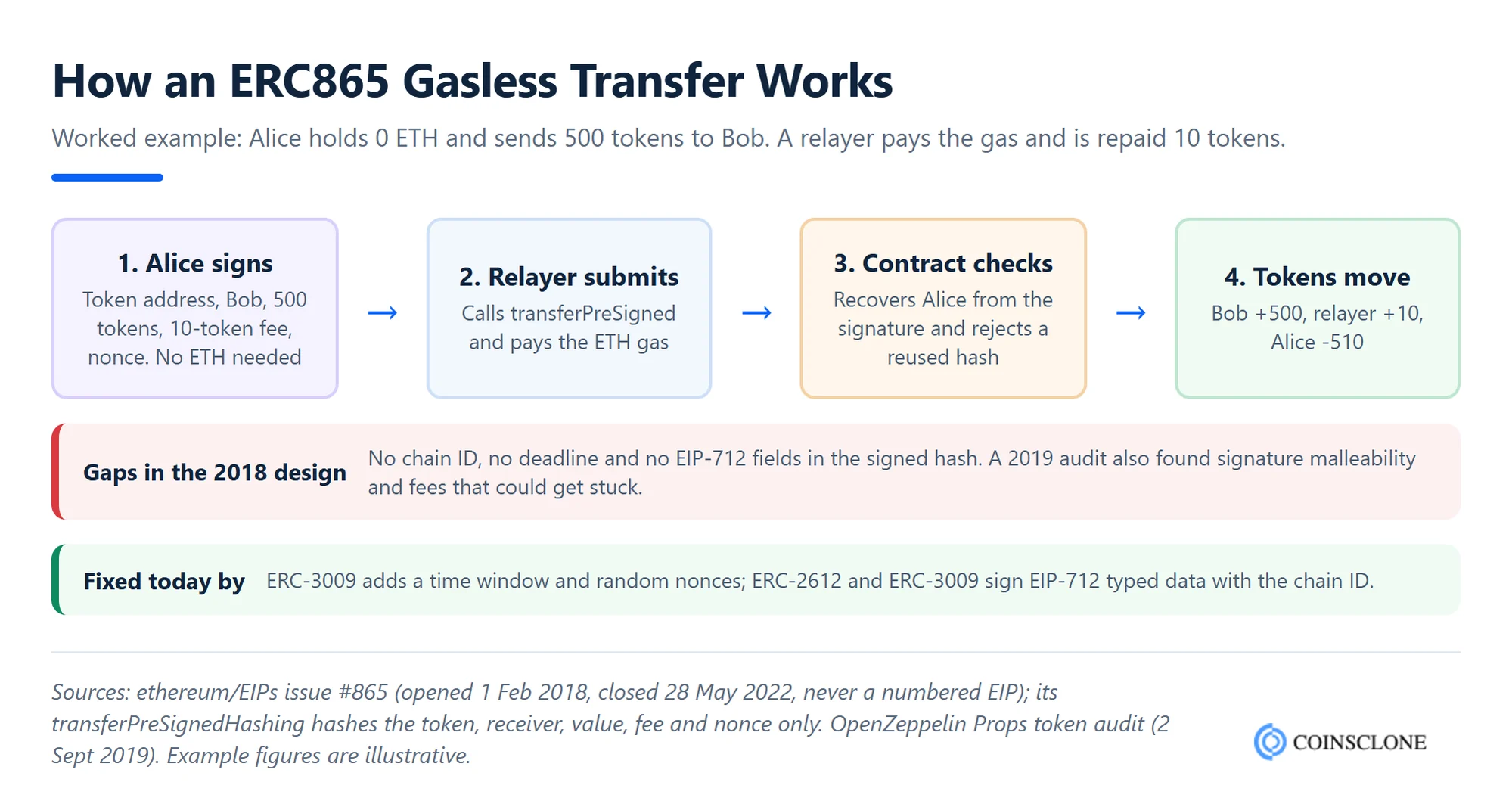
ERC865 added one main function to ERC-20, called `transferPreSigned`. Here is the flow with simple numbers:
- Alice signs: Alice wants to send 500 tokens to Bob, but she holds no ETH. Her wallet signs a message with the token address, Bob’s address, 500 tokens, a 10-token fee and a nonce.
- Relayer submits: A relayer picks up the signed message and calls `transferPreSigned` on the token contract. The relayer pays the ETH gas.
- Contract checks: The contract works out Alice’s address from the signature and rejects any message it has seen before.
- Tokens move: Bob gets 500 tokens, the relayer gets 10 tokens, and Alice’s balance drops by 510. She never needed ETH.
The flow is simple, which is why the idea spread. However, the signed message had gaps that later standards closed:
- No chain ID: The signed hash left out the chain ID. As a result, a signature could be replayed on a chain fork, or on a copy of the contract at the same address on another chain.
- No deadline: A signed transfer stayed valid until someone used it. A relayer could hold it and send it much later.
- No readable signing: The proposal hashed raw values instead of using EIP-712 typed data. So wallets showed users a hash, not clear fields they could check.
- Relayer pricing: The relayer pays in ETH but earns your token. If the token price falls, relayers lose money and stop serving users.
ERC865 vs the Gasless Standards Used Today
Five standards now cover what ERC865 tried to do. Some handle approvals, some handle transfers, and some sponsor any action. Here is how they compare:
| Standard | What it does | Who pays the ETH gas | Status (eips.ethereum.org, 16 Oct 2026) |
| ERC865 | Pre-signed transfer with a fee in tokens | A relayer, repaid in the token | Never an EIP (closed issue) |
| ERC-2612 | `permit`: signed approvals for ERC-20 tokens | Whoever submits the permit, often the dApp | Final |
| ERC-3009 | `transferWithAuthorization`: one signed, time-limited transfer | A relayer or payment facilitator | Draft (used by USDC) |
| ERC-2771 | Meta-transactions through a trusted forwarder | A relayer | Final |
| ERC-4337 | Smart accounts with paymasters that sponsor gas or take tokens | A paymaster | Final |
| EIP-7702 | Lets a normal wallet run smart account code | A sponsor or paymaster | Final, live since 7 May 2025 |
ERC-2612 Permit
ERC-2612 (Final, created April 2020) adds a `permit` function to ERC-20 tokens. Users sign an EIP-712 message instead of sending a paid `approve` transaction. The dApp or a relayer then submits the permit and spends the tokens in one transaction. Note that permit covers approvals only, so you pair it with a relayer or a contract that takes the fee in tokens. For older tokens without permit, Uniswap’s Permit2 contract gives the same signed approvals. Our guide to ERC712 token development explains how these signatures work.
ERC-3009 Transfer With Authorization (Used by USDC)
ERC-3009 is the closest heir to ERC865. The holder signs a one-time transfer to a set receiver, valid only inside a time window. A relayer submits it with `transferWithAuthorization`, and no allowance is left behind. It also uses random nonces, so a user can have many signed transfers open at once.
The proposal is still a Draft on eips.ethereum.org, yet USDC supports it. Circle’s guide to authorizing USDC (updated April 2026) lists it next to approve, permit and Permit2. Circle also advises `receiveWithAuthorization` when a contract pulls the funds, since it blocks front-running. In addition, the x402 payment protocol uses it to settle USDC payments, with the facilitator paying the gas. So the method is proven in USDC, but you should not call ERC-3009 a finished standard.
ERC-2771 Meta-Transactions
ERC-2771 (Final, created July 2020) lets a contract accept calls through a trusted forwarder. The user signs a request, a relayer sends it to the forwarder, and the contract reads the real sender from the end of the call data. OpenZeppelin ships `ERC2771Context` and `ERC2771Forwarder` for this.
Be careful with how you combine it, though. In December 2023, OpenZeppelin disclosed a flaw: when `ERC2771Context` and Multicall were used together, attackers could pose as any sender. It was patched in versions 4.9.4 and 5.0.1.
ERC-4337 Paymasters
ERC-4337 (Final, created September 2021) brings smart contract accounts without a change to Ethereum’s core rules. A paymaster contract can pay the gas for users, or accept an ERC-20 token instead of ETH. This is the ERC865 idea applied to any action, not just transfers.
For example, Circle Paymaster lets users pay gas in USDC on seven networks, Ethereum and Base among them. It adds a 10% gas surcharge on Arbitrum and Base, and it needs no API key.
EIP-7702 Smart Wallets
EIP-7702 went live in Ethereum’s Pectra upgrade on 7 May 2025. It lets a normal wallet address run smart account code. As a result, users keep their address and still get sponsored gas and batched calls through ERC-4337 tools. For a token team, this means gasless flows now reach existing wallet addresses, not just new smart wallets.
Which Gasless Standard Should You Use Instead of ERC865?
Start with what you control. If you are launching a new token, the token contract itself can carry the gasless logic. If you are building an app around tokens you do not own, the wallet layer must do the work instead.
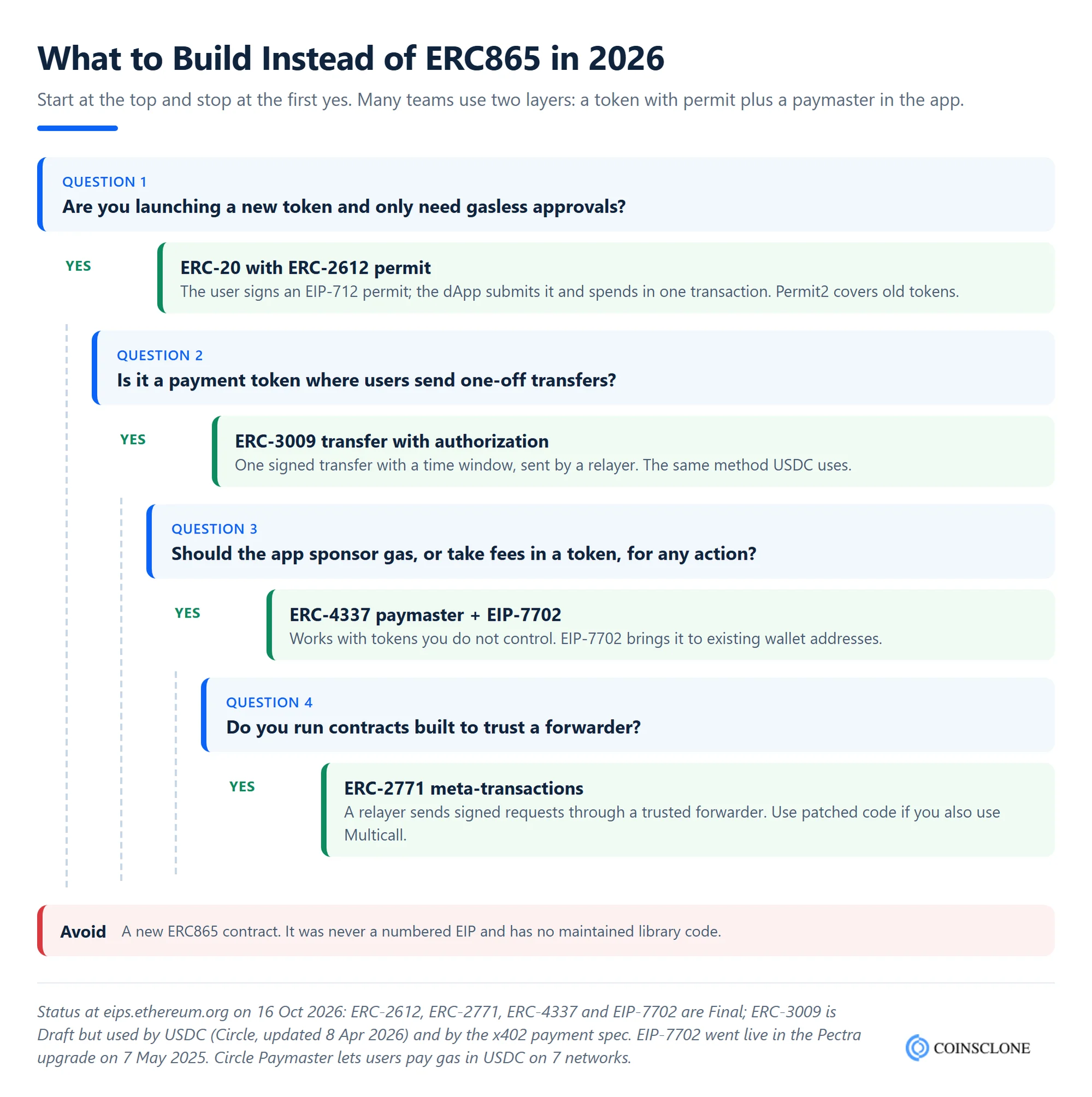
In practice, many teams combine two layers. For example, a payment token can ship with permit and ERC-3009 functions, while the app uses an ERC-4337 paymaster so new users can act without ETH. Coinsclone builds these setups through our Ethereum token development services, from the token contract to the gas payer.
Types of ERC865-Style Gasless Tokens We Develop
At Coinsclone, we build different types of gasless tokens for different needs.
- Utility token: We create utility tokens that unlock platforms, services and premium features. Users sign actions and the app covers gas, so the first visit feels easy.
- Payment token: We build payment tokens with permit and signed transfer functions. Users pay without holding ETH, and a relayer or paymaster handles the gas.
- Governance token: We build voting tokens that let holders decide on changes to the protocol. Votes can be signed off the chain, so taking part costs nothing.
- Security token: We build security tokens with transfer rules for asset sales that must follow the law. Signed transfers still pass the same identity and compliance checks.
Our Token Development Approaches
Every client is unique in their needs, goals and reasons to create a gasless token. To meet those needs, we offer two approaches.
Development from Scratch
We build your gasless token from the ground up, with the token logic, utility and scale you need. Our team designs the contract, the signing flow and the relayer or paymaster setup, then tests and deploys it with full support. This approach suits you if you want a long-term, enterprise-grade token without cutting corners on quality.
Hire Token Developers
Our token developers help companies that already run a platform and need gasless transfers fast. They work alongside your team to add permit, signed transfers or paymaster support, tune the smart contracts and tighten security. Hiring our developers cuts your in-house costs and speeds up delivery.
Features of an ERC865-Style Gasless Token
A modern gasless token keeps the ERC865 goal but adds the safety checks it lacked.
- Gasless Transfers: Users can send tokens without holding ETH, which removes the biggest barrier for new users.
- EIP-712 Signing: Wallets show clear fields, such as amount, receiver and deadline, so users know what they sign.
- Replay Protection: Each signature holds a nonce, the chain ID, the contract address and a deadline. So it works once, on one chain, for a short time.
- Flexible Fee Payment: The fee can come out of the token, be paid in a stablecoin, or be fully sponsored by your app.
- Gas Payer Setup: We link your token to the right gas payer for your flow, such as a relayer or a paymaster.
- Full ERC-20 Compatibility: The token still works as a normal ERC-20 token in wallets, exchanges and dApps.
- Audited Library Code: We build on maintained, audited libraries rather than old ERC865 sample code.
Use Cases of ERC865 Token Development
Gasless tokens serve many use cases across different industries.
- Payments and Stablecoins: Users pay merchants in tokens without topping up ETH first. This is where ERC-3009 and paymasters see the most use today.
- Crowdfunding: Gasless tokens make it easier for backers to take part, since they do not need to buy ETH first.
- Real-World Assets: You can turn real-world assets into tokens and let owners move them with a signature.
- Company Shares: Gasless tokens help you issue and move company shares to many buyers at low cost.
- Bonds and Notes: Bonds and notes issued as tokens can pay interest and move between holders with sponsored gas.
- Real Estate Investment: Investors around the world can buy and transfer property tokens through a simple signing flow.
- Funds: Fund managers can issue and run fund shares as tokens without asking each buyer to hold ETH.
- Revenue-Sharing Models: Earnings can be paid out to holders on a schedule, with the platform covering gas.
Benefits and Risks of Gasless Token Transfers
Launching a gasless token brings clear benefits, from lower user costs to faster adoption.
- Lower User Costs: Users no longer need to buy ETH just to move your token. The fee is paid in the token, in a stablecoin or by your app.
- Faster Onboarding: New users can act on day one, without a trip to an exchange to buy gas.
- Simpler Token Use: Users sign one clear message instead of handling gas settings.
- Broader Adoption: When gas is no longer a hurdle, more people try your product and stay.
However, gasless flows move some risks to you, so plan for them:
- Signature phishing: A signed permit or transfer is a real spending right, and it costs the user nothing to give away. The Scam Sniffer 2025 Crypto Phishing Report found that Permit and Permit2 signatures made up 38% of losses in 2025 cases of $1 million or more. Clear EIP-712 fields, deadlines and capped amounts reduce this risk.
- Gas costs for the sponsor: Someone still pays the ETH. Relayers and paymasters need spending limits, rate limits and rules on which actions they sponsor.
- Token price risk: If relayers are repaid in your token, a falling price can make them stop. Price the fee from a trusted source or sponsor gas in a stablecoin.
- Integration bugs: The ERC-2771 and Multicall flaw of December 2023 shows that safe parts can become unsafe when combined. An audit of the full flow matters.
- Draft status: ERC-3009 is still a Draft. It is safe to match USDC’s version, but watch for changes before you rely on new parts of it.
Industries We Serve With ERC865 Token Development
We help businesses across a broad range of sectors build gasless tokens.
- Finance and Banking: We build gasless tokens for banks and money firms to use in payments, settlement and asset tracking.
- Venture Capital and Private Equity: We help these firms issue share and fund tokens, so they can raise and pay out money with ease.
- Entertainment and Media: Gasless tokens let creators earn from their content, track royalties and engage fans in new ways, without asking fans to buy ETH.
- Crowdfunding Platforms: Gasless tokens make it easier for backers to contribute and for platforms to pay out funds.
- Technology and Startups: We help startups launch gasless tokens so they can grow user numbers without gas getting in the way.
How to Move an Old ERC865 Token to a Modern Setup
Some tokens launched in 2018 and 2019 still carry ERC865 functions. They keep working as ERC-20 tokens, but their pre-signed functions lack the protections above. Here is how to move forward:
- Stop new pre-signed transfers: Turn off any relayer that still calls `transferPreSigned`, and tell users to stop signing these messages.
- Pick the new gasless layer: If you can issue a new contract, add permit and signed transfer functions to it. If you cannot, keep the token and use an ERC-4337 paymaster that accepts it as the fee.
- Plan the swap: For a new contract, deploy a swap contract that trades old tokens for new ones one to one. Then agree a timeline with the exchanges that list you.
- Audit and announce: Audit the new contract and the swap, then publish the new address on your website and token pages.
Our ERC865 Token Development Process
We follow a clear, step-by-step build process.
- Requirement Analysis: We study your idea, token use, fee model and compliance needs, then give you a clear roadmap.
- Standard Selection: We choose the right mix of ERC-2612, ERC-3009, ERC-2771, ERC-4337 and EIP-7702 for your users and chains.
- Token Architecture and Smart Contract Design: Our experts design secure, scalable contracts and the EIP-712 signing format.
- Relayer or Paymaster Setup: We set up the service that pays gas, with spending caps, rate limits and fee pricing.
- Development and Testing: We build and test the token across major wallets, check replay protection and run security reviews.
- Audit and Deployment: After an outside audit, we launch your token on Ethereum or your chosen network, with full guides.
- Ongoing Support: We stay with you after launch to monitor, upgrade and harden the token and its relayers.
ERC865 Token Development Cost
Cost depends on how much sits around the token. Adding permit or signed transfer functions to a token is a small part of the work. A relayer service, a paymaster, staking, vesting or a full dApp take more time and testing.
Published 2026 agency cost guides put a standard ERC-20 or BEP-20 token at about $5,000 to $15,000 to build, and a feature-rich token with staking or vesting at about $20,000 to $80,000. Published 2026 audit price guides put a simple token audit at roughly $5,000 to $15,000, with complex DeFi systems far higher. On top of the build, budget for the gas your relayer or paymaster will sponsor each month. For a full breakdown, read our guide to the cost to create a crypto token.
Why Choose Coinsclone for ERC865 Token Development?
Coinsclone is a trusted crypto token development company that has been building since 2018. We have delivered 350+ platforms for 200+ clients across 20 industries. We build smart contracts for Ethereum and many other blockchains, such as Solana and Cardano.
We build gasless tokens on final, audited standards, so you get the ERC865 experience without its gaps. We also build other Ethereum tokens, such as ERC-6551 tokens, ERC827 tokens and ERC712 tokens. For a wider view, see our guide to ERC token standards. Ready to build a gasless token that users want? Connect with our technical experts and get started.
Frequently Asked Questions
1. What is ERC865 token development?
ERC865 token development is the process of creating an Ethereum token that lets users pay transfer fees in the token instead of ETH, while a relayer pays the gas. ERC865 itself was never finalised, so today the same gasless flow is built on ERC-2612 permit, ERC-3009, ERC-2771 or ERC-4337 paymasters.
2. How does an ERC865 token work?
The user signs a transfer off the chain with the receiver, the amount, a fee in tokens and a nonce. A relayer submits it through `transferPreSigned` and pays the ETH gas. The contract checks the signature, sends the tokens to the receiver and pays the fee to the relayer.
3. What is the difference between ERC865 and ERC20 tokens?
With a plain ERC-20 token, the sender must hold ETH to pay gas. ERC865 added a pre-signed transfer, so a relayer pays the gas and takes a fee in the token. An ERC865 token is still an ERC-20 token underneath.
4. What are the use cases of ERC865 tokens?
Gasless tokens suit payments and stablecoins, DeFi platforms, games, exchanges, crowdfunding and any dApp that targets users who are new to crypto and do not hold ETH.
5. Are ERC865 tokens secure?
The original ERC865 design had gaps: no chain ID, no deadline and no EIP-712 signing, and a 2019 audit found a signature flaw in one build. A secure gasless token uses EIP-712 signing, nonces, deadlines, audited code and an outside audit of the full relayer flow.
6. Do ERC865 tokens support smart contracts?
Yes. ERC865 tokens are smart contracts, and they work with other contracts like any ERC-20 token. Modern setups go further: ERC-4337 smart accounts and EIP-7702 wallets can bundle a gasless token transfer with other contract calls.
7. Which wallets support ERC865 tokens?
Any Ethereum wallet can hold an ERC865 token and send it as a normal ERC-20 token. The pre-signed transfer needs a dApp and a relayer that support it, and few do today. By contrast, EIP-712 signing for permits is widely supported, and smart wallets built on ERC-4337 or EIP-7702 handle sponsored gas.
8. How long does ERC865 token development take?
The timeline depends on the token logic, the relayer or paymaster setup and the audit. A standard token with permit or signed transfers is a short build. Tokens with a custom relayer, staking, vesting or a full dApp take longer because of testing and the audit queue.
See How Our Advanced ERC865 Framework Can Simplify Your Token Launch
ERC865 Token Development — done right.
- Gasless Transactions : Let users pay fees in your token, not ETH.
- Smart Contract Efficiency : Reduce transaction costs and boost scalability.
- Custom Token Features : Build tokens with advanced permissions, staking, and utility options.
- Faster Deployment : Ready-to-launch ERC865 solutions built for your business needs.
See a live demo of your ERC865 token — ready in 48 hours.
Book a Free Demo to discover how our ERC865 Token Development Company can take you from concept to live token in just 2–4 weeks.