
DeFi platform development means building a crypto app where smart contracts, not a bank, hold the funds and run the rules. Users can swap, lend, borrow or stake from their own wallets, and the code takes care of the rest. This guide walks you through the whole job: which kind of DeFi platform to build, the parts it needs, the steps, the tech, the cost and the time it takes.
We use live October 2026 data, not old forecasts. DeFi apps held about $95 billion in total value locked on 1 October 2026, and hackers took $2.24 billion from crypto projects in the first nine months of the year. So there is real money to win, and real money to lose if you rush.
In this guide:
- What DeFi platform development is, and the seven main kinds of DeFi platform you can launch
- The core parts every DeFi platform needs, from smart contracts to admin keys
- A 9-step build plan, plus the 2026 tech stack teams actually use
- What it costs, how long it takes, and how DeFi platforms make money, with worked numbers
- Where 2026 hacks came from and the rules you need to plan for
See How Our MVP System Can Help You Build a Scalable DeFi Platform Faster
DeFi Platform Development — your gateway to decentralized finance.
- MVP System : Launch your DeFi platform 90% faster with modular smart contracts.
- DeFi-Ready Modules : Lending, staking, liquidity, and governance in one system.
- Brand & Customization : Build your own branded DeFi ecosystem.
- Revenue Engine : Earn from yield farming, fees, and staking pools.
Get a free branded platform demo in 48 hours — before spending a cent!
Book a Free Demo to discover how our DeFi Platform System can take you from concept to launch in 8-12 weeks.
What Is DeFi Platform Development?
DeFi platform development is the process of building a finance app on a blockchain, using smart contracts to hold funds and carry out each trade, loan or reward. Teams build on chains such as Ethereum, Base, Solana, BNB Chain and Tron. The result is an app that is open all day, every day, to anyone with a crypto wallet.
The big difference from a normal exchange or bank app is who holds the money. In a DeFi platform, users keep control of their own funds. They sign each action with their wallet, and the contract does exactly what its code says. Because the code and every transaction sit on a public chain, anyone can check how the platform works.
In short, you build a DeFi platform in nine steps:
- Plan the model: pick one job, such as swaps, loans or staking, and decide how you will earn.
- Pick a chain: go where your users and their money already are.
- Design the token and liquidity plan: decide who supplies the money on day one and what they earn.
- Write the smart contracts: build on proven, audited code where you can.
- Build the front end and back end: clear screens for users, tools and alerts for your team.
- Add features: wallets, price oracles, swaps, staking, voting and alerts.
- Test and audit: unit tests, fork tests, a testnet run and an outside audit.
- Launch in stages: go live with caps on deposits, then raise them as the platform proves itself.
- Monitor and upgrade: watch the contracts 24/7 and improve them through clear rules.
Each step is explained below. First, though, it helps to choose what kind of DeFi platform you want to build.
Types of DeFi Platforms You Can Build
Most DeFi platforms fit one of seven models. Each one earns in a different way, so pick the model before anything else. The numbers below are total value locked (TVL) from DefiLlama on 1 October 2026.
- Decentralized exchange (DEX): users swap tokens from liquidity pools. Uniswap holds about $4.0 billion and PancakeSwap about $2.3 billion. DEXs also earn the most fees of any DeFi type, about $470 million in the 30 days to 1 October 2026. You can build one fast with a Uniswap clone script.
- Lending and borrowing: users lend crypto for interest or borrow against what they deposit. Lending holds about $55 billion in total, led by Aave at $19.3 billion. See our guide to DeFi lending and borrowing platform development.
- Staking and liquid staking: users stake tokens to help run a chain and get a token back they can still use. Lido alone holds $26.6 billion. Coinsclone builds these as a DeFi staking platform.
- Yield farming and aggregators: the platform moves deposits between pools to chase the best return. Read more on DeFi yield farming development.
- Perpetuals and derivatives: users trade with leverage. Hyperliquid now leads this field, with about $7.5 billion locked.
- Stablecoin and CDP platforms: users lock crypto and mint a stablecoin against it. Sky, the new name of MakerDAO, holds about $6.0 billion.
- Launchpads and crowdfunding: new projects raise money and list their tokens. Launchpads earned about $301 million in fees in 30 days, mostly from memecoin launches. See DeFi crowdfunding platform development.
A DEX or a staking platform is usually the fastest to launch. Lending and perpetuals need more risk work, because a bad price feed or a weak liquidation rule can drain the pools. Once you know your model, the business case gets much clearer.
Benefits Of DeFi Platform Development
A DeFi platform gives you a business that runs on code, sells to the whole world and earns from day one. Here are the main benefits.
Global Outreach
A DeFi platform is open to anyone with a wallet and an internet link. You do not need a bank partner in each country to let users swap or stake. That lets you reach crypto users worldwide, including people who are poorly served by banks. You still need to follow the rules where you operate, as we explain later.
Lower Running Costs
Because smart contracts handle the trades, loans and payouts, you do not need large teams to settle deals by hand. A white label build also cuts the upfront cost, since the core contracts are already written and tested. That said, a DeFi platform is not cheap to do well: audits, security tools and starting liquidity all cost real money.
Revenue Streams
Like other crypto businesses, a DeFi platform has clear ways to earn. You can take a share of swap fees, a cut of loan interest, a fee on staking rewards, listing or launch fees, and premium features. Most of the fees go to the people who supply the money, so you set your share in the contracts from day one. We show a worked example further down.
Ecosystem Building
DeFi platforms do not live alone. They plug into wallets, other exchanges, aggregators and lending markets. For example, a token listed on your DEX can be used as loan backing on another platform. Each link brings in new users and new liquidity, so your platform grows as the wider market grows.
With these benefits in mind, let us look at the parts every DeFi platform needs.
Top Core Components Of DeFi Platform Development
Every DeFi platform has a few core parts. Each one must work well, because one weak part can put all the funds at risk.
Front-End Interface
The front end is the app or website users see. It should be clean, fast and easy to use. Above all, it should show the price, the fees, the gas cost and the risks before a user signs anything. Most teams build it with React or Next.js.
Back-End Infrastructure
The back end is your team’s control room. It links the front end to blockchain nodes, price feeds and data indexers, and it powers the admin dashboard. It also runs alerts that warn your team the moment something looks wrong on chain.
Smart Contract
Smart contracts are the heart of any DeFi platform. They hold the funds and run the core jobs, such as swaps, lending and borrowing, staking and reward payouts. Since they control real money, they must be tested hard and audited before launch.
Liquidity Pools
A DeFi platform needs money in its pools before anyone can trade or borrow. Users deposit tokens into these pools, and in return they earn a share of trading fees or interest. Deep pools mean better prices for traders, so the pools are what bring users back.
Crypto Wallet
Users connect their own wallets to sign each action. Common options include MetaMask, Trust Wallet, Coinbase Wallet and any wallet that supports WalletConnect. Some platforms also add built-in wallets that let new users sign up with an email, so they do not need to learn about seed phrases on day one.
Price Oracle
An oracle feeds live prices into the contracts. Lending platforms need it to decide when a loan is unsafe, and swap platforms use it to check prices. Most teams use Chainlink or Pyth, because a weak price feed is one of the most common ways attackers drain a pool.
Admin Keys and Timelock
Someone must be able to upgrade the contracts or pause them in an emergency. That power should sit with a multisig wallet, where several people must sign, plus a timelock that delays changes so users can see them coming. As the security section shows, stolen or misused admin keys caused some of the biggest losses of 2026.
These are the core parts of a DeFi platform. Each one can carry extra features, but none of them should be skipped.
Launch Your Secure, Scalable DeFi Platform With Coinsclone!
Cost-effective, White-Label Solution, Premium Features, Customizable. Live Demo Available.
10 Best DeFi Platforms To Watch In 2026
The best way to plan your own platform is to study the leaders. Here are 10 of the largest DeFi platforms by total value locked, picked so that each main model is covered, with the model each one runs.
| # | Platform | Type | TVL (1 Oct 2026) | Main chains |
| 1 | Lido | Liquid staking | $26.6B | Ethereum |
| 2 | Aave | Lending and borrowing | $19.3B | Ethereum, Base, Arbitrum and more |
| 3 | Morpho | Lending markets | $11.2B | Ethereum, Base |
| 4 | Hyperliquid | Perpetuals exchange | $7.5B | Hyperliquid L1 |
| 5 | Sky (formerly MakerDAO) | Stablecoin (CDP) | $6.0B | Ethereum |
| 6 | Uniswap | DEX (AMM) | $4.0B | Ethereum, Base, Arbitrum and more |
| 7 | Jupiter | DEX aggregator, perpetuals, lending | $2.7B | Solana |
| 8 | PancakeSwap | DEX (AMM) | $2.3B | BNB Chain, Ethereum, Base |
| 9 | Curve Finance | Stablecoin DEX | $1.6B | Ethereum and more |
| 10 | Pendle | Yield trading | $1.3B | Ethereum, Arbitrum and more |
Source: DefiLlama protocol data, 1 October 2026. Totals add up all versions of each platform. Restaking, bridge and wrapped-token protocols, and some large lenders such as Spark and JustLend, are left out so that each model gets a place.
- Lido: the largest DeFi platform. Users stake ETH and get stETH back, which they can still use across DeFi.
- Aave: an open-source, non-custodial protocol for decentralized lending and borrowing. Its V4 went live on Ethereum in March 2026. You can launch a similar platform with an Aave clone script.
- Morpho: lending markets that other apps, including Coinbase, build their loan products on.
- Hyperliquid: a fast order-book exchange for perpetual futures on its own chain. It earned about $69 million in fees in 30 days.
- Sky: users lock crypto to mint the USDS and DAI stablecoins. MakerDAO renamed itself Sky in 2024.
- Uniswap: the best-known DEX. It offers permissionless token swaps on Ethereum and many Layer 2 networks through an automated market maker (AMM).
- Jupiter: Solana’s main swap router, with perpetuals and lending added on top.
- PancakeSwap: a popular DEX on BNB Chain, where users swap tokens and farm rewards. See our PancakeSwap clone script.
- Curve Finance: a decentralized exchange built for stablecoin swaps with low slippage.
- Pendle: splits yield-bearing tokens into a principal part and a yield part, so users can trade future yield.
You will notice some old names are missing. SushiSwap, Yearn and dYdX each hold less than $300 million today, and BakerySwap holds about $4 million. The lesson for builders is simple: the platforms that last are the ones with deep liquidity, strong security and a clear way to earn. With that in mind, here is how to build one.
How To Develop A DeFi Platform?
Creating a DeFi platform is not a daunting task if you have a solid roadmap and a skilled team to carry it out. If you want more detail on the app side, read our guide on how to create a DeFi app. Here is the full DeFi platform development process.
1. Roadmap Creation
Start with a clear roadmap. Write down the one job your platform will do, who it is for, how it will earn, and your budget and launch date. Also list the platforms you will compete with and what you will do better. A good roadmap keeps the whole team aligned and stops costly changes later.
2. Choice Of Blockchain
The chain you pick shapes your speed, fees and user base. Ethereum still holds more than half of all DeFi money, so most lending and staking platforms start there or on an Ethereum Layer 2 such as Base or Arbitrum. Solana suits fast trading apps, while BNB Chain and Tron have large retail user bases.
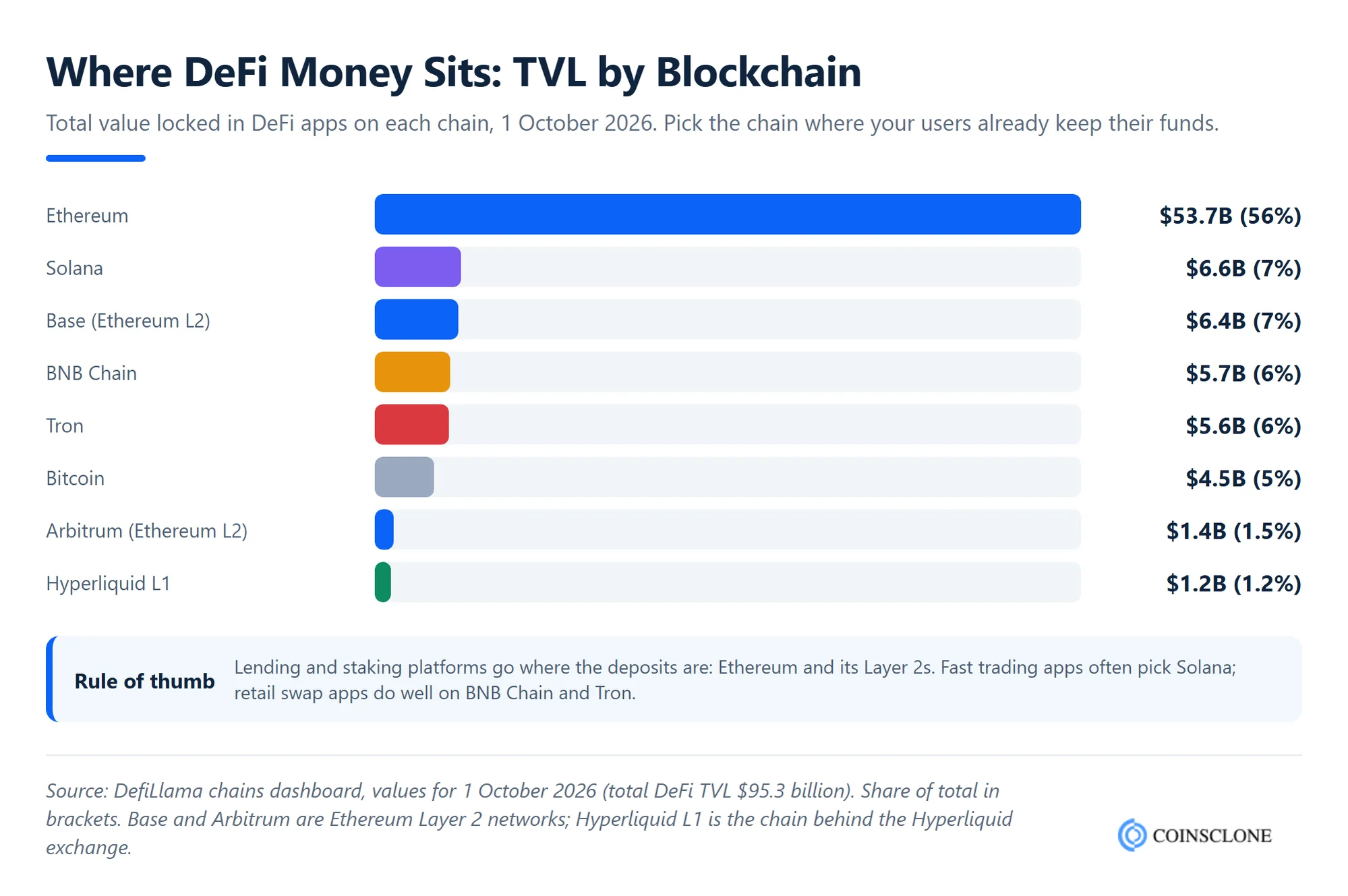
So pick the chain where your target users already keep their money. Also check gas fees, tool support and audit firms for that chain. Many platforms launch on one chain, then add more once the first one works.
3. Design The Token And Liquidity Plan
Before you write code, decide how money will flow. Who supplies liquidity on day one? What do they earn? Will you have a governance or reward token, and if so, how much goes to the team, the treasury and users, and over what vesting period?
New platforms often seed their own pools, pay rewards to early liquidity providers, or partner with market makers. Keep rewards modest and time-limited. Large token rewards bring in fast money that leaves the moment rewards drop.
4. Architect Your Smart Contracts
Next, write the contracts that hold funds and apply the rules. Use Solidity for Ethereum-style chains and Rust for Solana. Build on proven, audited code such as OpenZeppelin libraries where you can. Keep each contract small and focused, so a bug in one part cannot drain everything.
Also plan upgrades now. If contracts can be upgraded, put that power behind a multisig and a timelock. Finally, book an outside audit early, since good audit firms are often booked weeks ahead.
5. Design Frontend & Backend
A clean, simple front end drives user adoption. Design screens that show the price, fees, slippage and risks in plain words before the user signs. React and Next.js are the usual choices, with viem and wagmi to talk to the chain.
The back end, or admin dashboard, needs analytics, security checks and audit logs. It also runs an indexer, such as The Graph, which turns on-chain events into fast charts and history pages. Node.js is a common choice here.
6. Integrate Features
Your DeFi platform becomes complete once you add the right features. Common ones include:
- Wallet connection and a token swap screen
- Liquidity pools, staking and reward claims
- Price oracles and a fiat on-ramp so users can buy crypto with a card
- A DAO voting portal for governance
- User alerts, analytics and a transaction history
Add only what your first users need. Every extra feature adds code to test and audit.
7. Quality Assurance
Test everything before real money touches it. That means unit tests, fuzz tests that throw random inputs at the contracts, and fork tests that run your code against a copy of the live chain. Then run a public testnet phase, get at least one outside audit, fix every finding, and open a bug bounty.
8. DeFi Platform Launch
Launch in stages, not all at once. Start with caps on how much each pool can hold, then raise them as the platform proves itself under real use. At the same time, seed liquidity and start your community work, so traders find deep pools on day one.
9. Monitor And Upgrade
Your work does not end at launch. Watch the contracts 24/7 with alerts for big withdrawals, odd prices and admin actions. Keep an incident plan ready that says who can pause what. Then improve the platform with regular updates and fresh audits for every change.
With the right DeFi development company, you can launch a DeFi platform smoothly. Coinsclone builds DeFi platforms from roadmap to launch, using the steps above; you can see our full service on the DeFi development company page.
DeFi Platform Tech Stack in 2026
Here are the tools most DeFi teams use today. Older tools such as Truffle and Ganache were retired in 2023, so avoid any team that still lists them.
| Layer | Common 2026 choices |
| Blockchains | Ethereum, Base, Arbitrum, Optimism, BNB Chain, Solana, Tron |
| Contract languages | Solidity and Vyper (EVM chains), Rust (Solana) |
| Frameworks | Foundry and Hardhat (EVM), Anchor (Solana) |
| Contract libraries | OpenZeppelin |
| Front end | React, Next.js, viem, wagmi |
| Wallets | MetaMask, WalletConnect, embedded smart wallets |
| Price oracles | Chainlink, Pyth |
| Data indexing | The Graph or a custom indexer |
| Nodes (RPC) | Alchemy, Infura, QuickNode or your own nodes |
| Security tools | Slither, Echidna, Tenderly alerts |
| Admin and governance | Safe multisig, timelock contracts, Snapshot or Tally |
How Much Does DeFi Platform Development Cost?
DeFi platform development costs about $30,000 to $80,000 for a simple MVP and $150,000 to $500,000 or more for a complex, multi-chain protocol. The price depends on the model, the number of chains, how custom the contracts are, and how many audits you need. The ranges below come from 2026 rate cards published by several DeFi development firms.
| Scope | Typical cost | Typical time |
| White label DEX or staking platform | Lowest; core contracts already built | 5 to 10 weeks |
| Simple custom MVP (one model, one chain) | $30,000 to $80,000 | 2 to 5 months |
| Mid-size platform (custom rules, token, governance) | $65,000 to $200,000 | 5 to 8 months |
| Complex or multi-chain protocol | $150,000 to $500,000+ | 8 to 14 months |
On top of the build, budget for these:
- Security audits: about $5,000 to $20,000 for a small contract set, and far more for a large lending or perpetuals protocol. Plan for a second audit after big changes.
- Starting liquidity: often the biggest hidden cost. Pools need real money in them, from your treasury, partners or reward programmes.
- Running costs: nodes, indexers, hosting and monitoring tools, usually a few thousand dollars a month.
- Bug bounty: a reward pool for white-hat hackers who find bugs before attackers do.
Time matters as much as money. The chart below uses the delivery times Coinsclone publishes for each scope.
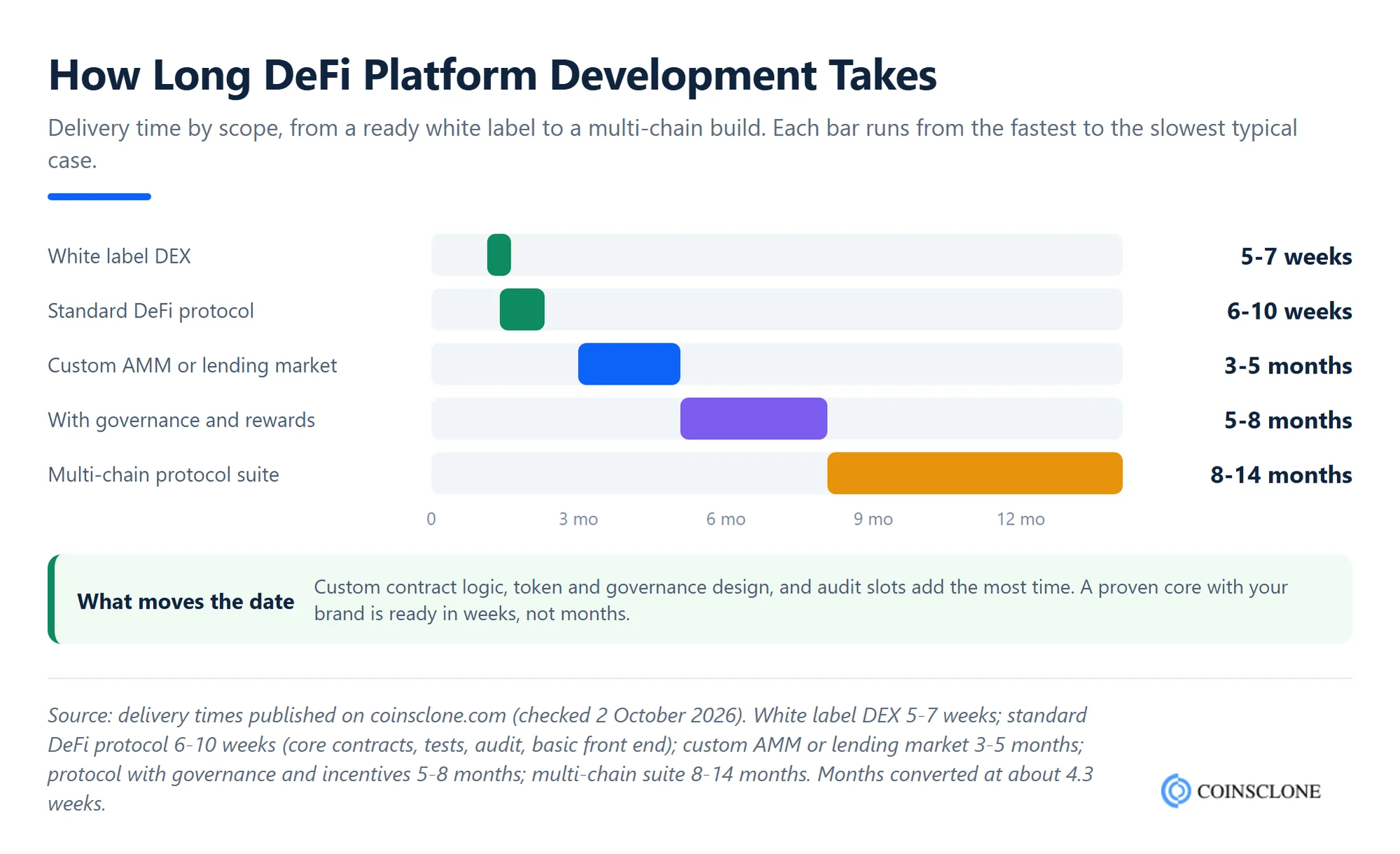
A white label or clone script is the fastest and cheapest route when a proven model fits your plan. Choose a fully custom build only when your edge is a new mechanism that no one has shipped.
How DeFi Platforms Make Money
DeFi platforms earn by taking a small share of the value that moves through them. The main revenue models are:
- Swap fees: a DEX charges a fee on each trade, such as 0.30% on many Uniswap pools or 0.25% on PancakeSwap V2. Most of it goes to liquidity providers, and the platform keeps a share.
- Interest spread: a lending platform keeps part of the interest borrowers pay, often 10% to 20% of it, through a setting called the reserve factor.
- Staking fees: a staking platform takes a cut of rewards. Lido, for example, takes 10% of staking rewards.
- Trading and liquidation fees: perpetuals platforms earn on each trade and on loans that get closed out.
- Listing and launch fees: launchpads and DEXs can charge projects to list or raise funds.
- Premium features: pro dashboards, faster trade routes or API access for teams.
Here is how the numbers look for a new DEX that trades $2 million a day in 0.30% pools and keeps one sixth of the fee, as Uniswap V2’s design allows.
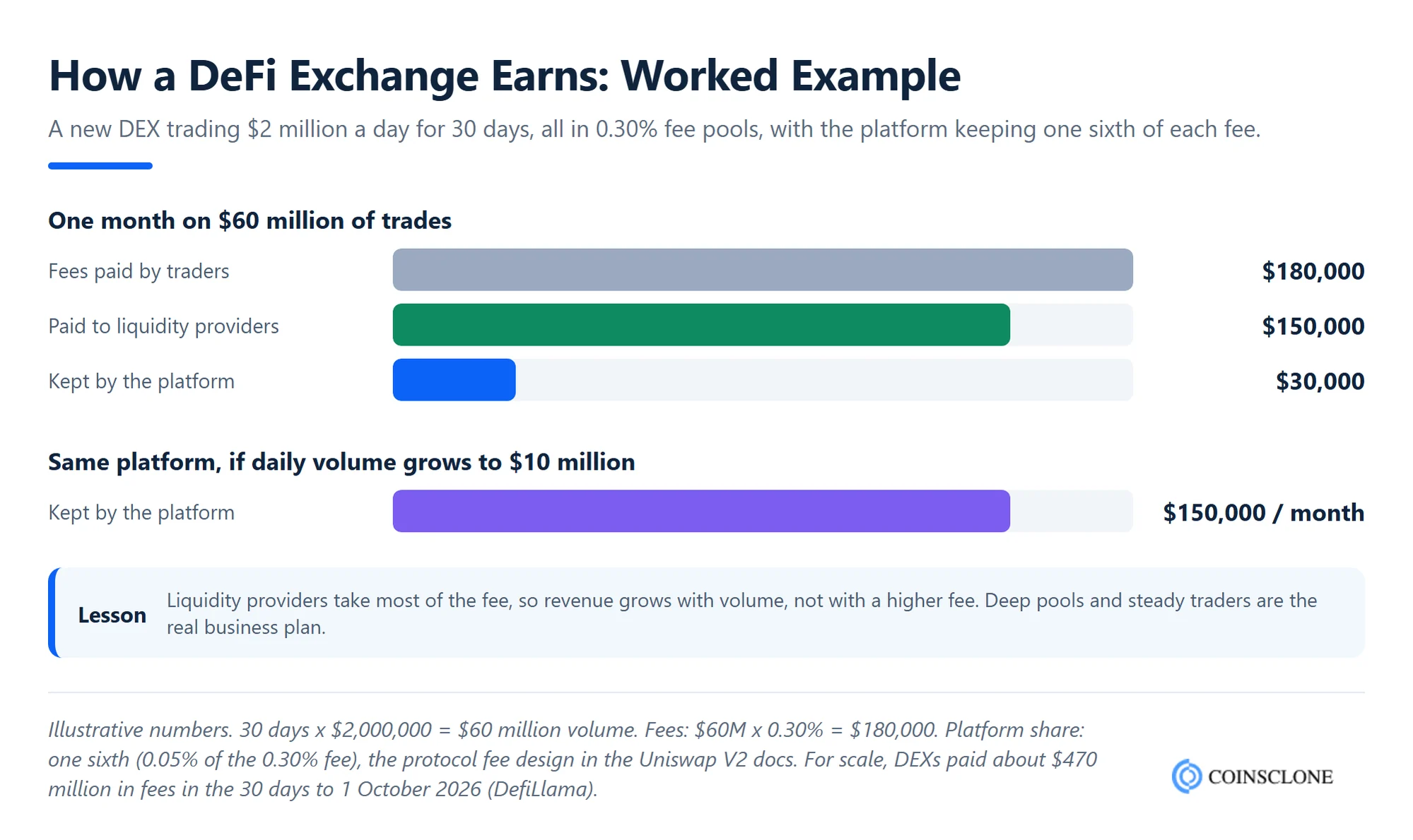
The takeaway: volume drives everything. To grow revenue, you need deep pools and steady traders, not a higher fee. That is why the token and liquidity plan in step 3 matters so much.
DeFi Platform Security: What 2026 Hacks Teach
Security is where DeFi platforms win or die. According to DefiLlama’s hack tracker, attackers took about $2.24 billion in 285 incidents between 1 January and 1 October 2026.
Most of that money did not go through classic code bugs. Stolen or weak keys cost about $704 million, and bridge and cross-chain flaws about $700 million. Access control failures cost another $369 million. In contrast, reentrancy bugs, the classic DeFi hack, cost almost nothing this year. Three cases stand out:
- Drift Trade, April 2026, $295 million: an attacker hijacked the contract upgrade process.
- Kelp, April 2026, $293 million: an attacker spoofed cross-chain messages.
- Tectonic, August 2026, $124.5 million: a “donation attack” broke the share math in a vault.
So protect your platform at every layer, not just the code:
- Admin keys: use a multisig with keys held on separate hardware devices, plus a timelock on upgrades.
- Bridges: use well-tested bridges, check messages from more than one source, and cap how much can cross at once.
- Contracts: get outside audits, run fuzz tests on all share and price math, and use proven libraries.
- Oracles: use more than one price feed and reject sudden price jumps.
- Operations: run 24/7 alerts, keep an incident plan, and pay a bug bounty.
Rules and Compliance for DeFi Platforms in 2026
The rules are getting clearer, but they still depend on where you and your users are. Here is the state of play in October 2026:
- European Union: the MiCA regulation now covers crypto service providers. Services that are fully decentralized sit outside it, but a company that runs the front end or issues the token often does not count as fully decentralized.
- United States: the GENIUS Act, signed on 18 July 2025, sets rules for stablecoins. The CLARITY Act, which would set wider market rules, failed a key Senate vote on 15 September 2026, so DeFi still has no full US framework.
- Everywhere: sanctions screening on the front end is standard practice, and some countries also require user checks for certain services.
Get legal advice before launch, especially if you run a front end, hold an admin key or issue a token. Build the platform so that you can add geo-blocking, wallet screening or user checks later without a rewrite.
How to Choose a DeFi Development Company
The team you pick decides how safe and how fast your launch will be. Before you sign, ask each firm these questions:
- Track record: which live DeFi platforms have they shipped, and on which chains?
- Security process: do they run fuzz tests, fork tests and outside audits as standard?
- Ownership: will you own the contracts, the front end and all the code?
- Launch plan: do they offer staged launches, monitoring and an incident plan?
- Support: who fixes problems after launch, and how fast?
Why Choose Coinsclone For DeFi Platform Development?
Coinsclone is a DeFi development company that has been building blockchain products since 2018. We have delivered 350+ platforms for 200+ clients across 20 industries, including DEXs, lending markets, staking platforms and DeFi wallets.
We build on Ethereum, Base, Arbitrum, Optimism, Polygon, BNB Chain, Solana and Avalanche. A standard DeFi protocol takes 6 to 10 weeks, and a custom AMM or lending market takes 3 to 5 months. Every build includes tests, an audit and a staged launch with monitoring, and you own the code. Reach out to our business team for an exact quote for your DeFi project.
Frequently Asked Questions
How much does DeFi platform development cost?
A simple DeFi MVP usually costs $30,000 to $80,000, a mid-size platform $65,000 to $200,000, and a complex multi-chain protocol $150,000 to $500,000 or more. Audits, starting liquidity and running costs come on top. A white label build is the lowest-cost route.
How long does it take to develop a DeFi platform?
A white label DEX can launch in 5 to 7 weeks, and a standard DeFi protocol in 6 to 10 weeks. A custom AMM or lending market takes 3 to 5 months, adding governance and rewards takes 5 to 8 months, and a multi-chain suite takes 8 to 14 months.
Which blockchain is best for DeFi platform development?
Ethereum is the most popular, with about 56% of all DeFi money locked on it in October 2026. Its Layer 2 networks, such as Base and Arbitrum, offer lower fees. Solana suits fast trading apps, while BNB Chain and Tron have large retail user bases.
Does every DeFi platform need a smart contract audit?
Yes. Any platform that holds user funds should get at least one outside audit before launch, and a fresh one after major changes. Audits are not enough on their own, though. In 2026, most losses came from stolen keys, bridges and access control, so you also need multisig keys, timelocks and 24/7 monitoring.
Is a DEX easier to build than a lending platform?
Usually, yes. A DEX built on a proven AMM design needs less risk work. A lending platform must manage price feeds, loan limits and liquidations, so a mistake can drain the pools. That is why custom lending markets take longer to build and audit.
How can a new DeFi platform attract liquidity?
Most new platforms seed their own pools, pay time-limited rewards to early liquidity providers, and partner with market makers or other protocols. Keep rewards modest and plan when they end, because liquidity that comes only for rewards tends to leave when they stop.
How do DeFi platforms make money?
They take a share of swap fees, loan interest, staking rewards, trading and liquidation fees, and listing fees. Most fees go to the people who supply the money, so the platform’s share is set in the contracts and the token plan.
Can I customise a white label DeFi platform?
Yes. A white label DeFi platform comes with tested core contracts that you can brand, deploy on your chosen chains and extend with your own fees, tokens and features. Any change to the contracts should get a fresh audit before launch.
What compliance issues should DeFi founders consider?
Check whether your service falls under MiCA in the EU or under US stablecoin and securities rules. Plan for sanctions screening on the front end, and take legal advice if you run the front end, hold admin keys or issue a token.
See How Our MVP System Can Help You Build a Scalable DeFi Platform Faster
DeFi Platform Development — your gateway to decentralized finance.
- MVP System : Launch your DeFi platform 90% faster with modular smart contracts.
- DeFi-Ready Modules : Lending, staking, liquidity, and governance in one system.
- Brand & Customization : Build your own branded DeFi ecosystem.
- Revenue Engine : Earn from yield farming, fees, and staking pools.
Get a free branded platform demo in 48 hours — before spending a cent!
Book a Free Demo to discover how our DeFi Platform System can take you from concept to launch in 8-12 weeks.