
Crypto exchange app development is the work of building a mobile app where people can sign up, pass KYC, add money and buy, sell or swap crypto from their phone. Most traders now trade on their phones, so for a new exchange the app is often the main product, not an extra. Building one is not just about code. It is about trust, speed and a safe place for user funds.
This guide walks you through the full process in plain words. You will see how an exchange app works behind the screen, the types you can build, the steps from idea to app store, the features and tech stack, and what it costs in 2026. You will also see the app store rules that block many crypto apps at launch, and how exchange apps earn money.
In this guide:
- How it works: the parts behind the app, from the matching engine to hot and cold wallets.
- Steps to build: eight steps from market and licence choice to launch and updates.
- Cost and time: 2026 price ranges for white label, custom MVP and full custom builds.
- App store rules: what Apple and Google Play ask of crypto exchange apps before they go live.
- Revenue: the main ways an exchange app makes money.
Crypto Exchange App Development in 2026
In 2026, crypto exchange app development means building iOS and Android apps on top of a full exchange back end: user accounts, KYC, wallets, a matching engine, liquidity and an admin panel. You can build it three ways. A white label exchange with mobile apps costs about $15,000 to $60,000 for the core software, plus about $30,000 to $100,000 if you want fully custom native apps. A custom MVP costs $100,000 to $200,000, and a full custom build costs $250,000 to $500,000 or more.
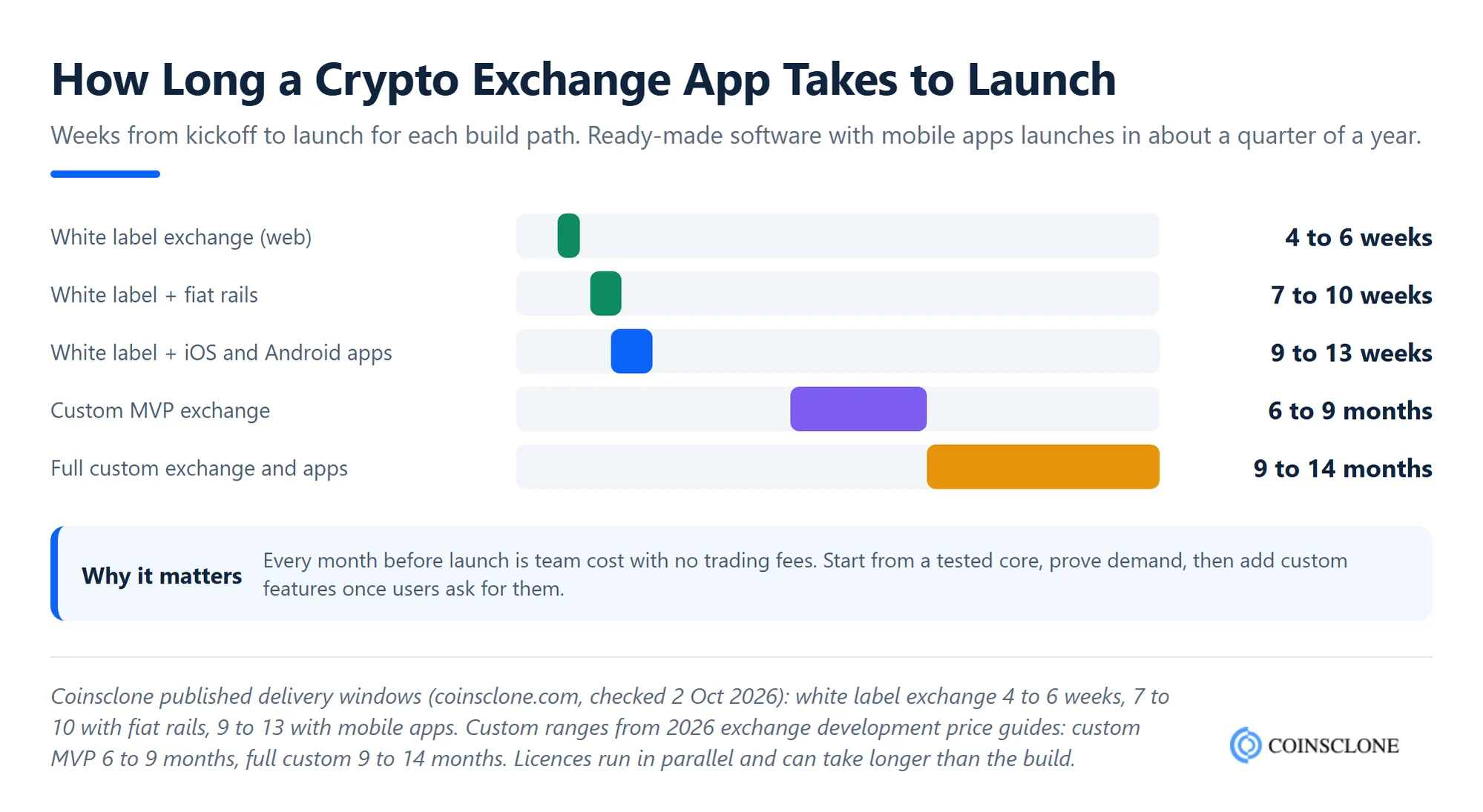
Time to launch follows the same pattern. A white label exchange with mobile apps can go live in about 9 to 13 weeks. A custom build takes 6 to 14 months. Before any of that, you need a licence in each market you serve, because both Apple and Google Play now ask for proof of it.
The market is still large. The top 10 centralized exchanges traded $1.95 trillion in spot volume in Q2 2026, per the CoinGecko 2026 Q2 crypto report. Binance alone held 38.7% of it. So there is room for new apps, but users expect the same speed and safety the big names give them.
Launch Your Crypto Exchange App in Record Time!
Turn your idea into a live Cryptocurrency Exchange App — fast, simple, and fully branded.
- MVP App in Weeks : Go from concept to app launch 90% faster.
- Plug & Play Wallets : Integrated liquidity, no coding required.
- Your Brand, Your Tokens : Full customization for your app’s look and feel.
- Built-In Revenue Engine : Earn from trading fees, listings, and staking.
See it live in 48 hours! Get a free branded demo before you spend a cent.
Book Your Free Demo Now and launch your crypto exchange app in just 8-12 weeks.
What is a Crypto Exchange App?
A crypto exchange app is a mobile app that lets users buy, sell, trade and stake cryptocurrencies from their smartphones. It acts as a bridge between traders and the blockchain network. The app shows prices, takes orders and moves funds, while the exchange’s servers do the heavy work.
Crypto exchange app development has become a strong business idea because one app can earn from many streams: trading fees, spreads, withdrawals, staking and more. There are several types of crypto exchanges, based on how they handle funds, who owns them and what features they offer. Before we get to those, it helps to see what happens behind the screen.
How a Crypto Exchange App Works
A crypto exchange app is the front door. Behind it sit five or six systems that work together on every trade. Here is what happens when a user buys Bitcoin on a centralized exchange app:
- Log in: the user opens the app and signs in with a password plus Face ID, a passkey or a 2FA code.
- Send the order: the app sends the buy order over a secure API to the exchange’s servers.
- Check the balance: the server checks that the user has enough funds and holds them for the trade.
- Match the order: the matching engine pairs the buy order with a sell order in the order book. If the book is thin, a liquidity provider or market maker fills the gap.
- Update the ledger: both users’ balances change in the exchange’s own records. No blockchain fee is paid yet.
- Withdraw: only when the user withdraws does the wallet system sign a real blockchain transfer, mostly from a small hot wallet. Most funds stay offline in cold storage.
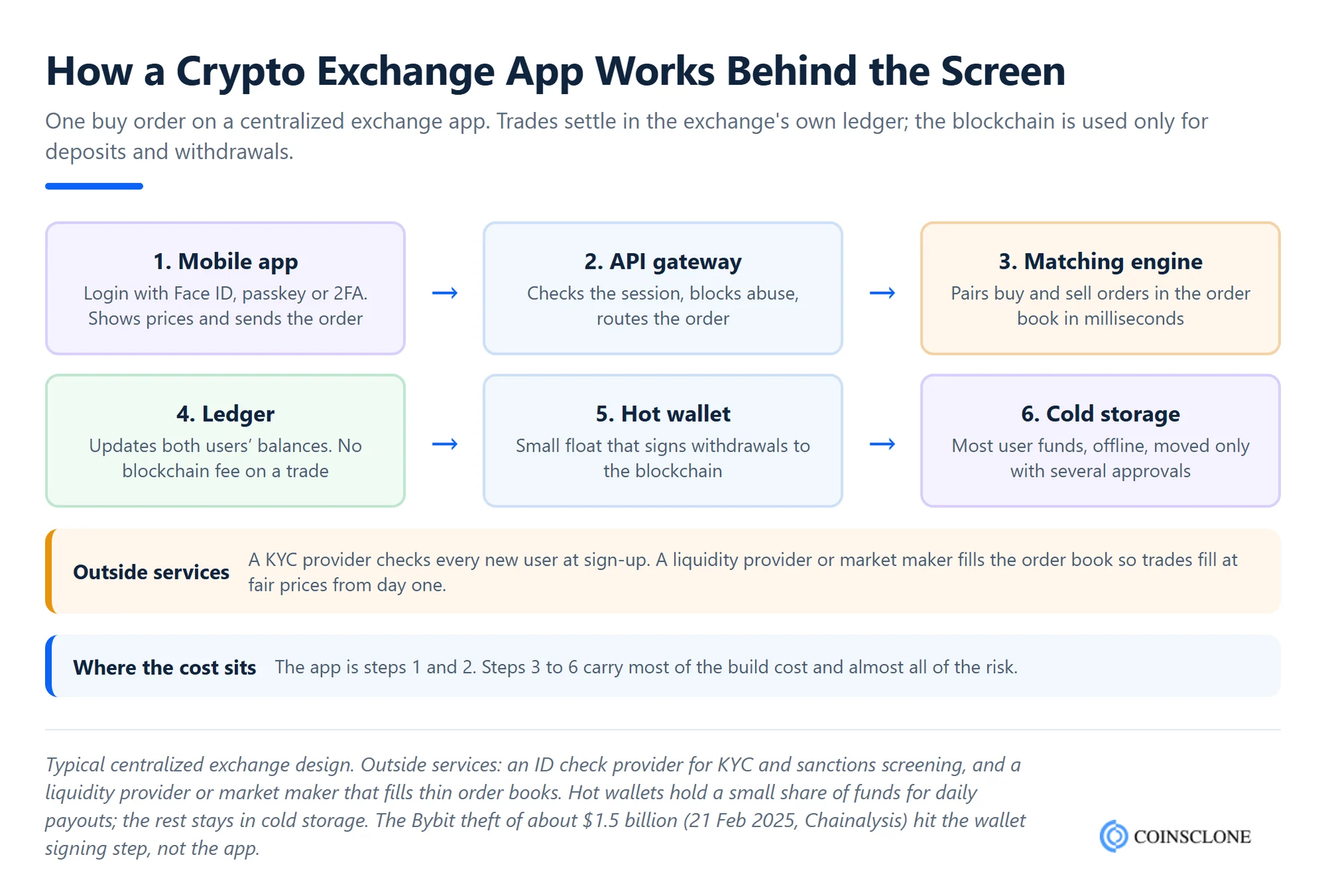
This split matters for your build. The app itself is the smaller part of the job. The matching engine, the wallets and the security around them carry most of the cost and risk. Read our full guide to crypto exchange architecture for the deeper view.
Types of Crypto Exchange Apps
Many kinds of crypto exchange apps serve different needs. Let’s take a closer look at these types of cryptocurrency exchanges, so you can choose the one that best fits your goals.
Centralized Exchange App (CEX)
A centralized exchange lets you build a fast and efficient trading platform with a simple interface and strong features. As the platform owner, you hold user funds and run every trade, so you can make trades smooth and safe. Some types of centralized crypto exchanges are order book exchanges, crypto derivatives exchanges, margin trading platforms and OTC crypto exchanges.
Decentralized Exchange Apps (DEX)
Unlike a centralized exchange, a decentralized exchange runs on blockchain technology. Smart contracts carry out trades, with no third party in the middle. Users keep their own keys and connect a wallet to trade. DEX apps offer a clear, safe and private trading experience for crypto users.
Hybrid Crypto Exchange Apps
A hybrid crypto exchange mixes the features and add-on modules of both CEX and DEX. A common 2026 design runs the order book off-chain for speed and settles trades on-chain for proof. The hybrid exchange aims to give users fast trading while they keep more control of their funds.
Choose the type based on your market, your rules and your goals. The build process is similar for each one, and the next section explains it in detail.
Steps To Create a User-Friendly Crypto Exchange App
Building a crypto exchange mobile app is simple with the right team and a clear plan. The app must have strong features, tight security and an easy interface. Let’s break down the 8 steps to create a crypto exchange app for smartphones.
Step 1: Pick Your Market and Licence
Start with where your users live, because that decides your licence. In the US, you need FinCEN registration and state money transmitter licences. In the EU, you need a MiCA licence as a crypto-asset service provider (CASP), and the last national transition periods ended on 1 July 2026. Dubai, the UK and others have their own regimes. App stores now check this too, as we explain below.
Plan the licence in parallel with the build. Licences often take longer than the software. Our crypto license guide covers costs and timelines by country.
Step 2: Choose the App Development Method
Once your business goal is clear, pick the right build method. Based on time, cost and how much you want to change, choose a custom build, a white label solution or a clone script.
- Custom Solutions: The crypto exchange mobile app is built from the ground up, and every feature is designed from scratch. It gives full freedom in design and build. But it needs more time, a bigger budget and skilled blockchain developers, so it suits funded founders.
- White-Label Solutions: White-label crypto exchange software is ready-made, tested software that you brand and adjust to launch your app quickly. It is the best fit for startups that want a faster launch and a lower build cost.
- Crypto Exchange Clone App: A clone script copies the features of a popular exchange like Binance, Kraken or Coinbase. For instance, if you want to create a crypto exchange app like Binance, a Binance clone app is a good choice. A clone script cuts both cost and build time.
All three methods work for Android and iOS. You can also use a cross-platform framework that runs on both from one codebase.
Step 3: Create the Wireframe and Mockup
After you pick the method, the next step is the wireframe and mockup. In this phase, the UI/UX design team designs the overall interface and dashboard.
Designers lay out the key screens, like the login screen, the trading screen, the wallet and the order confirmation. A wireframe helps you see the app flow, the features and the user journey before any code is written. On a small screen, every tap counts. So keep the buy and sell flow to a few clear steps, and always show the price, fee and total before the user confirms.
Step 4: Build the MVP
Before the full build, it is wise to create an MVP (Minimum Viable Product). It tests the app’s core features with real users. The MVP of a crypto exchange app includes sign-up, KYC, the wallet, deposits, withdrawals and basic trading. Getting the MVP right makes the full-scale build smoother and cheaper.
Step 5: Build the App Architecture and Connect Liquidity
Once early users of the MVP give feedback, the team builds the core system. This phase covers the back end, API links and the database. The team uses a modern tech stack to build exchange apps for both Android and iOS.
This is also where you add blockchain networks and connect liquidity. A new exchange has an empty order book on day one. So most launch with a crypto liquidity provider or a market maker that keeps prices tight. The overall crypto exchange architecture must be secure, able to grow and fast enough to handle high trading volume.
Step 6: Test and Refine
After the core build, the app is almost ready to launch. But first it needs full testing to find and fix bugs.
In this phase, the team runs functional tests, security tests, unit tests and load tests. A third-party security audit and a penetration test are a must for any app that holds user funds. Theft is a real threat: hackers stole $3.4 billion in crypto in 2025, per Chainalysis, and the Bybit hack alone took about $1.5 billion.
Step 7: Deploy to the App Stores
Now the crypto exchange mobile app is ready to launch on the Google Play Store (Android) and the Apple App Store (iPhone). Submit from your company account, attach your licence papers, set up tracking and meet each store’s rules. The next sections cover those rules in detail. After launch, promote the app through press releases, community events and other marketing.
Step 8: Update After Launch
Even after a smooth launch, the app needs regular updates and upkeep to stay useful and safe. In this ongoing phase, you can add new trading pairs, features, blockchains and APIs. You also patch security gaps as they appear, and keep up with new rules in each market.
With these steps, crypto exchange app development can run without much trouble. Next, let’s look at the features to build in.
Features to Integrate In A Cryptocurrency Exchange App
Features decide how well a crypto exchange mobile app works. Strong features and security help your app stay ahead of the competition. Some of the top features to build are:
- User Sign-Up: Lets users sign up and log in easily with email, phone number or a passkey.
- KYC/AML Verification: Checks each user’s ID and screens them against sanctions lists, with an in-app ID and selfie scan.
- Instant Buy/Sell: Lets users buy or sell crypto in one tap with fiat or other cryptocurrencies.
- Wallet: Stores many coins safely and handles deposits and payouts.
- Trading Engine: Matches buy and sell orders in real time and supports market, limit and stop orders.
- Live Charts: Shows prices, order books and candle charts that work on a small screen.
- Push Notifications: Sends instant alerts about prices, filled orders, new listings and security events.
- Trade History: Keeps a record of all trades, deposits and payouts, with export for tax reports.
- User Management: Lets the admin see new users and activity, and freeze suspicious accounts.
- Transaction Monitoring: Lets the admin track trades and flag unusual patterns for AML review.
- Reports: Shows trading volume, income and user actions in one place.
Security Features Integrated In Crypto Exchange Mobile Apps
Beyond these features, a crypto exchange app needs many layers of security. Some of the top security features are:
- 2-Factor Login (2FA): Adds a second check for logins and payouts.
- Biometric Login and Passkeys: Users can sign in with a fingerprint, Face ID or a passkey instead of a weak password.
- Data Encryption: Protects user data and trade data both on the phone and on the servers.
- Cold Storage: Keeps most user funds offline, which helps stop hacks and theft.
- Withdrawal Whitelist: Lets users send funds only to addresses they approved earlier.
- Anti-Phishing Code: Adds a private code to every email so users can spot fake messages.
- Anti-DDoS Protection: Shields the exchange app from traffic floods and cyber attacks.
For a deeper look, see our guide on how to build a non-hackable crypto exchange.
Additional Modules To Include in Crypto Exchange App
Along with the core and security features, you can add extra modules to boost the app’s growth. Let’s see them here:
- Staking and Earning Module: Users can stake their crypto and earn rewards right inside the app. This keeps users active and brings in new sign-ups.
- P2P Trading Module: Users can buy and sell crypto directly with other users, with escrow to protect both sides. This adds volume and serves markets where bank links are hard.
- Fiat On/Off Ramp: Users can buy and sell crypto with local money through cards, bank transfers and local payment methods. This makes the first purchase easy for new traders.
- Launchpad (IEO) Module: Crypto projects can raise funds through token sales on the app. Note that Apple only allows token sale and futures features from licensed financial firms.
- Affiliate Module: Users earn rewards for inviting new traders to the app. This grows the user base at a low cost.
With the right features in place, the build runs smoothly. Next, let’s look at the tools and languages used to build the app.
Tech Stack used in Our Crypto Exchange Mobile App
The tech stack changes with the operating system and how the app works. Here is the full list of the tech stack used to build Android and iOS apps.
Crypto Exchange Android App Development
- Programming Languages: Kotlin, Java
- UI/UX Design: Figma, Adobe XD
- Framework: Android Studio, Jetpack Compose
- Backend Development: Node.js, Python, Go
- Database: PostgreSQL, MySQL, MongoDB, Redis for live order books
- Smart Contract Language: Solidity, Rust
Build Your Crypto Exchange App with Ease and Security!
Scalable, Feature-Rich, and Fully Customizable Solutions. Get Your Free Demo!
Crypto Exchange iOS App Development
- Programming Languages: Swift (Objective-C only for older code)
- UI/UX Design: Figma, Sketch
- Framework: Xcode, SwiftUI
- Backend Development: Express.js, Django, Go
- Libraries: Web3.swift
Native or Cross-Platform?
You can build two native apps or one cross-platform app. Native apps (Kotlin and Swift) give the smoothest charts and the best access to secure phone chips for keys and Face ID. Cross-platform apps built with React Native or Flutter share one codebase, so they cost less and ship faster.
Many exchanges use a mix. They build the main screens in a cross-platform framework, then write the parts that touch keys, biometrics and live charts in native code. If speed to market matters most, start cross-platform. If you plan heavy trading tools, go native.
Now that we have covered the build, let’s look at the rules that decide whether your app gets into the stores at all.
App Store Rules for Crypto Exchange Apps
This is the step many guides skip, and it is where many crypto apps get stuck. Both Apple and Google Play now treat crypto exchanges as a regulated business. Your app must come from a real company, and it must hold a licence in each country where it is offered.
Apple App Store: Apple’s App Store Review Guidelines set four clear rules for exchange apps:
- Company account: Crypto exchange apps must be submitted by the legal entity that provides the service, not by a single developer (rule 5.1.1(ix)). Wallet apps must come from developers enrolled as an organization (3.1.5(i)).
- Licence by country: Exchange apps may only be offered in countries where the app has the right licence to run a crypto exchange (3.1.5(iii)).
- Futures and token sales: Apps that offer crypto futures, ICOs or similar trading must come from banks, securities firms, futures commission merchants or other approved financial firms (3.1.5(iv)).
- No crypto for tasks: Apps may not give crypto as a reward for tasks like downloading other apps or posting on social media (3.1.5(v)).
Google Play: Since 29 October 2025, Google Play’s crypto exchange and wallet requirements list the licence needed in each covered market. Examples:
| Market | What Google Play asks for |
| United States | FinCEN money services business registration plus state money transmitter licences, or a bank charter |
| European Union | Authorisation as a crypto-asset service provider (CASP) under MiCA |
| United Kingdom | Registration with the Financial Conduct Authority (FCA) |
| Canada | Registration with FINTRAC as a money services business |
| UAE | A licence from VARA, FSRA or DFSA |
| Japan | Registration as a crypto asset exchange service provider with the FSA |
| South Korea | A VASP report filed with the Korea Financial Intelligence Unit |
| Hong Kong | SFC Type 1 and Type 7 licences |
The same page also covers Bahrain, Indonesia, Israel, the Philippines, South Africa and Thailand, and since July 2026 it adds Liechtenstein, Iceland and Norway under MiCA. Non-custodial wallets are outside these rules.
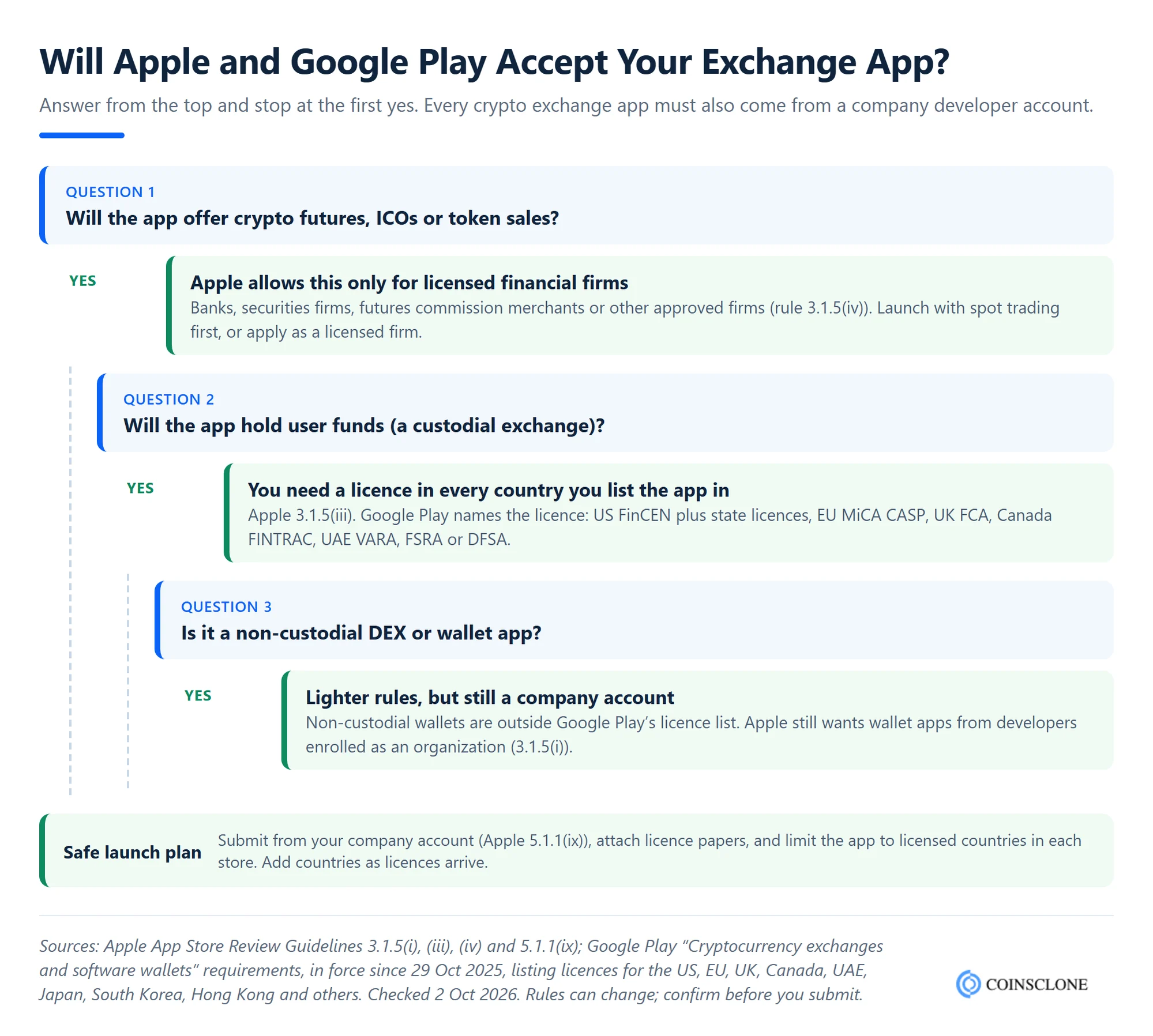
So the practical rule is simple. Set up your company account early, get your licence for each launch market, and limit the app to those countries in the store settings. Add more countries as each licence comes through.
How Much Does It Cost To Create A Crypto Exchange Mobile App?
The cost to create a crypto exchange mobile app depends mostly on the build path. Here are the 2026 ranges that exchange development firms publish:
| Build path | Typical cost (USD) | Time to launch | Best for |
| White label exchange with mobile apps | $15,000 to $60,000 for the core, plus custom app work if needed | 9 to 13 weeks | Startups that want to launch fast with tested code |
| Custom native or cross-platform apps | $30,000 to $100,000+ on top of the exchange | Adds 2 to 4 months | Brands that want their own app design and tools |
| Custom MVP exchange | $100,000 to $200,000 | 6 to 9 months | New ideas that ready-made software cannot run |
| Full custom exchange and apps | $250,000 to $500,000+ | 9 to 14 months | Funded firms that want their own engine and full control |
White label timelines are Coinsclone’s published delivery windows (4 to 6 weeks for the exchange, 7 to 10 with fiat rails, 9 to 13 with mobile apps). Custom ranges reflect 2026 price guides from exchange development firms.
The build is not the only cost. Plan for these too:
- Licence and legal work: from a free FinCEN registration to $100,000 or more once fees, capital and legal work add up in New York, the UK, the EU or Dubai.
- Liquidity: market maker fees, often several thousand dollars a month.
- KYC checks: a fee per user check paid to the ID provider.
- Security audits: a first audit before launch, then more after big updates.
- Hosting and upkeep: servers, monitoring, app updates and 24/7 support.
For a line-by-line view, see our full guide to crypto exchange development cost. Getting advice from an experienced crypto exchange development company also helps you pick the right path for your budget.
How Crypto Exchange Apps Make Money
A well-run exchange app earns from several streams at once. These are the main ones:
- Trading fees: a small share of each trade, usually split into maker and taker fees. This is the biggest stream for most exchanges.
- Spreads on instant buy: the gap between the buy and sell price on one-tap trades.
- Withdrawal fees: a fixed fee on each crypto withdrawal to cover network costs.
- Listing fees: fees from projects that want their token on your exchange.
- Staking and earn products: a share of the rewards users earn through the app.
- Margin and futures fees: interest and funding fees, where your licence allows them.
- Premium plans and APIs: paid tiers with lower fees or faster data for active traders.
Learn more in our guide on how crypto exchanges make money.
Business Benefits of Crypto Exchange App Development
A crypto exchange app brings clear gains for startups and founders who enter the crypto market. Here are the top benefits:
- Many Income Streams: A crypto exchange app earns from trading fees, staking, payouts, listings and paid plans, so no single stream carries the business.
- Mobile-First Reach: People all over the world use their phones for banking and shopping. An exchange app lets you reach a global audience with easy trading on the go.
- Brand Name: An app with a clean design, easy menus and useful features builds your name in the crypto market. A home screen icon also keeps your brand in front of users every day.
- Higher Engagement: Push alerts on prices and filled orders bring users back far more often than a website alone.
- Security and Compliance: Modern exchange apps use encryption, biometric login and fraud checks. Following the rules in each market protects user data and builds trust among traders.
As mentioned earlier, crypto exchange app development goes much more smoothly with an experienced team. If you are looking for one, Coinsclone is a strong choice.
Create Your Crypto Exchange App with Coinsclone!
Coinsclone is a leading cryptocurrency exchange development company that has been building crypto platforms since 2018. Our team builds cryptocurrency exchange software with all the advanced trading features while keeping costs in check.
Security is built into every layer, from cold storage and 2FA to audits before launch. If you want a budget-friendly crypto trading app that launches fast, Coinsclone can take you from idea to app store. Our Binance clone app and white label exchange come with native-quality iOS and Android apps, and a white label exchange with mobile apps can launch in about 9 to 13 weeks.
- 350+ platforms delivered for 200+ clients across 20 industries
- Expert in white label app development since 2018
- On-time launches with clear, published timelines
- A dedicated team of blockchain developers for a glitch-free exchange
- Software shaped around each client’s brand and market
- 24/7 tech help and support
Frequently Asked Questions
How much does it cost to build a crypto exchange app?
A white label exchange with mobile apps costs about $15,000 to $60,000 for the core software. Fully custom native apps add about $30,000 to $100,000 or more. A custom MVP exchange costs $100,000 to $200,000, and a full custom build costs $250,000 to $500,000 or more. Licence, liquidity and audits come on top.
How long does it take to build a crypto exchange app?
A white label exchange takes about 4 to 6 weeks, 7 to 10 weeks with fiat rails and 9 to 13 weeks with mobile apps. A custom MVP takes 6 to 9 months, and a full custom exchange takes 9 to 14 months. Licences can take longer than the build, so start them early.
Is it legal to create a crypto exchange app?
Building the software is legal. Running the exchange needs a licence in each market you serve, such as FinCEN registration and state licences in the US or a MiCA CASP licence in the EU. Apple and Google Play also require that licence before they list your app in that country.
How do crypto exchange apps make money?
Most earn from trading fees first. Other streams include spreads on instant buys, withdrawal fees, listing fees, staking rewards, margin and futures fees, and premium plans. Strong apps mix several streams so no single one carries the business.
What is a white label crypto exchange app?
A white label crypto exchange app is ready-made, tested exchange software that you brand as your own. It comes with the trading engine, wallets, admin panel and mobile apps. You set your fees, coins and design, then launch in weeks instead of months.
Should I build a native or cross-platform crypto exchange app?
Cross-platform apps built with React Native or Flutter cost less and ship faster because both stores share one codebase. Native apps in Swift and Kotlin give smoother charts and better access to secure chips for keys and Face ID. Many exchanges mix both.
Do I need a large team to run a crypto exchange app?
Not at the start. A white label launch can run with a small team for support, compliance, marketing and operations, while the software partner handles updates and hosting. As volume grows, most exchanges add in-house security, risk and listing staff.
Launch Your Crypto Exchange App in Record Time!
Turn your idea into a live Cryptocurrency Exchange App — fast, simple, and fully branded.
- MVP App in Weeks : Go from concept to app launch 90% faster.
- Plug & Play Wallets : Integrated liquidity, no coding required.
- Your Brand, Your Tokens : Full customization for your app’s look and feel.
- Built-In Revenue Engine : Earn from trading fees, listings, and staking.
See it live in 48 hours! Get a free branded demo before you spend a cent.
Book Your Free Demo Now and launch your crypto exchange app in just 8-12 weeks.